Available Online at www.ijpret.com 1642
INTERNATIONAL JOURNAL OF PURE AND
APPLIED RESEARCH IN ENGINEERING AND
TECHNOLOGY
A PATH FOR HORIZING YOUR INNOVATIVE WORK
EFFECTIVE FILTERING BASED ON LOCATION AND KEYWORD FOR PUBLISHER /
SUBSCRIBER
SHWETA KATHALKAR, PROF. R. R. SHELKE
Computer Science and Engineering, H.V.P.M COLLEGE Of Engineering And Tech., Amravati, India Accepted Date: 15/03/2016; Published Date: 01/05/2016
\
0
Abstract: Location-based services have been mostly used in many systems. Preceding systems uses
a pull model or user-initiated model, where a user arrival a query to a server which gives response with location-aware answers. To offer outcomes to users with fast responses, a push model or server-initiated model is flattering an important computing model in the next generation location-based services. In the push model, subscribers arrive spatio-textual subscriptions to fastening their curiosities, and publishers send spatio- textual messages. It is used for a high-performance location- aware publish/subscribe system to send publishers ‟ messages to valid subscribers. In this paper, we find the exploration happenstances that start in manipulative a location-aware publish/subscribe system. We recommend an R-tree based index by merging textual descriptions into R- tree nodes. We design efficient filtering algorithms and effective pruning techniques to accomplish high performance. This method can support likewise conjunctive queries and ranking queries.
Keywords: LBS, Spatial-Context, MBR Filter, Token Filter, Ranking Query, R t-Tree
Corresponding Author: MS. APARNA S. KALASKAR Access Online On:
www.ijpret.com
How to Cite This Article:
Shweta Kathalkar, IJPRET, 2016; Volume 4(9): 1642-1649
Available Online at www.ijpret.com 1643 INTRODUCTION
Available Online at www.ijpret.com 1644
tokens associated with Rt-tree nodes, we select some high-quality representative tokens from subscriptions and associate them with Rt-tree nodes. This technique not only reduces index sizes but also improves the performance. Experiments on large, real data sets show that our method achieves high performance.
We make the following contributions:
(1) We introduce a new computing model and formalize the location-aware publish/subscribe problem.
(2) We propose a novel index structure, the Rt-tree, by integrating high-quality representative tokens selected from subscriptions into the R-tree nodes. Our method can support both conjunctive queries and ranking queries.
(3) Using our proposed indexes, we develop efficient filtering algorithms and effective pruning techniques to improve the performance.
(4) We present how to support dynamic updates efficiently
LITERATURE SURVEY
Available Online at www.ijpret.com 1645
information into account. We have developed several index organizations and search algorithms for performing efficient filtering of XML documents for large-scale information dissemination systems. In this paper we describe these techniques and examine their performance across a range of document, workload, and scale scenarios[2] Reference entitled “Models and issues in data stream systems” included In this overview paper we inspire the need for and research issues get up from a new model of data processing. In this model, data does not take the form of tenacious relations, but rather arrives in multiple, continuous, rapid, time-varying data streams. In addition to revising preceding work related to data stream systems and current projects in the area, the paper explores topics in stream query languages, new requirements and encounters in query processing, and algorithmic issues.[3] Reference entitled “Retrieving top-k prestige based relevant spatial web objects”, include The location-aware keyword query gives ranked objects that are near a query location and that have textual explanations that match query keywords. This query presents intrinsic in many types of mobile and old-style web services and applications, e.g., Yellow Pages and
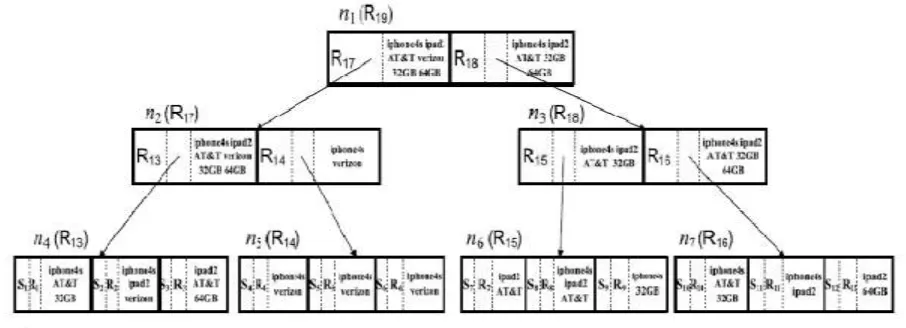
Figure 1. R t-tree index structure.
Available Online at www.ijpret.com 1646
PROPOSED SYSTEM
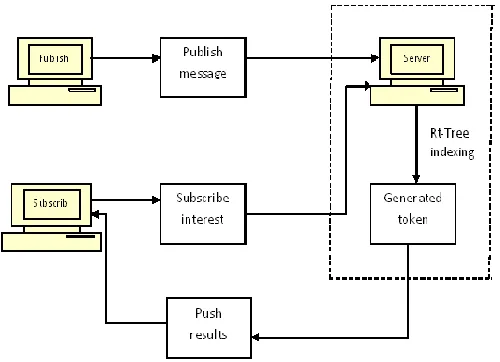
To address the encounters, a token-based tree index organized an idea by in escalating each R-tree node with a collection of tokens selected from subscriptions. Using the R t -R-tree, a filter-and-verification framework is organized for able to sending a message. To decrease the number of tokens connected with R t -tree nodes, select some high-quality illustrative tokens from subscriptions and associate them with R t -tree nodes.
Rt-TREE BASED METHOD
We first propose an Rt Tree algorithm structure and then devise efficient filtering algorithms.
1. R T -T REE A LGORITHM:
R t - Tree Indexing
Input: S, A subscription set, message m
Output: R, Outcomes of m
Step 1: Publisher publishes message m
Step 2: Build R t - tree index by collecting all message m
from „n‟ publishers
{p1, p2,...p n }
Step 3: Initialize a HashMap M
Step 4: return R t -tree ++
R t - Tree Pruning
Input: r, An R t -tree node, „m‟ a message, „R‟ outcome of m,
HashMap M
Output: R, Outcomes of m
Step 1: Visit flag = false;
Available Online at www.ijpret.com 1647
Step 3: Check location of node and filter message in
location R
Step 4: Check curiosity of node and filter message of
curiosity m
Step 5: prune outcome R and m
Step 6: Outcome of R t -tree prune to node.
L OCATION DETAILS
We consider location specific approach for publish/subscribe system. The region is considered to be rectangle, which we specify a numeric value for example 0-100 meant for one location and 100-200 meant for other location. Given a set of subscriptions S and a message m, a
location-aware publish/ subscribe system delivers m to si Є S if si. R∩m. R≠f and si:T⊆ m:T.
R-TREE Indexing:
As the standard R-tree has no textual pruning power, a token-based R-tree, called R t -tree, by mounting tokens of subscriptions into R-tree nodes. R t -tree is a balanced search tree. Each leaf node contains between b and B data entries, where each entry is a subscription. Each internal node is between b and B node entries. Each entry is a triple h Child, MBR, TokenSet i , where Child is a pointer to its child node, MBR is the minimum bounding rectangle of all admissions within this child, and TokenSet is a set of tokens selected from subscriptions. The outputs for subscriber are processing using R t - tree indexing and then filtered for further output processing.
MBR Filter:
Least bound rectangle filter for checks the location of the subscriber. This model filters the outcomes R t -tree index by examination the users location and publisher location. The location based outcome set conveys more location specific outcome, which does not consider the subscriber curiosities. These outcomes are used for further processing to get subscriber outcome.
Token Filter:
Available Online at www.ijpret.com 1648
location. The location based outcome set carry more curiosity specific outcome, which does not consider the location of subscriber. These outcomes are used for additional processing to get subscribers location based outcome.
Outcome Push To Subscriber:
In the push model, subscribers enter spatio-textual subscriptions to fastening their curiosities, and publishers send spatio-textual messages. The outcomes from the upstairs two methods, MBR filter and token filter, spatio- textual outcomes are filtered and send to subscriber. The server impetuses the outcome to subscriber instead of responding every time when subscriber queries.
SYSTEM ARCHITECTURE
Figure 2: System Architecture
CONCLUSION
Available Online at www.ijpret.com 1649
REFERENCES
1. Minghe Yu, Guoliang Li, Member, IEEE, Ting Wang, Jianhua Feng, and Zhiguo Gong “Efficient
Filtering Algorithms for Location-Aware Publish/Subscribe” Minghe Yu, Guoliang Li, Member, IEEE, Ting Wang, Jianhua Feng, and Zhiguo Gong.
2. M. K. Aguilera, R. E. Strom, D. C. Sturman, M. Astley, and T. D. Chandra, “Matching events in a
content-based subscription system,” in Proc. 18th Annu. ACM Symp. Principles Distrib. Comput., 1999, pp. 53–61.
3. M. Altinel and M. J. Franklin, “Efficient filtering of XML documents for selective dissemination
of information,” in Proc. 26 th Int. Conf. Very Large Data Bases, 2000, pp. 53–64.
4. B. Babcock, S. Babu, M. Datar, R. Motwani, and J. Widom, “Models and issues in data stream
systems,” in Proc. 21st ACM SIGMOD-SIGACT-SIGART Symp. Principles Database Syst., 2002, pp. 1–16.
5. X. Cao, G. Cong, and C. S. Jensen, “Retrieving top-k prestige based relevant spatial web
objects,” Proc. VLDB Endowment, vol. 3, no. 1, pp. 373–384, 2010.
6. X. Cao, G. Cong, C. S. Jensen, and B. C. Ooi, “Collective spatial keyword querying,” in Proc. ACM
SIGMOD Int. Conf. Manage. Data, 2011, pp. 373–384.
7. X. Chen, Y. Chen, and F. Rao, “An efficient spatial publish/ subscribe system for intelligent
location-based services,” in Proc. 2nd Int. Workshop Distrib. Event- Based Syst., 2003, pp. 1–6.
8. Y.-Y. Chen, T. Suel, and A. Markowetz, “Efficient query processing in geographic web search
engines,” in Proc. ACM SIGMOD Int. Conf. Manage. Data, 2006, pp. 277–288.
9. G. Cong, C. S. Jensen, and D. Wu, “Efficient retrieval of the top-k most relevant spatial web
objects,” Proc. VLDB, vol. 2, no. 1, pp. 337–348, 2009
10. P. Costa and G. P. Picco, “Semi-probabilistic content- based publish-subscribe,” in Proc. 25th
IEEE Int. Conf. Distrib. Comput. Syst., 2005, pp. 575–585.
11. G. Cugola and J. E. M. de Cote, “On introducing location awareness in publish-subscribe