Available Online At www.ijpret.com
INTERNATIONAL JOURNAL OF PURE AND
APPLIED RESEARCH IN ENGINEERING AND
OPTIMAL DESIGN OF HELICAL COMPRESSION SPRING BY USING GENETIC
SAIKRISHNA KISHORE K
1. M. Tech Student, Department of Mechanical Engineering, QIS College of Engineering & Technology, Ongole, Andhra Pradesh
2. Professor, Department of Mechanical Engineering, QIS College of Engineering & Technology, Ongole, Andhra Pradesh
Accepted Date: 12/03/2013 Publish Date: 01/04/2013 Keywords Genetic Algorithm Flexibility Corresponding Author Mr. Saikrishna Kishore K
IJPRET-QR CODE
Available Online At www.ijpret.com
INTERNATIONAL JOURNAL OF PURE AND
APPLIED RESEARCH IN ENGINEERING AND
TECHNOLOGY
A PATH FOR HORIZING YOUR INNOVATIVE WORK
OPTIMAL DESIGN OF HELICAL COMPRESSION SPRING BY USING GENETIC
ALGORITHM
SAIKRISHNA KISHORE K 1, U.HARI BABU2
M. Tech Student, Department of Mechanical Engineering, QIS College of Engineering & Technology, Ongole, Andhra Pradesh.
Professor, Department of Mechanical Engineering, QIS College of Engineering & Technology, Ongole, Andhra Pradesh.
Abstract
Optimal problems are often met in engineering practice. Springs are
important mechanical members which are used to store
provide flexibility and to exert force. Helical springs are most popular
type of springs. The method of helical spring optimization is a typical one which can be used to solve mechanical optimum design problem. An
optimization is to be used for the design of a helical spring. This
optimization function has to perform by a systematic analysis of helical spring requirements in the light of information on available materials and
their performances. The optimization phase will utilizes a finite elem model to take into account of various constraints under loading
conditions. The optimization problem has to be formulating to satisfy one
objective, namely minimum weight. This optimization will gives flexibility to the designer, as requirement. Thus,
develop and examine with genetic algorithm by available space and number of coils. This study initiates to strengthen the appropriate
relations of helical spring design parameters
INTERNATIONAL JOURNAL OF PURE AND
APPLIED RESEARCH IN ENGINEERING AND
A PATH FOR HORIZING YOUR INNOVATIVE WORK
OPTIMAL DESIGN OF HELICAL COMPRESSION SPRING BY USING GENETIC
M. Tech Student, Department of Mechanical Engineering, QIS College of Engineering &
Professor, Department of Mechanical Engineering, QIS College of Engineering &
Abstract
Optimal problems are often met in engineering practice. Springs are
important mechanical members which are used to store energy, to provide flexibility and to exert force. Helical springs are most popular
type of springs. The method of helical spring optimization is a typical one which can be used to solve mechanical optimum design problem. An
the design of a helical spring. This
optimization function has to perform by a systematic analysis of helical spring requirements in the light of information on available materials and
their performances. The optimization phase will utilizes a finite element model to take into account of various constraints under loading
conditions. The optimization problem has to be formulating to satisfy one
objective, namely minimum weight. This optimization will gives flexibility to the designer, as requirement. Thus, a mathematical model has to
develop and examine with genetic algorithm by available space and number of coils. This study initiates to strengthen the appropriate
relations of helical spring design parameters
Available Online At www.ijpret.com
1.0INTRODUCTION
A spring is a device, in which the material is
arranged in such way that it can undergo a
considerable change, without getting
permanently distorted. A spring is used to
absorb energy due to resilience, which may
be restored as and when required. The
quality of a spring is judged from the energy
it can absorb e.g., in which, when the spring
referring its original shape. A carriage spring
is used to absorb shocks. It is thus obvious
that spring, which is capable of absorbing
the greatest amount of energy for the given
stress is known to be the best one.
The spring is the medium of transmitting
the weight of the body of vehicle or wagon
to the axle of the box down to journal and
hence to rail. Spring observes the shocks
produced during dynamic conditions by the
track irregularities, helps preventing hot
axles, reduces wear and tear of other
components and adds to the riding quality
of the shock and in addition to these it
prevents off-loading of wheels to a great
extent and avoids derailment. As such, it
plays highly important role in efficient
rolling stock performance. Their failure
results in havocs of derailments, so there
through and intensive care and
maintenance at every stage deserves prime
importance
A spring is defined as an elastic body, which
is to distort when loaded and to recover its
original shape when the load is removed.
The helical spring are made up of wire
called in the form of helix and is primarily
intended for compressive or torsion loads.
The cross section of the wire from which
the springs is made may be circular, square
or rectangular. Helical springs are used in
secondary suspension trolleys, buffing and
gear and primary-suspension of ICF trolleys
for absorbing vertical shock directly or in
assistance of laminated bearing springs. In
comparison to laminated bearing springs,
helical springs are considered of better
quality for the cases of failure are very rare
in this type of springs. They last longer and
are quite capable enough to sustain the
vertical shocks easily and such they
contribute very much towards riding –
comforts.
In buffing and draw gear, they absorb
longitudinal shock and avoid damages to
Available Online At www.ijpret.com
the time of accidents their contribution is of
a high order in consuming the shocks and
alleviates sufferings. They are economical
as their manufacturing process is very
simple and easy
They are manufactured out of silco
manganese spring steel to IS specification
no. IS 3195-1975 of circular, square or
rectangular section by hot rounding the rod
of specified diameter, for specified springs
to the turns and lengths. Both the ends are
pre-tapered so that the top and bottom coil
is so formed as to keep the spring in
900angle when kept on a table from any
end.
Some helical springs of shorter diameter,
just new to equal to the inner diameter of
standard springs are also manufactured and
are fitted inside the outer helical springs are
called nested springs or inner springs. In
some trolleys there is set of three helical
springs are in each other and called the
outer, middle and inner springs.
The helical springs are said to be the closely
coiled when the spring wire is coiled so
close that the plane containing each turn is
nearly at right angles to the to the axis of
the helix and the wire is subjected to
rotation. In other words, in a closely coiled
helical spring, the helix angle is very small; it
is usually less than 100. The major stresses
produced in helical springs are shear
stresses due to twisting. The load applied is
parallel to or along the axis of the spring.
In open-coiled helical springs, the wire is
coiled in such a way that there is a gap
between the two consecutive turns, as a
result of which the helix angle is large. Since
the application of open coiled helical
springs are limited, therefore our discussion
shall confine to closely-coiled helical springs
only.
2.0 Materials for Helical Springs:
The material of spring should have high
fatigue strength, high ductility, high
resilience and it should be creep resistant. It
largely depends upon the service for which
they are used i.e., severe service, average
service or light service
The springs are mostly made from
oil-tempered carbon steel wires containing
0.60 to 0.70 percent carbons and 0.60 to
Available Online At www.ijpret.com
for small springs. Non-ferrous materials like
phosphor bronze, beryllium copper,
monels-metal, brass etc., may be used in
special cases to increase fatigue resistance,
temperature resistance and corrosion
resistance.The following table shows the
valves of allowable shear stress, modules of
rigidity and modules of elasticity for various
materials used for springs.
The helical springs are either cold formed or
hot formed depending upon the size of the
wire. Wires of small sizes less than 10mm
diameter are usually would cold whereas
large size wires are would hot. The strength
of the wires varies with size; smaller size
wires have greater strength and less
ductility, due to the greater degree of cold
working.
Table 1 Material property of spring materials
Material Minimum Tensile
Strength MPa
Modulus of Elasticity
E(MPa X 103)
Modulus in
Torsion
G(MPa X 103)
Oil tempered wire CLI- 1138-2020
CLII--1317-2234
207 79.3
Carbon epoxy wire 1100-1900 140 68
2.1 Oil tempered wire
This specification covers two classes of
oil-tempered steel spring wire intended
especially for the manufacture of
mechanical springs and wire forms. The
steel may be made by any commercially
accepted steel-making process and shall
either be ingot cast or strand cast. The
finished wire shall be free of detrimental
pipe and undue segregation. The wire shall
be oil quenched and tempered to produce
the desired mechanical properties such as
tensile strength. Cast, heat, and product
analysis shall conform to the chemical
composition requirements prescribed for
carbon, manganese, phosphorus, sulfur,
and silicon. Tension, wrap, and surface tests
shall be performed .General. The alloy
Available Online At www.ijpret.com
field of spring materials, particularly for
conditions involving high stress and for
applications where shock or impact loading
occurs. Alloy spring steels also can
withstand higher and lower temperatures
than the high-carbon steels and are
obtainable in either the annealed or pre
tempered conditions.
I. 2.2CARBON EPOXY COMPOSITE WIRE
A carbon fiber reinforced composite
coil spring is provided which is made from
a braid formed of carbon fibers oriented
at a preferred angle to the braid axis of
approximately plus or minus 45° and
impregnated with a resin which serves as a
substantially continuous matrix phase.
Longitudinal reinforcing fiber may be
incorporated into the braid to prevent it
from straightening under longitudinal
tension. The carbon fiber reinforced
composite coil spring is formed by wrapping
the braid, impregnated with a non-solidified
resin, within a groove which extends
helically along the surface of a helical
mandrel and solidifying the resinous
matrix material, and then removing the
solid composite coil spring from the helical
mandrel.
3.0DESIGN PROCEDURE
Figure.1: Dimensions of spring
Data assumption
Axle load of Wheel — 20.3 T
Maximum load of 4— Wheel car share is =
20.3 X 4 = 81.20 T
Tare Weight of a wagon 25.00 to 26.00 T
say = 26.00 T
Wheel weight is unspring of mass= 6.00 T
Spring mass under empty condition = 26.00
— 6.00 = 20.00 T
Maximum load spring can have 4— wheel
car including tare weight of wagon
= 81.20 T (say) = 82.00 T
4.0RESULTS
Available Online At www.ijpret.com
Figure.2: Displacement results of stainless
steel wire material
The above image is showing
distributed shape or variation of geometry
shape after applying loads. The maximum
displacement is 4.22 mm.
Figure.3: Vonmises stress
The above image is showing
vonmises stress value. Vonmises stress
depends on vonmises theory of failure.
4.2 STAINLESS STEEL WIRE WITH LOAD
Figure.4: Displacement results of stainless
steel wire material
The above image is showing distributed
shape or variation of geometry shape after
applying loads. The maximum displacement
is 16.457 mm.
Figure.5: Vonmises stress
4.3 CARBON EPOXY WITHOUT LOAD
Figure.6: Vonmises stress Displacement
Available Online At www.ijpret.com
The above image is showing distributed
shape or variation of geometry shape after
applying loads. The maximum displacement
is 6.276 mm.
Figure.7: Vonmises stress
4.4 CARBON EPOXY WITH LOAD
Figure.8: Displacement results of Carbon
Epoxy
The above image is showing distributed
shape or variation of geometry shape after
applying loads. The maximum displacement
is 24.474 mm.
Figure.9: Vonmises stress
The following is result of calculation and
Available Online At www.ijpret.com
Table 2: Results of oil tempered wire
Sl.No Name of the Parameter Numerical
Example
result
1 Coil’s weight (W Kg) 12.1 7.3805
2 Coil’s wire diameter (d mm) 24 19.54
3 Mean radius(R mm) 60 48.85
4 Number of active coils; n 7 11
By applying the method proposed in this
formulation, it was possible to obtain
results as shoen in table .2.The minimum
weight obtained F (d, R, n) = 4.6905, then
each the coil’s wire diameter, mean radius
and number of coils were (d= 19.54, R=
48.85, n= 11), respectively. After comparing
the helical spring calculation results, the
coil’s weight (W) optimized by 38.17 % and
mean radius is 18.58 %.
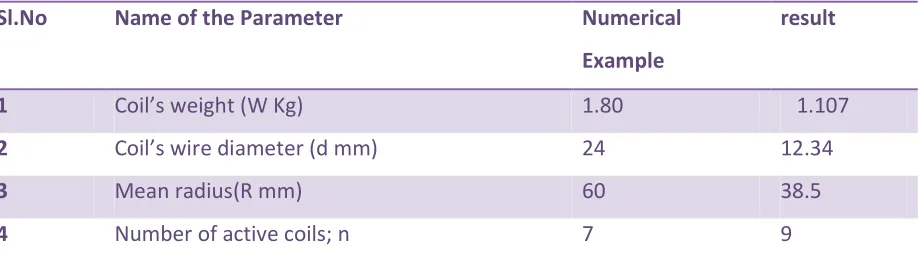
Table .3 Results of carbon epoxy wire
Sl.No Name of the Parameter Numerical
Example
result
1 Coil’s weight (W Kg) 1.80 1.107
2 Coil’s wire diameter (d mm) 24 12.34
3 Mean radius(R mm) 60 38.5
4 Number of active coils; n 7 9
By applying the method proposed in this
formulation, it was possible to obtain
results as shoen in table.3.The minimum
weight obtained F (d, R, n) = 1.107, then
each the coil’s wire diameter, mean radius
and number of coils were (d= 12.34, R=
38.5, n= 9), respectively. After comparing
the helical spring calculation results, the
coil’s weight (W) optimized by 38.5 % and
Available Online At www.ijpret.com
5.0 CONCLUSION
In this paper it was concluded that
to formulate an optimization of helical
spring weight for a constrained allowable
shearing stress, number of active coils and
coil’s average radius as a NIP problem and
solve it directly by keeping the non linear
constraint by using genetic algorithm. As a
result , the number of decision(design)
variables did not increase, and easily got
the best compromised solution.
As a result , it is obtained that a minimum
weight of oil tempered steel spring wire
F ( d,R,n) = 7.3805, and for composite
material steel wire F( d, R. n ) = 1.107,Then
the coil weight of oil tempered steel wire
optimized by 38.17% and composite
material steel wire is optimized by
38.5%,and confirmed the efficiency of the
proposed method. This study initiates to
strengthen the appropriate relations of
helical spring design parameters.
6.0 REFERENCES
1. Multi-Objective Optimization of a
Composite Material Spring Design Using an
Evolutionary Algorithm .Frédéric Ratle,
Benoît Lecarpentier, Richard Labib, François
Trochu
2. The optimal design and simulation of
helical spring based on particle swarm
algorithm and MAT LAB:XIAO QIMIN,LIU
LIWEI,XIAO QILI.
3. Simplified stress calculation method for
helical spring:koutaro WATANABE,Hideo
YAMAMOTO,Yuichi Ito,Hisao Isobe.
4. Innovization:Innovative Design
Principles Through Optimizaton:Kalyanmoy
Deb and Aravind Srinivasan
5. A Fast Elitist Non-Dominated Sorting
Genetic Algorithm for Multi-Objective
Optimization: NSGA-II Kalyanmoy Deb,
Samir Agrawal, Amrit Pratap, and T
Meyarivan
6. An interactive design procedure for
optimization of helical compression spring :