P R O T O C O L
Open Access
Center of pressure characteristics from
quiet standing measures to predict the risk
of falling in older adults: a protocol for a
systematic review and meta-analysis
Flavien Quijoux
1,2*, Aliénor Vienne-Jumeau
1, François Bertin-Hugault
2, Marie Lefèvre
2, Philippe Zawieja
2,
Pierre-Paul Vidal
1,3and Damien Ricard
1,4,5Abstract
Background:Falling is the most common accident of daily living and the second most prevalent cause of accidental death in the world. The complex nature of risk factors associated with falling makes those at risk amongst the elderly population difficult to identify. Commonly used clinical tests have limitations when it comes to reliably detecting the risk of falling, but existing laboratory tests, such as force platform measurements, represent one method of overcoming this lack of a test. Despite their widespread use, however, Center of Pressure (COP) signal analysis techniques vary and there is currently no consensus on which features should be used diagnostically. Our objective is to identify, through a systematic review and meta-analysis, the COP characteristics of older adults (≥60 years old) during quiet bipedal stance which will allow fallers to be distinguished from non-fallers.
Methods:The systematic review will include both prospective and retrospective articles. Five databases will be searched: PubMed, Cochrane CENTRAL, EMBASE, and ScienceDirect. In addition, a search of gray literature will be performed using Google Scholar and ClinicalTrials.gov. Searches will be circumscribed to include only older adults (aged over 60 years) who underwent a bipedal quiet standing measure of their balance and for whom the number of falls was reported. Two authors will independently assess the risk of bias for each included article using a 26-item checklist. Funnel plots will be drawn to attest of possible publication biases for each COP parameters. The results will be synthesized descriptively and a meta-analysis will be undertaken. When trial methodological heterogeneity is too great for pooling of the data into a meta-analysis, evidence strength will be evaluated using best evidence analysis.
Discussion:Despite the numerous advantages of posturography, the diversity of studies exploring balance in older fallers has led to uncertainty regarding the method’s ability to reliably identify fall-prone older adults. It is expected that the findings from this systematic review will help clinicians use bipedal quiet standing measures as a diagnostic test and allow researchers to explore COP characteristics to create better models for fall prevention care.
Systematic review registration:PROSPEROCRD42018098671
Keywords:Older adults, Fallers, Quiet standing, COP, Prediction, Risk of falling
© The Author(s). 2019Open AccessThis article is distributed under the terms of the Creative Commons Attribution 4.0 International License (http://creativecommons.org/licenses/by/4.0/), which permits unrestricted use, distribution, and reproduction in any medium, provided you give appropriate credit to the original author(s) and the source, provide a link to the Creative Commons license, and indicate if changes were made. The Creative Commons Public Domain Dedication waiver (http://creativecommons.org/publicdomain/zero/1.0/) applies to the data made available in this article, unless otherwise stated.
* Correspondence:[email protected]
1CNRS, UMR 8257 Cognition and Action Group, Paris, France 2Orpéa Group, Puteaux, France
Background
The risk of falling amongst older people is a major health-care issue representing one of the primary cause of injury
and death in this demographic group [1]. In elderly
people, even non-lethal falls can often lead to severe
injur-ies such as hip fracture or traumatic brain injury [2–4].
Over 15% of people aged over 65 and 25% of those over
80 years will fall multiple times in the course of 1 year [5].
This risk and the consequences could be reduced by improving the screening tools used to detect fall-prone older people. At the time of writing, most commonly used clinical screening tools, such as the Timed Up and Go test (TUG), STRATIFY, Performance Oriented Mobility Assessment (POMA), and the Berg Balance scale (BBS), are retrospectively correlated to a
pa-tient’s fall history from previous months [6], but they
have been repeatedly shown to lack both sensitivity and accuracy in order to be used prospectively to
identify the fall-prone older adults [7–11].
Further-more, these tests are also usually unable to follow changes in balance capacity with age in older people or the kind of change that occur in the early stages
of neurological diseases [12]. The BBS, for example,
re-quires an eight-point downgrade over 56 points in order
to be meaningful [13, 14], and it is also prone to errors
due to both floor and ceiling effects [15, 16]. Such
draw-backs can also be seen in other tests whose subcompo-nents cannot be separated, which also makes them
unsuitable for highly handicapped patients [17]. Other
clinical tests, such as the STRATIFY tool and the TUG test, do not have well-defined thresholds for classifying pa-tients as fallers or non-fallers. Due to these weaknesses, the predictive sensitivity and specificity of these tests are
lowered [18]. As a consequence, they are more likely
to be used as mere fall history questionnaires [11]. In
addition to their subjective nature, results from clin-ical tests to evaluate balance need to be combined in
order to identify the risk of falling [19]. Finally, even
if the aforementioned tests are widely available in Gerontology Services, they cannot be used to
discrim-inate fallers from non-fallers [20].
Quantitative posturographic tests, however, which as-sess balance by recording Center of Pressure (COP)
os-cillations [21] could provide a means to overcome these
issues. The COP signal, usually assessed with force plat-forms, contains features that allow characterization of a
patient’s postural strategies and modifications [22, 23].
Posturography also provides additional information on
specific balance control mechanisms [24] and thus
constitutes a clinically useful tool to identify those at risk
of falling [25]. A better understanding of stabilization
re-sponses should therefore allow a more targeted
manage-ment of the causes of imbalance in older people [26].
COP analysis has been used to determine motor strategies
for fall prevention [27,28], to reliably distinguish
patholo-gies [29] and to link fear of falling with posturographic
pa-rameters [30]. Studies have indicated that some sway
characteristics of a quiet stance, especially in the mediolat-eral direction, are significantly different between non-fallers and non-fallers and could therefore be good indicators
of those at increased risk of future falls [31]. Amongst
healthy, older adults who live in the community, balance and sway measurements have been shown to be strong
predictors of fall risk [32,33]. Despite this work, however,
to date, there has been no study to summarize those COP features which best discriminate fallers from non-fallers amongst older people aged over 60. In 2006, Piirtola and
Era [32] concluded that some COP parameters during
bipedal quiet stance could help to predict risk of falls in the elderly. Unfortunately, the results of the nine articles included were contradictory and the measurement proto-cols used varied widely. Similarly, the narrative review by
Pizzigalli et al. [31] reported some COP parameters as fall
risk predictors. However, the contradictory results and the absence of quantitative analysis in these two articles limit the application of their conclusions in clinical practice. We hope that a more exhaustive literature search, and a quantitative study based on different recording protocols, will establish which parameters, and under what condi-tions, are associated with an increased risk of falling. We will seek to minimize protocol heterogeneity in order to draw conclusions that can be applied in practice. A bi-pedal quiet stance is a simple test to study balance motor
strategy in older adults [28, 34] that, unlike unipedal or
more complex tests, is more inclusive for an older popula-tion as it has a reduced incidence of participant exclusion
due to falls during recording [35, 36]. Nevertheless, ways
exist that make the test more challenging: one can add a
double cognitive task [37], a soft support with a foam pad
[38,39] or asking the participant to close their eyes [40].
Therefore, the main aim of this systematic review is to extract the best biomarkers from COP bipedal quiet stance displacement data in order to (retrospective study) distinguish fallers from non-fallers and so (pro-spective study) predict fall risk. The second aim is to evaluate the accuracy of currently available predictive and classification models using these biomarkers.
Objectives
This systematic review protocol was designed to address the following questions:
– Which features of the statokinesigram in older patients (≥60 years) during a bipedal quiet stance test differ between fallers and non-fallers? – How well can the risk of falling in older adults be
– Which parameters should be included in a predictive or a classification model of fall risk assessment for an older population?
Methods Research protocol
This literature search and analysis was designed according to the PRISMA (Preferred Reporting Items for Systematic
Reviews and Meta-Analyses) [41] and MOOSE
(meta-ana-lysis of observational studies in epidemiology) [42]
guide-lines. This protocol was registered in the PROSPERO database under the number CRD42018098671.
Search strategy
An electronic database search of titles and abstracts pub-lished will be performed between March 2017 and July 2019 to identify all articles published that include fall data for older people and their COP recordings. Five databases (PubMed, Cochrane CENTRAL, EMBASE, and ScienceDirect) will be used as sources for published articles. The search will be performed for articles published without date restriction until July 1, 2019,
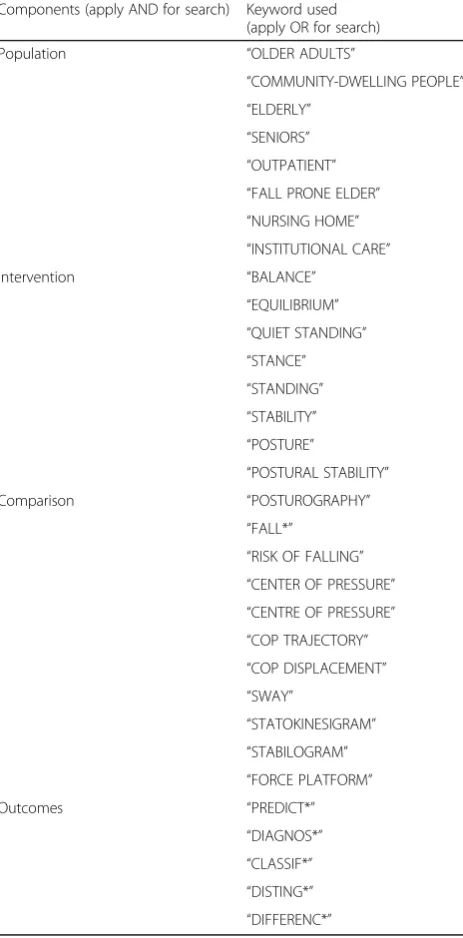
using associations of keywords (Table 1) from the PICO
methodology. The following MeSH terms will be also
used: “Accidental Falls/prevention & control,” “
Acciden-tal Falls/statistics & numerical data*,” “Aged,” “Postural
Balance/physiology*,” “Posture/physiology*,” “Predictive
Value of Tests,” and “Regression Analysis.” The main
database search will be supplemented by a review of gray literature which will be conducted through web searches on Google Scholar and ClinicalTrials.gov. In addition, all reference lists and bibliographies of included studies will be themselves reviewed for relevant studies that were not picked up through any electronic search.
Inclusion and exclusion criteria
Randomized control trials (RCTs), non-randomized con-trol trials, and observational studies will all be eligible for inclusion. Due to the risk of bias arising from only
including data from published RCTs [43, 44], data from
gray literature will also be included provided that they
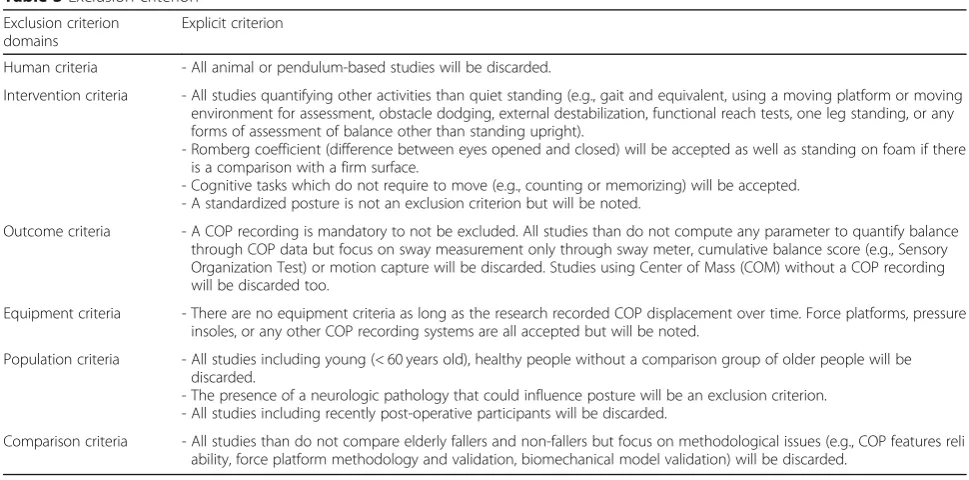
have met the inclusion criteria (Table 2). Exclusion
cri-teria will also be set (see Table3).
Paper review process
Potentially eligible studies will be screened for inclusion eligibility independently by two review authors (FQ and AV) based on their title, abstract, and full text. Articles will first be imported into the Zotero® bibliographic database (Corporation for Digital Scholarship and the Roy Rosenzweig Center for History and New Media, USA) before screening so that all articles can be reviewed from the same source in order to select those that meet the criteria. If there is disagreement between
the reviewers, the study will be discussed until a consen-sus is reached. Papers that are eligible will then be
sub-jected to data extraction and a “risk of bias” evaluation,
as described below.
Risk of bias evaluation
A quality/risk of bias assessment will be performed by using a 26-item checklist based on the work of Downs et
al. [45] (Additional file1). The checklist to be used will
retain 18 items unchanged from the previous version of
this checklist [46] while another three items will be
re-moved and two extra items added. The final risk of bias
Table 1Keywords from the P.I.C.O. framework
Components (apply AND for search) Keyword used (apply OR for search) Population “OLDER ADULTS”
“COMMUNITY-DWELLING PEOPLE”
“ELDERLY”
“SENIORS”
“OUTPATIENT”
“FALL PRONE ELDER”
“NURSING HOME”
“INSTITUTIONAL CARE” Intervention “BALANCE”
“EQUILIBRIUM”
“QUIET STANDING”
“STANCE”
“STANDING”
“STABILITY”
“POSTURE”
“POSTURAL STABILITY” Comparison “POSTUROGRAPHY”
“FALL*”
“RISK OF FALLING”
“CENTER OF PRESSURE”
“CENTRE OF PRESSURE”
“COP TRAJECTORY”
“COP DISPLACEMENT”
“SWAY”
“STATOKINESIGRAM”
“STABILOGRAM”
“FORCE PLATFORM” Outcomes “PREDICT*”
“DIAGNOS*”
“CLASSIF*”
“DISTING*”
assessment will also include a further six items from the original checklist that have been modified in order to evaluate the reliability of both the COP measures and the predictive models. In order to create and modify items, the Critical Appraisal Skills Programme (CASP)
Evaluate a Clinical Prediction Rule Checklist (v13.03.17) will be used. Quality assessment for each article will be per-formed by two assessors (FQ and AV), and each assessor will be blind to the score given by the other until both have completed the evaluation. Any disagreement over the final
Table 2Inclusion criterion
Inclusion criterion domains
Explicit criterion
General criteria - Published before July 1, 2018.
- Related to the main topics:“the risk of falling in elderly people.”Articles not related to this topic will not be included based on the two-reviewer evaluation system.
Language criteria - No language criteria are applied. However, for non-French, non-English, or non-Spanish articles, we will contact professional translators if no French, Spanish, or English version is found. Such translations will be indicated in the main article. - All full papers will be retrieved (or translated) and used.
Type-of-study criteria
- Retrospective and prospective clinical trials, randomized, or not. - Observational, time series, and cross-sectional studies.
Participants criteria - Older patients (aged≥60 years of age) considered to be otherwise healthy/without neurological disease as determined by a diagnostic assessment (or any specification from the authors) which could impact their posture including (but not limited to) Parkinson disease (PD), multiple sclerosis (MS), hemiplegia, paraplegic, stroke, or brain trauma. Orthopedic disorders affecting balance such as recent arthroplasty or amputation will also not be included in the review.
Intervention criteria - Articles analyzing the balance through COP recordings during quiet standing with both feet on the ground and evaluating the risk of falling by the number of falls during a period of time (retrospectively or prospectively)
- Any article measuring the risk of falling without an estimation of the number of falls per participant (i.e., indirect assessment through fear of falling tests or epidemiologic data only) or not related to the risk of falling (comparing elderly vs. young for example) will be discarded.
- If training (e.g., exercise training or a physiotherapy program) is a part of the intervention, the article will be discarded unless a baseline of the quiet standing capacities is recorded. In this case, only the data from the baseline will be used.
Comparison criteria - Fallers versus non-fallers (it can include“healthy elderly people”versus“fall prone elderly”or“low risk elderly”vs“high risk eld erly”or“single fallers”versus“multiple fallers”or“infrequent fallers”versus“recurrent fallers”)
Outcomes criteria - Primary outcomes will be the features in the COP analysis and their differences between the groups (odds ratio for dichotomous outcomes and mean differences for continuous outcomes).
- Secondary outcomes will be the precision of the prediction (or the model) of the risk of falling, such as sensibility, specificity, area under the curve (AUC) of receiver operating characteristic (ROC) curves, number of true(/false) positive(/negative), positive predictive value (PPV), and negative predictive value (NPV), odd-ratio or other evaluation of the system.
Table 3Exclusion criterion
Exclusion criterion domains
Explicit criterion
Human criteria - All animal or pendulum-based studies will be discarded.
Intervention criteria - All studies quantifying other activities than quiet standing (e.g., gait and equivalent, using a moving platform or moving environment for assessment, obstacle dodging, external destabilization, functional reach tests, one leg standing, or any forms of assessment of balance other than standing upright).
- Romberg coefficient (difference between eyes opened and closed) will be accepted as well as standing on foam if there is a comparison with a firm surface.
- Cognitive tasks which do not require to move (e.g., counting or memorizing) will be accepted. - A standardized posture is not an exclusion criterion but will be noted.
Outcome criteria - A COP recording is mandatory to not be excluded. All studies than do not compute any parameter to quantify balance through COP data but focus on sway measurement only through sway meter, cumulative balance score (e.g., Sensory Organization Test) or motion capture will be discarded. Studies using Center of Mass (COM) without a COP recording will be discarded too.
Equipment criteria - There are no equipment criteria as long as the research recorded COP displacement over time. Force platforms, pressure insoles, or any other COP recording systems are all accepted but will be noted.
Population criteria - All studies including young (< 60 years old), healthy people without a comparison group of older people will be discarded.
- The presence of a neurologic pathology that could influence posture will be an exclusion criterion. - All studies including recently post-operative participants will be discarded.
score for each article will be discussed; if no agreement can be reached, the rounded mean of both scores will be used.
Data extraction and analysis
Following inclusion of the articles for analysis, the text from each reference will be imported into Microsoft Excel (version 2013, Microsoft Corp., Redmond, WA) for data extraction. One assessor (FQ) will extract and collate information following the recommendations of
the Joanna Briggs Institute Reviewers’ Manual [47].
An-other assessor (AV) will verify the extracted data from the included articles in order to confirm coherence of the data. Key characteristics to be extracted will include information about the study itself such as author(s), title, year of publication, inclusion and exclusion criteria, sample size, study methodology (retrospective or pro-spective fall evaluation), study duration, rate of falls, and mention of any adverse events that occurred during the
study (Additional file 1). Population characteristics will
also be recorded including demographic and biometric
data such as participants’ gender, age, weight, height,
BMI, and cognitive capacities (e.g., following a Mini
Mental State Examination—MMSE). Data gathered
about the falls will include the studies’definition of a fall
and how they were evaluated and the geographical loca-tion of the work (country, region, and establishment where the measures took place); quiet standing test pa-rameters to be collected will include test conditions of the tests such as, for participants, whether they wore shoes or were barefoot, had their eyes open or closed, or if they were asked to use a comfortable or standardized foot position. For the test itself, data will be recorded on the type of standing surface (e.g., firm or foam) used, whether it was a cognitive double or single task, test duration, who performed the tests, the time interval be-tween the different test parts, the data collection methods (type of tools, sampling frequency, and filter characteristics), and the COP features. For predictive (in prospective studies) or classification (in retrospectives studies) models, their characteristics and level of accur-acy will also be extracted, when a statistical model has been used.
When these data are unavailable from the main text,
Additional file1will be examined for more information.
When data on the force platforms or other kind of equipment (such as the sampling frequency or the
pro-vider) are not available even in Additional file 1, the
specifications will be sought from other articles by the same author(s). For experimental studies, the available COP data will be extracted from the baseline measure-ments that were taken before any intervention had been implemented as long as the history of fall is also avail-able (retrospective classification). If the COP parameters before the intervention are not included, the article will
not be analyzed. For observational studies with prospect-ive evaluation of falls, data recorded before the follow-up assessment will used as in the analysis; if measure-ments were not performed before follow-up, the article will be excluded. Using software (like Plot Digitizer) to obtain data from figures was not considered as an option to extract data since this technique has been shown to be flawed concerning inter-rater reliability, with only a 50% agreement between both raters and an agreement
of 70% with the original data even for trained raters [48].
In addition to the time consumption of extracting data by two authors independently, there is no guidance for
this kind of extraction so far [49]. Therefore, we had
ra-ther not extracting the data on graphs to avoid introdu-cing new biases.
Finally, authors will be contacted via e-mail up to three times to request missing data when they are not available in the main text or from other sources as de-scribed above.
Strategy for data synthesis
Extracted data from included articles will be presented descriptively, especially study characteristics, population characteristics, COP features used, and the risk of bias. The risk of bias will be assessed using the value of the percentage scores from the 26-item checklist: score tribution will also be studied to look for a Gaussian dis-tribution or, on the contrary, a trend in favor of the studies included in the meta-analysis. The quality scores will also be used as a parameter of the COP heterogen-eity level in the meta-analysis.
For pooling predictor data from COP recordings, at least three studies must have used the same feature. If the included studies show consistency between their protocols, particularly with regard to the homogeneity of patient populations and the quiet standing test condi-tions, a meta-analysis of the aggregated data will be con-sidered. For features that cannot be aggregated into a
meta-analysis, a“best evidence synthesis”will be the
pre-ferred method of evaluating the strength of the studies’
evidence [50]. If data cannot be aggregated into a
meta-analysis or if the results seem contradictory, the best evi-dence analysis will support articles with the highest score in the risk of bias assessment. Particular care will be taken to ensure that the methodological quality of the studies and consistency of their results are reported.
If a meta-analysis is indicated, the method will follow the Cochrane Collaboration handbook recommendations
[51]. Means and standard deviations (SD) of measures
deviation values [29]. Effect size (ES) will be
calcu-lated using Eq. 1 [52, 53]:
ES¼ 1− 3 4ðn1þn2Þ−9
y
1−y2
S ð1Þ
ES is the unbiased effect size corrected for sample
sizes n1 and n2 provided by Hedges; y1 and y2 are the
means of each group and S is the pooled within-group
standard deviation.
The estimated within-study variance of ES is
com-puted from Eq.2:
^
σ2¼n1þn2
n1n2 þ
ES2
2ðn1þn2Þ ð
2Þ
Assuming a fixed-effects model, the weighting
coeffi-cient will be computed from Eq.3:
^
wFE¼1=^σ2 ð3Þ
If a random-effects model is preferred, the weighting
coefficient will be computed from Eq.4:
^
wRE¼1= σ^2þ^τ2
ð4Þ
^τ2¼Q−ðk−1Þ
c ð5Þ
In Eq. 5, ^τ2 is the estimated between-studies
vari-ance; Q is the heterogeneity statistic of the k
inde-pendent studies and c the coefficient computed from
Eq. 6:
c¼Xw^FE−
P
^
wFE
ð Þ2 P
^
wFE ð
6Þ
A fixed-effects model will be chosen if the
heterogen-eity is low to moderate (I2< 50%) [54]; otherwise, a
ran-dom-effect model will be used.
Finally, as shown in Eq. 7, the data will be pooled for
meta-analysis in case of clinical, methodological, and statistical homogeneity to assess the mean effect size of a COP feature according to:
ES¼ P ^
wES
ðP Þ
^
w ð7Þ
Confidence in cumulative evidence
Sensitivity analyses will explore the impact of recording settings on the COP results during the quiet standing measurement such as if patients had open or closed eyes, their foot position, standing surface firmness as well as whether the study was prospective or retrospect-ive. The impact of COP measurement variability, due to factors like recording duration or sampling frequency
[55], will also be discussed. Inter and intra-participant
reliability for the different COP parameters will also be discussed in order to assess their usefulness in clinical
practice [56–58]. If the data are detailed enough, the
causes of falls will be investigated further to determine whether external factors independent of balance disor-ders were involved in the fall/non-fall status; such exter-nal factors could weaken the overall ability of COP measures to predict falls. If the heterogeneity for a given COP parameter within the meta-analysis is too great (as
measured byI2> 50%), the decrease of this heterogeneity
will be tested by the deletion of studies that use a par-ticular COP recording configurations (with a different material than the other studies included for this param-eter for example); the hparam-eterogeneity decrease will then be discussed in relation to the study(s) deleted. If sub-groups exist, e.g., recurrent fallers vs infrequent fallers, Microsoft Excel (ibid.) will be used for their analysis.
If enough RCTs and interventional studies can be included, the overall quality of the evidence for each outcome will be presented using the GRADE (Grad-ing of Recommendations, Assessment, Development and Evaluation) criteria as per the Cochrane
Collabor-ation [59]. Otherwise, the cumulative evidence will be
assessed using our own rating system which is based on the GRADE system and was created to overcome the limitations of using GRADE on non-interventional observational studies. This system will give a score for each outcome based on (1) the mean risk of bias from every study included for that outcome, (2) the total number of studies used to pool the data, (3) a classification of heterogeneity from low to high, and
(4) the overall sample size (Table 4). Each outcome
could then be graded as either “High,” “Moderate,”
“Low,” or “Very Low.”
To visualize possible publication bias, funnel plots will be used to represent the estimated effect size of each art-icle against the standard error mean plotted on the verti-cal axis. A symmetric inverted funnel shape suggests no publication bias. A funnel plot will be drawn for each COP parameter with respect to the type of study (retro-spective or pro(retro-spective).
Discussion
This systematic review is expected to provide a valuable means of predicting and so preventing falls in older indi-viduals by providing robust, evidence-based guidelines for the clinical and laboratory evaluation of risk of falling using a simple and reliable bipedal COP test.
The proposed study will retrieve and extract data from clinical trials and observational studies. It will report the spatio-temporal parameters of the center of pressure displacements during a bipedal quiet stand-ing task in older people who are then classified as
chosen bipedal tests because of the applicability of these tests to all older people. Unipedal tests, which are more difficult to perform, tend to exclude frailer individuals who find themselves unable to stand on
one leg [60]. We do not think that conducting a
sen-sitivity study based on this subgroup of people would be feasible due to a lack of individual data. We also chose to focus only on bipedal tests to reduce the di-versity of recording methods used in the articles ana-lyzed; including other methods for other tests would only further complicate the task of analyzing such already-heterogeneous data to obtain reliable results. Finally, we consider it possible that the motor strat-egies used to maintain balance during a one-legged stance are different from those used during bipedal
stance [61] and, hence, a multivariate analysis of
bi-pedal COP tests would be more suited as the topic of a separate, equally specific, systematic review.
Non-systematic reviews from other publications in this field have indicated that the reliability of the bi-pedal COP measurements appears to be high across
the different study protocols [55, 62, 63] and it thus
seems reasonable to assume that the repetition of measures will only increase this reliability. Biomech-anical factors (such as height and weight) and acquisi-tion settings are known to have a moderate to high
influence on COP parameters [64, 65], and so
par-ticular attention will need to be paid to these factors in order to pool the data without bias.
One conceivable, and potentially major, limitation of this systematic review would be a lack of this par-ticipant and test protocol information in the included articles. In particular, fall circumstances can be key confounding variables: some COP measures might be associated with falls only under particular circum-stances and not others. For parameters where the data are available, we will carry out a sub-analysis stratified by fall circumstances. We will also try to re-duce these risks of bias by taking into account the quality of each study and by extracting information
regarding the definition and evaluation of “a fall,” as
well as data about adverse events gathered during the follow-up after from each acquisition protocol.
Additional file
Additional file 1: 26-items quality checklist. Extracted data ordered by domain of interest. (DOCX 36 kb)
Abbreviations
AUC:Area under the curve; BMI: Body mass index; COM: Center of mass;
COP: Center of pressure; GRADE: Grading of Recommendations, Assessment, Development, and Evaluation; MMSE: Mini-mental state examination;
MS: Multiple sclerosis; PD : Parkinson’s disease; RCT: Randomized control trial;
ROC: Receiver operating characteristic
Acknowledgements
The authors would especially like to thank Jean-Philippe Régneaux from the Cochrane Collaboration for his help and advice in the preparation of this protocol.
We would also thank Jennifer Dandrea Palethorpe for her review of the English language to ensure the quality of this manuscript.
Authors’contributions
FQ, AV, PZ, FBH, ML, PPV, and DR collaborated to develop and refine the conception, design, and writing of the study protocol. FQ, AV, and DR contributed to the search strategy and the quality appraisal. FQ and AV wrote the draft of the study protocol with inputs from PZ and DR. All authors critically reviewed the manuscript and approved the final version.
Funding
In the context of a CIFRE thesis, this systematic review with meta-analysis protocol has been funded by ORPEA Group.
Availability of data and materials
Not applicable.
Ethics approval and consent to participate
Not applicable
Consent for publication
Not applicable
Competing interests
The authors declare that they have no competing interests.
Author details
1CNRS, UMR 8257 Cognition and Action Group, Paris, France.2Orpéa Group,
Puteaux, France.3Hangzhou Dianzi University, Hangzhou 310018, Zhejiang, China.4Service de Neurologie de l’Hôpital d’Instruction des Armées de Percy,
Service de Santé des Armées, Clamart, France.5Ecole du Val-de-Grâce, Service de Santé des Armées, Paris, France.
Received: 13 November 2018 Accepted: 27 August 2019
References
1. World Health Organization, éditeur. WHO global report on falls prevention
in older age. Geneva: World Health Organization; 2008. 47.
Table 4Cumulative evidence scale (low is rated 0, moderate 1, and high 2 for each item. The final rating is very low (< 2), low (2–4), moderate (5–6), high (> 6))
Quality Risk of bias score (mean of the 32-score)
Number of studies (n)
Heterogeneity (I2)
Cumulative sample size High > 22 > 10 < 30% (low heterogeneity) > 400 Moderate 16–22 3–10 30–75% (moderate) 200–400 Low < 16 0–3 > 75% (high heterogeneity) < 200
2. Luukinen H, Herala M, Koski K, Honkanen R, Laippala P, Kivelä S-L. Fracture risk associated with a fall according to type of fall among
the elderly. Osteoporos Int. 2000;11(7):631–4.
3. Stevens JA, Corso PS, Finkelstein EA, Miller TR. The costs of fatal and non
-fatal falls among older adults. Inj Prev. 2006;12(5):290–5.
4. Harvey LA, Close JCT. Traumatic brain injury in older adults: characteristics,
causes and consequences. Injury. 2012;43(11):1821–6.
5. HAS. Évaluation et prise en charge des personnes âgées faisant des chutes
répétées. 2009.
6. Schoene D, Wu SM-S, Mikolaizak AS, Menant JC, Smith ST, Delbaere K,
et al. Discriminative ability and predictive validity of the timed up and go test in identifying older people who fall: systematic review
and meta-analysis. J Am Geriatr Soc. 2013;61(2):202–8.
7. Ambrose AF, Cruz L, Paul G. Falls and fractures: a systematic
approach to screening and prevention. Maturitas. 2015;82(1):85–93.
8. da Costa BR, Rutjes AWS, Mendy A, Freund-Heritage R, Vieira ER. Can
falls risk prediction tools correctly identify fall-prone elderly rehabilitation inpatients? A systematic review and meta-analysis. Baradaran HR, éditeur PLoS One 2012;7(7):e41061.
9. Perell KL, Nelson A, Goldman RL, Luther SL, Prieto-Lewis N,
Rubenstein LZ. Fall risk assessment measures: an analytic review. J
Gerontol A Biol Sci Med Sci. 2001;56(12):M761–6.
10. Raîche M, Hébert R, Prince F, Corriveau H. Screening older adults at
risk of falling with the Tinetti balance scale. Lancet. 2000;356(9234):
1001–2.
11. Gates S. Systematic review of accuracy of screening instruments for
predicting fall risk among independently living older adults. J Rehabil Res Dev. 2008;45(8):12. PMID: 19235113.
12. Pajala S, Era P, Koskenvuo M, Kaprio J, Törmäkangas T, Rantanen T.
Force platform balance measures as predictors of indoor and outdoor
falls in community-dwelling women aged 63–76 years. J Gerontol Ser
A. 2008;63(2):171–8.
13. Yelnik A, Bonan I. Clinical tools for assessing balance disorders.
Neurophysiol Clin Neurophysiol. 2008;38(6):439–45.
14. Downs S, Marquez J, Chiarelli P. The Berg Balance Scale has high
intra-and inter-rater reliability but absolute reliability varies across the
scale: a systematic review. J Physiother. 2013;59(2):93–9.
15. Pardasaney PK, Ni P, Slavin MD, Latham NK, Wagenaar RC, Bean J, et
al. Computer-adaptive balance testing improves discrimination between community-dwelling elderly fallers and nonfallers. Arch Phys
Med Rehabil. 2014;95(7):1320–1327.e1.
16. Blum L, Korner-Bitensky N. Usefulness of the Berg Balance Scale in stroke
rehabilitation: a systematic review. Phys Ther. 2008;88(5):559–66.
17. Mancini M, Horak FB. The relevance of clinical balance assessment
tools to differentiate balance deficits. Eur J Phys Rehabil Med. 2010; 46(2):239.
18. Beauchet O, Fantino B, Allali G, Muir SW, Montero-Odasso M,
Annweiler C. Timed up and go test and risk of falls in older adults: a
systematic review. J Nutr Health Aging. 2011;15(10):933–8.
19. Lusardi MM, Fritz S, Middleton A, Allison L, Wingood M, Phillips E, et
al. Determining risk of falls in community dwelling older adults: a systematic review and meta-analysis using posttest probability. J
Geriatr Phys Ther. 2017;40(1):1–36.
20. Barry E, Galvin R, Keogh C, Horgan F, Fahey T. Is the Timed Up and Go test
a useful predictor of risk of falls in community dwelling older adults: a systematic review and meta-analysis. BMC Geriatr. 2014;14(1):1.
21. Błaszczyk JW. The use of force-plate posturography in the assessment of
postural instability. Gait Posture. 2016;44:1–6.
22. Bauer C, Gröger I, Rupprecht R, Meichtry A, Tibesku CO, Gaßmann K-G.
Reliability analysis of time series force plate data of community dwelling
older adults. Arch Gerontol Geriatr. 2010;51(3):e100–5.
23. Berger L, Chuzel M, Buisson G, Rougier P. Undisturbed upright stance
control in the elderly: part 2. Postural-control impairments of elderly fallers. J
Mot Behav. 2005;37(5):359–66.
24. Hof AL. The equations of motion for a standing human reveal three
mechanisms for balance. J Biomech. 2007;40(2):451–7.
25. Williams HG, McClenaghan BA, Dickerson J. Spectral characteristics of
postural control in elderly individuals. Arch Phys Med Rehabil. 1997;
78(7):737–44.
26. Maki BE, McIlroy WE. The role of limb movements in maintaining upright
stance: the“Change-in-support”strategy. Phys Ther. 1997;77(5):488–507.
27. Maki BE, McIlroy WE. Control of rapid limb movements for balance recovery:
age-related changes and implications for fall prevention. Age Ageing. 2006;
35(suppl_2):ii12–8.
28. Hsiao-Wecksler ET, Katdare K, Matson J, Liu W, Lipsitz LA, Collins JJ.
Predicting the dynamic postural control response from quiet-stance
behavior in elderly adults. J Biomech. 2003;36(9):1327–33.
29. König N, Taylor WR, Baumann CR, Wenderoth N, Singh NB. Revealing the
quality of movement: a meta-analysis review to quantify the thresholds to pathological variability during standing and walking. Neurosci Biobehav Rev.
2016;68:111–9.
30. Dueñas L, Balasch i Bernat M, Mena del Horno S, Aguilar-Rodríguez M,
Alcántara E. Development of predictive models for the estimation of the probability of suffering fear of falling and other fall risk factors based on posturography parameters in community-dwelling older adults. Int J Ind
Ergon. 2016;54:131–8.
31. Pizzigalli L, Micheletti Cremasco M, Mulasso A, Rainoldi A. The contribution
of postural balance analysis in older adult fallers: a narrative review. J Bodyw
Mov Ther. 2016;20(2):409–17.
32. Piirtola M, Era P. Force platform measurements as predictors of falls among
older people–a review. Gerontology. 2006;52(1):1–16.
33. Bigelow KE, Berme N. Development of a protocol for improving the clinical
utility of posturography as a fall-risk screening tool. J Gerontol A Biol Sci
Med Sci. 2011;66(2):228–33.
34. Masani K, Popovic MR, Nakazawa K, Kouzaki M, Nozaki D. Importance of
body sway velocity information in controlling ankle extensor activities
during quiet stance. J Neurophysiol. 2003;90(6):3774–82.
35. Lichtenstein MJ, Shields SL, Shiavi RG, Burger MC. Clinical determinants of
biomechanics platform measures of balance in aged women. J Am Geriatr
Soc. 1988;36(11):996–1002.
36. Maki BE, Holliday PJ, Topper AK. Fear of falling and postural performance in
the elderly. J Gerontol. 1991;46(4):M123–31.
37. Bergamin M, Gobbo S, Zanotto T, Sieverdes JC, Alberton CL, Zaccaria M, et
al. Influence of age on postural sway during different dual-task conditions.
Front Aging Neurosci. 2014;6 Disponible sur:http://journal.frontiersin.org/
article/10.3389/fnagi.2014.00271/abstract. Cité 10 Août 2018.
38. Fujimoto C, Egami N, Demura S, Yamasoba T, Iwasaki S. The effect of aging
on the center-of-pressure power spectrum in foam posturography. Neurosci
Lett. 2015;585:92–7.
39. Hong SK, Park JH, Kwon SY, Kim J-S, Koo J-W. Clinical efficacy of the
Romberg test using a foam pad to identify balance problems: a comparative study with the sensory organization test. Eur Arch
Otorhinolaryngol. 2015;272(10):2741–7.
40. Howcroft JD, Kofman J, Lemaire ED, McIlroy WE. Static posturography of
elderly fallers and non-fallers with eyes open and closed. In: World Congr
Med Phys Biomed Eng June 7-12 2015 Tor Can, vol. 51; 2015. p. 966–9.
41. Moher D, Liberati A, Tetzlaff J, Altman DG, the PRISMA Group. Preferred
reporting items for systematic reviews and meta-analyses: the prisma
statement. Ann Intern Med. 2009;151(4):264–9.
42. Stroup DF, Berlin JA, Morton SC, et al. Meta-analysis of observational studies
in epidemiology: a proposal for reporting. JAMA. 2000;283(15):2008–12.
43. Russo MW. How to review a meta-analysis. Gastroenterol Hepatol.
2007;3(8):637.
44. Shamseer L, Moher D, Clarke M, Ghersi D, Liberati A, Petticrew M, et al.
Preferred reporting items for systematic review and meta-analysis protocols (PRISMA-P) 2015: elaboration and explanation. BMJ. 2015;349(jan02 1):g7647.
45. Downs SH, Black N. The feasibility of creating a checklist for the
assessment of the methodological quality both of randomised and non-randomised studies of health care interventions. J Epidemiol
Community Health. 1998;52(6):377–84.
46. Vienne A, Barrois RP, Buffat S, Ricard D, Vidal P-P. Inertial sensors to
assess gait quality in patients with neurological disorders: a systematic review of technical and analytical challenges. Front Psychol. 2017;8
Disponible sur:http://journal.frontiersin.org/article/10.3389/fpsyg.2017.
00817/full. Cité 23 Juin 2017.
47. The Joanna Briggs Institute. The Joanna Briggs Institute Reviewers’
Manual 2015: the systematic review of studies of diagnostic test
accuracy: The Joanna Briggs Institute; 2015. Disponible sur:www.
joannabriggs.org. Cité 28 Mars 2017
48. Jelicic Kadic A, Vucic K, Dosenovic S, Sapunar D, Puljak L. Extracting data
from figures with software was faster, with higher interrater reliability than
49. Vucic K, Jelicic Kadic A, Puljak L. Survey of Cochrane protocols found methods for data extraction from figures not mentioned or unclear. J Clin
Epidemiol. 2015;68(10):1161–4.
50. Mathew SA, Heesch KC, Gane E, McPhail SM. Risk factors for hospital
re-presentation among older adults following fragility fractures: protocol
for a systematic review. Syst Rev. 2015;4(1) Disponible sur:http://
systematicreviewsjournal.biomedcentral.com/articles/10.1186/s13643-015 -0084-5. Cité 22 Déc 2017.
51. Chandler J, Higgins JP, Deeks JJ, Davenport C, Clarke MJ. Cochrane
Handbook for Systematic Reviews of Interventions Version 5.2.0 (updated February 2017), Cochrane, 2017.
52. Marín-Martínez F, Sánchez-Meca J. Weighting by inverse variance or
by sample size in random-effects meta-analysis. Educ Psychol Meas.
2010;70(1):56–73.
53. Hedges LV. Distribution theory for Glass’s estimator of effect size and
related estimators. J Educ Stat. 1981;6(2):107.
54. Higgins JP, Thompson SG, Deeks JJ, Altman DG. Measuring inconsistency in
meta-analyses. BMJ. 2003;327(7414):557.
55. Ruhe A, Fejer R, Walker B. The test–retest reliability of centre of pressure
measures in bipedal static task conditions–a systematic review of the
literature. Gait Posture. 2010;32(4):436–45.
56. Worthen-Chaudhari LC, Monfort SM, Bland C, Pan X, Chaudhari AMW.
Characterizing within-subject variability in quantified measures of balance
control: a cohort study. Gait Posture. 2018;64:141–6.
57. Baltich J, von Tscharner V, Zandiyeh P, Nigg BM. Quantification and
reliability of center of pressure movement during balance tasks of varying
difficulty. Gait Posture. 2014;40(2):327–32.
58. Lin D, Seol H, Nussbaum MA, Madigan ML. Reliability of COP-based postural
sway measures and age-related differences. Gait Posture. 2008;28(2):337–42.
59. Ryan R, Hill S. How to GRADE the quality of the evidence. Cochrane
Consumers and Communication Group, éditeur. 2016.
60. Michikawa T, Nishiwaki Y, Takebayashi T, Toyama Y. One-leg standing test
for elderly populations. J Orthop Sci. 2009;14(5):675–85.
61. Jonsson E, Seiger A, Hirschfeld H. One-leg stance in healthy young and
elderly adults: a measure of postural steadiness? Clin Biomech Bristol Avon.
2004;19(7):688–94.
62. Li Z, Liang Y-Y, Wang L, Sheng J, Ma S-J. Reliability and validity of
center of pressure measures for balance assessment in older adults. J Phys Ther Sci. 2016;28(4):1364.
63. Swanenburg J, de Bruin ED, Favero K, Uebelhart D, Mulder T. The reliability
of postural balance measures in single and dual tasking in elderly fallers
and non-fallers. BMC Musculoskelet Disord. 2008;9(1) Disponible sur:http://
bmcmusculoskeletdisord.biomedcentral.com/articles/10.1186/1471-2474 -9-162. Cité 28 Mars 2017.
64. Chiari L, Rocchi L, Cappello A. Stabilometric parameters are affected by
anthropometry and foot placement. Clin Biomech. 2002;17(9):666–77.
65. Schmid M, Conforto S, Camomilla V, Cappozzo A, D’alessio T. The
sensitivity of posturographic parameters to acquisition settings. Med
Eng Phys. 2002;24(9):623–31.
Publisher’s Note