M E T H O D O L O G Y
Open Access
A novel Gateway
®
-compatible binary vector
allows direct selection of recombinant clones in
Agrobacterium tumefaciens
Sy Mamadou Traore and Bingyu Zhao
*Abstract
Background:Cloning genes into plasmid vectors is one of the key steps for studying gene function. Recently, Invitrogen™developed a convenient Gateway® cloning system based on the site-specific DNA recombination properties of bacteriophage lambda and the cytotoxic protein ccdB, which is lethal to mostE. colistrains. The ccdB protein, however, is not toxic toAgrobacterium tumefaciens, an important player often used for studying gene functionin planta. This limits the direct application of the Gateway® cloning system in plant transformation-mediated research.
Results:In this study, we constructed a novel Gateway®-compatible destination vector, pEG101-SacB/R, by replacing theccdBgene with a SacB-SacRgene cassette as the negative selectable marker.
Conclusion:Our results demonstrate that the new pEG101-SacB/R destination vector can be used for Gateway® cloning inAgrobacterium tumefaciens. pEG101-SacB/R will be a valuable tool for high-throughput functional analysis of genesin planta.
Background
The wide-spread availability of genomic sequences from many organisms has raised interest in characterizing the biological functions of newly discovered genes through various high-throughput methodologies [1]. In order to study gene function, a gene-of-interest needs to be cloned into different plasmid vectors. In plant biology research, the gene-of-interest is frequently cloned into binary vectors that can be used for Agrobacterium-mediated transformation [2].
Gateway® technology was developed as a convenient and fast gene cloning system (Invitrogen™, Carlsbad, CA). This method involves three key steps: (1) amplify-ing the targeted gene by PCR; (2) directly clonamplify-ing the PCR product into a TopoEntr/D™vector without diges-tion/ligation; and (3) subcloning the targeted gene from the entry vector into any destination vector using the Gateway® LR cloning technique. The Gateway® LR cloning reaction is mediated by the site-specific homolo-gous DNA recombination properties of bacteriophage
lambda [3]. This method is more convenient than other methods because it does not involve either DNA diges-tion nor ligadiges-tion, two processes that can hinder the cloning process [4]. The Gateway®-compatible destina-tion vector harbors a negative selectable marker, the ccdBgene, which produces a toxic protein that is lethal to mostE. colistrains, includingDH5a[5,6]. During the Gateway®LR reaction, theccdB gene in the destination vector is replaced by the targeted gene from an entry vector through site-specific homologous DNA recombi-nation. The LR reaction mixture containing both recom-binant and non-recomrecom-binant plasmids are subsequently transferred into anE. colistrain, such as DH5a, that is sensitive to the toxic effect of ccdB. Only recombinant destination plasmids that have lost the ccdB gene are able to survive in the transformedE. colicells.
Recently, a collection of Gateway®-compatible binary destination vectors, that can be used forAgrobacterium -mediated transformation, have been constructed and are available to the plant research community [7-10]. Tar-geted genes can be easily cloned into these binary vec-tors through Gateway® LR cloning. However, the
Gateway® LR cloning mixture has to first be
* Correspondence: [email protected]
Department of Horticulture, Virginia Polytechnic Institute and State University, Blacksburg, VA, 24061, USA
transformed and screened in E. colistrains before the recombinant plasmid can be mobilized toAgrobacterium tumefaciens (A. tumefaciens) by either conjugation or electroporation. This process could be simplified if the recombinant binary plasmids from the Gateway® LR reaction could be directly transformed and selected in A.tumefaciens. Unfortunately,A.tumefaciens is insensi-tive to the toxic effect of ccdB [6]. Thus, the binary vec-tors that contain the ccdB gene cannot be negatively selected against in A. tumefaciens. To overcome this problem, a new negative selectable marker that is func-tional inA. tumefaciens must be tested.
The SacB-SacR genes were originally isolated from Bacillus subtilis and encode levansucrase, an enzyme involved in both the hydrolysis of sucrose and the bio-synthesis of levan [11,12]. Levan cannot be metabolized by most gram-negative bacteria, includingE. coliandA. tumefaciens, and is therefore toxic to this group of organisms [13,14]. TheSacB-SacRgene cassette, driven by its native promoter, has been used as a negative selectable marker for many gram negative bacteria and works by preventing the transformed bacterial strains from growing on culture medium supplemented with 5% sucrose [15]. Therefore, it will be interesting to test if the ccdB gene in any Gateway®-compatible binary vector can be replaced with theSacB-SacRgene cassette as the negative selectable marker. This would allow for direct transformation and screening of the Gateway® LR cloning product inA. tumefaciens.
In this study, one popular Gateway®-compatible destina-tion binary vector, pEarleyGate101 [9], was modified by replacing theccdBgene with aSacB-SacRgene cassette. The novel destination binary vector, pEG101-SacB/R, would allow for the direct selection of Gateway® recombi-nant clones inA. tumefaciens. To test the efficiency and functionality of pEG101-SacB/R, aluciferasegene (Luc) and a bacterial effector geneAae2166were used as repor-ters and cloned into the pEG101-SacB/R destination vec-tor. TheLucgene encodes the fire fly luciferase protein, an enzyme that catalyzes luciferin and produces a lumines-cence signal when expressed in plant cells. This makes the Lucgene a convenient reporter gene for this study [16]. The bacterial type III putative effector geneAae2166, iso-lated from bacterial pathogenAcidovorax avenae pv. citrulli, encodes a homolog ofAvrBsT [17]. Transient expression of Aae2166 in the leaves of Nicotiana benthamiana(N.benthamiana) could trigger a cell death phenotype (Traore S and Zhao B, unpublished results). Therefore,Aae2166is also a convenient marker for testing the functionality of the newly developed pEG101-SacB/R destination vector. The results of this study demonstrated that both genes were successfully cloned, selected for inA. tumefaciens, and expressed inN. benthamianaleaves. Therefore, the new destination vector is a convenient tool
for cloning and expressing genes inA. tumefaciens. The new vector also has potential to be used in high-through-put cloning applicationsin planta.
Methods Bacteria strains
Escherichia coli (E. coli) DH5a [F- endA glnV44 thi-1 recA1 relA1 gyrA96 deoR nupG F80dlacZΔM15Δ (lac-ZYA-argF)U169, hsdR17(rK-mK+),l-] and A. tumefaciens
(GV2260) [C58 background, rifampicin resistant with the Ti plasmid (pTiB6s3)]
Preparation of electroporation competent cells
1. E. coli DH5a andA. tumefaciens GV2260strains were streaked on Luria Broth (LB) agar media sup-plemented with appropriate antibiotics and incu-bated at 37°C and 28°C, respectively.
2. Single colonies of DH5a and A. tumefaciens (GV2260) were inoculated in 50 ml of LB liquid media, incubated at 37° and 28°C, respectively, and shaken at 200 rpm for 24 hours.
3. A new 500 ml LB liquid culture was re-inoculated from the initial saturated bacterial culture to pro-duce a final concentration of OD600 nm= 0.1. The liquid cultures were incubated at 18°C and 28°C for DH5a and A. tumefaciens (GV2260), respectively, until the OD at 600 nm reached 0.6.
4. The bacterial liquid culture was subsequently chilled on ice for 20 minutes.
5. Bacterial cells were harvested by centrifugation at 6000 × g for 10 minutes at 4°C.
6. The bacterial cells were washed twice with 250 ml of ice-cold water, and then finally washed with 25 ml of 10% ice-cold glycerol.
7. The bacterial cells were pelleted by centrifugation and re-suspended in 5 ml of 10% ice-cold glycerol. 8. A 100 μl aliquot of bacterial cells was transferred to 1.5 ml microtubes and immediately frozen in liquid nitrogen.
9. The cells were stored at -80°C for at least six months without loss of competency.
Plant materials
N. benthamiana(PI 555478) plants were propagated in a growth chamber programmed for 16 hours light (140 μmol/m2/s cool white fluorescent irradiance) at 28°C and 8 hours dark at 24°C.Agrobacterium-mediated transient assays were conducted on three to four week old plants.
Construction of the destination binary pEG101-SacB/R vector
-AATCAGGAAGGGATGGCTGAGG
GATATCGGATC-GATCCTTTTTAACCCATCAC-3’and SacB/R Reverse:
5’
-AGACCGGCACACTGGCCATATCGGTGGGA-TATCTTATTTGTTAACTGTTAATTGTCCT-3’. The
BbvCI and BstXI restriction sites appear in the primers as bolded and underlined text, respectively. The nucleo-tide sequences of the SacB-SacR genes, including their native promoter, can be found in GenBank [GenBank: AB183144].
The iProof™ high fidelity Taq DNA polymerase (Bio-Rad, Hercules, CA) PCR program consisted of 1 cycle at 98°C (2 min), followed by 30 cycles at 98°C (30 s), 55°C (45 s), and 72°C (1 min), and finished with a 1 cycle extension at 72°C (7 min). The PCR products were digested with BbvCI andBstXI (New England BioLabs Inc, Ipswich, MA), and gel purified using an AccuPrep™ Gel Purification Kit (Bioneer, Alameda, CA).
The destination binary plasmid pEarleyGate101 [9] was obtained from the Arabidopsis Biological Resource Center at Ohio State University (Columbus, OH) and digested with BbvCI and BstXI to remove the ccdB gene. The gel-purified PCR product of the SacB-SacR gene cassette was then cloned into theBbvCI and BstXI restriction sites of pEarleyGate101. The ligation pro-ducts were transformed into DH5a using a gene pulse electroporation apparatus (2.5 Kv/uM/mSec) (Bio-Rad). Successfully transformed bacteria were selected for on LB medium supplemented with kanamycin (50 mg/ml) and chloramphenicol (25 mg/ml). The derived new des-tination vector was re-named pEG101-SacB/R.
Plasmid DNA isolation
All plasmid DNA was isolated using an AccuPrep™ Plasmid Extraction Kit (Bioneer).
Negative selection for theSacB-SacRgene
Bacterial cells that were successfully transformed with the pEG101-SacB/R plasmid were negatively selected for on LB medium supplemented with 5% sucrose as described previously [13,14].
Cloning of theLucgene andAae2166 into the TopoEntry/
D vector
The open reading frame (ORF) of the Luc gene was cloned from plasmid pDesA-luc [19] with primers:
Sal_-LucFor:5’
-caccgtcgacGGCGGTGGCTCATCTGGCG-GAGGTatggaagacgccaaaaac-3’ and Pst_LucRev: 5’
-ctgcagTTACAATTTGGACTTTCCGCCCTTCTTGG-3’.
The start and stop codons of the Lucgene are bolded and underlined in the forward and reverse primers, respectively. The ORF of theAae2166 gene was ampli-fied from genomic DNA of Acidovorax avenae subs citrullistrain AAC-001 using primers: Aae2166 For: 5’
-caccAGATCTATGAAGAATTTCATGCGATCGAT -3’
and Rev: 5’-
GTCGACTTCGATAGCTTTTCT-GATTTTTCTCA-3’. The start codon of Aae2166 is bolded and underlined. The PCR products of the Luc and Aae2166 genes were gel purified and cloned into the TopoEntr/D™vector (Invitrogen) following the instructions of the user’s manual. Plasmid DNA was sequenced at the Core facility of the Virginia Bioinfor-matics Institute (Blacksburg, VA).
LR reaction and transformation ofAgrobacterium
tumefaciensby electroporation
The Gateway® LR clonase enzyme mix kit (Invitrogen) was used for the LR recombination reaction. In brief, the LR reaction mixture contained: 1-5 μl (100 ng) of entry clone plasmid DNA, 1 μl (100 ng) of destination vector pEG101-SacB/R plasmid DNA, 2 μl of 5 × LR clonase reaction buffer, and 2 μl of LR clonase enzyme. The reaction mixture was brought to a final volume of 10 μl with TE buffer (pH 8.0) and incubated at room temperature for 1 hour. Following the incubation, a 3-5 μl aliquot was mixed with 100μl of competentA. tume-faciens (GV2260) cells. A gene pulse apparatus (Bio-Rad), programmed for 2.5 Kv/uM/mSec, was used to transform the cells by electroporation. Following elec-troporation, the mixture was resuspended in 1 ml of liquid LB and incubated shaking at 28°C/200 rpm for 3 hours. Successfully transformed cells were then selected for on LB agar supplemented with kanamycin (50 mg/ ml), rifampicin (100 mg/ml), and 5% sucrose. The LB plates were incubated at 28°C for 2-3 days. After incuba-tion, ten colonies were randomly selected for further analysis. Recombinant plasmids were confirmed by PCR with primers: 35S forward 5’ -AAGAAGACGTTCCAAC-CACGTC-3’and NLuc reverse: 5’
-AACTGCAGTCATC-CATCCTTGTCAATCAAG-3’ to detect theLuc gene
(1.4 kb) [19]. Recombinant plasmids were also con-firmed by PCR using primers 35S forward plus Aae2166
reverse: 5’-
GTCGACTTCGATAGCTTTTCT-GATTTTTCTCA-3’to detect the Aae2166 gene (1.1 kb). The PCR fragments were separated on a 0.8% agar-ose gel, stained with 0.01% ethidium bromide solution, and visualized using the Gel-Document Image System™ under UV light (Bio-Rad).
Agrobacterium-mediated transient assays inN. benthamianaplants
at room temperature. The bacterial inoculums were adjusted to OD600 nm = 0.6 and infiltrated into the sto-mata of fully expandedN. benthamianaleaves using a 1 ml blunt-end syringe without a needle. The inoculated plants were incubated at room temperature under con-tinuous light for 20-48 hours before the detection of expressed proteins. Transient expression of theLucgene was detected by applying 1 μM luciferin to the inocula-tion site [21]. The chemical fluorescent signals were captured with a CCD camera and visualized using the Gel-Document Image System (Bio-Rad). The fluorescent signal of the Aae2166-GFP fusion protein was moni-tored 20 hours after inoculation by fluorescent
micro-scopy (Zeiss Axio Observer.A1, Carl Zeiss
MicroImaging, Inc., Thornwood, NY).
Results and discussion
Constructing a novel Gateway®-compatible binary vector
pEG101-SacB/R
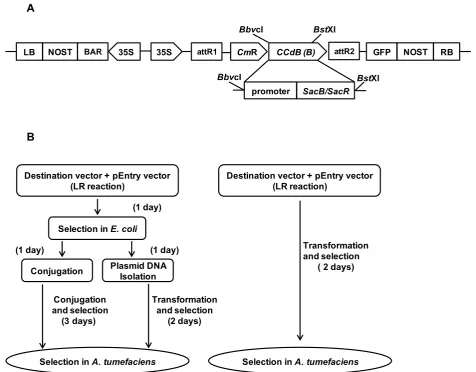
In order to construct a new Gateway®-compatible desti-nation binary vector that can be used for selection of recombinant plasmids in A. tumefaciens, theSacB-SacR gene cassette was amplified and cloned into theBbvCI andBstXI restriction sites of pEarleyGate 101 [9]. The SacB-SacRgenes replacedccdBto generate a novel des-tination vector, pEG101-SacB/R. The key components of pEG101-SacB/R are illustrated in Figure 1A. To test the functionality of theSacB-SacRgene cassette as an effec-tive negaeffec-tive selectable marker,A. tumefaciens strain GV2260, A. tumefaciensstrain GV2260 carrying pEar-leyGate101, andA. tumefaciensstrain GV2260 carrying pEG101-SacB/R were grown on LB agar medium sup-plemented with or without 5% sucrose (Figure 2). As shown in Figure 2A and 2B,A. tumefaciensgrew equally well on LB medium with or without 5% sucrose, which suggested that sucrose in LB agar medium has no inhi-bitory effect toA. tumefaciens. TheA. tumefaciens strain GV2260 carrying pEarleyGate101 also grew well on LB agar medium with or without 5% sucrose (Figure 2C and 2D). This result demonstrates that the ccdbgene cassette in pEarleyGate101 cannot be used as a negative selectable marker inA. tumefaciens. To test the func-tionality of theSacB-SacR gene cassette as an effective negative selectable marker in A. tumefaciens, the pEG101-SacB/R plasmid DNA was transformed into A. tumefaciens strain GV2260. After transformation, ten randomly selected clones were raised on LB medium supplemented with or without 5% sucrose.A. tumefa-ciens carrying pEG101-SacB/R grew well on LB agar medium without sucrose (Figure 2E); however, their growth was completely inhibited when the LB agar med-ium was supplemented with 5% sucrose (Figure 2F). These results show that the new destination vector, pEG101-SacB/R, can efficiently select against A.
tumefaciens when grown on LB agar medium supple-mented with 5% sucrose.
Testing the stability of binary vector pEG101-SacB/R To test the stability of destination vector pEG101-SacB/ R inE. coli, the restriction patterns of pEG101-SacB/R were compared before and after repeated sub-culturing. A single E. coli clone carrying pEG101-SacB/R was grown overnight in LB liquid medium supplemented with both kanamycin and chloramphenicol. The over-night bacterial culture was diluted (5000 ×) with LB medium and sub-cultured for an additional 24 hours. This process was repeated five times as described pre-viously [22]. The plasmid DNA of pEG101-SacB/R was isolated after each generation and digested with BstXI andBbvCI to remove a 1.9 kb fragment corresponding to the inserted SacB-SacRgene cassette. As shown in Figure 3, the restriction digestion patterns of pEG101-SacB/R from each generation were identical. All plasmid DNAs were further transformed into both E. coliand A. tumefaciens and the derived clones were re-plated on LB agar medium supplemented with or without 5% sucrose. All transformed bacteria colonies failed to grow on LB agar medium supplemented with 5% sucrose, confirming the functionality of the SacB-SacR genes. These results demonstrate that pEG101-SacB/R can be stably propagated in E. coligrown on LB agar medium without sucrose.
Generating recombinant clones inAgrobacterium
tumefaciensthrough Gateway LR cloning
with the N-terminus of the GFP gene in the recombi-nant pEG101-Aae2166 plasmid. Conversely, a stop codon was added to the C-terminus of the Lucgene; therefore, GFP fusion would not have occurred.
Validating the function of recombinant binary plasmids byAgrobacterium-mediated transient assays
To examine the expression of the Luc and Aae2166 genes cloned in pEG101-SacB/R,A. tumefacienscolonies carrying the recombinant plasmids pEG101-Luc or pEG101-Aae2166 were inoculated into the leaves ofN. benthamiana. As shown in Figure 5B, A. tumefaciens colonies carrying pEG101-Luc (Figure 5 B-2) but not pEarleyGate 101 (Figure 5 B-1) triggered strong lumi-nescence after treatment with luciferin, thereby confirm-ing the expression of luciferase. As a negative control,
the same A. tumefaciensstrain, carrying pEG101-Luc, was spotted onto either the leaf surface ofN. benthami-anaor onto a LB agar plate. After treatment with luci-ferin, the samples were examined under a CCD camera and no luminescence signal was detected (data not shown). This result confirmed that the luminescence signal in Figure 5B-2 was from the transiently trans-formedN. benthamianaplant cells. WhenN. benthami-anaplants were inoculated withA. tumefaciens colonies carrying pEG101-Aae2166, cell death was observed at 48 hours after inoculation (Figure 5C-2). As a negative con-trol, an A. tumefaciensstrain carrying an un-modified pEarleyGate101 was inoculated into the leaves of N. benthamiana, which did not trigger cell death at 48 hours after inoculation (Figure 5C-1). Since we modified Aae2166 to contain a C-terminal GFP tag (Figure 1A),
35S 35S attR1 CmR CCdB (B) NOST
NOST
LB BAR attR2 GFP RB
BbvcI BstXI
BstXI SacB/SacR promoter
BbvcI
Selection in E. coli
Destination vector + pEntry vector (LR reaction)
Destination vector + pEntry vector (LR reaction)
Selection in A. tumefaciens Selection in A. tumefaciens
Transformation
and selection ( 2 days)
(1 day)
(1 day) (1 day)
Transformation and selection
(2 days) Conjugation
and selection (3 days)
Conjugation Plasmid DNA Isolation
A
B
pEG101-Aae2166expressed an Aae2166-GFP fusion protein. As shown in Figure 5E, the fluorescent signal of the Aae2166-GFP fusion protein was visible by fluores-cent microscopy. The picture in Figure 5E was taken at 20 hours after inoculation, at which point there was no
GV2260 +
pEG101/SacB/R
GV2260 +
pEarleyGate101
GV2260
LB + 5% Sucrose
LB
Figure 2The growth ofAgrobacterium tumefaciensstrain on LB agar plates with different selections.A. tumefaciensstrain GV2260 grew equally well on LB medium with (A) or without 5% sucrose (B). TheccdBgene cassette in the pEarleyGate 101 vector could not inhibit the growth of
A. tumefacienson LB medium with (C) or without 5% sucrose (D).A. tumefaciensstrain GV2260 carrying the newly generated pEG101-SacB/R destination vector grew well on LB medium without sucrose (E), but growth was inhibited on LB medium supplemented with 5% sucrose (F).
1.9 kb 12 kb M 1 2 3 4 5
Figure 3The destination vector pEG101-SacB/R can be stably propagated in theE. colistrainDH5a. Restriction digestion (BstXI andBbvCI) of plasmid DNAs, isolated from five repeated overnight cultures ofE. colicarrying the pEG101-SacB/R destination vector, showed identical restriction patterns. M: 1 kb marker. Lanes 1 through 5 were digested plasmid DNAs of five repeated subcultures.
M 1 2 3 4 5 6 7 8 9 10 11 12
A
M 1 2 3 4 5 6 7 8 9 10 11 12
B
1.4 kb
1.1 kb
Figure 4PCR analysis of recombinant clones ofAgrobacterium
tumefaciens. (A). Clones ofA. tumefacienstransformed with pEG101-Luc. M: 1 kb marker; lanes 1 through 10 were from bacteria colonies carrying the recombinant plasmid pEG101-Luc, where a 1.4 kb band was amplified corresponding with the expected 35S-Luc
gene; lane 11 was a negative PCR control usingA. tumefaciensonly as a template; lane 12 was a positive PCR control using plasmid DNA of pEG101-Lucisolated fromE. colias a template. (B). Clones of
A. tumefacienstransformed with pEG101-Aae2166. M: 1 kb marker; lanes 1 to 10 were clones carrying the recombinant plasmid pEG101-Aae2166. Amplified fragments corresponded to 35S-Aae2166
(1.1 kb). Lane 11 was a negative PCR control usingA. tumefaciens
cell death observed at this time. This eliminated the possibility of autofluorescent signals from dead cells. Aae2166-GFP proteins were predominantly localized in the cytosol of transformed cells, although this observa-tion requires further confirmaobserva-tion by an independent method. As a negative control, A. tumefacienscarrying an un-modified pEarleyGate101 did not incite a fluores-cent signal in N. benthamiana (Figure 5D). These results demonstrated that two different genes could be efficiently cloned into pEG101-SacB/R using the Gate-way LR reaction with direct selection inA. tumefaciens. The two genes were functionally expressed when assayed byAgrobacterium-mediated transient assays.
Conclusions
In this report, a novel Gateway®-compatible binary vec-tor pEG101-SacB/R is described that allows direct trans-formation and selection of recombinant LR-generated clones in A. tumefaciens. The Luc gene, along with a putative bacterial effector gene,Aae2166, were used to demonstrate the efficiency and functionality of this newly developed Gateway®-compatible binary vector. The ability to directly clone and select recombinant genes in A. tumefaciens would save time, labor, and would also minimize potential contamination problems associated with conjugation or transformation manipula-tion. The new vector pEG101-SacB/R described here has great potential for simplifying and improving the effi-ciency of cloning genes in A. tumefaciens for plant transformation research. The pEG101-SacB/R vector can also be adapted for high- throughput applications. For example, a gene-of-interest mutant library could be gen-erated by Error-Prone PCR from a TopoEntr/D™ (Invi-trogen) plasmid template. The loss-of-function mutants could be identified through Agrobacterium-mediated transient assays in N. benthamiana leaves. Therefore, the new destination binary vector pEG101-SacB/R may be a valuable tool for high-throughput functional analy-sis of genesin planta.
Acknowledgements
The authors thank Drs. Richard Veilleux, Gregory E. Welbaum, Ms. Taylor Frazier and Kerri Mills for their critical comments on the manuscript. Financial support was provided by grants from Binational Agricultural Research and Development Fund (BARD) (US-4216-09 to BZ), US NSF (IOS-0845283 to BZ), and the Virginia Agricultural Experiment Station (VA135872).
Authors’contributions
ST designed and performed the experiments. BZ is the the principal investigator who conceived the project and the cloning strategy. ST and BZ analyzed the data and wrote the manuscript. All authors read and approved the final manuscript.
Competing interests
No competing interests were claimed by the authors. The vector pEG101-SacB/R is available upon request from the authors.
Received: 24 August 2011 Accepted: 7 December 2011 Published: 7 December 2011
References
1. Ausubel FM:Summaries of National Science Foundation-sponsored Arabidopsis 2010 projects and National Science Foundation-sponsored plant genome projects that are generating Arabidopsis resources for the community.Plant Physiol2002,129(2):394-437.
2. Chakrabarty R, Banerjee R, Chung SM, Farman M, Citovsky V, Hogenhout SA, Tzfira T, Goodin M:pSITE vectors for stable integration or transient expression of autofluorescent protein fusions in plants: probing
Nicotiana benthamiana-virus interactions.Mol Plant-Microbe Interact2007,
20(7):740-750.
3. Papagiannis CV, Sam MD, Abbani MA, Yoo D, Cascio D, Clubb RT, Johnson RC:Fis targets assembly of the Xis nucleoprotein filament to promote excisive recombination by phage lambda.J Mol Biol2007,
367(2):328-343.
1
1
2
2
C
D
E
1
2
1
2
A
B
Figure 5Functionality test of two genes, cloned into the pEG101-SacB/R destination vector, by means ofAgrobacterium -mediated transient assays in the leaves ofNicotiana
4. Invitrogen:Gateway® vector conversion system.Gateway®Technology Manual2004, (Version B).
5. Bernard P, Gabant P, Bahassi EM, Couturier M:Postive-selection vectors using the F-plasmidccdBkiller gene.Gene1994,148(1):71-74. 6. Bernard P, Couturier M:Cell killing by the F-plasmid CCDB protein
involves poisoning of DNA-Topoisomerase-II complexes.J Mol Biol1992,
226(3):735-745.
7. Curtis M, Grossniklaus U:A Gateway cloning vector set for high-throughput functional analysis of genes in planta.Plant Physiol2003,
133:462-469.
8. Karimi M, Inze D, Depicker A:GATEWAY vectors forAgrobacterium -mediated plant transformation.Trends Plant Sci2002,7:193-195. 9. Earley KW, Haag JR, Pontes O, Opper K, Juehne T, Song K, Pikaard CS:
Gateway-compatible vectors for plant functional genomics and proteomics.Plant J2006,45(4):616-629.
10. Chen SB, Songkumarn P, Liu JL, Wang GL:A Versatile zero background T-Vector system for gene cloning and functional genomics.Plant Physiol
2009,150(3):1111-1121.
11. Chambert R, Petitglatron MF:Study of the effect of organic solvents on the synthesis of levan and the hydrolysis of sucrose byBacillus subtilis
levansucrase.Carbohydr Res1989,191(1):117-123.
12. Quandt J, Hynes MF:Versatile suicide vectors which allow direct selection for gene replacement in gram-negative bacteria.Gene1993,
127(1):15-21.
13. Schweizer HP:Alielic exchange inPseudomonas aeruginosausing novel ColE1-type vectors and a family of cassettes containing a portableoriT
and the counter-selectableBacillus subtilis sacBmarker.Mol Microbiol
1992,6(9):1195-1204.
14. Gay P, Lecoq D, Steinmetz M, Berkelman T, Kado CI:Positive selection procedure for entrapment of insertion-sequence elements in gram-negative bacteria.J Bacteriol1985,164(2):918-921.
15. Ried JL, Collmer A:An NptI-SacB-SacR cartridge for constructing directed, unmarked mutations in gram-negative bacteria by marker exchange-eviction mutagenesis.Gene1987,57(2-3):239-246.
16. Gould SJ, Subramani S:Firefly luciferase as a tool in molecular and cell biology.Anal Biochem1988,175(1):5-13.
17. Kim NH, Choi HW, Hwang BK:Xanthomonas campestrispv.vesicatoria
effector AvrBsT induces cell death in pepper, but suppresses defense responses in tomato.Mol Plant-Microbe Interact2010,23(8):1069-1082. 18. Metz M, Dahlbeck D, Morales CQ, Al Sady B, Clark ET, Staskawicz BJ:The
conservedXanthomonas campestrispv.vesicatoriaeffector protein XopX is a virulence factor and suppresses host defense inNicotiana benthamiana.Plant J2005,41(6):801-814.
19. Ow DW, Wood KV, Deluca M, Dewet JR, Helinski DR, Howell SH:Transient and stable expression of the firefly luciferase gene in plant cells and transgenic plants.Science1986,234(4778):856-859.
20. Wydro M, Kozubek E, Lehmann P:Optimization of transient
Agrobacterium-mediated gene expression system in leaves ofNicotiana benthamiana.Acta Biochim Pol2006,53(2):289-298.
21. Chen HM, Zou Y, Shang YL, Lin HQ, Wang YJ, Cai R, Tang XY, Zhou JM:
Firefly luciferase complementation imaging assay for protein-protein interactions in plants.Plant Physiol2008,146(2):368-376.
22. Shizuya H, Birren B, Kim UJ, Mancino V, Slepak T, Tachiiri Y, Simon M:
Cloning and stable maintenance of 300-kilobase-pair fragments of human DNA inEscherichia coliusing an F-factor-based vector.Proc Natl Acad Sci USA1992,89(18):8794-8797.
doi:10.1186/1746-4811-7-42
Cite this article as:Traore and Zhao:A novel Gateway®®-compatible binary vector allows direct selection of recombinant clones in
Agrobacterium tumefaciens.Plant Methods20117:42.
Submit your next manuscript to BioMed Central and take full advantage of:
• Convenient online submission
• Thorough peer review
• No space constraints or color figure charges
• Immediate publication on acceptance
• Inclusion in PubMed, CAS, Scopus and Google Scholar
• Research which is freely available for redistribution