www.ijper.org
Formulation and
In-vitro
Evaluation of Sublingual
Tablets of Ondansetron Hydrochloride using
Coprocessed Excipients
Ajeet M. Godbole, Sandesh N. Somnache*, Shalin P. Thakker, Sudhir R Iliger, Ashwini S. Joshi, Bhautik V. Patel
SET’S College of Pharmacy, S.R. Nagar, Dharwad-580002, INDIA
ABSTRACT
The formulation of sublingual tablets of Ondansetron HCl was carried out by using direct compression technique and evaluation tests were carried out as per pharmacopoeial specifications. Poor compressibility problem of Mannitol was overcome by coprocessing it with maltose and corn starch in varying ratios. The results of evaluation tests indicate that the ratio of Mannitol: Maltose: Corn starch: 19:2:1 gave better tableting performance with respect to precompression & postcompression parameters. It was also observed that increase in maltose content, increased the hardness but negatively affects disintegration and drug release and vice versa. Furthermore the study on effect of superdisintgrants shows that Crospovidone gives faster disintegration and satisfactory drug release in concentration of 4% compared to that of Sodium starch glycolate & Croscarmelose sodium. Formulation using a bioadhesive polymer PVP K 30 in ratio of 0.5% showed uniform release of drug over a period of 20 minutes with complete solubilization of tablet compared to that of gelatin and carbopol 934. On numerical optimization of prepared formulations, three formulations were suggested by Design Expert 8.0.7.1(Trial Version), among that Formulation B gave better correlation between predicted value and observed value. Thus Formulation B was chosen as global best formulation.
Key words: Sublingual Tablet, Direct Compression, Co-processing of excipients, Historical Data Optimization,
Ondansetron HCl.
DOI: 10.5530/ijper.48.4s.2
Correspondence Address
Prof Sandesh N. Somnache
Department of Pharma-ceutics, SET’S College of Pharmacy, S.R. Nagar, Dharwad-580002, INDIA. Email: sandeshsomnache@ gmail.com
INTRODUCTION
Vomiting is the reflex action of ejecting contents of stomach through the mouth and sometimes through the nose, while nau -sea is the feeling that one is about to vomit. The act of emesis and sensation of nausea occurs due to a variety of reasons like inges -tion of drugs, gastric irritant, chemother -apy, radiotherapy GI infections.1 Vomiting occurs due to stimulation of the emetic center (Chemoreceptor Trigger Zone) at medulla oblongata. Nausea is accompanied by reduced gastric tone.2
Ondansetron is a highly selective 5-HT3 receptor antagonist and numerous studies have demonstrated its superior antiemetic efficacy in prevention of nausea and vom
-Submission Date : 17-04-13 Revision Date : 22-09-14 Accepted Date : 06-11-14 iting. Until, now only intravenous and oral
formulations of 5HT3 receptor antagonists were available. Recently a new formulation of a 5HT3 receptor antagonists in the form of suppositories, nasal drug delivery formu
-lations, transdermal drug delivery systems have been developed.3,4 The intravenous
formulation is suitable for in-patient, but it is not ideal in ambulatory conditions. The oral dosage form is not appropriate for all patients, in particular for individuals with difficulty in swallowing or those with poorly controlled nausea or vomiting.5 Transdermal
or nasal formulations though have number of advantages over oral or parenteral route, difficulties in formulation & high cost of
-come these problems oral mucosa can be used as an alternative route for administration of antiemetic drugs. Drug absorption through a oral mucosa is generally efficient due to absence of the stratum corneum epi -dermis. Mucosal surfaces are rich in blood supply, pro -viding the means for rapid drug transport directly into the systemic circulation. Oral transmucosal adminis -tration also bypasses the enterohepatic circulation and prevents immediate destruction of therapeutic agent by gastric acid or first-pass effects of hepatic metabo -lism.6 Oromucosal drug delivery can be categorized into sublingual, buccal, palletal and gingival.The sublingual mucosa is more permeable & show faster onset of action compared to other oromucosal routes.7
Sublingual route refers to a method of administering therapeutic substances through the floor of mouth in such a way that the substances are rapidly absorbed through the rich vasculature that exists under the tongue rather than through the digestive tract, which allows the drug substances a more direct contact with the blood cir -culation, thus providing fast onset of action.8 Although various sublingual formulations are available, tablet for -mulation is the most preferred dosage form.9 Sublingual tablets containing soluble ingredients get dissolved in a specified time without causing any discomfort.
Direct compression is simplest method of tablet man -ufacture as it required less equipments, has minimum processing steps, reduced labor cost. It is a dry pro -cess hence deterioration of active ingredient has been prevented. Further advantage of direct compression is that tablets disintegrate into their primary particles rather than granular aggregates. The resultant increase in surface area available for dissolution results in faster drug release.10 The direct-compression process is highly influenced by powder characteristics such as flowability, compressibility, and dilution potential. Difficulty in get -ting suitable excipients with high functionality creates opportunities for the formulation scientists to develop newer grades of existing excipients. Developing newer grades of existing excipients with varying physicochem -ical properties has been carried out by using techniques referred as “Coprocessing” or “Particle Engineering” of excipients. Co-processing is a novel phenomenon of developing a new single-bodied excipient by interact -ing two or more excipients at sub-particle level with an objective to provide a synergy of functionality improve
-ment as well as masking of the undesirable properties of individual excipients. A combination of plastic & brittle materials is necessary in order to have an opti -mum tableting performance.11
MATERIALS AND METHODS
Ondansetron Hydrochloride supplied as a gift sample by Samartha Lifesciences Pvt Ltd. Mannitol, Maltose, Corn Starch, PVP K30, Carbopol 394 and Gelatin were purchesed from Himedia labs, Mumbai. Super-disin -tegrants (Crospovidone, Croscarmelose sodium and Sodium starch glycolate) were purchased from Yarrow chemicals, Mumbai.
Selection of Excipients for Coprocessing:
Mannitol is mostly used as a diluent for the direct com -pression. But it is a poorly compressible saccharide with high hygroscopic nature. This may cause difficul -ties in tableting performance leading to poor mechani -cal strength, andunsatisfactory flow characteristics. According to scientific literatures, combination of poorly compressible saccharides and highly compress -ible saccharides gives a good mechanical strength. Malt -ose is high compressible saccharide usually used in the preparation of chewable tablets. Combining mannitol & maltose gives better hardness to the formulation. Flowability, compressibility of a formulation could be improved by Coprocessing of a brittle material with a fibrous material. Starch is the most widely used filler/ binder in tablet formulations, generally it is used in a concentration of 5-25% w/w as binder & 3-15% w/w as tablet disintegrant. Thus in the present work Man -nitol was co-processed with maltose & corn starch and used as diluent for the preparation of sublingual tablets of Ondansetron HCl.12-14
Coprocessing of mannitol
Physical mixtures of mannitol and corn starch were prepared in different ratios as mentioned in the (Table 1). Maltose was dissolved in specified quantity of dis -tilled water. The prepared maltose solution was added to mannitol-corn starch mixture with constant stirring at 200 rpm using magnetic stirrer. Stirring was continued up to 30 minutes. The resultant mixture was kept in a refrigerator overnight & then dried at 700 C. The dried mass obtained was ground & passed through sieve No. 44 to obtain fine granules.
Table 1: Ratios of excipients for Coprocessing
Mannitol (gm) Maltose(gm) Corn Starch(gm) Distilled Water (ml)
CP mannitol I 20 1 1 10
CP mannitol II 19 2 1 10
Formulation of sublingual tablets of Ondansetron HCl: Accurate amount of the Ondansetron HCl and all addi -tives were homogeneously blended in geometric dilu -tions. Magnesium stearate & Talc ware added to the mixture. Tablets were directly compressed by a 10 sta -tion Rotary Tablet Press (Cadmac) with 7.5 mm con -cave punch and die set. A compression force of 4 kg/ cm2 and a weight of 125 mg were maintained for all the tablets. Compositions of each formulation are given in (Table 2.)
Evaluation of tablets for Precompression parameters:
Angle of Repose15
Angle of repose of powder blend was determined by the funnel method. The accurately weighed powder blend was allowed to flow through the funnel freely on to the surface. The diameter of the powder cone was measured and angle of repose was calculated using the equation θ = Tan-1 h/r.
Density of powder16
A powder blend from each formulation was introduced in to a 10 ml glass measuring cylinder. The initial vol -ume and weight was noted. The cylinder was tapped 50 times on to a hard surface from a height of 2.5 cm at an interval of one second. Tapped volume was noted. Based upon the data obtained Untapped Bulk Density and Tapped Bulk Density were calculated.
Compressibility Index and Hausner’s Ratio16
Compressibility Index and Hausner Ratio of powder blend was determined by using Tapped bulk density and untapped bulk density.
Evaluation of tablets for Post compression studies:
Hardness 17
A diametric compression test was performed according to European Pharmacopoeial method 2.9.8 using Mon -santo Hardness Tester. According to standard literature in case of sublingual tablet hardness of 2 kg/cm2 was acceptable.18
Friability19
The friability test was performed according to the IP guidelines. Since the tablet weight (125 mg) was always less than 650 mg, a random sample of whole tablets cor -responding to 6.5 g was dedusted, accurately weighed, and placed in the drum of a Roche Friability tester (Mfg by Koshiash Industries). Drum was rotated 100 times and tablets were removed, dedusted, and accurately weighed. A maximum weight loss of not more than 1.0% was considered acceptable.
Uniformity of weight 19
As per IP guidelines to perform test for uniformity of weight 20 tablets from each batch were selected ran -domly and their average weights were calculated using a digital weighing balance (Essae Teraoka ltd). Percentage weight difference was calculated and checked with IP specifications.
Wetting time20
The test for wetting time was carried out by using two layers of a rectangular absorbent paper (11 cm x 7.5 cm) fitted into a Petri dish & wetted thoroughly with distilled water. The tablet was placed at the center of the plastic dish and the time required for the water to diffuse from the wetted absorbent paper throughout the entire tablet was recorded using a stopwatch.
Determination of drug content21, 22
Twenty tablets from each formulation were weighed and powdered. 10 mg of the powder was weighed accurately and dissolved in 100 ml of distilled water. The mixture was sonicated (Equitron) for 180 seconds and filtered through Whatman filter paper No. 40. The filtrate was further diluted with distilled water and absorbance was measured at 310 nm. By using slope of standard calibra -tion curve the amount of Ondansetron HCl was calcu -lated.
Disintegration Test15
Disintegration test was carried out according to USP NF standard. One tablet was placed in each of the six tubes and the using distilled water maintained at 370 C
± 20 C and the tablets were observed for disintegration. At the end of the time limit i.e. 2 minute as directed for sublingual tablet, the basket from the fluid was lifted up and observed for the tablets complete disintegration.
In-vitro drug release profile23
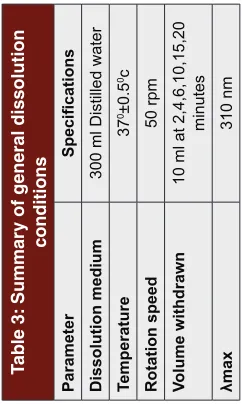
In vitro drug release studies were carried out by adopting Modified European Pharmacopoeial method by using distilled water as dissolution medium at 370 C ± 0.50 C with at 50 rpm (paddle). Samples were collected at 2, 4, 6, 10, 15 & 20 minutes intervals. The amount of Ondan -setron HCl released was estimated at 310 nm using UV spectrophotometer (Lab India 3000+). The cumulative percentage of drug release was calculated and the data obtained was presented in the dissolution rate profiles as a function of time in (Table 3). According to the sci -entific literature, the amount of drug released from sub -lingual tablets must exceed 80% of its total content with in 15 minutes.24
In-vitro Drug release kinetics25, 26
Tab
le 2:
Form
ulation of Ondansetr
on HCl sub
lingual tab let Ingredients (mgs) F1 `F2 F3 F4 F5 F6 F7 F8 F9 F10 F11 F12 API Ondansetron HCl 5 5 5 5 5 5 5 5 5 5 5 5 Diluents CP mannitol I 109.06 00 00 106.56 00 00 00 00 00 00 00 00 CP mannitol II 00 109.06 00 00 106.56 106.56 106.56 106.56 106.56 107.18 105.93 00 CP mannitol III 00 00 109.06 00 00 00 00 00 00 00 00 00
Physical blend (Mannitol + Maltose + Corn Starch¬)
00 00 00 00 00 00 00 00 00 00 00 106.56 Super- disintegrants Crospovidone 2.5 2.5 2.5 5 5 00 00 5 5 5 5 5 Ac-Di-Sol 00 00 00 00 00 5 00 00 00 00 00 00
Sodium starch glycolate
00 00 00 00 00 00 5 00 00 00 00 00 Bioadhesives PVP K-30 0.625 0.625 0.625 0.625 0.625 0.625 0.625 00 00 00 1.25 0.625 Carbopol 934 00 00 00 00 00 00 00 0.625 00 00 00 00 Gelatin 00 00 00 00 00 00 00 00 0.625 00 00 00 Sweeter Sodium Saccharine 0.312 0.312 0.312 0.312 0.312 0.312 0.312 0.312 0.312 0.312 0.312 0.312 Glidant Talc 6.25 6.25 6.25 6.25 6.25 6.25 6.25 6.25 6.25 6.25 6.25 6.25 Lubricant Magnesium Stearate 1.25 1.25 1.25 1.25 1.25 1.25 1.25 1.25 1.25 1.25 1.25 1.25 Tab le 3: Summar
y of g
eneral dissolution
conditions
Parameter
Specifications
Dissolution medium
300 ml Distilled water
Temperature 37 0±0.5 0c Rotation speed 50 rpm Volume withdrawn
10 ml at 2,4,6,10,15,20
minutes
λmax
study the zero order release kinetics, data obtained from
in vitro drug release studies were plotted as % cumulative amount of drug released versus time while for first order release rate kinetics, the data obtained was plotted as log cumulative % of drug remaining versus time which would yield a straight line with a slope of -nK/2.303. The results thus obtained were compared with good -ness of fit test by linear regression analysis to determine drug release kinetics of developed formulation.
RESULTS AND DISCUSSIONS
Coprocessing of mannitol with maltose and Corn Starch in varying ratios was carried out and it was compared
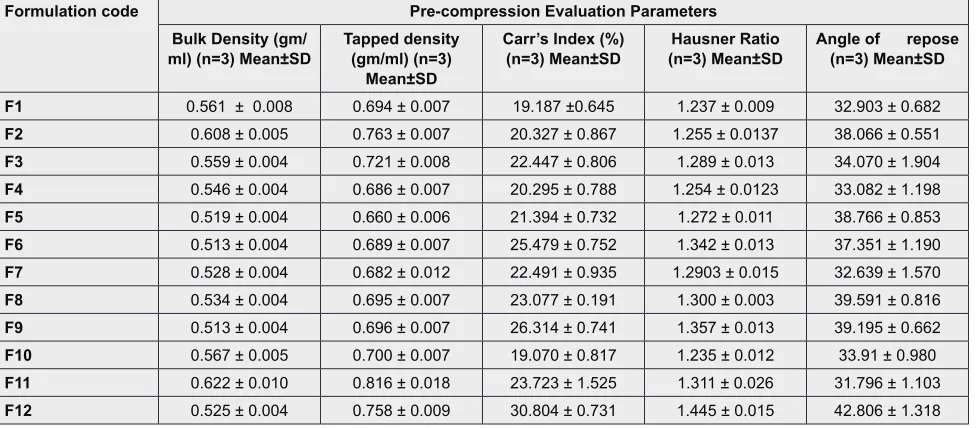
with their physical blend (formulations F5 & F12). The result obtained showsed that coprocessing of excipient improves the tableting characteristics of excipient and gives out a tablet with better hardness, reduced friabil -ity & satisfactory in vitro drug release. Along with this coprocessing also improves precompression character -istics as better flow property, bulk density to near about 0.5 w/v which is desirable for a sublingual tablet. The tablets prepared using unprocessed physical blends fail flowability test and in case friability test chipping of tab -lets was observed. But tab-lets prepared by using copro -cessed excipients with equal concentrations of other excipient showed a satisfactory flow, better hardness and a uniform in vitro drug release. Hardness of tablet Table 4 : Precompression parameters of all the formulations
Formulation code Pre-compression Evaluation Parameters Bulk Density (gm/
ml) (n=3) Mean±SD Tapped density (gm/ml) (n=3) Mean±SD
Carr’s Index (%)
(n=3) Mean±SD (n=3) Mean±SDHausner Ratio Angle of repose (n=3) Mean±SD F1 0.561 ± 0.008 0.694 ± 0.007 19.187 ±0.645 1.237 ± 0.009 32.903 ± 0.682
F2 0.608 ± 0.005 0.763 ± 0.007 20.327 ± 0.867 1.255 ± 0.0137 38.066 ± 0.551
F3 0.559 ± 0.004 0.721 ± 0.008 22.447 ± 0.806 1.289 ± 0.013 34.070 ± 1.904
F4 0.546 ± 0.004 0.686 ± 0.007 20.295 ± 0.788 1.254 ± 0.0123 33.082 ± 1.198
F5 0.519 ± 0.004 0.660 ± 0.006 21.394 ± 0.732 1.272 ± 0.011 38.766 ± 0.853
F6 0.513 ± 0.004 0.689 ± 0.007 25.479 ± 0.752 1.342 ± 0.013 37.351 ± 1.190
F7 0.528 ± 0.004 0.682 ± 0.012 22.491 ± 0.935 1.2903 ± 0.015 32.639 ± 1.570
F8 0.534 ± 0.004 0.695 ± 0.007 23.077 ± 0.191 1.300 ± 0.003 39.591 ± 0.816
F9 0.513 ± 0.004 0.696 ± 0.007 26.314 ± 0.741 1.357 ± 0.013 39.195 ± 0.662
F10 0.567 ± 0.005 0.700 ± 0.007 19.070 ± 0.817 1.235 ± 0.012 33.91 ± 0.980
F11 0.622 ± 0.010 0.816 ± 0.018 23.723 ± 1.525 1.311 ± 0.026 31.796 ± 1.103
F12 0.525 ± 0.004 0.758 ± 0.009 30.804 ± 0.731 1.445 ± 0.015 42.806 ± 1.318
Table 5 : Post-compression Parameters of All Formulations
Formulation
code Hardness Post-compression Evaluation Parameters Kg/cm2
(n=10)
Weight Variation (mg) (n=20)
Friability
(%) Drug Content (%) (n=3) In vitro DT (sec) (n=6) time(sec) (n=6) Wetting Mean±SD
% CDR after
15 min F1 1.62 ± 0.13 124.4 ± 2.23 0.672 98.400 ± 0.38 55 ± 2.60 45.5 ± 1.516 88.85±0.55
F2 2.63 ± 0.18 124.9 ± 2.33 0.504 97.306 ± 0.29 88.333 ± 4.41 76.333 ± 2.422 80.02±0.60
F3 3.21 ± 0.14 124.6 ± 2.01 0.289 99.663 ± 0.14 201.833±13.48 210.167 ± 7.521 40.10±0.23
F4 1.56 ± 0.13 125.15 ± 1.72 0.580 100.252 ± 0.25 26.5 ± 1.37 31.5 ± 2.345 96.80±0.14
F5 2.48 ± 0.15 124.85 ±1.49 0.460 99.83 ± 0.38 65.166 ± 1.72 51.333 ± 2.581 96.10±0.26
F6 2.47±0.09 124.2±2.30 0.473 100.673±0.14 112.5±1.87 109.5 ± 3.016 83.92±0.39
F7 2.53±0.14 125.25 ±2.31 0.351 95.791 ± 0.38 204 ± 1.78 207.667±7.890 35.14±0.53
F8 2.42±0.12 122.9 ± 6.01 0.765 98.148 ± 0.14 74.5 ± 2.73 71.5 ± 2.509 79.32±0.73
F9 2.41±0.12 124.7 ± 1.59 0.581 100.757 ±0.25 78.5 ± 1.87 64.5 ± 3.146 95.63±0.25
F10 2.36±0.10 125.4 ± 2.52 0.198 95.538 ± 0.14 65.5 ± 2.34 45.666 ± 3.777 88.48±0.44
F11 2.66±0.09 124.9 ± 2.26 0.471 97.390 ± 0.38 75 ± 2.60 85.166 ± 3.311 78.73±0.50
F12 0.33±0.18 124.45±2.56 Breaking & Cracking
tablets
increased with increase in ratio of maltose in Copro
-cessed excipient. But it also negatively affects disintegra
-tion time and drug release. The tablet with Coprocessed excipient with ratios of mannitol:maltose:Corn Starch 19:2:1 gave better hardness with satisfactory disinte
-gration time and a good in vitro drug release. Further increase in Maltose concentration, increased hardness but resulted in decreased in vitro drug release & increased disintegration time. While decrease in maltose content although improved drug release and reduced Disinte
-gration time, the tablet becomes too soft i.e. below the normal range of tablet hardness for a sublingual tablet.
Type of superdisintegrants and their ratios mainly affects the disintegration time and indirectly also affects Dis -solution rate of the tablet. By comparing Formulations F5, F6, F7 it was found that tablets containing Crospo -vidone showed faster disintegration compared to that of tablets containing Ac-Di-Sol & Sodium starch glycolate. Ac-Di-Sol though gave better result than that of Sodium starch glycolate, but in comparison with Crospovidone it showed slower disintegration and higher wetting time. By comparing formulations F2 and F4 it was also found that, the increase in concentration of superdisintegrant reduced disintegration time and resulted in faster disin -gration.
To ensure a more intimate contact of sublingual dosage form the bioadhesive polymers can be employed which posses strong bioadhesive/ mucoadhesive properties. Increasing the contact time with the sublingual mucosa with a mucoadhesive polymer improves sublingual bio -availability and result in more predictable plasma levels of the drug, leading to better therapeutic efficacy and reproducibility. The concentration and type of muco -adhesive polymer employed has significant influence on release and absorption of drug from sublingual tablet dosage form. By comparing Formulation F5, F10 and F11 it was observed that addition of a bioadhesive poly
-Table 6: Release Kinetics Profile of all formulation F-1 to F-12
Formulation code Mathematical Model (r-value)
Zero order kinetic First order kinetic Results Best fit Model
F1 0.646 0.841 First Order
F2 0.966 0.982 First Order
F3 0.970 0.984 First Order
F4 0.512 0.727 First Order
F5 0.654 0.908 First Order
F6 0.750 0.924 First Order
F7 0.969 0.989 First Order
F8 0.930 0.998 First Order
F9 0.613 0.884 First Order
F10 0.864 0.984 First Order
F11 0.922 0.990 First Order
F12 0.859 0.989 First Order
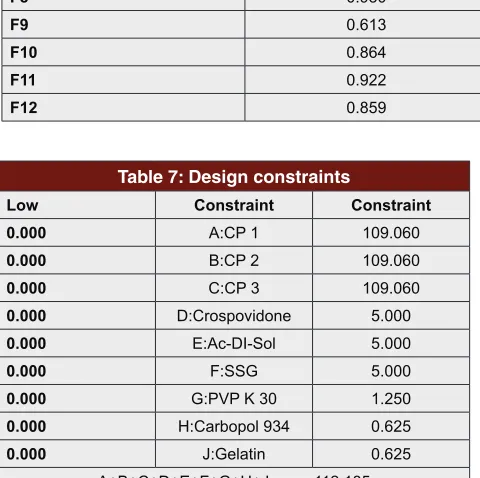
Table 7: Design constraints
Low Constraint Constraint 0.000 A:CP 1 109.060
0.000 B:CP 2 109.060
0.000 C:CP 3 109.060
0.000 D:Crospovidone 5.000
0.000 E:Ac-DI-Sol 5.000
0.000 F:SSG 5.000
0.000 G:PVP K 30 1.250
0.000 H:Carbopol 934 0.625
0.000 J:Gelatin 0.625 A+B+C+D+E+F+G+H+J 112.185
Table 8 : Dependent variables with their acceptable ranges for a sublingual tablet
Dependent Variable Acceptable ranges Goal Hardness >2 Kg/cm2 Maximum
Disintegration Time < 120 seconds minimum
Wetting Time < 120 seconds Minimum
% Drug release after 15 minutes >80% within 15 minutes Targeted to 80%
First order release kinetic (r value) 0.9 to 0.999 In range
Weight variation 116 to 134 Targeted to 125
mer to the formulation gave uniform release of drug while formulation without bioadhesive polymer showed irregular drug release pattern. Increase in concentration of bioadhesive polymers resulted in a decreased drug release. Comparison between formulations F5, F8 and F9 showed that PVP K 30 gave a better in vitro drug release than Carbopol 934 and Gelatin. Formulation containing Carbopol 934 fails to comply weight varia -tion test due to its stickiness and improper die filling. Formulation containing gelatin though gave satisfactory
in vitro drug release but residue remained after complete dissolution, which could give an unpleasent mouth feel.
Optimization of prepared sublingual tablet26-30
In the present work formulation Nos. 1 to 11 were tabu -lated in historical data mixture design 8.0.7.1(Trial Ver
-sion) and based on numerical optimization the global best formulation (best values of excipients) was deter -mined. In a mixture design, the level of a single com -ponent cannot be changed independently and the sum of the mixture components has to be equal to 100%. Ondansetron HCl (5 mg) tablets were prepared with a constant weights of various excipients like magnesium stearate (1.25 mg), talc (6.25 mg) and Sodium saccha -rine (0.312 mg)and the total tablet weight was kept con -stant (125 mg). Therefore, the experimental range lies between 0 and 112.185 mg. The restrictions imposed on the mixture component proportions are shown in (Table 7).
Experimental ranges were applied in order to comply with the relevant amounts of the same actually utilized in commercial pharmaceutical formulations. Dependent Table 9: Formulations of Ondansetron HCl sublingual tablet as suggested by Design Expert 8.0.7.1 (Trial
Ver-sion).
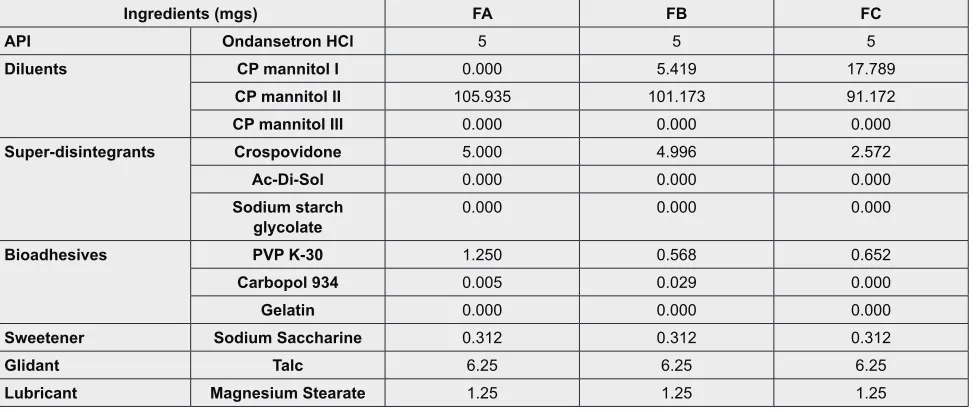
Ingredients (mgs) FA FB FC
API Ondansetron HCl 5 5 5
Diluents CP mannitol I 0.000 5.419 17.789
CP mannitol II 105.935 101.173 91.172
CP mannitol III 0.000 0.000 0.000
Super-disintegrants Crospovidone 5.000 4.996 2.572
Ac-Di-Sol 0.000 0.000 0.000
Sodium starch
glycolate 0.000 0.000 0.000 Bioadhesives PVP K-30 1.250 0.568 0.652
Carbopol 934 0.005 0.029 0.000
Gelatin 0.000 0.000 0.000
Sweetener Sodium Saccharine 0.312 0.312 0.312
Glidant Talc 6.25 6.25 6.25
Lubricant Magnesium Stearate 1.25 1.25 1.25
Table 10: Comparative values of predicted and observed responses of FA, FB, FC:
Response Formulation A Formulation B Formulation C
Predicted Value Observed value Predicted Value Observed value Predicted Value Observed value Hardness 2.65 2.51±0.11 2.44 2.46±0.11 2.45 2.46±0.09
Disintegration
Time 72.33 66.83±1.72 65.78 74.33±1.86 84.35 89.83±3.06
Wetting Time 80.56 57.66±1.63 58.93 46.33±2.80 71.55 85.16±3.31
% Drug release
after 15 minutes 82.93 90.28 88.07 88.64 81.39 80.31 R value of First
order release kinetic
0.953 0.982 0.943 0.985 0.976 0.983
Weight
variation 124.86 125.05±1.63 125.01 124.65±1.75 124.699 124.7±1.97 Content
Comparative % cumulative drug release profiles of Ondansetron HCl Sublingual Tablets
0 2 4 6 1 0 1 5 2 0
0 10 20 30 40 50 60 70 80 90 100
110 F1
F2 F3 F4 F5 F6 F7 F8 F9 F10 F11 F12
Time in minutes
%
CDR
Figure 1: Comparative in vitro release profile of different formulations of Ondansetron HCl Sublingual Tablets.
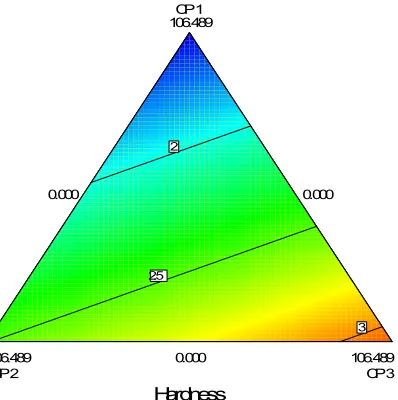
Design-Expert® Software Component Coding: Actual Hardness
3.21
1.56
X1 = A: CP 1 X2 = B: CP 2 X3 = C: CP 3
Actual Components D: Crospovidone = 1.627 E: Ac-DI-Sol = 1.627 F: SSG = 1.627 G: PVP K 30 = 0.407 H: Carbopol 934 = 0.203 J: Gelatin = 0.203
CP 1 106.489
CP 2 106.489
CP 3 106.489
0.000 0.000
0.000
Hardness
2
2.5
3
Figure 2: Hardness of tablet.
variables considered in this study were hardness, dis -integration time, wetting time, % drug release, first order release kinetic, weight variation & content uniformity which are shown in (Table 8). along with their acceptable ranges for a sublingual tablet. The formulations prepared were evaluated for pre -compression and post -compression parameters. The data obtained was analyzed using linear model of design expert 8.0.7.1(Trial version). The response contour plots predicted from the linear model for dependent variable are shown in (Table 2-5).
Design-Expert® Software Component Coding: Actual Disintegration Time
Design Points 204
26.5
X1 = A: CP 1 X2 = B: CP 2 X3 = C: CP 3
Actual Components D: Crospovidone = 2.500 E: Ac-DI-Sol = 0.000 F: SSG = 0.000 G: PVP K 30 = 0.625 H: Carbopol 934 = 0.000 J: Gelatin = 0.000
CP 1 109.060 CP 2 109.060 CP 3 109.060 0.000 0.000 0.000 Disintegration Time 100 120 150 Design-Expert® Software Component Coding: Actual Disintegration Time
Design Points 204
26.5
X1 = A: CP 1 X2 = B: CP 2 X3 = C: CP 3
Actual Components D: Crospovidone = 5.000 E: Ac-DI-Sol = 0.000 F: SSG = 0.000 G: PVP K 30 = 0.625 H: Carbopol 934 = 0.000 J: Gelatin = 0.000
CP 1 106.560 CP 2 106.560 CP 3 106.560 0.000 0.000 0.000 Disintegration Time 100 120 150 50 Design-Expert® Software Component Coding: Actual Disintegration Time
204
26.5
X1 = A: CP 1 X2 = B: CP 2 X3 = C: CP 3
Actual Components D: Crospovidone = 0.000 E: Ac-DI-Sol = 2.500 F: SSG = 0.000 G: PVP K 30 = 0.625 H: Carbopol 934 = 0.000 J: Gelatin = 0.000
CP 1 109.060 CP 2 109.060 CP 3 109.060 0.000 0.000 0.000 Disintegration Time 100 120 150 200 Design-Expert® Software Component Coding: Actual Disintegration Time
204
26.5
X1 = A: CP 1 X2 = B: CP 2 X3 = C: CP 3
Actual Components D: Crospovidone = 0.000 E: Ac-DI-Sol = 0.000 F: SSG = 2.500 G: PVP K 30 = 0.625 H: Carbopol 934 = 0.000 J: Gelatin = 0.000
CP 1 109.060 CP 2 109.060 CP 3 109.060 0.000 0.000 0.000 Disintegration Time 150 200
Figure 3: Disintegration Time
Figure 4: Percent drug release after 15 minutes
Design-Expert® Software Component Coding: Actual Drug Release
Design Points 99.6919
36.2374
X1 = A: CP 1 X2 = B: CP 2 X3 = C: CP 3
Actual Components D: Crospovidone = 5.000 E: Ac-DI-Sol = 0.000 F: SSG = 0.000 G: PVP K 30 = 0.625 H: Carbopol 934 = 0.000 J: Gelatin = 0.000
CP 1 106.560 CP 2 106.560 CP 3 106.560 0.000 0.000 0.000 Drug Release 60 70 80 90 Design-Expert® Software Component Coding: Actual Drug Release
Design Points 99.6919
36.2374
X1 = A: CP 1 X2 = B: CP 2 X3 = C: CP 3
Actual Components D: Crospovidone = 5.000 E: Ac-DI-Sol = 0.000 F: SSG = 0.000 G: PVP K 30 = 1.250 H: Carbopol 934 = 0.000 J: Gelatin = 0.000
CP 1 105.935 CP 2 105.935 CP 3 105.935 0.000 0.000 0.000 Drug Release 50 60 70 80 90 Design-Expert® Software Component Coding: Actual Drug Release
Design Points 99.6919
36.2374
X1 = A: CP 1 X2 = B: CP 2 X3 = C: CP 3
Actual Components D: Crospovidone = 5.000 E: Ac-DI-Sol = 0.000 F: SSG = 0.000 G: PVP K 30 = 0.000 H: Carbopol 934 = 0.625 J: Gelatin = 0.000
CP 1 106.560 CP 2 106.560 CP 3 106.560 0.000 0.000 0.000 Drug Release 50 60 70 80 90 Design-Expert® Software Component Coding: Actual Drug Release
Design Points 99.6919
36.2374
X1 = A: CP 1 X2 = B: CP 2 X3 = C: CP 3
Actual Components D: Crospovidone = 5.000 E: Ac-DI-Sol = 0.000 F: SSG = 0.000 G: PVP K 30 = 0.000 H: Carbopol 934 = 0.000 J: Gelatin = 0.625
Design-Expert® Software Component Coding: Actual Weight Variation
Design Points 125.4 122.9
X1 = A: CP 1 X2 = B: CP 2 X3 = C: CP 3 Actual Components D: Crospovidone = 5.000 E: Ac-DI-Sol = 0.000 F: SSG = 0.000 G: PVP K 30 = 0.625 H: Carbopol 934 = 0.000 J: Gelatin = 0.000
CP 1 106.560 CP 2 106.560 CP 3 106.560 0.000 0.000 0.000 Weight Variation 124.96 124.98 125 125.02 Design-Expert® Software Component Coding: Actual Weight Variation
Design Points 125.4 122.9
X1 = A: CP 1 X2 = B: CP 2 X3 = C: CP 3 Actual Components D: Crospovidone = 5.000 E: Ac-DI-Sol = 0.000 F: SSG = 0.000 G: PVP K 30 = 0.000 H: Carbopol 934 = 0.000 J: Gelatin = 0.625
CP 1 106.560 CP 2 106.560 CP 3 106.560 0.000 0.000 0.000 Weight Variation 124.62 124.64 124.66 124.68
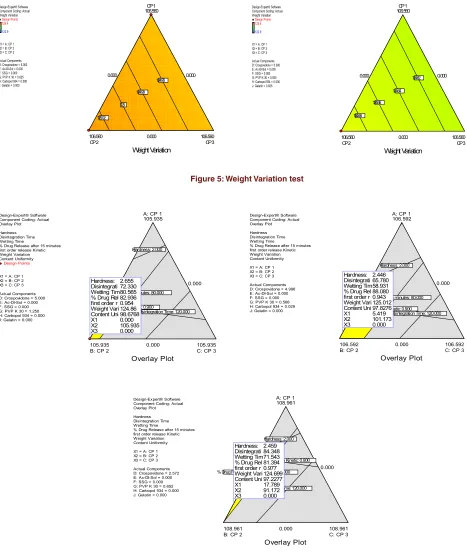
Figure 5: Weight Variation test
Figure 6: Formulations (A,B,C)
Design-Expert® Software Component Coding: Actual Overlay Plot Hardness Disintegration Time Wetting Time
% Drug Release after 15 minutes first order release Kinetic Weight Variation Content Uniformity
Design Points
X1 = A: CP 1 X2 = B: CP 2 X3 = C: CP 3 Actual Components D: Crospovidone = 5.000 E: Ac-DI-Sol = 0.000 F: SSG = 0.000 G: PVP K 30 = 1.250 H: Carbopol 934 = 0.000 J: Gelatin = 0.000
A: CP 1 105.935
B: CP 2 105.935
C: CP 3 105.935
0.000 0.000
0.000
Overlay Plot Hardness: 2.000
Disintegration Time: 120.000 % Drug Release after 15 minutes: 80.000
first order release Kinetic: 0.900 Hardness: 2.655 Disintegrati 72.330 Wetting Tim80.565 % Drug Rel 82.936 first order r 0.954 Weight Vari 124.86 Content Uni 98.6768
X1 0.000
X2 105.935
X3 0.000
Design-Expert® Software Component Coding: Actual Overlay Plot Hardness Disintegration Time Wetting Time
% Drug Release after 15 minutes first order release Kinetic Weight Variation Content Uniformity X1 = A: CP 1 X2 = B: CP 2 X3 = C: CP 3 Actual Components D: Crospovidone = 4.996 E: Ac-DI-Sol = 0.000 F: SSG = 0.000 G: PVP K 30 = 0.568 H: Carbopol 934 = 0.029 J: Gelatin = 0.000
A: CP 1 106.592
B: CP 2 106.592
C: CP 3 106.592
0.000 0.000
0.000
Overlay Plot Hardness: 2.000
Disintegration Time: 120.000 % Drug Release after 15 minutes: 80.000
first order release Kinetic: 0.900 Hardness: 2.446 Disintegrati 65.780 Wetting Tim58.931 % Drug Rel 88.080 first order r 0.943 Weight Vari 125.012 Content Uni 97.8276
X1 5.419
X2 101.173
X3 0.000
Design-Expert® Software Component Coding: Actual Overlay Plot Hardness Disintegration Time Wetting Time
% Drug Release after 15 minutes first order release Kinetic Weight Variation Content Uniformity X1 = A: CP 1 X2 = B: CP 2 X3 = C: CP 3 Actual Components D: Crospovidone = 2.572 E: Ac-DI-Sol = 0.000 F: SSG = 0.000 G: PVP K 30 = 0.652 H: Carbopol 934 = 0.000 J: Gelatin = 0.000
A: CP 1 108.961
B: CP 2 108.961
C: CP 3 108.961
0.000 0.000
0.000
Overlay Plot Hardness: 2.000
Disintegration Time: 120.000 % Drug Release after 15 minutes: 80.000
first order release Kinetic: 0.900 Hardness: 2.459 Disintegrati 84.348 Wetting Tim71.543 % Drug Rel 81.394 first order r 0.977 Weight Vari 124.699 Content Uni 97.2277
X1 17.789
X2 91.172
X3 0.000
The observed values of responses were compared with predicted values for respective formulations by Design Expert (Trial Version 8.0.7.1). Comparative values of pre -dicted and observed responses along with the formulation components are reported in (Table 10).
SUMMARY AND CONCLUSION
The sublingual tablet containing Ondansetron HCl as a model antiemetic agent was formulated by direct com -pression technique using mannitol coprocessed with maltose corn starch and optimized using Historical data mixture design 8.0.7.1(Trial Version). Based upon the results obtained it was concluded that coprocessing of low compressible saccharides with high compressible saccharides improves precompression as well as post -compression characters of tablet such as flow property, compressibility, hardness, disintegration and in vitro drug release. Mannitol:Maltose:Cornstarch in ratio of 19:2:1 exhibited ideal sublingual tablet characteristics. Study on effect of superdisintegrants on tablet formulation proved that the use of crospovidone in a concentra -tion of 4% gave tablets with disintegra-tion time of less than 80 seconds while drug release of more than 80 % after 15 minutes of in vitro dissolution studies was observed. Addition of bioadhesive polymer into formulation helps to release the drug uniformly over period of 20 minutes. In case of prepared tablet, PVP K 30 in a concentration of 0.5% exhibited better in vitro
drug release. Based on results of Optimization studies Formulation B prepared by using coprocessed excipi -ent of mannitol:maltose:corn starch in ratios of 19:2:1 was adjudged as global best formulation as it established good correlation between predicted and observed val -ues for response.
REFERENCES
1. Tripathi KD. Essentials of Medical Pharmacology. 5thEd. New Delhi: Jaypee Brothers Medical Publishers (p) Ltd; 2003. p. 7-10, 599-609.
2. Brunton LL, Parkar KL, editors. Goodman & Gillman’s Manual of
Pharmacology & therapeutics. NY: The McGraw-Hill; 2008. p. 644-50.
3. Tuca A. Use of granisetron transdermal system in the prevention of
chemotherapy-induced nausea and vomiting: A review. Cancer Management and Research. 2010; 2: 1-12.
4. Eunsook C, Hyesun G, Inkoo C. Formulation and evaluation of ondansetron
nasal delivery systems. Int J Pharm. 2008; 349(1): 101-7.
5. Fumoleau, Giovannini M, Rolland F, Votan B, Paillarse JM. Ondansetron
Suppository: an Effective Treatment for the Prevention of Emetic Disorders Induced by Cisplatin-based Chemotherapy. Oral Oncol. 1997; 33(5): 354-8.
6. Zempsky, William T. Alternative Routes of Drug Administration--Advantages and Disadvantages. Pediatrics. 1997 July 1; 100(1): 143-53.
7. Narang N, Sharma J. Sublingual mucosa as a route for systemic drug
delivery. Int J Pharm Pharm Sci. 2011; 3(2): 18-22.
8. Leilani Lea. Sublingual Absorption. [Online]. 1996 July 13 [cited 2012 oct 18]; [6 screens] Available form: URL: http://www.positivehealth.com/article/colon-health/sublingual-absorption
9. Nibha KP, Pancholi SS. An Overview on: Sublingual Route for Systemic Drug Delivery. Ijrpbsonline. 2012 Apr-Jun; 3(2): 913-23.
10. Norman AA. Tablet Manufacture by Direct Compression. In: James S, editor. Encyclopedia of pharmaceutical technology. Vol 2 New York (NY): Informa Healthcare USA, Inc; 2007. p. 3674.
11. Bansal AK, Nachaegari SK. Co-processed excipient for solid dosage form. Pharm Technol. 2004 Jan; 28(1): 52-64.
12. William RP, Tapash KG. Intraoral Delivery Systems: An Overview, Current Status, and Future Trends. In: James S, editor. Drug Delivery to the Oral Cavity: Molecules to Market. Boca Raton, FL CRC Press Taylor & Francis Group; 2005. p. 1-40. (DRUGS AND THE PHARMACEUTICAL SCIENCES; vol 145).
13. Raymond CR, Paul JS, Sian CO, editors. Handbook of pharmaceutical excipients. Great Britain: The Pharmaceutical Press; 2006. p. 447-53, 725-30.
14. Peter D. Oral Solid Dosage Forms. In: Mark Gibson, editor. Pharmaceutical Preformulation and Formulation: A Practical Guide from Candidate Drug Selection to Commercial Dosage. 2nd ed. New York (NY): Informa Healthcare USA, Inc; 2009. p. 367-75.( Drugs And The Pharmaceutical Sciences A Series of Textbooks and Monographs; vol 199)
15. United State Pharmacopeia 30-National Formulary 25 [CD ROM]. The United States Pharmacpeial Convention, Inc; 2007: 276, 643, 2426.
16. British pharmacopeia 2007 [CD ROM]. Vol IV Appendices XVII H. Resistance to Crushing of Tablets (Ph. Eur. method 2.9.8).
17. Kalaichelvi R, Madhava B, Manikanta S, GopinathG, Usha M, Venkataramana D, et al. UV spectrophotometric method for determination of Ondansetron Hydrochloride in pure and its formulation. Int J Pharm Pharm Sci. 2012; 4(4): 151-2.
18. Finkel R, Clark MA, Cubeddu LX. Lippincott’s Illustrated Reviews: Pharmacology. 4thed. Philadelphia, (PA): Lippincott Williams & Wilkins; 2009. p. 337-9. 19. British pharmacopeia 2007 [CD ROM]. Vol I & II. Monographs: Medicinal &
Pharmaceutical Substances. Ondansetron Hydrochloride Dihydrate.(Ph Eur monograph).
20. Nagendrakumar D, Raju SA, Shirsand SB, Para MS. Design of fast dissolving Granisetron HCl tablets using novel co–processed superdisintegrants. J Biosci Tech. 2009; 1(1): 8-14.
21. Government of Indian Ministry of health, Indian Pharmacopeia. The controller of publication, New Delhi. 2007; 1: 175-88.
22. Bhanja SB, Ellaiah P, Roy HK, Samal BK, Tiwari S, Murthy KVR. Formulation and evaluation of Perindopril Sublingual Tablets. Ijrpbs online. 2011 Jul-Sept; 2(3): 1193-8.
23. Bhardwaj V, Shukla V, Goyal N, Salim MD, Sharma PK. Formulation and evaluation of fast disintegrating sublingual tablets of Amlodipine Besylate using different superdisintegrants. Int J Pharm Pharm Sci. 2010; 2(3): 89-92. 24. Tas C, Bayrak Z, Tasdemir U, Erol H, Ozkan CK, Savaser A, et al. Formulation of Zolmitriptan sublingual tablets prepared by direct compression with different polymers: In vitro and In vivo evaluation. Eur J Pharm Biopharm. 2011; 78(3): 499-505.
25. Dash S, Padala NM, Lilakanta N, Chowdhury P. Kinetic modeling on drug release from controlled drug delivery systems. Acta Poloniae Pharmaceutica n Drug Research. 2010; 67(3): 217-23.
26. Noushin BB, Naghmeh H, Seyed MF, Bijan S. Formulation and optimization of Captopril sublingual tablet using D-Optimal Design. Iran J Pharm Res. 2008; 7(4): 259-67.
27. Sharma RN, Pancholi SS. Optimization techniques in pharmaceutical industry: A Review. J Current Pharm Res. 2011; 7(1): 21-8.
28. Dalavi VV, Patil JS. Optimization techniques: An introductory overview. J Pharm Res. 2009 Feb; 2(2): 144-7.
29. Narendra C. Review on design of experiment and optimization. VIPS, Bangalore. 2006; volume and issue missing? 1-21.