University of New Orleans University of New Orleans
ScholarWorks@UNO
ScholarWorks@UNO
University of New Orleans Theses and
Dissertations Dissertations and Theses
Fall 5-16-2014
Keep It Up: The Things Within and Without
Keep It Up: The Things Within and Without
Vanessa R. Centeno [email protected]
Follow this and additional works at: https://scholarworks.uno.edu/td
Part of the Art Practice Commons, and the Fine Arts Commons
Recommended Citation Recommended Citation
Centeno, Vanessa R., "Keep It Up: The Things Within and Without" (2014). University of New Orleans Theses and Dissertations. 1852.
https://scholarworks.uno.edu/td/1852
This Thesis is protected by copyright and/or related rights. It has been brought to you by ScholarWorks@UNO with permission from the rights-holder(s). You are free to use this Thesis in any way that is permitted by the copyright and related rights legislation that applies to your use. For other uses you need to obtain permission from the rights-holder(s) directly, unless additional rights are indicated by a Creative Commons license in the record and/or on the work itself.
Keep It Up: The Things Within and Without
A Thesis
Submitted to the Graduate Faculty of the University of New Orleans
in partial fulfillment of the requirements for the degree of
Master of Fine Arts in
Fine Arts Painting
By
Vanessa Renae Centeno
B.F.A San Francisco Art Institute, 2005
ACKNOWLEDGEMENTS
I would like to extend my sincere gratitude towards those who have helped open my lens of perception and pushed me beyond my limitations. This thesis would not be possible without the assistance and support of my committee members Rebecca Reynolds, Aaron McNamee and my sponsor Jim Richard. I would also like to acknowledge the University of New Orleans, Department of Fine Arts faculty and staff for their commitment towards sharing the beauty and knowledge of the arts.
A special thanks is given to my colleagues whom I have embraced as family, especially Mr. Hoffman, who has always kept me on my toes throughout this program. I would like to thank the 2014 graduating class who have brought intellectual conversation and stimulation beyond the doors of the university.
TABLE OF CONTENTS
List of Figures ... iv
Abstract ... v
Introduction ... 1
Objects of Attraction ... 4
Volatile Crush and the Abjects of Desire ... 15
Taking it Personal ... 24
Levity and Purpose ... 32
Conclusion ... 37
Bibliography ... 38
LIST OF FIGURES
Figure 1: Paint Thing, 2012 ... 7
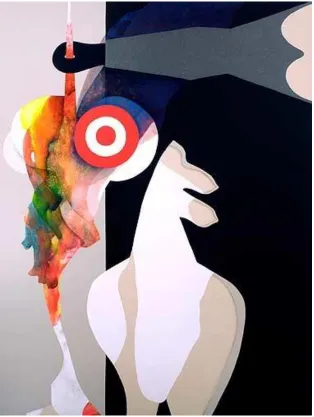
Figure 2: Josseph-Marie, Saint Theresa of Avila, ... 9
Figure 3: Saint Thing, 2012 ... 11
Figure 4: Saint Thing, 2012 (Installation shot) ... 11
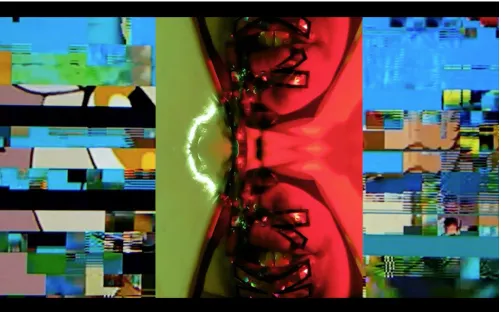
Figure 5: Ryan Trecartin, I-BE AREA, 2007 (video still) ... 13
Figure6: Eat It Saint Thing, 2013 (video still) ... 14
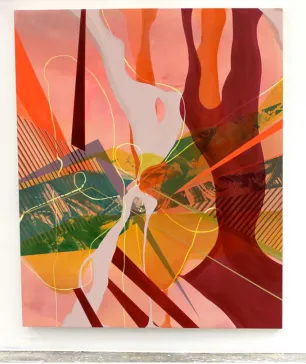
Figure 7: Carrie Moyer, BalletMecanique, 2008 ... 16
Figure 8: Last Dance, 2012 ... 17
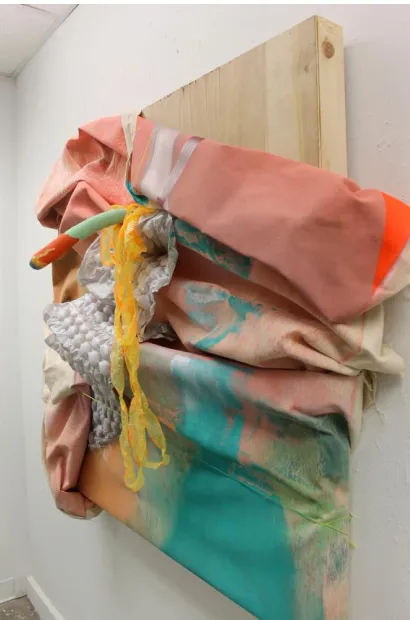
Figure 9: Ding-A-Ling, 2012 ... 18
Figure 10: Inner, 2012 (video still) ... 20
Figure 11: Hung Over, 2012 ... 22
Figure 12: Graceful Lies, 2012 ... 22
Figure 13: My first Koosh ball, ... 24
Figure 14: Busted, 2012 ... 26
Figure 15: Ding-A-Ling Photo-shoot, 2013 ... 29
Figure 16: Keep It Up, 2014 ... 31
Figure 17: Studio Wall Chatter, 2013 ... 34
Figure 18: Studio Wall Chatter, (close up) 2013 ... 34
ABSTRACT
My art explores my attraction and repulsion to a commodity driven society. Paint Thing and Saint Thing are characters that I created to push my boundaries as a painter and question my process within painting. Working through my agitation, feeling of loss and confusion, I find that two parts need to be present: a belief in the process and the fear of it coming undone.
I use painting, sculpture and video to question the materiality of canvas and paint. I incorporate plastic objects, glittery materials, and things that have ephemeral qualities. I am attracted to synthetic forms and objects when arranging them in my compositions. In my work I look closely at the social constructs and systems that bind us to the commodity driven market. I feel if we are to understand our current conditions, we must also include the impact and importance of things in our material world.
INTRODUCTION
As I look back at my three years here at University of New Orleans and my previous years as an undergraduate at the San Francisco Art Institute, I see all that my education and hard work has given me. My education has given me the opportunity to grow and develop as a professional artist. My education has allowed me to work with artists and teachers who have pushed me to look closer and ask more questions. My education has taught me how to place myself as a female Latina artist. My Identity as a female Mexican-American artist has shaped my questions and reflections about how my work is perceived and analyzed in the art intuitions. Do I play the female intellectual painter, do I play the
feminist advocate, or do I play a strong Chicana from South Texas? These questions I have asked myself many times as I enter my studio. As soon as someone defines me, there is a loss of something else that was not considered, that was left out. To be defined as a particular this or that is to lose the point. Art and artists go beyond boundaries; they redefine and constantly question the parameters. I hope in some point in my life that I will not solely be defined as a female Mexican American artist, but as an artist that makes work that reaches beyond those superficial perspectives of artmaking. I want to be considered a world artist. I understand the need to find categories and specific titles to place on the work and on artists. I do not feel that labeling the artist brings any greater insight to their work or makes it any stronger. I try to move away from being placed as a female Latina artist but the questions keep coming up.
A song by Gwen Stefani plays in the back of my head sometimes called “I’m Just A Girl.” There is this phrase that Gwen sings; “take this pink ribbon off my eyes, I’m exposed and it’s no big surprise, don’t you think I know exactly where I stand, this world is forcing me to hold your hand.”1 In the music video Stefani has this pin-up look with black eyeliner,
platinum hair, and bright red lipstick. While her male bandmates are jamming in a grungy boy’s bathroom, she’s stomping around in a girl’s powder room decorated with bright flowers and mirrors, belting out the song. Eventually the boys make it over to the women’s powder room and jam out, surrounded by a large jumping crowd. The song can be used to
look at the contained systems and the influence of femininity versus masculinity in society. In my work I do consider these frameworks that society sets up just as much as I consider the walls that I work on. The walls are either in the way or support the work. I don’t think about making work that is about being female or Latina. I just want to make work that works. Using labels and categories helps others define you and your work, but it can also create a narrow margin of perspective. Maybe I do want to make work that is about being a female Latina artist. This would explain why I use pink and why I make phallic references and make religious references, ‘cuz I’m a girl and I’m a Chicana. But I don’t think so. I’m attracted to bright colors, religion and sex just as much as a teenage pubescent boy that comes home from Catholic school, gets mesmerized with video games, and jerks off under his sheets. I just like to do it.
The context of my work deals with my struggle to find my artistic dialogue and to have faith in my intuitions in the studio. During my time as a graduate student I was able to re-evaluate my previous works and begin to focus on where I wanted to move forward and what I was willing to let go of. The confusion that came from indecisions and the need to produce work led me to feelings of loss, uncertainty and acceptance. Working through these emotions, I began a closer investigation of the area between my work and self. Many of my hesitations were not only from my personal hang-ups but also rooted in the historical barricades that have terrorized many artists over the span of art history.
This realization allowed me to acknowledge the indifferences within painting and pushed me forward to create artworks that included multimedia installations. The work that developed resulted in a tension between the materiality of the canvas and the structural supports that bind it. The paintings which transformed into sculptures, video, and installations reflected my personal state of aggravation and captured the push and pull between sculptural objects and two-dimensional surfaces. Using my Ding-A-Ling forms and Thing characters I was able to see the excessiveness of the things within, and the guttural insides of the things within. I started to observe the humanness and the emotional charge that my new works possessed. The work began to transform into the inner
these things.
The thingness of objects is the underlying topic in my work and is also a part of my reflective view of the world. The concept of things and their essence stems from a collection of childhood memories and my upbringing. There was a lot of “hocus pocus alimagocus” circulating within my imagination as a child. I remember Jim Henson’s Fraggle Rock character, “Trash Heap,” and a mannequin named Jeff coming to life with a magical hat on Today’s Special. The power of objects also seeped in from my Catholic schooling and regular mass attendance. During the services at church I was a witness to the gathering forces that objects attained and the mystery they symbolize. These early encounters helped shape my perspective, gave me the foundation to explore the multiple relationships I have with objects, and encouraged me to question how others construct meaning in their lives.
OBJECTS OF ATTRACTION
The multitude of mundane objects and household commodities glistening in the fluorescent light of the Dollar Tree store seduces me. The rows of mass-produced goods and generic products make me laugh and feel sad at the same time. The flashy packaging and catchy phrases printed in bright bold lettering entice the buyer. Once the items are bought, opened and used, they are tossed away and become trash. The brightly colored plastic flowers, party decorations and small toys all end up in a tragic pile of waste. The Dollar Tree store offers bargaining with optimism but also the contamination of decay and neglect. How could the exchange value shift so quickly, from one moment a backdrop to a festive celebration of life to the next moment becoming a deflated piece of trash? Do we discount our lives and meaningful relationships with one another as we do inanimate objects? Osterwold writes about the “myths of everyday life” in the article “The Signs of the Times.”2 The bombardment of "consumer goods has turned into the waste-disposal
problem of a 'throw-away' society in which the desires and fates of individuals disappear in the mass."3 I want to turn the idea of ‘throw-away’ into things that matter, things that we
should consider. The singular functions and purposes of inanimate objects are so easily forgotten and tossed into the ends of the earth. I want to address the potential of
disposable objects and extend the object’s function beyond the limits of its designed purposes and into meaningful art objects.
My Dollar Store encounters give me inspiration and spark my playful investigation in my studio. I seek flashy materials such as glitter, brightly colored objects, party
decorations, and things that capture the idea of cheap thrills. I view objects as windows into our state of being, how within us there is always a dark void of the disregarded and uselessness, of what is not wanted, accepted or needed in society. I feel that I am able to sympathize with the things I collect in my studio and restore the lost hopes and dreams of objects’ imagination and hopefully our own.
I find the reflective qualities of particular objects and things intriguing and engaging.
2TilmanOsterwold, “The Signs of the Times-The Themes of Pop”: Pop Art, (Italy: Taschen, 2003),
11.
I want to investigate the relationship between the product and the consumer, a consumer that is inextricably connected with a commodity-driven reality. The relationship between human beings and the material world leads me to question why people are obsessed with filling their lives with the new and improved. Is our purpose to surround ourselves with more things? Is it to create, define, and be defined by products, or is it the objects
themselves that possess us and lead us to our own destruction? I myself am guilty of these desires. I too want that tool that will make my life a little easier, to accomplish more and to be a better person. But, do we take this access for granted? Has our drive for material positions desensitized us? We have created our own destruction and there will be a hefty price to pay and it will come silently lurking in the shadow trash of yesterday. It is the forces of the dark shadows that are watching you.
That useless toaster you tossed out, the carpet that no longer matches your new sofa, and that old toothbrush that is just no good will come back to haunt you in the shadows. I imagine the end of our world would be consumer objects and mass-produced things coming to life and attacking us. This world of throwaways and a constant search for new gratification will disrupt our human relationships, and objects will hijack our humanity. I believe that objects contain an extension of our inner voids, fears and hopes. Maybe it is my fear that creates my narrative to explore and find meaning and purpose as an artist who makes things. To acknowledge the importance of objects we must also examine the
uselessness and disregarded devices of society. I believe all objects have a desire to be something great and in my studio there is a place that I can provide which allows them the opportunity to be regarded as art objects. My compositions are an attempt to explore and ultimately further define the multiple relationships between human will and the inanimate ‘thing’.
I am drawn to the complexity and philosophy of ‘things’ and the concepts that
surround thing theory. I was greatly influenced by the book Things, edited by Bill Brown: a collection of articles that explores the mysteries and the intricacy of objects and the
thingness that surrounds them. 4 Brown illuminates the philosophy of Martin Heidegger’s
techniques of phenomenology, which discuss the concepts of the thing. Heidegger’s
4
perspective pushed the notion that objects contained a thingness that was a gathering force. Brown references Bruno Latour’s influence by Heidegger’s beliefs and posed the statement, “things do not exist without being full of people.”5 In order to understand our
modern society, we must consider the relationships we have with objects and how they have shaped our identity. Walter Benjamin is another philosopher that Brown brings to the forefront on the discussion of things. Brown writes, “Subjects may constitute objects, but within Benjamin’s materialism things have already installed themselves in the human psyche.”6 Benjamin’s theories during the 20th century bring the conceptualization of
objects containing hidden powers and magical properties. The concept of objects is that they are tangible forms that have exchange value in society. Dollar store trinkets, religious relics, art objects and hand made one of-a-kind objects all have an exchange value. Objects are a part of the productive value, economic value and symbolic value in our society. A thing, on the other hand, is the presence, power, and the magical meanings of objects. Things can also be used to describe something that does not have a given name or
something that is undefined. As Brown writes, “To our understanding, then, the integrity of things must always fragment, along with words that attempt to fill their hollows.”7 The
concept of Thing Theory explains my process in which I encounter the shifting nature of things and carefully look at the underlayers of my artistic instinct.
I am immersed in creating a dialogue that brings the fantastical shadows out from objects’ contained confines and into a visual display of objects’ mystical otherness.
Theodor W. Adorno writes in his book, The Dialectic of Enlightenment, “But as the magical illusion fades away, the more relentlessly in the name of law repetition imprisons man in the cycle- that cycle whose objectification in the form of natural law he imagines will ensure his action as a free subject.”8 The idea that we live in a free world and the mode it
represents is the thing that confines us to its system. In my work I seek to look beyond the habituated forms, function and purpose, and find a place that breaks from the contained forces that rule as truth. I believe if we are able to transform objects then maybe objects 5 Brown, 12 6 Brown, 11 7 Brown, 143 8
will help transform us beyond the artificial life.
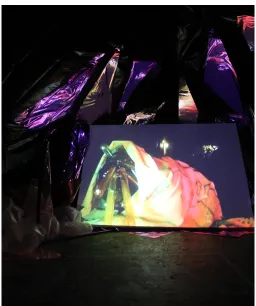
As an attempt to push my boundaries, I set aside my stretcher bars and brushes and picked up the video camera to capture an illusionary realm of objects and human flesh in collaboration. I wanted to set up a situation that manipulated painting and uncovered the mystery and voids within the canvas. Armed with a headdress of bubble tubes, colored vinyl, a painted canvas, strobe lights, a party curtain, and black leather gloves, I was going to become the Paint Thing (Figure 1).
Figure 1: Paint Thing, 2012, Installation, video, plastic tarp, pink trash bags.
the camera and strobe lights were attached to a small box; pulling the rope enabled me to drag the camera setup away then continue to crawl forward. The character slowly sways while moving toward the camera, and the strobe lights create a stop motion aesthetic while adding a ticking syncopated beat to the audio. For exhibition, the video was placed inside a black plastic tent-like cave; large purple and pink crystals made out of cardboard and metallic gift-wrap framed the projection. As the viewer enters the cave, small inflated, rose-scented trash bags float around and gently moved within the space. This installation articulated my interactions with objects and displayed the thing-like quality that I was exploring. The space invited the viewer to enter another world of possibilities, where the shifting characteristics of the objects transformed into the dark mystical crevices that circulate within the void. This is where the thing-like essence emerges from inanimate objects.
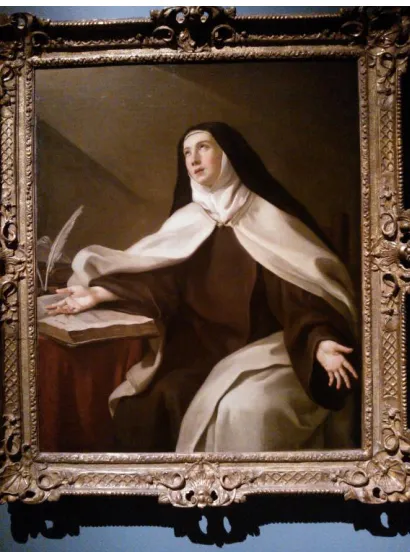
During a stroll at the New Orleans Museum of Art, I came across a religious portrait of Saint Theresa of Avila painted by Joseph-Marie Vien. The similarities to Paint Thing were very apparent in Saint Theresa’s wardrobe. The drapery of the material and the
illuminating light immediately struck me with awe. The artist portrayed Saint Teresa sitting at her desk, writing about her heavenly visitations from Jesus Christ. The painting captured Saint Theresa’s devotion and her divine inspiration from the glory of God. The artist Vien was able to capture the enlightenment and ecstasy from the divine heavens. The soft blending and illuminating highlights in the painting surround the Saint with majestic holiness. It was through the saints’ devotion and calling from God that they were able to transcend the mortal flesh and enter into the gates of Heaven. That is one of the mysteries of faith in Catholicism, where beliefs and rituals are based on the idea of divine
Figure 2: Joseph-Marie Vien, Saint Theresa of Avila, 1754-1755. NOMA permanent collection.
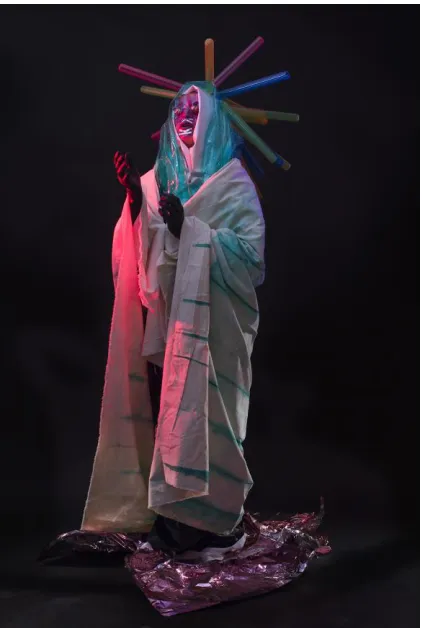
The influence of religious iconography and relics has shaped my beliefs in the way objects contain powerful and symbolic meaning. I apply this same belief to art objects and how art contains powerful presence and meaning within the form. There is a magical moment when an inanimate object transforms into an object of attraction. Using my character Paint Thing, I was able to simulate the spectacle of objects that brought a unique perspective between my movement and the objects that I used. In an attempt to recreate the magical shifting movements in Paint Thing, I used the same character but arranged the video angle to confront the viewer. Instead of the character crawling in an obscured human form, I wanted to reveal more of the character’s humanistic physical features. Setting up my background, I sprayed gold paint onto construction netting, used
textures and the intensity of colors gave the ambiguous creature a very distinct look. This time I called the character Saint Thing (Figure 3).
The objects enabled me to transcend my normal physical self and create a character that had a higher saintly presence. It was through this exploration of things that I was able to shift into this otherness and act as a stand-in for the objects. As Saint Thing, I could confront the viewer. The draping canvas, vinyl materials, bright colored lights and the intensity of the doll eyes staring into the camera became very similar to the way saints are depicted in their portraits. There is this moment of serenity to the portraits of saints’ faces, as if the higher power of God circulates above them and God’s divine hand runs through these holy beings. I did feel as though I was an advocate for objects, helping them to promote change. As an artist there is a divine power in all of us, to send a message or to bring a topic forward in hopes of creating awareness.
For the installation of Saint Thing (Figure 4), I made a confessional booth out of plastic corrugated siding; wood and cemetery spikes were placed at the top of the unit. Inside the confessional was a kneeler made from wood and stuffed white vinyl with poly-fill. As the viewer entered the space he or she would be intoxicated by the strong scent of toilet bowl freshener that permeated the room. Approaching the confessional, the viewer would then kneel down to watch the video. I wanted to combine the intricacies of crafted objects and brightly colored visuals with a nauseating smell that would trigger images of urinals and Port-O-Potties. This installation brought together the similar aspects of a urinal and a confessional. On the one side, you are relieving your bladder, and on the other,
you’re purging the filth of sin. I was seeking to create work that blurred the lines between function and absurdity, and through this exploration, hopefully find a new visual
Figure 3: Saint Thing, 2012, photograph Figure 4: Saint Thing, 2012, installation
Many artists have used objects as a way to reflect and question the role of a
commodity-driven society. Marcel Duchamp is a major inspiration for my work. Duchamp cultivated a framework within which artists could experiment freely and define boundaries outside the handcrafted art object. Duchamp’s approach enabled me to look beyond my canvas and paint and toward the mechanisms of our culture. Duchamp ultimately succeeded in creating a new type of dialogue between art and spectator by redefining objects through an artistic language and by declaring the artist a “Mediumistic being.”9 His
Readymades, such as Fountain, were a pivotal step in exploring the dialectical relationship between man and object. Duchamp’s sculpture Fountain was an ordinary object, but an object that caught the viewer off guard, and exposed the internal contradictions within the object itself. The contradiction of a mass-produced object becoming art created a new
language; the viewer was forced to examine the object’s exchange value as an art object. Taking objects from the consumer world and placing importance on the objects’ ability to participate in the looking was Jacques Lacan’s theory of the gaze. The Lacanian system is one of the core thoughts that have brought me to my beliefs of inanimate objects containing life. Lacan derives the concept of objects taking on emotional personality of which the subject is unaware. The idea that the object or thing can return the gaze and comprehend itself as being an object for another consciousness brings Duchamp’s
Readymades to the forefront. Pieces such as Fountain and Bicycle Wheel and Stool capture a sense that these objects have an awareness of their presence. The participants look back and acknowledge its ‘Gaze’. This is an idea that objects contain an extension of our human willpower while only existing because of our human desire. This brings me back to my belief that objects do have the ability to transcend the domestic facade with which they are prescribed. The character Saint Thing is used as a catalyst to transcend the objects’
material reality and allow for the object to express its inner dialogue. I wanted Saint Thing to be the eyes for all objects, to return the gaze and comprehend itself as being an object for another consciousness. Saint Thing is the patron saint for all things that have failed and have been forgotten.
Brown suggests that the ideas stem first from the objects. It is the object that gives us insight, knowledge and clues into understanding our own nature of being. Bill Brown states, “an object that helps to dramatize a basic disjunction, a human condition in which things inevitably seem too late- belated, in fact, because we want things to come before ideas, before theory, before the word, whereas they seem to persist in coming after: as the alternative to ideas.”10 Objects connect our ability to transfer concepts and ideas and
allows for new perspectives to arrive as new ways of seeing. Our relationship with objects circulates within the constructs of our self-awareness and the necessity to be productive human beings.
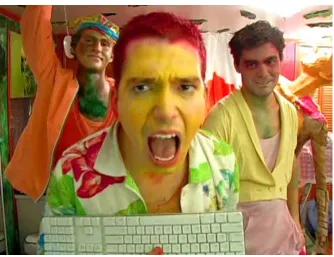
Contemporary artist Ryan Trecartin dives into the obscenely fantastical digital world of insanity. His ability to mix hyperreal scenarios with twisted characters that play
borderline psychotic inspired me to take the plunge into a suburebral (suburb/cerebral)
10
landscape (Figure 5). Through his performance videos and installation he portrays the modern dilemmas of backlash reality TV. Trecartin’s layered videos of super-saturated bright colors and green screen paint dive into the intangible nightmares of a glitched generation. The artificial landscapes and household objects piled into Trecartin’s backgrounds bring the reference of everyday modern living into the nightmares of consumerism gone wrong. Trecartin’s ability to highlight the deranged world of a
consumer society serves as a truth and insight to the reality of our obsessive technological world.
Figure 5:Ryan Trecartin, I-BE AREA, 2007, video still
society. The failure of the TV and its ability to function properly opened a window to explore and create new meaning and a moment of reflection to look at the patterns of a failed technology.
VOLATILE CRUSH AND THE ABJECTS OF DESIRE
Working with objects and things, my paintings have become anthropomorphic and loaded with emotional baggage. My intense excavation of the canvas with video and Thing characters has led me to the internal side of painting. I was seeking beyond the surface of the canvas; I wanted to know why it possessed me so much. I went to the extent of
enclosing myself in the painted canvases, crawling and lying inside them so that I could become them. There was a force that compelled me to keep pushing and searching for some sort of purpose. I remember the moment that I knew I was a painter. I had driven with a friend to Los Angeles to check out The Los Angeles County Museum of Art and was excited to see all the original works firsthand and up close. As I walked to the second floor, there was a huge painting by Robert Motherwell, Elegy to the Spanish Republic 100. It took up the entire room and I was breathless; a jolt of energy rushed through my body and I was so flooded with emotions that all I could do was cry. At that moment I understood the power of painting and how it could impact viewers. I declared myself a painter for life; I took the oath and would do whatever I needed to do to keep painting. Art and my passion for painting have led me to some very dark and confusing areas in my life. It has consumed more than half my life, and will continue to push me and constantly question my existence and purpose. In the course of my time at the University of New Orleans, I have been able to investigate the volatile crush I have on painting, and begin a new journey within the
expansive threads of canvas. I was headed towards the underbelly of what was driving me. I wanted to find out what’s inside and look it straight in the eye. I was interested in pulling out painting from the crevasses of the unknown.
graphic patterns to bring balance within my compositions. I was in love with the sensuality of painting, the seduction, and its pressing femininity. Painting to me has sexuality; the organic flow and pools of color have a feminine touch. The sexuality comes from the movement of paint across the surface and what I like to think of as the juices. The most seductive paintings are the juicy paintings, the ones that are dripping with sexuality.
Figure 8: Last Dance, 2012, acrylic on canvas
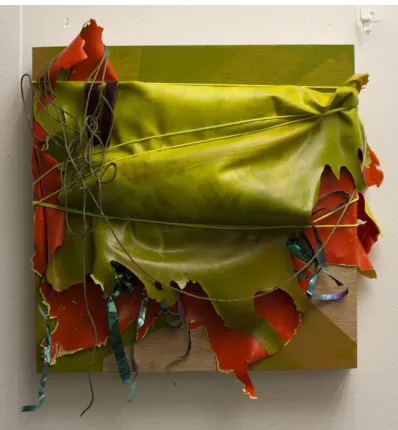
like a one -night stand, drunk and ready to be wild. It felt good, and I didn’t hesitate or think about making a painting. I allowed intuition to be my guide. I stapled the backside of the painting to the front of a panel. I incorporated a plastic lei, neon string, bubble wrap, spray paint and a Ding-A-Ling, which is my term for my sewn finger forms. The painting became the aftermath of a raw encounter, where things came out to play. It was like being in a club made only for you. As Heidegger says, “The ‘thing’ [is] a gathering force that allows the dynamics that surround it to show up.”11 It was within my studio that the forces
came together and transitioned into the inner world of painting. The painting looked like something I could feel and relate to. A living breathing thing, I could see the pathetic-ness, its sadness, and its yearning to belong.
Figure 9: Ding-A-Ling, 2012, acrylic, mixed media, on panel
This was one of my first paintings that spoke out (Figure 9). It was a painting that was looking at me looking at it. It was aware of the struggle, and it was okay. Artist Rachel Harrison’s work deals with paintings as objects in a reflective manner. She uses painted
figurative forms and lumpy clumps of paint arrangements to act out beyond the predictability of painting. Harrison’s work is funny and very serious about being odd. Harrison’s installations and found objects embraced the ridiculousness of American commodity culture. The arrangements and awkward placements of objects make a direct statement about the contradictions and odd nature of our mental and social predicaments.
I identify with her process and how readymade objects role-play to create situations of absurdity and confusion. This approach to artmaking creates a stage for the viewer to recognize the object-culture of America and the artist’s attempt to deconstruct that notion and bear witness to the disillusion and decay of society. Her work inspired me to keep working sculpturally with painting and installation.
My next strategy towards painting was to find an entry point, a point that would lead me to the intestinal passageways of understanding. I had set up my second 7ft by 4ft canvas that was halfway to becoming “just another good girl painting” and decided that I needed to crawl through it. I sewed a twelve-foot tunnel of painted canvas and blue plastic tarp that I was going to crawl through. I then sewed the painting tunnel onto my large canvas. I cut out an entry point on the backside where I would begin my journey. I wired the stretcher bars to my studio walls, set up my camera, and I was ready to dive in. I chose to include my studio space to frame the performance. I felt that the things that were surrounding me in my studio were just as important to the physical act that would take place.
As I started I realized how narrow the painting tunnel was and I had just enough room to wiggle through with my arms by my side. I kept my pace slow and used the time to be present within the material. The smell of the cotton had a lingering scent of the factory. It reminded me of stale bread that was stored in a plastic container. The fluorescent lights from the studio ceiling filtered through the fibers and washes of color. I felt like I was crawling through some kind of magical animal’s tunnel. I had put myself in an awkward position and was irritated, but I thought it was pretty hilarious. The act of crawling
and it looks as though the painting is reflecting on itself. I squirmed to reach the full
extension of the material and began to crawl backwards in an anxious attempt to get myself out of my painting.
The video reflected my physical obstruction with painting and the struggle to find my inner voice. Becoming consumed by my work and sucked into its thing quality, I was no longer in control and became a medium that allowed my artistic process to be the struggle.
There was something very self-punishing and flagellant about confining myself within the walls of my own work. I titled the video Inner (Figure 10),because itshowed me the never-ending possibilities of painting. The question became: how far do I want to go, and/or how far am I willing to go?
As much as I am attracted to the glitter surfaces of objects I am also attracted to the intestinal passageways of the grotesque. When looking at glamor in fashion magazines, I can’t help but see the bubbly bloated bellies of the self-indulging America. There is an awkwardness that appears when something is too right or too perfect; I know that the opposite lies closely behind. In the article “Modern Metamorphoses and Disgraceful Tales,” Jonathan Lamb quotes a passage from The Lives of Animals by Coetzee. He is writing about a young boy looking at his mother: “He can see up her nostrils, into her mouth, down the back of her throat. And what he cannot see he can imagine: the gullet, pink and ugly, contracting as it swallows, like a python drawing things down to the pear-shaped belly-sac…”12 The reflection of realizing the inner workings of human anatomy is very surreal. I
have had several up-close encounters with human cadavers and it is something that you can never quite see in your own reflection. I enjoyed the idea that flesh could be so horrific, beautifully entrancing and foreign. It led me to incorporate these concepts into my own work. I was still attached to bright colors, glossy layers, and glittery glamour, but I was looking to mix it up with a nauseating hangover (Figure 11) and a few intestinal guts to slip in and out. I wanted my work to be like me. I wanted to play dress-up and get fucked-up so I could make sense out of the absurd and still be able to laugh about it. My canvases were bodily personas of failed attempts at graceful beauty (Figure 12). The idea of beautiful paintings becoming ruptured and falling off frames was a way for me to insert myself into the discomfort of making art.
12
Figure 11: Hung Over, 2012, acrylic and Figure 12: Graceful Lies, 2012,
mixed media on panel. acrylic, great stuff, plastic teeth on canvas.
I have struggled with my stretchers and my painting surfaces. I was tied to the traditional formats of painting and unsure how painting could exist without the structural supports. Looking at artist Lynda Benglis and how she was able to move beyond the surface and defy gravity enabled me to shift sculpturally in my work. Lynda Benglis who is an artist that is combative, bawdy, and beautiful has broken many traditions for female artists. It is her unbinding abruptness that transgresses form and language. She says, “Asserting the formless does not mean asserting non-forms, but rather engaging in a labor of forms equivalent to the labor of giving birth or agony: a rending process that puts something to death and in this negativity, invents something absolutely new.”13 Benglis’s
process as an artist involved purging ideas and self as an artist while challenging her audience to ask the questions she is asking. Her large oozing forms that devour space, expanding colorful paint pours, thick bands of wax layers, and provocative photographs expose the undeniable truth in discovering ourselves through matter, time and space. These are the questions that push the boundaries of art and art making and give insight
and clues to the foreign nature of what it means to be human.
I was beginning to understand my vocabulary in the studio. I was making work and was able to surrender and not be obstructed by making paintings. It was, and is, a passage that has led me to let go of my painting self and be involved as an artist, with purpose, commitment and understanding of the unpredictability of life. The beauty I saw was not just something to be made, “but indeed facility to believe, impatience to doubt, temerity to answer, glory to know, doubt to contradict, end to gain, sloth to search, seeking things in words, resting in part of nature; these and the like have been the things which have forbidden the happy match between the mind of man and the nature of things; and in a place thereof have married it to vain notions and blind experiments.”14 It is within the
structure of objects that I see the potential for destroying boundaries and thoughts from the web of forces that create them. If we are to understand our own being and presence, we must also include the importance of things. Things have been bound to the threads of our culture, but we need to reconsider these things and our relationship to them. The material world has had a huge impact on our way of living; the excessive, the abundance, and the disposable have manipulated man, and man has become like things as an object ready for consumption. We are commodities, to be chewed up and spit out, a commodity to be used and to be made useful. Man manipulates things and this ultimately translates to how things manipulate man.
TAKING IT PERSONAL
A form that often appears in my work is the controversial object called the Ding-A-ling. It all started innocently on a casual stroll by the toy section in Walgreens. There it was: this translucent glowing purple ball with a thousand uniform tentacles gracefully covering the surface, sitting anxiously in a caged container (Figure 13). I picked it up and inside this soft Koosh ball was a multi-colored strobe light that flashed when I bounced it. I had to take this object home with me; it was too awesome to just let it sit there. This new toy gave me wonderful company. We played together, we made videos together, we
painted together and we shared hugs in stressful times together. It eventually got worn out and sticky and I had to throw it away and that was a very sad moment. Not too long after that a friend of mine was having a clothes swap at her studio, and lo and behold, that same ball appeared to me. It was like that one time when I was a kid and I saw an apparition. Jesus’s face was projected onto a wooden picket fence by light passing through the leaves of the tree. I couldn’t believe it. The ball was a bit larger and bright neon yellow; I knew it was just meant to be. I believe this object found me, really. The Koosh ball had entertained me for several years in my studio in San Antonio before I brought it with me to New
Orleans. It was my comfort object.
The Koosh ball made me think, made me reflect and question what this idea of things and thingness is. As all objects do in my studio, they get lots of special attention, but I was particularly fond of this ball since we had a history together. I could easily be
entertained with this object, so much so that I decided that it needed to be a part of my paintings again. I struggled with finding the right materials to create a singular tentacle form from the ball. I had tried several different methods in an attempt to mimic its
movement and grace. In the end I found that sewing the form out of muslin and stuffing it came pretty close. The form is a tube-like shape with a rounded tip sewn out of white muslin cotton and stuffed with polyester fiber. Each one is painted with bright washes of color and dipped into thick acrylic paint with intentional drips on the sides and then topped off with a sprinkle of colored glitter. When I first showed my painting Busted (Figure 14) which used the tentacle-like forms, I got a lot of laughs and giggles. Comments and questions about the nature of the forms, along with its phallic association were
brought up during critique.
Figure 14: Busted, 2012, acrylic, vinyl, on panel
When I learned of artist Yayoi Kusama after creating the Ding-A-Lings, it gave me affirmation that I was heading into something that had great possibilities. Kusama’s work is obsessive, detailed and multitudinous in scale. She pushed the boundaries of perception and insanity. She is consumed by her work and her work consumes her. In her sculptural artworks entitled Compulsion Furniture (1964), Kusama had a series of thousands of compulsively hand-sewn cotton forms attached to chairs, couches, boats, and shoes. Her monochromatic sculptural works were embracing her fears, obsessions and visions of her mental struggle. Kusama pushed the extreme intensity of labor in her artwork and inspired me to work through my obsessions and stay true to my visions. Kusama invested in
for the vanguard Pop Art movement during the 60’s and 70’s.
I found that using the Ding-A-Lings allowed me to explore the anonymity of creating work without thinking about who I am or where I’m from. I was interested in the ways the viewer perceived the Ding-A-Ling forms and how often the forms would get caught up in the phallic role. The sexual innuendos of the Ding-A-Lings dared me to take what starts as an innocent form into a world of provocative fantasy. There would be no mistaking the Ding-A-Lings’ origins and its use of lewd acts of shameless lust. I was thinking of Lynda Benglis in her 1974 Artforum magazine spread, where she posed naked holding a large dildo between her legs. Benglis gave me ‘ganas’; it spurred my concept for a photo-shoot.
I planned a scene that involved four naked girls, with brightly colored painted bodies playing erotically with one another, each equipped with an 8-inch Ding-A-Ling attached to a thong. I had asked my colleague if I could use his room to do a photo-shoot; his bedroom wall arranged with his elegant oil paintings would be the perfect background. The models were color-coordinated from the earrings, shoes, lipstick and Ding-A-Ling colors to the bed sheets and nipple stickers. I wanted to create a mood that was surreal, obscene, and delicious. I flooded the room with bright florescent lights hooked up with colored gels. My friend David brought his camera and was going to take the pictures. I felt that it was important that I was in the scene and joined in to direct the action. Once we got started and felt comfortable with the situation, it was fun.
Figure 15: Ding A Ling Photo-shoot, 2013, photo.
As an artist interested in exploring objects, it is important to my process to critically view the origins of particular objects and critique their place and function. Art writer and critic Kate Linker writes about the social dynamics of our society and the roles played by women under male patriarchy and how this sets up false constructs of reality. This leads me to question my ideas and opinion as a female Latina artist. Linker writes about
language, social conditions and the implications these structures have on the female. In her article “Representation and Sexuality” from 1983, Linker writes about the symbolic
essay brings insight to my own questions about objects and how these things carry more than what the object represents. I believe that the object comes first, before language, and is a major focus in our society. In our systems of a patriarchal society it is easy to get shoved under the masculinity of understanding the artistic dialogue “Since reality can be known only through the forms that articulate it, there can be no reality outside of
representation.”15 Linker discusses the Lacanian system and how the female is a subject
for the male gaze and “becomes the mystified object.” She continues, “As a subject in process, in language, woman is at liberty to counter anatomy and with it, the claims of essential femininity, freeing herself from the fixed terms of identity by recognition of its textual production.”16 This mode of exploring the phallus and dephallicizing of form
brought perspective into my own work and my battle with the Lings. The Ding-A-Ling forms allowed me to reassign new meaning from the original koosh ball tentacle to the G-string Strap-on’s.
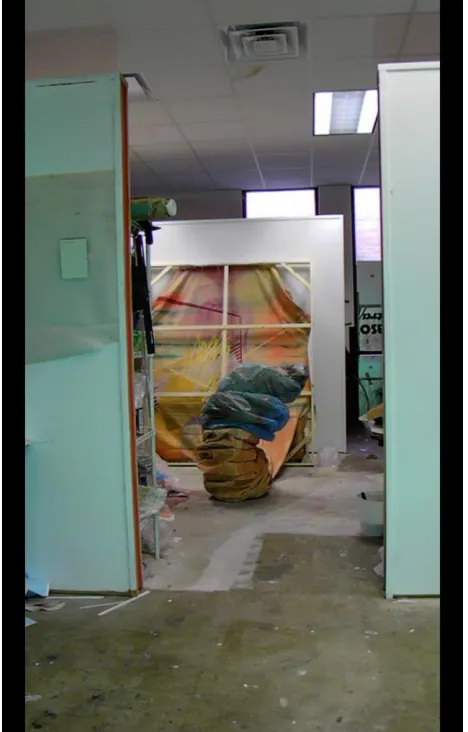
For my thesis show during January 2014 at the University of New Orleans Gallery, I was determined again to challenge the phallic nature of the Ding-A-Ling. With five hundred tentacle forms attached to a twelve foot by twelve foot wave of canvas, I created a large installation that consumed a corner of the gallery wall. I was interested in shifting the singular Ding-A-Ling form into a continuous fluid gesture of rhythmic color. I was going back to the original structure of the ball form and attempted to place it into a mode that was light and entertaining. I fabricated each Ding-A-Ling from muslin cotton, stuffed them with polyester fiber, and painted them with acrylic paint and glitter. I chose three color combinations that would give a bright and hyperreal lure to the installation. Underneath the heavy canvas I used stacked chairs and two-by-four stands to prop up the fabric
sculpture. I had welded three pencil rod cross bars to give support and add organic flow to the sculpture. The entirety of the installation piece was seven feet tall and about eight feet across. In the center of the mound I installed purple LED lights that splashed upward on the white wall and ceiling. I titled the piece Keep It Up (Figure 16).
Creating the sculptural piece Keep It Up paralleled my emotional and physical
15 Kate Linker, “Representation and sexuality,” Art After Modernism. Edited by Brain Wallis. (New Museum, New York, 1984), 392.
struggle. This project consumed numerous hours of repetitive processes and never-ending stuffing and painting. I felt like I was the machine, just barely keeping up with the
demands. In my mind I could see the final image of the sculpture and had moved on in my head. I was thinking about what I wanted to make next and how it was going to be bigger, better and different. I was just like a consumer looking at the latest product that would be more than what I have right now. Towards the end of installing Keep It Up, I felt that I was losing the battle; it wasn’t coming out how I had planned or set up like I had intended. It just hung there, a little stiff and a bit forced and droopy. It took four adults to maneuver the Ding-A-Ling mound and position it in a somewhat presentable pose. I had to walk away and say, “It is what it is.” At this moment of reflection I realized, yes! It is what it is! It is about the struggle, about my insecurities, about being on the verge of failing and wanting to give up. It was about not knowing how it was all going to come together or fall apart. It became more about letting go and putting a stop to reducing myself to a cultural identity or a gender. It was about letting go of painting and just about being honest, feeling exposed and confused. We somehow bring ourselves up and out to continue that next exhausting task, on to that next thing that will be better than before and we might just barely make it. You just have to say, keep It Up!
LEVITY AND PURPOSE
I orchestrate an illusionary world of symbolic meaning where reality can be set aside and absurdity embraced because problems can be solved by the touch of a Ding-A-Ling and a little bit of glitter. In my studio it is important for me to approach artmaking as a way of playing. Playing allows me to not be an artist but to summon my instincts and use my humor and mood to have some fun. It becomes about finding the most extreme
connections and making them fit together, like a mother Bengal Tiger feeding little piglets dressed up as tiger cubs. It has happened, and as odd as it may sound, there are those possibilities. I still feel attached to my curiosity of the inner child and that way of thinking. For me the magical elements of life still spin in my head and things really do have voices and personality. This is my way of bringing together the serious intent of play and of observing the humor with a sense of purpose and intellectual reflection.
Playing as a child works to build relationships to the outside world. As children gaze out into the world of life with virgin consciousness, they see how adults behave and how they interact. When a child enters it’s own space to play, the child is able to confront, question and act upon situations that investigate reality with a playful imagination. Imagination is what we use to embrace the intangible visions of our mind and to enact the possibility of becoming reality. Play can also be a way of confronting fear, like an
introduction to the things or situations that we don’t want to talk about or don’t want to put ourselves in. It makes me think of the game show called “Fear Factor” where
In my studio, when I am surrounded with my finds and material things that catch my eye, there is a moment of giddiness that takes over me. My fingers and hands start to glide across my table of goodies and I sing, “Eeny, meeny, miny, moe, catch a thingy by its toe!” I enjoy making myself laugh and being a little bit silly, whether it is sliding perfumed
deodorant bars onto barbeque skewers or making an altar for a momma and baby cockroach. It makes me giggle and that is where I like making. I will sometimes start by making small jokes to myself or bringing together remnants from a previous art piece that was just sitting on my studio table. I arrange them in a half ass, I don’t give a fuck, kind-of way, and then I laugh and move on. Eventually I will come back to the piece, which is either on the floor or stapled to my studio wall, and the piece just stares at me. The object is alive and I sense that it is trying to tell me something, so I listen. I see in between the form of the object and the space the object contains. This is where I see the thingness of objects. This is where I see the object’s energy. For example, when I walk into the dollar store and I’m drawn to a brightly colored basket, I like the shape and form of the basket. Inside the colorful basket there is a space, which can be filled with other things. The function of the basket is to hold things inside the basket’s center, but what if I put two baskets together and glued them shut? Is it still a basket or does it become something else? The space inside the basket still exists but it’s not acting like a basket should. The nature of the form has shifted its meaning as a art object.
An artist that I admire for her playful ability with objects is Jessica Stockholder. Her large-scale installations and colorful materials compose a new way of painting.
Stockholder’s combination of mass-produced objects with painted surfaces that sometimes extend beyond the gallery walls brings viewers to question the edges of where art lies. As Stockholder stacks, piles, squishes, and drapes, she collects common everyday junk and creates a framework in which to reexamine the discarded American commodity culture. There is a poetic beauty to Jessica Stockholder’s work that illuminates the overlooked corners and edges of nonfictional pieces of our consumer world. Art objects, when given the opportunity, can enter a white-walled gallery and become more than just a pile of used tennis balls or broken tables. Art objects tap into the complexities of the systems in which we live; they can bring humor, truth, or fear and influence our ways of thinking.
society and situations of reality.
In my video entitled Wall Chatter (Figure 17, 18) I was having fun stapling my green painted Ding-A-Lings inside of a wall that I had cut out. I had removed a section of the wall to keep a painting intact which included the surface of my studio wall. I was left with a four-foot by seven-foot cavity in my space.
Figure 17: Studio Wall Chatter, 2013, Figure 18: Studio Wall Chatter, close up acrylic, Ding-A-Lings, great stuff, styrofoam, Billy Bob teeth
My reaction to the interior wall was to put Ding-A-Lings in it. It needed something. As weeks went by, I would look over to the wall and see it begging for something more, so then I added two small painting blobs made out of great stuff and Billy Bob teeth. I
propped the two little painting blobs up with skewers and they began to jiggle around like bobbling heads. I continued to add to the scene and placed three mirrors on the floor, which reflected the Ding-A-Lings and painting blobs. Playing around, I tapped the painting blobs with a long wooden stick and watched them jiggle around. The humor and
photographed the wall and decided that a video recording would capture the gestures of the creatures best. Using blue floodlights, I accentuated the mood; the color cast an aqua haze onto the wall and created a science fiction effect. In the final video I was able to cut out all of the hand manipulations and I layered distorted laughter sounds that were synchronized to each painting blob’s bobble. During my thesis exhibition I projected the video sideways into a dark green frame painted onto the wall (Figure 19.) The horizontal placement of the video allowed me to line up a corner of the gallery to the vertical line (in the video) that split between the wall and the reflected wall from the mirrors. The mirrors mimic the way we view our reflection. I wanted the video to act as window in which to view the painting objects viewing its’ self while also confronting the viewer peering in. Using Lacan’s notion of the gaze I wanted to set the viewer into the arena of the objects’ thingness. Framing the installation I placed a faux wood linoleum mat into the corner of the wall. The play between the psychological, humorous laughter and the staged narration of the installation Wall Chatter reveals moments of chance and spontaneity in my studio.
The interplay of different materials and playful arrangements captures my aesthetic instinct. When I step back and look closely at the assemblages, I make connections as to why things come together or why they should be apart. I want to continue to use painting as a tool to construct my playful investigation of art and language. I use play and humor as a way of creating a new reality to reflect the functions, dysfunctions, and the unknown. My studio is the platform of possibilities; it is an open invitation to imagination and meaningful intellectual play that gives purpose to my work and to my visions. My art objects become physical manifestations of my message and reflections of my questions about the world around me.
CONCLUSION
“The things within and the things without” is a reflection of my time in the studio during my graduate studies at the University of New Orleans. Working through my questions of self-understanding and self-determination, I find it important to accept uncertainty; fear connects me to a truth. The truth of the moment can be caught up in the things which are not always present but fleeting. From manufactured dollar store items to handmade one-of-a-kind trinkets, objects contain a narrative that allow the owner to dictate its meaning. The art object is a point where I can reference the nature of
practicality or mystical qualities that are within. The material world and our consumer-driven reality are in a constant rotation. From government, social, and religious
institutions, objects have a place value within each system. The structures of our material world bring our physical, visual and verbal connections to work within specific modes of believing and living.
As an artist it is important to reassess and reassign the value structures that compose our reality. In my work I use various plastic materials to construct painterly backgrounds that bring analysis to our relationship with objects. I am attracted to the dynamic roles that objects and things can represent in our day-to-day lives and also how objects can contain mystical properties. It is within my studio that I probe the thing-like essence of objects. I do believe that objects are reflective and can reveal more than what is at face value. I believe that objects contain extensions of our inner voids, fears and hopes.
BIBLIOGRAPHY
Benjamin, Walter. Illuminations. (Edited and with an Introduction by Hannah Arendt). New York: Schocken Books, 1968.
Brown, Bill, ed. Things. Chicago: University of Chicago, 2004.
Ebony, David. “Anselm Reyle, Glittering Entropy,” Art in America, (April 2011) v.99 n4 (2011 04 01): p. 104-110
Hegel, Georg Wilhelm Friedrich. Hegel, on the Arts: Selections from G.W.F. Hegel’s Aesthetics, or the Philosophy of Fine Art. Trans. Henry Paolucci. Smyrna, DE: Griffon House, 2001.
Heywood, Ian and Sandywell, Berry. The Hand Book Of Visual Culture, New York: Berg Publishers, 2012
Horkheimer, Max and Adorno W., Theodor. Dialectic of Enlightenment. (Translated by John Cumming). New york: The Continuum Publishing Company, 1996.
Linker, Kate. “Representation and Sexuality.” Art After Modernism. Vol. 1. Boston: New Museum of Contemporary Art, 1984.
Macey, Dave. The Penguin Dictionary of Critical Theory. London: Penguin, 2001.