World Maritime University
The Maritime Commons: Digital Repository of the World
Maritime University
World Maritime University Dissertations
Dissertations
2000
Memorandums of understanding on port state
control : the need for a global MOU?
Dilip Mehrotra
World Maritime UniversityFollow this and additional works at:
http://commons.wmu.se/all_dissertations
Part of the
Admiralty Commons
This Dissertation is brought to you courtesy of Maritime Commons. Open Access items may be downloaded for non-commercial, fair use academic purposes. No items may be hosted on another server or web site without express written permission from the World Maritime University. For more
Recommended Citation
Mehrotra, Dilip, "Memorandums of understanding on port state control : the need for a global MOU?" (2000).World Maritime
University Dissertations. 319.
WORLD MARITIME UNIVERSITY
Malmö, Sweden
Memorandums of Understanding on Port State
Control:
The Need for a Global MOU?
By
DILIP MEHROTRA
India
A dissertation submitted to the World Maritime University in partial
fulfilment of the requirements for the award of the degree of
MASTER OF SCIENCE
In
MARITIME SAFETY AND ENVIRONMENTAL PROTECTION
(Operational)
2000
DEDICATION
DECLARATION
I certify that all the material in this dissertation that is not my own work has been identified, and that no material is included for which a degree has previously been confirmed on me.
The contents of this dissertation reflect my own personal views, and are not necessarily endorsed by the University.
……….. (Signature)
………. ( Date)
Supervised by:
Name : Jan-Åke Jönsson
Office: Associate Professor, Maritime Safety and Environment Protection World Maritime University
Assessor:
Name: Dr. P. K. Mukherjee
Office: Professor, Maritime Safety and Environment Protection
Institution : World Maritime University
Co-assessor:
Name: Tage Tirén
Office: Chief Surveyor ( Retired )
Acknowledgement
I wish to express my sincere gratitude to the Ministry of Surface Transport and the Directorate General of Shipping, Government of India, for providing me the opportunity to study at the World Maritime University.
Shri B.K. Biswas, Chief Surveyor with the Government of India, Director General of Shipping for having recommended my nomination.
The IMO-Norway Technical Co-operation Programme Fellowships for having sponsored my studies at WMU.
Shri Subimal Chakarborthy, Principal Officer, Mercantile Marine Department, Chennai District for all his help and guidance.
Shri B. Ganguli, Secretary, Indian Ocean Memorandum of Understanding, for granting me an interview and spending his valuable time during my visit to IMOU, Goa, India.
Shri N. P. Pai, Deputy Chief Mechanical Engineer, Cochin Port Trust, for having assisted my family as a guardian during my stay at Malmo.
My thanks to the staff of Mercantile Marine Department, Cochin for all the help rendered to my family, while I was at Malmo.
Professor P. Mukherjee, Course Professor for his guidance throughout the 17 months of study at WMU.
My sincere gratitude to those without whose help, completing this dissertation would not have been possible.
My appreciation and thanks to the Library Staff, especially to Susan and Cecilia, for all the help they rendered for the completion of my studies and dissertation.
I also express my sincere thanks to my wife Kirti for her encouragement and support and to my children Tarun and Pranav for bearing with me the separation during my stay at Malmo.
Abstracts
Title Memorandums of Understanding on port State control: Need for a Global MOU?
Degree MSc
The dissertation is a study of existence of substandard ships and the means to eradicate them, to ensure safety and protection of the environment. Further more the basis and development of co-operation in port State control in various region is discussed.
A brief look is taken on the circumstances leading to Indian Ocean Memorandum of Understanding (IOMOU), the flag State role in the implementation of IMO conventions and the role of classification societies in eradicating substandard ships.
Port State control is seen as a crucial step towards eradication of substandard ships. It acts as a safety net when the shipowner, classification society, flag State or insurer has in one way or another failed to do their job.
The adoption of Regional Co-operation arrangement - MOU’s- in port State control is the only alternative and most effective means available to eradicate substandard ships and to protect the lives of seafarers and the marine environment.
Paris MOU on port State control, adopted in 1982, was the result after the grounding of “Amoco Cadiz”, off the French Coast. It was the first port State control co-operation system in the world. Now there are seven Regional co-co-operations in place and more to be adopted.
standard of inspection. A study of various MOU’s on port State control has been carried out by the author.
The concluding chapters examine the prospects of a Global MOU on port State control with a co-operation between all the MOU’s, so as to have a complete data bank and exchange of information on substandard ships. Exchange of information is vital for keeping a track on a ship.
Table of Contents
Dedication ii
Declaration iii
Acknowledgements iv
Abstract vi
Table of Contents vii
List of Tables xi
List of Figures xii
List of Abbreviations xiii
1 Introduction 1
2 Circumstances leading to Indian Ocean MOU 8
2.1 Background 8
2.2 Functioning of various members 10
2.3 Jurisdiction 12
2.3.1 IMO Assembly Resolution pertaining to port State
Control 13
2.3.2 Relevant IMO Conventions 14
2.4 Present status of member States of Indian
Ocean region MOU 16
3 Present Status of port State control in India 19
3.1 Duties of flag State 19 .
3.2 Flag State implementation and port State control 21 3.3 Genuine link concept in the 1982 UNCLOS 27
3.5 Port State control in India 33
4 Relevant IMO Conventions and role of classification
societies in port State control 38
4.1 Origin of classification society 38
4.2 IACS commitment 40
4.3 Duties of classification societies 44 4.4 Consequences of accidents on classification societies 50
4.5 Relevant IMO Conventions 56
4.6 Effect of ISM on port State control 57
4.6.1 Purpose of the Code 58
5 The need for Harmonized Regional Procedures and
Global MOU on port State control 64
5.1 Why harmonized regional procedure? 64
5.1.1 Various existing MOU 73
5.1.2 Regions yet to establish MOU 86
5.1.3 Improvement in port State control after MOU´S 88 5.2 Role of IMO in Global MOU
on port State control 89
5.3 Elements for harmonised regional procedure 92 5.3.1 Training as per IMO model course 92 5.3.2 Regional MOU´S meetings 93 5.3.3 Qualified and sufficient port State control officers 94
5.4 Need for a Global MOU 94
6 Conclusions and Recommendations 96
Annexes
Annexe 1 Details of the IMO Conventions ratified by
the IOMOU member State 110
Annexe 2 Flags dominating the world shipping 113
Annexe 3 International Conventions and Protocols
ratified by India 114
Annexe 4 Procedure responding to port State control,
by IACS Members and Associates 117
Annexe 5 Port State Inspections per Classification Society 120
Annexe 6 ABS proposal for older ships inspection 122
Annexe 7 Asia Pacific Report on ISM 123
Annexe 8 Target factor details of Paris MOU 125
Annexe 9 Comparative table of different MOU’s 128
List Of Tables
Table 2 A Details of port State control inspection by
members of IOMOU 16
Table 3 A
Top 10 users of open registries in 1999
30
Table 3 B Total reported losses, 1979-98 32
Table3 C Details of Indian Vessels detained by various
port State control authorities 35
Table 3 D Port State and Flag State Inspection details 35
Table 3 E Flag of the vessels that had more
number of detentions 36
Table 4 A Tokyo MOU detentions as per 49
classification societies
List of Figures
Graph 5.1 Statistics of ships detained by Paris MOU 77
Graph 5.2 Contribution by Member States of Paris MOU 78
Graph 5.3 Number of deficiencies observed, Paris MOU 78
Graph 5.4 Inspection by Individual Members as
compared to the target of Paris MOU 79
Graph 5.5 Number of Individual ships inspected
by Paris MOU
79
Graph 5.6 Overview of port State control results 1994 to
1998,TokyoMOU 81
Graph 5.7 Number of ships with deficiencies, Tokyo MOU 81
Graph 5.8 Number of detentions, Tokyo MOU 82
List of Abbreviations
ABS American Bureau of Shipping
BV Bureau Veritas
DGS Directorate General of Shipping
EU European Union
GL Germanischer Lloyds
IACS International Association of Classification Societies. IMO International Maritime Organization
IOMOU The Indian Ocean Memorandum of Understanding on port State control
ISM International Safety Management Code LR Lloyd’s Register of Shipping
MOU Memorandum of Understanding
NK Nippon Keji Kyo Kon
RINA Registro Italiano Navale SOLAS Safety of Life at Sea
Tokyo MOU Tokyo Memorandum of Understanding (formally known as the Memorandum of Understanding on Port State Control in the Asia Pacific Region)
Chapter 1
Introduction
“As the new Millennium unfolds, we can be sure that the rate of change will accelerate and it would be brave- or perhaps reckless- to try to predict what shipping will look like in ten year’s time, let alone in fifty or a hundred. That it will be very different is certain. But I would expect that, above all, it will be safer, because shipping safety and environmental protection are higher on the political agenda and are IMO’S most important objective and will still be our priority in the near and distant future” (Mr. William A. O’ Neil).
Ships and the management of ships represent one of man's oldest economic enterprises. Today, approximately 35,000 ships of ocean going size ply the sea routes. What has changed with the time are the types of ships from sailing ships to modern high-speed crafts.
The International Maritime Organization (IMO) has developed many international conventions to protect the safety of the crew, cargo, and the environment. Maritime accidents still happen resulting in losses of lives, property, and damage to the marine environment due to, among other reasons, increased merchant fleet age, improper maintenance on board ships to reduce costs, increasing lack of experienced crew due to shortage of trained manpower and non-compliance with minimum international safety standard.
In the chain of responsibility the shipowner is ultimately responsible for the safety of his vessels at sea. He must ensure that ship and crew always comply with international convention regulations. The shipowner must make sure that the ship and equipment are maintained to keep the prescribed level for safety at sea.
to the classification society entrusted to carry out statutory inspections on behalf of a flag State.
To have an effective lasting solution to ship safety problems co-operation of all participants in the international shipping industry is required. The IMO, flag States, port States, classification societies, shipowners, managers, crews, insurance underwriters, charterers, ship financiers and cargo owners all need to participate to have safer ships and cleaner oceans.
Now the question arises, what happens if the shipowner and the flag State fail to do their job, as required, to ensure the safety of the vessel and the environment. There is no check on the vessel after the issuance of the certificates, till the time they are due for annual or renewal survey. In other words, there is no inspection on the vessel for nearly a period of twelve months.
The shipowner will not carry out any rectification of the defects, if it is not interfering with his day to day operation of the vessel. For example, if a lifeboat is lost at sea due to bad weather and the Master requests a new lifeboat, the owner will take action only if he is concerned about the safety of his employees. Otherwise he may delay till the next safety equipment survey falls due.
To overcome the problem of unseaworthy ships run by unscrupulous operators was one of the reasons why port State control came into existence. Even some of the classification societies and flag State Administrations failed to comply with the requirements of the International Maritime Conventions in one way or the other. Now the target of IMO is to cover the entire world with different Memoranda of Understanding (MOU) on port State control.
So we can say that port State control is to eliminate substandard ships from operating, and at the same time also to confirm that ships which are operating are complying with all international conventions. In the following chapters there is discussion on substandard ships. What is a substandard ship? A ship is regarded as substandard if the hull, accommodation, machinery or equipment for radio, life saving and fire fighting are below the standards required by the relevant convention. A ship is substandard if she is not in a possession of valid statutory certificates, or if she presents a threat to marine environment (Ulstrup).
“Substandard ship” has been defined in IMO Resolution A.787 (19) in Chapter 1.6.9 as “A ship whose hull, machinery, equipment or operational safety is substantially below the standards required by the relevant convention or whose crew is not in conformance with the safe manning document.”
To identify a ship, which does not meet the above definition as a substandard ship may sometimes be a difficult task for the port State control officer. A ship to be called a substandard ship has to be substantially below the standard required by the convention. The officer carrying out inspection has to be experienced, as he ultimately has to decide on the spot the action to be taken.
Initially very few States having major interests in shipping were involved in maritime safety and pollution prevention. For example, following the Court of Formal Investigation into the loss of the Titanic, representatives from just 13 States attended the international conference convened by the United Kingdom in London in 1913 (Cowley, 1989a).
The tendency of European and North American shipowner’s to flag out their ships to open registers accelerated toward the end of 1970. As the foreign ships safety standard started to decline the Hague Memorandum of Understanding was established in 1978 by eight North Sea States Belgium, Denmark, France, Federal Republic of Germany, Netherlands, Norway, Sweden and the United Kingdom. The six monthly frequency of information exchange was too low to be of any result. In January 1982 the Hague Memorandum was superseded by the Paris MOU, with the additional participation of Finland, Greece, Ireland, Italy, Portugal and Spain. In 1994, Canada became a full member (Cowley, 1995b).
Resolution A. 682(17), entitled “Regional Co-operation in the control of Ships and Discharges” recognizes the important contribution to maritime safety and pollution prevention made through regional co-operation. The resolution invites Governments to consider concluding regional agreements on the application of port State control measures in co-operation with IMO.
It can thus be said that the Paris MOU was the beginning of the era of Regional MOU’s on port State control. The last one signed on between States is known as the Black Sea MOU. After the Paris MOU came the Tokyo MOU, formerly known as the MOU on port State control in the Asia pacific region, and the last two MOU’s signed are the West and Central Africa Region signed on 22nd October 1999 and Black Sea
MOU signed on 7th April 2000. Remaining to be signed is the Persian Gulf Region.
But will this solve the ongoing problem of substandard ships from plying? Will MOU’s be sufficient or would we require more control and monitoring of the substandard ships.
him, it is the experience which will be a tool for him to carry out port State inspection.
The port States cannot ignore the shipping industries and shipowner’s concern with regard to different standards of port States control inspections and a lack of harmony. The issue was raised at a meeting of the Asian Shipowner’s forum (ASF) safe Navigation meeting held in Singapore. A communiqué issued by the Committee highlighted the owners concern about the rising number of inconsistent and non-uniform inspection standards adopted by port State control (Bousen, 1999a).
Port State control inspection is different from flag State inspection. The flag State surveyor or recognized organizations carry out inspection for the issuance of statutory certificates. That survey can be carried out at a time decided by the owner and surveyor whereas the port State has to be completed during the call of the vessel at the port. The main difference between the two, is that the first one is on owner’s request and the latter, i.e. the port State, is not a statutory requirement for the owner, but a check on his vessel by the port States. That is one of the reasons why the port State control officer is not always a welcome guest on board ship.
What the Paris MOU basically did was that 14 member States joined their forces to make the inspection more stringent and deter the shipowner of an unseaworthy ship from sailing his vessel. Initially shipowners and developing states for various reasons did not take it in a good spirit.
It is one of the weak links between the flag State, classification society, owner or others, which must have been responsible for such a drastic disaster in maritime history. Questions are being raised as to what the port States are doing? But port State control is not responsible for the seaworthiness of the vessel as such! It’s a spot check, because a port State control officer is not expected to check the construction defects, especially not inside the tanks, unless there is some evidence of structural failure. How can a port State control officer go inside the tanks of the tanker without gas freeing, etc? The question should be raised with the International Association of Classification Societies (IACS) and the flag State. It’s like doing a post-mortem now. Will we learn any lesson from this? May be for a few months, charterers might be careful in chartering old vessels and port State control may be more vigilant, but is this a solution?
No doubt the port State has taken the leading role in eliminating substandard ships, but it should not be taken as the ultimate solution. The cost of implementing port State control is one of the factors, which comes as a hindrance for the developing States. The other area, which has been discussed in the maritime industry, is about the different standards of port State inspection. To achieve a harmonized level of inspection through out the Globe, what is required is a co-operation between all the MOU’s. To achieve co-operation and co-ordination between different port State regimes, a global network of information exchange is essential.
Inspite of stringent controls by classification societies, flag States, port State control, insurers and brokers, substandard ships do exist. The report of various MOU’s and the US Coast Guard confirms this. Port State control is no substitute for effective flag State control and, on its own, unlikely to eliminate substandard ships. What effective port State control can do is to prevent some loss of life and may reduce environmental pollution.
substandard ships? The infrastructure is there; it is not a difficult task to identify the sub-standard ships as information exists in some form or another. The main problem appears to be that the information is not available to all concerned.
The port State control regime has achieved substantially in eradicating substandard ships since the inception of the Paris MOU. The other advantage is that shipping companies hesitate in taking a chance to allow their ships to operate in substandard condition. In the pre port State control days, owners were not as particular about the requirements of the ship. But now they are aware that the ship may be detained and it is an expensive affair if his ship is detained. He would rather comply with the requirements then have his ship detained.
Now we have eight MOU’s in different regions. But just having MOU’s is not going to solve the problem. Exchange of information among all the MOU’s will be far more beneficial in eradicating substandard ships, so as to restrict them from operating in any of the regions. If we take a look at other regions, we see that the USA introduced stringent port State control long before the MOU came into being. The lack of uniformity in the implementation of port State control has been a topic for discussion since the first port State control inspection began in the early 1980.
Chapter 2
Circumstances leading to Indian Ocean MOU
“There is no doubt in my mind that the emphasis should be on the implementation of existing standards rather then on the development of new measures. There is little point in piling more regulations on top of those, which are already in place but are being ignored, by some sections of the industry” (Mr. William A. O’ Neil).
2.1 Background
A prominent feature of current policy in the IMO is its aggressive emphasis on the implementation of international conventions (Payoyo). With a view to eradicating substandard ships, the Assembly of the IMO adopted in November, 1991 Resolution A.682 (17) “Regional Co-operation in the Control of Ships and Discharges” to propose the establishment of port State control regimes in the various regions of the world following the pattern adopted by the European region through the Paris Memorandum of Understanding in 1982 (Plaza, 1999a).
The concept of having the IOMOU was mooted on the basis of a review of adequacy of the regions maritime safety infrastructure, as well as requirements in accordance with the I M O, carried out during the period August 1997 to September 1997. It was felt that a regional co-operation for the States on the Indian Ocean rim, would be the solution to control the plying of sub-standard ships in the region.
French coast should now be an example for all concerned, so that no substandard ships are allowed to operate. The case of tanker Erika will be discussed in more detail in later chapters.
A brief report on IOMOU. (Source: Secretariat, IOMOU)
Delegations from Australia, Bangladesh, Djibouti, Eritrea, Ethiopia, India, Kenya, Maldives, Mauritius, Mozambique, Myanmar, Oman, Seychelles, Singapore, South Africa, Sri Lanka, Tanzania and Yemen attended the first preparatory meeting on the developing of flag and port State capabilities in the Indian ocean rim. The meeting was held from 13th to 17th October, 1997, at Mumbai, India at the invitation
of the Secretary General of the IMO, and following the generous offer of the Government of India, to host the meeting.
The second preparatory and signatory meeting was held between 1st and 5th June
1998, at Pretoria, South Africa, hosted by the Government of South Africa. A draft Memorandum was drawn at this meeting, which was subsequently finalized. In addition to the countries mentioned earlier, Sudan also participated in this meeting.
The MOU on port State control for the Indian Ocean, was signed, subject to acceptance, by the representatives of Djibouti, Eritrea, Ethiopia, India, Iran, Kenya, Maldives, Mauritius, Mozambique, Seychelles, South Africa, Sri Lanka, Sudan, Tanzania and Yemen.
The Memorandum was kept open for signature, at the headquarters of the Secretariat i.e. Goa, India, from 5th June 1998 to 22nd January 1999. During this period of time, the following countries signed the Memorandum of Understanding:
Australia
Sudan Tanzania
India
Eritrea
South Africa
The Mauritius Administration acceded to the MOU on 15th October 1999, and the
Sri Lanka Administration on 8th November. The other countries are yet to convey
compared to the other five MOU’s, that are already in force and the seventh MOU, for West and Central Africa, has been recently signed.
2.2 Functioning of various members
Initially eighteen States had participated in the meetings, but later Singapore, Malaysia, Thailand and Philippines decided to keep away from the IOMOU as they had already joined Asia Pacific Memorandum of Understanding. At present only eight States are full-fledged members namely:
Australia Sri Lank India Sudan
Mauritius Tanzania Eritrea South Africa
The reasons for not acceding to the MOU may be mainly because of economic considerations. Eighteen States are signatory to the Memorandum, the majority of them do not have strong maritime administrations. As a result, port State control is at its infancy in most of the signatory member States. However, most of the States realizing the need for strong port State control have started appointing persons with seafaring background and training in port State control.
During the discussion with the Secretary of IOMOU, he informed that they are planning to have training for port State control officers, belonging to the member States. IOMOU is also developing a manual for the port State control officers.
By having their port State control officers trained, in the same way all member States will have a harmonized system of port State control through out the region. It is understood that even the MOU’s are trying to have a harmonized approach in port State control inspection. Mutual cooperation and interaction between IOMOU and Tokyo MOU is existing in the same manner as is being done in Paris and Tokyo MOU. The advantage of this will be that right from the beginning the approach will be in a harmonized manner.
Chairman of the IOMOU in his address during the second meeting also showed his disappointment at the lack of commitment by the member States. He further stated that he could only surmise that other more serious commitments have kept the representatives away or that a lack of funding preludes their attending this meeting.
No doubt, member States of IOMOU are not amongst the richest in the world, but the financial problem should not be a hindrance in implementing the port State control in the region. The whole concept of regional MOU’s will not work if all member States do not participate in the functioning of the MOU.
However it is not the only MOU where member States may be facing financial problems as we see from the report of Secretary General of the maritime organization for West and Central Africa, citing an example of how dire the lack of funding has become, doubts have been raised whether the MOU on port State control, will take effect. Why? Because the member States are too poor to pay even their IMO dues, so the entire process could become effectively invalid (“West African Shipping---”).
The Secretariat of the IOMOU since the conclusion of the Second Preparatory meeting at Pretoria, was operational, on an interim basis from the Directorate General of Shipping (DGS), Mumbai, India. Secretariat and the Interim Information center started functioning from its own premises at Goa, India from 1st June 1999. At
present the Secretariat operates on an interim basis and it has to move from interim to full in April 2001.
2.3 Jurisdiction
The blue print for port State control is contained in the United Nations Convention on the Law of the Sea (UNCLOS) in respect of Safety and Pollution. UNCLOS Part XII Articles 218, 226,are the main provisions and other articles are 217, 222, 223,224, 225, 226, and 228. Article 25, paragraph 2, provides that the Coastal State has the right, in the case of ships proceeding to internal waters or a call at a port facility outside internal waters, to take the necessary measures to prevent any breach of the conditions to which admissions to internal water is subject.
Article 211 Paragraph 3, of the convention provides the basis for the establishment by a group of States of particular requirements for the prevention, reduction and control of pollution of the marine environment as a condition for the entry of foreign vessels into their ports or internal waters (Report on UNCLOS to UN).
Article 218 deals with investigation and proceedings in respect of any discharge from the vessel out side the internal waters territorial sea or exclusive economic zone of that State in violation of applicable international rules and standards established through the competent international organization. However Article 218 imposes some restriction on port State jurisdiction. It states that no proceedings shall be initiated in respect of a discharge violation in the internal waters, territorial sea or exclusive economic zone of another State unless requested by that State. States may undertake an investigation when a vessel is voluntarily within a port or at an offshore terminal of a State, where the evidence so warrants, and also institute proceedings if any discharge has taken place from the vessel.
Article 218 mainly deals with discharge violation, and port State jurisdiction is limited to that. Article 220 deals with the enforcement by the Coastal State and authorizes the port State to investigate proceedings in respect of violation of applicable laws and regulations by the foreign vessels, which are voluntarily within a port or offshore terminal.
States pursuant to the regional MOU’s and in the case of European Community States, by reasons of the entry into force of the European Commission directive. In the future, such linkage between the LOS Convention and the MOU’s may evolve, into a mutually beneficial relationship between the Regional and Global regime” (Keselji).
2.3.1 IMO Assembly Resolution pertaining to port State control
1. Resolution A. 321(IX), Procedure for the Control of ships Relating to SOLAS 60 and 1966 LL Convention adopted by IMO during its ninth session in 1975.
2. Resolution A. 390(X), Procedure for the Control of ships relating to the SOLAS 60 and LL1966 Conventions. This convention was adopted on 14th Nov.1977.
3. Resolution A. 391(X), Procedure for the Control of discharges relating to oil pollution, 1954 as amended in 1962and 1969, adopted during the tenth session on 14th Nov.77.
4. Resolution A. 466(XII), Procedure for the Control of Ships relating to the application. Provisions of the SOLAS and 1966 ILL conventions adopted during the 12th session on Nov.1981.
5. Resolution A. 481(XII), Principles of Safe Manning, adopted during the 12th
session on Nov.1981.Resolution A. 542(XIII), Procedure for the Control of Ships and Discharges relating to the annex 1 of MARPOL 73/78 adopted during the 13th session on 17th Nov.1983 as a substitute to Resolution A. 392(X).
6. Resolution A. 542(XIII), Procedure for the Control of Ships and Discharges relating to the annex 1 of Marpol 73/78 adopted during the 13th session on 17th
Nov.1983 as a substitute to Resolution A. 392(X).
7. Resolution A. 597(XV), Amendments to Resolution A. 466(XII) adopted during the 15th session on November 1987.
8. Resolution A. 682(17), Regional Co-operation in the control of ships and discharges.
9. Resolution A. 742(18), Procedure for the Control of Operational requirements related to the Safety of Ship and Pollution Prevention.
10. Resolution A. 787(19), Procedures for port States control adopted at the 19th
11. Resolution A. 882(21), Amendments to the procedures for the port State control, updating the 1995 resolution adopted at 21st assembly, in November 1999.
12. MSC/Cir.890- MEPC /Cir.354 on Interim guidelines for port State control related to the ISM Code.
13. MEPC 26(23), Procedure for the Control of Ships and discharge under Annex II of Marpol 73 /78.
2.3.2 Relevant IMO Conventions
The International Convention of Safety of life at Sea (SOLAS)
The earliest international convention on safety of life at sea was drafted in 1929 before IMO came into existence, and has since been revised in 1948, 1960 and 1974. SOLAS 1974 was also amended in 1978 by a protocol and entered into force from May 1981.
Regulation 19, of Chapter1, incorporates the right and obligation of port States to verify that certificates on board are valid and that they are issued under provision. Regulation 4 of chapter XI deals with operational requirements in respect of the safety of ships, when there are clear grounds for believing that the master or crews are not familiar with essential shipboard procedures relating to the safety of ships.
Article 1(3) of the 1988 Protocol relating to the SOLAS deals with ships of non-parties to the convention and the Protocol. It states that the non-parties to the present Protocol shall apply the requirements of the Convention and the present Protocol as may be necessary to ensure that no more favorable treatment is given to ships of non-parties to the convention. That is, port State control is not only limited to ships flying the flag of contracting parties.
The International Convention on Standard of Training Certificate and Watch keeping for Seafarers (STCW)
The STCW convention was the first to establish basic requirements on training, certification and watch keeping for seafarers on an international level. Article X, Regulation I/4; STCW Code sections A-I/4, and Section B-I/4 incorporates the rights and obligation for the control. It has been confirmed that more than 80% of the accidents takes place due to human error.
International Convention for the Prevention of Pollution from ships
MARPOL 73/78; Article 5(2) and (3), Article 6(2), (3), (4) and (5), provides the right and obligation for the port States to carry out inspections. It also contains provisions concerning inspections of ships at ports to verify whether they have discharged any harmful substances in contravention of the provisions of the Convention.
Annex I, Regulation 8 A; Annex II, Regulation 15; Annex III, Regulation 8; Annex V, Regulation 8 deals with the control. Details are given in each regulation as to the requirement for control. For example, Regulation 8 of Annex II requires Parties to MARPOL 73/78 to appoint or authorize surveyors for the purpose of implementing the regulation.
International Convention on Load Line
Article 21, is basically to ensure that a ship is not loaded beyond the limits allowed by the certificate, and that the Load Line corresponds with the certificate. It also contains provision to confirm that no alterations are made after the issue of the certificate.
International Convention on Tonnage measurement
ILO 147
Ratifying States to exercise control on foreign ships at its ports, even if the flag State has not ratified and shall relate to Minimum Age, Medical Examination, Accommodation of Crew, Food and Catering, Officers Competency Certificates and safety on board ships.
2.4 Present status of member States of IOMOU
The committee during their first meeting of IOMOU had agreed to the work program for the first year of operation, as follows:
• preparation of a manual for port State control officers;
• publishing of details of training courses for port State control officers; • approaching the Tokyo MOU for assistance with regard to the IT system; • publishing statistics on port State control inspections, on a monthly basis;
• publishing of a quarterly newsletter, informing members of the latest developments;
• publishing an annual report after the second Committee meeting.
The progress made is enumerated below.
The Secretariat has put up a proposal for the signatory and member States of IOMOU to nominate port State control officers for training, but except for Tanzania, no other Authorities responded.
How can we except a MOU to achieve its goal if all the member States do not participate in all the related activities. Is it just an obligation on part of a State to be a member of one of the MOU on port State control? Or is it that by just being a member, all obligations towards eradicating substandard ships are over? These are the matters, which require attention of all concerned, if we have to achieve our goal of eradicating substandard ships to operate in the Ocean.
Table 2A- Details of port State control inspection by IOMOU Members.
Period of inspection: June 1999 to October 1999.
Name of Administration No. of Shipsinspected No. of ShipsDetained DeficienciesNo.of for detained
ships
Australian Maritime Safety Authority 896 48 96
South African Maritime Authority 197 8 31
Director General of Shipping (India) 117 67 920
Maritime Administration Directorate
(Sudan) Not available 14 16
Source: Secretariat –IOMOU
As seen from the above statistics which is only for a period of five months, the number of ships detained are 137 out of the total 1210 inspected by different Administrations, which comes to 11%. Definitely this figure will increase, when the member States are better equipped with trained officers and other facilities. These ships would have been operating if there were no port State control or rather in much worse condition, as there was no fear of being detained, as these deficiencies were when the operator was aware that port State control may inspect the vessel.
Reasons for the above may be either that the shipowner or operator is taking a calculated risk, like a gamble. If he escapes he has made his money or he feels even if the vessel is detained, he has made his voyage and at the same time the money.
From the above data even though it is only for a very short period it appears that the vessels calling at some ports are either complying with all regulations and are in good condition or the port State control inspection standard is not the same in all the regions, going by the figure of number of ships detained and deficiencies observed by those authorities.
As stated earlier the IOMOU secretariat has prepared the draft manual and it was submitted during the second meeting of the committee. After some debate it was agreed that a task team be established, who will finalize the manual, which will be submitted for approval during the third committee meeting. The task team would be led by the Secretariat and would comprise a representative from Australia, Iran, Mauritius and South Africa.
It was also agreed by the representatives of the member States to adopt the style of manual as of the Paris MOU, they having an experience of 15 years. This manual will be an effective tool for the port State control officers and will be guidance for them, regarding the inspection and to have a harmonized system of conducting port State control in the region.
The IOMOU has been granted a observer status in the Tokyo MOU, which will help in having a closer relation ship between the two MOU’S. The IOMOU is still in the infancy stage; the information system and web site is still to be installed, and groundwork for the same is being done, to have it at the earliest.
Details of the IMO conventions ratified by the member States is listed in Annex-1.
Some of the States have not even ratified the important conventions dealing with the safety and environment protection. For such States to implement the same on other flagships visiting their ports, will not be possible.
Chapter 3
Present Status of port State control in India
"Implementation, according to the dictionary, means putting something into effect. Making sure that it gets done. And as far as IMO'S twin targets of Safer shipping and Cleaner oceans are concerned, implementation is the key to success. It is a responsibility that no one in shipping can evade"(Mr. William A. O' Neil).
3.1 Duties of Flag States
A convention before it becomes binding upon States, which have ratified, has to be formally accepted by individual States. The adoption of a convention is only the first step of a long process before the convention comes into force.
“If the State so fails to implement the convention, it is nevertheless subject to it vis a vis other State parties, but it cannot enforce the convention against them, unless that convention becomes part of the law of the land by whatever legal process is applicable in that State’s jurisdiction. The implementation of an international convention to which a State has become a party is therefore an essential step without which the State Party cannot benefit insofar as the application of that law within its jurisdiction is concerned” (Mukherjee).
It is the duty of the flag State to implement the new regulations after they are ratified and accepted and legislated in their national laws. Without the co-operation of the flag States, it is next to impossible to implement the IMO Conventions. Thus emerges the vital need for the assumption of regulatory responsibilities by the flag States.
“The need for the shipping industry to learn from its mistakes has always been recognized by IMO. The first convention to be adopted by IMO after it came into being in 1959 was the 1960 version of SOLAS” (O’ Neil 1999a).
Substandard ships are not due to the lack of international standards, but due to the lack of enforcement of existing standard. In signing major IMO conventions, a flag State not only takes the responsibility for enforcing those aboard its ships, but also it gets the authority to inspect the foreign vessels visiting its ports.
As stated by United Kingdom’s Minister of Shipping, “The IMO, the European Commission and other responsible Administration do not believe that regulations offers the best prospect of eliminating substandard ships”. Basically she said, there are sufficient regulations but the challenge is to ensure the uniform application of them uniformly (“Flag State responsibility---“).
Regulation 21 of SOLAS Chapter 1 states "Each Administration undertakes to conduct an investigation of any casualty occurring to any of its ships subject to the provision of the present Convention when it judges that such an investigation may assist in determining what changes in the present regulations might be desirable".
The findings of the fire on board the Scandinavian Star in 1990, revealed many factors, among which not all were covered by the regulations, but which were to a large extent connected to qualifications, experience and attitudes towards the operation of passenger ships. The official investigation carried out after the disaster concluded that the following factors played a significant role (Christensen).
• the master had not taken the necessary action to train the crew in fire fighting and evacuation, and the ship was not properly prepared for the intended service; • the qualification of the crew with regard to safety were low;
• communication between the crew members was hindered by the lack of a common language, and the sound level of the alarms and loudspeakers was low and not able to warn the passengers of any danger;
• the arrangements of staircases and the corridors, where the cabins for passengers were situated, was complicated, making it difficult for the passengers to find their way around the ship;
• the visual signposts were difficult to understand and located in non visual positions, previous inspection of the ship failed to find certain faults; and
• the fire protection of the ship was not satisfactory, even if the present regulations were complied with.
What we learn from the above report, is that having regulations is not sufficient. The crew has to act at the time of emergencies, for which continuous training is required. The flag State should ensure that all crews are well trained to act during emergencies. Now through the ISM Code a lot can be achieved, if done in a proper way and with a good intention. If only paper work is done to comply with the ISM Code and to satisfy the Auditors, then the whole concept of ISM will be lost.
3.2 Flag State implementation and port State control
must be considered as an investment rather than as a cost factor to the industry, because, undoubtedly, safety pays” (Plaza, 1999a).
For identifying the measures necessary to ensure effective and consistent global implementation of IMO instruments, a new IMO Sub-Committee on Flag State Implementation (FSI) was established in 1992.
The sub-committee was assigned the following terms of reference:
• to identify the range of the flag State obligations emanating from the IMO treaty instruments;
• to assess the current level of implementation of IMO instruments by flag States; • to identify those areas where flag States have difficulty in fully implementing IMO
instruments;
• to assess problems in the involvement of the States party to the IMO instruments in their capacity as port States, Coastal States and countries training and certifying officers and crews;
• to identify the reasons for the difficulties identified in the above two; • to make proposals to assist parties;
• from its inception the FSI Sub-Committee dealt with a number of issues related to port States responsibilities, resulting in the development of various guidelines and recommendations, either adopted as resolutions or circulated by means of MSC/MEPC or FSI circulars(Plaza ,1999a).
Some of the important / and /or recommended /instruments developed by the Sub-Committee are listed below:
• guidelines for the authorization of organization acting on behalf of the Administration;
• model agreement for the authorization of organization acting on behalf of the Administration;
• guidelines to assist flag States in the implementation of IMO instruments,
• specifications for the survey and certification of functions of recognized organizations;
Self-• criteria for the self-assessment of flag state performance.
FSI sub-committee has laid down clear guidelines for various activities being carried out by them. If it is followed the flag States should not have any difficulties in implementing the conventions. But as seen the level of enforcement varies greatly from Administration to Administration, which is one of the reason for having regional MOU’s for port State control. Work of the FSI sub-committee on port State control will be discussed in later Chapters.
It is sometimes argued that flag State control is being superseded by port State control. Indeed it is sometimes argued that if the flag States won’t do the job the port States must (Douglas).
But in reality it is confusing, as to how a flag State can carry out port State control when the ships flying its flag are not up to the standard and being detained. How can that flag State be relied on for the standard of inspection as port State.
As we see from the past maritime disasters starting from the Titanic to the Exxon Valdez, new regulations were made to avoid reccurrence of such casualties. In 1967 the tanker Torrey Canyon ran aground off the West Coast of England, resulting in the world's first major oil pollution. New conventions came after the disaster, as there was a complete failure of measures to contain the spill and to clean up the pollution that resulted and the amount of cost involved.
The most important initiatives by States and the IMO have been prompted by disasters. The Torrey Canyon led to several conventions dealing with legal issues, including liability and compensations. The most important convention was the Prevention of Pollution from Ships (MARPOL) 1973. Later on a series of tanker accidents off the coast of the United States led to the adoption of the 1978 Protocol to MARPOL and to SOLAS.
speech to the general council of the Baltic and the International Council in May 1999, "public opinion forces governments into action and it is impossible to avoid this reaction. How could the British or Swedish authorities hope to convince the public that ro-ro’s were safe when the Herald of Free Enterprise and Estonia had just sunk? How could the United States tell people that tankers were good for them when their television screens were filled with images of the Exxon Valdez surrounded by dead sea birds covered with oil"(O’ Neil, 1999a).
The most recent case of the last century, the tanker ‘Erika’ is an example. Post mortem of the case is still going on, with each concerned party blaming the other.
A statement from the chief executive of ABS is reproduced, which states as follows: “When a vessel such as Erika is able to operate, it is a result of a cumulative failure of the entire system. The disastrous consequences of that casualty rest with all those who participated. If any one of those participants had raised objection to the continued operation of the Erika, the vessel would have ended up in the scrap yard where it obviously belonged” (“ABS proposes tougher--- “)
From the above statement it is quite clear, that somewhere in the line of operation, there was a weak link, which allowed the continued operation of ships like Erika. Even the port State control failed to stop the vessel from operation.
The compliance of IMO various Conventions and Protocols depends on the implementation It is the responsibility of the flag States to legislate the various treaties and conventions to which they are.party. Even most of the IMO conventions are not ratified by the member States.
“Ratification involves both the privileges and obligation but before ratifying, a country must be in a position to meet the requirements of the Convention as included in its Articles and Regulations” (Cowleya). In practice it does not happen. It takes years by
legislated cannot enforce them on their flags and foreign flags visiting their ports. In other words they are not able to carry out port State control.
IMO only sets the standards, providing a basis for legislation, but cannot execute legally binding forces of the convention on any party States. IMO has relied on the flag Administrations who are members to provide domestic legislation and oversight of the established requirements for vessels flying their flags as part of their duties. Member States must incorporate the provisions of a convention into laws and regulations. It is their role to play in implementing IMO standards and contribution in eradicating substandard ships from their region.
Many States are not well equipped, they lack the necessary domestic legislation to enforce the treaty. There are no trained surveyors to carry out inspections or facilities to enable compliance with the regulations. In the opinion of the author the lack of trained manpower and funds are the main reasons for not having an established Maritime Administration in some of the States.
Flag States may delegate to classification societies, to carry out necessary inspections and issuance of the statutory certificates, but as per SOLAS 74 as amended, the responsibility lies with the flag States. Once the laws and regulations are established, they must be enforced, and this is up to the individual flag States for enforcing the same. Flag States and classification societies are expected to meet certain basic criteria’s concerning their ability and commitment to comply with the regulations in various conventions.
For safe manning of the ships, the flag States are to comply with the following regulations.
1.The flag State is primarily responsible for setting and monitoring of safety standards, as per IMO SOLAS Convention (1974) Chapter V, Regulation 13:
• the contracting governments undertake, each for its national ships, to maintain or, if it is necessary, to adopt measures for the purpose of ensuring that, from the point of view of safety of life at sea, all ships will be sufficiently and efficiently manned;
• every ship to which Chapter 1 of this convention applies shall be provided with an appropriate Safe manning document or equivalent, issued by the Administration as evidence of the minimum safe manning considered necessary to comply with, the provision of paragraph ‘a’ of regulation 13.
2. United Nations Convention on the Law of the Sea 1982: Article 94(3)(b) states that every State shall take measures for ships flying its flag as are necessary to ensure safety at sea with regard, to the manning of ships, to labour conditions and the training of crews, taking into account the applicable international instruments.
3. ILO Merchant Shipping (Minimum Standard) Convention (1976): No.147, Article 2 (e) states that each member which ratifies this convention undertakes to ensure that seafarers employed on ships registered in its territory are properly qualified or trained for the duties for which they are engaged.
Further the role of the flag State is clearly defined, it states that flag States should have laws or regulations for:
• safety standards, including standards for competency, hours of work and manning;
• sound security measures;
• condition of employment and living arrangements.
• on ships registered in its territory,
• by seafarers of its nationality employed on foreign ships.
The flag States have the ultimate responsibility for ensuring: • living and working condition of seafarers.
• safe manning on ships registered with the flag; • competence of its seafarers;
For achieving the above, the following are essential pre-requisites: • an adequate and competent Maritime Safety Administration ; • international regulations included in the national legislation.
Many flag States lack the resources and /or expertise to fulfil the obligations, and therefore delegate survey and inspection responsibilities to classification societies or other organizations. Consequently some ships never see a flag State surveyor on board. With such a scenario, in various maritime circles, one gets an impression that port State control is the overall mechanism for ship safety and pollution prevention.
3.3 Genuine link concept in the 1982 UNCLOS
Registration is the administrative mechanism by which a State confers its nationality upon a ship. The genuine link concept is referred to in article 91 (1) of UNCLOS in the following words, "Every State shall fix the conditions for the grant of its nationality to ships, for the registration of ships in its territory, and for the rights to fly its flag. Ships have the nationality of the State of whose flag they are entitled to fly. There must exist a genuine link between the State and the ship".
Article 94 of UNCLOS emphasizes that every State, apart from taking measures for ensuring safety at sea for ships flying its flag with respect to construction, equipment and seaworthiness must also maintain a register of ships containing the names and particulars of ships flying its flag.
No longer, in most cases, does the nationality of a ship’s owner have anything to do with the flag the ship flies. Most of the ocean going vessels owned by Americans is registered abroad, in open registries, in places like Panama and Liberia (Morris).
Sometimes it even becomes difficult to trace the owner of a ship, in the case of Erika, a French commission of inquiry into the sinking of the vessel has condemned as “unacceptable" the opaqueness of the ownership of the tanker, admitting that it had so far been unable to trace the ultimate owners. (Spurrier, 2000a).
The real owner, who is behind the scene, sometimes even goes scot-free after the incident without being punished. It becomes difficult to fix responsibilities and claim the compensation if the same is insufficient to meet the claim from the Oil Pollution Compensation fund.
Numerous loop holes and weak links surface only after the major accident takes place, and the concerned authority starts to react, so as to avoid more incidents of the same nature. But the scrupulous operators find ways to keep their substandard ships afloat. After the Erika incident the French transport minister stated that the practice of chartering oil tankers under flags of convenience should be outlawed. (Spurrier,2000b). Concerned parties responsible for the safety of the vessel viz. flag
States, port States, IACS and others, are now tightening all the loose ends.
Intertanko has launched an initiative of one on one meeting with flag States to stress the need for improving quality. The exercise could in turn, see the creation of a “preferred flag list” as a criterion for Intertanko membership (Joshi).
3.4 Open Registries
As the Rochdale report said in 1970, " it is not easy to provide a simple
definition of flag of convenience, which effectively encompasses their
significance and characteristics” The report defined such flags as follows:
• the country of registry allows ownership and/or control of its merchant vessels by non-citizens;
• access to the registry is easy; a ship may usually be registered at a consulate; • equally important, transfer from the registry at the owner’s option is not
restricted;
• taxes on the income from the ships are not levied locally, or are very low. A registry fee and an annual fee, based on tonnage, are normally the only charges made;
• the country of registry has small power with no national requirements under any foreseeable circumstances for all the shipping registered, but receipts from very small charges on a large tonnage may however produce a substantial effect on its national income and balance of payment,
• manning of ship by non-nationals is freely permitted;
• the country of registry has neither the power nor the Administration machinery to impose any government or international regulation, nor has it the inclination to
control the shipping companies themselves (
Kasoulides).
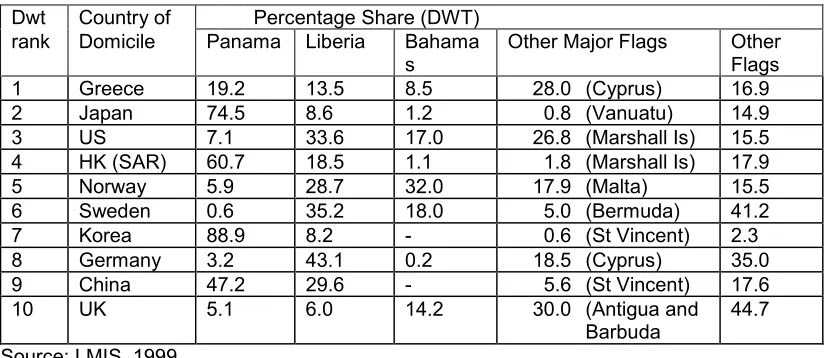
Open registries or flags of convenience account for almost 53 percent of the world fleet by total dead weight tonnage for ships of 1000 gt. and over or a little over 40 percent of the world fleet by number of ships. Of this share, the five ‘majors’ Panama, Liberia, Malta, Bahamas and Cyprus account for about 83 percent (Hawkins). Flags that dominate world shipping is detailed in Annex 2, among top ten are major open registries.
his ship and some shipowners who only believe in trading substandard ships, make use of these registries
Table 3 A: Top 10 users of open registries in 1999 (ships of 1000 gt and over)
Dwt Country of Percentage Share (DWT) rank Domicile Panama Liberia Bahama
s Other Major Flags OtherFlags
1 Greece 19.2 13.5 8.5 28.0 (Cyprus) 16.9
2 Japan 74.5 8.6 1.2 0.8 (Vanuatu) 14.9
3 US 7.1 33.6 17.0 26.8 (Marshall Is) 15.5
4 HK (SAR) 60.7 18.5 1.1 1.8 (Marshall Is) 17.9
5 Norway 5.9 28.7 32.0 17.9 (Malta) 15.5
6 Sweden 0.6 35.2 18.0 5.0 (Bermuda) 41.2
7 Korea 88.9 8.2 - 0.6 (St Vincent) 2.3
8 Germany 3.2 43.1 0.2 18.5 (Cyprus) 35.0
9 China 47.2 29.6 - 5.6 (St Vincent) 17.6
10 UK 5.1 6.0 14.2 30.0 (Antigua and
Barbuda 44.7
Source: LMIS, 1999
.
Flags of convenience, especially those that are not serious in complying with the IMO conventions and without proper Administrations should not be encouraged by shipowners who believe in standard ships. Then there will be fewer substandard ships in the oceans
But slowly things are changing as the net of port State control is getting tighter. The Maritime Administration of Honduras cancelled the registration of around 750 vessels deemed to be substandard in an effort to upgrade the ship register The exercise was done to improve its image from one that tends to attract poor quality ships. As per Dr Rivera, Director General, operation of open registers will be increasingly restricted and regulatory pressures will reduce the number of such flags. He added that the revenue generated from the fleet of 3,400 ships registered in the country remained important (Grey).
As we see from the report, regarding a concept being born for creating a Global Network of Quality shipping registers, which saw the first light of day at the Mare Forum, 99 conference in Amsterdam. Mr. Nieuwport stated that “shipping is being exposed to a two phased approach to quality and safety. One is punishment based, with liability being handed on to the shipowner and this system being enforced by port State control. Numerous rules and regulations, both national and international in origin govern the other approach”. He further stated that ”there’s a scope for quality registers and quality shipping companies to discuss how to create a new basis in the market, a minimum foundation for safety and protection of the environment. Ships and owners who qualify for these standards could be rewarded” (Insight).
On the other hand we see a report from the shipowners point of view. “The shipping industry will suffer an increasingly tumultuous ride in the next century as growing regulatory pressure and charter consolidation rocks the business”. This was the resounding conclusion of a congregation of industry experts at the City of London club (Smith).
No doubt the burden of the new regulations falls on the shipowner, in respect of cost as well as human resource. Most of the shipping companies had to struggle till the end to comply with the first phase of the ISM Code. Not all had experienced staff to implement it, especially the smaller companies who had to depend on consultants.
In the view of the author, the main reasons for the owners’ registering their ships in safe havens is to avoid the strict imposition of regulations and taxes. Some flags of convenience may not even have any expertise in Maritime Administration. The operators find them much easy to deal with to get dispensations, and exemptions, than they would have with established Administrations.
How far the above statement is true, the author is not in a situation to comment on, but, if the intention of the flag State is to generate revenue form registration of the ships at the cost of compromising the safety standard, this should not be encouraged at any cost. To inspect such vessels registered by the open registries was also one of the causes for the birth of port State control so as to check substandard ships from plying the seas.
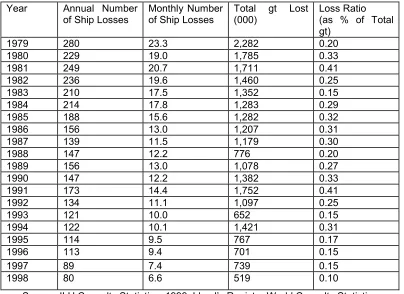
From table 3B below we observe that the number of ship losses has been on a decreasing trend except in 1991. Strict enforcement of regulations will definitely bring quality in shipping, but how long it will take to eradicate sub-standard ships is to be seen? The attitude of shipowners operating these ships like Erika has to be changed.
TABLE 3B: Total reported losses, 1979-98 (ships of 500 gt and over)
Year Annual Number
of Ship Losses Monthly Numberof Ship Losses Total gt Lost(000) Loss Ratio (as % of Total gt)
1979 280 23.3 2,282 0.20
1980 229 19.0 1,785 0.33
1981 249 20.7 1,711 0.41
1982 236 19.6 1,460 0.25
1983 210 17.5 1,352 0.15
1984 214 17.8 1,283 0.29
1985 188 15.6 1,282 0.32
1986 156 13.0 1,207 0.31
1987 139 11.5 1,179 0.30
1988 147 12.2 776 0.20
1989 156 13.0 1,078 0.27
1990 147 12.2 1,382 0.33
1991 173 14.4 1,752 0.41
1992 134 11.1 1,097 0.25
1993 121 10.0 652 0.15
1994 122 10.1 1,421 0.31
1995 114 9.5 767 0.17
1996 113 9.4 701 0.15
1997 89 7.4 739 0.15
1998 80 6.6 519 0.10
Almost everybody agrees that substandard ships and their owners and operators must not be allowed to continue in operation. It is those ships, which are targeted to try to improve maritime safety, save lives and prevent pollution of the seas.
Port State control has produced results with substandard ships being detained by various port State authorities until they meet international regulations. Flag States that consistently fail to maintain internationally agreed minimum standards are identified by effective port State control. It does not drive out these flag States nor get rid of substandard vessels, these substandard ships are driven to the other areas of the world where States are unable to carry out port State control due to various reasons.
In order to get rid of all the substandard ships, what is required is interaction between all regional MOU’S, exchange of information between them and a common data base, to keep track of all the vessels moving from one region to the other.
3.5 Port State control in India
Port State control inspection was carried out if there were any complaints of unseaworthiness of the ship or its equipment, by the crew or any other interested party before 1990. So we can say that port State control existed in India but mostly on complaint basis. Nowadays it is mandatory for a port State control officer to carry out certain numbers of inspections every month.
A brief report on the development of port State control in India.
Due to the increase of workload resulting from amendments to various conventions and introduction of new conventions, and limited number of surveyors not commensurate with the growth in tonnage, port State control was not getting much attention as flag State was fairly active on flag State implementation. Now port State control has been taken up seriously, and much more is to be done, to reach the target and to have an effective system to cover all the ports.
target. Inspections of machinery and equipment are no more carried out by the Administration surveyors. The surveyors of the Administration are still carrying out inspections for issuance of Safety equipment certificate. General inspections are also carried out during that time. If the ship is at foreign port the classification society surveyors carry out the inspection for safety equipment.
The status of Indian Shipping in the international scene during 1992 was not very encouraging. Under the Paris MOU India featured first in the 21 States selected for priority inspection Indian ships detention percentage was 27.87 % as compared to the world’s average of 5.62%. Appropriate measures were immediately introduced by the Administration to improve the status of Indian shipping. Detained ship history was probed. Deficiencies observed on ships were analyzed on quarterly and annual basis and reports were circulated amongst shipowners and surveyors in field offices. Meetings were held with the shipowners and classification societies whenever necessary and fresh guidelines were issued to the Administration surveyors.
It was also observed that majority of the vessels detained were bulk carriers and vessels on cross trade. It was not possible for Administration Surveyors to inspect these vessels as they rarely called into Indian ports and conditions of the vessels were not known. Renewal of statutory certificates for the vessels on cross trade were carried out by classification societies on behalf of the Administration The trend of deficiencies observed on board Indian flag vessels were similar to the trend world over and detentions were fairly on genuine grounds. The trend of MOU’S had just started, as such, standard of inspections were not uniform the world over and in many States the port State control officers were not adequately qualified or trained.
Measures taken by the Administration did bring some desired effect in the standard of vessels and the percentage of detention dropped as follows;
• Detention under Paris MOU steadily declined to 3.5% in the Year 1996. • India is no longer on the priority list of Paris MOU.
Table 3C: Details of Indian Vessels Detained by Various port State control Authorities
Year Total vessels detained
Paris MOU Tokyo MOU USCG Others
1994 24 17 4 3
-1995 21 8 8 5
-1996 18 2 10 6
-1997 16 7 3 4 2
1998 9 1 6 1 1
1999 19 11 4 3 1
Source: DGS
The reports received from the Paris MOU for 1997 were reflecting more on operational deficiencies. This was brought to the notice of the masters of the ships and the Administration also started interacting with senior officers of the ships besides the shipowners.
More attention was paid to port State control as the effect of different MOU’s on port State control on the Indian ports was felt. The number of substandard ships calling at Indian ports increased, as it was difficult for such ships to operate in the other regions due to effective port State control regime.
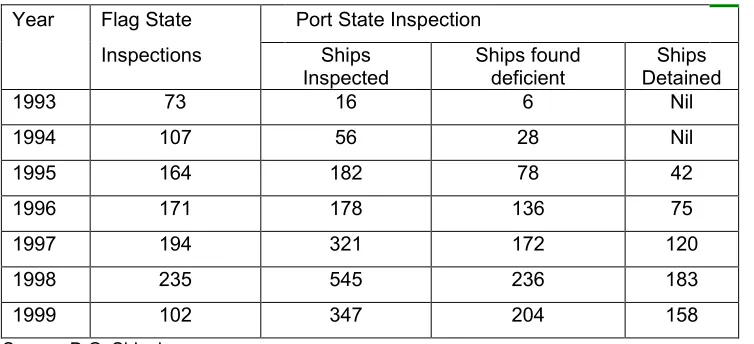
Table 3D: Port State and Flag State Inspections Details
Year Flag State Port State Inspection
Inspections Ships
Inspected Ships founddeficient DetainedShips
1993 73 16 6 Nil
1994 107 56 28 Nil
1995 164 182 78 42
1996 171 178 136 75
1997 194 321 172 120
1998 235 545 236 183
1999 102 347 204 158
As observed from table 3D above, the total number of foreign flag vessels inspected were 347 and the total number detained 158, which is around 45% of the total number of inspections carried out. If there was no port State control, these substandard vessels would have been operating with deficiencies; owners would not have bothered to rectify them.
Hopefully with the Indian Ocean MOU in place the percentage may increase. The Administration is taking steps to increase the number of qualified and trained surveyors to increase port State inspection to at least 15%.
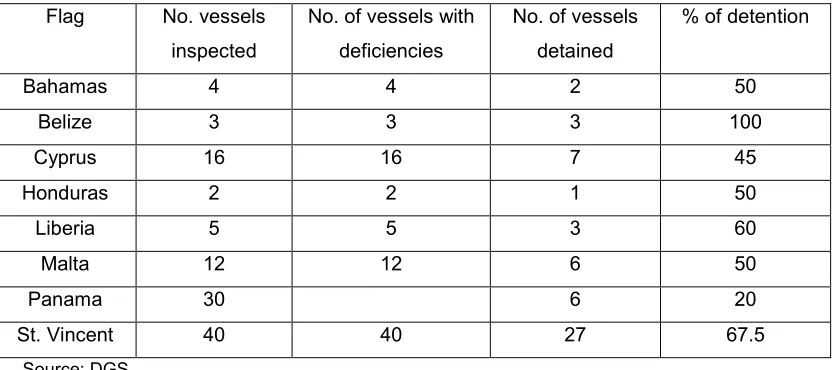
Table 3E: Flag of the vessels that had more numbers of detentions is listed:
Flag No. vessels
inspected
No. of vessels with deficiencies
No. of vessels detained
% of detention
Bahamas 4 4 2 50
Belize 3 3 3 100
Cyprus 16 16 7 45
Honduras 2 2 1 50
Liberia 5 5 3 60
Malta 12 12 6 50
Panama 30 6 20
St. Vincent 40 40 27 67.5
Source: DGS
Apart from the above flags, ships of different flags were found deficient but their percentage was much less then the flags detailed in the above table.
According to a news item in the UK P&I Club bulletin, authorities in Mumbai are being very strict regarding substandard ships and taking their responsibilities for implementation of port State control very seriously (UK P& I Club).
increased tremendously, new ports have developed, tankers traffic has increased due to new oil refineries. There are about 7 minor ports in the region, which require more attention by port State control.
Being one of the oldest maritime States in the Indian Ocean India will have to play a major role in eradicating substandard ships in the region. At the same time India have to strengthen its flag State regime so as to maintain the requisite level of standard on their ships.