World Maritime University
The Maritime Commons: Digital Repository of the World
Maritime University
World Maritime University Dissertations
Dissertations
2000
An analysis of the implementation of the ISM Code
in Mauritius after 1 July 2002 and beyond
Johnny J.M.D.C. Lam Kai Leung
World Maritime UniversityFollow this and additional works at:
http://commons.wmu.se/all_dissertations
Part of the
Admiralty Commons
This Dissertation is brought to you courtesy of Maritime Commons. Open Access items may be downloaded for non-commercial, fair use academic purposes. No items may be hosted on another server or web site without express written permission from the World Maritime University. For more information, please [email protected].
Recommended Citation
Lam Kai Leung, Johnny J.M.D.C., "An analysis of the implementation of the ISM Code in Mauritius after 1 July 2002 and beyond"
(2000).World Maritime University Dissertations. 273.
WORLD MARITIME UNIVERSITY
Malmö, Sweden
AN ANALYSIS OF THE IMPLEMENTATION OF
THE ISM CODE IN MAURITIUS AFTER
1 JULY 2002 AND BEYOND
By
JOHNNY J.M.D.C LAM KAI LEUNG
MAURITIUS
A dissertation submitted to the World Maritime
University in partial fulfilment of the requirements
for the award of the degree of
MASTER OF SCIENCE
in
MARITIME SAFETY AND ENVIRONMENT PROTECTION
(Operational specialisation, Engineering)
2000
DECLARATION
I certify that all material in this dissertation that is not my own work has been identified, and that no material is included for which a degree has been previously conferred to me.
The contents of this dissertation reflect my personal views, and are not necessarily endorsed by the University.
---Supervised by:
Capt. S-A. Wernhult
Maritime Safety and Environmental Protection Course World Maritime University, Malmö, Sweden
Assessor:
Professor P.K. Mukherjee
Maritime Safety and Environmental Protection Course World Maritime University, Malmö, Sweden
Co.Assessor:
Capt. D. Sarenius
Head, Senior Administrative Officer Master Mariner
ACKNOWLEDGEMENTS
My profound gratitude to all people who have helped and assisted me in various ways during the period of my study and research. No achievement would have been possible without the generous assistance, instruction of the professors, staff and visiting professors who have provided me with useful information and advice without which this project would not have been possible. I am also greatly indebted to the library staff for their help and assistance.
I would like to express my special thanks to Professor P.K. Mukherjee, my course professor, for his expert guidance; Professor J-Å. Jönsson for his encouragement, his useful comments, supervision and advice, Capt S-Å Wernhult for his help and assistance during the supervision phase and Capt. D. Sarenius for answering my questions and helping me with facts and material that were not always readily available.
I wish to put on records my gratitude to Capt. P.Seebaluck, Director of Shipping, Mr. R. Pyeneeandee, Secretary to Shipping Development, for helping me in taking advantage of the placement offered to me to pursue this post-graduate programme, in Maritime Safety and Environmental Protection, at WMU. My sincere thanks also go to my colleagues for assisting me and providing me with information that was needed.
I would like to express my sincere appreciation to my sponsor, The Technical Co-operation Fund of I.M.O. for providing me with financial aid to successfully complete my study.
ABSTRACT
Title of dissertation: An analysis of the Implementation of the ISM Code in Mauritius after 1 July 2002 and beyond.
Degree: MSc
The limited jurisdiction of the Mauritian administration to effectively exercise all its duties under the conventions it has ratified goes against the principles of all international maritime conventions. Article 94 of UNCLOS 1982 reminds the administration of its duties under international law and besides, it is a requirement under Art. 300 that Parties would "fulfil in good faith the obligations and shall exercise the right, jurisdiction…" with regard to this convention.
Jurisdiction is composed of two distinct elements, namely legislative and enforcement jurisdiction for which our legal and administrative infrastructure is still inadequate in Mauritius. Although the code addresses the operator, it is a reminder to the administration to implement convention standards that the ISM Code manages. Being a Party to UNCLOS and the main international maritime conventions, Mauritius has an obligation under art 217 of UNCLOS to exercise its obligations for effective enforcement of all the standards contained therein on its own ships.
Due to limited jurisdiction and control, obligations under port state, coastal state and flag state regimes with respect to requests from other States add to the difficulties already experienced so far in discharging flag states duties. If our administration do not give full effect to the applicable international standards, alternative measures of enforcement will be exercised, on our ships, through Port States jurisdiction. Not only will national ships be constantly targeted until a clean bill of health is proved, but the name of the registry we are trying to promote will also be tarnished.
TABLE OF CONTENTS
Declaration...ii
Acknowledgments ...iii
Abstract ...iv
Table of contents...v
List of tables...vii
List of figure...viii
List of abbreviations...ix
1. Introduction...1
1.0 Introduction ...1
1.1 Background & Purpose of the ISM Code...4
1.2 A Synopsis...7
2. Legal Aspect...9
2.1 Mandatory nature of the Code ...9
2.2 Responsibilities of companies...9
2.2.1 Personnel...13
2.2.2 Safety and pollution...14
2.2.3 Conformity with Code ...17
2.2.4 Documentation ...21
2.3 Liability - Civil...24
2.3.1 Negligence...24
2.3.2 Seaworthiness and due diligence...28
2.4 Liability - Criminal / Regulatory...31
2.4.1 Conviction and Corporate Man Slaughter...31
3. Administration and Flag Responsibility ...37
3.2 I.S.M Code - Obligations as Flag and Port States ...38
3.3 Flag Performance...43
3.4 What to delegate ...46
3.5 Diminishing role of Classification Societies?...50
3.6 Strengthening the Administration functions ...52
3.7 Quality Control...56
3.8 Drawback of Present Act...59
3.9 Deterrents...63
4. Maritime Enforcement ...69
4.1 Enforcement of International standards...69
4.2 Reasons for Expanded enforcement duties and mechanisms ...73
4.3 Quality Inspections and Surveys as a Flag State ...74
5. Conclusions and Recommendations ...79
5.1 Possible Approach...79
5.2 Implementation - Not in Isolation...82
5.3 Agency or Not?...84
5.4 Steps towards a More Responsible administration...84
5.5 Recommendations...85
6. Bibliography...88
7. Annexes Annex 1-A IMO Conventions acceded by Mauritius...94
Annex 1-B ILO Conventions acceded by Mauritius...95
Annex 2 Agreement between Danish Maritime Administration And Recognised Classification societies...96
Annex 3 Proposed amendments to the ISM Code MSC 72/15/1...103
Annex 4 Structure of the Mauritian Shipping Act, 1986 as amended ....104
LIST OF TABLES
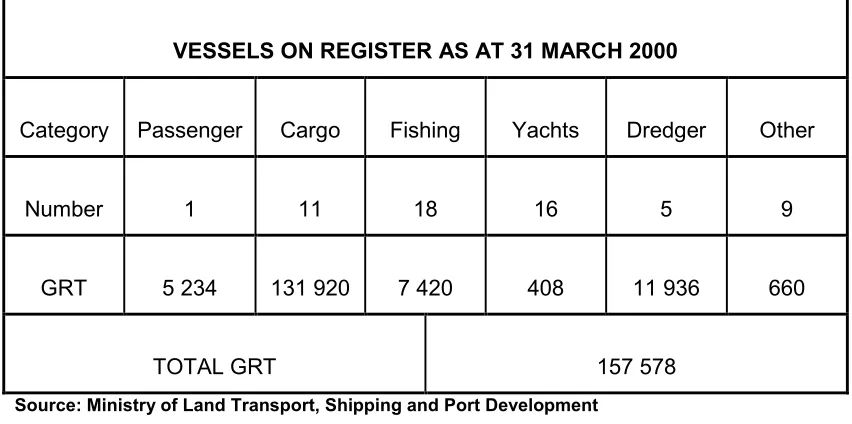
Table 1 Vessels on the Mauritian register as at 31 March 2000... p.38
LIST OF FIGURES
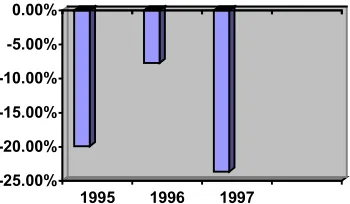
Figure 1 Detention rate of Mauritian vessels by Paris MOU
TERMS AND ABBREVIATIONS
DOC
Document of compliance
D.P.
Designated person
Dwt
Deadweight tonnage
COLREG
Collision regulations
EQUASIS
European quality shipping info system
FSI
Flag state implementation
IACS
International association of classification societies
ILO
International labour organisation
IMO
International maritime organisation
LLMC
Limitation on liability for maritime claims
MARPOL
International convention for the prevention of pollution from ships
MOU
Memorandum of understanding
MSA
Mauritian shipping Act
OPRC
International convention on oil pollution preparedness, response, and
co-operation
SOLAS
International convention for safety of life at sea
SMC
Safety management certificate
SMS
Safety management system
TOCA
Transfer of class agreement
ORGANISATION
Refers to IMO
CHAPTER 1
1.0 INTRODUCTION
In 1836, following 3 years of ship casualties, 1702 British ships were lost, 1714 people drowned and property valued at £ 8,510,000 was destroyed1. A select committee was set up in 1836. The conclusions are not different from what we see to-day. Imperfections in design and construction, improper repair, incompetence of masters and officers or faulty and defective equipment still rank high as reasons behind casualties.
Notable shipping casualties like the Herald of Free Enterprise, Zebrugge (1987); Dona Paz, Philippines (1987); Exxon Valdez, Alaska (1989) are still fresh in our minds due to the lives lost and the impact on the environment. Recently, between 25 November 1999 and 12 December 1999 there has been 3 serious casualties namely the State-owned Chinese passenger/truck ferry "Dashun" which sank with the loss of 280 lives2. The brand new Norwegian twin hull HSC passenger ferry "Sleipner" sank claiming 16 lives 3 and the Maltese-flag tanker Erika which sank without any loss of life but which spilled 8000 tons of thick fuel oil.
The high casualty rates, over the years, have revealed flaws in administrative performance. For many, the issuance of certificates has become more of a formality. This prompted the industry to react to the way management companies were being run. To reduce unfair competition in the industry and make each one responsible for his functions, it was imperative to regulate the operation of ships.
New management companies have put additional stress on management fees. Existing and well-established companies had to cut down costs while on the other hand salaries and insurance have increased. According to Couper, A. (1998), the 1980’s onwards, were depressed years for shipping and it became difficult for small owners to operate. In the name of profitability, ships were handed over to
management companies in order to keep costs low and the whole concept of follow-up in training and belonging to an enterprise were eroded.
Crewmembers were recruited and renewed as often as necessary. Training was geared to satisfy company’s requirements and to balance costs, companies flagged out. Recruitment from the developing countries where quality was not always the highest priority was on the rise.
In many countries, company’s survival was increasingly dependent on low operating costs of which 63% represents salaries of personnel1. Crew employment on ships became more a matter of cost rather than qualification and experience. As freight rates plunged, less crew was being employed on board to reduce daily operating costs in order to remain competitive in the market. Consequently ship deterioration was experienced and qualified seafarers moved to alternative employment exacerbating the issue of safe ships further.
Weak administrations lack the expertise of some developed nations. They were contended with their level of safety and this created different standards among different nations. This could be, on one hand, due to pure ignorance where the interpretation of the rules reflected the level of competency of the administration instead of the latter adjusting itself to International standards.
Things had to change at international level to match new shipboard technology with increased standard of seamanship. The changes came through the amendments of STCW ‘78 and the introduction of the ISM code. For the first time, the administration had to provide for means to audit its administrative structure under regulation I/8 of STCW ’78 as amended in 1995. The philosophy is to get the administration more involved and this has been the first step towards self-assessment. The ISM Code went even further by requiring the managing companies to have a mission statement to which its activities have to be audited.
Although the ISM Code primarily addresses ship-owners and operators, the work of administrations is more and more coming under scrutiny. The role of administrations towards contributing to eliminate or reduce sub-standard ships is so important that IMO. has even gone further in circumventing the claims of sovereignty to expose activities of Flag States through its Flag Assessment Form.
Failure of class societies to ensure safety on board ships has on numerous occasions been clearly demonstrated from Port State inspection reports. The competition and the different standards that exist among them have mainly caused a variation of standards for customers. Weak administrations, devolving their responsibilities upon them has compounded the sub-standard effect. Ship insurers and bankers have highly criticised the performance of classification societies.
Owners, ship operators, charterers, crew and administrations have all contributed to lower standards. Other bodies like insurance and charterers have not always given enough priority to safety issues. Many insurance policies were being issued through operating subsidiaries that would come under a different regulatory regime from that of traditional insurance companies. Some of the subsidiaries very often do not have the necessary expertise and provided cover to anyone ready to pay the high premiums.
In light of the above, it became a high priority to look at the responsibility of the whole spectrum of the shipping industry including inter alia owners, the non-regulatory bodies of class, underwriters and charterers. Administrations as regulatory bodies were not exempted.
1.1 Background and purpose of the ISM Code
Pressure was exerted by public and politicians following casualties like Herald of Free Enterprise in 1987, the Agean Sea in 1982, the Exxon Valdez in 1989 and the Braer in 1993. All these events had huge impacts in the world press. The problem of competency of crew and organisational problems at management level were criticised and needed to be addressed urgently. The answer to unsafe ships and delinquent operators does not reside in more regulations. First and foremost, it is essential to enforce rules that already exist.
Additional regulations have drawbacks not only in terms of costs but also for operators who are already operating below accepted standards. New rules will not make them comply better than the way they are behaving with existing ones. The responsible operators and IMO. will simply have to watch the gap of operating costs between the good and undisciplined operators widen. In this case regulations will have the negative effect of driving responsible operators out of business instead of reducing sub-standard ships.
Instead of contending our-selves to comply with prescriptive rules the shipping industry required more emphasis on overall ship’s performance and hazards that a vessel may encounter. Hence a change of attitude in the industry. The whole concept of compliance had to shift to one of attitude.
The initiatives really took shape following investigations into the casualty resulting form the flooding of the Ro-Ro- passenger vessel “The Herald of free Enterprise” in 1987 when the IMO. Assembly adopted a resolution in the same year 1.
In November 1987, the Maritime safety Committee was asked through Resolution A596(15)2 to develop guidelines concerning shipboard and shore based
1
It was pointed out “that the great majority of maritime accidents are due to human error and fallibility and that the safety of
ships will be greatly enhanced by the establishment of improved operating practices” (IMO. News N° 3).
2 Res A596 (15) - Safety of Passenger Ro-Ro Ferries. MSC was requested by the Assembly to take all possible measures to
management to ensure safe operation of passenger Ro-Ro ferries. In 1989 a set of guidelines on management for safe operation of ships and for pollution prevention was adopted by the IMO. Assembly as Resolution A 647(16)1. The guidelines were amended in 1991 by resolution A 680(17)2 and further amended and adopted in 1993 through resolution A741(18)3 to become what we know as the International management Code for safe operation of ships and for pollution prevention.
Following the Estonia tragedy (1994) which claimed 853 lives, the European Union speeded the entry into force of the ISM code and decided to make the code mandatory for Ro-Ro passenger ships not later than 1 July 1996 4.
Due to the importance and the nature of the ISM Code, it had to be made mandatory. This idea was reinforced when the Code was adopted unanimously by the Assembly in 1993, which was regarded as equivalent to full support of all IMO. Member States. But waiting for individual Governments to make the code mandatory was over realistic as past experience has shown that this is the attitude that can reasonably be expected from some countries5.
The Code cannot be made mandatory for all members of IMO unless brought as an amendment in the SOLAS Convention. The machinery was therefore set in motion to get an amendment to SOLAS to incorporate a new chapter on Management of Safe Operation of Ships. The whole thing is to get acceptance as quickly as possible through the tacit acceptance. This was not a straight forward case and pressed by other casualties, there was consideration by the Secretary General to reduce the circulation process to three months. But this would have been against the amendment procedure and was therefore not acceptable.
1 IMO Guidelines on Management For Safe Operation of Ships and for Pollution Prevention. Assembly invited all
Governments to encourage all ship operators to implement a management system along these guidelines. 2 Guidelines on management for the Safe Operation of Ships and for Pollution Prevention adopted in Nov. 1991
3 International Management Code for the Safe Operation of Ships and for Pollution Prevention (ISM Code. Governments were strongly urged to implement the Code pending the mandatory application of same.
4 The Council Directive 92/21/EG issued on 19th June 1995 called for the mandatory application of international safety
Under normal procedures of tacit acceptance, an amendment can be adopted by an expanded Maritime Safety Committee. Under tacit acceptance procedure, article VIII (vi) of SOLAS allows fast entry into force of an amendment but the period cannot be
less than 12 months after acceptance by a
2
3
majority in an expanded Maritimesafety Committee. Furthermore Article VIII (i) of SOLAS ’74 as amended in 1978 stipulates that an amendment shall be circulated at least 6 months prior to its consideration and article VIII (e) prescribes a period of 6 months before it can enter in force after being accepted. The earliest possible period was therefore 24 months and it was considered too long for the entry into force of the requirements of the Code.
A Conference had to be convened due to the fact that a Conference, by virtue of Article VIII (c) (iii) of SOLAS ’74 as amended in 1978, can decide on a period of acceptance of less than a year1. To accelerate the adoption procedure for the ISM Code, the period of acceptance was brought to 6 months while keeping the period of circulation and the period between acceptance and entry into force to 6 months too. The time frame for the entry into force was therefore reduced to 18 months.
The amendment adopted by a diplomatic conference in May 1994 was introduced in Solas'74 as amended in 1978 as a new chapter IX under the name “Management For the Safe Operation of Ships”. The ISM Code gained mandatory status by making reference to it explicitly in Chapter IX of the SOLAS ’74 Convention as amended.
The ISM Code is about management of ship-board and shore-based operations. It brings into the regulatory framework of ship activities, a system of processes and procedures against which non-conformities are evaluated. The purpose of the ISM code is to provide an International standard for safe management and operation of ships and for pollution control 2.
The Code is a proactive approach that is meant to provide for a structured system of performance monitoring against a set of rules and regulations. Such a system, if properly managed can prevent incidents from turning into disastrous casualties. Looking at the ISM Code from a broader perspective, there are definitely more than the main purpose of its mandatory operation to improve on the safety management of ships by administrations.
In fact the short and medium term objective of the code is to uncover the substandard owner, management and administration and probably reduce their number. In the longer term, based on casualty analysis and experience gained, the code can be expected to improve the safety management system at all levels and also the responsibility from Flag States. The end result might be a decrease in the prevailing fierce competition, which is at the root of reduced standards and eventually push the rogue owner closer to the breaking yard1.
1.2 A synopsis
Chapter 2 makes an in-depth study of the legal aspect of the code. At national level, the development of maritime law and its enforcement have not really been effective. The ISM code brings in additional legal implications with a central theme of seaworthiness associated with due diligence. Shortcomings in ship's procedures and non-compliance with the ISM requirements make a ship unseaworthy. The different facets and ways to ensure compliance will be examined.
Chapter 3 looks at the administration and the way it addresses its obligatory functions. The need to review the way it addresses International Safety Conventions will be assessed. The importance of redefining its role faced with multiple challenges like the development of its register and the issue of delegation in order to ensure the highest standards are applied and improve its image will be looked at. The ISM
Code covers all major International Conventions and standards. By extension, it addresses improvement on performance and efficiency of present administrative procedures. Means to strengthen the administrative and technical capabilities will be explored.
Chapter 4 deals with enforcement. Flag states have an obligation to successfully enforce international agreed standards. Presently there are drawbacks in our system. Most of the major IMO and ILO Conventions are not properly addressed and the ISM Code cannot be implemented in isolation. The degree of success in achieving a safety culture depends primarily on proper regulatory, administrative and enforcement framework. The best regulations are of no use if proper inspections and enforcement measures are not practised.
CHAPTER 2 LEGAL ASPECT
2.1 Mandatory nature of the ISM Code
Unlike art.16 (5) of MARPOL 73/78, SOLAS '74 as amended do not contain similar stringent requirements as to the adoption and entry into force of new technical provisions. Art. VIII of SOLAS requires explicit acceptance to the Articles and chapter 1 only, implicitly allowing the tacit acceptance to be applicable to new technical standards. The ISM Code benefited from the arrangement under SOLAS and entered into force as a new chapter IX.
Amendments and Protocols fall within the ambit of International agreement between States and are governed by International law. Any international agreement between States governed by international law is subject to the Pacta Sunt Servanda1 principle of art. 26 of the Vienna Convention on law of Treaties. Technical amendments to SOLAS, which made the ISM code mandatory, is binding on all parties and must be performed in good faith. It is, therefore, not only a matter of incorporating the provisions into national legislation but rather facilitating early incorporation through adequate legislative and regulatory mechanisms to ensure enforcement is adequate and in conformity with other State practices.
2.2 Responsibilities of companies
To ensure the effectiveness of the ISM code in its daily operation and reduce risks of liability stemming from casualties, a company should lay down the foundation work for a safety management policy encompassing the basic and primary function of :
1. Establishing a policy around which all actions to promote safety and prevent pollution can be built.
2. Developing instructions and procedures for day-to-day running activities, for the preparation and response of emergency operations identified by
risk analysis, reporting, communication within ship and shore-based structures and exchange of any information between ship and shore. 3. Developing procedures for internal audits and review of management
system.
In designing the policy of the company it is important that the policy successfully meets the objectives of the ISM code. It is the responsibility of the ship operator or company to exercise its duty and obligation to provide a safe environment on board with a minimum risk to people and to the environment. Both shore-based and shipboard personnel have their roles in the policy formulation and should be active players in the development and practice of the code. No standard format for achieving the objectives of the code can be provided. Each company has an obligation to develop safe practices which do not violate the intent of the code and which take the peculiarity of the trade and type of operation into consideration.
This can be achieved by identifying all the risks likely to be encountered that go against the objectives of the code. Besides, the policy should identify weaknesses in the safety management system, skills of personnel and provide for a continuous improvement based on non-conformity reports and regular internal audits. While doing so, special care should be paid to the ability of personnel to promptly and effectively respond to emergencies likely to be encountered during the operation of the vessel.
The tools at the disposal of the company to meet the objectives are stipulated at sec 1.2.3 of the ISM code1. Companies also have obligations to provide an organisational relationship of all those involved with the management and verification of matters relating to safety and environmental protection 2. The establishment of clear lines of communications enables ease of reporting of
1
"The safety management system should ensure compliance with mandatory rules, regulations, codes, guidelines and standards
developed by IMO., classification societies, administrations and relevant organisations within the shipping industry".
conformities, accidents and near-misses1, to the highest level of management 2,so that rectification can be promptly addressed. The way the code is implemented affects the relationship of the owner with respect to insurance including P&I. Insurance and underwriters will withhold payment if at the time of the casualty it can be proved through the paper trail that the vessel was not ISM-compliant. It should be remembered that neither contractual obligation, made in the name of the owner under contract of carriage of goods, nor his liability for oil pollution damage can be delegated to managing companies.
From an operating company's perspective, the DOC and SMC are vital documents for its commercial activities. In order to ensure that the management system can guarantee the validity of the ISM certificates, the company has a duty to:
1. Ensure the workability of the code and compliance through documentation and authority of all those involved (Sec.3.2)
2. Verify that non-conformities are brought promptly to the attention of the proper person. Delay in reporting may give rise to a non-conformity 3. Ensure the competence of the designated person is adequate to deal
with the deficiencies. Short term solutions or temporary repairs conflict with the philosophy of the code.
The company is responsible for the selection of the proper designated person ashore as a link between the ship and top management. The choice should not be limited to experience, qualification, motivation, independence and integrity only. The ability to properly monitor the operation of the ship as well as being conversant with the S.M.S. are as important. The position of the D.P. in the hierarchy should be clearly defined to avoid management conflicts when adequate resources and sufficient shore-based support are sought.
A company is commercially responsible to operate as profitably as possible. There may be a tendency to favour the technical side only. The ISM code has, as far as
companies are concerned, introduced responsibility with accountability and probably more vulnerability in court. It is, therefore, of great importance to attribute equal attention to the human and operational management instead of concentrating on the technical side only.
Under the ISM code, a company or an organisation or a manager or a bareboat charterer who has assumed responsibility from the owner to operate the ship is the owner of a ship. The responsibility carries an obligation to fulfil all duties and responsibilities imposed by the Code1. Any entity operating the ship is obliged to be registered with the Flag State as the entity responsible for ensuring that the shore and ship management functions as expected. For companies who operate a vessel and sub-contract crew management, there is no allowance under the code for shared responsibility. The company is still responsible for demonstrating, through audits, that services dispensed by the sub-contractors fully comply with the company's S.M.S.
The owner or carrier will still be responsible for exercising the non-delegable obligation to make the ship seaworthy under the contract of carriage of goods 2. An owner who has delegated the management to a company may be liable for large sums based on fault of managing company. Consequently, the operating company will probably be responsible, to the owner through a contract, to hold a valid D.O.C. and operate the vessel in accordance with the approved S.M.S. Additional responsibilities imposed on the company by the owner, to fight any claim brought against him, will invariably include availability of any relevant material used for the implementation of the ISM code.
There is also a fundamental obligation to establish a safety and environmental policy and ensure that the policy is properly implemented. Writing down detailed management procedures with too many things that are not directly relevant can result in putting a company in a disastrous situation by exposing more evidence for claimants, insurers and lawyers to prove non-compliance with the code. Companies
have, therefore, a moral responsibility to ensure that owners are not unnecessarily exposed to unlimited liability due to privity by way the shipping activity is conducted.
2.2.1 Personnel
On the operation side, the ISM code imposes specific duties and responsibilities on the master of a ship. The master's responsibility is laid down in section 5 1 of the code and requires the company to clearly define and document his responsibility pertaining to
1. Implementation of safety and the environment protection policy of the company.
2. Motivation of the crew to observe the policy laid down. 3. Issuance of clear orders and instructions.
4. Verification that any specified requirements are observed. 5. Review of S.M.S. and reporting of non-conformities.
The master, however, may exercise his right under sec. 5.2 to use his overriding authority and his actions may deviate from the procedures laid down in the S.M.S. According to Anderson, P. (1998) 2, Courts will most probably adopt "the principle of agony of the moment" 3 when accidents and casualties result from such actions. To be exonerated the master should prove that he did not have any time to make a proper judgement for an alternative action. The paper trail behind overriding decisions will be fully investigated to confirm that despite such action, the S.M.S. was fully functional.
Whenever a casualty occurs, courts will try to look at the different facets of the ISM code to find any correlation between the event and any deficiency in the S.M.S. In the process, the aptitudes of the personnel will be closely scrutinised. Four- Fifths of maritime casualties are due to human error 4. A Company is obliged by Sec.6.0 5 to ensure that the ship is sufficiently manned by a properly qualified and medically fit
1 Master's responsibility and authority
2 ISM Code: A practical guide to the legal and insurance implications, p 109 3Based on "The Bywell Castle 1879 Case
master and crew. It may be sufficient to only prove defective procedures for recruitment or absence of a policy to ensure recruitment activities in order to incriminate a company as not fulfilling the requirements imposed by sec.6.2 1 of the code.
The safe manning level will be determined according to the flag state requirements and STCW but whether the complement is adequate to actually run the ship safely, will in practice be something the company will need to review if the internal audit of the S.M.S. proves the contrary. The safe manning level will also depend on considerations of accidents, non-conformities or hazardous situations that are directly influenced by fatigue of crew. The company is required to establish procedures, meaning a review of the S.M.S. for bringing in corrective actions 2.
If an accident occurs and the cause can be traced back to insufficient personnel, important questions can be raised about the seaworthiness of the vessel. Seaworthiness is intimately linked to liability and insurance statutes. It might be difficult to prevent loss of the right to limit and insurance cover if there are no proper procedures for familiarisation of new personnel on the ship and the training programme in force do not cater for any lack of knowledge3.
2.2.2 Safety and pollution
Art. 94(1) of UNCLOS addresses the fundamental functions namely jurisdiction and control over administrative, technical and social matters on registered ships. The administrative duty relates to the grant of nationality, which in essence requires compliance with technical and social requirements enacted in national legislation. The element of control is reinforced by art. 94(3) of UNCLOS 4. Without satisfactory measures to enforce mandatory standards, a State would be in violation of art 1 of SOLAS 5 and similar provisions in international conventions.
1 The company should ensure that each ship is manned with qualified, certificated and medically fit seafarers in accordance
with national and International requirements 2 Sec.9.2 of ISM Code.
3Sec.6.5 of ISM Code
4 Every state shall take such measures through national laws for ships flying its flag as are necessary to ensure safety at sea. 5 The contracting Government undertakes to promulgate all laws decrees, ..and regulations and to take all steps necessary to
There is nothing in the ISM code that can be taken as imposing sanctions upon owners/operators who fail to comply with provisions of the code. This is left to the State to see that appropriate measures are available in the municipal legislation. Through national legislation, an owner/operator may face civil or criminal liability 1.
Non-judicial sanctions like administrative fines or compounding of offences, which are fines settled out of courts might not be the best deterrents for serious offences as they can easily be absorbed in costs and passed to the customer. However they are valuable as they are inevitable and can be applied promptly.
The route to fines and liability in national law may present many advantages. The fines imposed can be extremely high to act as a powerful deterrent and serve as an example to others. However, civil liability in maritime law has a drawback. Except for oil pollution where liability is mostly strict, owners will in many instances be able to limit liability 2. Unless it is expressly provided in national legislation that the sanction for particular violations is strict liability, judges will invariably look at the "mens rea" or motive behind the state of mind of the directing will of the company through his alter ego.
Under the 1957 limitation Convention which is still in force in many jurisdictions, the owner/operator may limit his liability unless the casualty resulted from his actual fault or privity. A wrong plot on the navigational chart, leading to a casualty can hardly be considered as the actual fault of the owner it there are proper procedures in place to recruit competent crews. The owner/operator will most likely lose his right to limit due to privity, through reports of non-conformities, rather than actual fault. To reduce risks of being privy to too many things happening on board, companies are distancing themselves from the responsibilities of the master by giving him sufficient autonomy and responsibility to act on his own. Furthermore, a responsible company
1 One example is Reg. 19(1) of the UK statutory instrument SI 1998 N° 1561 related to the U.K Merchant Shipping (ISM
Code). " Any contravention to Regs. 4, 5 or 8 by a company shall be an offence punishable on summary conviction by a fine not exceeding the statutory maximum or on convivtion on indictment by imprisonment for a term not exceeding two years, or a fine, or both."
able to prove that a serious casualty was the result of a mistake of the crew and has nothing to do with any deficiency in management will be able to limit his liability.
The 1976 LLMC provides a better regime of limitation to the owner. An operating company may even choose a forum where the 1976 convention is in force for a better chance of limiting its liability. Besides, unless it comes to light that management has deliberately ignored reports of non-conformities brought to its attention, it is not usually easy to prove that a loss resulted from the personal acts or omissions of a company, acting recklessly with knowledge. Coupled with above, the fault of the D.P might not always be the "Personal fault" 1 of the owner or directing mind of the company.
Enforcement categorisation under national law strictly depends on the administration. Offences vary in complexity and end results. The administration may wish to attribute criminal procedures as a more forceful deterrent for specific offences. A state may choose to make a breach of safety and pollution a criminal offence or may choose to prosecute under the civil liability regime. However, the degree of success under criminal provisions is more difficult as the threshold of proof is higher than under the civil liability regime.
Although compensation or monetary fines are considered as deterrents, their usefulness can be questioned when the damages can be covered by a P&I cover. For a recurrent offender higher premiums can act as a deterrent and cause an improvement in operating standards.
To give a well deserved weight to the different elements of the safety management network the jurisdictional control to be adopted by the administration need to emphasise on both the responsibility on board and ashore. Although the master's authority within the safety management system is well defined at sec. 5.2 of the code, this is not enough if there are no safeguards. It goes against the improvement
of safety and pollution prevention if the management ashore has a strong hold on his duties.
The master and crew may even experience unfair disciplinary measures for their actions. A master should be able to act freely even if actions are in direct opposition with the instructions coming from ashore. Unless there has been a clear and fundamental breach of procedures leading to a casualty a master should be protected from unfair dismissal for actions taken. A company allowed to dispense a master or key members of the crew with too much ease cannot work in the best interest of safety and pollution prevention.
Fines or any other form of prosecution are useful means to ensure compliance. However, these cannot be relied upon as the only means to ensure compliance. Close interaction with ship-operators aiming at voluntary compliance should be encouraged. In addition co-operation with administrations during vessel transfer is also an important element in the safety chain. The Estonia casualty revealed the draw-back of lack of co-operation between administrations. Although the Estonian authority has a duty to inspect its own ships, the Finnish Government failed to inform the Estonian authorities of exemptions to SOLAS when the ship was transferred1. For a wider field of control, co-operation can be extended to charterers, cargo owners, classification societies, insurers, financiers, and the shipbuilding industry for improvements in the existing relationship.
2.2.3 Conformity with Code
Public Authorities have a duty to ensure that shipping is conducted in a safe manner and assures a comfortable degree of protection of public interests without harm to life, health and the environment. For the operator, conformity with the ISM code provides non-negligible advantages in terms of financial returns.
Ships trading in Europe, regardless of flag, are faced with EU State laws on port state control based on EU Directive 95/21/EC of 19.06.1995, as amended which
entered in force on 1 July 1996. The doctrine has introduced a mandatory targeting of black listed flags and to a certain extent categories of ships most likely to result in casualties. EU States are compelled to look beyond convention requirements to evaluate the general condition of the ship, its engine room, habitable, working and hygienic conditions on board.
The essential objective of administrations should, therefore, ensure effective conformity with mandatory rules, regulations and guidelines developed by the industry through verification of the SMS. The contents of the code provides for the first time guidance to administrations of what should be considered as the best practice in ship management and operation and owners will be judged by these standards.
Being a Party to Solas'74, the Mauritian Administration has an obligation to adhere to the ISM framework. It is, therefore, important to implement and enforce measures contained therein to guarantee an effective standard of compliance. A State cannot expect owners to comply with the requirements of the code if it lacks enforcement powers and deterrents. In this context, one area of law that puts pressure on owners' liability and affects their vulnerability will be examined.
Hague and Visby Rules Art III
1. "The carrier shall be bound, before and at the beginning of the voyage, to exercise due diligence to
(a) Make the ship seaworthy
(b) Properly man, equip and supply the vessel…" Art IV
make his ship seaworthy, and to secure that the ship is properly manned, equipped and supplied…"
Whenever loss or damage has resulted from unseaworthiness, the burden of proving the exercise of due diligence shall be on the carrier or other person claiming exemption under this article.
2. "Neither the carrier nor the ship shall be responsible for loss or damage arising or resulting from
(a) Act, neglect or default of the master, mariners, pilots or servants of the carrier in the navigation or in the management of the ship…"
With the advent of the ISM code, the defences enjoyed so far by the carrier, usually the ship-owner, under Art.IV(a) above, regarding crew negligence/competence and privity have been strongly eroded. More care has to be exercised by the owner or charterer in abiding with the requirements of the ISM code to avoid exposure to claims from cargo-owners. If it is established that the vessel was not seaworthy, the ship-owner has to prove that he exercised due diligence at the commencement of the voyage. Otherwise he may be liable for actions of the managing company in not ensuring a proper selection of the crew (Sec 6.2). The obligation to exercise due diligence is on the operator and cannot be delegated to management companies.
Art. III (a) above1.
Considering the financial implications of the ISM code, where documentation has opened the flood-gates of recovery demands from claimants, Mauritius may wish to have a Marine Insurance Act in the national legislation to give some protection to the ship-owner. The Act can be based on the British Marine Insurance Act 1906 which states that "in a time policy there is no implied warranty that the ship shall be seaworthy at any stage of the adventure, but where, with the privy of the assured, the ship is sent to sea in an unseaworthy condition the insurer is not liable for any loss attributable to unseaworthiness". This may act as a forceful deterrent compelling a ship-owner to comply with the ISM code.
Mauritius is a Party 2 to the 1957 Limitation of Liability Convention 3. Compared to the 1976 Limitation convention, the 1957 regime allows an owner to limit his liability if the resulting casualty is without his actual fault or privy, as explained earlier. The greater degree of transparency, introduced by documentation and audits, will diminish any difficulty experienced so far to prove that an irresponsible owner had actual knowledge and turned a blind eye or acted recklessly with knowledge.
Although the Hague and Visby rules and insurance law are private laws it would be wise to implement them in the national legislation together with the 1976 LLMC. The 1976 LLMC provides a better mean to limit liability and better insurance cover is available to the owner. Actually the level of premium will most probably be calculated on how easy it is easy to break limit. By all means, with the 1976 Limitation of Liability Convention 1976 in place, an owner/operator will be less
1In the Maxine Footwear Co.Ltd v. Canadian Government Merchant Marine Ltd, it was held that the " principle of reliance
may not be placed on the Hague-Visby Rules exeption where the operative cause of loss is a failure on the part of the carrier to ecercise due diligence to provide a seaworthy ship under Art III 1. (a)". Girvin D. S. !997) IJSL, p.205.
2The convention entered in force for Mauritius in 1968.
3It would not be difficult to prove fault under the 1957 Convention due to the transparency of the documentation. According to
inclined to turn a blind eye to non-conformities reported to him for fear of being charged as having acted recklessly with knowledge. Not only the owner/operator will lose the right to limit but will be exposed to claims in full.
As a powerful deterrent to ensure conformity with the ISM code the Mauritian Administration may think in terms of :
• Having a provision of corporate manslaughter in the national legislation for sending an unseaworthy ship to sea.
• Making an insurer not liable under law for any loss attributable to unseaworthiness if during the course of the voyage the ship becomes unseaworthy due to the fault of the insured.
Sections 98 and 100 of the 1993 U.K. Merchant Shipping Act may serve as a model in the preparation of the legislation.
2.2.4 Documentation
Documents have been introduced to fulfil the intention of the ISM code i.e. to learn from mistakes and apply the lessons learnt to improve safety and protection of the environment.
The question that has been debated over the years is whether such documentation may be misused by flag states, Port states, claimants, insurers and courts against companies.
A proper and functional SMS generates enormous documentation 1 and may incriminate an owner or senior officials of management and also the D.P. Losing the right to limit the financial liability, due to a paper trail, in the event of an involvement of the ship in a major incident is a legitimate fear of owners.
The question that arises is whether all documents should be public and allowed for scrutiny by claimants. Exposing a management to all sorts of claims may jeopardise the existence and the good intentions of the company having the commitment to improve its management system. Furthermore, it might even be a deterrent if more time is spent in courts rather than spearheading efforts to enhance safe procedures on board.
However, the documentation generated may become a source of interest during court proceedings on what really happened and with hindsight, serve to highlight incidents which have been the precursor of the actual accident. It may even be possible to establish grounds for a proper analysis of what went wrong, why things went wrong, what owners have done and what they should have done. Provided that reports on corrective actions can be promptly produced, the owner may be incriminated by his own documents. He may be charged on grounds of fault and privity, by having knowledge, and recklessness with intent by being aware of the risks but disregarded them.
According to Connaughton, S. (1998), charterers, shippers, insurers may misuse the ISM documentation to secure a commercial advantage or exert pressure to improve their negotiating powers or even break valid contracts and charter parties. One of the well-known cases of documentation misuse is the Coors Brewing Company of Colorado. The company, which was not violating any terms of the permit of operation conducted an internal audit of its systems and found that the plant was emitting more air pollutants than the Federal requirement because the Government's approved method of determining emissions were inaccurate. The company brought modifications to its systems to reduce the level of air pollution and wanted to share the information with the Government 1.
To plaintiffs, the ISM is an ideal tool for increased exposure of owners/operators to criminal culpability and criminal negligence. The owner/operator may be tempted not
1
" State officials of the environment backed by the US Government used the results of the audit to impose a heavy fine on the
to document the reports of non-conformities or writing the bare minimum. Such a move may, in fact, result in a deficiency of the ISM Code and constitutes a major non-conformity.
In case of strict liability arising from a pollution incident, documents play a secondary role. The ship-owner will automatically be liable for clean-up costs and damages caused. However the documentary evidence of actions taken prior to the spill ranging from emergency preparedness procedures, training, corrective measures and audits can be very helpful to prove that due diligence was exercised to mitigate the results of any probable spill. Thus, punitive actions can be limited.
Documents may be helpful to limit liability but will most likely be self-incriminating in many instances. There are risks that the documentation produced may be misused against a good operator. Documentary evidence of procedures has been introduced to identify problems, rectify shortcomings and improve on existing procedures in order to avoid accidents occurring.
While risks of misuse of the documentation are evident, claimants should not be deprived of a fair deal. It would also be against the objective of the ISM Code to expose a good owner to unnecessary claims arising from his non-conformity reports. Good operators are more likely to strive for a safety culture and they should be encouraged to record non-conformities and correct deficiencies without fear.
Connaughton, S. (1998) suggests that administrations may enact legislation to provide some protection to self-incriminating ISM documentation. In that connection, reports, policies, plans, instructions, audits and other materials prepared for compliance with the ISM Code should be excepted from admission as evidence in any civil, criminal or administrative proceedings other than those proceedings to ensure compliance with the ISM code.
documents may be considered as private and confidential. They will be attributed a privileged status and be classified as documents whose exposure is to be disclosed to judges while the latter may be classified under documents to be produced and available for inspection to litigants. Contrary to production, disclosure would mean that they are exempted from being opened to scrutiny while there is an obligation to make these documents known.
Other legal options suggested comprise consideration by the administration to protect the attorney and client privilege over any legal advice of non-conformities following a casualty.
To encourage conformity with the code and protect documents generated by the ISM code from being wrongly used, administrations may encourage companies to:
1. Audit own system in parallel with the audit performed by outside company to evaluate deficiencies with the ISM requirements. Such audits are steered by the company and are not mandatory and might not be asked for.
2. Keep the ISM documentation as simple as it can possibly be. Take care not to fall into the trap of over documentation.
3. Clearly identify documents related to trade secrets.
4. Keep documents as long as is necessary as there is no mandatory requirement to keep the documents for any length of time.
2.3 Liability - civil
2.31 Negligence
above entities to put in place a safety policy and practice it 1 as well as complying with mandatory regulations and guidelines developed by the industry 2. It is not in the interest of owners to turn a blind eye to best available and well-proven practices.
The origin of something going wrong can be traced back from two definite sources. Firstly, from a negligent act by servants of owners and secondly from a defect of the management system for which the owner/operator has personal responsibility. The mandatory requirements that should be complied with are clearly laid down in the code. An owner or operating company falling short of these requirements will be exercising less than due diligence and seaworthiness and would be categorised as negligent. The owner/operator can try to escape liability by showing that there was no negligence on his part and the incident was not foreseeable. With the documentation system in place, as positive evidence, it will not be easy to use such defence to avoid civil liability and probably criminal sanctions if negligent acts are uncovered.
Management functions broadly fall into four main branches namely planning, organising, supervising and control. Supervision and control are non-delegable functions under law 3. A company which does not exercise proper supervision and control of ship board operations would therefore fail the test of due diligence and be termed as negligent.
Section 2 of the code provides the framework of responsibilities that a diligent owner/operator would have in place to "ensure that the policy is implemented and maintained at all levels of the organisation both, ship-based and shore based". This is reinforced by the judgement in the Marion Case where the company did not have procedures to control the master. Although the latter was competent, according to the owners, the owners were made privy of the accident and lost their right to limit liability. Actually they should have known that lack of procedures to control sensitive operations, like chart corrections, could lead to accidents 4. To reduce the likelihood
1 Sec 2 of the ISM Code 2Sec.1.2.3 of the ISM Code
of casualties due to human error, Section 4 of the ISM code goes even further than Sec. 2 above, to require a designated person "to ensure the safe operation of each ship and to provide a link between the company and those on board".
In case of a serious ship casualty, a court may use the ISM code as a yard stick of conduct and lead to closer scrutiny of whose act or state of mind may be associated with the company. Unless it can be proved that the D.P. is the directing mind, his chances of conviction are remote. Instead it may be assumed that the company is privy to any non-conformity which has been brought to the attention of the designated person. Negligence shifts to top management and the company director may, through the negligence of the D.P., be accused of reckless behaviour leading to liability and loss of insurance cover.
The actions or inaction of the D.P. may be a determinant factor when the actual fault or privty of the owner or operating management is questioned. There will be times when his position, relationship and access to top management will come under scrutiny as he is the one monitoring the rectification of deficiencies arising from non-conformities and reporting back to top management.
Although the designated person might be proved guilty of gross negligence in the exercise of his duties, he is not, in many instances, the person responsible for the operation of the ship. According to the ISM code the designated person responsibilities are limited to monitoring safety 1.
However, in deciding whose negligent act it is, the court will examine whether the act leading to liability is part of an obligation under law, or is part of the company's obligations or was specifically authorised by a board resolution or an agreement of shareholders. Whether the D.P or the managing director is held guilty of negligence and criminal wrongdoings will depend on the extent the D.P. is entrusted with powers of the board. Without such powers the role of the D.P. is limited to monitoring the safety and pollution prevention aspects of the ship and giving advice
1 Sec. 4 of the Code - The responsibility and authority of the designated person should include monitoring the safety and
to senior management of the company. In such a case, he cannot be categorised as the one responsible for the operation of the ship.
Even in the absence of proper lines of communication between the D.P. and top management, the latter may be liable for the negligent acts of the designated person. Failing to receive reports from the designated person requires the top management to enquire what could have gone wrong. It would be naïve to assume that the absence of reports means that everything is under control. By not attempting to find out what could be wrong, especially if other ships in the same management have suffered important damages, may be considered as an inappropriate behaviour below what should be expected of normal and prudent management. A Ship-operator, may, therefore be unable to exercise the right of limitation as there is an element of constructive knowledge meaning that he ought to have known that damages would probably result from such situations.
It is therefore a requirement for top management to enquire what the designated person knows or ought to know at any specific time. Furthermore ignoring mandatory rules, regulations, guidelines developed by the industry will amount to turning a blind eye to best operating practices and will constitute a violation of a mandatory obligations. In the Eurysthenes court of appeal case, Lord Denning stated " if a man, suspicious of the truth, turns a blind eye and refrains from enquiring so that it should not know it for certain, then he is regarded as knowing the truth. The turning a blind eye is far more blameworthy than mere negligence. Negligence is not knowing the truth and is not knowledge of it" 1.
that the SMS should provide for measures ensuring that the company's organisation can respond at any time to hazards, accidents and emergency situations involving the vessel"
By tradition, a tort of negligence is assessed against a prescribed duty of care. For a case of negligence to succeed, it must be proved that a mandatory legal duty that existed has been breached. During the normal course of one's obligations, a duty of care is owed to someone who might be affected by one's acts or omissions. As casualties caused by human errors are amply documented, the way the ISM code is drafted implies that a deficiency in the management system will probably lead to a casualty. Ignoring the importance of the SMS in reducing casualties due to human error would mean more than negligence for not giving enough consideration to damages that could occur to third parties.
2.3.2 Seaworthiness and due diligence
Seaworthiness is about safe standards "which a prudent and careful operator will require on his ship having regard to all probable circumstances" that may arise during the voyage 2. Failure to observe the requirements of the ISM code is not necessarily unseaworthiness. Surely, it will lead to that direction as ISM is about mandatory acceptable minimum standards for safe operation within a safety management system based on safe practices, safeguards against all identified risks and preparation for emergencies 3.
In the Elder Dempster v. Paterson Zochonis case (1924) 4, the English court held that stowage of cargo may or may not affect seaworthiness of a ship. Bad stowage as opposed to improper stowage, only affects the cargo but does not affect the ship. If bad stowage results in endangering the ship, it amounts to unseaworthiness of the ship. In the same vein a culmination of unsafe practices central to the theme of the ISM code will make a vessel less than seaworthy. Incompetence of a master or
1 Anderson, P. (1998). ISM Code: A practical guide to the legal and insurance implications, p.97
2MacFadden v. Blue Star Line (1905).The judge pointed out " Would a prudent owner have required the defect to be remedied
before sending his ship to sea if he had known it? If he would, the ship would be unseaworthy. (Anderson, P. p. 102) 3Functional requirements - See Sec. 1.4 of ISM Code
crew attributed to defects in the quality of manning and bad stowage amplify the risk and endanger the seaworthiness of the ship 1.
Under Rule 1, Art.III of the Hague-Visby rules the obligation on the carrier is to exercise due diligence to make the ship seaworthy, to properly man the ship and to make the ship cargo-worthy. Here a distinction has to be between incompetence and negligence. A seafarer is considered as incompetent when he does not have the required ability to perform his job. However negligence arises when the seafarer does not exercise his ability and his performance is below what is reasonably accepted of him 2. In cases of negligence of the crew, the carrier may be able to use the defence under Art IV of Hague-Visby Rules but the same defence will not be available if the crew is incompetent. In the event of the crew being found incompetent, a carrier would have to prove that he exercised due diligence in having adequate procedures in place to recruit a competent crew in order to escape liability.
Some other factors that may affect the seaworthiness of a ship due to the incompetence of the crew to properly discharge their duties are include drunkenness, incapacity of crew to communicate among themselves, fatigue and ignoring established ship operation techniques.
The SMS and mandatory procedures to be complied with under the ISM code will be documentary evidence of due diligence exercised. The degree of fitness of a ship will be also be judged against failure to provide the ship with the necessary information for safe operation and by not ensuring that the personnel can operate the ship safely will also constitute unseaworthiness. This was apparent in the Standard Oil Corp v. Clan Line(1924) 3 where the master neither had any special knowledge of the vessel nor knowledge of the design on her stability.
1
In the Makedonia case (Lloyd’s Report 316, it was held that “a ship may be rendered unseaworthy by the inefficient master
who commands her.” (Anderson, P. p. 124)
Of similar character, section 1.2.2.2 of the ISM code requires the establishment of safeguards against all identified risks. Therefore to ensure seaworthiness, a ship-owner must ensure that the vessel is properly manned, the crew is adequately trained for their tasks and have received adequate instructions to familiarise themselves with the ship and the company ISM policy and the ship is properly equipped before the commencement of the voyage. Not only does the ISM code require policies to be in place for recruiting personnel, but the policy, for monitoring the performance of the master and the crew, must be properly documented. Otherwise the owner may find it difficult to prove that he exercised due diligence to make the ship seaworthy and will be exposed to liability.
It will be up to the company to prove that it exercised due diligence in employing the right crew, and training it to keep the ship in a seaworthy condition. It was made clear in the Makedonia 1 that there is an obligation on the ship-owner to have a policy to recruit personnel and verify the documents of those being employed, to interview and require information from previous employers that the seaman is fit to occupy the post he is offered.
An administration condoning sub-standard operations and not having adequate control over an authorised organisation will create unseaworthiness of ships. Besides improper manning, lack of familiarisation procedures and poor equipment, other factors pertinent to ship's operation may also affect the seaworthiness of a ship. Defective procedures for navigation and protection of the environment may also be causative of an accident. The list is not limited to the above mentioned elements only. Other factors include design, common language, bunkers, mental state and medical fitness of crew, drugs and alcohol abuse, up-to-date charts, maintenance procedures and emergency routines.
To verify ISM compliance and ensure seaworthiness two types of control are exercised. One is preventive and the other reactive. Preventive control ensures conformity with the requirements of the code and prevents violation of the applicable
standards. An unseaworthy ship can lead to detention and serious offences can give rise to withdrawal of the Safety Management certificate. Reactive control is triggered by investigations into casualties to determine if there has been any violation against rules and regulations affecting seaworthiness. In such a case, depending on the severity of the violation, civil or criminal prosecution could result if provided for in national legislation. Both types of control are complementary and being an integral part of our obligations, should be exercised fully by the administration to reduce conditions that will lead to sub-standard and unseaworthy ships.
2.4 Liability - criminal/regulatory
2.4.1 Conviction and corporate manslaughter
There have recently been a few notable disasters that hit the media. Public disgust has been expressed about the way companies are running business giving more attention to economic returns. The same is felt by the law Commission established in the UK to review the criminal code. It is stated in the report that the commission "sees no reason why companies should continue to be effectively exempt from the law of man slaughter, and that they should be liable to prosecution for a homicide offence if they cause death through conduct that is sufficiently blameworthy" 1.
As big corporations walk away easily, free from prosecution, the feeling was that the public was being cheated and justice was not done. Some of the notorious cases, which involved some wrongdoings for which there has been no successful prosecution so far, are 2:
1. The loss of 187 lives following the capsizing of Herald of Free Enterprise in 1987
2. The loss of 4386 lives following the collision of Dona Paz in 1987
1 Source: http//www.lawcom.gov.uk/library/Ic237/Ic237sum.htm, 22.04.2000. (1996). Executive summary of Law
3. The loss of 167 lives following the Piper Alpha oil platform disaster in 1988
4. The loss of 853 lives following the sinking of Estonia in 1994
The burning question that was on the lips of many was why blame is always placed on junior employees and not on employers1 who steer the operation and reap the benefits. It was actually said that a corporation cannot be guilty of man-slaughter 2.
It is already standard practice in the US, following a pollution incident, to institute criminal investigation that can lead to criminal charges levied upon the master, crew, corporations and corporate officers (OPA 90).
At least in the Herald of Free Enterprise it was mentioned at paragraph 14.1 of the accident investigation report that the management was at fault but they were not prosecuted for criminal manslaughter. The reason for this was that under English law it has to be proved that one person, acting as the directing mind of the corporation has acted in such a way as to create an obvious and serious risk of injury responsible for actions causing death. The case was not successful because the single person criterion was not fulfilled.
Trying to convict a corporation under a duty of care owed to victims might not be easy as there might not exist any clear personal responsibility undertaken by a corporation to the victims. For a corporation to be liable, it has to be shown that the corporation itself failed in its duty to ensure that the ship was operated in a safe manner. However, identification of the directing mind might not be as easy as in a one-man company3.
1 Ang Fong, B (1997). In january 1983, the drilling tower ENIWETOK collided with the cableway in Singapore killing 7
people. The Commission of inquiry concluded that it was too much a burden and onerous on individuals to conclude that their actions were causative of the accident.
2 Such a principle stems from a decision by Judge Finlay in 1927 in the Cory Bros Ltd. Case. Law Commission report 237, p
79. " An indictment will not lie against a corporation on the ground that mens rea could not be present in case of an artificial entity like a corporation"