Use of the “Minnesota Living with Heart Failure
Questionnaire” Quality of Life Questionnaire in
Kosovo’s Heart Failure Patients
Artan Ahmeti
1,2, Pranvera Ibrahimi
1, Ibadete Bytyçi
1, Edmond Haliti
1,2, Rozafa Olloni
2,
Shpend Elezi
2, Gani Bajraktari
1,21. Clinic of Cardiology, University Clinical Centre of Kosova, Prishtina, Kosovo 2. Medical Faculty, University of Prishtina, Prishtina, Kosovo
Corresponding author:
Professor Gani Bajraktari, FESC, FACC
Clinic of Cardiology, University Clinical Centre of Kosova, Rrethi i Spitalit, P.N., 10000, Prishtina, Kosovo
Phone: +37745800808
E-mail: [email protected] and [email protected]
Introduction
Heart failure (HF) is the late stage of all heart disease and is characterized by low exercise tolerance [1], short survival and poor quality of life [2,3,4,5]. The prevalence of HF remains very high despite the advanced medical and device therapy. In elderly population (>70 years old) the prevalence of HF is up to 17% [6,7]. The QoL in HF patients is severely compromised as compared with the general population of the same gender and age due to the
deteriorated physical, mental, and social domains [8, 9, 10]. The compromised QoL correlate with poor outcomes in HF patients emphasizing the importance of its assessment [11, 12,13].
The Minnesota Living With Heart Failure Questionnaire (MLWHFQ), which is today largely used worldwide, is a specific questionnaire for the assessment of QoL in HF patients that was introduced
* Corresponding author. E-mail: [email protected]
Highlights
Background
Quality of life (QoL) is one of the most important end-points in heart failure (HF) patients. The Minnesota Living with Heart Failure Questionnaire (MLHFQ) is the most widely used measurement for assessing the QoL in HF patients. This questionnaire had been translated and validated into the Albanian language. We used this questionnaire to evaluate the QoL in HF patients in Kosovo.
Methods
The study subjects were 103 consecutive HF patients (63±10 years, 56 female, 48% hypertensive and 26% ischaemic etiology, classified as NYHA I-III) admitted in outpatient or in-patient clinics at University Clinical Centre of Kosovo. At the moment of evaluation the patients were clinically stable and on optimized drug therapy. Relationships were tested between questionnaire score and different clinical and demographic factors.
Results
There was no difficulty in the administration of the Albanian version of MLHFQ or in the patient’s understanding of the questions. The overall median score of MLHFQ was 51 (mean 50±18). Female patients had higher total (p=0.015), emotional (p=0.022) and physical (p=0.019) MLWH compared to male patients. Te total MQLQ score had good correlation with 6MWT distance (p<0.001), but not with the level of NTproBNP level (p=0.364).Significant relationship was found also between MLWH and NYHA functional class in HF patients (p=0.002 for total, p=0.026 for emotional, and p<0.001 for physical MLHF score). NYHA functional class also significantly correlated with 6MWT distance (p<0.001 for both).
Conclusions
The Albanian version of the MLHFQ proposed in this study proved to be valid for HF patients and served as a new and important instrument for assessing QoL in Kosovo’s patients. The MLHFQ was mildly higher in our patients compared with previous studies and was higher in female patients. The questionnaire score correlates with functional NYHA class, reflecting the severity of the disease, and with 6 minute walk test, reflecting exercise capacity.
Keywords: Heart Failure, Quality of Life, Minnesota.
Citation: Ahmeti A, Ibrahimi P, Bytyçi I et al. Use of the “Minnesota Living with Heart Failure Questionnaire” Quality of Life Questionnaire in Kosovo’s Heart Failure Patients. International Cardiovascular Forum Journal 2016;9:36-40. DOI: 10.17987/icfj.v9i0.390
by Rector et al, in 1987 [14]. However, this questionnaire has not been translated and validated in Albanian language. This study sought to translate and validate the Albanian version of the MLHFQ for use in HF patients. We also evaluated the QoL in HF patients in Kosovo, using this questionnaire.
Methods
Study population
We studied 103 consecutive HF patients (63±10 years, 56 female), with clinical diagnosis of congestive HF secondary to ischemic heart disease or non-ischemic aetiology, who were in New York Heart Association (NYHA) functional class I-III. Patients were referred to the Clinic of Cardiology, University Clinical Centre of Kosova, between December 2010 and April 2016. At the time of the study all patients were on full cardiac medications, optimized at least 2 weeks prior to enrollment. Patients with NYHA IV, limited physical activity due to factors other than cardiac symptoms (e.g. arthritis), more than mild renal or hepatic failure, chronic obstructive pulmonary disease or those with recent acute coronary syndrome, stroke, psychical disorders or those with severe anemia were excluded. Patients gave a written informed consent to participate in the study, which was approved by the local Ethics Committee. This study was supported and monitored by Kosovo Society of Cardiology [15], which is trying to implement European Society of Cardiology guidelines and other current diagnostic and therapeutic modalities worldwide.
Data collection
Detailed history and clinical assessment were obtained in all patients, in whom routine biochemical tests were also performed including hemoglobin, lipid profile, blood glucose level, and kidney function. Estimated body mass index (BMI) was calculated from weight and height measurements. Waist and hip measurements were also made and waist/hip ratio was calculated.
Quality of life assessment
The MLWHFQ contains 21 questions whose aim is to determine how heart failure affects the physical, psychological and socioeconomic condition of patients. The questions refer to the signs and symptoms of heart failure, social relationships, physical and sexual activity, work and emotions [14]. The physical dimension (from 1 to 7, 12, and 13) which is highly interrelated with dyspnea and fatigue, an emotional dimension (from 17 to 21), and other questions (8, 9, 10, 11, 14, 15, and 16) which added to the previous dimensions, make up the total score. The scale of answers to each question ranges from 0 (none) to 5 (very much), where 0 represents no limitation and 5 represents maximal limitation (the greater the score, the worse the quality of life).
The Kosovo version of the MLHFQ had the same structure and metrics of the original version (Appendix 1).
The validation of the questionnaire in Albanian language was done through below steps:
• Initial translation of the questionnaire was undertaken by a bilingual native speaker of the language in question.
• Back translation into English was done by a bilingual native English speaker, who was not involved in the translation stage.
Statistical analysis
All statistical analysis was performed using SPSS version 20.0 software for Windows. Data are presented as mean ± SD or
proportions (% of patients). Continuous data was compared with two-tailed unpaired Student’s t test and discrete data with Chi-square test. Correlations were tested with Pearson coefficients. Patients were divided according to their ability to walk >300m into good and limited exercise performance groups (16), and were compared using unpaired Student t-test.
Results
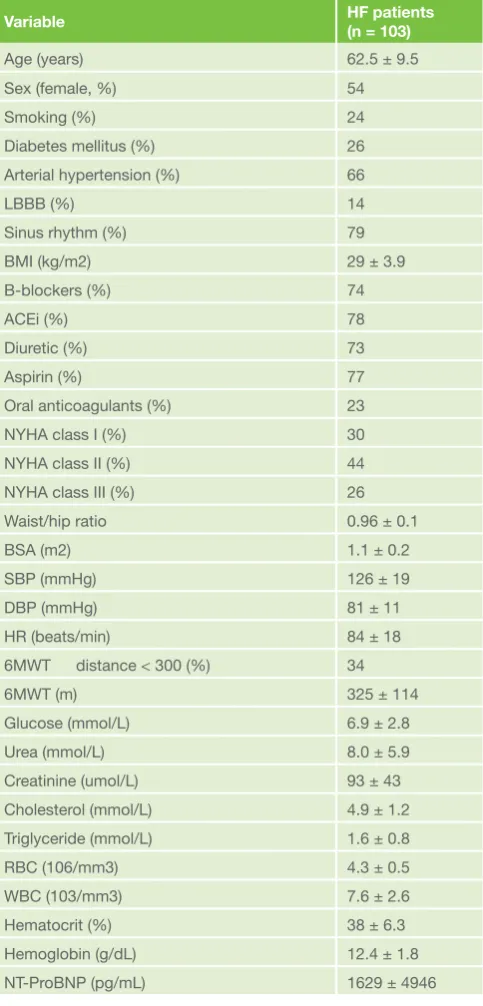
The clinical, demographic and quality of life data of the study patients are presented in Table 1. Of study patients, 78% were receiving ACE inhibitors or ARB, 74% beta-blockers, 77% aspirin
Table 1. Clinical and biochemical data of the study patients
Variable HF patients(n = 103)
Age (years) 62.5 ± 9.5
Sex (female, %) 54
Smoking (%) 24
Diabetes mellitus (%) 26
Arterial hypertension (%) 66
LBBB (%) 14
Sinus rhythm (%) 79
BMI (kg/m2) 29 ± 3.9
B-blockers (%) 74
ACEi (%) 78
Diuretic (%) 73
Aspirin (%) 77
Oral anticoagulants (%) 23
NYHA class I (%) 30
NYHA class II (%) 44
NYHA class III (%) 26
Waist/hip ratio 0.96 ± 0.1
BSA (m2) 1.1 ± 0.2
SBP (mmHg) 126 ± 19
DBP (mmHg) 81 ± 11
HR (beats/min) 84 ± 18
6MWT distance < 300 (%) 34
6MWT (m) 325 ± 114
Glucose (mmol/L) 6.9 ± 2.8
Urea (mmol/L) 8.0 ± 5.9
Creatinine (umol/L) 93 ± 43
Cholesterol (mmol/L) 4.9 ± 1.2
Triglyceride (mmol/L) 1.6 ± 0.8
RBC (106/mm3) 4.3 ± 0.5
WBC (103/mm3) 7.6 ± 2.6
Hematocrit (%) 38 ± 6.3
Hemoglobin (g/dL) 12.4 ± 1.8
NT-ProBNP (pg/mL) 1629 ± 4946
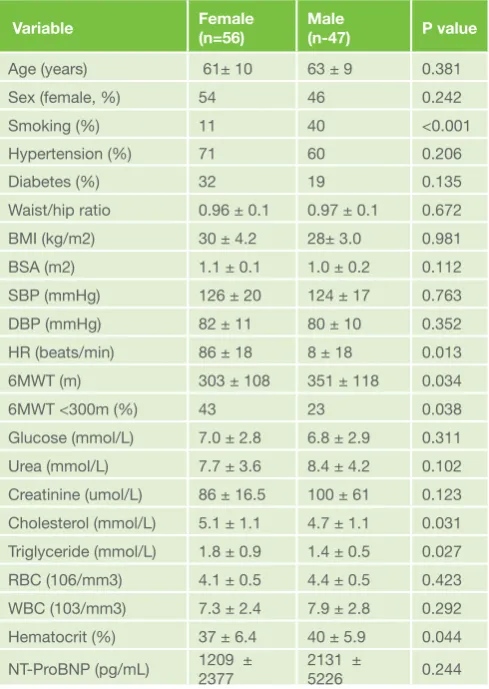
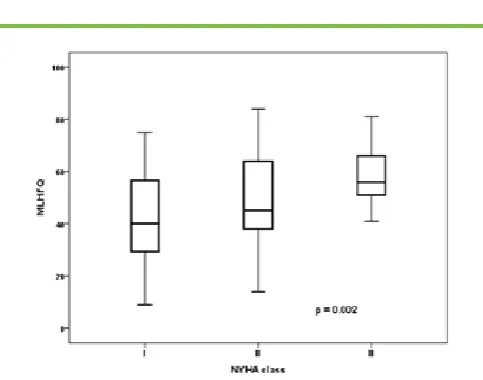
and 23% oral anticoagulants, and 79 % of them were in sinus rhythm. The data of the patients’ quality of life are presented in Table 2. Female patients walked less during 6-MWT (p=0.034) had higher blood cholesterol level (p=0.031, Table 3) had higher total (p=0.015), emotional (p=0.022) and physical (p=0.019, Table 4) MLHFQ compared to male patients. The MLHFQ score had good correlation with 6MWT distance (p<0.001, Table 5, Figure 1) and significant but weak correlation with heart rate (p=0.036), whereas not significant correlation was found between MLHFQ score and NTproBNP level (p=0.364). Significant relationship was found also between MLWHQ and NYHA functional class in HF patients (p=0.002 for total, p=0.026 for emotional, and p<0.001 for physical MLHFQ score, Table 6). NYHA functional class also significantly correlated with 6MWT distance (p<0.001 Table 6).
Discussion
Findings: We proved that the translated Albanian version of the MLHFQ proposed in this study was valid for HF patients and served as a new and important instrument for assessing QoL in Kosovo’s patients. As the QoL, i.e., relief of symptoms, is as important as duration of life in patients with advanced disease in general, and in HF patients in particular [17,18]. We underwent this modest study to see the possible introduction of the translated in Albanian MLHFQ in Kosovo’s patients. We did not found any difficulty in translation and/or interpretation of the questionnaire. However, we found that some elderly and some patients with low educational level had difficulties in its using and they required help of the professionals to fulfill it.
The other important finding of our study is that the MLHFQ was mildly higher in our patients compared with previous studies in different countries and in different languages [3,19]. We believe that this higher MLHFQ score in our population could be due to the luck of the specialized HF units in our health institution as well as the luck of physical activity trainings in our institution that could reflect higher physical QoL scoring, compared with the institutions in previously published studies in different countries [20, 21, 22]. On the other hand, our study patients are at age that almost all of them suffered the Kosovo war, and many of them loosed their relatives and friends in the last war. This could be the reason of the higher emotional score in these patients, who we
Table 2. Characteristics of the quality of life of the study patients
Variable HF patients(n = 103) Means ± SD
Minnesota Living with Heart Failure (points)
Global Score 49.6 ± 17.7
Physical dimension 23.3 ± 8.3
Emotional dimension 9.5 ± 4.7
Table 3. Gender differences of clinical and biochemical indices of the study patients
Variable Female(n=56) Male(n-47) P value
Age (years) 61± 10 63 ± 9 0.381
Sex (female, %) 54 46 0.242
Smoking (%) 11 40 <0.001
Hypertension (%) 71 60 0.206
Diabetes (%) 32 19 0.135
Waist/hip ratio 0.96 ± 0.1 0.97 ± 0.1 0.672
BMI (kg/m2) 30 ± 4.2 28± 3.0 0.981
BSA (m2) 1.1 ± 0.1 1.0 ± 0.2 0.112
SBP (mmHg) 126 ± 20 124 ± 17 0.763
DBP (mmHg) 82 ± 11 80 ± 10 0.352
HR (beats/min) 86 ± 18 8 ± 18 0.013
6MWT (m) 303 ± 108 351 ± 118 0.034
6MWT <300m (%) 43 23 0.038
Glucose (mmol/L) 7.0 ± 2.8 6.8 ± 2.9 0.311
Urea (mmol/L) 7.7 ± 3.6 8.4 ± 4.2 0.102
Creatinine (umol/L) 86 ± 16.5 100 ± 61 0.123
Cholesterol (mmol/L) 5.1 ± 1.1 4.7 ± 1.1 0.031
Triglyceride (mmol/L) 1.8 ± 0.9 1.4 ± 0.5 0.027
RBC (106/mm3) 4.1 ± 0.5 4.4 ± 0.5 0.423
WBC (103/mm3) 7.3 ± 2.4 7.9 ± 2.8 0.292
Hematocrit (%) 37 ± 6.4 40 ± 5.9 0.044
NT-ProBNP (pg/mL) 1209 ± 2377 2131 ± 5226 0.244 BMI: body mass index; BSA: body surface area; SBP: systolic blood pressure; DBP: diastolic blood pressure; HR: heart rate; NYHA: New York Heart Association; 6MWT: six-minute walk test: RBC: red blood cell; WBC: white blood cell.
Table 4. Gender differences of quality of life of the study patients indices in HF
Variable Female(n = 56) Male(n = 47) P value
Global Score 53 ± 14 45 ± 20 0.015
Physical dimension (score) 25 ± 7 21 ± 9 0.019
Emotional dimension (score) 10 ± 4 3.4 ± 5 0.022
believe that in addition to the HF symptoms and limited exercise capacity, they have higher rate of depression as compared with previous studies done in other countries.
We found also that female have poorer quality of life than male HF patients. This finding is in line with previous studies [7, 23]. The female subjects in our country, traditionally less exercise during their life, the fact that could find the female HF patients less physically trained and this could be the important factor for their higher MLHFQ score, reflecting their poorer physical capability that the man had. On the other hand, in our country the educational level of female was traditionally lower, which could affect their emotional intolerance with their chronic disease and then their poorer QoL. The other important finding of our study was that QoL had inverse
correlation with functional NYHA class and exercise capacity, assessed by 6MWT. This finding is in accordance with previous studies [24], and it was expecting result as the higher functional NYHA class should affect QoL in these patients. On the other hand the correlation of the QoL expressed by MLHFQ, found to have a good relationship with exercise capacity, expressed by 6 MWT distance. This finding is in line with previous studies [25, 26].
Limitations of the study: We did not compare this questionnaire to any other such as the SF-36. Although the questionnaire ought to be completed by the patient, but the characteristics of our population required that many receive help in this task from a nurse.
Conclusions
The Albanian version of the MLHFQ proposed in this study proved to be valid for HF patients and served as a new and important instrument for assessing QoL in Kosovo’s patients. The MLHFQ was mildly higher in our patients compared with previous studies and was higher in female patients. The questionnaire score correlates with functional NYHA class, reflecting the severity of the disease, and with 6 minute walk test, reflecting exercise capacity.
Declarations of Interest
The authors declare no conflicts of interest.
Acknowledgements
The authors state that they abide by the “Requirements for Ethical Publishing in Biomedical Journals” [27].
References
1. Bajraktari G, Kurtishi I, Rexhepaj N, Tafarshiku R, Ibrahimi P, Jashari F, et al. Gender related predictors of limited exercise capacity in heart failure. IJC Heart Vessels. 2013 Dec;1:11–6.
2. Chizzola PR, Gonçalves de Freitas HF, Marinho NVS, Mansur JA, Meneghetti JC, Bocchi EA. The effect of beta-adrenergic receptor antagonism in cardiac sympathetic neuronal remodeling in patients with heart failure. Int J Cardiol. 2006 Jan 4;106(1):29–34.
3. Carvalho VO, Guimarães GV, Carrara D, Bacal F, Bocchi EA. Validation of the Portuguese version of the Minnesota Living with Heart Failure Questionnaire. Arq Bras Cardiol. 2009 Jul;93(1):39–44.
4. Bytyçi I, Bajraktari G. Mortality in heart failure patients. Anatol J Cardiol. 2015 Jan;15(1):63–8.
5. Ibrahimi P. Predictors of exercise capacity in heart failure. Int Cardiovasc Forum J. 2015 Mar 29;1(1):37.
6. McMurray JJ, Stewart S. Epidemiology, aetiology, and prognosis of heart failure. Heart Br Card Soc. 2000 May;83(5):596–602.
7. Parajón T, Lupón J, González B, Urrutia A, Altimir S, Coll R, et al. [Use of the Minnesota Living With Heart Failure Quality of Life Questionnaire in Spain]. Rev Esp Cardiol. 2004 Feb;57(2):155–60.
8. McMurray JJV, Adamopoulos S, Anker SD, Auricchio A, Böhm M, Dickstein K, et al. ESC guidelines for the diagnosis and treatment of acute and chronic heart failure 2012: The Task Force for the Diagnosis and Treatment of Acute and Chronic Heart Failure 2012 of the European Society of Cardiology. Developed in collaboration with the Heart Failure Association (HFA) of the ESC. Eur J Heart Fail. 2012 Aug;14 (8):803–69.
9. Hoekstra T, Lesman-Leegte I, van Veldhuisen DJ, Sanderman R, Jaarsma T. Quality of life is impaired similarly in heart failure patients with preserved and reduced ejection fraction. Eur J Heart Fail. 2011 Sep;13(9):1013–8. 10. Lesman-Leegte I, Jaarsma T, Coyne JC, Hillege HL, Van Veldhuisen DJ,
Sanderman R. Quality of life and depressive symptoms in the elderly: a comparison between patients with heart failure and age- and gender-matched community controls. J Card Fail. 2009 Feb;15(1):17–23. 11. Stevenson LW. Design of therapy for advanced heart failure. Eur J Heart
Fail. 2005 Mar 16;7(3):323–31.
12. Jaarsma T, Beattie JM, Ryder M, Rutten FH, McDonagh T, Mohacsi P, et al. Palliative care in heart failure: a position statement from the palliative care workshop of the Heart Failure Association of the European Society of Cardiology. Eur J Heart Fail. 2009 May;11(5):433–43.
13. Iqbal J, Francis L, Reid J, Murray S, Denvir M. Quality of life in patients with chronic heart failure and their carers: a 3-year follow-up study assessing hospitalization and mortality. Eur J Heart Fail. 2010 Sep;12(9):1002–8. Table 5. Correlations of clinical variables with MLHFQ
Variable R P
Age 0.066 0.522
BMI 0.060 0.545
6MWT distance -0.446 <0.001
Creatinine -0.009 0.928
Glicemia -0.041 0.682
Hemoglobin -0.189 0.056
Heart rate 0.207 0.036
Waist/hips ratio 0.013 0.893
BMI: body mass index; MLHFQ: Minnesota Living With Heart Failure Questionnaire; 6 MWT: Six Minute Walk Test.
Table 6. Correlation of NYHA class and MLHF and other clinical indices
NYHA I
mean±sd NYHA II mean±sd NYHA III mean±sd p
MLHF total 42±18 50±18 58±11 0.00
MLHF emotional 8.2±4.6 9.2±5 11±3.7 0.026
MLHF physical 19.0±8.9 23.6±8.3 28±4.7 <0.001
6MWT 376±90 334±106 251±11 <0.001
MLHF: Minnesota Living with Heart Failure; 6MWT: 6 minute walk test.
14. Rector TS, Cohn JN. Assessment of patient outcome with the Minnesota Living with Heart Failure questionnaire: reliability and validity during a randomized, double-blind, placebo-controlled trial of pimobendan. Pimobendan Multicenter Research Group. Am Heart J. 1992 Oct;124(4):1017–25.
15. Bajraktari G. The Kosovo Society of Cardiology. Int Cardiovasc Forum J [Internet]. 2015 May 12 [cited 2016 Sep 18];2(1). Available from: http:// icfjournal.org/icfj/index.php/icfj/article/view/93
16. Ingle L, Rigby AS, Nabb S, Jones PK, Clark AL, Cleland JGF. Clinical determinants of poor six-minute walk test performance in patients with left ventricular systolic dysfunction and no major structural heart disease. Eur J Heart Fail. 2006 May;8(3):321–5.
17. Dobre D, de Jongste MJL, Haaijer-Ruskamp FM, Sanderman R, van Veldhuisen DJ, Ranchor AV. The enigma of quality of life in patients with heart failure. Int J Cardiol. 2008 Apr 25;125(3):407–9.
18. Austin BA, Wang Y, Smith GL, Vaccarine V, Krumholz HM, McNamara RL. Systolic function as a predictor of mortality and quality of life in long-term survivors with heart failure. Clin Cardiol. 2008 Mar;31(3):119–24. 19. Ruiz Comellas A, Pera G, Baena Díez JM, Mundet Tudurí X, Alzamora Sas
T, Elosua R, et al. [Validation of a Spanish Short Version of the Minnesota Leisure Time Physical Activity Questionnaire (VREM)]. Rev Esp Salud Pública. 2012 Oct;86(5):495–508.
20. Brokalaki H, Patelarou E, Giakoumidakis K, Kollia Z, Fotos NV, Vivilaki V, et al. Translation and validation of the Greek “Minnesota Living with Heart Failure” questionnaire. Hell J Cardiol HJC Hellēnikē Kardiologikē Epitheōrēsē. 2015 Feb;56(1):10–9.
21. Moon JR, Jung YY, Jeon E-S, Choi J-O, Hwang JM, Lee S-C. Reliability and validity of the Korean version of the Minnesota Living with Heart Failure Questionnaire. Heart Lung J Crit Care. 2012 Feb;41(1):57–66.
22. Huang T-Y, Moser DK, Hsieh Y-S, Lareau SC, Durkin AC, Hwang S-L. Validation of Chinese version of the Modified Pulmonary Functional Status and Dyspnea Questionnaire with heart failure patients in Taiwan. Am J Crit Care Off Publ Am Assoc Crit-Care Nurses. 2008 Sep;17(5):436–42. 23. Naveiro-Rilo JC, Diez-Juárez DM, Romero Blanco A, Rebollo-Gutiérrez F,
Rodríguez-Martínez A, Rodríguez-García MA. Validation of the Minnesota living with heart failure questionnaire in primary care. Rev Esp Cardiol. 2010 Dec;63(12):1419–27.
24. Santos JJA dos, Plewka JEA, Brofman PRS. Quality of life and clinical indicators in heart failure: a multivariate analysis. Arq Bras Cardiol. 2009 Aug;93(2):159–66.
25. Garin O, Ferrer M, Pont A, Rué M, Kotzeva A, Wiklund I, et al. Disease-specific health-related quality of life questionnaires for heart failure: a systematic review with meta-analyses. Qual Life Res Int J Qual Life Asp Treat Care Rehabil. 2009 Feb;18(1):71–85.
26. Carvalho EEV de, Costa DC, Crescêncio JC, Santi GLD, Papa V, Marques F, et al. Heart failure: comparison between six-minute walk test and cardiopulmonary test. Arq Bras Cardiol. 2011 Jul;97(1):59–64.