International Journal of Research Publications Volume 2 – Issue. 1, April 2018
Evaluation of Quality Attributes during Storage of Ready-To-Serve (RTS) Beverage Prepared from Bael (Aegle marmelos L.) Fruit S. Gayathiri, T. Mahendran and M. R. Roshana Department of Agricultural Chemistry, Faculty of Agriculture, Eastern University, Sri Lanka
Abstract
A research was carried out to formulate the ready-to-serve functional beverage using different pulp concentration and to assess the quality of beverages during storage. Bael fruit pulp concentrations of 2, 4, 6, 8, 10 and 12 % of were used with sugar, citric acid, distilled water and 70ppm of potassium metabisulphite, considering the findings of preliminary studies and Sri Lankan Standards (SLS 729) for RTS fruit beverage. Based on the physico-chemical, microbial and sensory analysis, and the most preferred bael RTS beverage with fruit pulp concentrations of 4, 6 and 8% combinations were selected for storage studies. The formulated beverages were stored at ambient temperature of 30±1°C and relative humidity of 70-75% for 12 weeks. Beverages were subjected to quality assessments at two weeks interval for the entire storage period. Among the treatments, beverage prepared from 6% of pulp concentration contained 3.48mg/100ml of ascorbic acid, 0.91% of titratable acidity, 11.61% of total sugar and 9.50% of total soluble solid at the end of 12 weeks of entire storage period. The results of organoleptic assessment showed that there were significant differences (p<0.05) among the treatments in terms of colour, taste, consistency, aroma and overall acceptability. From the results of quality assessments, beverage produced with 6% of pulp concentration could be stored at 30±1°C of temperature and 70-75% relative humidity for a minimum period of 12 weeks without any significant changes in the quality characteristics Keywords; Bael fruit; Functional beverage; Physico-chemical analysis; Sensory qualities Corresponding author. Tel.: +94774803833 E-mail address: mrroshana30@gmail.com
International Journal of Research Publications
Volume-3, Issue-1,April 2018
Accepted and Published Manuscript
EVALUATION OF QUALITY ATTRIBUTES DURING STORAGE
OF READY-TO-SERVE (RTS) BEVERAGE PREPARED FROM
BAEL (Aegle marmelos L.) FRUIT
M. R. Roshana , T. Mahendran , S. Gayathiri
PII : M. R. Roshana .100315201879
DOI: 100315201879
Web: http://ijrp.org/paper_detail/80
To appear in: International Journal of Research Publication (IJRP.ORG)
Received date: 17 Apr 2018
Accepted date: 28 Apr 2018
Published date: 06 May 2018
Please cite this article as: M. R. Roshana , T. Mahendran , S. Gayathiri ,
EVALUATION OF QUALITY ATTRIBUTES DURING STORAGE OF
READY-TO-SERVE (RTS) BEVERAGE PREPARED FROM BAEL
(Aegle marmelos L.) FRUIT , International Journal of Research
Publication (Volume: 3, Issue: 1), http://ijrp.org/paper_detail/80
Available online at www.ijrp.org
International Journal of Research Publications
Volume 2 – Issue. 1, April 2018
Evaluation of Quality Attributes during Storage of Ready-To-Serve
(RTS) Beverage Prepared from Bael (Aegle marmelos L.) Fruit
S. Gayathiri, T. Mahendran and M. R. Roshana
Department of Agricultural Chemistry, Faculty of Agriculture, Eastern University, Sri Lanka
Abstract
A research was carried out to formulate the ready-to-serve functional beverage using different pulp concentration and to assess the quality of beverages during storage. Bael fruit pulp concentrations of 2, 4, 6, 8, 10 and 12 % of were used with sugar, citric acid, distilled water and 70ppm of potassium metabisulphite, considering the findings of preliminary studies and Sri Lankan Standards (SLS 729) for RTS fruit beverage. Based on the physico-chemical, microbial and sensory analysis, and the most preferred bael RTS beverage with fruit pulp concentrations of 4, 6 and 8% combinations were selected for storage studies. The formulated beverages were stored at ambient temperature of 30±1°C and relative humidity of 70-75% for 12 weeks. Beverages were subjected to quality assessments at two weeks interval for the entire storage period. Among the treatments, beverage prepared from 6% of pulp concentration contained 3.48mg/100ml of ascorbic acid, 0.91% of titratable acidity, 11.61% of total sugar and 9.50% of total soluble solid at the end of 12 weeks of entire storage period. The results of organoleptic assessment showed that there were significant differences (p<0.05) among the treatments in terms of colour, taste, consistency, aroma and overall acceptability. From the results of quality assessments, beverage produced with 6% of pulp concentration could be stored at 30±1°C of temperature and 70-75% relative humidity for a minimum period of 12 weeks without any significant changes in the quality characteristics
Keywords; Bael fruit; Functional beverage; Physico-chemical analysis; Sensory qualities
Corresponding author. Tel.: +94774803833
2 Gayathiri et al. / International Journal of Research Publications (IJRP.ORG)
1.Introduction
Fruits and their value added products plays an crucial role in human diet because they provide most of the vital nutrients especially vitamins, carbohydrates, protein and minerals required for normal growth and development of the human body which leads to maintain healthy physique and mind. Normal consumption of fruits significantly reduces the risk of heart diseases, stress, and premature aging due to the antioxidant
properties of fruits (Sindumathi et al., 2015). Nowadays people prefer food or beverage which has
physiological benefits besides basic nutrition to reduce the risk of chronic diseases. RTS beverages have been increasingly gaining popularity throughout the country due to their health and nutritional benefits, apart from pleasant flavour and taste. Fruit based RTS beverages are not only rich in essential minerals, vitamins and other nutritive factors but also are delicious and have a universal appeal.
Bael (Aegle marmelos L.) is one of the most useful medicinal fruit. The common name of Bael is stone
apple. It contains many vitamins like vitamin C, vitamin A, thiamine, riboflavin, niacin, and minerals like
calcium, and phosphorus (Bag et al., 2011). Bael fruit is very rich in vitamins, amino acids and minerals when
compared to other fruits (Charoensiddhi and Anprung, 2010), and it can contribute significantly to the daily nutrient needs of the individual. In addition, it can be used advantageously to supplement deficiencies of other
foods (Baliga et al., 2011).
People have a preference for value added products than for consuming it as a completely edible fruit. The different parts of bale plant contain number of coumarins, alkaloids, sterols and essential oils. Various parts of this plant such as leaves, fruit and seed possess hypoglycaemic, hypolipidemic and blood pressure lowering
property (Lmbole et al., 2010). The peel of the fruit which is a very hard shell and green to brown in colour
depends on ripening stage. The appearance of yellow or orange edible pulp is like a boiled pumpkin, possesses a slightly sweet taste and a characteristic floral, terpene-like aroma, very fragrant and pleasantly flavored. Seeds are surrounded by slimy transparent mucilage (Suvimol and Pranee, 2008).
Ready-To-Serve (RTS) fruit drink is a type of fruit beverage which contains at least 10% fruit and 10% TSS besides about 0.5% acid intended for consumption without dilution and prepared from unfermented pure fruit juice with or without some of the pulp and containing any soluble carbohydrate and water (SLS 729:1985). Adding preservatives such as sulphur dioxide and benzoic acid can increase the shelf life of RTS beverages. In this research, Ready-To-Serve (RTS) beverage was prepared using bale fruit juice at different pulp concentrations and kept in ambient conditions in order to study the quality and shelf life during storage.
2.Materials and Methods
2.1 Preparation of RTS beverages of Bael fruit
The ripe bale fruit was taken. The fruit pulp along with its seeds and fibers was scooped with the help of stainless steel spoon. Amount of water equal to the weight of pulp was added. The mixture of pulp and water was then heated up to 70°C for 1 minute and cooled. The amount of bale fruit pulp was changed to prepare different pulp concentration of RTS beverage.
Gayathiri et al. / International Journal of Research Publications (IJRP.ORG) 3
Six formulations of 4, 6, 8, 10, 12 and 14% of pulp were prepared with one kilogram in each concentration for the final product. The requisite amount of sugar and citric acid were dissolved in requisite amount of water to prepared sugar syrup in heating condition and then mixed with bale fruit pulp in RTS beverage. Same amount (0.07g) of potassium metabisulphite was added for all the six recipes as a preservative, considering the standard limit specified by the Sri Lankan standards institute (SLS.729:1985) for the RTS fruit beverages. Just after addition of KMS, hot filling was done into already sterilized glass bottles and capped with stopper immediately. The sealed bottles were put in the hot water bath at 80°C for 30 minutes for pasteurization.
The treatment formulations are given below:
T1 - 2% Bael fruit pulp concentration
T2 - 4% Bael fruit pulp concentration
T3 - 6% Bael fruit pulp concentration
T4 - 8% Bael fruit pulp concentration
T5 - 10% Bael fruit pulp concentration
T6 - 12% Bael fruit pulp concentration
2.2 Storage Studies
Based on the physico-chemical and sensory analysis, the most preferred bael RTS beverage with 4, 6 and 8% combinations were selected for storage studies. They were stored at ambient temperature 30±1°C and relative humidity70-75% for 12 weeks and were assessed to shelf life. Three replications were prepared per each treatment. The physico-chemical characteristics such as titrable acidity, ascorbic acid, total soluble solid and total sugar were analyzed in two weeks interval and observations were also carried out to evaluate the samples during storage.
3.Results and Discussion
3.1 Shelf Life Evaluation of Bael Pulp RTS Beverages
Based on the Physico-chemical and sensory analysis of freshly made bael pulp RTS beverages, the most preferred three RTS treatments were selected for storage studies. They were stored at the existing temperature of 30±1°C and relative humidity of 70-75% in storage room condition.
The most preferred treatments are,
T2 - 4% of Bael fruit pulp
T3 - 6% of Bael fruit pulp
T4 - 8% of Bael fruit pulp
3.2 Changes of Physico-Chemical Qualities of Bael RTS Beverage during Storage
3.2.1 Ascorbic acid
4 Gayathiri et al. / International Journal of Research Publications (IJRP.ORG)
The values are means of triplicates
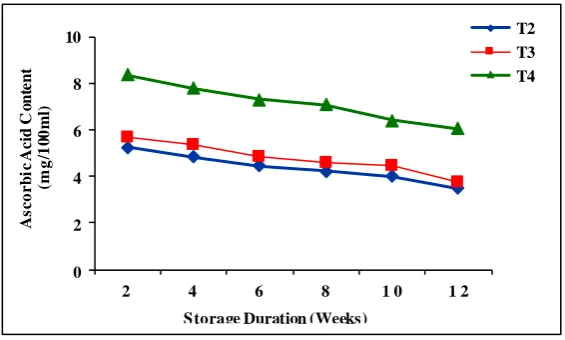
Figure 1: Changes in Ascorbic Acid content of Bael RTS Beverage during Storage
Our findings were in agreement with Singh et al. (2015) and they have reported decline in the ascorbic acid
content of bael-aonla RTS beverage during six months storage. Similar reduction in ascorbic acid was also reported by Nagpal and Rajyalakshmi (2009) in bael-citrus fruit blends. The reason for ascorbic acid reduction during storage period was due to the fact that ascorbic acid being sensitive to oxygen, light and heat is easily oxidized in presence of oxygen by both enzymatic and non-enzymatic catalyst from ascorbic acid to dehydroascorbic acid. The similar finding was given in jamun beverages (Das, 2009). According to Srilakshimi (2001), if fruits are bruised, peeled, cooked or exposed to air, alkali or copper large amounts of the ascorbic acid may be oxidized.
3.2.2 Total Soluble Solids (TSS)
The changes in TSS of different formulations along with the storage period are given in the Table 1. The maximum (9.93°Brix) and minimum (9.46°Brix) mean values of TSS was observed in treatment which had
6% bael pulp and 4% bael pulp in respectively 2nd, 12th weeks of storage period.
Table 1: Changes in Total Soluble Solids of Bael RTS Beverage during Storage
Values are means of triplicates ± Standard error
Storage Duration
(Weeks)
T2 T3 T4
2 9.87±0.09a 9.93±0.09a 9.80±0.16a
4 9.80±0.16a 9.87±0.09a 9.73±0.09a
6 9.73±0.10a 9.73±0.10a 9.73±0.10a
8 9.60±0.30a 9.70±0.10a 9.67±0.00a
10 9.53±0.10a 9.73±0.10a 9.53±0.10a
12 9.50±0.10a 9.50±0.01a 9.46±0.01a 0 2 4 6 8 10
2 4 6 8 1 0 1 2
T2 T3 T4
Storage Duration (Weeks)
Gayathiri et al. / International Journal of Research Publications (IJRP.ORG) 5
The TSS of RTS beverages decreased slightly with the increase in storage duration. Similarly, Saklani et
al. (2012) indicated that the TSS of the Sea buckthorn RTS Beverage decreased with increased period of
storage in all the treatments for 120 days. Similarly also reported by Puranik et al. (2013) in herbal functional
RTS beverage. The TSS reduced gradually which might be due to the chemical interactions taking place among the organic constituents of the beverage (Ghorai and Khurdiya, 1998).
3.2.3 Titrable acidity
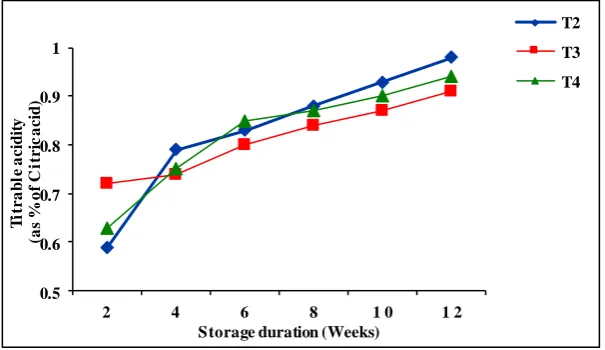
The changes in titrable acidity of bael fruit RTS functional beverages during storage are shown in Figure 2. The changes in titrable acidity of bael pulp RTS beverages during storage period had increasing trend throughout the storage period in all treatments but the acidity values were within the standard limits specified by the Sri Lankan Standards Institute (SLS 729:1985) for the RTS fruit beverages.
The increase in acidity during storage of bael-aonla beverage blends might be due to formation of organic
acids by the degradation of ascorbic acid (Singh et al., 2015). Similar results were in conformity with findings
of Sharma et al. (2012) in overall acceptability of guava-jamun blends RTS drink and squash, Joshi et al.
(2012) in the preparation of tamarind RTS beverages.
Values are means of triplicates
Figure 2: Changes in Titrable Acidity of Bael RTS Beverage during Storage
3.2.4 Total sugar
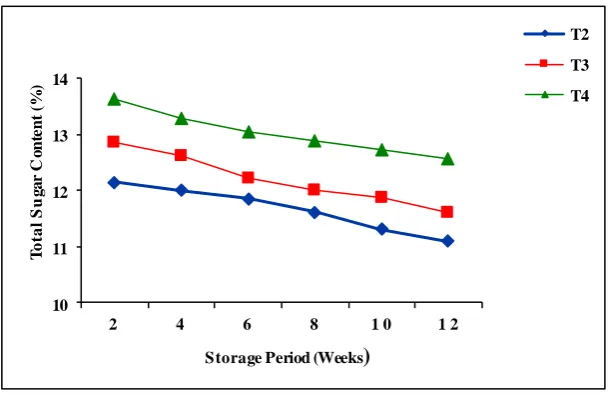
The changes in total sugar of bael pulp RTS beverages during storage are shown in Figure 3. According to DMRT, total sugar decreased significantly (p<0.05) throughout the storage period. This could be due to high polymerization of sugars at high temperature as discusses by Fennema (1996). Total sugar in all treatments had the decreasing trend with the storage period because hydrolysis of polysaccharides and oxidation of sugars took place during the storage period. Nilugin and Mahendran (2010) found that the significant reduction in total sugar throughout the storage period at ambient temperature in the RTS beverages.
0.5 0.6 0.7 0.8 0.9 1
2 4 6 8 1 0 1 2
T it r a b le a c id it y (a s % o f C it r ic a c id )
Storage duration (Weeks)
T2
T3
6 Gayathiri et al. / International Journal of Research Publications (IJRP.ORG)
Values are means of triplicates
Figure 3: Changes in Total Sugar Content of Bael Pulp RTS Beverage during Storage
The declining trends of total sugar was reported by Saranyah and Mahendran (2015) in pineapple blend
watermelon RTS beverage. Similar, results have also been reported by Saklani et al. (2012) indicated that the
total sugar of the Sea buckthorn RTS Beverage decreased with increased period of storage in all the treatments for 120 days.
3.3 Sensory qualities of bael pulp RTS Beverages during Storage
Sensory evaluation was done for three selected bael pulp RTS beverage after a period of 12 weeks through a panel of 30 semi-trained panellists. The panel evaluated colour, aroma, consistency, taste, and overall acceptability. A 7-point hedonic scale was used for this purpose. Organoleptic quality determines the storage stability of any prepared product. Organoleptic characters of bael pulp RTS Beverages stored at ambient conditions were changed slightly apart from freshly made RTS beverages during the storage period. This is due to increase in acidity and reduction in total sugar content by oxidation reactions.
The sensory scores of sensory evaluation after 12 weeks of storage are given in the Table 2. Similar
findings have been reported by Jain et al. (2011) in guava and papaya fruit mixed RTS beverages.
Table 2: Sensory Evaluation of Bael pulp RTS Beverage following Storage
Sensory Attributes
T2 T3 T4
Colour 5.83±0.37b 5.83±0.37b 5.83±0.37b
Aroma 5.46±0.49b 5.46±0.49b 5.46±0.49b
Consistency 4.96±0.17c 4.96±0.17c 4.96±0.17c
Taste 4.93±0.99b 4.93±0.99b 4.93±0.99b
Overall
Acceptability 5.40±0.48
b 5.40±0.48b 5.40±0.48b
Values are means of 30 replicates ± standard error
Means with the same letters in same column are not significantly different from each other
10 11 12 13 14
2 4 6 8 1 0 1 2
T o ta l S u g a r C o n te n t (% ) T2 T3 T4
Storage Period (Weeks
)
Gayathiri et al. / International Journal of Research Publications (IJRP.ORG) 7
The statistical analysis of sensory scores showed significant difference (p<0.05) for overall acceptability of drinks during the storage of 12 weeks. From the overall acceptance rating, maximum mean score was
attained by T3 (6% of bael pulp) followed by T4 (8% of bael pulp) while minimum score was recorded in T2
(4% of bael pulp). 6% of bael pulp containing RTS beverage was selected as the most preferred formulation according to the sensory evaluation.
3.4 Microbial Studies
There was no bacterial growth was observed in the RTS beverage samples which were stored at ambient
condition after 12th weeks of storage. This may due to the inhibition of microbial growth by Potassium
metabisulphite and the low pH levels of RTS fruit beverage. The sulphites inhibit yeasts, moulds and
bacteria (Doughari and Elmahmood, 2007). Carter et al. (2007) reported that many products that could safely
be maintained sterile by a pasteurization process alone could be doubly preserved by the addition of potassium metabisulphite. Pasteurization to prevent foodborne illness also provides higher quality and a longer shelf life because of the simultaneous reduction in spoilage microflora. Therefore, the heat treatment was sufficient to destroy initial microbial load in the fruit drinks.
4.Conclusions
The bael fruit is known for its medicinal properties and is one of the most nutritious fruits. This research was done to utilize the bael fruit pulp to increase the shelf life through the development of Ready-To-Serve (RTS) beverage. The results of the study showed that 6% of bael pulp RTS beverage was selected as most preferred treatment at the end of preparation based on the chemical and organoleptic point of view. This ready to serve beverage can be stored at 30±1°C of temperature and 70-75% relative humidity up to 12 weeks without any significant changes, which also has no deleterious effect on consumers.
References
Bag, S. K., Srivastav, P. P. and Mishra, H. N. (2011). Optimization of process parameters for foaming of Bael (Aegle marmelos L.) fruit pulp. Food Bioprocess Technology. 4: 1450-1458.
Baliga, M. S., Bhat, H. P., Joseph, N. and Fazal, F. (2011). Photochemistry and medicinal uses of the bael
fruit (Aegle marmelos L.): A concise review. International Journal of Food Research. 44(7): 1768-1775.
Carter, H. W., Charley, V. L. S. and Bristol. C. (2007). The preservation of fruit juice products with special
reference to nutritional value. Journal of Cambridge. 8: 1214-1221.
Charoensiddhi, S. and Anprung, P. (2010). Characterization of bael fruit (Aegle marmelos L.) hydrolysable as
affected by enzyme treatment. Journal of Food Biochemistry. 34(6): 1249-1267.
Das, J. N. (2009). Studies on nutritional quality and storage stability of jamun beverages. Indian Journal of
Horticulture. 66(4): 508-510.
Doughari, J. H. and Elmahmood, A. M. (2007). Effect of some chemical preservatives on the shelf life of
sobo drink. African Journal of Microbiology. 2: 5-6.
8 Gayathiri et al. / International Journal of Research Publications (IJRP.ORG)
Ghorai, K. and Khurdiya, D. S. (1998). Storage of heat processed kinnow, mandarin juice. Journal of Food
Science and Technology. 35(5): 422-424.
Jain, P. K., Priyanka, J. and Prabhat, K. N. (2011). Quality of guava and papaya fruit pulp as influenced by
blending ratio and storage period. American Journal of Food Technology. 6: 507-512.
Joshi, A. A., Kshirsagar, R. B. and Sawate, A. R. (2012). Studies on standardization, preparation and quality
evaluation of tamarind RTS beverages, var. Ajanta. Beverage and Food World. 39(11): 55-57.
Lmbole, V. B., Murti, K., Kumar, U., Bhatt, S. P. and Gajera, V. (2010). Phyto-pharmacological properties of
Aegle marmelos as a potential medicinal tree: An overview. International Journal of Pharmaceutical Sciences Review and Research. 5(2): 14-26.
Nagpal, S. and Rajyalakshmi, P. (2009). Quality and storage of RTS beverage from bael and citrus fruit
blends. Beverage and Food World. 36(4): 24-25.
Nilugin, S. E. and Mahendran, T. (2010). Preparation of Ready-To-Serve (RTS) beverage from Palmyrah
fruit pulp. Journal of Agricultural Science. 5(1): 80-88.
Puranik, V., Chauhan, K. and Mishra, V. (2013). Development of herbal functional RTS beverage.
International Journal of Biotechnology Research. 1(3): 28-37.
Saklani, S., Sharma, H. R. and Singh, V. (2012). Chemical constituents and sensory acceptability of ready to
serve Sea buckthorn beverage. International Journal of Food Quality and Safety. 2(4): 23-12.
Saranyah, K. and Mahendran, T. (2015). Standardization and characterization of value added watermelon
juice (Citrullus lanatus) Ready-to-serve beverage. Sri Lanka Journal of Economics Research. 3(1): 65-78.
Sharma, M., Gehlot, R., Singh, R. and Siddiqui, S. (2012). Changes in chemical constituents and overall
acceptability of guava-jamun blends ready-to-serve drink and squash during storage. Beverage and Food
World. 39(4): 39-42.
Sindumathi, G. and Premalatha, M. R. (2015). Development and storage studies of naturally flavored papaya
pineapple blended ready-to-serve (RTS) Beverage. International Journal of Science and Research.4(2):
856-860.
Singh, O., Singh, R. and Singh, P. (2015). Studies on quality evaluation of bael-aonla ready-to-serve (RTS)
drink during storage. The Asian Journal of Horticulture. 10(1): 181-183.
Sri Lanka Standard Institute. (1985). Specifications for ready-to-serve fruit drinks SLS 729:1985. Colombo.
Srilakshmi, B. (2001). Food Science. Second Edition. New Age International Limited, India. pp. 187-277.
Suvimol, C. and Pranee, A. (2008). Bioactive compounds and volatile compounds of Thai bael fruit (Aegle
marmelos L.) Correa) as a valuable source for functional food ingredients. International Food Research Journal. 15(3): 1-9.