
D
D
I
I
S
S
C
C
O
O
V
V
E
E
R
R
I
I
N
N
G
G
T
T
H
H
E
E
O
O
R
R
E
E
M
M
S
S
A
A
B
B
O
O
U
U
T
T
T
T
H
H
E
E
G
G
A
A
U
U
S
S
S
S
I
I
A
A
N
N
M
M
E
E
R
R
S
S
E
E
N
N
N
N
E
E
S
S
E
E
Q
Q
U
U
E
E
N
N
C
C
E
E
W
W
I
I
T
T
H
H
T
T
H
H
E
E
M
M
A
A
P
P
L
L
E
E
´
´
S
S
H
H
E
E
L
L
P
P
F
Fr
ra
an
nc
ci
is
sc
co
o
R
Re
eg
gi
is
s
V
Vi
ie
ei
ir
ra
a
A
Al
lv
ve
es
s
11,
,
P
Pa
au
ul
la
a
M
Ma
ar
ri
ia
a
M
Ma
ac
ch
ha
ad
do
o
C
Cr
ru
uz
z
C
Ca
at
ta
ar
ri
in
no
o
22,
,
M
Mi
il
le
en
na
a
C
Ca
ar
ro
ol
li
in
na
a
d
do
os
s
S
Sa
an
nt
to
os
s
M
Ma
an
ng
gu
ue
ei
ir
ra
a
331 Federal Institute of Education, Scicence, Technology of Ceará - Brazil, Department of Mathematics 2 University of Trás-os-Montes - Portugal, Department of Mathematics
3 Federal Institute of Education, Scicence, Technology of Ceará - Brazil, Department of Mathematics
Corresponding Author: Alves, Francico Regis Viera; [email protected]
ABSTRACT: In Brazil, we are interested in the study of second-order recurrent numerical sequences. Such mathematical content has an enormous potential to provide a differentiated mathematical culture for the math teachers in initial training. However, it becomes important that the teacher in Brazil knows properties beyond the traditional and classic numerical sequences, such as the Fibonacci sequence, Lucas sequence, Pell sequence, Jacobsthal sequence, Narayana sequence, etc. Thus, in the present work, we present a proposal of CAS Maple as technological resources in the study and discovery of new
theorems derived from the Mersenne sequence.
Throughout the work, we show that the software allows the discovery of theorems from matrix properties derived from the Mersenne sequences and the sequence of Gaussian numbers of Mersenne. The research presented in the paper can stimulate the formation of Mathematics teachers in Brazil.
KEY WORDS: Mersenne sequence, Gaussian sequence of Mersenne, Theorems, Teacher training, Technology.
1. INTRODUCTION
In the context of the formation of Mathematics teachers in Brazil, we sometimes observe a tendency of authors of Mathematical History books to dedicate an exagerated attention only to the bases of differential and integral calculus, while other mathematical contents, from the point of view of their historical origin and emergence, remain disregarded by the books of History of Mathematics published and used in Brazilian universities. ([AA18]).
On the other hand, an important aspect related to the teaching of Mathematics in the historical, mathematical and evolutionary context concerns the possibilities of using the technology and its possibilities, with the interest of providing Mathematics teachers in Brazil a differentiated itinerary for direct contact both with Mathematics, as well as the perception of the potentialities of the current Technology and the implementation of a scientific research itinerary with an extended set of
theoretical and conceptual tools.
From these preliminary considerations, we consider the Mersenne sequence as an object of discussion and study. We consider the following set indicating
some of these values
(0, 1, 3, 7, 15, 31, 63, 127, … , 𝑀(𝑛)).
The Mersenne numbers are defined recurrently by the inhomogeneous equation 𝑀(𝑛 + 1) = 2𝑀(𝑛) + 1. On the other hand, we can write 𝑀(𝑛 + 2) = 2𝑀(𝑛 + 1) + 1. From these two equations, we can easily get a homogeneous equation ([CCV16]). In fact, we write 𝑀(𝑛 + 2) − 𝑀(𝑛 + 1) = 2𝑀(𝑛 + 1) − 2𝑀(𝑛) + 1) = 2𝑀(𝑛 + 1) − 2𝑀(𝑛) . Finally, we have 𝑀(𝑛 + 2) = 3𝑀(𝑛 + 1) − 2𝑀(𝑛). From this, we take the following mathematical definition for the Mersenne sequence.
Definition 1: The Mersenne sequence is defined by the recurrently relation indicated 𝑀(𝑛 + 2) = 3𝑀(𝑛 + 1) − 2𝑀(𝑛), with initial conditions 𝑀(0) = 0, 𝑀(1) = 1, 𝑛 ≥ 0.
Moreover, we can determine the elements of the set (𝑀(−𝑛)). Let's look at some of them in the list below, for every integer 𝑛 ≥ 0:
(… , 𝑀−𝑛, … . , − 7 8, −
3 4, −
1
2, 0,1,3,7, … , 𝑀𝑛, … )
However, directly from the fundamental recurrence relation 𝑀𝑛+2= 3𝑀𝑛+1− 2𝑀𝑛, 𝑛 ≥ 0 we can determine such elements indicated by 〈𝑀−𝑛〉𝑛∈ℕ, considering now the set of the negative integer indices.
We can also consider that 𝑀𝑛+2= 3𝑀𝑛+1− 2𝑀𝑛 ↔
↔𝑀𝑛+2 𝑀𝑛+1
= 3 − 2 𝑀𝑛 𝑀𝑛+1
↔𝑀𝑛+2 𝑀𝑛+1
= 3 − 2 1 (𝑀𝑀𝑛+1
𝑛 )
We will take 𝑀𝑛+2
equation 𝑡𝑛+2= 3 − 2. 1
𝑡𝑛+1. Finally, we consider that exists the following limit lim
𝑛→∞𝑡𝑛= 𝑡 ∈ ℝ and we can take the identity 𝑡𝑛+2. 𝑡𝑛+1= 3𝑡𝑛+1− 2. If we take the symbol of limit in the both side, we will find that 𝑡2= lim
𝑛→∞(𝑡𝑛+2𝑡𝑛+1) = lim𝑛→∞(3𝑡𝑛+1− 2) = 3𝑡 − 2 ↔ 𝑡2= 3𝑡 − 2. From this equation, we can verify that 𝑡2 = 3𝑡 − 2 = (𝑀
2. 𝑡 − 2. 𝑀1). Moreover, we can still find that 𝑡3= 𝑡. 𝑡2= (3𝑡 − 2)𝑡 = 3𝑡2− 2𝑡 = 3(3𝑡 − 2) − 2𝑡 = 7𝑡 − 2.3 = 𝑀3. 𝑡 − 2. 𝑀2. We can easily determine the roots of the quadratic equation 𝑡1− 3𝑡 + 2 = 0, with the real roots indicated by 𝑟1= 1, 𝑟2= 2. By mathematical induction, we can find that 𝑟1𝑛= 𝑀𝑛. 𝑟1− 2. 𝑀𝑛−1 and 𝑟2𝑛= 𝑀𝑛. 𝑟2− 2. 𝑀𝑛−1, for every integer 𝑛 ≥ 0. Finally, we will enunciate the first theorem.
Theorem 1: For every integer 𝑛 ≥ 0, we have: (𝑖) 𝑀𝑛= 2𝑛− 1; (𝑖𝑖) 𝑀−𝑛= −
𝑀𝑛
2𝑛.
Proof. We have already determined that 𝑟1𝑛 = 𝑀𝑛. 𝑟1− 2. 𝑀𝑛−1 and 𝑟2𝑛 = 𝑀𝑛. 𝑟2− 2. 𝑀𝑛−1. We can consider the following difference 𝑟1𝑛− 𝑟2𝑛 = (𝑀𝑛. 𝑟1− 2. 𝑀𝑛−1) − (𝑀𝑛. 𝑟2− 2. 𝑀𝑛−1) =
𝑀𝑛(𝑟1− 𝑟2). Finally, we find that 𝑀𝑛= 𝑟1𝑛−𝑟2𝑛
𝑟1−𝑟2,
where 𝑟1= 1, 𝑟2= 2. In this way, we can also write that 𝑀𝑛 =
1𝑛−2𝑛
1−2 = 2
𝑛− 1. On the other hand, we can replace the index ′𝑛′ by ′−𝑛′ and determine another formula 𝑀−𝑛= (2−𝑛− 1) = (
1 2)
𝑛 − 1 =
− 1 2𝑛(2
𝑛− 1) = (−𝑀𝑛
2𝑛), for every integer 𝑛 ≥ 0.
From the work ([CCV16]), we can consider the following matrix 𝐼𝑀 = ( 0 1
−2 3). In the subsequent section we will develop the study of several numerical and mathematical properties derived from the matrix power of the special type 𝐼𝑀𝑛 = ( 0 1
−2 3) 𝑛
and 𝐼𝑀−𝑛= ( 0 1 −2 3)
−𝑛
, where 𝑛 ≥ 0. In the first case, for example, we can determine that: 𝐼𝑀 = ( 0 1
−2 3) = (
−2𝑀0 𝑀1 −2𝑀1 𝑀2), 𝐼𝑀2= (−2 3
−6 7) = (
−2𝑀1 𝑀2 −2𝑀2 𝑀3), 𝐼𝑀3= (−6 7
−14 15) = (
−2𝑀2 𝑀3 −2𝑀3 𝑀4), 𝐼𝑀4= (−14 15
−30 31) = (
−2𝑀3 𝑀4 −2𝑀4 𝑀5), 𝐼𝑀5= (−30 31
−62 63) = (
−2𝑀4 𝑀5 −2𝑀5 𝑀6), 𝐼𝑀6= (−62 63
−126 127) = (
−2𝑀5 𝑀6 −2𝑀6 𝑀7), 𝐼𝑀7= (−126 127
−254 255) = (
−2𝑀5 𝑀7 −2𝑀7 𝑀8),
𝐼𝑀8= (−254 255 −510 511) = (
−2𝑀7 𝑀8 −2𝑀8 𝑀9), 𝐼𝑀9= (−510 511
−1022 1023) = (
−2𝑀8 𝑀9 −2𝑀9 𝑀10), 𝐼𝑀10= (−1022 1023
−2046 2047) = (
−2𝑀𝑛−1 𝑀𝑛 −2𝑀𝑛 𝑀𝑛+1), etc.
For the matrix case 𝐼𝑀−𝑛= ( 0 1 −2 3)
−𝑛
we can verify that:
𝐼𝑀−1= ( 0 1 −2 3)
−1 = (− 3 2 − 1 2 1 0 ) =
(−2 (− 3 4) −
1 2
−2 (−12) 0 ) = (
−2𝑀−2 𝑀−1 −2𝑀−1 𝑀0) , 𝐼𝑀
−2= ( 7 4 − 3 4 3 2 − 1 2
) = (−2𝑀−2𝑀−3 𝑀−2
−2 𝑀−1) = 𝑀−2, 𝐼𝑀 −3= ( 15 8 − 7 8 7 4 − 3 4
) = (−2𝑀−2𝑀−4 𝑀−3
−3 𝑀−2) = 𝑀−3, 𝐼𝑀 −4= ( 31 16 − 15 16 15 8 − 7 8
) = (−2𝑀−2𝑀−5 𝑀−4
−4 𝑀−3) = 𝑀−4, 𝐼𝑀 −5= ( 63 32 − 31 32 31 16 − 15 16
) = (−2𝑀−2𝑀−6 𝑀−5
−5 𝑀−4) = 𝑀−5, 𝐼𝑀 −6= ( 127 64 − 63 64 63 32 − 31 12
) = (−2𝑀−2𝑀−7 𝑀−6
−6 𝑀−5) = 𝑀−6, 𝐼𝑀 −7= ( 255 128 − 127 128 127 64 − 63 64
) = (−2𝑀−2𝑀−8 𝑀−7
−7 𝑀−6) = 𝑀−7, 𝐼𝑀 −8= ( 511 128 − 255 256 255 128 − 127 128
) = (−2𝑀−2𝑀−9 𝑀−8
−8 𝑀−7) = 𝑀−8,
𝑀−9, 𝑀−10, etc.
Mathematics and the History of Mathematics. ([Alv18]).
Definition 2: For every positive integer 𝑛 ≥ 0, the matrices determined by the Mersenne numbers are defined by two conditions:
(𝑖) 𝐼𝑀𝑛 = (−2𝑀−2𝑀𝑛−1 𝑀𝑛
𝑛 𝑀𝑛+1), for every integer 𝑛 ≥ 0;
(𝑖𝑖) 𝐼𝑀−𝑛= (−2𝑀−2𝑀−𝑛−1 𝑀−𝑛 −𝑛 𝑀−𝑛+1) =
(−2𝑀−2𝑀−(𝑛+1) 𝑀−𝑛
−𝑛 𝑀−(𝑛−1), for every integer 𝑛 ≥ 0. In the next section we will see a research itinerary and how the CAS Maple can help us to identify certain properties related to the Mersenne sequence. 2. DISCOVERING THEOREMS ABOUT THE
MERSENNE SEQUENCE
Now, we will explore some matrix representations related to the Mersenne sequence. We will verify that when we deal with the Mersenne sequence the operational calculation becomes quite complicated and the use of software such as Maple can provide the exploration of an investigative process based in the inductive thinking aiming the confirmation of certain important mathematical and combinatorial properties. In a preliminary way, we present some particular cases of the Mersenne sequence.
With the computational resource, we will show that matrices of type (𝐼𝑀−1)𝑛= 𝐼𝑀−𝑛= ( 0 1
−2 3) −𝑛
determine the elements of the Mersenne sequence with negative indices. Indeed, from the previous examples, we have determined, for example, that
𝐼𝑀−5= ( 63 32 −
31 32 31 16 −
15 16
) = (−2𝑀−2𝑀−6 𝑀−5
−5 𝑀−4) = 𝐼𝑀−5.
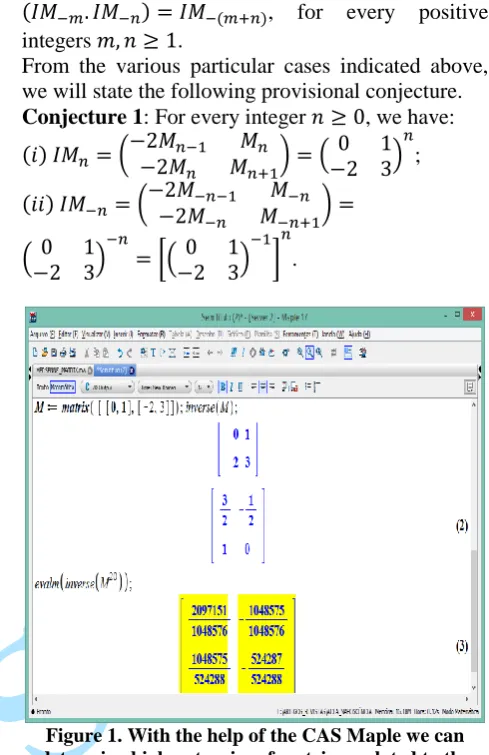
For example, in Figure 1, we show determination of the matrix
(𝐼𝑀−1)20= 𝐼𝑀−20= (−2𝑀−2𝑀−8 𝑀−7
−7 𝑀−6) = 𝐼𝑀−20. Another property and theorem that can be discovered with the aid of CAS Maple, for example, refers to the character of commutativity expressed as follows 𝐼𝑀𝑛+𝑚= (𝐼𝑀𝑛. 𝐼𝑀𝑚) = (𝐼𝑀𝑚. 𝐼𝑀𝑛) = 𝐼𝑀𝑚+𝑛, for every positive integers 𝑚, 𝑛 ≥ 1. From commutative properties involving the inverse matrices verified with the software related to inverse matrices, we can formulate mathematical conjectures such as 𝐼𝑀−(𝑛+𝑚)= (𝐼𝑀−𝑛. 𝐼𝑀−𝑚) =
(𝐼𝑀−𝑚. 𝐼𝑀−𝑛) = 𝐼𝑀−(𝑚+𝑛), for every positive integers 𝑚, 𝑛 ≥ 1.
From the various particular cases indicated above, we will state the following provisional conjecture. Conjecture 1: For every integer 𝑛 ≥ 0, we have: (𝑖) 𝐼𝑀𝑛= (
−2𝑀𝑛−1 𝑀𝑛 −2𝑀𝑛 𝑀𝑛+1) = (
0 1 −2 3)
𝑛 ; (𝑖𝑖) 𝐼𝑀−𝑛= (
−2𝑀−𝑛−1 𝑀−𝑛 −2𝑀−𝑛 𝑀−𝑛+1) =
( 0 1 −2 3)
−𝑛
= [( 0 1 −2 3)
−1 ]
𝑛 .
Figure 1. With the help of the CAS Maple we can determine high potencies of matrices related to the
Mersenne sequence (Prepared by the author)
The investigative discovery process and theorem verification can be improved with CAS Maple. In this case, we can prove, a posteriori, the veracity of the previous conjecture through the Mathematical Induction model. Immediately, by mathematical induction, we will consider that
𝐼𝑀𝑛= ( 0 1 −2 3)
𝑛
= (−2𝑀−2𝑀𝑛−1 𝑀𝑛
𝑛 𝑀𝑛+1) = (𝐼𝑀𝑛). Thus, we can directly verify that
𝐼𝑀𝑛+1= ( 0 1 −2 3)
𝑛+1
= ( 0 1 −2 3)
𝑛
. ( 0 1 −2 3) = (−2𝑀−2𝑀𝑛−1 𝑀𝑛
𝑛 𝑀𝑛+1) . ( 0 1 −2 3) = (−2𝑀−2𝑀𝑛 3𝑀𝑛− 2𝑀𝑛−1
𝑛+1 3𝑀𝑛+1− 2𝑀𝑛) =
(−2𝑀−2𝑀𝑛 𝑀𝑛+1
𝑛+1 𝑀𝑛+2) = (𝐼𝑀𝑛+1),
since we know that 𝑀𝑛+2= 3𝑀𝑛+1− 2𝑀𝑛, from definition 1. For the case of inverse matrices, we know the following relationship 𝑀−𝑛= −
𝑀𝑛
𝐼𝑀−𝑛= (−2𝑀−2𝑀−𝑛−1 𝑀−𝑛 −𝑛 𝑀−𝑛+1) =
(−2 (− 𝑀𝑛+1 2𝑛+1) −
𝑀𝑛 2𝑛
−2 (−𝑀𝑛
2𝑛) −
𝑀𝑛−1
2𝑛−1 ) = (
𝑀𝑛+1
2𝑛 −
𝑀𝑛
2𝑛
𝑀𝑛
2𝑛−1 −
𝑀𝑛−1
2𝑛−1 ) =
1 2𝑛(
𝑀𝑛+1 −𝑀𝑛
2𝑀𝑛 −2𝑀𝑛−1) = (𝐼𝑀𝑛) −1.
Finally, we can verify that
𝐼𝑀−𝑛= 𝑀𝑛−1= ((−2 30 1) 𝑛
) −1
= ( 0 1 −2 3)
−𝑛 .
Thus, with computational resources, we can finally enunciate the discovery of the following theorem related to the Mersenne sequence with the Maple´s help. We note that all properties can be verified for a broad data set provided by the CAS Maple. Thus, we can formulate the following theorem derived from some mathematical invariant elements identified in the preceding information (see figure 1).
Theorem 2: For every integer 𝑛, 𝑚 ≥ 0, we have: (𝑖) 𝐼𝑀1𝑛= ( 0 1
−2 3) 𝑛
= (−2𝑀−2𝑀𝑛−1 𝑀𝑛
𝑛 𝑀𝑛+1) = 𝐼𝑀𝑛;
(𝑖𝑖) 𝐼𝑀−𝑛= (𝐼𝑀𝑛)−1= (−2 30 1) −𝑛
; (𝑖𝑖𝑖)𝐼𝑀(𝑛+𝑚) = 𝐼𝑀𝑛. 𝐼𝑀𝑚 = 𝐼𝑀𝑚. 𝐼𝑀𝑛; (𝑖𝑣)𝐼𝑀−(𝑛+𝑚)= 𝐼𝑀−𝑛. 𝐼𝑀−𝑚= 𝐼𝑀−𝑚. 𝐼𝑀−𝑛. Proof. Just consider the above arguments.
In the following section we will present and define a second-order recurrent sequence with the introduction of an imaginary unit with the classical property 𝑖2= −1.
3. DISCOVERING THEOREMS ABOUT THE GAUSSIAN MERSENNE SEQUENCE
In this section we will introduce a new mathematical definition.
Definition 3: The Mersenne sequence is defined by the recurrently relation 𝐺𝑀𝑛+2= 3. 𝐺𝑀𝑛+1− 2. 𝐺𝑀𝑛, wtth initial conditions 𝐺𝑀0= 0 + 𝑖, 𝐺𝑀1= 1 + 3𝑖, for every integer 𝑛 ≥ 0.
From this new definition, we can determine that: 𝐺𝑀2= 3 + 7𝑖 = 𝑀2+ 𝑀3𝑖, 𝐺𝑀3= 7 + 15𝑖 = 𝑀3+ 𝑀4𝑖, 𝐺𝑀4= 15 + 31𝑖 = 𝑀4+ 𝑀5𝑖, 𝐺𝑀5= 31 + 63𝑖 = 𝑀5+ 𝑀6𝑖, 𝐺𝑀7= 127 + 255𝑖 = 𝑀7+ 𝑀8𝑖, etc. From these relations, we will see some arithmetical properties for the Gaussian numbers of Mersenne.
Let us now see some examples of the determination of the Gaussian numbers of Mersenne, for negative integer indices. In fact, we can see that if we take
𝐺𝑀−1=
3𝐺𝑀0− 𝐺𝑀1
2 =
3𝑖 − 1 − 3𝑖
2 = −
1 2 =1 + 2𝑖 − 2 − 2𝑖
2 =1 + 2𝑖
21 − (1 + 𝑖).
We can see another example if we take
𝐺𝑀−2=
3𝐺𝑀−1− 𝐺𝑀0
2 = −
3 4−
1 2𝑖 =
−3 − 2𝑖 4 =1 + 2𝑖 − 4 − 4𝑖
4 =1 + 2𝑖
22 − (1 + 𝑖).
We can also verify that: 𝐺𝑀−3= −
7 8−
3 4𝑖 =
−7−6𝑖
8 =
1+2𝑖−8−8𝑖
4 =
1+2𝑖 23 − (1 + 𝑖), 𝐺𝑀−4= −1516−78𝑖 =1+2𝑖24 − (1 + 𝑖),
𝐺𝑀−5= − 31 32−
15 16𝑖 =
1+2𝑖
25 − (1 + 𝑖), 𝐺𝑀−6= −63
64− 31 32𝑖 =
1+2𝑖
26 − (1 + 𝑖), etc.
Now, we will explore some matrix representations related to the Gaussian Mersenne sequence. We will verify that when we deal with the Gaussian Mersenne sequence the operational calculation becomes quite complicated and the use of software such as CAS Maple can provide the exploration of an investigative process based on the inductive thinking aiming at the confirmation of certain important mathematical properties. In a preliminary way, we present some particular cases of the Gaussian Mersenne sequence denoted by 〈𝐺𝑀𝑛〉𝑛∈ℕ. For this, we define the following matrix 𝐼𝑁 =
( 1 𝑖
−2𝑖 1 + 3𝑖). Next, we will use the following formal definition
Definition 4: For every positive integer 𝑛 ≥ 0, the matrices determined by the Gaussian Mersenne numbers are defined by two conditions:
(𝑖) 𝐺𝐼𝑀𝑛= (
−2𝐺𝑀𝑛−1 𝐺𝑀𝑛
−2𝐺𝑀𝑛 𝐺𝑀𝑛+1), for every integer 𝑛 ≥ 0;
(𝑖𝑖) 𝐺𝐼𝑀−𝑛= (
−2𝐺𝑀−𝑛−1 𝐺𝑀−𝑛 −2𝐺𝑀−𝑛 𝐺𝑀−𝑛+1) =
(−2𝐺𝑀−2𝐺𝑀−(𝑛+1) 𝐺𝑀−𝑛
−𝑛 𝐺𝑀−(𝑛−1)), for every integer 𝑛 ≥ 0.
Thus, for every integer 𝑛 ≥ 0, we will investigate the behavior of the following matrices indicated by ( 0 1
−2 3) 𝑛
( 1 𝑖
−2𝑖 1 + 3𝑖) and ( 0 1
−2 3) −𝑛
( 1 𝑖
determine with the help of CAS Maple, which we have the matrix property
(𝐼𝑀. 𝐼𝑁) = (𝐼𝑁. 𝐼𝑀) = (−2(1 + 3𝑖) 3 + 7𝑖−2.1𝑖 1 + 3𝑖), 𝐼𝑀2. 𝐼𝑁 = 𝐼𝑁. 𝐼𝑀2= (−2(1 + 3𝑖)−2(3 + 7𝑖) 7 + 15𝑖3 + 7𝑖 ), 𝐼𝑀3. 𝐼𝑁 = 𝐼𝑁. 𝐼𝑀3= (−2(7 + 15𝑖) 15 + 31𝑖−2(3 + 7𝑖) 7 + 15𝑖), 𝐼𝑀4. 𝐼𝑁 = 𝐼𝑁. 𝐼𝑀4= (−2(7 + 15𝑖) 15 + 31𝑖
−2(15 + 31𝑖) 31 + 63𝑖), 𝐼𝑀5. 𝐼𝑁 = 𝐼𝑁. 𝐼𝑀5=
(−2(15 + 31𝑖) 31 + 63𝑖 −2(31 + 63𝑖) 63 + 127𝑖), 𝐼𝑀6. 𝐼𝑁 = 𝐼𝑁. 𝐼𝑀6=
(−2(31 + 63𝑖) 63 + 127𝑖 −2(63 + 127𝑖) 127 + 255𝑖), 𝐼𝑀7. 𝐼𝑁 = 𝐼𝑁. 𝐼𝑀7=
(−2(63 + 127𝑖) 127 + 255𝑖 −2(127 + 255𝑖) 255 + 511𝑖), 𝐼𝑀8. 𝐼𝑁 = 𝐼𝑁. 𝐼𝑀8=
(−2(127 + 255𝑖) 255 + 511𝑖
−2(255 + 511𝑖) 511 + 1023𝑖), etc.
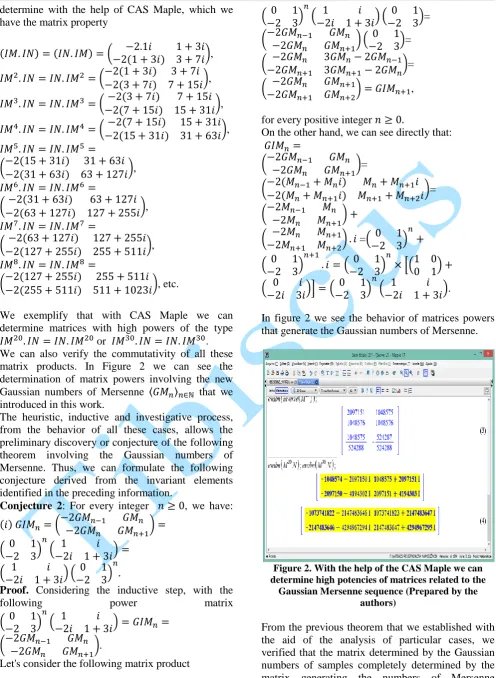
We exemplify that with CAS Maple we can determine matrices with high powers of the type 𝐼𝑀20. 𝐼𝑁 = 𝐼𝑁. 𝐼𝑀20 or 𝐼𝑀30. 𝐼𝑁 = 𝐼𝑁. 𝐼𝑀30. We can also verify the commutativity of all these matrix products. In Figure 2 we can see the determination of matrix powers involving the new Gaussian numbers of Mersenne 〈𝐺𝑀𝑛〉𝑛∈ℕ that we introduced in this work.
The heuristic, inductive and investigative process, from the behavior of all these cases, allows the preliminary discovery or conjecture of the following theorem involving the Gaussian numbers of Mersenne. Thus, we can formulate the following conjecture derived from the invariant elements identified in the preceding information.
Conjecture 2: For every integer 𝑛 ≥ 0, we have: (𝑖) 𝐺𝐼𝑀𝑛= (−2𝐺𝑀−2𝐺𝑀𝑛−1 𝐺𝑀𝑛
𝑛 𝐺𝑀𝑛+1) =
( 0 1 −2 3)
𝑛
( 1 𝑖
−2𝑖 1 + 3𝑖) =
( 1 𝑖
−2𝑖 1 + 3𝑖) ( 0 1 −2 3)
𝑛 .
Proof. Considering the inductive step, with the
following power matrix
( 0 1 −2 3)
𝑛
( 1 𝑖
−2𝑖 1 + 3𝑖) = 𝐺𝐼𝑀𝑛= (−2𝐺𝑀−2𝐺𝑀𝑛−1 𝐺𝑀𝑛
𝑛 𝐺𝑀𝑛+1).
Let's consider the following matrix product
( 0 1 −2 3)
𝑛+1
( 1 𝑖
−2𝑖 1 + 3𝑖)=
( 0 1)𝑛( 0 1) ( 1 𝑖 ) =
( 0 1 −2 3)
𝑛
( 1 𝑖
−2𝑖 1 + 3𝑖) ( 0 1 −2 3)= (−2𝐺𝑀−2𝐺𝑀𝑛−1 𝐺𝑀𝑛
𝑛 𝐺𝑀𝑛+1) ( 0 1 −2 3)= (−2𝐺𝑀−2𝐺𝑀𝑛 3𝐺𝑀𝑛− 2𝐺𝑀𝑛−1
𝑛+1 3𝐺𝑀𝑛+1− 2𝐺𝑀𝑛)= (−2𝐺𝑀−2𝐺𝑀𝑛 𝐺𝑀𝑛+1
𝑛+1 𝐺𝑀𝑛+2) =𝐺𝐼𝑀𝑛+1, for every positive integer 𝑛 ≥ 0.
On the other hand, we can see directly that: 𝐺𝐼𝑀𝑛 =
(−2𝐺𝑀−2𝐺𝑀𝑛−1 𝐺𝑀𝑛 𝑛 𝐺𝑀𝑛+1)=
(−2(𝑀−2(𝑀𝑛−1+ 𝑀𝑛𝑖) 𝑀𝑛+ 𝑀𝑛+1𝑖 𝑛+ 𝑀𝑛+1𝑖) 𝑀𝑛+1+ 𝑀𝑛+2𝑖)= (−2𝑀−2𝑀𝑛−1 𝑀𝑛
𝑛 𝑀𝑛+1) +
(−2𝑀−2𝑀𝑛 𝑀𝑛+1 𝑛+1 𝑀𝑛+2) . 𝑖 =(
0 1 −2 3)
𝑛 +
( 0 1 −2 3)
𝑛+1
. 𝑖 = (0 1 −2 3)
𝑛
× [(1 0 0 1) + ( 0 𝑖
−2𝑖 3𝑖)] = ( 0 1 −2 3)
𝑛
( 1 𝑖
−2𝑖 1 + 3𝑖).
In figure 2 we see the behavior of matrices powers that generate the Gaussian numbers of Mersenne.
Figure 2. With the help of the CAS Maple we can determine high potencies of matrices related to the
Gaussian Mersenne sequence (Prepared by the authors)
From the previous theorem that we established with the aid of the analysis of particular cases, we verified that the matrix determined by the Gaussian numbers of samples completely determined by the matrix generating the numbers of Mersenne ( 0 1
−2 3) 𝑛
Let us now see the particular behavior of the following matrix product 𝐼𝑀1−𝑛. 𝐼𝑁:
𝐼𝑀1−1. 𝐼𝑁=𝐼𝑁. 𝐼𝑀1−1= ( 3
2+ 𝑖 − 1 2+ 0𝑖 1 + 0𝑖 0 + 1𝑖 ) =
(−2 (− 3 4−
1
2𝑖) − 1 2 −2 (−1
2) 0 + 𝑖
) = (−2𝐺𝑀−2𝐺𝑀−2 𝐺𝑀−1 −1 𝐺𝑀0) =
𝐺𝐼𝑀−1,
𝐼𝑀1−2. 𝐼𝑁=𝐼𝑁. 𝐼𝑀1−2= ( 7 4+
3 2𝑖 −
3 4−
1 2𝑖 3
2+ 𝑖 − 1 2+ 𝑖
) =
(−2 (− 7 8−
3 4𝑖) −
3 4−
1 2𝑖
−2 (−3 4−
1
2𝑖) −
1 2
) =
(−2𝐺𝑀−2𝐺𝑀−3 𝐺𝑀−2
−2 𝐺𝑀−1) = 𝐺𝐼𝑀−2, 𝐼𝑀1−3. 𝐼𝑁=𝐼𝑁. 𝐼𝑀
1−3= ( 15
8 + 7 4𝑖 −
7 8− 3 4𝑖 7 4+ 3 2𝑖 −
3 4−
1 2𝑖
) =
(−2 (− 15 16−
7 8𝑖) −
7 8−
3 4𝑖 −2 (−7
8− 3 4𝑖) −
3 4−
1 2𝑖
) =
(−2𝐺𝑀−2𝐺𝑀−4 𝐺𝑀−3
−3 𝐺𝑀−2) = 𝐺𝐼𝑀−3, 𝐼𝑀1−4. 𝐼𝑁=𝐼𝑁. 𝐼𝑀1−4= (
31 16+
15 8 𝑖 −
15 16− 7 8𝑖 15 8 + 7 4𝑖 −
7 8−
3 4𝑖
) =
(−2 (− 31 32−
15 16𝑖) −
15 16−
7 8𝑖
−2 (−15 16−
7
8𝑖) − 7 8−
3 4𝑖
) =
(−2𝐺𝑀−2𝐺𝑀−5 𝐺𝑀−4
−4 𝐺𝑀−3) = 𝐺𝐼𝑀−4.
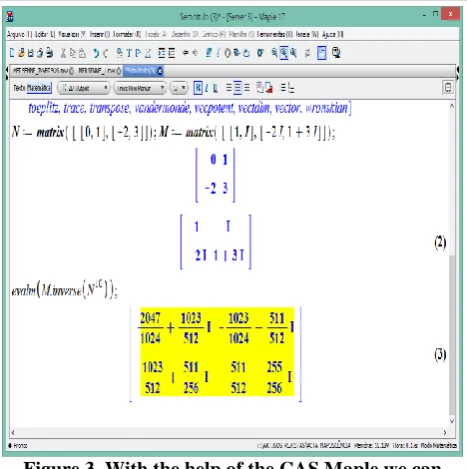
We can also verify the commutativity of all these matrix products. In Figure 3 we can see the determination of inverse matrix powers involving the new Gaussian numbers of Mersenne 〈𝐺𝑀−𝑛〉𝑛∈ℕ that we introduced in this work.
In Figures 3 and 4 we provide an extended set of data obtained with the computational resource and that can aid in the understanding of the inductive model of recurrence and that will allow the determination and discovery of a new theorem on the Gaussian numbers of Mersenne. In figure 5 we show the behavior of inverse matrices with high exponents and that makes the calculation impracticable when we disregard the technology in the investigative process.
Conjecture 3: For every integer 𝑛 ≥ 0, we have: (𝑖)𝐺𝐼𝑀−𝑛= (−2𝐺𝑀−2𝐺𝑀−𝑛−1 𝐺𝑀−𝑛
−𝑛 𝐺𝑀−𝑛+1) =
( 0 1 −2 3)
−𝑛
( 1 𝑖
−2𝑖 1 + 3𝑖), for 𝑛 ≥ 0. Proof. From the definition, we have
𝐺𝐼𝑀−𝑛= (−2𝐺𝑀−2𝐺𝑀−𝑛−1 𝐺𝑀−𝑛 −𝑛 𝐺𝑀−𝑛+1)
= (−2𝐺𝑀−2𝐺𝑀−(𝑛+1) 𝐺𝑀−𝑛 −𝑛 𝐺𝑀−(𝑛−1))
= (
−2 (− 1
2𝑛+1𝑀𝑛+1+ 2𝑀𝑛𝑖) −
1
2𝑛(𝑀𝑛+ 2𝑀𝑛−1𝑖)
−2 (− 1
2𝑛−1𝑀𝑛+ 2𝑀𝑛−1𝑖) −
1
2𝑛−1(𝑀𝑛−1+ 2𝑀𝑛−2𝑖) )
= ( 1
2𝑛(𝑀𝑛+1+ 2𝑀𝑛𝑖) −
1
2𝑛(𝑀𝑛+ 2𝑀𝑛−1𝑖) 1
2𝑛−1(𝑀𝑛+1+ 2𝑀𝑛𝑖) −
1
2𝑛−1(𝑀𝑛−1+ 2𝑀𝑛−2𝑖) )
= (
−2. (− 1
2𝑛+1𝑀𝑛+1) −2. (− 1 2𝑛𝑀𝑛)
−2. (− 1
2𝑛𝑀𝑛) −2. (− 1
2𝑛−1𝑀𝑛−1) )
+ (
−2. (− 1
2𝑛𝑀𝑛) −2. (− 1
2𝑛−1𝑀𝑛−1)
−2. (− 1
2𝑛−1𝑀𝑛−1) −2. (− 1
2𝑛−2𝑀𝑛−2) ) . 𝑖
= (−2𝑀−2𝑀−(𝑛+1) 𝑀−𝑛 −𝑛 𝑀−(𝑛−1))
+ (−2𝑀−2𝑀−𝑛 𝑀−(𝑛−1) −(𝑛−1) 𝑀−(𝑛−2)) . 𝑖
=𝐼𝑀𝑛−1+ 𝐼𝑀𝑛−1−1 𝑖 = (−2 30 1) −𝑛
+
( 0 1 −2 3)
−(𝑛−1) 𝑖
= ( 0 1 −2 3)
−𝑛
+ ( 0 1 −2 3)
−𝑛
( 0 1 −2 3)
1 𝑖
= ( 0 1 −2 3)
−𝑛
[(1 0 0 1) + (
0 1 −2 3) 𝑖] = ( 0 1
−2 3) −𝑛
( 1 𝑖
−2𝑖 1 + 3𝑖)
Thus, we determine the following matrix decomposition
𝐺𝐼𝑀−𝑛= (−2 30 1) −𝑛
( 1 𝑖
−2𝑖 1 + 3𝑖), for every integer 𝑛 ≥ 0.
Figure 3. With the help of the CAS Maple we can determine high potencies of matrices related to the
Gaussian Mersenne sequence (Prepared by the authors)
Figure 4. With the help of the CAS Maple we can determine high potencies of matrices related to the
Gaussian Mersenne sequence (Prepared by the authors)
4. SOME IMPLICATIONS FOR THE TEACHERS IN BRAZIL
In the past sections, we have presented and detailed several matrix properties that can be explored in detail with the help of CAS Maple. Of particular form, we verified the possibility of discovering properties that can be enunciated, from the point of view of Mathematics, as true theorems. We observed that the activity of producing conjectures in the investigative process is essential.
From a historical and epistemological point of view, Mathematics teachers need to understand that Mersenne's Gaussian numbers, from the introduction of an imaginary unit, constitute a natural generalization of the original numbers of the Mersenne sequence. Thus, the notion of Gaussian numbers of Mersenne can acquire a practical operational and mathematical sense, inasmuch as in addition to being exposed to the proposition of a new mathematical definition, mathematics teachers in Brazil can operate and perform arithmetic and algebraic manipulations with the resource computational.
The mathematics teachers should understand that the combinatorial properties that can be determined with CAS Maple, a broad set of particular cases for the behavior of the matrix that we indicate by 𝐼𝑀𝑛= ( 0 1
−2 3) 𝑛
and 𝐼𝑀−𝑛= (−2 30 1) −𝑛
, where 𝑛 ≥ 0, allow the verification of the behavior of numbers of the Mersenne sequence for extremely large indices. Similarly, mathematics teachers should understand that the combinatorial properties that can be determined with CAS Maple, a broad set of particular cases for the behavior of the matrix that
we indicate by
( 1 𝑖
−2𝑖 1 + 3𝑖) ( 0 1 −2 3)
𝑛 and
( 1 𝑖
−2𝑖 1 + 3𝑖) ( 0 1 −2 3)
−𝑛
, where 𝑛 ≥ 0, allow the verification of the behavior of numbers of the Gaussian Mersenne sequence for extremely large indices.
We observed the importance of an understanding by the Mathematics teacher regarding the evolutionary process of second-order recurrent sequences and that, in Brazil, almost predominantly; teachers maintain contact only with the Fibonacci sequence. On the other hand, from the study of the Mersenne sequence and to a certain extent the representation in the complex plane corresponding to the Gaussian sequence of Mersenne, teachers acquire a differentiated mathematical culture ([Kle12]; [Sti89]).
concepts, and as, the current evolutionary stage of mathematical models and their increasing progress ([Alv18]).
Figure 5. Gullberg ([Gul97], p.286) describes the sequence of immortal rabbits
5. CONCLUSIONS AND FUTURE RESEARCH
In this work, we discuss and detailed some properties derived from the second - order recursive sequence, which characterizes the Mersenne sequence defined by the recurrence relation 𝑀𝑛+2= 3𝑀𝑛+1− 2𝑀𝑛. It is worth noting that although the publication of results and more specialized properties only in scientific journals, the dissemination and knowledge of historical and epistemological value regarding an evolutionary character of the Mersenne´s model is very important because we can understand that Mathematics is made up of non-static scientific knowledge.
In the present work we introduce two new mathematical notions in the literature. The first involves the matrix representations that determine the numbers of the Mersenne sequence, for both positive integer and negative integer indices.
In addition, in an unprecedented way, we describe the elements of the sequence of Gaussian of Mersenne not yet formulated in the scientific literature and that, with the computational resource; we can identify several other interesting algebraic combinatorial mathematical properties.
In the table below we can see (on the left side) the formulation of several properties and the description of theorems that have been discovered from the use of CAS Maple, by verifying and testing a large set of data and invariant mathematical elements.
Table 1. Summarized information determined and related to the discovery of new theorems related to the
notion of Mersenne number and Gaussian number of Mersenne
Description of discovered properties and theorems with the
Maple´s help
Mathematical meaning
𝐼𝑀𝑛= (−2𝑀−2𝑀𝑛−1 𝑀𝑛
𝑛 𝑀𝑛+1) =
( 0 1 −2 3)
𝑛
, 𝑛 ≥ 0.
It allows to determine the matrix constituted of the Mersenne numbers 𝑀𝑛 from the powers of the generating matrix ( 0 1
−2 3). 𝐼𝑀−𝑛=
(−2𝑀−2𝑀−𝑛−1 𝑀−𝑛 −𝑛 𝑀−𝑛+1) =
( 0 1 −2 3)
−𝑛
, 𝑛 ≥ 0.
It allows determining the matrix constituted of the Mersenne numbers from the powers of the generating matrix ( 0 1
−2 3), with the determination of negative sequence index elements 𝑀−𝑛. 𝐼𝑀𝑛+𝑚 = 𝐼𝑀𝑛. 𝐼𝑀𝑚 =
𝐼𝑀𝑚. 𝐼𝑀𝑛and 𝐼𝑀−(𝑛+𝑚)= 𝐼𝑀−𝑛. 𝐼𝑀−𝑚 = 𝐼𝑀−𝑚. 𝐼𝑀−𝑛, for every
integer 𝑛 ≥ 0.
Description of commutative properties with both positive and negative integer indices
𝐼𝑀−𝑛, 𝐼𝑀−𝑚. 𝐺𝐼𝑀𝑛=
(−2𝐺𝑀−2𝐺𝑀𝑛−1 𝐺𝑀𝑛 𝑛 𝐺𝑀𝑛+1) =
( 1 𝑖
−2𝑖 1 + 3𝑖) ( 0 1 −2 3)
𝑛
, 𝑛 ≥ 0.
Description of matrices generating Gaussian numbers of Mersenne, with positive integer indices.
𝐺𝐼𝑀−𝑛= (−2𝐺𝑀−2𝐺𝑀−𝑛−1 𝐺𝑀−𝑛
−𝑛 𝐺𝑀−𝑛+1) =
( 0 1 −2 3)
−𝑛
( 1 𝑖
−2𝑖 1 + 3𝑖) , 𝑛 ≥ 0.
Description of matrices generating Gaussian numbers of Mersenne, with negative integer indices.
Regarding our future research and other implications, we can define the following matrix, the entries of which are to be described by means of the
Mersenne quaternions 𝑄𝐼𝑀𝑛=
(−2𝑄𝑀−2𝑄𝑀𝑛−1 𝑄𝑀𝑛
𝑛 𝑄𝑀𝑛+1). A quaternion of Mersenne will be defined by the following relation: 𝑄𝑀𝑛= 𝑀𝑛+ 𝑀𝑛+1𝑖 + 𝑀𝑛+2𝑗 + 𝑀𝑛+3𝑘, where the imaginary units have the propertie 𝑖2 = 𝑗2 = 𝑘2= −1.
Repeating some of the previous arguments, we can verify that:
𝑄𝐼𝑀𝑛= (
−2𝑄𝑀𝑛−1 𝑄𝑀𝑛 −2𝑄𝑀𝑛 𝑄𝑀𝑛+1) = (
0 1 −2 3)
𝑛 . 𝑀𝑄, where
𝑀𝑄 =
(−2 (− 1
2+ 0𝑖 + 1𝑗 + 3𝑘) 0 + 𝑖 + 3𝑗 + 7𝑘 −2(0 + 1𝑖 + 3𝑗 + 7𝑘) 1 + 3𝑖 + 7𝑗 + 15𝑘).
REFERENCES
[Alv18] F. R. V. Alves - On teaching of Generalized Catalan Numbers with the
Maple´s help. Acta Didactica
Naposcencia, 11 (1), pp. 25-40, 2018. [AA18] F. R. Alves, M. Alves Dias -
Didactical Engineering for the Binnet´s theorem: preliminary and a priori
analysis. Journal of Education,
Sciences and Human Sciences, 19 (2), pp. 1-25, 2018.
[CCV16] P. Catarino, H. Campos, P. Vasco - On the Mersenne sequence, Annales Mathematicae et Informaticae, 46, pp. 37-53, 2016.
[Gul97] J. Gullberg - Mathematics from the birth of Numbers. New York: W. W. Norton Company, 1997.
[Kle12] I. Kleiner - Excursions in the History of Mathematics. New York: Springer, 2012.
![Figure 5. Gullberg ([Gul97], p.286) describes the sequence of immortal rabbits](https://thumb-us.123doks.com/thumbv2/123dok_us/8958653.1868021/8.595.292.540.100.656/figure-gullberg-gul-p-describes-sequence-immortal-rabbits.webp)
