DOI: 10.22075/JRCE.2019.16080.1302
journal homepage: http://civiljournal.semnan.ac.ir/
Torsion Effect on the RC Structures using Fragility
Curves Considering with Soil-Structure Interaction
A. Anvarsamarin1, F. Rahimzadeh Rofooei2* and M. Nekooei1
1. Department of civil Engineering, Science and Research Branch, Islamic Azad University, Tehran, Iran 2. Civil Engineering Department, Sharif University of Technology, Tehran, Iran
Corresponding author:[email protected]
ARTICLE INFO ABSTRACT
Article history:
Received: 2 October 2018 Accepted: 15 February 2019
The existence of torsion, as well as consideration of the Soil-Structure Interaction (SSI), increase the natural periods of the structure resulting from a subsequent decrease in the seismic demand of the system. This paper summarizes the probabilistic assessment for evaluation of collapse fragility curves in concrete moment resisting structure with different mass center eccentricities. A 12-story, 3-D, moment resisting concrete structure with fixed-base and considering SSI, both types of one- and two-way eccentricities is employed to estimate the collapse fragility curve by the IM-based approach. According to the obtained results, increasing the torsion due to shifting the mass centers decreases the median of the collapse fragility curve. In addition, it was observed that the SSI consideration for soil type D with shear wave velocity of 180m/s to 360m/s leads to reduction of the median of collapse capacity by 30% − 40% in the presence of torsion effect due to one- and two-way mass center eccentricities in range of 0-20% of the building's plan dimensions respectively. In other words, the fixed-base assumption overestimates the median of collapse capacity and leads to unsafe design. Moreover, shifting the mass centers of all the stories up to 20% of the building's plan dimensions, with or without the consideration of the SSI, decreases the median of collapse capacities and increases the seismic vulnerability of the building. Accordingly, the fixed-base assumption can be underestimated the dispersion range of the collapse fragility curve. The result shows that the mentioned differences cannot be neglected.
Keywords: Intensity Measure, Collapse Fragility Curve, Incremental Dynamic Analysis, Intensity Measure,
Mass Center Eccentricity, Soil-Structure Interaction.
1. Introduction
The study of the global collapse was triggered by considering P- effects on
turn lead to the structural collapse. Seismic demands exceeding the tolerable limits of a structure reduce the strength and stiffness of structural elements and this may result in global or partial collapse of the building. Structural performance assessment needs to a numerical criterion. According to FEMA 2000, the Incremental Dynamic Analysis (IDA) approach is proposed to estimate the structural capacity of the buildings. In addition, FEMA 2000 is classified the point of occurrence of collapse based on the following conditions: Numerical non-convergence in Structural analysis algorithm, The occurrence of a slope equal to 20% of the initial elastic slope in the IDA curve and Exceedance of the maximum internal drift ratio (IDR) above %10. Jalayer and Cornell used the IDA concept to estimate the total dynamic instability capacity of a regular RC structure. The study considered strength deterioration caused by the shear failure of columns in accordance with the model developed by Pincheria in 1999 [1]. The stochastic nature of strong ground motions and the fact that no analytical approach can model all features of structural behavior increase the complexity of the seismic collapse analysis of structures [2-5]. A performance target in collapse level can be considered as a tolerable collapse probability in a given hazard level.
Currently, the collapse fragility curve is the most important and accepted tool for evaluating the collapse of the structure. A set of IDA analyses can play a vital role in determining the estimation parameters and in turn determine the collapse fragility curve. Incremental Dynamic Analysis (IDA) was invented to take the inherent variability of earthquakes into account during the seismic response analysis of structures [6]. The probabilistic estimation of maximum story
drift demands by considering a nine-story, moment resisting frame building exposed to a set of 40 ground motions was improved by Stoica et al. [7]. Vulnerability assessment methodology has been developed by Andreas J. Kappos and Georgios Panagopoulos to estimate the fragility curves of all types of common RC buildings in Greece. This methodology was based on the hybrid approach, which combines statistical data with properly processed results from nonlinear static or dynamic analyses. This procedure permit interpolation and (under certain conditions) extrapolation of statistical data to PGAs and/or spectral displacements for which no data is available [8]. Haselton and Dierlin evaluated the collapse risk of 30 four-story buildings with a special moment frame designed in accordance with ASCE9-02. According to their results, the likelihood of structural collapse for earthquakes with a return period of 2475 years ranges from 3% to 20% with a mean of 11% [9]. Lignos et al. used the results of a collapse test conducted on a 4-story steel moment frame on the shaking table of the E-Defence laboratory and derived the essential parameters required for modeling the collapse reliability of buildings. They concluded that Riley damping leads to better results than stiffness-proportional damping. Moreover, they showed that the accurate estimation of the collapse capacities of structures demands the consideration of P-∆ effects [10]. Palermo et al. evaluated the efficiency of current modeling techniques in predicting the collapse capacity of the studied structures. According to the study, modern techniques have a better capability of predicting the collapse capacity of structures [11].
structural performance, especially strategic ones [12]. Even though several codes such as ATC-3-06, NEHRP-2012, and NIST GCR 12-917-21 do not extend the interest on SSI effects to residential buildings [13-15]. This is due to the numerical simulation challenges of the SSI effect. In particular, many simplifications are considered in finite element models for residential structures, e.g., the study performed by Renzi et al. [16]. Therefore, these approaches should be verified in order to correctly assess the SSI effect. Some researchers have modeled the effect of soil-structure interaction with direct method [17- 21]. In addition, there are cases that modeled the soil with different approaches such as beam-on-nonlinear-Winkler-foundation [22, 23], elasto-plastic Mohr-Coulomb modeling [24] and equivalent linear behaviors [25, 26]. The seismic performance and energy dissipation of structures can significantly be changed by considering the SSI effects. Khoshnoudian et al. showed that soil flexibility increases the dynamic instability of the structural system, and collapse strength reduction factor highly decreases by increasing non-dimensional frequency [23].
Recently, Shakib and Homaei showed that SSI consideration reduces the structural seismic capacities, ductile deformation and life-safety confidence level [27]. Moreover, it was shown that considering SSI increases the drift demand and causes that the location of maximum drift moves to the first story [28]. They showed that SSI changes the pattern of distribution of vulnerability, especially for the beams of shear wall buildings, and increases the seismic vulnerability on soft soils. Also, Ghandil et al. applied the direct method by considering a nonlinear behavior for the frame elements of the structure in order to demonstrate that SSI increases the
drifts and ductility demands of the lower stories [29]. SSI effect on fragility curves of RC moment resisting frame buildings investigated by applying the direct method [30]. The evaluation of the seismic fragility curve of the structure is a prerequisite for seismic loss estimation and risk management. The seismic vulnerability of structures is usually expressed by a fragility function, which indicates the probability of exceeding prescribed levels of damage for a wide range of ground motion intensities. Currently, available seismic fragility databases for RC buildings [31] are developed for fixed based structures ignoring SSI effect.
Assessing the seismic performance of structures during the past earthquakes indicates that irregularities due to mass, stiffness, and distribution of strength are one of the main reasons for the vulnerability of the structures. The existence of torsion in buildings causes changes in the seismic demands in the different corner of each story, so under severe ground motion, some members of the frame on the side of the building may experience non-linear behavior while the frame members on the other side of the building are still in the elastic region. Torsion and soil-structure Interaction (SSI) can alter the performance of structure totally including its dynamic characteristics, response maxima and more important, distribution of nonlinear response through the structure where the accurate calculation of it is vital for the performance evaluation. This paper aims to move from the previous contributions to extend the assessment of the SSI effect on different mass center eccentricities, considering both types of the one- and two-way eccentricities.
and soil-structure interaction (SSI) consideration on the median and dispersion of the collapse fragility curves. To evaluate the effect of torsion in both types of the fixed- and flexible-base of the building, the mass centers of all the stories was shifted as much as 0 to 20% of the building's plan dimensions subjected to the simultaneous effects of the horizontal components of the selected earthquake records.
2. Case Study and Numerical
Modeling
2.1. Design Characteristics
A 12-story building with 3-D moment resisting frame RC structure with a fundamental period of 1.375 seconds was considered and designed according to the ACI 318-08 and ASCE 7-10 code requirements [32, 33]. This structural model is assumed to be of administrative buildings type with the same plan dimensions, located in a high seismic site at California with site
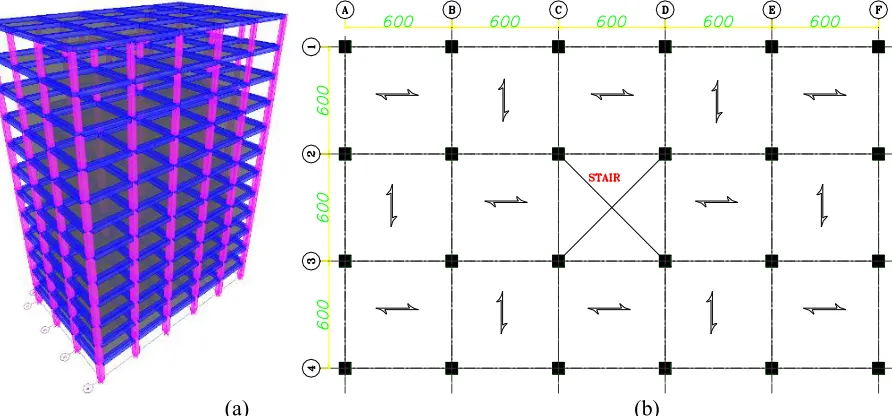
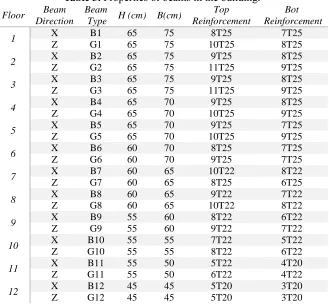
class D according to the ASCE 7-10 [33]. The seismic parameters Ss and S1 were considered 1.4438 and 0.612, respectively; the importance factor (I) of 1, the response modification factor (R) of 5 were considered, and the seismic coefficient (Cs) of 0.089 based on ASCE 7-10 [33]. The structural system of the 12-story building is an intermediate moment resisting frame. The specified compressive strength of concrete is 240 kg/cm2. In all members, the ultimate strength of longitudinal bars is 5000 kg/cm2. The ETABS (2013) program was used to design the structural models [34]. The studied building has a 30 m×18 m rectangle plan with a story height of 3.2 m and spans of 6m. In designing the building model the story drift ratios were limited to values specified by the considered code. Figure 1 shows the structural models and a typical plan of the building was considered in this study. The applied gravity loads to the structural model are presented in Table 1. Also, Tables 2 and 3 show the beams and columns properties of the studied building.
(a) (b)
Table 1. Gravity loads.
Load type Story Roof
Dead load (Kg/m2) 520 520
Live load (Kg/m2) 250 150
Perimeter walls (Kg/m) 570 300
Table 2. Properties of columns in the building.
Floor Column Type B=H (cm) Cover (cm) Reinforcement
1 C1 75 5.8 28T25
2 C2 75 5.8 24T25
3 C3 75 5.8 24T25
4 C4 70 5.8 20T22
5 C4 70 5.8 20T20
6 C5 70 5.8 20T20
7 C5 65 5.8 20T20
8 C5 65 5.8 20T20
9 C6 60 5.8 20T20
10 C7 55 5.8 20T20
11 C8 50 5.8 16T20
12 C9 45 5.8 16T18
Table 3. Properties of beams in the building.
Floor Beam Direction
Beam
Type H (cm) B(cm)
Top Reinforcement
Bot Reinforcement
1 X B1 65 75 8T25 7T25
Z G1 65 75 10T25 8T25
2 X B2 65 75 9T25 8T25
Z G2 65 75 11T25 9T25
3 X B3 65 75 9T25 8T25
Z G3 65 75 11T25 9T25
4 X B4 65 70 9T25 8T25
Z G4 65 70 10T25 9T25
5 X B5 65 70 9T25 7T25
Z G5 65 70 10T25 9T25
6 X B6 60 70 8T25 7T25
Z G6 60 70 9T25 7T25
7 X B7 60 65 10T22 8T22
Z G7 60 65 8T25 6T25
8 X B8 60 65 9T22 7T22
Z G8 60 65 10T22 8T22
9 X B9 55 60 8T22 6T22
Z G9 55 60 9T22 7T22
10 X B10 55 55 7T22 5T22
Z G10 55 55 8T22 6T22
11 X B11 55 50 5T22 4T20
Z G11 55 50 6T22 4T22
12 X B12 45 45 5T20 3T20
2.2. Numerical Modeling
The open system for earthquake engineering simulation (OpenSees) program [35] is used for numerical modeling and analysis of the considered structural models. The force-based element (FBE) and displacement force-based element (DBE) are two techniques by OpenSees software for modeling the non-linear behavior of different structural
members. In this study,
"NonlinearBeamColumn" command is adopted to model the structural members using the fiber section, which is based on the force formulation and considers the spread of plasticity along the element [36]. This is the most economical and accurate approach to investigate the seismic behavior of RC structures [37, 38]. The unidirectional steel and concrete layers in flexural members are shown in Figure 2.
Fig. 2. Modeling flexural members using fiber command [39, 40].
The accuracy of the solution in FBE can be improved by either increasing the number of integration points or the number of elements. Rayleigh damping is used in modeling of structures. Rayleigh damping is viscous damping that is proportional to a linear combination of mass and stiffness. The damping matrix (C) is given by Equation 1, where a0 is the mass proportional damping coefficient and a1 is the stiffness proportional damping coefficient.
C=a0.M+a1.K (1)
A damping ratio of 5% was assigned to the first the mode and the mode at which the cumulative mass participation exceeds 95%. The Rayleigh command allows the user to specify whether the initial, current, or last committed stiffness matrix is used in the damping matrix formulation.
It should be emphasized about RC members that the core concrete, which has been confined by stirrups, has higher Compressive strength than cover concrete due to the so-called confinement effect. "Concrete02" material command is used for concrete modeling in OpenSees software. In order to promote modeling accuracy, the compressive strength and strain of core concrete are determined using the Mander-Priestly model (Figure 3) [39]. The aforementioned model is used as a general model to take confinement effects into account in different columns. Lateral reinforcements have different types such as circular, spiral and rectangular stirrup with or without ties. This project studies the structural members sections as rectangular sections with rectangular stirrup exposed to unidirectional loads. The stress-strain relationship of confined concrete has been studied widely as Equation 2:
𝑓𝑐 =
𝑓𝑐𝑐́ 𝑋𝑟
𝑟 − 1 + 𝑋2 , 𝑋 =
𝜀𝑐
𝜀𝑐𝑐
,
𝜀𝑐𝑐= [𝑅 (
𝑓𝑐𝑐́
𝑓𝑐0
− 1) + 1] 𝜀𝑐0 ,
𝑟 = 𝐸𝑐
𝐸𝑐−𝐸𝑠𝑒𝑐 (2)
tests. This model suggests R=3 and R=6 for high strength concrete and typical concrete, respectively. Equation 3 gives the maximum stress of confined concrete based on Mander's relation:
𝑓𝑐𝑐́ = 𝑓𝑐𝑜́ (2.254√1 +
7.94𝑓́1
𝑓𝑐𝑜́
−2𝑓́1 𝑓𝑐𝑜́
− 1.254),
𝑓́ =1 1
2𝐾𝑒𝜌𝑠𝑓𝑦ℎ, 𝐸𝑠𝑒𝑐 = 𝑓𝑐𝑐́
𝜀𝑐𝑐 (3)
Fig. 3. Calculation of the compressive strength of confined core concrete based on Mander's model
[39].
The effective confinement coefficient Ke is a very important parameter. It shows the effectiveness of different lateral stirrups. Mander et al. [39] introduced different relations for different lateral reinforcements, especially circular and spiral stirrups, in order to calculate Ke.
𝐾𝑒=
1−𝑘𝑆/𝐷"
1−𝜌𝑐𝑐 (4)
where 𝜌𝑐𝑐 represents the ratio of longitudinal reinforcement area to the core concrete section area. 𝜌𝑠 is the ratio of lateral confining lateral reinforcements volume to the confined the core concrete volume. fyh is the yielding stress of lateral reinforcements. k is 0.5 for spiral and 1.0 for stirrup reinforcement. The stress-strain curves of confined core concrete in structural element
sections were determined using the KSU-RC program [40] and the Mander relationship. Rayleigh damping is used in modeling of structures. It should be noted that to avoid numerical instability or non-convergence, "Steel02" command is used for reinforcing bars modeling in OpenSees software. In the "Steel02" command, the strain-hardening ratio is considered equal to 0.01.
2.3. Soil–Structure Model
To define the coefficients of this element taking also into account soil nonlinearity, established parameters of the cone model are modified based on the equivalent linear approach. To model the soil effect under the structure, the cone model (monkey-tail model) was used with presented modifications [41]. Figure 4 shows the schematic model intended for the soil-foundation element based on the cone model concept.
Table 4 presents the properties of the cones and discrete-element models representing a rigid rectangular foundation with area A0 and area moment of inertia about the axis of rotation I0 (for torsional rotation, I0 is the polar moment of inertia) on the surface of homogeneous half-space. In this Table, ν is the Poisson’s ratio of the soil, Vs is the shear-wave velocity in the soil (in small strains), Vp is the P-wave velocity of the soil, ρ is density and G is the effective soil shear modulus of the soil. Initial soil shear modulus (G0) can be obtained using geoseismic experiments and measure the shear wave velocity in small strains (Equation 4).
𝐺0= 𝜌𝑉𝑠2 (4)
earthquakes). As a result, the changes in the soil shear modulus and material damping ratio with shearing strain amplitude must be accounted for in the ground response analysis. The linear solution, which is applicable for small vibration levels, can be modified to overcome this problem. One approach to handling nonlinear soil behavior due to shaking during a design level event is to perform linear analyses with dynamic soil properties that are iterated in a manner consistent with an “effective” shearing strain induced in the soil layer [42, 43]. This iterative approach is called "equivalent linear
analysis". The effective soil shear modulus, G, which decreases with increasing strain, can be estimated in terms of the initial soil shear modulus (G0), cite class and peak ground acceleration according to Equation 5.
𝐺 = 𝐺0× ( 𝐺
𝐺0) (5)
where (𝐺
𝐺0) is the effective shear modulus ratio that shall be calculated in accordance with ASCE/SEI 41-06 [44]. It should be noted that Stiffness coefficients of foundation in table 4 were calculated for rectangle shaped foundations (L×B, L>B).
Table 4. con model of properties of the rectanqular foundation on a homogeneous half-space [41].
Motion Horizontal Vertical Rocking Torsion
equivalent radius
(r0) √
A0 π √ A0 π √ 4I0 π 4
√2I0
π
4
Aspect ratio z0
r0
π 8(2 − υ)
π 4(1 − υ)(
V Vs)
2 9π
32(1 − υ)( V Vs)
2 9π
32 Poisson's ratio All value ν≤1/3 1/3<ν≤1/2 ν≤1/3 1/3<ν≤1/2 All value wave velocity (V) Vs Vp 2Vs Vp 2Vs Vs
added mass 0 0 2.4(υ −1
3)ρA0r0 0 1.2(υ − 1
3)ρAI0r0 0
Lumped-parameter model
Kx=
GB
2 − υ[3.4(L B⁄ )
0.65
+ 1.2]
Ky=2−υGB[3.4(L B⁄ ) 0.65
+ 0.4 L B⁄ + 0.8] Kz=
GB
1 − υ[1.55(L B⁄ )
0.75
+ 0.8] C = ρ. V. A0
C′=2ξ0
ω0K, m
′= ξ0
ω0C
Kxx=
GB3
1 − υ[0.4(L B⁄ ) + 0.1]
Kyy=
GB3
1 − υ[0.4(L B⁄ )
2.4
+ 0.034]
Kzz= GB3[0.53(L B⁄ ) 2.45
+ 0.51]
C𝜃= ρ. V. I0 , C𝜃′=
2ξ0
ω0
Kθ
Mθ= ρI0z0 , m𝜃′= ξ0
ω0Cθ
Fig. 4. Cone Model layout and equivalent lumped elements for soil replacement model [41].
To model sub-structure using the monkey-tail model, two nodes at the same location have been defined at the base level. Using spring stiffness independent of frequency and a
Uniaxial Material objects base on the cone model. All degree of freedom in the first node and Vertical degree of freedom in the second node have been constrained. The springs and dampers have been connected from the first node to the second node using a zero-length element and the vertical degree of freedom was ignored. In addition, the masses of the separated model have been applied to the second node. The soil Poisson’s coefficient, soil damping ratio, and soil density, as the essential parameters for soil modeling, were considered to be 0.33, 0.05 and 2000 kg/m3.
2.4. Validation of the Mathematical Model
In order to evaluate the validity of the employed model, the bridge column subjected to the loading protocol which is shown in Figure 5 [36] is considered. (Lehman & Moehle, PEER 1998/01 (Column 415)). The column model is calibrated using the force-based element with 5 integration points. For the best compatibility between the numerical modeling and experimental results, five integration points were selected. In this case, the column had to be modeled with one force based element (FBE). Local response quantities could not be compared due to the lack of experimental data. The results are shown in Figure 6. In addition, to evaluate the validity of the structural model in OpenSees, the variation of the fundamental periods of the 12-story building model is compared with the result of ETABS software. Table 5 presents that the fundamental period of the 12- story structure are close together with acceptable accuracy in two cases.
Table 5. The fundamental period of 12 story structure for different software.
Period (sec) T1 T2
ETABS 1.3749 1.2939 OpenSees 1.3753 1.3089
Fig. 5. Bridge column detail and cyclic loading protocol [36].
Fig. 6. Comparing the results of numerical modeling with FBE and experimental results
[36].
2.5. The Earthquake Records Used for Parametric Studies
earthquake records that have been registered on stiff soil (soil type D with shear wave velocity of 180m/s to 360m/s) resulting from events with a magnitude of 6.2 to 7.3 and fault distance of 21.2 to 50.7km. The selected
records were normalized according to the ASCE 7-10 code [33] before being used in the extensive nonlinear dynamic time history analyses.
Table 6. Specification of earthquake records for the numerical analyses.
No Date Earthquake
Name Record name
Magnitude (Ms)
Station
number PGA(g) Vs(m/s)
1 01/17/94 Northridge NORTHR /MUL279 6.7 90013 0.516 356
NORTHR /MUL009 0.416
2 01/17/94 Northridge NORTHR /LOS270 6.7 90057 0.482 309
NORTHR /LOS0 0.41
3 01/17/94 Northridge NORTHR /HOL90 6.7 24303 0.358 256
NORTHR /HOL360 0.231
4 11/12/1999 Duzce,Turkey Duzce /BOL090 7.3 Bolu 0.822 326
Duzce/BOL0 0.728
5 10/15/79 Impeial Valley
IMPVALL\H-DLT352
6.9 6605
0.351
275
IMPVALL\H-DLT262 0.238
6 10/15/79 Impeial Valley IMPVALL\H-EL1230 6.9 5058 0.38 196
IMPVALL\H-EL140 0.364
7 10/15/79 Impeial Valley IMPVALL\H-CHI012 6.9 6621 0.27 256
IMPVALL\H-CHI282 0.254
8 11/24/87 Superstitn Hills(B)
SUPERST/ B-CAL315
6.6 5061
0.247
208 SUPERST/
B-CAL225 0.18
9 8/17/99 Kocaeli,Turkey KOCAELI\ DZC270 7.8 Duzce 0.358 276
KOCAELI \DZC180 0.312
10 10/01/1987 Whittier Narrows
WHITTIER /A-BIR180
5.7 90079
0.299
276 WHITTIER
/A-BIR090 0.243
11 06/28/92 Landers LANDERS /YER270 7.4 22074 0.245 354
LANDERS /YER360 0.152
12 06/28/92 Landers
LANDERS /CLW-TR
7.4
23 0.417
271 LANDERS
/CLW-LN Coolwater 0.283
13 10/18/89 Loma Preita LOMAP /CAP000 7.1 47125 0.529 289
LOMAP /CAP090 0.443
14 10/18/89 Loma Preita LOMAP /GO3000 7.1 47381 0.555 350
LOMAP /GO3090 0.367
15 10/18/89 Loma Preita LOMAP /SLC360 7.1 1601 0.278 289
LOMAP /SLC270 0.194
16 11/24/87 Superstitn Hills(B)
SUPERST /B-ICC000
6.6 1335
0.358
192 SUPERST
/B-BICC090 0.258
17 11/24/87 Superstitn Hills(B)
SUPERST /B-POE270
6.6 Poe Road
0.446
208 SUPERST /B-
No Date Earthquake
Name Record name
Magnitude (Ms)
Station
number PGA(g) Vs(m/s)
18 04/25/92 Cape Mendocino
CAPEMEND/RIO360
7.1 89324 0.549 312
CAPEMEND/RIO270 0.385
19 09/20/99 Chi-Chi Taiwan
CHICHI/CHY101-N
7.6 CHY101 0.44 259
CHICHI/ CHY101-W 0.353
20 04/24/84 Morgan Hill MORGAN/HD4165 6.1 1656 0.098 256
MORGAN/HD4255 0.092
21 02/09/1971 San Fernando SFERN/PEL090 6.6 135 LA 0.21 316
SFERN /PEL180 0.174
22 05/02/1983 Coalinga
COALINGA/H-C05270
6.5 36227
0.147
256
COALINGA/H-C05360 0.131
23 01/16/95 Kobe KOBE/ SHI000 6.9
Shin-Osaka
0.243
256
KOBE/ SHI090 0.212
3. Analysis and Results
Following the selection and normalization of the earthquake records and preparation of the structural models, the IDA analyses were conducted using the OpenSees program [35] under the applied bi-directional seismic excitations. In the process of modeling, both types of the one- and two-way mass center eccentricities in the range of 0 − 20% of the building's plan dimensions are considered by proper shifting the mass centers of all stories. Also, the SSI effect was investigated corresponded to the median and dispersion of collapse fragility curves. The IDA curves were developed considering the Sa(T1, ζ=5%) as scalar intensity measures (IM). It is worth noting that the selection of an intensity measure (IM) depends on the efficiency in terms of seismic intensity and on the sufficiency in terms of the number of earthquake records. Generally, the purpose of this feature is to reduce the dependence of the results on records specifications. If there is no near field earthquake caused directivity
(a) (b)
Fig. 7. IDA curves of the 12-story building with the fixed-base assumption (a) with a one-way eccentricity of 5% (b) with a one-way eccentricity of 20%.
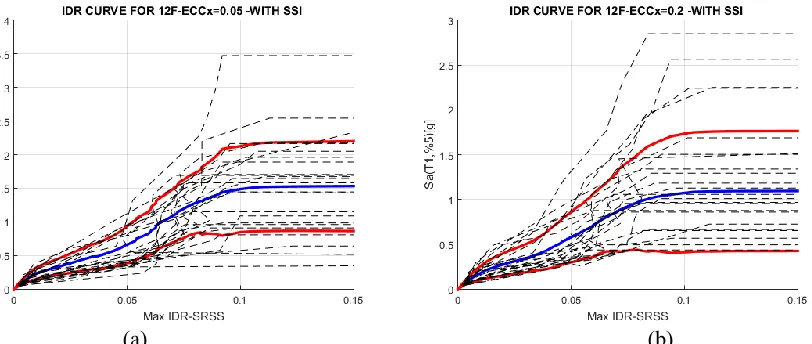
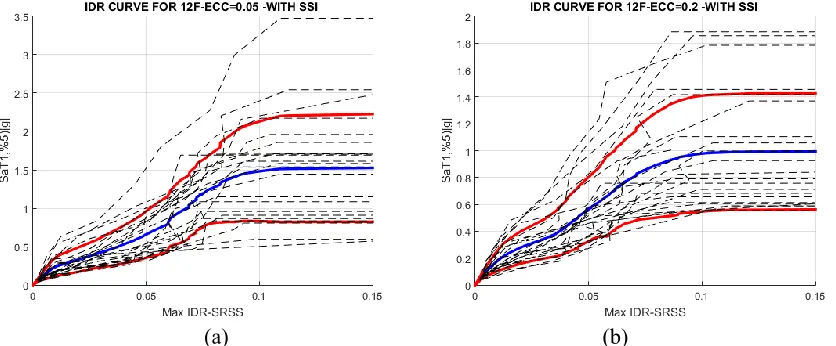
(a) (b)
Fig. 8. IDA curves of the 12-story building with considering SSI (a) with a one-way eccentricity of 5% (b) with a one-way eccentricity of 20%.
(a) (b)
(a) (b)
Fig. 10. IDA curves of the 12-story building with considering SSI (a) with a two-way eccentricity of 5% (b) with a two-way eccentricity of 20%.
3.1. Estimation of Collapse Fragility Curves with Fixed-Base Assumption
To extract the occurrence probability of collapse from IDA results, the so-called fragility curves are used. Collapse fragility curve can be considered as a log-normal cumulative distribution function (CDF) of a stochastic variable namely collapse capacity (Sac). Ibarra and krawinkler showed that Sac points follow a log-normal distribution i.e.
Ln(Sac) → N(ηC, βRC) where ηC and βRC are median and dispersion of the collapse capacity values due to different earthquake records which are numerically equal to the standard deviation of collapse capacity values [48]. For a given hazard level, like PR, corresponding spectral acceleration can be obtained using seismic hazard curves and collapse probability can be calculated from Equation 6, where 𝜂𝐶 and 𝛽𝑅𝐶 are median and standard deviation of the log-normal cumulative distribution function, respectively:
𝑃(𝐶|𝑆𝑎𝑃𝑅) = 𝛷(𝐿𝑛(𝑆𝑎𝑃𝑅)−𝐿𝑛(𝜂𝐶)
(a) (b)
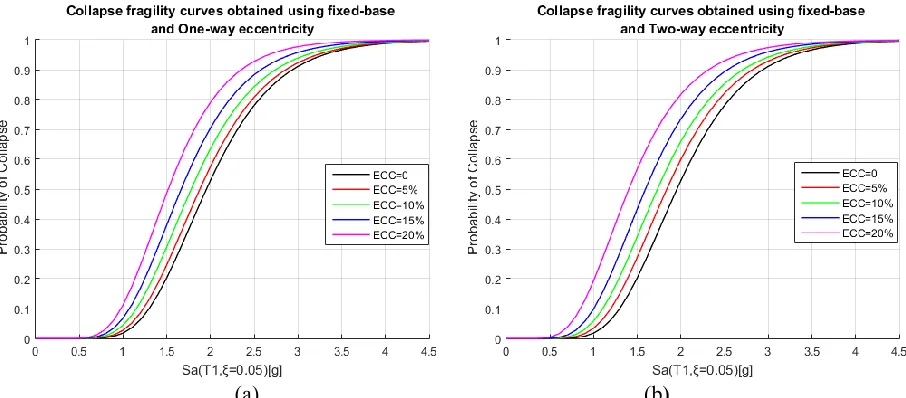
Fig. 11. Collapse fragility curves obtained using the direct method and fixed-base assumption: (a) One-way mass centers eccentricities, (b) two-One-way mass centers eccentricities.
(a) (b)
Fig. 12. Collapse fragility curves obtained using the fitting method and fixed-base assumption: (a) One-way mass centers eccentricities, (b) two-One-way mass centers eccentricities.
Table 7 presents the median (𝜂𝐶) and standard deviation (𝛽𝑅𝐶) of the fragility curve of the studied building with fixed-based in the form of the log-normal cumulative distribution function. It should be noted that collapse fragility curves obtained by the fitting method give the lower
dispersion value. Also, the median of the collapse capacities (by fixed-base assumption) decreases respectively by
3.84% − 22.36% and 5.93% − 28.22% for
Table 7. The fragility curve parameters obtained by fixed-base assumption using various methods.
Estimation
method Eccentricities type Parameters Statistical
Percentage of the mass center eccentricities
Ecc=0 Ecc=5% Ecc=10% Ecc=15% Ecc=20%
Direct method
One-way
median(μ) 1.9543 1.8762 1.7703 1.6656 1.5250 Standard
deviation(βRC) 0.4089 0.4156 0.4298 0.4346 0.4913
Two-way
median(μ) 1.9543 1.8350 1.7213 1.6065 1.3880 Standard
deviation(βRC) 0.4089 0.4299 0.4402 0.4684 0.5544
Fitting Method
One-way
median(μ) 1.9531 1.8780 1.7786 1.6641 1.5163
Standard
deviation(βRC) 0.3183 0.3280 0.3377 0.3412 0.3419
Two-way
median(μ) 1.9531 1.8371 1.7300 1.5925 1.4020 Standard
deviation(βRC) 0.3183 0.3341 0.3497 0.3617 0.3913
3.2. Estimation of Collapse Fragility Curves with SSI Consideration
In this section, collapse fragility curves of the studied building were obtained using the SSI consideration for soil type D. As in the previous section, mass centers of all stories were shifted in the range of the 0% − 20%
of the building's plan dimensions and in the form of one- and two-way mass center eccentricities. In addition, the fragility curves were obtained using two mentioned approaches. Figures 13 and 14 present the collapse fragility curves of the studied building based on the two types of the mentioned methods under the various eccentricities. Since the fragility curves are in the form of the log-normal cumulative distribution function with median (𝜂𝐶) and standard deviation (𝛽𝑅𝐶) parameters, their values are summarized in Table 8.
SSI consideration. The results of this comparison are shown in Figure 15. The results show that in the absence of the mass center eccentricities, the fixed-base assumption overestimates the median of collapse capacity as much as 29.87% compared with the SSI consideration. Moreover, in one- and two-way eccentricity of mass centers equal to 20% of the building
dimensions, fixed-base assumption in comparison with the SSI consideration for soil type D overestimates the median of the collapse capacity by 36.3% and 39.45%. This difference is significant and cannot be neglected, respectively. In addition, the presence of torsion and consideration of the SSI effect increase the dispersion of the fragility curve.
(a) (b)
Fig. 13. Collapse fragility curves obtained using the direct method with SSI consideration: (a) One-way mass centers eccentricities, (b) two-way mass centers eccentricities.
(a) (b)
Table 8. The fragility curve parameters obtained by SSI consideration using various methods. Estimation
method Eccentricities type Parameters Statistical Ecc=0 Percentage of the mass center eccentricities Ecc=5% Ecc=10% Ecc=15% Ecc=20%
Direct Method
One-way
median(μ) 1.4125 1.3390 1.2369 1.1473 1.0053 Standard
deviation(βRC) 0.4694 0.4737 0.4955 0.4980 0.5126
Two-way median(μ) Standard 1.4125 1.2812 1.1519 1.0561 0.9013 deviation(βRC) 0.4694 0.5006 0.5260 0.5355 0.5677
Fitting Method
One-way
median(μ) 1.3696 1.2950 1.1901 1.0916 0.9656
Standard
deviation(βRC) 0.3808 0.3912 0.4037 0.4151 0.4400
Two-way median(μ Standard 1.3696 1.2361 1.1104 1.0023 0.8489 deviation(βRC) 0.3808 0.3929 0.4077 0.4197 0.4404
Fig. 15. Differences between the median of the fragility curves due to fixed-based assumption and SSI
.
4. Conclusions
In this paper, a 12-story RC moment resisting building considering both types of the one- and two-way eccentricities and regular elevation subjected to bi-directional ground motions is presented. By considering the non-linear behaviors of reinforcing bars as well as cover and confined concrete materials, the effect of torsion, both types of the fixed-base assumption and considering of
record to record in seismic behavior study and increases the reliability of results.
In the studied building, increasing the torsion can be decreased the median of the collapse capacities. Moreover, increasing the torsion can be increased the dispersion of the fragility curve in direct and fitting methods. It is worth mentioning that fixed-base assumption overestimates the median of collapse capacity by 29.87% − 39.45% in the presence of torsion due to one- and two-way eccentricities, respectively. Also, if there is no torsion in the building, assuming fixed-base overestimates the median of collapse fragility curve by 29.87% compared with SSI consideration. In addition, the fixed-based condition illustrates an underestimation of the dispersion value of the collapse fragility curves in range by 0.049-0.098 in comparison with the SSI conditions. Finally, the fixed-base assumption with the existence of the mass centers eccentricity of all stories as much as 20% of the building's dimensions can be overestimated respectively the median of the collapse capacity of building in one- and two-way eccentricities by 36.3% and 39.45%.
It should be pointed out that presences of the torsion in the studied building with fixed-based assumption can significantly escalate the discrepancies of the median of the collapse capacity. This fact is more important. Therefore, eventually, it can be stated that considering of the SSI effect for building with one- or two-way mass center eccentricities up to 20% of the building's plan dimensions is a curial case for fragility curve analysis.
REFERENCES
[1] Jalayer, F., & Cornell, C. A. (2003). “A technical framework for probability-based demand and capacity factor (DCFD) seismic formats.” RMS.
[2] Cornell, C. A., Jalayer, F., Hamburger, R. O., Foutch, D. A. (2002). “Probabilistic basis for 2000 SAC federal emergency management agency steel moment frame guidelines.” Journal of structural engineering, Vol. 128 no.4, pp. 526-533. [3] Ibarra, L. F., Krawinkler, H. (2005). “Global
collapse of frame structures under seismic excitations.” Berkeley, CA: Pacific Earthquake Engineering Research Center, pp. 29-51.
[4] Haselton, C. B., Liel, A. B., Dean, B. S., Chou, J. H., Deierlein, G. G. (2007). “Seismic collapse safety and behavior of modern reinforced concrete moment frame buildings.” In Structural engineering research frontiers, pp. 1-14.
[5] Zareian, F., Krawinkler, H. (2007). “Assessment of probability of collapse and design for collapse safety.” Earthquake Engineering & Structural Dynamics, Vol. 36(13), pp. 1901-1914.
[6] Vamvatsikos, D., Cornell, C. A. (2002).
“Incremental dynamic
analysis.” Earthquake Engineering & Structural Dynamics, Vol. 31(3), pp. 491-514.
[7] Stoica, M., Medina, R. A., McCuen, R. H. (2007). “Improved probabilistic quantification of drift demands for seismic evaluation.” Structural Safety, Vol. 29(2), pp. 132-145.
[8] Kappos, A. J., Panagopoulos, G. (2010). “Fragility curves for reinforced concrete buildings in Greece.” Structure and Infrastructure Engineering, Vol. 6(1-2), pp. 39-53.
http://dx.doi.org/10.1080/15732470802663771 [9] Haselton, C. B., Liel, A. B., Deierlein, G. G.,
collapse safety of reinforced concrete buildings. I: Assessment of ductile moment frames.” Journal of Structural Engineering, Vol. 137(4), pp. 481-491. [10] Lignos, D. G., Hikino, T., Matsuoka, Y.,
Nakashima, M. (2012). “Collapse assessment of steel moment frames based on E-Defense full-scale shake table collapse tests.” Journal of Structural Engineering, Vol. 139(1), pp. 120-132. [11] Palermo, M., Hernandez, R. R., Mazzoni, S.,
Trombetti, T. (2014). “On the seismic behavior of a reinforced concrete building with masonry infills collapsed during the 2009 L'Aquila earthquake.” Earthquake and Structures, Vol. 6(1), pp. 45-69. [12] Bolisetti, C. (2014). “Site response,
soil-structure interaction and soil- structure-soil-structure interaction for performance assessment of buildings and nuclear structures.” (Doctoral dissertation, State University of New York at Buffalo). [13] ATC-3-06 (1978). “Amended tentative
provisions for the development of seismic regulations for buildings.” ATC publications ATC 3-06, NBS Special Publication 510, NSF Publication 78-8, Applied Technology Council. US Government Printing Office: Washington DC.
[14] NEHRP Consultants Joint Venture. (2012). Soil-Structure Interaction for Building Structures. NIST GCR. http://doi.org/12-917-21
[15] NIST GCR 12-917-21 (2012). “Soil-Structure Interaction for Building Structures”. U.S. Department of Commerce National Institute of Standards and Technology Engineering Laboratory Gaithersburg, MD 20899, September 2012. [16] Renzi, S., Madiai, C., Vannucchi, G. (2013). “A simplified empirical method for assessing seismic soil-structure interaction effects on ordinary shear-type buildings.” Soil Dynamics and Earthquake Engineering, Vol. 55, pp. 100-107.
[17] Saouma, V., Miura, F., Lebon, G., Yagome, Y. (2011). “A simplified 3D model for soil-structure interaction with radiation damping and free field input.” Bulletin of Earthquake Engineering, Vol. 9(5), pp. 1387.
[18] Rayhani, M. T., El Naggar, M. H. (2012). “Physical and numerical modeling of seismic soil-structure interaction in layered soils.” Geotechnical and Geological Engineering, Vol. 30(2), pp. 331-342. [19] Pecker, A., Paolucci, R., Chatzigogos, C.,
Correia, A. A., & Figini, R. (2014). “The role of non-linear dynamic soil-foundation interaction on the seismic response of structures.” Bulletin of Earthquake Engineering, Vol. 12(3), pp. 1157-1176. [20] Sáez, E., Lopez-Caballero, F.,
Modaressi-Farahmand-Razavi, A. (2013). “Inelastic dynamic soil–structure interaction effects on moment-resisting frame buildings.” Engineering structures, Vol. 51, pp. 166-177.
[21] Figini, R., Paolucci, R. (2017). “Integrated foundation–structure seismic assessment through non‐linear dynamic analyses.” Earthquake Engineering & Structural Dynamics, Vol. 46(3), pp. 349-367.
[22] Raychowdhury, P. (2011). “Seismic response of low-rise steel moment-resisting frame (SMRF) buildings incorporating nonlinear soil–structure interaction (SSI).” Engineering Structures, 33(3), 958-967.
[23] Khoshnoudian, F., Ahmadi, E., Kiani, M., Tehrani, M. H. (2015). “Dynamic instability of Soil-SDOF structure systems under far-fault earthquakes.” Earthquake Spectra, Vol. 31(4), pp. 2419-2441.
[25] Ghandil, M., Behnamfar, F., Vafaeian, M. (2016). “Dynamic responses of structure– soil–structure systems with an extension of the equivalent linear soil modeling.” Soil Dynamics and Earthquake Engineering, Vol. 80, pp. 149-162.
[26] Anvarsamarin, A., Rofooei, F. R., Nekooei, M. (2018). “Soil-Structure Interaction Effect on Fragility Curve of 3D Models of Concrete Moment-Resisting Buildings.” Shock and Vibration, Vol. 2018.
[27] Shakib, H., Homaei, F. (2017). “Probabilistic seismic performance assessment of the soil-structure interaction effect on seismic response of mid-rise setback steel buildings.” Bulletin of Earthquake Engineering, Vol. 15(7), pp. 2827-2851.
[28] Behnamfar, F., Banizadeh, M. (2016). “Effects of soil–structure interaction on distribution of seismic vulnerability in RC structures.” Soil Dynamics and Earthquake Engineering, Vol. 80, pp. 73-86.
[29] Ghandil M., Behnamfar F. (2017). “Ductility demands of MRF structures on soft soils considering soil-structure interaction”, Soil Dynamics and Earthquake Engineering Vol. 92, pp. 203–214.
[30] Karapetrou, S. T., Fotopoulou, S. D., Pitilakis, K. D. (2015). “Seismic vulnerability assessment of high-rise non-ductile RC buildings considering soil– structure interaction effects.” Soil Dynamics and Earthquake Engineering, Vol. 73, pp. 42-57.
[31] Pitilakis, K., Crowley, H., Kaynia, A. M. (2014). “SYNER-G: typology definition and fragility functions for physical elements at seismic risk.” Geotechnical, Geological and Earthquake Engineering, Vol, 27.
[32] ACI Committee, American Concrete Institute, International Organization for Standardization. (2008). “Building code requirements for structural concrete (ACI
318-08) and commentary”. American Concrete Institute.
[33] ASCE 7-10. (2010). “Minimum Design Loads for Buildings and Other Structures.” American Society of Civil Engineers, Reston, VA, USA.
[34] ETABS, Structural Analysis Program, Computers and Structures Inc. (2013). Berkeley, CA, USA.
[35] OpenSees (2011). “Open System for Earthquake Engineering Simulation.” University of Berkeley, Berkeley, CA, USA.
http://opensees.berkeley.edu/wiki/index.php/Mai n_Page.
[36] Terzic, V. (2011). “Force-based element vs. Displacement-based element.” University of Berkeley, OpenSees, NEES, & NEEScomm.
[37] Spacone, E., Filippou, F. C., Taucer, F. F. (1996). “Fibre beam–column model for non‐linear analysis of R/C frames: Part I. Formulation.” Earthquake Engineering & Structural Dynamics, Vol. 25, no. 7, pp. 711-725.
[38] Spacone, E., Filippou, F. C., Taucer, F. F. (1996). “Fibre beam–column model for non‐linear analysis of R/C frames: part II. Applications.” Earthquake engineering and structural dynamics, Vol. 25, no. 7, pp. 727-742.
[39] Mander J B., Priestley M J N., Park R. (1988). “Observed stressstrain behavior of confined concrete.” Journal of Structural Engineering, Vol. 114, no. 8, pp. 1827– 1849.
[40] KSU-RC. (2007). “KSU-RC: Moment-Curvature, Force and Interaction Analysis of Reinforced Concrete Member, V 1.0.11, Inc.” Kansas State University, Kansas, USA.
Engineering (No. LCH-CONF-1995-004, pp. 583-592).
[42] Schnabel, P.B., Lysmer, J., Seed, H.B. (1972). “SHAKE: A Computer Program for Earthquake Response Analysis of Horizontally Layered Sites,” Report, UCB/EERC-72/12, Univ. of California at Berkeley.
[43] EduPro Civil System, Inc. (1998). ProShake Users Manual – Ground Response Analysis Program, EduPro Civil System, Inc., Redmond, Washington.
[44] ASCE/SEI Seismic Rehabilitation Standards Committee. (2007). “Seismic rehabilitation of existing buildings (ASCE/SEI 41-06).” American Society of Civil Engineers, Reston, VA.
[45] Pacific Earthquake Engineering Research Center (PEER), PEER Next Generation Attenuation (NGA) Database. (2013). https:// ngawest2.berkeley.edu.
[46] Federal Emergency Management Agency. (2005). “Improvement of nonlinear static seismic analysis procedures.” FEMA 440, prepared by Applied Technology Council (ATC-55 Project).
[47] Shome, N. (1999). “Probabilistic seismic demand analysis of nonlinear structures.” Stanford University.
[48] Ibarra, L. F., Krawinkler, H. (2005). “Global collapse of frame structures under seismic excitations.” Berkeley, CA: Pacific Earthquake Engineering Research Center, pp. 29-51.
![Fig. 2. Modeling flexural members using fiber command [39, 40].](https://thumb-us.123doks.com/thumbv2/123dok_us/8957324.1866692/6.612.77.289.389.474/fig-modeling-flexural-members-using-fiber-command.webp)
![Fig. 3. Calculation of the compressive strength of confined core concrete based on Mander's model [39]](https://thumb-us.123doks.com/thumbv2/123dok_us/8957324.1866692/7.612.73.293.141.396/calculation-compressive-strength-confined-concrete-based-mander-model.webp)
![Table 4. con model of properties of the rectanqular foundation on a homogeneous half-space [41]](https://thumb-us.123doks.com/thumbv2/123dok_us/8957324.1866692/8.612.99.516.299.623/table-model-properties-rectanqular-foundation-homogeneous-half-space.webp)
![Fig. 5. Bridge column detail and cyclic loading protocol [36].](https://thumb-us.123doks.com/thumbv2/123dok_us/8957324.1866692/9.612.340.514.71.369/fig-bridge-column-cyclic-loading-protocol.webp)