A Comparative Study between Z-Source
Inverter and Voltage Source Inverter for
Induction Motor Drive
Shobhana D. Langde1, Dr. D.P. Kothari2
1,2
Electrical Engineering Department, R.T.M. Nagpur University.
Abstract— This paper presents comparative performance characteristics of Z-source inverter (ZSI) fed Induction Motor (IM) drives with traditionally used voltage source inverter (VSI) fed Induction Motor (IM) drives. As ZSI has unique capabilities of voltage buck and boost, it can produce any desired output AC voltage. It employs a combination of cross coupled network of two inductors and two capacitors to dc-link of main inverter circuit. By using simple boost control the ZSI reduces line harmonics, improve power factor, increases reliability as variable torque is provided. Simulation result of ZSI fed IM drives as compared with VSI fed IM drives gives superior performance for torque, speed, and stator & rotor current characteristics.
Keywords— SPWM, Simple-boost control, Shoot-through state, Motor drives, Voltage source inverter, Z-source inverter.
I. INTRODUCTION
A ZSI is a type of power inverter, a circuit that converts direct current to alternating current. It functions as a buck-boost inverter without making use of DC-DC Converter Bridge. Generally there two types of traditional inverter: Voltage Source Inverter (VSI) and Current Source Inverter (CSI). In conventional Voltage-Source Inverter, the dc capacitor is the sole energy storage and filtering element to suppress voltage ripple and serve temporary storage. The AC voltage limited below and cannot exceed the dc-rail voltage the VSI is a buck (step-down) inverter. As upper and lower devices of each phase leg gated simultaneously either by any reason or by Electromagnetic Interference (EMI) noise causes a shoot-through problem which effect on reliability of inverter and dead time to block both upper and lower devices provided in VSI which cause waveform distortion because of this VSI has relatively low efficiency.
The VSI fed IM Drives suffers from some common problems like
A. Obtained output voltage is limited quite below the input voltage.
B. Voltage sag can interrupt the drive system and shut down critical loads as dc-capacitors in VSI fed IM drives is small energy storage element which cannot hold dc voltage above level under such voltage sag.
C. Inrush and harmonic current can distort the line.
D. Miss-gating cause shoot-through problem and common mode voltage causes shaft current reason in failures of the motor and dead time cause low reliability and has unstable operation at low speeds.
A recently developed new inverter, Z-source inverter for motor drives overcome all above mentioned problems.
[image:2.612.98.514.551.681.2]II. EQUIVALENTCIRCUITANDOPERATINGPRICIPLEOFZSI
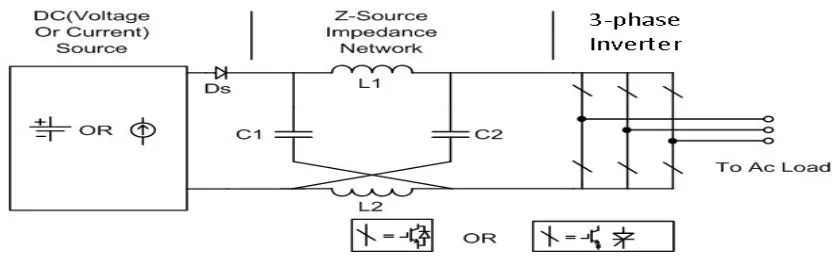
Figure 1 shows general circuit diagram of Z-SOURCE INVERTER. The ZSI having Z-impedance network as it consists of two inductors and two capacitors connected in a X-fashion. Unlike in traditional three-phase inverter has eight switching states a ZSI bridge has nine switching states. The VSI has six active states when the DC voltage is impressed across load and two zero states where load terminals are shorted else ZSI has one extra zero state where both the upper and lower switches of a phase leg gating at same time, this extra zero-state is called as shoot-through state to boost the DC bus voltage. The shoot through state is not allowed in VSI as it occur shoot-through. This shoot-through state in ZSI can be generated by different ways via anyone phase leg, combination of any two legs and all three legs.
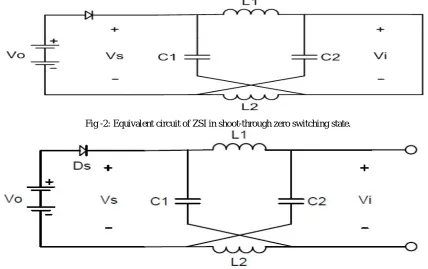
Fig -2: Equivalent circuit of ZSI in shoot-through zero switching state.
Fig -3: Equivalent circuit of ZSI in Traditional zero switching state.
[image:3.612.95.518.497.622.2]To known the operating principle of the ZSI, figure 2 shows equivalent circuit of the Z-Source Inverter viewed from DC link. Figure 3 shows the inverter bridge is equivalent to a short circuit when inverter bridge in shoot-through zero state, whereas the inverter bridge becomes an equivalent current source as shown in figure 4 when in one of the six active states.
Fig -4: Equivalent circuit of ZSI in non-shoot through zero switching state.
For circuit analysis to get output voltage assuming that the inductors L1 and L2 and capacitors C1 and C2 have same inductance (L) and capacitance (C) respectively. As summarized all equations. The output peak phase voltage from the traditional inverter can be expressed as
Where,
= Maximum sinusoidal inverter output voltage M = Modulation Index
= DC input voltage
The Boost factor is given as
where T0 is the shoot-through interval over one switching cycle T.
III.SIMPLEBOOSTCONTROLMETHODS
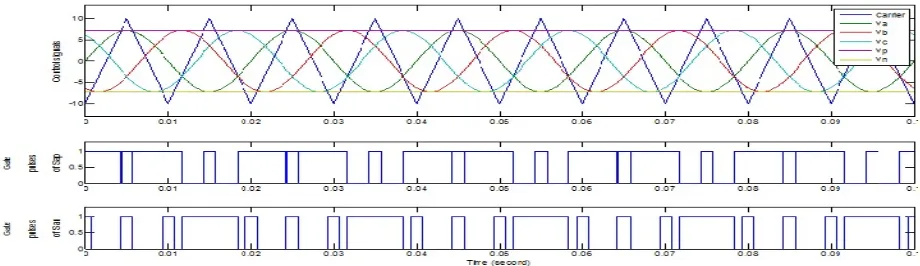
[image:4.612.66.526.408.541.2]There are various methods can be used to control ZSI. This can be classified into two according to the different shoot-through states insertion methods. In first method shoot-through are generated by properly level shifting the modulation signals of voltage source inverter. Shoot-through states then will be inserted at every state transition. In second method, there is direct replacement of null states (111 and 000) by shoot-through states. In this paper we used simple boost control method which is illustrated in figure 5. In this two straight lines are employed to realize the shoot-through duty ratio. The first line is equal to the peak value of the three-phase sinusoidal reference voltages while other line is the negative of the first one. Whenever the triangular carrier signal is higher than the positive straight line or lower than the negative straight line, the inverter will operate in shoot-through else wise it work as a traditional PWM inverter. Figure 5 shows the modulation, the driver signals for two switches and shoot-through signals of simple boost control method.
Fig -5: PWM Signal of Simple Boost Control.
IV.VSIFEDIMDRIVEANDZSIFEDIMDRIVE
In this paper, for the comparison of VSI and ZSI, two models are prepared in MATLAB/SIMULINK. ZSI fed IM drive model is based on simple boost control technique. Whereas, the VSI fed IM drive model is based on sinusoidal pulse width modulation (SPWM). All the traditional pulse width modulation (PWM) schemes can be used to control the ZSI and their theoretical input– output relationships.
V. SIMULATIONRESULTS
Fig -6: Speed of VSI fed IM Drive
Fig -7: Speed of ZSI fed IM Drive
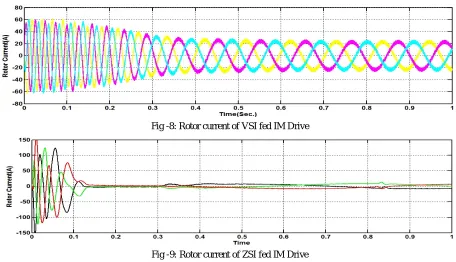
[image:5.612.76.532.442.704.2]Figure 6 and 7, shows the speed of VSI fed IM drive and ZSI fed IM Drive resp. From the results, it is clear that the ZSI gives better speed control than the VSI model. ZSI also provides less jerky motion at the starting of the motor as compared to VSI. When the variable torque is applied the change in the speed in VSI fed IM drive is greater and sudden as compared to ZSI fed IM drive. Figure 8 and 9 shows the rotor current for VSI fed and ZSI fed IM Drive resp. It shows that with ZSI, settling time for rotor current is decreased as compared to VSI. It is also clearly seen that VSI has more ripple component as compared to ZSI.
Fig -8: Rotor current of VSI fed IM Drive
respectively. From results, it is clear that the torque distortions are more in the VSI fed IM drive as compared to ZSI. It is also noted that with the ZSI fed IM drive attain the load torque with less time as compared to VSI
[image:6.612.89.528.117.372.2]Fig -10: Electromagnetic Torque of VSI fed IM Drive
Fig -11: Electromagnetic Torque of ZSI fed IM Drive
VI.CONCLUSIONS
This paper presents a comparative study of performance characteristics the VSI and ZSI fed induction motor drive using MATLAB. The characteristics of 3-phase induction motor such as speed, rotor current and electromagnetic torque was given on variable load conditions. Simulation results of ZSI Fed IM Drive under simple boost control method showing better performance than ZSI Fed IM Drive.
REFERENCES
[1] F. Z. Peng, “Z-Source Inverter,” IEEE Transaction Industry Applications, vol. 39, pp. 504–510, March/April 2003.
[2] Fang Zheng Peng, Alan Joseph, JinWang, Miaosen Shen, Lihua Chen, Zhiguo Pan, Eduardo Ortiz-Rivera, Yi Huang, “Z-Source Inverter for Motor Drives” IEEE Transactions On Power Electronics, vol. 20, no. 4, pp. 857-863, July 2005.
[3] D. Kumar, Z. Husain, “ A Comparative Study of Z-Source Inverter Fed Three-Phase IM Drive with CSI and VSI fed IM,” International Journal of Power Electronics and Drive System (IJPEDS), vol.3, no.3, pp. 259-270, September 2013.
[4] F.Z. Peng, M. Shen, and Z. Qiang, “Maximum Boost Control of the Z-Source Inverter”, IEEE Transactions on Power Electronics, vol. 20, no. 4, pp. 833-838, July 2004.
[5] Omar Ellabban, Joeri Van Mierlo and Philippe Lataire,” Comparison between Different PWM Control Methods for Different Z-Source Inverter Topologies”, The 13th European Conference on Power Electronics and Applications, EPE '09. 8-10 Sept. 2009, Barcelona-Spain.
[6] Xinping Ding, Zhaoming Qian, Shuitao Yang, Bin Cui, Fangzheng Peng, “A New Adjustable-Speed Drives (ASD) System Based on High-Performance Z-Source Inverter” , IEEE Industry Applications Conference, 23-27 Sept. 2007, pp: 2327 – 2332.
[7] B. Singh, SP Singh, J Singh, M. Naim, “Performance evaluation of three phase induction motor drive fed from z-source inverter,” International Journal on Computer Science and Engineering (IJCSE), 2011.
[8] B Husodo, S. M. Ayob, M. Anwari, Taufik, “Simulation of Modified Simple Boost Control for Z‐Source Inverter,” International Journal of Automation and Power Engineering (IJAPE), Vol. 2, Issue 4, May 2013.
[9] T.Meenakshi, K.Rajambal, “Identification of an Effective Control Scheme for Z-Source Inverter”, Asian Power Electronics Journal, vol. 4, no. 1, April 2010.