Solid Polymer Electrolytes: Temperature Dependent Ionic
Conductivity and Solid State Battery Fabrication
Kiran Thakur1, Angesh Chandra2, Archana Chandra2 and S. S. Thakur3
1Department of Chemistry,
Govt. Pataleswar College Masturi, Bilaspur, Chhattisgarh, INDIA.
2Shri Shankaracharya Institute of Professional Management & Technology,
Raipur – 492 015, Chhattisgarh, INDIA.
3Department of Chemistry,
Guru Ghasidas University, Bilaspur, Chhattisgarh, INDIA. email: [email protected]; [email protected].
(Received on: April 30, 2019)
ABSTRACT
Temperature dependent ionic conductivity studies of a newly synthesized silver ion conducting solid polymer electrolyte (SPE): [70PEO:30AgCl] have been reported. The activation energy (Ea) of SPE have also been calculated with the help
of Arrhenius equation below the transition temperature. Solid state battery fabrication and cell potential discharge characteristic studies on thin film solid state battery are reported. Ag+ ion conducting SPE: [70PEO: 30AgCl (wt.%) as electrolyte was
sandwiched between Ag-metal foil as anode and hot-pressed film of (C+I2+Electrolyte) as cathode. The cell potential discharge profiles were drawn under
different load conditions at room temperature. An open circuit voltage (OCV) ~ 0.62 V, obtained in these batteries, is fairly low as compared to the theoretical OCV (~0.687V). Temperature dependent ionic transference number (tion) was determined
with the help of dc polarization technique.
Keywords: Solid polymer electrolytes, ionic conductivity, ionic transference number, polymer battery.
1. INTRODUCTION
super-capacitors, memories electrochromic displays etc.1-3. In the last 3-4 decades, a large
number of solid state ionic materials in different phases such as crystalline/ polycrystalline, glassy/ amorphous, composite, ceramic, polymeric etc. and involving variety of mobile ionic species viz. H+, Li+, Ag+, Cu+, Na+, F-, O2- etc. has been discovered. Amongst the known
superionic solids, polymeric electrolyte systems, including conventional, micro/ nano composite/ gels, attracted widespread attention as the most appropriate choice to fabricate flexible, compact laminated all-solid-state electrochemical batteries4-8. Polymer electrolytes
are prepared, in general, by complexing ionic salts in variety of polymeric hosts by dissolving both the salt & polymer in a common solvent. There are very few systems reported which involve other mobile ions viz. Ag+, Cu+ etc. This is probably due to the limitation of the
preparation technique based on solution-cast. In the present paper, a novel hot-press technique has been reported for casting polymer electrolyte membranes. This is a more rapid and least expensive solvent-free procedure to form completely dry polymer electrolyte membranes complexed with variety of ionic salts9-12.
The present paper reports the temperature dependent ionic conductivity and ionic transference measurements of a newly synthesized Ag+ ion conducting solid polymer
electrolyte (SPE): [70PEO:30AgCl], wt.%. A solid state polymer battery is also fabricated by using the present SPE as an electrolyte.
2. EXPERIMENTAL
The AR grade chemicals: poly (ethylene oxide) PEO (105 MW, Aldrich, USA), AgCl
(purity > 98%, Reidel, India) have been used for the preparation of SPE: [70PEO:30AgCl] in wt.%. The present SPE have been synthesized in hot-press method, as mentioned in our previous communication13. The ionic conductivity (σ) measurements were carried out by using
an LCR-bridge (HIOKI 3520 - 01, Japan) at different temperatures with the help of following equation:
σ =
.A R
l
b
[S.cm-1] (1)
where Rb is the bulk resistance, l is the thickness and A is the cross sectional area of the
polymeric sample material. The bulk resistance Rb was determined from the impedance
analysis by using an LCR- bridge (model: HIOKI 3520- 01, Japan). The ionic transference number (tion) was determined by using transient ionic current (TIC) technique with the help of
following equation14,15:
tion = 1 -
T e
I
I
(2)
where Ie is the electronic current and IT is the total current of the cell: [SS // SPE OCC // SS].
3. RESULTS AND DISCUSSION
3.1 Temperature Dependent Ionic Conductivity
Temperature dependent ionic conductivity of newly synthesized SPE OCC film: [70PEO: 30AgCl] have been calculated. Figure 1 shows ‘log - 1/T’ plot for the SPE OCC: [70PEO: 30AgCl] and it indicated that as the temperature increases ionic conductivity of SPE OCC also increases. The increase in ionic conductivity is due to the increase in free volume and available of conduction paths. The conductivity increased almost linearly with temperature up to ~ 65-70 oC at which an upward jump in conductivity was observed. The jump in
conductivity at this temperature corresponds to semi-crystalline to amorphous phase transition temperature (Tm) of PEO. The linear portion of ‘log σ -1/T’ plots below Tm can be expressed
by following Arrhenius type equation:
log σ(T) = 4.29 x10⁻¹ exp (- 0.34/ kT) [Scm-1] (3)
where 0.34 (eV) is the activation energy (Ea) computed by least square linear fitting of the
data. The low ‘Ea’ in the present SPE OCC is indicative of relatively easier ion migration and
this can be potentially used as electrolyte for electrochemical device applications.
Fig 1. ‘Log σ – 1/T’ plot of SPE OCC: [70PEO: 30AgCl].
3.2: Temperature Dependent Ionic Transference Number (tion)
Ionic transference number (tion) has also been evaluated at different temperatures using
dc polarization technique with the help of following equation:
tion = 1 - T e
I
I
where Ie is the electronic current and IT is the total current of the cell: [SS // SPE OCC // SS].
Figure 2 shows the ‘current (IT) versus time’ plots at various temperatures. One can clearly
note that tion is 0.95 at all the temperatures and hence the charge transport in the present system
is predominantly ionic with a negligible contribution (~ 0.5) of electrons.
Fig. 2: ‘IT - time’ plots for SPE OCC: [90PEO:30AgCl] at different temperatures.
3.3 Solid State Battery Fabrication
Based on the newly synthesized solid polymer electrolyte (SPE) system, following all-solid-state polymer battery has been fabricated:
Ag-metal Anode
SPE OCC: (70PEO:30AgCl) Electrolyte
SPE+C+I2
Cathode
Ag-metal foil was used as anode while cathode film was prepared by hot-pressing the homogeneous physical mixture of elemental iodine (I2), the conducting graphite (C) and SPE
in 1:1:1 weight ratios at ~ 50 oC. The cell performances were studied under different load
Fig.3. Cell potential discharge profiles of micro/ thin film battery under different load resistances: Cell I: 50 (■) and 100 (●) kΩ.
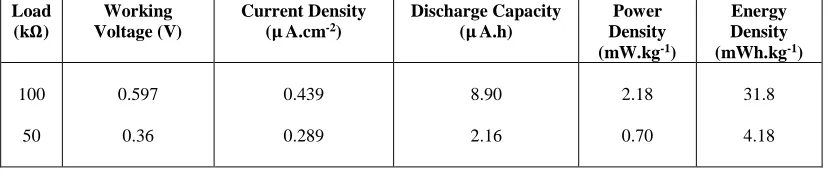
Table 1: Some important battery parameters calculated in the plateau regions of the discharge profiles of different solid polymer batteries
Load (kΩ)
Working Voltage (V)
Current Density (μA.cm-2)
Discharge Capacity (μA.h)
Power Density (mW.kg-1)
Energy Density (mWh.kg-1)
100
50
0.597
0.36
0.439
0.289
8.90
2.16
2.18
0.70
31.8
4.18
The cell exhibited OCV ~ 0.65 V, which is relatively lower than the theoretical OCV ~ 0.687 V for Ag/ I2 couple16,19. This may be due to the use of cathode film mixture (C+I2)
with polymer electrolyte binder. After the usual initial drop, the cell potential of the Cell practically remained stable ~ 0.59 V for ~ 15 hrs with 100 kΩ load ; ~ 0.36 V for ~ 6 hrs with 50 kΩ load respectively. The performance of the polymer batteries has been relatively batter at high load resistance or during low current drain states.
4. CONCLUSION
A new Ag+ ion conducting solid polymer electrolyte: [70PEO: 30AgCl],(wt.%) has
been prepared using a hot-press technique. The low activation energy in the present system indicates that this can be potentially used for solid state device applications. tion ~ 0.95 is
indicative of the fact that the 95% of Ag+ ions are mobile in the present system and only a
REFERENCES
1. Chandra S, Superionic Solids- Principle and Applications, (North Holland, Amsterdam), (1981).
2. Fenton DE, Parker JM & Wright PV, Polymer, 14, 589 (1973). 3. Armand MB, Adv Mater, 2, 278 (1990).
4. Abraham KM, Applications of Electroactive Polymers (Chapman and Hall, Springer, London, 1993).
5. Agrawal R C & Pandey G P, J Phys D Appl Phys, 41, 223001 (2008).
6. Ellis B L & Nazar L F, Current Opin Solid State and MaterSci, 16, 168 (2012). 7. Chandra A, Chandra A & Thakur K, Eur Phys J Appl Phys, 69, 20901 (2015). 8. Chandra A, Polym Bull, 73,2707 (2016).
9. Appetecchi GB, Croce F, Hasson J, Scrosati B, Salomon M & Cassel F, J Power Sources, 114, 105 (2003).
10. Agrawal RC & Chandra A, J Phys D Appl Phys, 40, 7024 (2007). 11. Sengwa R J, Sankhla S & Choudhary S, Ionics, 16, 697 (2010). 12. Chandra A, Indian J Phys, 90, 759 (2016).
13. Thakur K, Chandra A, Chandra Archana & Thakur SS, Chem Sci Rev & Lett, in press (2019).
14. Chandra S, Tolpadi SK & Hashmi SA, Solid State Ionics, 28-30, 651 (1988). 15. Chandra A, Polym Bull, 76, 785 (2019).
16. Chandra S & Agrawal R C, Solid state battery prospects and limitations, Nat Acad Sci India-Golden Jubilee Comm, edited by U S Shrivastava, Naya Prakash, Kolkata, p. 429 (1980).
17. Chandra, Indian J Pure Appl Phys, 54, 676 (2016). 18. Chandra A, Comp Commu, 4, 33 (2017).
![Fig 1. ‘Log σ – 1/T’ plot of SPE OCC: [70PEO: 30AgCl].](https://thumb-us.123doks.com/thumbv2/123dok_us/8806792.1775016/3.612.180.431.357.537/fig-log-s-plot-spe-occ-peo-agcl.webp)
![Fig. 2: ‘IT - time’ plots for SPE OCC: [90PEO:30AgCl] at different temperatures.](https://thumb-us.123doks.com/thumbv2/123dok_us/8806792.1775016/4.612.149.464.176.397/fig-time-plots-spe-occ-agcl-different-temperatures.webp)