
Research Journal
Volume 7, No. 20, Dec. 2013, pp. 98–103
DOI: 10.5604/20804075.1079219 Original Article
Received: 2013.10.18 Accepted: 2013.11.14 Published: 2013.12.06
THE CONCEPT OF INTEGRATED ENGINEERING AND BUSINESS (EB)
EDUCATION SYSTEM
Michał Charlak1, Marek A. Jakubowski2
1 Fundamentals Technology Faculty, Lublin University of Technology, 38 Nadbystrzycka Str., 20-618 Lublin,
Poland, e-mail: [email protected]
2 Management Faculty, Lublin University of Technology, 38 Nadbystrzycka Str., 20-618 Lublin, Poland, e-mail:
ABSTRACT
In our approach to engineering and business education system an engineer is a man working as creator and user of technical products. We stress that the process of un-derstanding and gaining knowledge of technical reality and creativity of engineers are
the essential for EB concept . Next, we describe briefly three perspectives for building
the system of innovative product origination as a basis for EB system: 1) designer’s perspective; 2) business perspective. 3) consumer perspective.
Keywords: engineering educational system, heuristics, innovation, organization.
INTRODUCTION
Modern engineer must not only be a specialist in engineering (for example: an electrician, me-chanic, architect, and so on), but very often he also needs to be a businessman. More and more often an engineer works as a logistics specialist, environment protection expert, a manager, an IT specialist. He works as a constructor, technolo-gist, materials expert and simultaneously as a chief production manager. Very often he must participate in the process of creating the organi-zation and as a work-safety specialist.
It is necessary to create the appropriate place at technical universities to combine multiple dis-ciplines including business, management and er-gonomics. We have to choose what knowledge
and specific fields of study (perhaps all) students
of engineering need to master. The humanities and social sciences must represent sub-disciplines
that allow achieving high qualifications to design objects to the various fields of engineering. We
propose a new approach – an engineer is a man who is simultaneously a creator and user of tech-nical products. He need modern knowledge and
XXI century skills from all disciplines concern-ing examinconcern-ing various characteristics for own work, for example: physical, psychical, social,
health aspects. We name some important fields:
physiology, psychology, praxeology, medicine, neurology, anthropometry, and some important sciences related to engineering, such as: manage-ment, business, economy, health and work safety management etc. Our modern engineer must be prepared to perform a creative work for innova-tive organizations within large and continuously and turbulent changing spheres of the needed knowledge and skills.
A process of understanding the process of gaining knowledge is the best model of a process of education at a technical university. This process includes the following four stages: understanding basic facts of reality; the process of understand-ing, followed by binding acts of understanding into particles of knowledge; enriching the current knowledge with understood elements of knowl-edge and enlarging the state of understanding;
cre-ating knowledge assets. Therefore, the profile of a
knowledge of heuristics and methods of creative work, and other human and social sciences [6].
PLACE OF HEURISTICS IN THE PROCESS
OF GAINING ENGINEERING KNOWLEDGE
Most often creation is defined as a process
based on matching and analogies which bring new and useful products. In many authors’ opin-ions creative process comes for four basic phases:
• preparation – preparatory actions for finding
of idea,
• incubation – finders of brain action,
• illumination – actions of idea appearance,
• verification – actions of estimates and modi
-fication.
It is possible to identify all of them in the schemes of ergonomic structures of project de-signs in authors discussing the problem of use-ing complex knowledge about functionuse-ing tech-nically-social system for technique. It is also possible to single out many trends in modern uses of heuristics:
Heuristics as a creative solution of a problem equal to logical, managerial as well as
mathemati-cal (e.g. solution of task, building of definition)
particularly by experiment, often with the aid of methods of attempts and errors, appealing for analogy, generalization, called as ‘applied cre-ation’, formulated by A. Góralski as: ‘approach
oriented on purpose, first of all, drying inspiration
from requirements of practices of inventions and serve this purpose’.
Heuristics as a method of instructing, facilitat-ing and invitfacilitat-ing a student to discover knowledge in an active and independent manner. Socrates was a precursor of such understanding of heu-ristics (469–399 b.c.). He developed a method of dynamic dialogue consisting of critical and con-structive element. He comprehended teaching not as devolution of knowledge, but as a process of investigating the truth.
One of unmistakable advantages of creative approach for solving project problems is that it does not only develop imagination of a planner but also promotes the inclusion of human factor
criterion to a specific technical attitude of mind.
It is necessary to remember that there is no al-gorithm which guarantees the fastest solution to problems. Without creative approach in solving problems the conditions of solving engineering problems will not emerge [6].
THE SYSTEM OF INNOVATIVE PRODUCT
ORIGINATION AS A PRIMARY SOURCE
OF THE INTEGRATED EB EDUCATION
CONCEPT
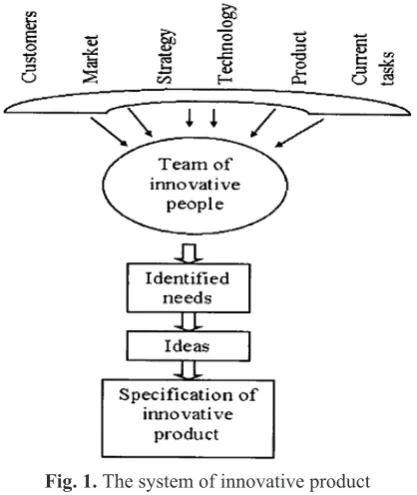
The development of ideas for an innovative product needs to be subordinated to complex ac-tivities of teams of creative people to a systematic procedure (see: Figure 1). The need of recogni-tion is a mental perceprecogni-tion which initiates a prod-uct development project [9].
Fig. 1. The system of innovative product development [9]
Companies achieve competitive advantage through acts of innovation. They approach inno-vation in its broadest sense, including both new technologies and new ways of doing things [7].
We emphasize that innovative research in par-ticular is a relatively young and unconsolidated
field. At technical universities we need to prepare
your students for the necessity of synthesizing the knowledge that exist in real world. Moreover, this knowledge must be useful for wider community and for various nations and cultures.
Tidd et al. describe four different kinds of in-novation in engineering design processes:
• innovation to introduce or improve products,
• innovation to introduce or improve processes,
• innovation to define or re-define positioning of the firm or products,
VARIOUS PERSPECTIVES ON INNOVATIVE
PRODUCT CHARACTERISTICS, AS BASIS
FOR INTEGRATED EB EDUCATION
CONCEPT
While the understanding of knowledge which engineers use in practice is rapidly growing, there is still much to be learned from exploring the contribution which related disciplines can offer. Since each discipline has its own way of developing its knowledge base, it is important for engineering science and practice to grasp the underlying manner in which they tackle their work. EB concept must bring together the ma-terial about many of these disciplines, which is normally scattered amongst a wide range of sources. It must be presented in a manner which is both accessible and relevant to engineering community for its practice and education. It will help engineers in practice and scientists to iden-tify the ways in which the knowledge they ac-quire through study or experience can be used constructively to develop the service they offer to their clients.
The concept has the following assumptions:
• It is directly related to engineering practice and education at technical and corporate uni-versities.
• Specialist contributors must explore complex ideas and present them succinctly and clearly
• We need a way in which the theory which is taught and the theory which is used in practice can be brought together to improve engineer-ing practice and technical science.
Our concept will offer insight into some of the fundamental changes which need to occur, especially in Poland as EU member, for engineer-ing attitudes and thinkengineer-ing. It will provide stimu-lating reading and discussion material for prac-tice engineering, technical universities professors etc. It will be useful for teachers and instructors working in degree and post-registration courses, as well as for practitioners who wish to keep at the forefront of a profession which is undergoing continuing and dramatic change.
According to Hansen and Andreasen one can distinguish three different perspectives on the product idea which we use as a basis for our inte-grated EB education concept;
• The engineering designer perspective.
• The business perspective.
• The consumer perspective [3].
Following the basis of a very short literature review we describe a subjective selection of some important research works about innovative prod-uct characteristics.
The designer perspectives
Asimov writes: ”The first step in the study is
to demonstrate whether the original need, which was presumed to be valid, does indeed have cur-rent existence, or strong evidence of latent exis-tence”.
He writes: ”We assume that we have been giv-en a primitive statemgiv-ent of needs. By primitive we mean that the statement represents opinion based mainly on causal observations, but unsup-ported by organized evidence. Such opinions are valuable as starting points when they come from people who have had the opportunity and have the ability to make observations and to temper them with considered judgment”. And: “Effective
needs we will define as those which have an exis -tence in the market place, by virtue of consumers’ willingness and ability to acquire the means for their satisfaction” [1].
According to Asimov the work needs to be strongly integratied with the ideas about their products and the market place, by virtue of con-sumers and clients.
Harrisberger writes: “A feasibility study is an iterative process – check and revise, then check again – until all possible alternative ideas for achieving the requirements of the design, are explored”. And: ”The ultimate goal is a product idea that has enough merit to be worth extensive design, development, and testing. However, it is also likely that a feasibility study will verify that the idea would not be practical in terms of cost or utility; that is, ‘Sure we can do it – but is it worth the effort?” [4].
Ulrich and Eppinger write: “Needs are largely independent of any particular product we might
develop; they are not specific to the concept we
eventually choose to pursue”. They write: “A pro-duct concept is an approximate description of the technology, working principles, and form of the product. It is a concise description of how the prod-uct will satisfy the consumer needs. A concept is usually expressed as a sketch or as a rough three-dimensional model and is often accompanied by a brief textual description” [11].
between engineers’ ideas and which must satisfy the consumer needs.
The business perspectives
In the USA Cooper described and recom-mended a state-gate model of the design process. The spirit of stage 1 is to ‘spend a little money, gather some information, so that the project can be reevaluated at gate 2 in the light of better
infor-mation’. Therefore, this first stage is a quick and
inexpensive assessment of the technical merits of the project and its market prospects. Preliminary
market, technical and financial assessments con -stitute stage 1.
Cooper writes that an idea occurs when tech-nological possibilities are matched with market needs and expected market demand. Ideas may be generated by the marketplace – a recognition
of unsatisfied customer needs, direct request from
customers, or a competitive product. Such market- pull ideas represent the source for the majority of new product projects. But technology-push ideas – which are generated by researchers, science or technology, or result from serendipitous discover-ies – also play an important role, particularly in radical innovations or breakthrough products [2],
We stress, that in the approach called ‘To-tal design’ market needs and demands are very strongly integrated with engineering activity and have priority before the concept of engineering design.
Leifer et. al. define a radical innovation proj -ect, which is the one with the potential to pro-duce one or more of the following: an entirely new set of performance features; improvements
in known performance features; of five times or greater; a significant (30 percent or greater) re -duction in cost.
He writes that in some cases, radical innova-tion starts with a technical idea or a set of techni-cal ideas. The idea may be born out of natural cu-riosity of a scientist or engineer, or be stimulated by a challenging problem. The technical idea can take a form of a discovery of novel technology, new insight into an old problem, or a new way of linking the existing technologies. In other cases, radical innovation has its roots in a market need, an industry ‘Holy Grail’ (a great and unsolved challenge in the company’s industry), or the
stra-tegic vision of the firm’s leadership. Each of these
can catalyze the development of technical ideas with a potential to be breakthroughs. Because
ideas can come from so many sources, noticing
them is difficult. Many are missed for lack of an
alert receiver.
In the following text Leifer et. al. clearly de-scribe the concept of strong integration between engineering and business integration. By anal-ogy, this idea is very important for education of engineers in XXI century – century of turbulent market economy.
For a radical idea to move forward, someone must recognise its business potential, in other words, make a connection between a novel tech-nical solution and a compelling market need [5].
The consumer perspective
Creusen focuses on consumers’ ‘responses to product appearance’. In many purchase situations product appearance determines the consumers ‘impression’, and based on this impression, con-sumers reason about other product attributes, e.g. performance and quality. Creusen distinguishes six roles of product appearance: attention draw-ing, categorization, communication of practical, ergonomic, hedonic, and symbolic product infor-mation. The roles are not independent, and con-sumers evaluate product appearance in a holistic way into accounting a global product
appear-ance, rather than the way the specific functions
are designed. Tidd et. al. discuss buying behav-ior of consumers. Two types of theories describ-ing consumer behavior are presented: utilitarian theories and behavioral approaches. Utilitarian theories assume that a consumer is rational and make purchase decision based on a comparison of the product utility with consumer’s requirements. However, such a rational process is seldom seen in practice [10].
Henry Mintzberg was the first one who re -gards the most crucial part of managerial activ-ity (Table 1) as that concerned with making de-cisions. He divided the managerial activity into three categories: interpersonal relationship, infor-mation processing and decision making.
For Henry Mintzberg the roles that he plac-es in the managerial activity rolplac-es are based on different classes of decision, namely: entrepre-neur, disturbance handler, resource allocator, negotiator.
is to be done. In principle they are acting volun-tarily. This is very different from their role as dis-turbance handler, where mangers have to make decisions which arise from events beyond their control and unpredicted. The ability to react to events as well as to plan activities is an important managerial skill in Mintzberg’s eyes.
The resource allocation role of a manager is central to much of the organizational analysis. Clearly, a manager has to make decisions about the allocation of money, people, equipment, time and so on. Mintzberg points outs that in doing so a manager is actually scheduling time, program-ming work and authorizing actions. The negotia-tion role is put in the decisional category by Mint-zberg because it is ‘resource trading in real time’. A manager has to negotiate with others and, in the process, be able to make decisions about the com-mitment of organizational resources.
For Mintzberg these roles provide a more adequate description of what managers do than any of various schools of management thought. In these roles it is information that is crucial; the manager is determining the priority of informa-tion. Through the interpersonal roles a manger acquires information, and through the decisional roles it is put into use. The scope for each man-ager to choose a different blend of roles means that management is not reducible to a set of
sci-entific statements and programs. Management is
essentially an art and it is necessary for managers
to try and learn continuously about their own situ-ations. Self study is vital. According to Mintzberg ‘the management school has been more effective at training technocrats to deal with structured problems than managers to deal with unstructured ones [8].
We emphasise that according to Mintzberg’s text we have no suitable management theory for teaching our students, he need to try and learn on basis own experience.
Mintzberg presents a way of understanding the design of organizations and suggests that there
are seven types. As shown in Table 2, the first five
types are differentiated according to which the basic part of the organization forms the key to its operations. In the entrepreneurial organization it is the strategic apex which is key. In a manufac-turer, for example, this would be the President of Chief Executive, the Board of directors, and their personal staff. In a machine organization, it is the ‘technostructure’ which is key, this includes those
in planning, finance, operations research and
work study and production scheduling. The key part in a professional organization is the ‘operat-ing core’, those at the work‘operat-ing base of the organi-zation. While in a manufacturer this would be the buyers, machine operators, sales people and dis-patchers, in a professional organization it might be doctors and nurses (in a hospital) or teaching staff (in a college). It is important for mangers
to understand the configuration of their particu -Table 1. Managerial roles [9]
Interpersonal Informational Decisional
Figurehead Monitor Entrepreneur
Leader Disseminator Disturbance handler
Liaison Spokesperson Negotiator
– – Resource allocator
Table 2. Seven organizational types according to H. Mintzberg [8]
Seven Organizational Types
Organizational configuration Prime coordinating mechanism Key part Type of decentralization
Entrepreneurial Direct supervision Strategic apex Vertical and horizontal centralization
Machine Standardization of work processes Technostructure Limited horizontal decentralization
Professional Standardization of skills Operating core Horizontal decentralization
Diversified Standardization of outputs Middle line Limited vertical decentralization
Innovative Mutual adjustment Support staff Selected decentralization
Missionary Standardization of norms Ideology Decentralization
lar organization in order to ensure that the
vari-ous parts ‘fit together’ and are consistent in what
they do. But, Mintzberg warns against forgetting that there will always be contradictions among the forces in organizations. Managers should use these contradictions creatively rather than ignor-ing or tryignor-ing to suppress them [8].
CONCLUSIONS
1. An engineer is a man interpreted as a creator and user of technical products.
2. Without knowledge of heuristics and knowledge management the condition will not emerge for achievement of progress in engineering edu-cation systems.
3. Basis for integrated engineering and busi-ness (EB) education system is subordination the complex (engineers and business people) teams to a systematic procedures.
REFERENCES
1. Asimov M., Introduction to design. Prentice – Hall Inc., Englewood, N.J., 1962.
2. Cooper R.G., Winning at new products – accelerat-ing the process from idea to launch. 2nd ed.,
Addi-son-Wesley Publ. Co., 1993.
3. Hansen C.T., Andreasen M.M., On the content of a product idea. In: Proceedings of 14th International
Conference on Engineering Design (ICED 03), Stockholm 2003.
4. Harrisberger L., Engineersmanship – a philosophy of design. Brooks/Cole Publ. Co., Belmont, Calif., 1966.
5. Leifer R., McDermott C.M., O’Connor G.C., Pe-ters L.S., Rice M.P., Veryzer R.W., Radical innova-tion: how mature companies can outsmart upstarts, Harvard Business School Press, Boston, Massa-chusetts 2000,
6. Marcinkowski J.S. et al., Ergonomic education at the technological university. Publishing House of Poznan University of Technology, Poznan, 2012. 7. Porter M., The competitive advantage of nations.
McMillan, London 1990.
8. Pugh D.S., Hickson D.J., Writers on organizations. An invaluable introduction to the ideas and argu-ments of leading authorities on management. Fifth edition, Penguin Books, 1996.
9. Rohatynski R., Innovative product management in Innovation by Design. Ed. R. Rohatynski, Publ. House - Wroclaw University of Technology, De-partment of Mechanical Engineering, Wroclaw 2011.
10. Tidd J., Bessant J., Pavitt K., Managing innova-tion. John Wiley and Sons, 2005.
![Table 2. Seven organizational types according to H. Mintzberg [8]](https://thumb-us.123doks.com/thumbv2/123dok_us/8810113.1776883/5.595.71.520.626.772/table-seven-organizational-types-according-h-mintzberg.webp)
