This is an open access journal, and articles are distributed under the terms of the Creative Commons Attribution-Non Commercial-ShareAlike 4.0 License, which allows others to remix, tweak, and build upon the work non-commercially, as long as appropriate credit is given and the new creations are licensed under the identical terms.
© 2018 Journal of Advanced Pharmacy Education & Research | Published by SPER Publication
77
The significance of multi-outcome anesthesia for pediatric
patient diagnosis and monitoring
M. Elsonbaty, A. Elsonbaty, Islam Rasmy
*
, Yasmin Elbasha, Shaimaa Wahba, Mohamed Abdelghany,
Ahmed Hazem, Ahmed Salaheldin, Ismaiel sayed, Maged Elgendy, Ayman Abougabal, Mohamed
Ramadan, Ahmed Hussien
Department of Anesthesia, Surgical ICU & Pain Management, Faculty of Medicine, Cairo University, Cairo, Egypt.
Correspondence: Islam Rasmy, Department of Anesthesia, Surgical ICU & Pain Management, Faculty of Medicine, Cairo university, Cairo, Egypt. E_mail: [email protected]
ABSTRACT
Background and Aim: The neural-fuzzy systems used in modeling patient dynamics are usually complex while the Wiener models adopt a single anesthetic input for single output. Therefore, the research aimed at providing a real-time, multi-input and multi output model for anesthetic administration among pediatric patients that can be used in place of other complex models, for example, the neural fuzzy models which are complex as they contain many parameters. Methods: The study included 100 pediatric patients scheduled for herniorrhaphy surgery, which was via intravenous unconscious sedation. Two groups were used in the study, which were Group N (sevoflurane and rocuronium anesthesia was administered, n=50) and Group M (propofol and rocuronium anesthesia was administered, n=50) to establish their effects on the participants. The patients were taken to an operating room, and started by a face mask hooked at an electrocardiogram (ECG) monitor, and a non-invasive cuff which was subsequently placed on the contralateral arm where the cuff cycle was calibrated to measure the blood pressure after every 180 seconds, taking an average time of 154 minutes. Heart rates and BIS levels were also measured. Results: For Group M, 42%, 28%, and 30% of patients had normal, high, and low blood pressure levels, respectively. For Group N, 34%, 30%, and 36% of patients had normal, high, and low blood pressure levels in that order. For Group M, 24%, 34%, and 42% of patients had normal, high, and low heart rate levels in succession. For Group N, 20%, 34%, and 46% of patients had normal, high, and low heart rate levels correspondingly. For Group M, 12%, 46%, and 42% of patients had normal, high, and low BIS values concurrently. For Group N, 16%, 42%, and 42% of patients had normal, high, and low BIS values in that order. Conclusion: Real-time, multi-input and multi output model for anesthetic administration among pediatric patients is more effective compared to neural-fuzzy systems used in modeling patients’ dynamics, which are usually complex while the Wiener models were ineffective as they adopted a single anesthetic input for single output.
Keywords:ECG, BIS value, heart rate, blood pressure.
Introduction
Real-time anesthesia decisions are usually paramount in the clinical setting and are exemplified for attaining adequate clinical considerations, including the consciousness of the pediatric patients and ventilation control among other aspects.
Administering anesthesia to infants is potentially detrimental if the correct dosage is not overseen. According to Madaelil, Kansagra, Cross, Moran, and Derdeyn [1], one of the main
requirements for administering the correct dosage in decision process is predicting the impact of the various inputs, including the drug infusion rates, ventilator mode, and fluid flow rates among other aspects on the subsequent outcome, including heart rates, blood pressures, and consciousness levels.Predictability of the results can effectively be utilized in predicting the diagnosis, warning, displaying, controlling, making comparisons of the outcomes, as well as decision analysis [2, 3]. As such, predictability is vital in preventing adverse
effects among pediatric patients. Therefore, for accurate predictions, there needs to be a reliable model about the anesthetic inputs and outputs [4, 5].
Access this article online
Website:www.japer.in E-ISSN: 2249-3379
How to cite this article: M. Elsonbaty, A. Elsonbaty, Islam Rasmy, Yasmin Elbasha, Shaimaa Wahba, Mohamed Abdelghany et al. The significance of multi-outcome anesthesia for pediatric patient diagnosis and monitoring. J Adv Pharm Edu Res 2018;8(2):77-81.
Source of Support: Nil, Conflict of Interest: None declared.
[6] highlighted that the success of the model is reliant on
allowing multiple inputs to measure the many outcomes, which is as opposed to the traditional modeling, monitoring, control, and diagnosis as only one drug used for a single outcome. However, [7] asserted that with a new model that can allow for
multi-input and output, the accuracy of the diagnosis and monitoring of anesthetic administration among pediatric patients can be increased. Since real-time data requires individualized pediatric patient’s modeling, low complexity must be planned. However, there is a challenge when multiple anesthetics are used, which becomes a complicated scenario. Wiener models are the basic methods for single anesthetic input and output [8, 9]. However, the current paper introduced
multiple inputs and outcome scenarios that are real-time simplifying the problem and promoting easier decision-making in comparison to the neural-fuzzy systems and Wiener models that are complex and ineffective, in real-time monitoring and diagnosis.
Materials and Methods
This study was performed between September 2017 to December 2017 after approval of the ethical committee of the anesthetic department of the University of Cairo. The selected patients were undergoing herniorrhaphy surgery, which was via intravenous unconscious sedation. Patients encompassed in the study were aged between six months and two years, and since the anesthesia that was used was propofol, rocuronium, and sevoflurane (The participants were divided into two groups Group N (sevoflurane and rocuronium anesthesia administered; n=50) and Group M (propofol and rocuronium anesthesia administered, n=50)), they had no previous adverse effects on the sample of patients used, including allergy. Exclusion criteria that were used while selecting the study sample included those pediatric patients with allergy to the drugs, those who were obese, with coagulation disorders, and those with neurologic diseases. The sample used for the study was 100 patients (N=100). The participants were divided into two groups: Group N (sevoflurane and rocuronium anesthesia administered; n=50) and Group M (propofol and rocuronium anesthesia administered, n=50).
The method for selecting participants was randomized-type and included 100 patients. An experienced anesthesiologist administered them. The patients were seen, evaluated, and examined, and the anesthesiologist made sure that they were ready for the herniorrhaphy. Safe dose of anesthesia was administered after receiving consent for the surgery, as well as approval to participate in the study. The benefits and risks had been explained to the parents while obtaining consent to participate in the study.
The patients were consequently taken to an operating room and started on a face mask hooked at an electrocardiogram (ECG) monitor, which records the heart's activity and rhythm on a screen, and a non-invasive cuff was subsequently placed on the contralateral arm where the cuff cycle was calibrated to
measure the blood pressure every 180 seconds, taking an average time of 154 minutes. Besides, a pulse oximeter was then hooked to the patients’ contralateral index. Also, the patients’ consciousness levels during the anesthesia administration were then measured using a bispectral index (BIS) monitor by Aspect Medical Devices, Inc. It is, in fact, one of the commercial monitors available and in use in many operating rooms [10]. The BIS monitor provides single
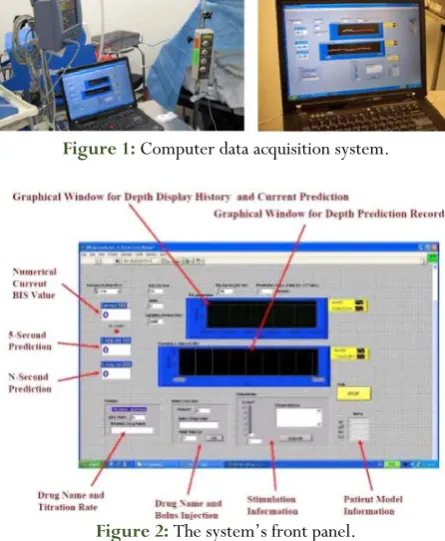
dimensionless numbers that range from 0 (equivalent to EEG silence) to 100. Also, the monitor provided a cumulative index ranging 0 to 100 so that the lower the index value, the deeper the state of the anesthesia. 0 value indicated no brain activity while a value of 100 indicated the presence of brain activity. A BIS electrode was subsequently placed on the patients’ forehead before anesthesia was administered. The electrode was then connected to the monitor and in turn to a computer system that allowed for continuous recordings, as well as saving the values read on the BIS. The computer software used was from Wayne’s university department of computer engineering. It was an effective tool for predicting BIS values for each patient, which consequently allowed for the generation of real-time patient models using the response data from the pediatric patients who had been administered with anesthesia, as shown in Figure 1 and Figure 2 below.
Figure 1: Computer data acquisition system.
Figure 2: The system’s front panel.
consequently, the pediatric patient was awakened, and the BIS was more than 75. After that, the patient was taken to a recovery room, and oxygen was administered while undergoing an observation.
The participants were divided into two groups Group N (sevoflurane and rocuronium anesthesia administered; n=50) and Group M (propofol and rocuronium anesthesia administered, n=50). Since two anesthesia were used per group (Group N - sevoflurane and rocuronium anesthesia administered, and Group M - propofol and rocuronium anesthesia administered), these were the inputs, and the outputs were established by the interactions of the drugs - heart rates, BIS values, and blood pressures. As such, these outcomes were observed for each patient. Essentially, it can be noted that different individuals react differently to various medications, and these outcomes were the main aim of making correlations. As such, as a control strategy that can be used in regulating the administration of anesthesia, it can be noted that the outcomes vary among the patients, and this can be used in establishing a predictive control mechanism in regulating two patient outcomes at the same time [11, 12].
Statistical Analysis
The collected data was subsequently analyzed using the Statistical Package for Social Science (SPSS) version 16. Besides, the parametric data was then expressed using means and standard deviations. The comparisons of the mean and the standard deviation were paired and unpaired student t-test. Also, non-parametric data was expressed using percentages of the outcomes in comparison to the total participants of the study. The outcomes of the administered anesthetics were then compared, and the distributions were created using Chi-square test, and also repeated-measures analysis of variance were then followed by conducting the Bonferroni’s post hoc testing at a P -value < 0.05 that was considered as statistically significant.
Outcome Measures
The primary outcome measure was the prediction of the various anesthetic outputs based on the inputs. The outputs were then compared in accordance with the effectiveness in making an accurate diagnosis, as well as ensuring the proper monitoring of pediatric patients. Both Group N (sevoflurane and rocuronium anesthesia administered) and Group M (propofol and rocuronium anesthesia administered) had multiple outcomes. Sevoflurane had a direct influence on the blood pressure and the BIS values. Between 0-200 secondsafter sevoflurane and rocuronium were injected, the blood pressure decreased from 110mmHg to 90 mmHg. Propofol and rocuronium, on the other hand, controlled the depth of the anesthesia and the blood pressure. Between 350-1000 seconds, blood pressure and BIS value rose as the propofol and rocuronium rate of administration was lowered. Secondary outcomes included consciousness levels after the surgery, and thus, both groups (Group M (n=25) and Group N (n=25)) had the samples (N=50) checked for the level of consciousness.
Results
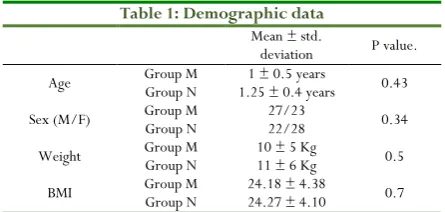
All demographic data, such as sex, weight, height, as well as the body mass index (BMI), were comparable in both groups.
Table 1: Demographic data
Mean ± std.
deviation P value. Age Group M Group N 1.25 ± 0.4 years 1 ± 0.5 years 0.43
Sex (M/F) Group M Group N 27/23 22/28 0.34
Weight Group M Group N 10 ± 5 Kg 11 ± 6 Kg 0.5
BMI Group M Group N 24.18 ± 4.38 24.27 ± 4.10 0.7
Data were express as mean (±SD), P value < 0.05 is considered significant. Group (M) = Propofol and rocuronium group. Group (N) = Sevoflurane and rocuronium, BMI = body mass index.
Table 2: Operative Data
Group M
(n = 50) Group N (n = 50) P value Anesthesia Time
(in minutes) 180 ± 15 183 ± 12 0.6
Surgical Time
(in minutes) 160 ± 10 158 ± 17 0.21
Data are expressed as mean (±SD), P value < 0.05 is considered significant. Group (M) = Propofol and rocuronium group. Group (N) = Sevoflurane and rocuronium.
Table 3: Outputs impacts (Blood pressure)
Blood Pressure Group M (n = 50) Group N (n = 50) Normal (Systolic blood pressure is 90-105,
and diastolic blood pressure is 55-70) 21 (42%) 17 (34%) High (above the normal systolic and diastolic
blood pressure) 14 (28%) 15 (30%) Low (below the normal systolic and diastolic
blood pressure) 15 (30%) 18 (36%)
Table 4: Output Impact (heart rates)
Heart rate Group M (n = 50) (n = 50) Group N Normal (80-130 contractions of the heart
per minute) 12 (24%) 10 (20%)
High (above the normal 80-130
contractions of the heart per minute) 17 (34%) 17 (34%) Low (below the normal 80-130
contractions of the heart per minute) 21 (42%) 23 (46%)
Table 5: Output Measures (BIS values)
Heart rate Group M (n = 50) Group N (n = 50) Normal (40 – 60 while in surgery and
awake after the surgery) 6 (12%) 8 (16%) High (above 40 – 60 while in surgery and
slow wakening after surgery) 23 (46%) 21 (42%) Low (below 40 – 60 while in surgery and
slow wakening after surgery) 21 (42%) 21 (42%)
high (above the normal systolic and diastolic blood pressure); and (3) low (below the normal systolic and diastolic blood pressure) (See table 3). The anaesthesia also had variant outcomes on the heart rate, which was: (1) normal (80-130 contractions of the heart per minute); (2) high (above the normal 80-130 contractions of the heart per minute); and (3) low (below the normal 80-130 contractions of the heart per minute) (See table 4). The anaesthesia also affected the patient BIS values differently: (1) normal (40 – 60 while in surgery and awake after the surgery); (2) high (above 40 – 60 while in surgery and slow wakening after surgery); and low (below 40 – 60 while in surgery and slow wakening after surgery) (See table 5).
Discussion
The anesthesia used, as expected, had multiple outcomes (BIS values, heart rate, and blood pressure), which was anticipated as multiple inputs were entered (Group N had sevoflurane and rocuronium anesthesia administered and Group M had propofol and rocuronium anesthesia administered). Therefore, this means that it is essential that medical practitioners monitor patient vitals in real-time, as well as diagnose and predict multiple outcomes of administering anesthesia to pediatric patients. For this reason, it is critical to view the anesthesia dynamics of the patient as multi-input where multi-drugs are used and multi-output where multiple outcomes are achieved after the anesthesia administration, during and after the surgery. In essence, the pediatric patients had different reactions to the drugs (Group M and Group N), meaning that there were multiple outcomes, and thus, there was a need to consider and predict the effects of the drugs. Therefore, bear in mind, this model of reduced parameters is easy for anesthesiologists to monitor and diagnose, and also allows for real-time mapping of the patient vitals.
As shown in the results, it is also essential to monitor adverse events of blood pressure, BIS, and heart rate once pediatric patients have been administered with multi-anesthetic drugs. In fact, adverse outcomes are common during and after surgery [13, 14], which is why it is important to have simplified models for
clarity in comprehending the various outcomes. By using simple models, it is easy to rectify the high and low outcomes of anesthetic drug administration in pediatric care [15]. This calls for
a move from complex to simple models that can be monitored in real-time.
In instances of multi-objective anesthesia diagnosis, various researchers, for example, [16] and [17], have considered
multivariate models. The neural-fuzzy systems used in modeling patient dynamics are usually complex [16, 17]. A
multivariate piecewise linear model used in relating drugs and surgical stimulations to patient outcomes including heart rates, BIS values, as well as blood pressure, as shown in the current study, is essential for anesthetic diagnosis, prediction, and monitoring, primarily because the model of multi-input and multi-output is simple [18, 19]. Neural-fuzzy systems, besides
being complex, are black-box models whose parameters do not carry any clear physiological meanings for patients undergoing surgery. Therefore, this implies that the system parameters may not provide direct inputs, as well as allow for adjusting or limiting the model parameters. Besides, the neural fuzzy models are complex as they contain many parameters. Hence, it becomes a complex process in diagnosing and monitoring anesthesia [16, 17, 20]. Besides, the initial process of learning the
fuzzy neural systems is in most cases time-consuming, and it limits the use of small real-time data sets in deriving an individualized and reliable patient model. The approach used in the current study was simple, and contained four input parameters that reflect an anaesthesiologist comprehension of a pediatric patient dynamic response, including delay, sensitivity, and speed of administering the anesthesia during surgery. These parameters can, therefore, be adjusted, making the simplified model of multi-input and multi-output easy to use due to the reduced parameter, as well as incorporating the benefit of real-time patient modeling.
Conclusion
Real-time, multi-input and multi output model for anesthetic administration among pediatric patients is more effective compared to neural-fuzzy systems used in modeling patient dynamics, which are usually complex while the Wiener models are ineffective as they adopt a single anesthetic input for single output.
References
1. Madaelil, T. P., Kansagra, A. P., Cross, D. T., Moran, C. J., & Derdeyn, C. P. (2016). Mechanical thrombectomy in pediatric acute ischemic stroke: Clinical outcomes and literature review. Interventional
Neuroradiology, 22(4), 426-431.
2. Chang, J. J., Syafiie, S., Kamil, R., & Lim, T. A. (2015). Automation of anaesthesia: a review on multivariable control. Journal of clinical monitoring and
computing, 29(2), 231-239.
3. Riddle, J. D. (2015). Clinical Utility of
Pharmacogenomic Testing to Support Prescriptive Decision Making Among Anesthesia Providers: A Mixed-Method
Study. South Carolina, SC: Medical University of
South Carolina.
4. Marrero, A., Méndez, J. A., Reboso, J. A., Martín, I., & Calvo, J. L. (2017). Adaptive fuzzy modeling of the hypnotic process in anesthesia. Journal of clinical
monitoring and computing, 31(2), 319-330.
in the Danish Anaesthesia Database. Anaesthesia, 70(3), 272-281.
6. Hemmerling, T. M., Arbeid, E., Wehbe, M., Cyr, S., Taddei, R., & Zaouter, C. (2013). Evaluation of a novel closed-loop total intravenous anaesthesia drug delivery system: a randomized controlled trial. British
journal of anaesthesia, 110(6), 1031-1039.
7. Ruano, A. E., Ge, S. S., Guerra, T. M., Lewis, F. L., Principe, J. C., & Colnarič, M. (2014). Computational intelligence in control. Annual Reviews
in Control, 38(2), 233-242.
8. Wang, L. Y., Wang, H., Yin, G. G. (2015). U.S.
Patent No. 8,998,808. Washington, DC: U.S. Patent
and Trademark Office. Retrieved from https://www.google.com/patents/US8998808
9. Cox, S. (2017). Modeling of drug effect in general closed-loop anesthesia. Retrieved from
2%2%2%2%2%2%2http://www.diva-portal.org/smash/get/diva2:1096376/FULLTEXT0 1.pdf
10. Matsumoto, K., Nagahara, A., Matsumoto, K., Akazawa, Y., Komori, H., Nakagawa, Y., & Hojo, M. (2015). Optimization of deep sedation with spontaneous respiration for therapeutic endoscopy combining propofol and bispectral index monitoring. Gastroenterology research and practice, 282149: 1-6.
11. Chang, J. J., Syafiie, S., Kamil, R., & Lim, T. A. (2015). Automation of anaesthesia: a review on multivariable control. Journal of clinical monitoring and
computing, 29(2), 231-239.
12. Bhole, K., & Agashe, S. (2015). Automating Intravenous Anesthesia with a Fuzzy Inference System Coupled with a Proportional Integral Derivative (PID) Controller. American Journal of Biomedical Science
and Engineering, 1(6), 93-99.
13. Helwani, M. A., Avidan, M. S., Abdallah, A. B., Kaiser, D. J., Clohisy, J. C., Hall, B. L., & Kaiser, H.
A. (2015). Effects of regional versus general anesthesia on outcomes after total hip arthroplasty: a retrospective propensity-matched cohort study. JBJS,
97(3), 186-193.
14. Renteria, O., Mokdad, A. A., Imran, J., & Huerta, S. (2017). Resident postgraduate year does not influence rate of complications following inguinal herniorrhaphy. journal of surgical research, 219, 61-65. 15. Hannam, J. A., & Anderson, B. J. (2015).
Pharmacodynamic interaction models in pediatric anesthesia. Pediatric Anesthesia, 25(10), 970-980. 16. Mahfouf, M., Nunes, C. S., Linkens, D. A., &
Peacock, J. E. (2005). Modelling and multivariable control in anaesthesia using neural-fuzzy paradigms: Part II. closed-loop control of simultaneous administration of propofol and remifentanil. Artificial
Intelligence in Medicine, 35(3), 207-213.
17. Nunes, C. S., Mahfouf, M., Linkens, D. A., & Peacock, J. E. (2005). Modelling and multivariable control in anaesthesia using neural-fuzzy paradigms: Part I. Classification of depth of anaesthesia and development of a patient model. Artificial Intelligence
in Medicine, 35(3), 195-206.
18. Ionescu, C., Machado, J. T., De Keyser, R., Decruyenaere, J., & Struys, M. M. (2015). Nonlinear dynamics of the patient’s response to drug effect during general anesthesia. Communications in nonlinear
science and numerical simulation, 20(3), 914-926.
19. Silva, M. M. (2014). Nonlinear modeling and feedback
control of drug delivery in anesthesia (Doctoral
dissertation, Acta Universitatis Upsaliensis).
Retrieved from
2%2%2%2%2%2%2http://www.diva-portal.org/smash/get/diva2:751821/FULLTEXT01. pdf