DOI 10.1007/s10726-016-9506-6
Interactive Evolutionary Multiple Objective
Optimization for Group Decision Incorporating
Value-based Preference Disaggregation Methods
Miłosz Kadzi ´nski1 · Michał K. Tomczyk1
Published online: 9 August 2016
© The Author(s) 2016. This article is published with open access at Springerlink.com
Abstract We present a set of interactive evolutionary multiple objective
optimiza-tion (MOO) methods, called NEMO-GROUP. All proposed approaches incorporate pairwise comparisons of several decision makers (DMs) into the evolutionary search, though evaluating the suitability of solutions for inclusion in the next population in different ways. The performance of algorithms is quantified with various convergence factors derived from the extensive computational tests on a set of benchmark prob-lems. The best individuals and complete populations of solutions constructed by the proposed approaches are evaluated in terms of both utilitarian and egalitarian group value functions for different numbers of DMs. Our results indicate that more promis-ing directions for optimization can be discovered when exploitpromis-ing the set of value functions compatible with the DMs’ preferences rather than selecting a single repre-sentative value function for each DM or all DMs considered jointly. We demonstrate that NEMO-GROUP is flexible enough to account for the weights assigned to the DMs. We also show that by appropriately adjusting the elicitation interval and starting generation of the elicitation, one could significantly decrease the number of pairwise comparisons the DMs need to perform to construct a satisfactory solution.
Keywords Evolutionary multiple objective optimization·Interactive method·Group
decision·Additive value function·Preference disaggregation·NEMO
This paper significantly extends our work presented at the 2015 Group Decision and Negotiation International Conference (GDN 2015) in Warsaw, Poland (June 22–26, 2015).
B
Miłosz Kadzi´nski1 Introduction
In Multiple Objective Optimization (MOO), several objectives are optimized simul-taneously. As goals to be attained usually represent conflicting viewpoints, it is impossible to find a solution for which all objectives reach their individual optima (Branke et al. 2008). Instead, one can identify a number of Pareto-optimal (non-dominated) solutions which are considered equally desirable in case no addi-tional information is available. A solution is called Pareto-optimal if none of the objective functions can be improved in value without deteriorating some of the other objective values. A possibly infinite set of such solutions forms a Pareto front in the objective space.
The need for efficient and reliable MOO methods is increasing in practically every field of science, engineering, and business. These approaches need to involve two important steps: finding Pareto-optimal solutions and incorporating the preference information of the Decision Maker (DM) to identify the most satisfactory solution(s). Depending on the paradigm used, such information may be introduced before, during, or after the optimization process (Branke et al. 2008). In this perspective, for decades, in MOO one has developed two separate methodological streams: interactive and evolutionary ones.
On one hand, Interactive Multiple Objective Optimization (IMO) deals with identi-fication of the most preferred solutions by means of alternating stages of optimization and preference elicitation. IMO methods provide the DM with a sample of can-didate solutions, and (s)he is expected to return some crucial evaluation of these solutions. This permits to construct or find a new sample that better fits the DM’s preferences (Kadzi´nski and Słowi´nski 2012). On the other hand, Evolutionary Mul-tiple Objective Optimization (EMO) is focused on efficient generation of the whole Pareto optimal set or its good approximation by adopting the principles of natural evolution. Working with a population of solutions, EMO algorithms can search for several Pareto-optimal solutions in a single run. Only in the post-optimization phase, the DM is involved to identify the most preferred solution(s) among them.
The recent trend in MOO consists in merging the interactive and evolutionary approaches (for a review see, e.g., Branke et al. 2008, 2015). This is achieved by interlacing the preference handling and the evolutionary search. The underlying moti-vation for constructing such hybrid methods consists in biasing the search towards a sample of all Pareto-optimal solutions which is most relevant from the DM’s point of view. In this way, the parts of Pareto front which are clearly irrelevant for the DM are neglected. Moreover, incorporating the DM’s preference information in the search process speeds up the convergence to the more suitable sample of Pareto-optimal solutions and introduces the necessary selection pressure when more objectives are optimized simultaneously (Branke et al. 2015).
When it comes to preference information asked from the DM, it may be related to the objectives, constraints, or solutions (seeCoello 2000;Kadzi´nski and Słowi´nski 2012;
Rachmawati and Srinivasan 2006). Indeed, many MOO methods ask the DM to spec-ify weights of the objectives, admissible trade-offs, reference or aspiration points (see
Fonseca and Fleming 1993;Said et al. 2010), or desirability functions (Wagner and Trautmann 2010). Such direct elicitation of preference information can cause excessive
cognitive burden on the DM. Hence, indirect preference questions have been proposed for lowering the elicitation effort (Kadzi´nski and Tervonen 2013). In this regard, in some existing MOO studies, the DM is expected to provide a partial ranking for a lim-ited subset of solutions (Deb et al. 2010), to pick the best and the worst solutions from such subset (Korhonen et al. 1984), or, more generally, to supply some pairwise com-parisons (seeBranke et al. 2015;Phelps and Köksalan 2003). Such indirect preference information is claimed to be understandable, natural, and advantageous in terms of admitting the DM to see the connection between provided preferences and resulting recommendation (Kadzi´nski and Słowi´nski 2012).
Whenever handling the DM’s preference information, the MOO algorithms need to assume a particular preference model. When properly exploited, such model can be used for guiding the method to the relevant part of Pareto front. For this purpose, the vast majority of existing MOO approaches employ value functions (Kenney and Raiffa 1993). The scores they provide indicate the quality of solutions from all relevant points of view considered jointly. Nonetheless, value functions used in various methods differ in terms of their complexity and role.
1.1 Review of Existing Value-Based Multiple Objective Optimization Algorithms Eliciting Indirect Preference Information
In this subsection, we review some representative MOO algorithms that learn value functions from user’s indirect preference information. Some of them select a single value function compatible with the DM’s preference information. In particular, in
Phelps and Köksalan(2003) the DM is asked to provide at regular intervals some pair-wise comparisons of solutions. These are used to derive the most discriminant additive linear value function, which serves to rank individuals in the evolutionary algorithm. Differently, inDeb et al.(2010) one constructs a polynomial value function based on the DM’s (partial) ranking of a small subset of solutions. Such function is employed to identify the most desirable solutions in the population and to reject a large subset of these which are non-relevant for the DM. The same type of preference information is used inBattiti and Passerini(2010) though with a highly non-linear complex function which is used to rank individuals in the same Pareto front. This algorithm has been proven to work well with few interactions with the DM, but requiring her/him to rank larger subsets of solutions than inDeb et al.(2010). Finally, in the NEMO-0 (Necessary preference enhanced Evolutionary Multi-objective Optimization-0) method (Branke et al. 2015), one generalized the approach ofPhelps and Köksalan(2003) for inferring an arbitrarily monotonic value function compatible with the DM’s pairwise compar-isons, and used it in the same way as in Battiti and Passerini (2010). The method has been illustrated to perform well even if the DM’s preference information is not representable with a linear model.
Instead of using a single value function, some other approaches exploit a set of functions compatible with the DM’s indirect preferences. In this regard,Greenwood et al.(1997) consider a set of linear value functions compatible with the DM’s ranking of a few solutions. This set is exploited to derive the necessary preference information confirmed by all compatible functions. Such relation—reflecting robust consequences
of the DM’s exemplary statements—is used to replace the non-dominance sorting step of the evolutionary algorithms. NEMO-I (Branke et al. 2015) implements the same idea though with more general additive value functions. Recently, to reduce the computational complexity of NEMO-I, in NEMO-II (seeBranke et al. 2015,2016) the necessary relation has been replaced with the preference fronts obtained by iterative identification of potentially optimal solutions, i.e., individuals which are ranked first by at least one compatible value function. Moreover, NEMO-II adjusts the complexity of an assumed preference model to the pairwise comparisons provided by the DM, thus, starting the iterative process with a simple linear value function and switching to the Choquet integral (Choquet 1954) when the linear model is not expressive enough. In this paper, we focus on the NEMO methods. They can be perceived as hybrids combining the evolutionary method, called Non-dominated Sorting Genetic Algo-rithm II (NSGA-II) (Deb et al. 2002), with some interactive ordinal regression approaches (seeJacquet-Lagrèze and Siskos 2001;Corrente et al. 2013). Our interest in NEMO comes from its favorable characteristics in terms of both preference infor-mation and preference model it employs. Indeed, NEMO requires the DM to compare some pairs of solutions from the current population, which is less demanding than specifying precise values for some preference model parameters, but also less restric-tive and more general than ranking a subset of individuals or picking the best or the worst one among them. Moreover, it uses an additive value function as the preference model. Such function is often an appropriate simplification of the DM’s preference structure, it has high explainability due to its low amount of inter-criteria preference parameters, and is more transparent than some non-parametric approaches used in MOO, such as support vector machines (Battiti and Passerini 2010) or artificial neural networks (Todd and Sen 1999).
1.2 Motivation and Contribution
NEMO, alike other existing interactive EMO methods, has been designed to deal with preferences expressed by a single DM. However, one often faces situations when individuals collectively make a choice. Each of the group members can have her/his own priorities, perception of the decision problem to be tackled, and unique contribu-tion to the outcomes (Matsatsinis et al. 2005). In such case, the decision is no longer attributed to a single group member, but instead the aim is to find a group consensus. When dealing with multiple DM in the context of MOO, the main challenge consists in designing the algorithms so that they are able to focus the search on the consensus solutions. The promising initial results in this regard (Kadzi´nski and Tomczyk 2015) encourage us to extend this line of research in terms of both further methodological advancements and experimental analysis.
In this paper, when compared toKadzi´nski and Tomczyk(2015), we propose a few additional variants of NEMO-GROUP that incorporate indirect preference information of several DM. All these variants properly modify NSGA-II so that it promotes the solutions preferred by the group members in the optimization run. They differ, however, in how they evaluate the quality of constructed solutions. In particular, solutions may be ranked either with respect to a single compatible value function or the whole set
of such functions. A representative function can be derived individually for each DM or constructed for all group members considered jointly. When working with a set of compatible models, the elitism of solutions can be preserved by referring either to the fronts of potential optimality the solution belongs to, or to the most advantageous result attained by each solution. Finally, the population of solutions can be evolved separately for each DM or in common for the entire group.
Such diversity of approaches allows us to discover the paradigms which are most beneficial in terms of consensus seeking in the interactive evolutionary MOO. The per-formance of the algorithms is judged in terms of the quality of solutions they construct. We employ both utilitarian and egalitarian value functions, thus, verifying the level of satisfaction of an average group member or the least satisfied DM, respectively. In this regard, we evaluate both the best solution and the most advantageous popula-tion obtained throughout the optimizapopula-tion run, as well as the algorithms’ convergence toward the part of Pareto front that is satisfactory for the whole group.
The proposed methods are thoroughly tested on a set of benchmark MOO prob-lems with different numbers of objectives. In this way, we illustrate the impact that including additional relevant viewpoints may have on consensus reaching. Moreover, we demonstrate the potential of some variants of NEMO-GROUP for incorporating the DMs’ weights, thus, differentiating the importance of group members. Finally, we assess how the performance of proposed methods is influenced by the frequency of eliciting pairwise comparisons from the DMs and the generation in which the prefer-ence elicitation starts.
The paper is organized as follows. The next section provides a brief reminder on ordinal regression, basic evolutionary methods, and their interactive counterparts. Section3presents different variants of our method, NEMO-GROUP. The results of an extensive experimental study are discussed in Sect.4. The last section concludes.
2 Reminder on Ordinal Regression, Evolutionary Optimization
Algorithms, and Their Interactive Counterparts
In this section, we remind the basic concepts and methods that are referred throughout the paper. These include formulation of the multiple objective optimization problem, ordinal regression, NSGA-II and NEMO methods. Some parts of this reminder are derived from our previous work (Kadzi´nski and Tomczyk 2015).
Multiple objective optimization problem We consider MOO problem in which
a set of solutions A = {a,b, . . .}is evaluated in terms ofm conflicting objectives,
G = {f1, f2, . . . , fm}. These objectives are to be minimized while assuming that the considered solutions belong to some non-empty feasible region S. The general formulation of such problem is:
Minimize {f1(a),f2(a), . . . , fm(a)}
subject to a ∈S. (1)
LetFjdenote the value set of objective fj. FollowingBranke et al.(2015), we assume that Fj ⊆ R, and that the value space on each objective fj is bounded, such that
Fj = [αj, βj],αj < βj, whereαj andβj are, respectively, the best and the worst objective values. Consequently,F =F1×F2×. . .Fmrepresents the objective space, and each solutiona ∈ Ais associated with an evaluation vector denoted by f(a)=
(f1(a),f2(a), . . . , fm(a))∈ F.
Group decision making We consider a set of DM (let us denote it by D =
{D M1, . . . ,D Mk, . . . ,D Ms}, wheresis the number of DMs) aiming to find a subset of the best consensus solutions. We assume two realistic scenarios:
– the relative importance of the DMs is defined with a set of weights{WD M1, . . . ,
WD Mk, . . . ,WD Ms}such that s
k=1WD Mk =1;
– all DMs play the same role in the committee (thus,WD Mk =1/sfork=1, . . . ,s).
Group preference modelEachD Mk∈Devaluates solutions with her/his individual
“true” value functionUkT RU E. The collective preference model combines these eval-uations into a comprehensive value that solutiona∈ Arepresents to the whole group. We consider two specific group value functions: utilitarian (UT) and egalitarian (EG). These are defined as follows:
UDU T(a)= s k=1 WD Mk·UkT RU E(a)and (2) UDE G(a)=mi nk=1,...,sUkT RU E(a). (3) 2.1 Ordinal Regression
Preference information Each D Mk ∈ Doffers individual preference information
which is a set Bk of pairwise comparisons of some reference solutions inAkR E F. In general, AkR E F = AlR E F for D Mk,D Ml ∈D. The comparison of a pair(a∗,b∗)∈
Bk ⊆AkR E F×AkR E Fprovided byD Mkstates the strict preference, weak preference, or indifference. These relations are denoted by,a∗k b∗,a∗k b∗, anda∗ ∼k b∗, respectively. Let each pairwise comparison fromBkbe denoted byBkt,t =1, . . . ,pk, where pkis the number of comparisons contained inBk.
Preference modelTo model the preferences provided by the DM and evaluate a set
of solutions, we use an additive value function. It is defined onAas follows ( Jacquet-Lagrèze and Siskos 2001):
U(a)= m j=1 uj(fj(a))= m j=1 uj(a), (4)
whereuj : Fj → R, j =1, . . . ,m, are subject to monotonicity and normalization constraints: uj(a)≥uj(b), if fj(a) < fj(b), uj(βj)=0, m j=1uj(αj)=1. EU (5)
When marginal value functions are assumed to be linear, for eacha∈ Aand fj ∈G:
Ordinal regrssionThe pairwise comparisons provided by eachD Mk ∈ Dform the input data for the ordinal regression (Jacquet-Lagrèze and Siskos 2001) that finds the whole set of value functionsUkbeing able to reconstruct these judgments. The set of linear constraintsEkgiven below translates a reference pre-order provided by D M
k to a value function: U(a∗)≥U(b∗)+ε, for Bkt =(a∗k b∗) U(a∗)≥U(b∗),for Bkt =(a∗k b∗) U(a∗)=U(b∗), for Bkt =(a∗∼kb∗) ⎫ ⎬ ⎭ fort =1, . . . ,pk ⎫ ⎬ ⎭ Ek (7) whereεis an arbitrarily small positive value.
Thus,Uk is defined by a set of constraints EUk = EU ∪ Ek. The set of value functionsUDcompatible with the pairwise comparisons of all DMs is defined with
EUD=EU∪Ek,k=1, . . . ,s. Note thatU
Dcorresponds to the intersection of sets of compatible value functions for all DMs inD.
Ifε∗=maxε, s.t.EUk(EUD), is greater than 0 andEUk (EUD)is feasible, the set of compatible value functionsUk (UD)is non-empty (Kadzi´nski et al. 2013). Other-wise, the provided preference information is inconsistent with the assumed preference model, which means that there is no value function that would reproduce the pairwise comparisons provided byD Mk(ifUk = ∅) or all DMs (ifUD= ∅).
Representative value function for a single DMThe issue of selecting a
representa-tive function for a single DM has been discussed in detail inKadzi´nski et al.(2012). In this paper, we will use the most discriminant value functionUkR E P, which is obtained by maximizingε, subject toEUk. It discriminates comprehensive values of reference solutions related by the preference in the DM’s partial ranking. When pairwise com-parisons provided by the DM are inconsistent with an assumed preference model, they are removed, starting from the oldest one, until feasibility is restored. This approach has been employed inBranke et al.(2015) andPhelps and Köksalan(2003) to avoid an excessive use of Mixed Integer Linear Programming (MILP) techniques. Then,UkR E P
is selected analogously.
Representative value function for a group of DMsTo select a representative value
functionUDR E P−E P Sfor a group of DMs, we discriminate the comprehensive values of reference solutions compared by all DMs in the following way:
maxε, s.t. EUD. (8)
When there is no value function compatible with the preference information provided by all DMs,εis interpreted as a non-statistical misranking error which indicates the dis-tance between the DM’s preferences and the recommendation which can be obtained for the assumed model (Corrente et al. 2013). Obviously, in case of incompatibility, some pairwise comparisons are not reproduced byUDR E P−E P S.
Alternatively, to deal with incompatibility of preference information at the group level, we may identify a set of consistent pairwise comparisons of all DMs. For this purpose, we maximize a minimal number of pairwise comparisons of any DM which are consistent, being representable by a single additive value function (Kadzi´nski et al. 2013). It can be achieved by solving the following MILP problem:
Maxi mi zev, s.t. (9) fork=1, . . . ,s, fort =1, . . . ,|Bk| : [1−vtk(a∗,b∗)] +U(a∗)≥U(b∗)+ε, vk t(a∗,b∗)∈ {0,1}, fork=1, . . . ,s: v≤|Bk| t=1vtk(a∗,b∗), EU. ⎫ ⎪ ⎪ ⎪ ⎪ ⎪ ⎪ ⎪ ⎪ ⎪ ⎬ ⎪ ⎪ ⎪ ⎪ ⎪ ⎪ ⎪ ⎪ ⎪ ⎭ EUD
Apart from providing the minimal number of non-contradictory pairwise comparisons of all DMs (v∗), the solution of the above problem indicates which pairwise
compar-isons can be reproduced together by an additive value function (they are distinguished withvtk,∗ = 1). If for all DMs the numbers thereof are imbalanced, we arbitrarily choose the last v∗ non-contradictory pairwise comparisons provided by each DM, so that none of them is favored. Then, we determine a representative (most discrim-inant) value functionUDR E P−M A X compatible with thus selected subset of holistic judgments.
Potential optimalityTo verify if solutiona ∈ Ais potentially optimal forD Mk ∈D,
we need to check if it is at least as good as all remaining solutions for at least one value function compatible with her/his preferences (Lee et al. 2002). This can be achieved by solving the following problem:
Maxi mi zeεkA DV, s.t. (10) forb∈ A\ {a} : U(a)≥U(b)+εkA DV, EUk. ⎫ ⎪ ⎬ ⎪ ⎭E Uk P O(a)
whereEUkdiffers fromEUkin that it involves only consistent pairwise comparisons (the feasibility is restoterd by removing the oldest pairwise comparisons) and assumes εto be equal to an arbitrarily selected small positive value.
If ε1A DV,k (a) = max εkA DV, s.t. EUk
P O(a)is greater or equal to zero, a is poten-tially optimal. The set of all such potenpoten-tially optimal solutions for D Mk is denoted byPO1,k. Moreover,ε1A DV,k (a)indicates the advantage thata has over the remain-ing solutions for the most advantageous value function. Ifε1A DV,k (a) < 0, it reveals the minimal loss ofa to the best solution in Afor some compatible value function. Different values ofε1A DV,k (a)are comparable, because being defined on the conjoint interval scale of the marginal value function (Wakker 1989), they have the meaning of intensity.
The above procedure can be repeated to assign all solutions to their respective levels of potential optimality. That is, the solutions which become potentially optimal once solutions inPO1,k are removed from the explored set are denoted byPO2,k and their maximal advantage over the solutions in A\PO1,k byε2A DV,k (a), etc. The level of potential optimality for a ∈ Aand D Mk ∈ Dis denoted by P Ok(a)and
the respective advantage by εA DVP Ok(a),k(a). Obviously, the less P Ok(a), the better. Let us call a procedure which sorts the solutions into a set of potential optimality levelsPOk= {PO1,k,PO2,k, . . .}bypot-opt-sortk(A). From the group decision perspective, this procedure can be generalized to:
– UT-pot-opt-sort(A)employing utilitarian level of potential optimality, i.e.,
P OU T(a)= s
k=1WD Mk·P Ok(a), to sort individuals; this procedure ranks the solution into fronts by iteratively identifying all solutions for which the average level of potential optimality among all DMs is the most advantageous;
– EG-pot-opt-sort(A)using the egalitarian level of potential optimality, i.e.,
P OE G(a) = maxk=1,...,sP Ok(a), for ranking individuals; let us denote a set of DMs for which the level of potential optimality fora ∈ A is the worst by
DM A X
P O (a)= {k∈ {1, . . . ,s}, ∀l∈ {1, . . . ,s} :P Ok(a)≥ P Ol(a)}.
Finally, we denote a procedure which imposes a complete order on set A ⊆ A
according to some measureM(e.g., comprehensive valueUkR E P(a)of solutiona ∈ A
for the representative value function or the maximal advantageε1A DV,k (a)ofa∈ Aover the remaining solutions) bysort(A,M(a)). Clearly, the greater M(a)fora ∈ A, the better its rank.
2.2 NSGA-II
The role of genetic algorithms is to estimate meta-heuristically the Pareto fronts in MOO problems. In particular, NSGA-II (Deb et al. 2002) incorporates a fast non-dominated sorting algorithm to identify Pareto optimal solutions, and a diversity preservation mechanism for maintaining a well-spread Pareto front. It starts with the initialization of a random parent population P0 of size N. Then, the offspring
Q0of the same size is created using the usual selection, recombination and mutation
operators. Further, the parents and their offspring (Rt = Pt ∪Qt) are combined to obtain a population of size 2N. This population is sorted into a set of Pareto fronts
F using non-dominated-sort(Rt)procedure. Thus, F1 is composed of non-dominated solutions,F2contains solutions dominated only by some solutions fromF1, etc.
The new population (Pt+1) is filled with the best Pareto fronts from Rt (firstF1, thenF2, etc.), until the size of the next front (Fl) is larger than the number of free slots inPt+1. To have exactlyNmembers in the new population and to maintain diversity,
the frontFl is ordered using the crowded distanceC Dmeasure. The total crowding distance of a solution is the sum of its individual objectives’ distances which are computed as the absolute normalized differences between the solution and its closest neighbors. Then, the solutions with the greatest crowding distance are added toPt+1.
This ensures a uniform spread-out of the front throughout the various stages of the algorithm. Overall, in order for a solution to be preferred to another one it has to belong to a better non-domination front or to have a larger crowding distance in case the two belong to the same front. Algorithm1describes a single NSGA-II iteration for the
Algorithm 1A single NSGA-II iteration for constructing thet-th generation Qt+1=make-new-pop(Pt+1)
Rt=Pt∪Qt
F=non-dominated-sort(Rt) Pt+1= ∅andi=1
while|Pt+1| + |Fi| ≤Ndo Pt+1=Pt+1∪Fi i=i+1 end while
crowding-distance-assignment(Fi) sort(Fi,CD(a))
Pt+1=Pt+1∪Fi[1:(N− |Pt+1|)] t=t+1
2.3 NEMO
NEMO (Branke et al. 2015) is an interactive evolutionary hybrid which combines NSGA-II with IMO approaches based on the principle of ordinal regression. The major innovation of NEMO when compared to NSGA-II consists in asking a (single) DM at regular intervals to compare a pair of solutions (note that set Ais composed of solutions from the current population). The accumulated preference information is used to constrain the space of compatible value functions.
In what follows, we focus on NEMO-0 and NEMO-II (seeBranke et al. 2015,2016) that will be extended in our proposal. We neglect NEMO-I (Branke et al. 2015), because it needs to solve a prohibitively large number of Linear Programming (LP) problems, which makes it infeasible for dealing with real-world optimization problems.
Alike NSGA-II, NEMO-0 uses the Pareto fronts as a primary criterion to rank indi-viduals. Then, the algorithm selects a representative additive general value function
UREP(Kadzi´nski et al. 2012), and the solutions within each Pareto frontFiare ranked usingsort(Fi,UREP(a))(i.e., the greaterUREP(a), the better the solutiona). Dif-ferently, NEMO-II uses the levels of potential optimality and crowding distance as the two criteria to judge individuals in terms of their suitability for inclusion in the next population.
3 NEMO-GROUP: Interactive Evolutionary Multiple Objective
Optimization for Group Decision
In this section, we present a few approaches for interactive evolutionary multiple objective optimization incorporating preference information of several DMs. Each of these approaches extends NEMO, originally designed for dealing with preferences of just a single DM. The scheme of this extension is common for all proposed variants (see Algorithm2).
The procedure begins with selecting individuals from the current populationPt of sizeNfor mating. Then, it generates offspringQt using mutation and crossover. The offspring is added to the population Rt =Pt ∪Qt (size=2N). At regular intervals (defined with an “elicitation interval” (EI)), each D Mk ∈ Dis asked to compare
a pair of randomly drawn non-dominated solutions. In a basic scenario, the preference elicitation starts with the evolutionary search. However, the “starting generation for preference elicitation” (SGE) may be delayed to SGE>0. In any case, the accumulated pairwise comparisons are used to construct preference model of the DM/DMs.
Algorithm 2A single NEMO-GROUP iteration for constructing thet-th generation
Qt=make-new-pop(Pt) Rt=Pt∪Qt
ifTime to ask the DMsthen
EachD Mk∈Dcompares a pair of non-dominated solutions fromRt end if S=primary-sort(Rt) for allSi∈Sdo secondary-sort(Si,M(a)) end for Pt+1= ∅andi=1 while|Pt+1| + |Si| ≤Ndo Pt+1=Pt+1∪Si i=i+1 end while Pt+1=Pt+1∪Si[1:(N− |Pt+1|)] t=t+1
The individuals in Rt are sorted according to the primary-sort(Rt) proce-dure into a setS of fronts. Within each frontSi ∈ S, the solutions are ranked with
secondary-sort(Si,M(a))using a quality measure M. These two sorting
proce-dures refer to the performances of solutions inRt on all considered objectives and/or to the results derived from exploitation of the DMs’ preference models. The new pop-ulationPt+1is constructed analogously as in NSGA-II, i.e., by filling it with the best
fronts inSuntil the number of free slots inPt+1is not exceeded and the best solutions
(according toM) form the first front which cannot be entirely contained inPt+1.
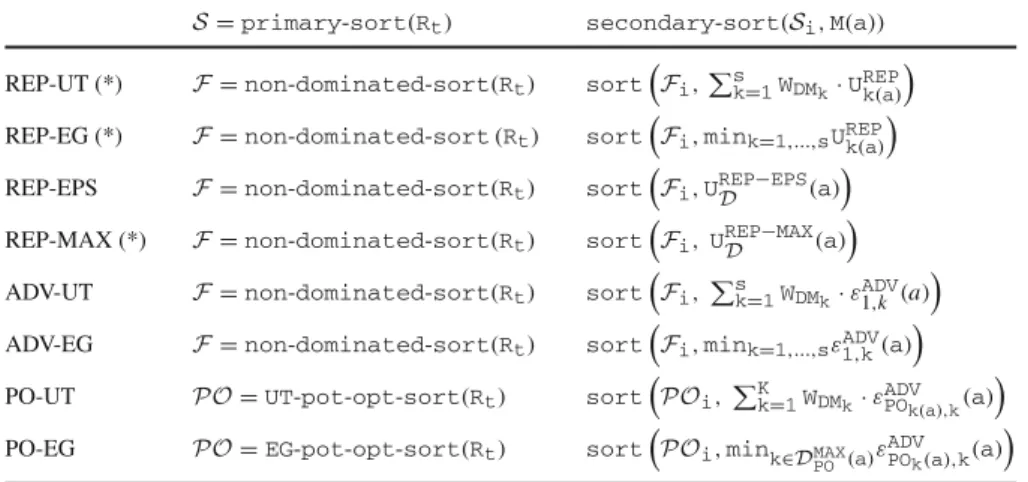
The main variants of NEMO-GROUP evolve a joint population for the whole group of DMs. They differ in terms of the sorting procedures they use for judging the suitabil-ity of individuals for inclusion in the next population. These procedures are presented in Table1[the ones marked with a star (*) have been initially proposed inKadzi´nski and Tomczyk(2015)]. In what follows, we explain all approaches briefly.
The first group of approaches learns a single value function representing the preferences of the DM(s). In particular, the representative value functions derived individually for each DM may be used to construct a group preference model as fol-lows:
– NEMO-GROUP-REP-UT determines a representative value functionUkR E P for each D Mk ∈ D based on her/his pairwise comparisons only, and then ranks solutions within Pareto fronts according to their representative utilitarian compre-hensive valuesUU TR E P(a)=sk=1WD Mk·UkR E P(a);
– NEMO-GROUP-REP-EG determines UkR E P for each D Mk ∈ D, and ranks subsets of Pareto fronts using representative egalitarian comprehensive values
Table 1 Sorting procedures used to judge the suitability of solutions from the populationRtfor inclusion inRt+1by different variants of NEMO-GROUP
S=primary-sort(Rt) secondary-sort(Si,M(a))
REP-UT (*) F=non-dominated-sort(Rt) sort Fi,sk=1WDMk·U REP k(a)
REP-EG (*) F=non-dominated-sort(Rt) sort Fi,mink=1,...,sUREPk(a)
REP-EPS F=non-dominated-sort(Rt) sort Fi,UREP−EPS
D (a) REP-MAX (*) F=non-dominated-sort(Rt) sort Fi,UREP−MAX
D (a) ADV-UT F=non-dominated-sort(Rt) sort Fi,sk=1WDMk·ε
ADV
1,k (a)
ADV-EG F=non-dominated-sort(Rt) sort Fi,mink=1,...,sεADV1,k(a)
PO-UT PO=UT-pot-opt-sort(Rt) sort POi,Kk=1WDMk·ε
ADV POk(a),k(a)
PO-EG PO=EG-pot-opt-sort(Rt) sort POi,min
k∈DPOMAX(a)ε ADV POk(a),k(a)
Alternatively, a single representative value function can be constructed for all group members considered jointly. The two approaches implementing this idea differ in how they deal with potential incompatibility of preference information provided by different DMs:
– NEMO-GROUP-REP-EPS determines the representative value function
UDR E P−E P Sby minimizing the misranking error when dealing with pairwise com-parisons of all DMs, and uses the inferred function to rank individuals within the same Pareto fronts;
– NEMO-GROUP-REP-MAX maximizes the minimal number of pairwise compar-isons of any D Mk ∈ D that can be represented together by an additive value function, determines the representative value functionUDR E P−M A X compatible with the consistent pairwise comparisons of all DMs (equal number of compar-isons provided by each DM), and uses it to rank subsets of Pareto fronts.
The other group of approaches learns a set of value functions representing the prefer-ences of the DM(s). This set is exploited to compare each solution with all remaining ones in the current population in terms of either the greatest advantage it may attain over the remaining solutions or fronts of potential optimality they belong to:
– NEMO-GROUP-ADV-UT determines for each D Mk ∈ D and each solution
a ∈ Rt the advantage ε1A DV,k (a)this solution has over the remaining solutions for the most advantageous value function compatible with the pairwise compar-isons provided byD Mk, and then ranks solutions within Pareto fronts according to their utilitarian most beneficial advantages:εU TA DV(a)=sk=1WD Mk·ε
A DV
1,k (a); – NEMO-GROUP-ADV-EG determines ε1A DV,k (a)for each D Mk ∈ D and each solutiona∈ Rt, and then ranks solutions within the same Pareto fronts according to their egalitarian most beneficial advantages:εA DVE G (a)=mi nk=1,...,sε1A DV,k (a);
– NEMO-GROUP-PO-UT sorts the solutions according to their utilitarian levels of potential optimalityP OU T(a)=sk=1WD Mk ·P Ok(a), and then orders the individuals within each level according toεU TA DV(a);
– NEMO-GROUP-PO-EG sorts the solutions according to their worst levels of potential optimalityP OE G(a)=maxk=1,...,sP Ok(a), and then orders the solu-tions within each level according to their minimal advantage among the DMs for whom the level of potential optimality is the worst, i.e.,mi nk∈DM A X
P O (a)ε A DV P Ok(a),k(a). As a benchmark procedure, we consider NEMO-GROUP-IND which divides a pop-ulation into 1/s equal sub-populations, one for each D Mk ∈ D, and evolves them separately using a representative value functionUkR E P(a)of each D Mk ∈ D(as in standard NEMO-0 described in Sect.2.3). A final population is obtained by putting together sub-populations of all DMs.
4 Experimental Results
To study the performance of different variants of NEMO-GROUP, we refer to a set of benchmark problems with two (2D) to seven (7D) objectives. We use artificial DMs applying the pre-defined individual value functions for comparing pairs of solutions whenever preference elicitation is conducted. Precisely, forD Mk ∈ Dwe use either linear or Chebycheff function defined as follows:
UkTRUE-LIN(a)= m j=1 wk jgj(a), (11)
andUkTRUE-CH(a)=maxj=1,...,m{wkjgj(a)}, (12)
wherewkj, j =1, . . . ,m, are weights of themcost-type objectives. Since both these functions are to be minimized, the whole group aims at minimizing utilitarianUDU T(a)
and/or egalitarianUDE G(a)group value functions. Obviously, all these individual func-tions are unknown to NEMO-GROUP, which instead uses an additive value function defined in Sect.2.1as an internal preference model.
In our tests, we use a real-valued representation. We generate offspring by simulated binary crossover with probability of 0.9 and distribution indexηc=5, whereas mating selection is performed by tournament selection. We also apply Gaussian mutation with probability of 1/50 and standard deviation equal to 0.1. The population size is set to 60, and all methods are run for 500 generations.
Whenever different is not explicitly stated, we assume that all DMs play the same role in the committee, the preference elicitation is performed every 10 generations starting with the evolutionary search (i.e., (SGE,EI)=(0,10)), whereas the numerical results are averaged over 50 independent runs. For clarity of presentation, all these experimental results are provided in “Appendix 1”. When presenting them in a tabular form, the text in bold and italics indicates the best performing algorithm across all 50 optimization runs. Additionally, we indicate in bold these approaches whose distance
0 0.1 0.2 0.3 0.4 0.5 0.6 0.7 0.8 0.9 1 0 0.1 0.2 0.3 0.4 0.5 0.6 0.7 0.8 0.9 1 NSGA-II (500) IND (500) REP-UT (500) REP-EG (500) ADV-UT (500) ADV-EG (500) 0 0.2 0.4 0.6 0.8 1 0 0.2 0.4 0.6 0.8 1 REP-EG (50) REP-EG (300) ADV-UT (50) ADV-UT (300) DM1 DM2 DM3 ) ( 1 a f ) ( 2 a f
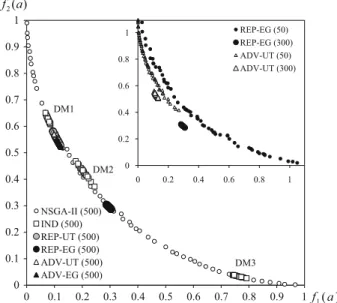
Fig. 1 Exemplary results of five variants of NEMO-GROUP and NSGA-II on DTLZ2-2D with three decision makers after 500 generations. The results for REP-EG and ADV-UT after 50 and 300 generations are provided in the top-right corner
from the best performer proved to be statistically insignificant according to a Mann– Whitney-Utest with 5 % significance level.
The results in this section significantly extend the experimental study presented inKadzi´nski and Tomczyk(2015). The latter provides a view only on the conver-gence of a limited number of NEMO-GROUP variants (IND, REP-UT, REP-EG, and REP-MAX) in terms of a utilitarian value of the solutions they construct for two benchmark problems, ZDT1-2D and DTLZ2-5D. The experimental evaluation presented in this paper is more extensive in terms of (i) considering additional vari-ants of NEMO-GROUP, (ii) accounting for more diverse benchmark problems, (iii) considering greater numbers of DMs, (iv) employing an egalitarian group value function in addition to a utilitarian one, (v) investigating the impact that assigning different weights to the DMs has on the results, and (vi) quantifying the impact of different parameterizations of a preference elicitation process on the algorithms’ convergence.
4.1 Illustrative Example
In this subsection, we use a convex version of DTLZ2-2D to illustrate how the proposed approaches bias the search towards a sample of all Pareto-optimal solutions which is relevant for the DMs. We assume that the true linear value functions of three DMs are parameterized with the following weights(wk1, w2k)fork=1,2,3:D M1−(0.7,0.3),
D M2−(0.6,0.4), andD M3−(0.2,0.8). Intuitively, the greater the weight, the more
Figure1shows the results for five variants of NEMO-GROUP after 500 generations. As can be seen, NSGA-II approximates the whole Pareto front, whereas all variants of NEMO-GROUP are focused on the solutions preferred to the DMs. Since IND evolves a separate sub-population for each DM, the final population it delivers is composed of three clearly disjoint sets of solutions, each containing individuals which are most preferred to a particular DM. For algorithms evolving a joint population for the whole group, the final set of solutions is narrowed to a single small part of the Pareto front which can be seen as the best compromise for all DMs. However, these approaches differ in terms of both the region of the Pareto front to which they converge as well as the dispersion of a final population. This confirms the flexibility of the interactive evolutionary hybrids in a group decision context. In particular, REP-UT, ADV-UT, and ADV-EG converged to a part of the front which is more favorable forD M1and
D M2whose preferences are consistent to a great extent. On the contrary, the
popu-lation constructed with REP-EG is located in the central part of the objective space, because the preference information of D M3significantly affects the convergence of
this algorithm. Moreover, the population obtained with REP-UT is more stretched due to the utilitarian aggregation of the DMs’ individual representative value functions.
To demonstrate the convergence to the Pareto front over time, for REP-EG and ADV-UT, we additionally depict the populations obtained after 50 and 300 genera-tions (see top-right corner of Fig.1). These clearly demonstrate the improvement of solutions during the evolutionary search as well as constraining the population due to incorporation of DMs’ preference information into the evolutionary search.
4.2 The Convergence in Terms of a Utilitarian Value of the Solutions
In this subsection, we study the evolution of utilitarian values of the best-of-population and average-in-population solutions in successive generations. These convergence factors permit to assess the performance of different variants of NEMO-GROUP from the point of view of a whole group of DMs. On the one hand, the best solution in the returned population may be perceived as a default outcome of the method that is most likely to be accepted by the DMs. On the other hand, an average quality of the individuals contained in the population reveals if the search has been appropriately focused on the group consensus solutions (Branke et al. 2015). The algorithms are compared for the DTLZ2-3D and DTLZ4-3D problems with the number of DMs ranging between 2 and 7. Let us emphasize that DLTZ4 is considered more challenging than DTLZ2.
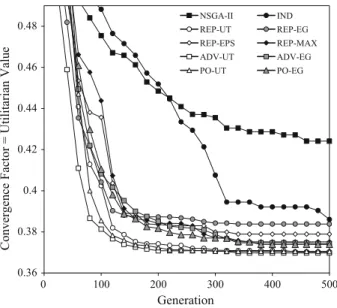
Figures2and3present the convergence plots for, respectively, value of the best solution and average value of all solutions in the population for DTLZ2-3D with three DMs. These plots demonstrate when different approaches start to converge towards the Pareto front, what is their convergence speed measured in terms of a change of a utilitarian value, and what is value of the solution(s) at which their performance sta-bilizes. Nonetheless, to compare the performance of proposed approaches for various benchmark problems and different numbers of DMs, we focus on the precise measures derived from the convergence plots.
0.36 0.38 0.4 0.42 0.44 0.46 0.48 0 100 200 300 400 500 Con v ergen ce Factor = Utilitarian Valu e Generation NSGA-II IND REP-UT REP-EG REP-EPS REP-MAX ADV-UT ADV-EG PO-UT PO-EG
Fig. 2 Utilitarian value of the best-of-population solution in successive generations for three decision makers applied to DTLZ2-3D 0.36 0.38 0.4 0.42 0.44 0 100 200 300 400 500
Convergence Factor = Utilitarian Value
Generation
NSGA-II IND REP-UT REP-EG
REP-EPS REP-MAX ADV-UT ADV-EG PO-UT PO-EG 0.35 0.45 0.55 0.65 0 100 200 300 400 500
Fig. 3 Utilitarian value of the average-in-population solution in successive generations for three decision makers applied to DTLZ2-3D
First, we refer to the minimal values obtained throughout the 500 generations (see Table2). When it comes to the best utilitarian solution obtained during the optimization run (i.e., the minimal best-of-population value), the variants of NEMO-GROUP which evolve a joint population for all DMs significantly outperform NSGA-II and NEMO-GROUP-IND which, respectively, approximate an entire Pareto front or evolve a
sub-population individually for each DM. Thus, it is beneficial to integrate user preferences and to seek for the group consensus solution already during the evolutionary search. The greater the number of DMs, the more evident these conclusions are.
The best performing variants of NEMO-GROUP are ADV-UT, REP-UT, and PO-UT. The slight differences between these methods are statistically insignificant for most considered settings. These approaches aggregate the evaluations of each solution conducted individually for each DM with, respectively, the per-solution most advantageous value function, the representative value function approximating the DM’s true preference model, or the front of potential optimality the solu-tion belongs to. Thus, to discover a solusolu-tion which is on average perceived well by the group members, when judging the individuals in terms of their suitabil-ity for inclusion in the next population, one should apply the utilitarian measures. Indeed, REP-UT, ADV-UT, and PO-UT outperform their egalitarian counterparts: REP-EG, ADV-EG, and PO-EG, respectively. Finally, the worst performing vari-ants of NEMO-GROUP in terms of the best-of-population value are REP-EPS and REP-MAX. This indicates that construction of a joint single representative value functions for all group members may bias the search to the less relevant regions of the Pareto front. Overall, our results confirm that it is more advantageous to aggregate the potentially conflicting viewpoints of different DMs within the sorting proce-dures of the evolutionary algorithm rather than when inferring the DMs’ preference model.
When comprehensively judging the returned population of solutions being most favorable from the point of view of the whole group (i.e., the best average-in-population value), again REP-UT, ADV-UT, and PO-UT perform the best in view of the majority of considered problem settings. Obviously, for all methods a single best solution is clearly better than a complete best population. For example, the comprehensive utilitarian values of the best solution and population for REP-UT, DTLZ4-3D and 3 DMs are equal to, respectively, 0.3748 and 0.3814. When this difference is relatively small (see, e.g., ADV-EG), the constructed population is well focused, whereas higher differences (see, e.g., REP-EPS) suggest greater dispersion of the constructed solutions in the objective space.
Overall, when comprehensively evaluating the whole population rather than a sin-gle solution, the differences in the performance of various methods become more evident. The benefits of integrating the DMs’ preference information into the evolu-tionary search are best confirmed with the average-in-population value of different NEMO-GROUP variants being significantly better than the best-of-population value for II. For example, for DTLZ2-3D and 5 DMs the value of the best NSGA-II solution is 0.4502, while the average value of all solutions in the population of ADV-UT is 0.3941.
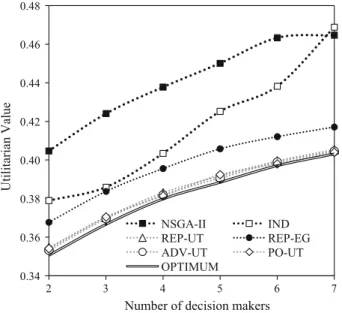
Intuitively, the comparison of results for different numbers of DMs indicates that the more DMs are involved in the optimization process, the worse are the utilitarian values of the best returned individual and population (i.e., the worse is their average perception by the group members). For example, when ranging the number of DMs from 2 to 7 for DTLZ2-3D, the value of the best solution con-structed with REP-UT is, respectively, 0.3547, 0.3703, 0.3830, 0.3917, 0.3995, and 0.4054.
0.34 0.36 0.38 0.40 0.42 0.44 0.46 0.48 2 3 4 5 6 7 Utilitarian Value
Number of decision makers
NSGA-II IND
REP-UT REP-EG
ADV-UT PO-UT
OPTIMUM
Fig. 4 Utilitarian value of the best solution constructed with different variants of NEMO-GROUP for various numbers of DMs for DTLZ2-3D
However, this is mainly due to the lower value of the optimal utilitarian solu-tion that can be constructed when preferences of more DMs are accounted. It is clearly visible in Fig. 4 which compares the values of such optimal solutions and the best individuals constructed with a few variants of NEMO-GROUP for different numbers of DMs for DTLZ2-3D. For example, when 2, 4 or 6 DMs are involved, the utilitarian value of the optimal solution is equal to, respectively, 0.3506, 0.3798, and 0.3971. Clearly, NEMO-GROUP cannot do any better. However, the analysis of Fig.4indicates that for the best performing approaches (REP-UT, ADV-UT, and PO-UT) the absolute value difference of the best returned individual from the opti-mal solution decreases with the increase in the number of DMs. For example, for REP-UT for 2, 4 or 6 DMs, it is equal to, respectively, 0.0040, 0.0035, and 0.0024. This suggests that the proposed algorithms scale up well to greater numbers of DMs.
As the other set of measures derived from the convergence plots we consider the average group utilitarian values observed throughout 500 generations (see Table3). They quantify the overall performance of the algorithms from the point of view of either the best solution or a complete population returned after each generation. Since the value to which the algorithms converge highly affects the overall performance, the conclusions about the best and worst performing algorithms are analogous to the case of considering only the best results. The important differences are the follow-ing:
– When comparing the best performers in terms of the minimal value of the returned solution and population, ADV-UT and PO-UT compare positively to REP-UT. The former methods converge faster to the most preferred region of the Pareto
front, deriving their comprehensive superiority from exploiting more favorable search directions in the first 200 generations. Exploitation of the whole set of compatible value functions in ADV-UT and PO-UT implies that they are less sensitive to the accumulation of conflicting preference information provided by the DMs than the methods constructing a single representative value function for each DM individually or all DMs jointly. Such robustness proves to be particularly advantageous when the evolutionary search is still chaotic.
– REP-EG, REP-EPS, and REP-MAX are even less advantageous than in case of con-sidering the best results, because (i) the selection pressure they introduce between 100 and 300 generations is too weak, (ii) their convergence curves are more erratic than the others, deteriorating several times in the phase when performance of other algorithms stabilizes or still slightly improves.
– IND performs poorly in terms of the best-of-population value, because it starts to converge later than other algorithms. With greater numbers of DMs its convergence is worse than that of NSGA-II. This is due to evolving less individuals in the sub-population allocated for each DM.
4.3 The Convergence in Terms of an Egalitarian Value of the Solutions
In this subsection, we study the performance of NEMO-GROUP in terms of egalitarian values of the best-of-population and average-in-population solutions. Thus, instead of measuring the quality of solutions as the average (or sum) of individual judgments, we compute the quality that each solution represents to the whole group with respect to the least satisfied DM. Otherwise, we use the same experimental setting as in Sect.4.2. The best egalitarian values of a single solution and an entire population obtained by different algorithms throughout 500 generations are provided in Table4. Obviously, they are higher (less advantageous) than the respective utilitarian values presented in Table2.
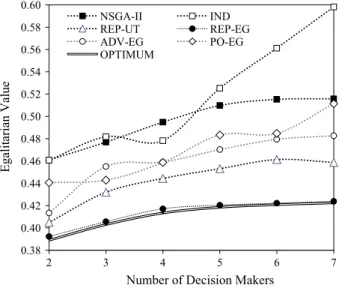
For all considered problems and numbers of DMs, REP-EG significantly outper-forms the remaining algorithms. Let us remind that when judging individuals in terms of their suitability for inclusion in the next population, REP-EG accounts for the representative value function of the least satisfied DM. Since this function aims at approximating the DM’s true preference model, when constructing the population REP-EG optimizes a quality measure which is consistent with the egalitarian group value function. This characteristic is central to its competitive advantage for the con-sidered three-dimensional benchmark problems.
Interestingly, although accounting for the least satisfied DM during the evolution-ary search, PO-EG and ADV-EG perform worse than their utilitarian counterparts PO-UT and ADV-UT, respectively. This suggests that evaluation of solutions in terms of the worst fronts they belong to or the least advantage they have over the remaining solutions, is not sufficient for discovering individuals with competitive egalitarian values. Overall, these measures are less discriminant for the compari-son of different solutions than their utilitarian counterparts, and, thus, they fail to introduce a sufficiently strong selection pressure into the search. Conversely, with the focus on constructing the solutions which are acceptable for all DMs,
REP-0.38 0.40 0.42 0.44 0.46 0.48 0.50 0.52 0.54 0.56 0.58 0.60 2 3 4 5 6 7 Eg alitarian Valu e
Number of Decision Makers NSGA-II IND REP-UT REP-EG ADV-EG PO-EG OPTIMUM
Fig. 5 Egalitarian value of the best solution constructed with different variants of NEMO-GROUP for various numbers of DMs for DTLZ2-3D
UT, ADV-UT, and PO-UT perform reasonably well also in terms of an egalitarian value.
Figure5demonstrates the egalitarian values of optimal solution and the best indi-viduals constructed with different variants of NEMO-GROUP for DTLZ2-3D for the number of DMs ranging from 2 to 7. Analogously to the case of using a utilitarian value function, the more DMs are involved, the worse are the egalitarian values of the best possible solutions as well as the ones returned by the algorithms. Interestingly, whatever the number of DMs, REP-EG is able to construct a solution which is very close to the optimal one. For the remaining approaches, the gap from the optimal solution, in general, slightly increases when more DMs are involved.
4.4 The Convergence in View of Different Numbers of Objectives and Types of True DMs’ Value Functions
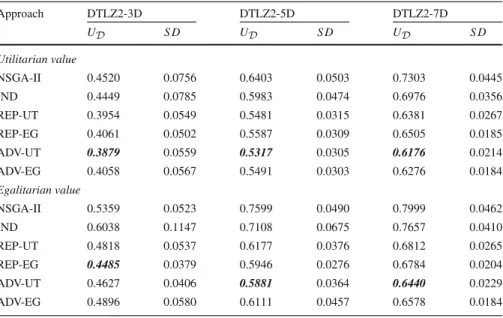
In this subsection, we demonstrate the impact that including additional objectives and considering different types of true DMs’ value functions (i.e., linear or Chebycheff ones) has on the convergence of proposed algorithms. To save space, we compare NSGA-II with a representative subset of NEMO-GROUP variants (UT, REP-EG, ADV-UT, ADV-REP-EG, and IND) which use dominance relation as the first sorting procedure. Their performance is verified on DTLZ2 with 3, 5, and 7 objectives in view of utilitarian and egalitarian comprehensive value functions for 3 DMs. We focus on the average best-in-population solution throughout 500 generations.
First, we refer to the values obtained when simulating the DMs with linear value functions (see Table5). For all considered algorithms, both utilitarian and egalitarian best-of-population values become worse with the increase in the number of considered
objectives. Intuitively, the more dimensions are involved, the more challenging it is to construct the solutions which are relevant from the point of view of the whole group.
As the number of objectives increases, it becomes more difficult to identify the complete Pareto front. Since an increasing proportion of all feasible solution becomes non-dominated, the dominance relation fails to sufficiently discriminate the solutions within the evolutionary algorithms. As a result, the decrease in performance of NSGA-II is significant, and the constructed solutions are far from the true Pareto front. On the contrary, integrating DMs’ preferences into evolutionary search allows to re-introduce the necessary selection pressure. Indeed, the advantage of the interactive evolutionary hybrids over NSGA-II becomes more evident in more dimensional problems.
When it comes to the utilitarian best-of-population value, ADV-UT is the best performer whatever the number of objectives. Interestingly, when more objectives are considered ADV-EG is gaining a competitive advantage over the methods which employ the representative value functions. Thus, when the number of objectives increases, it is more beneficial to exploit a set of compatible value functions. This seems to ensure greater robustness when indicating more promising directions for optimization.
The latter conclusion is strengthened by the analysis of egalitarian best-of-population values. As indicated in Sect. 4.3, REP-EG was the best performer for a three-dimensional DTLZ2. While still performing better than REP-UT for all con-sidered numbers of objectives, already with 5 dimensions REP-EG is outperformed by ADV-UT and for DTLZ2-7D its convergence is even worse than that of ADV-EG. The status of ADV-UT as an overall best performer among the considered variants of NEMO-GROUP is confirmed by the results obtained when simulating the DMs with true Chebycheff functions (see Table6). ADV-UT outperforms other methods for all considered settings. The relative comparison of the remaining approaches is the same as for the linear value functions. In particular, REP-UT is slightly better than REP-EG for the utilitarian function, whereas for the egalitarian one this order is inverse.
Apparently, the average best-in-population values presented in Table6 decrease with the increase in the number of objectives. However, this is due to the internal definition of the Chebycheff function. That is, when more dimensions are involved, the maximal value this function can take decreases. In our experiments, for 3, 5, and 7 objectives, these maximal values were equal to, respectively, 0.6278, 0.4538, and 0.3447 for the utilitarian group value function, and 0.7977, 0.5585, and 0.4329 for the egalitarian one. Thus, the ability of algorithms to construct group consensus solutions should be judged while referring to these maximal values. For all con-sidered variants of NEMO-GROUP the value of the best solution they construct becomes closer to the maximal possible value when more objectives are involved. For example, for the utilitarian value function for ADV-UT the respective differ-ences are equal to 0.4046 (=0.6278−0.2232) for 3D, 0.2475 (=0.4538−0.2063) for 5D, and 0.1676 (=0.3447−0.1771) for 7D. Thus, again, our results confirm that with more objectives, it is more challenging to find a group consensus solu-tion.
4.5 The Impact of Incorporating the Weights Assigned to the DMs into the Evolutionary Search
In this subsection, we study the potential of some proposed approaches—REP-UT and ADV-UT—for incorporating the DMs’ weights, thus, differentiating the importance of group members. Such investigation makes sense in the context of utilitarian group value function.
Let us first illustrate how REP-UT and ADV-UT are able to bias the search depend-ing on the weights assigned to the DMs. We consider three DMs whose linear value functions are parameterized with the following weights(wk1, w2k)for k = 1,2,3:
D M1−(0.7,0.3),D M2−(0.4,0.6), andD M3−(0.2,0.8). Moreover, we account
for the following three vectors of weights(WD M1,WD M2,WD M3)assigned to the DMs:
WSet I =(1/3,1/3,1/3),WSet II =(0.1,0.45,0.45), andWSet III=(0.7,0.2,0.1). Thus, in the first considered scenario all DMs play the same role in the committee, for the second set of weights – the role ofD M1is rather neglected, while for the third set
–D M1can be considered as a dictator.
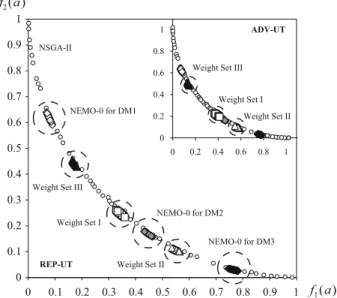
Figure6 shows the results of NSGA-II, NEMO-0 for the three DMs as well as REP-UT and ADV-UT with different sets of DMs’ weights on DTLZ2-2D after 500 generations. Whatever the vector of DMs’ weights, REP-UT and ADV-UT are able to focus the search on a single small part of the Pareto front reflecting the relative importance of the DMs. Thus, with the same weights of DMs, the population for
WSet I is rather central in the objective space. For WSet II—the returned solutions are situated between the regions that are relevant forD M2andD M3(though closer
to the part which is most preferred by D M2 due to the marginal impact of partial
0 0.1 0.2 0.3 0.4 0.5 0.6 0.7 0.8 0.9 1 0 0.1 0.2 0.3 0.4 0.5 0.6 0.7 0.8 0.9 1 NEMO-0 for DM2 NEMO-0 for DM3 Weight Set III
Weight Set II Weight Set I
NSGA-II
Weight Set III
Weight Set II Weight Set I REP-UT ADV-UT 0 0.2 0.4 0.6 0.8 1 0 0.2 0.4 0.6 0.8 1 NEMO-0 for DM1 ) ( 1 a f ) ( 2 a f
Fig. 6 Exemplary results of NSGA-II, NEMO-0 for three individual DMs, REP-UT (in the main part) and ADV-UT (in the top-right corner) with different sets of DMs’ weights (WSet I = (1/3,1/3,1/3), WSet II=(0.1,0.45,0.45), andWSet III=(0.7,0.2,0.1)) on DTLZ2-2D after 500 generations
preferences ofD M1). Finally, the population returned forWSet IIIis very close to the solutions constructed individually forD M1whose weight (0.7) is much greater that
the weight of the remaining two DMs considered jointly. Note, however, that there are slight differences between REP-UT and ADV-UT with respect to the parts of the Pareto front to which they converge.
To experimentally evaluate the impact of incorporating DMs’ weight into the inter-active evolutionary hybrids, we consider DTLZ2-3D with three DMs whose Cheby-cheff value functions are parameterized with the following weights(wk1, wk2, w3k)for
k=1,2,3:D M1−(0.1,0.1,0.8),D M2−(0.3,0.4,0.3), andD M3−(0.4,0.3,0.3).
We also consider two sets of DMs’ weights:WSet I I andWSet III.
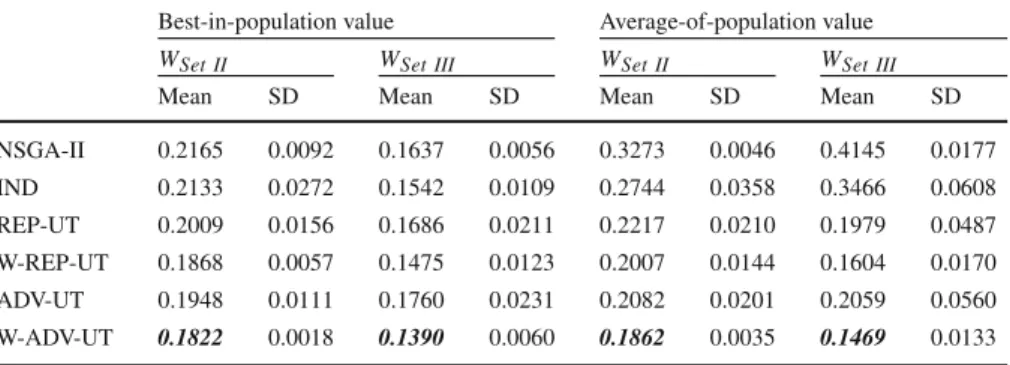
We evaluate the algorithms in terms of the minimal utilitarian best-in-population and average-of-population values they obtain throughout 500 generations (see Table7). Obviously, when evaluating the returned individuals with a utilitarian group value function, we account for the weights assigned to the DMs. In this perspective, the variants of REP-UT and AVG-UT which incorporate the DMs’ weights already dur-ing the evolutionary search (called W-REP-UT and W-AVG-UT) attain significantly better results than their counterparts assuming that all DMs play the same role in the committee. This proves both the flexibility of proposed algorithms and the benefits of accounting for the DMs’ weights when judging the individuals in the evolutionary algorithms.
Overall, W-ADV-UT attains the best results for all considered problem settings in terms of both a single solution and a complete population. The advantage of NEMO-GROUP variants incorporating the DMs’ weights is more evident forWSet IIIwhere
D M1can be considered as a dictator. Nonetheless, to prove that the preferences of
the remaining (less important) DMs do influence the search, one can refer to the best-in-population value for IND. Evolving a sub-population for each DM individually, this method is able to discover solutions which are considered reasonably good by the whole group (assuming the prevailing role of D M1). Indeed, forWSet III, IND is
considered better than REP-UT and ADV-UT. However, it is still significantly worse than W-REP-UT and W-ADV-UT, which confirms that the impact ofD M2andD M3
in these algorithms is non-negligible. Obviously, when taking into account a com-plete population, NSGA-II and IND are significantly outperformed by all considered variants of NEMO-GROUP.
4.6 The Impact of Elicitation Interval and Starting Generation for Preference Elicitation on the Convergence
In this subsection, we evaluate the performance of REP-UT and ADV-UT for different elicitation intervals in{10,20,30}and starting generations for preference elicitation in{0,100,200,300}. In Table 8, we provide mean utilitarian value differences of the best-in-population solutions constructed by these methods with respect to the true utilitarian solution for DTLZ2-3D discovered with LP techniques. The results indicate that NEMO-GROUP is not always able to find the true utilitarian solution, but the observed value differences are very small.
0 0.05 0.1 0.15 0.2 0.25 0 100 200 300 400 500
Value Difference w.r.t. the True Utilitarian Solution
Generation EI=10 SGE=0 EI=20 SGE=0 EI=30 SGE=0 0 0.05 0.1 0.15 0.2 0 100 200 300 400 500 EI=10 SGE=0 EI=10 SGE=100 EI=10 SGE=200 EI=10 SGE=300
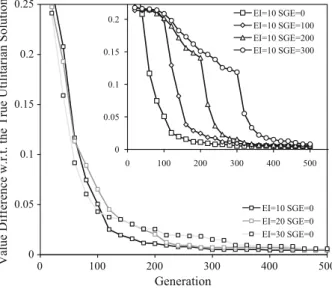
Fig. 7 Mean value difference between the true utilitarian solution and the REP-UT’s best-in-population solution, for different number of generations, elicitation intervals (EIs) and starting generations for prefer-ence elicitation (SGEs)
As a general rule, the more often the DMs are questioned, the more advantageous is the best solution (with the exception of REP-UT for SGE=100 or 200). Moreover, delaying the elicitation by 100 or 200 generation does not significantly influence the best-in-population value. In fact, for both algorithms, our results indicate that better solutions can be found when delaying the preference elicitation process to SGE=100. Nevertheless, with SGE=300 and too rare questioning of the DMs, the convergence of algorithms is affected negatively.
For all EIs>0 and SGEs>0, the convergence of algorithms over time to the most preferred region is affected significantly. To support this claim, in Fig.7, we provide the convergence plots for REP-UT concerning the value difference between the true utilitarian solution and the best-in-population solution, for different EIs and SGEs.
Firstly, the lower the EI, the faster the convergence, i.e., the sooner the best solution becomes competitive with the true utilitarian solution. However, the plots indicate that in the initial generations when the evolutionary search is still chaotic, it is more beneficial to question the DMs rarely (see the main part of Fig.7). Only once the population is well distributed (for our problem, this happens after 100 gen-erations), the preference elicitation should be performed more often. Secondly, when the preference elicitation is delayed (SGE > 0), one could observe a visible dif-ference in the convergence before and after the SGE (see the top-right corner of Fig.7).
To compare the convergence of algorithms for different EIs and SGEs, Table9 indi-cates the number of generations for which the average best-in-population value reaches two arbitrarily selected value distances, 0.015 and 0.01, from the true utilitarian solu-tion. For example, when the preference elicitation is performed every 10 generations withSGE=0, the convergence indicator is 0.015 already before 175 generations for