266
Evaluation of Anti-inflammatory activity of Petroleum ether and Methanolic extract of Phyllanthus reticulatus leaves
Patel Jaya1*, Gaudani Rashmi2
1. B.S.Patel Pharmacy College, Linch, Mahesana, Gujarat, India.
2. Shree Swaminarayan Sanskar Pharmacy College, Zundal, Gujarat, India. *Corresponding author: [email protected]
ABSTRACT
Phyllanthus reticulatus is the plant belonging to family Euphorbiaceae. It is widely
distributed throughout the tropical India, in Khasi, Jaintia hills and in Andaman Island. The leaves and stem of Phyllanthus reticulatus is used as antidiarrhoeal, astringent, diuretic, anti-inflammatory, in bleeding gums, in anemia and in burns. The anti-inflammatory activity of petroleum ether and methanolic extracts of leaves of P. reticulatus were evaluated for carrageenan induced rat paw edema at doses of 150 and 300 mg/kg. The result indicates that the petroleum extract have high significant activity than methanolic extract.
Key words: Phyllanthus reticulatus, Carrageenan, Anti-inflammatory
INTRODUCTION
Inflammation is considered as a primary physiologic defense mechanism that helps body to protect itself against infection, burn, toxic chemicals, allergens or other noxious stimuli. An uncontrolled and persistent inflammation may act as an etiologic factor for many of these chronic illnesses1. Although it is a defense mechanism, the complex
events and mediators involved the inflammatory reaction can induce, maintain or aggravate many diseases2. Currently used anti-inflammatory drugs are associated with
some severe side effects. Therefore, the development of potent anti-inflammatory drugs with fewer side effects is necessary.
Phyllanthus reticulatus (Euphorbiaceae) is commonly known as Krishna kamboji and
widely distributed throughout the tropical India, in Khasi, Jaintia hills and in Andaman Island3-6. The literature review revealed that the leaves and stems of Phyllanthus
reticulatus is used as antidiarrhoeal, astringent, diuretic, anti-inflammatory, in bleeding
gums, in anemia and in burns3-8. Literature survey reveals that there are no reports on
267
in the present study effort has made to establish the scientific validity to the anti-inflammatory property of Phyllanthus reticulatus leaf extracts using Carrageenan induced paw edema model in Rats.
MATERIALS AND METHODS
Plant Material:
The whole plant of Phyllanthus reticulatus were collected and authenticated by Dr. A. S. Reddy, Prof. and Head of Botany Dept., Sardar Patel Universtiy, Vallabh Vidyanagar, Gujarat, India. The leaves are then dried, powdered and stored in airtight container for further use.
Drug and Chemicals:
The drug Dexamethasone sodium was purchased from commercial sources and all other chemicals were of analytical grade.
Preparation of Extracts:
Dried leaf of Phyllanthus reticulatus were reduced to a fine powder with a mechanical grinder. The powdered plant material was extracted with petroleum ether and then defatted powder was refluxed with methanol. The extracts were concentrated to dryness and stored.
Collection of Animals:
Male albino rats of Wistar strain (150-250 gm) were procured from Cadila Pharma Ltd., Dholka, Ahmedabad, Gujarat, India. They were housed in standard polypropylene cages. The animals were maintained under standard environmental conditions and had free access to standard diet and water. All the experimental protocols were approved by the CPCSEA.
Anti-inflammatory Activity:
268
linear paw volume was measured plethysmographically immediately after injection, again at 1, 3, 4 and 6 hour and eventually 24 hours after challenge. The increase of paw volume after 3 or 6 hour was calculated as percentage compared with the volume measured immediately after injection of the irritant for each animal.
Statistical Evaluation:
The difference of average values between treated animals and control groups were calculated for each time and statistically evaluated. All the values were expressed as mean ± SEM and one-way ANOVA was applied to determine the significance of the difference between the control groups and rat treated with the test compounds. A value of P<0.05 was considered to be significant.
RESULTS AND DISCUSSION
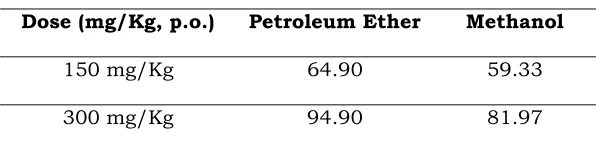
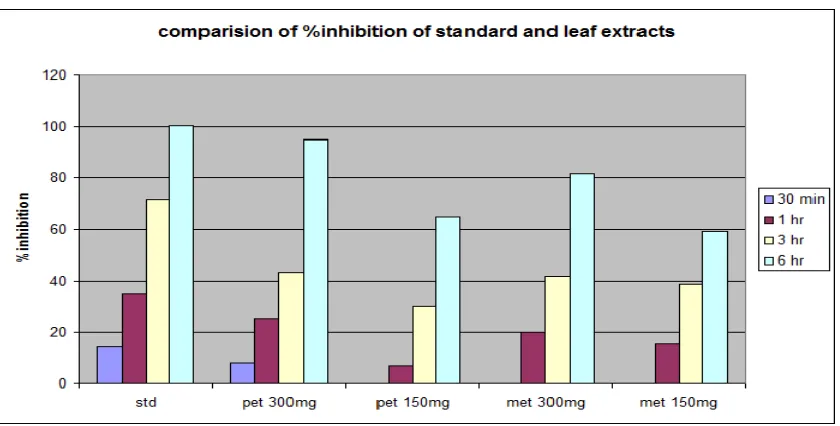
The Petroleum ether and methanolic extracts of leaf of Phyllanthus reticulatus was evaluated by carrageenan induced rat paw edema. They produced dose dependent and significant inhibition of carrageenan induced rat paw edema. The inhibition was however, less than that of standard drug, Dexamethasone. In the acute inflammation model, the petroleum ether and methanolic extracts of leaf of Phyllanthus reticulatus in doses of 150 and 300 mg/Kg, p.o. produced dose dependent inhibition of paw edema. The test and the standard drug produced significant inhibition of paw edema as compared to the control. The results showed that the petroleum ether extract with a dose of 300mg/Kg and methanolic extract with a dose of 300mg/Kg showed 94.9% and 81.57% inhibition respectively on carrageenan induced rat paw edema at end of 6 hrs (Table 1 and Figure 1). This result indicated that petroleum ether extract with a dose of 300mg/Kg and methanol extract with a dose of 300mg/Kg showed a maximum anti-inflammatory activity as compared to control. So, from that it was concluded that 300mg dose of petroleum ether extract of leaf gives highly significant effect than methanolic extract.
Table - 1 % Inhibition at 6th Hour
% Inhibition at 6th Hour
Dose (mg/Kg, p.o.) Petroleum Ether Methanol
150 mg/Kg 64.90 59.33
269
Fig. 1: Comparison of % Inhibition of Standard and Leaf Extracts
CONCLUSION
The present study on extract of Phyllanthus reticulatus has demonstrated that this plant has significant anti-inflammatory property and it justifies the traditional use of this plant in the treatment of various types of inflammation.
REFERENCES
1. Kumar V, Abbas AK and Fausto N (Eds.) (2004). Robbins and Cotran pathologic basis of disease, 7th edition, Elsevier Saunders, Philadelphia, Pennsylvania, pp.
47-86.
2. Sosa S, Balicet MJ, Arvigo R, Esposito RG, Pizza C and Altinier GA (2002). Screening of the topical anti-inflammatory activity of some Central American plants. J. Ethanopharmacol., 8: 211-215.
3. Kirtikar K.R., Basu B.D., Blatter E., Caius J.F., and Mhaskar “ Indian Medicinal Plants ” Vol-III, 2nd edition, Published By International Book Distributors, pp. 2219.
4. Anonymous (1959) “ The Wealth of India ” A Dictionary of Indian raw materials and Industrial Products, Vol- V Published by Council of scientific & Industrial Research New Delhi, pp. 320.
270
6. Dr. Satyavati G.V., Dr. Gupta A.K., Smt. Tandon Neeraj, and Dr. Seth S.D. (1987), “Medicinal Plants of INDIA”, Vol- 2, Published by Indian Council of Medicinal Research, New Delhi, pp. 118.
7. Dr. Nadkarni K.M., Nadkarni A.K. and Chopra R.N., “Indian Materia Medica”, Vol-I, Published by Bombay Popular Prakashan, pp. 947-949.