P R O T O C O L
Open Access
Is increased carer knowledge of the health
care system associated with decreased
preventable hospitalizations for people in
the community diagnosed with dementia?
A systematic review protocol
Jane V. Tehan
1, Anita Panayiotou
2*, Helen Baxter
1, Paul Yates
1, Joanne Tropea
3, Frances Batchelor
2and Melbourne Ageing Research Collaboration
Abstract
Background:People living with dementia (PLWD) are admitted to hospital twice as often as those without dementia, for ambulatory care sensitive conditions (ACSC) that could have been managed in ambulatory and primary care settings. PLWD are at greater risk of poor outcomes during and following hospital admission. Compared to those without dementia, they are almost twice as likely to die in hospital and two to three times more likely to experience an adverse event. Although some hospitalizations are clinically necessary, there may be a proportion related to ACSC that could be potentially avoided with additional support and education for PLWD and their carers. This study aims to assess the effectiveness of interventions focused on reducing avoidable hospitalization for PLWD by supporting carers to manage the health care needs of the PLWD, via improved awareness and understanding of health and the healthcare system. Method:Scientific and gray literature will be searched using a combination of keywords pertaining to dementia, caregivers, education, and support. Included studies will involve community-dwelling PLWD and caregivers, with interventions aimed at improving carer’s understanding of the healthcare system and ability to manage the caregiving role. The primary outcome will be hospitalization related to the PLWD and secondary outcomes will be carer burden, stress, wellbeing, and quality of life. All study designs will be considered. Data from included studies will be analyzed using descriptive statistics and content analysis. If the data permits, we will perform a meta-analysis and subgroup analyses, related to the intervention and participant characteristics.
Discussion:This review will provide a comprehensive picture of the knowledge available on the subject and identify knowledge gaps in existing literature. The findings may highlight the lack of existing interventions for PLWD and their carers who live in the community and will help stakeholders to identify needs and develop programs targeted to carers and care recipients that prevent avoidable hospitalization for PLWD.
Systematic review registration:PROSPERO number:49655. Keywords:Dementia, Carers, Hospitalization
* Correspondence:[email protected]
2National Ageing Research Institute, Parkville, VIC, Australia Full list of author information is available at the end of the article
Background
There are approximately 354,000 Australians living with dementia, and it is the single greatest cause of disability in older adults (65 years or over) [1,2]. Dementia affects 50 million people worldwide, with prevalence rates ex-pected to triple by 2050 [3].
People living with dementia (PLWD) are major users of acute care services. Studies examining the overrepresenta-tion of PLWD in hospital have found more than 20% of inpatients aged 70 or older had dementia [4]. PLWD are admitted to hospital twice as often as those without de-mentia, for ambulatory care sensitive conditions (ACSC) that could otherwise have been managed in ambulatory and primary care settings [4]. The increased demand on the hospital system for PLWD is evident for all cause ad-missions, controlling for age, sex, and comorbidity.
This growing issue has an impact not only on PLWD but families and more broadly on society. PLWD are at greater risk of poor outcomes during and following hos-pital admission. They are almost twice as likely to die in hospital. Compared to those without dementia, PLWD are two to three times more likely to experience an ad-verse event, such as falls resulting in fracture, delirium, sepsis, or pressure ulcers, during their hospital admis-sion [5–8]. The hospital environment and particularly the emergency department (ED) can have deleterious impacts on PLWD. Many hospitals do not have appriately trained staff to manage the complexities of pro-viding healthcare for PLWD within the general ward setting [7]. Emergency departments often have high levels of activity and stimulation, which can cause or ex-acerbate confusion and agitation in PWLD; dementia is under-detected; and staff lack knowledge and expertise in relation to dementia [8]. Additionally, carers and fam-ilies are placed under increased stress.
There are clear societal implications too, especially with the greater burden on health care systems. The average hospital cost for PLWD is higher than in those without, irrespective of the principal diagnosis [8]. Once admitted, the median length of stay is longer for those with a diagnosis of dementia for most conditions [8]. Length of stay makes up a large proportion of the total health cost for an admission.
Although some presentations to hospital are clinically necessary, there may be a proportion of presentations and admissions related to ACSC including carer stress, escalation in challenging behaviors, delirium, and con-tinence or wound management which could be poten-tially avoided with additional support and education for PLWD and their carers.
There are a number of strategies currently being ex-plored to prevent avoidable hospitalizations for PLWD in residential aged care. However, in Australia, the ma-jority (70%) of PLWD reside in the community [9].
Ninety-two percent of these individuals receive support from family and friends, with a national estimate of 200,000 informal carers in the community [2]. Despite this significant number, there are no formal guidelines or recommendations designed for carers, aimed at pre-venting avoidable hospitalization.
A systematic review by Phelan et al. [10] aimed to iden-tify interventions that prevent hospitalization for those in the community with dementia. The available literature until December 2013 was reviewed with 10 studies identi-fied for inclusion based on the following criteria: (1) pub-lished in English, (2) included a control or comparison group, (3) reported hospitalization, and (4) included community-dwelling older adults with dementia. Most of the intervention strategies of the included studies con-sisted of face-to-face assessments of PLWD and their caregivers and the development and implementation of a care plan. None of the studies found a significant reduc-tion in hospital admissions. Five years on, there has been growing interest and several newer publications on this topic. In the current systematic review, the selection cri-teria were broadened to those of Phelan et al. and will evaluate several additional publications that substantially add to the knowledge on this topic.
Objectives
The study aims to assess the effectiveness of interven-tions aimed at reducing avoidable hospitalization for PLWD by supporting carers to manage the health care needs of the PLWD, via improved awareness and under-standing of health and the healthcare system.
Question
How effective are interventions at (1) improving carers’ understanding of healthcare decision making and (2) pre-venting avoidable hospital presentations for community-dwelling PLWD?
Methods
Refer to the PRISMA-P checklist for details.
Protocol and registration
The current systematic review protocol has been registered on PROSPERO number: 49655https://www.crd.york.ac.uk/ prospero/display_record.php?RecordID=49655
Eligibility criteria
Participants/population
care recipient must live in the community and have a for-mal diagnosis of dementia.
Interventions
The interventions of the study are any interventions tar-geted at carers including formal resources, training, or support, additional to information or assistance already freely available, aimed at improving the carer’s under-standing of the healthcare system and their ability to manage the health-related aspects of the caregiving role (e.g., which healthcare services to access, encouraging regular GP appointments). Interventions may be deliv-ered in a hospital, primary care, or community setting but not in institutionalized care.
Comparisons
The comparison group included those not receiving any active intervention or any other type of active interven-tion(s) beyond usual care.
Outcomes
Primary outcome
The primary outcome includes hospital admissions or presentations related to the PLWD.
Secondary outcomes
We will also focus on validated measures of carer bur-den, stress, wellbeing, or quality of life, including ques-tionnaires such as the Zarit Burden Interview, the Depression Anxiety and Stress Scale or the Hospital Anxiety and Depression Scale, and the Health Status Questionnaire.
Study designs
Randomized controlled trials, cluster randomized con-trolled trials, before and after studies, and observational studies will be included. Systematic literature reviews and narrative reviews will be reviewed with their refer-ence lists examined. The TIDieR checklist [11] will be used to describe the intervention included in each trial and to improve comparability between studies.
Inclusion criteria
Studies focused on evaluating interventions for people living in the community with a formal diagnosis of de-mentia and their carers, with an outcome relating to hospital presentations. All study designs will be consid-ered. We will include studies published in all languages and contact authors for unpublished data wherever it appears relevant.
Exclusion criteria
Studies involving interventions structured as a model of care (e.g., Hospital Admission Risk Program (HARP),
Immediate Response Service) will be excluded as they are beyond the scope of a single targeted intervention. Studies that were conducted in a residential aged care setting will be excluded.
Search strategy
Information sources
An electronic database search will be performed using MEDLINE, PsycINFO, Embase, and Emcare via Ovid. Clinical trial registers will also be reviewed using the Cochrane Library Central Register of Controlled Trials (CENTRAL) andClinicalTrials.gov. A search for gray lit-erature will be performed using Trove, Google Advanced, Open Grey, ALOIS, and websites of relevant local organi-zations such as Alzheimer’s Australia (now Dementia Australia), Australian Institute of Health and Welfare, and the National Health and Medical Research Council. Man-ual searches of the reference lists of all included studies and reviews will also be performed to locate additional relevant studies.
Search
The full electronic search strategy that will be used for the retrieval of citations from MEDLINE via the Ovid Platform is presented in Table1.
Data collection and analysis
Study selection
After performing the electronic searches, duplicates will be removed. Two review authors (AP, JVT) will independ-ently screen the titles and abstracts in Covidence system-atic review software, Veritas Health Innovation, Melbourne, Australia (available atwww.covidence.org), to identify studies that meet the inclusion criteria. Any dis-agreement will be resolved by discussion or, if needed, by consulting a third reviewer (either FB or PY). Full-text ar-ticles will be reviewed by AP and JVT for inclusion eligi-bility. The reasons for exclusion will be reported.
Data extraction and management
Data items
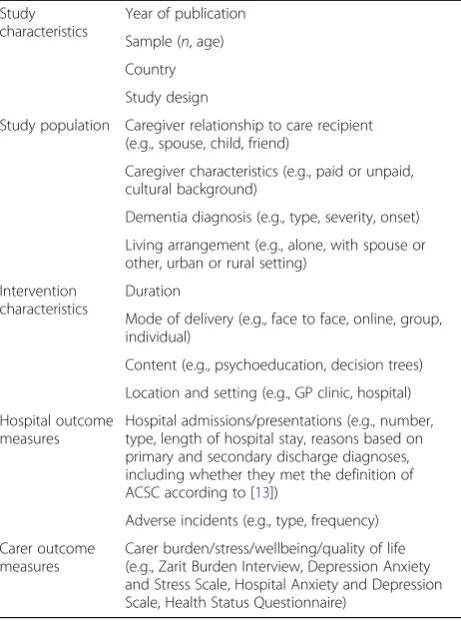
Data from included studies will be analyzed using descrip-tive statistics and content analysis. Outlined in Table 2, study characteristics (e.g., year of publication, study population) will be collected, along with the intervention characteristics (e.g., duration, delivery mode, content, set-ting/location).
Risk of bias in included studies
Two review authors (AP, JVT) will independently assess the risk of bias in included studies by using the Cochrane risk of bias tool for randomized controlled tri-als and the CASP criteria for all other study types. Any disagreement will be resolved by discussion or, if needed, by requesting a third review author to also rate the stud-ies (either FB or PY). The following sources of bias will be assessed: selection bias (including random sequence generation and allocation concealment), performance bias (blinding of participants and personnel), detection bias (blinding of outcome assessments), attrition bias (incomplete outcome data), and reporting bias (selective reporting). Risk of bias will be reported as either “low risk,” “unclear risk,” or “high risk,” and an explanation for each rating will be provided.
Summary measures
The measure of treatment effects across studies will be risk ratios with a 95% confidence interval (CI) for di-chotomous variables and mean difference with a 95% CI for continuous variables. Standardized mean difference with its 95% CI will only be used if similar outcome con-structs are measured with different rating scales.
Unit of analysis issues
The unit of analysis of interest will be the individual al-located to the intervention or comparison groups in the included trials. If cluster randomized trials are found, we will follow the methods recommended in the Cochrane Handbook for Systematic Reviews of Interventions [12].
Dealing with missing data
Where there is missing data, we will contact the corre-sponding author of the study.
Assessment of heterogeneity
Each reported comparison will include an assessment of between-studies heterogeneity using the I2 statistic for meta-analysis. We will combine the results of the studies if we consider it meaningful to do so and if theI2 statis-tic values are moderate (> 60%). Otherwise, we will not Table 1Full electronic search strategy for retrieval of citations
from MEDLINE via the Ovid Platform
1 exp Dementia/
2 dement*.mp.
3 alzheimer*.mp.
4 (lewy* adj2 bod*).mp.
5 (chronic adj2 cerebrovascular).mp
6 (organic brain disease or organic brain syndrome).mp.
7 (cerebr* adj2 deteriorat*).mp.
8 (cerebral* adj2 insufficient*).mp.
9 or/1-8
10 caregivers/
11 (carer or caregiver* or care giver* or family or families or spouse or parent or kin or relatives or daughter or son or partner or husband or wife or neighbo* or friend*).mp.
12 10 or 11
13 Health education/ or consumer health information/ or Health literacy/ or patient education as topic/ or health promotion/ or health behavior/ or health knowledge, attitudes, practice/ or health services for the aged/ or evidence-based practice/
14 (psychoeducation or health literacy or evidence based program* or health promotion).mp.
15 (carer or caregiver or care giver) adj3 (information or intervention or counselling or counseling or support or education or program*)).mp.
16 13 or 14 or 15
17 9 and 12 and 16
Table 2Data items to be extracted from each included study
Study characteristics
Year of publication
Sample (n, age)
Country
Study design
Study population Caregiver relationship to care recipient (e.g., spouse, child, friend)
Caregiver characteristics (e.g., paid or unpaid, cultural background)
Dementia diagnosis (e.g., type, severity, onset)
Living arrangement (e.g., alone, with spouse or other, urban or rural setting)
Intervention characteristics
Duration
Mode of delivery (e.g., face to face, online, group, individual)
Content (e.g., psychoeducation, decision trees)
Location and setting (e.g., GP clinic, hospital)
Hospital outcome measures
Hospital admissions/presentations (e.g., number, type, length of hospital stay, reasons based on primary and secondary discharge diagnoses, including whether they met the definition of ACSC according to [13])
Adverse incidents (e.g., type, frequency)
Carer outcome measures
combine the studies and will only provide subgroup ana-lysis or individual results.
Assessment of reporting bias
If the required number of 10 studies is reached for an outcome, we will perform an assessment of the risk of reporting bias using funnel plots. We will also make contact with authors to request results if we find any clinical trial protocols that are not published and appear to be completed.
Data synthesis
The anticipated heterogeneity between the included studies, both with regard to diversity of interventions and outcomes measured, may make a quantitative pool-ing of the outcome data inappropriate. In this case, we will present a narrative synthesis of the different inter-ventions identified, along with the main results of the in-cluded studies. If the between-studies heterogeneity permits, we will perform a meta-analysis for each com-parison that includes at least two studies, using a ran-dom effects model. Review Manager (RevMan) version 5 will be used for the analysis.
Risk of bias across studies
Two review authors (AP, JVT) will independently assess the quality of evidence using the GRADE approach for each outcome measure. Any disagreement will be re-solved by discussion. The following sources of bias will be assessed: imprecision, inconsistency, indirectness, risk of bias, and publication bias.
Subgroup analysis and investigation of heterogeneity
Depending on the between-studies heterogeneity and the availability of sufficient data, we will conduct sub-group analyses according to:
The intensity/length of the intervention provided;
The application format of the intervention (individual- versus group-based);
The characteristics of the caregivers (e.g., cultural and linguistic background, rural versus urban setting);
The characteristics of the carer recipient (e.g., severity of dementia, type of dementia, rural versus urban setting).
Discussion
This review will provide a comprehensive picture of the knowledge available on the subject and identify know-ledge gaps in existing literature. The findings may high-light the lack of existing interventions for PLWD and their carers who live in the community and will help stakeholders to identify needs and develop programs
targeted to carers and care recipients that prevent avoid-able hospitalization for PLWD.
Limitations
Some difficulties may impact on the completion and ob-jectives of this study. This includes the potential for the included studies (and reported data) to be too few to ad-dress the research questions. However, this is not un-common for systematic reviews and may encourage future research addressing this gap. In addition, there may be variability in the definition of the main concepts (e.g., dementia), and these variations could affect com-parisons between the included studies. To address this and enable data analysis, definitions and measures used by each study for main concepts will be detailed when conducting the data extraction. Lastly, there is the po-tential that the data retrieved from different studies may not be applicable to every country due to differences in the healthcare system.
Abbreviations
ACSC:Ambulatory care sensitive conditions; PLWD: People living with dementia
Acknowledgements
The authors wish to acknowledge members of the Project Advisory Group who supported this study and advised on the protocol including the following: Mr. Drew Aras1, Ms. Betty Haralambous2, Mr. Andre Catrice3, Professor Nicola
Lautenschlager4, and Ms. Paulene Mackell2.
1. Northern Health, Epping, VIC, Australia; 2. National Ageing Research Institute, Parkville, VIC, Australia; 3. Department of Health and Human Services, Melbourne, VIC, Australia; 4, Academic Unit of Old Age Psychiatry, University of Melbourne, Parkville, VIC, Australia.
Funding
The Melbourne Ageing Research Collaboration and State Trustees Australia Foundation provided support and funds to conduct this systematic review.
Availability of data and materials Not applicable.
Authors’contributions
JVT and AP conceived the study question, drafted the study protocol, and drafted the final manuscript. HB refined the study question, developed the search strategy, and edited the final manuscript. PY and JT advised on the study protocol and edited the final manuscript. FB conceived the study question, advised on the study protocol, and edited the final manuscript. All authors read and approved the final manuscript.
Ethics approval and consent to participate Not applicable.
Consent for publication Not applicable.
Competing interests
The authors declare that they have no competing interests.
Publisher’s Note
Springer Nature remains neutral with regard to jurisdictional claims in published maps and institutional affiliations.
Author details
Received: 18 February 2018 Accepted: 5 November 2018
References
1. Australian Institute of Health and Welfare: Australia’s Health 2016. In: Australia's health series no 15. Canberra: AIHW; 2016.
2. Australian Institute of Health and Welfare: Dementia in Australia. In. Canberra: AIHW; 2012.
3. Travers C, Byrne G, Pachana N, Klein K, Gray L: Prospective observational study of dementia and delirium in the acute hospital setting. Intern Med J. 2013;43(3):262–69.
4. Phelan EA, Borson S, Grothaus L, Balch S, Larson EB. Association of incident dementia with hospitalizations. Jama. 2012;307(2):165–72.
5. Sampson EL, Blanchard MR, Jones L, Tookman A, King M: Dementia in the acute hospital: prospective cohort study of prevalence and mortality. The British Journal of Psychiatry. 2009;195(1):61–66.
6. Bail K, Berry H, Grealish L, Draper B, Karmel R, Givson D, Peut A. Potentially preventable complications of urinary tract infections, pressure areas, pneumonia, and delirium in hospitalised dementia patients: retrospective cohort study. BMJ Open. 2013;3(6):e002770.
7. Alzheimer's Australia: Dementia Care in the Acute Hospital Setting: Issues and Strategies. In.: Alzheimer's Australia; 2014.
8. Australian Institute of Health and Welfare: Dementia care in hospitals: costs and strategies. In. Canberra: AIHW; 2013.
9. Alzheimer's Australia: Living with dementia in the community: challenges and opportunities. A report of national survey findings. In.: Alzheimer's Australia; 2014.
10. Phelan EA, Debnam KJ, Anderson LA, Owens SB: A systematic review of intervention studies to prevent hospitalizations of community-dwelling older adults with dementia. Med care. 2015;53(2):207–13.
11. Hoffmann TC, Glasziou PP, Boutron I, Milne R, Perera R, Moher D, Altman DG, Barbour V, Macdonald H, Johnston M, et al. Better reporting of interventions: template for intervention description and replication (TIDieR) checklist and guide. BMJ. 2014;348:g1687.
12. Higgins JPT, Green S (eds.): Cochrane Handbook for Systematic Reviews of Interventions Version 5.1.0: The Cochrane Colaboration; 2011. Available from http://handbook.cochrane.org.