Optimizing the impact resistance
of high tenacity Nylon 66 weft knitted
fabrics via genetic algorithm
Dariush Semnani, Farshad Hassani, Mehdi Hadjianfar
*and Pedram Rezazadeh Tehrani
Introduction
When a missile hits a fabric, a reflective force is implied to the missile which reduces its speed and at times fabric is deformed and strain waves are transferred to fabric edges through the yarns. Kinetic energy of missile is dissipated by strain energy of yarns in places where slipping friction exists. Thus, missile energy dissipation is influenced by factors such as; fiber type, fabric structure, missile geometry, speed of impact, friction between missile and fabric and friction of yarns and fibers in the fabric. Determining a quantitative value for yarn strain energy, kinetic energy and energy dissipation in places with friction is very difficult and in some cases impossible (Duana et al. 2006a).
Impact loads are dynamic indentation loads. Mass and speed of missile are the two determining factors of impact force. Impact energy is divided into two elements of absorbed energy by surface and elastic energy which causes missile to turn back. A great number of experiments and theoretical efforts has been conducted in order to
Abstract
The aim of the present research is evaluating the impact resistance of weft knitted fabrics which are knitted in basic patterns from the high tenacity Nylon 66. The woven fabrics have been applied for manufacturing technical and ballistic textiles so far. Although woven fabrics have been demonstrated satisfactory tensile properties, but they have not been resisted against impact, because of their poor strain against tensile forces. This research is important because knitted fabrics are applied in wide range of applications including technical textiles such as, package belts, safety belts, ballistic belts, and can be used to remove ice from airplane wings. Various knitted fabrics with different knitting elements such as knit, tuck and miss loops were produced. Mechani-cal properties including strength, work of the rupture and impact resistance of knitted samples were tested. The artificial neural network was used to predict mechanical properties of fabrics produced from the knitted structure as fitness function in genetic algorithm. After that, genetic algorithm was applied to find the optimum structure of knitted fabric with maximum impact resistance. The results of the genetic algorithm show that optimum structure of the fabric is cross-miss and rib structure with high stitch density.
Keywords: Knitted fabric, Optimizing, Impact resistance, High tenacity, Genetic algorithm
Open Access
© 2016 The Author(s). This article is distributed under the terms of the Creative Commons Attribution 4.0 International License (http://creativecommons.org/licenses/by/4.0/), which permits unrestricted use, distribution, and reproduction in any medium, provided you give appropriate credit to the original author(s) and the source, provide a link to the Creative Commons license, and indicate if changes were made.
RESEARCH
investigate the behavior of impact on yarn and fabrics. Transverse impact behavior is investigated on one layer fabrics (Roylance 1977). In some researches, ballistic impacts on systems containing fabrics, have been studied (Field and Sun 1990; Wilde et al. 1973; Wilde 1974; Briscoe and Motamedi 1992; Shim et al. 1995; Shocky et al. 2011). In a fab-ric system under ballistic impact, parameters like fiber characteristics, weave pattern and its type, number of fabric layers, surface density, missile parameters and impact parameters affect system energy absorption (Cunniff 1992). Surface friction also plays an important role in ballistic impact systems which affects energy absorption capacity (Bazhenov 1997).
Generally, only primary and secondary speeds in ballistic experiments are meas-ured which are the entering and exiting speed of bullet when it passes through the aim, respectively. However, an improved laser system is devised to measure missile speed in ballistic impact experiments (Starratt et al. 2000). A large quantity of studies have been conducted on ballistic impacts of high tensile strength fabrics (Cunniff 1992; Bazhenov 1997; Starratt et al. 2000; Tan et al. 2003; Cheeseman and Bogetti 2003; Duana et al. 2005, 2006b; Nilakantan et al. 2010; Parga-Landa and Hernandez-Olivares 1995; Billon and Robinson 2001; Zheng et al. 2006; Nilakantan et al. 2011). The effects of friction have been studies on ballistic impact behavior on high tensile strength fabrics (Duana et al. 2005, 2006a). Likewise, fabric armor behavior against ballistic impacts has been modeled (Billon and Robinson 2001; Tan and Ching 2006). Regarding broad usage of woven fabrics in armor systems and also yarn arrangement in these fabrics, the crimp in woven fabrics against ballistic impacts has been also modeled (Tan et al. 2005). Stud-ies have been conducted on ballistic impact modeling on armor fabrics in which textile based composites play an important role (Novotny et al. 2007; Mamivand and Liaghat 2010; Lim et al. 2003; Barauskas and Abraitiene 2007).
Although woven fabrics have been demonstrated satisfactory tensile properties, but they have not been resisted against impact, because of their poor strain against tensile forces. Therefore, in this work, effect of impact has been studied on different weft knit-ted fabrics. Mechanical properties of knitknit-ted samples were tesknit-ted. The artificial neural network was applied to predict mechanical properties of fabrics from weft knitted fabric factors in the knitting process. Genetic algorithm was then applied to find the optimum structure of knitted fabric with optimum impact resistance.
Methods
Materials
In order to investigate the tensile strength of various fabrics, 100-denier 20-TPM multi-filament Nylon 66 yarns, were used and four knitting patterns with two different densi-ties were produced by Falmac single knit circular knitting machine (48 feeders, gauge 24) and Mayer & Cie double knit circular knitting machine (96 feeders, gauge 24).
Mechanical properties
179-1:2000 (ISO 2000). The pendulum had energy of 150 J and the specimens were pre-pared in 150 × 50 mm. Impact surface was 50 × 2 mm and the pendulum hit the center of the sample. The samples were clamped in two sides.
Artificial intelligence
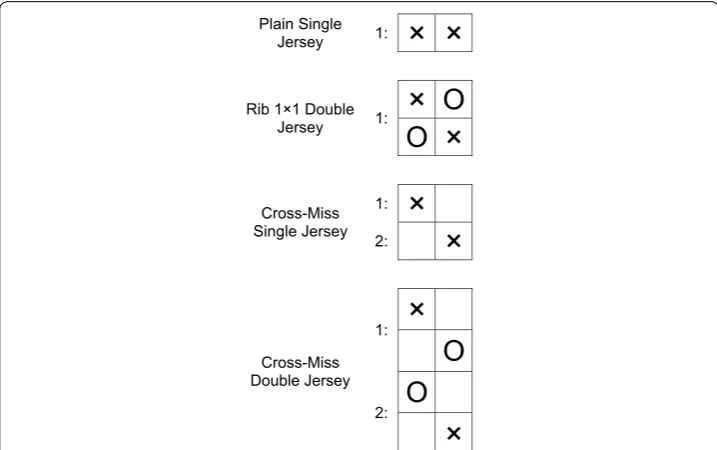
Five samples were used for testing every type of fabrics and the results were used as neu-ral network inputs and outputs. In the neuneu-ral network, input parameters were knit ratio that is the ratio of knitted loops in comparison with total loop in each unit cell of knit-ted structure, miss ratio that is the ratio of missed loops in comparison with total loop in each unit cell of knitted structure, stitch density and loop length. Output parameters were the work of the rapture in the course and wale direction, the tensile strength in the course and wale direction and impact resistance. Figure 1 shows the knitting notation of the different patterns.
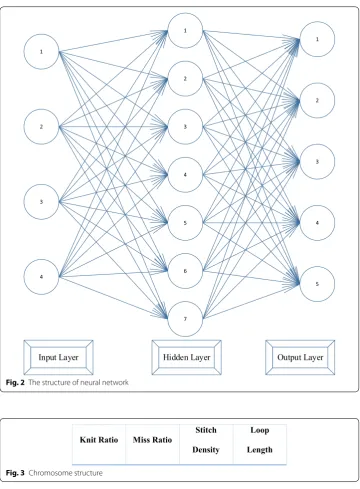
An artificial neural network with four nodes in the input layer, seven nodes in the hid-den layer and five nodes in the output layer was used. Levenberg–Marquardt Back Prop-agation training algorithm with mean square error performance was used to train the network. Figure 2 shows the structure of artificial neural network.
The learning rate of neural network was 0.01, the momentum was 0.5, maximum epoch number was 500 and the final value of performance function was 10−2. Linear
transfer function, log-sigmoid transfer function and hyperbolic tangent sigmoid func-tion, were used for input layer, hidden layer and output layer, respectively. 70 % of data were used for training, 10 % for validation and 20 % for testing. The initial size of popula-tion in genetic algorithm that was used to optimized structure, was 20. The chromosome structure is depicted in Fig. 3.
In order for a better performance it is inevitable that mechanical parameters should tend to maximum value. Thus, the fitness function is defined as reverse value of
×
×
1: Plain SingleJersey
O
×
1: Rib 1×1 DoubleJersey
O
×
×
1: Cross-MissSingle Jersey 2:
×
×
1: Cross-MissDouble Jersey
O
O
2:
×
mechanical properties. Generally, the number of individuals remained constant in each generation and the best surviving ones and the ones with lower fitness value were elimi-nated in each generation. In the chromosome producing, the first and the second genes which were related to knit ratio and miss ratio, got a value of two totally. Therefore, for double jersey fabrics with 100 % knit, two was considered for the first gene and zero for the second gene. Consequently, for single jersey fabrics with 100 % knit, one and zero were considered for the first and the second genes correspondingly.
The next generation was made from the previous generation. For this, one member as elite member was transferred to the next generation directly and crossover for the other
1
2
3
4
1
2
3
4
5
6
7
1
2
3
4
5
Buon
Input Layer Hidden LayerBuon Output LayerBuon
Fig. 2 The structure of neural network
Knit Ratio Miss Ratio Stitch Density
Loop
Length
members was considered 0.9. The rest of individuals of the next generation were formed by mutation.
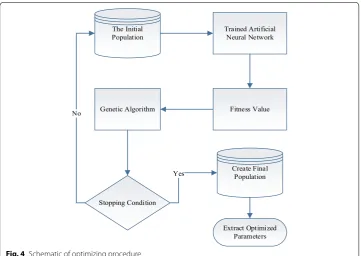
For determining fitness function, artificial neural network output was used. Therefore, each individual input was added to the trained neural network. Eventually, the output values of network for each output parameter was reversed and their summation was considered as fitness value of the mentioned individuals. After several generations, when fitness function value was not changed or reached desired fitness value, the genetic algorithm was stopped and the last generation was shown as the optimized population whereof the optimized knitting parameters values could be extracted by the use of gene structure. Figure 4 shows optimization procedure schematically.
Results and discussion
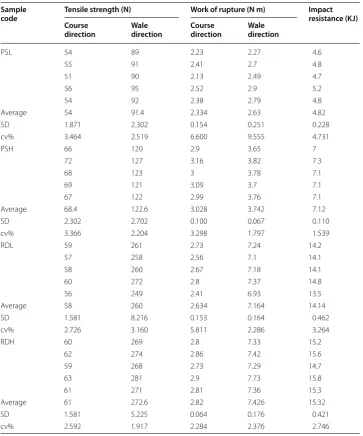
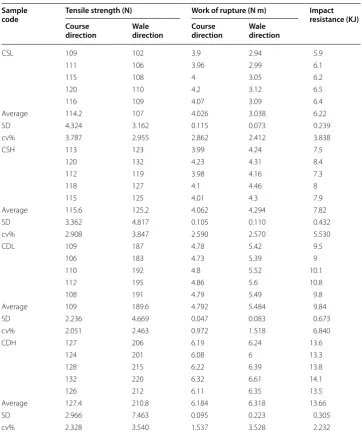
The mechanical properties of 40 samples from 8 different types of fabrics were tested at first. Table 2 shows the results of mechanical tests. After determining knitting param-eters which are shown in Table 1, they were used as neural network inputs and results of tensile strength, work of rupture and impact resistance were used as target of neural network.
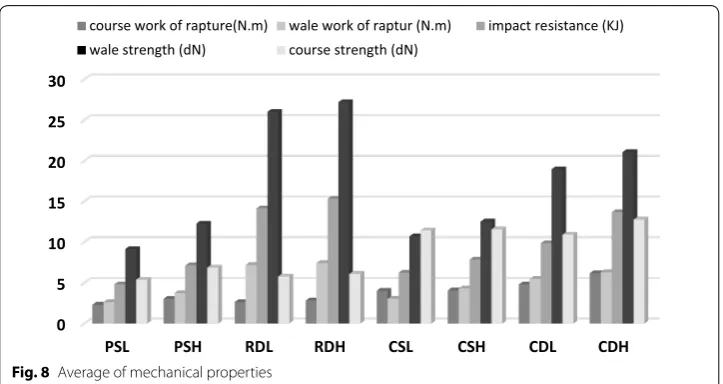
One can see from Table 2 that RDH sample has the highest work of rupture and tensile strength in wale direction, and impact resistance and CDH sample has the highest ten-sile strength and work of rupture in coarse direction.
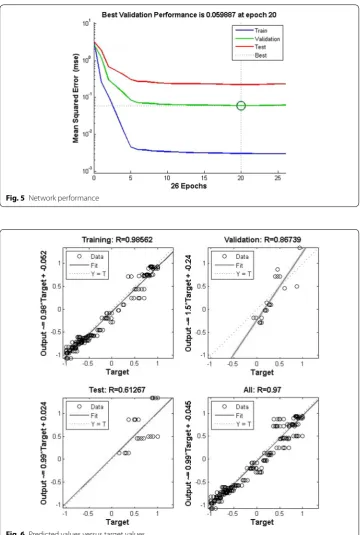
A trained artificial neural network with four nodes in the input layer, seven nodes in the hidden layer and five nodes in the output layer was used as fitness function. Figure 5 shows network performance values and Fig. 6 shows predicted values versus target val-ues, which has an acceptable correlation coefficient.
Stopping Condition
Trained Artificial Neural Network
Fitness Value Genetic Algorithm
Extract Optimized Parameters Create Final
Population Yes
The Initial Population
No
Table 1 Fabrics properties
Sample
code Structure CPC WPC Weight (g/m2) Stitch density (1/cm2) Loop length (mm)
PSL Plain, Single Jersey, Low Density 11.46 10.56 55 121 3.9
PSH Plain, Single Jersey, High Density 15.36 14.13 68 217 2.9
RDL Rib, Double Jersey, Low Density 13.35 21.12 105 282 2.6
RDH Rib, Double Jersey, High Density 14.93 21.56 116 322 2.4
CSL Cross Miss, Single Jersey, Low Density 14.59 12.34 84 180 3.3
CSH Cross Miss, Single Jersey, High Density 17.05 14.48 102 247 2.8
CDL Cross Miss, Double Jersey, Low Density 12.2 19.84 105 242 2.8
CDH Cross Miss, Double Jersey, High Density 14.44 23.54 156 340 2.3
Table 2 The results of mechanical tests
Sample
code Tensile strength (N) Work of rupture (N m) Impact resistance (KJ) Course
direction Wale direction Course direction Wale direction
PSL 54 89 2.23 2.27 4.6
55 91 2.41 2.7 4.8
51 90 2.13 2.49 4.7
56 95 2.52 2.9 5.2
54 92 2.38 2.79 4.8
Average 54 91.4 2.334 2.63 4.82
SD 1.871 2.302 0.154 0.251 0.228
cv% 3.464 2.519 6.600 9.555 4.731
PSH 66 120 2.9 3.65 7
72 127 3.16 3.82 7.3
68 123 3 3.78 7.1
69 121 3.09 3.7 7.1
67 122 2.99 3.76 7.1
Average 68.4 122.6 3.028 3.742 7.12
SD 2.302 2.702 0.100 0.067 0.110
cv% 3.366 2.204 3.298 1.797 1.539
RDL 59 261 2.73 7.24 14.2
57 258 2.56 7.1 14.1
58 260 2.67 7.18 14.1
60 272 2.8 7.37 14.8
56 249 2.41 6.93 13.5
Average 58 260 2.634 7.164 14.14
SD 1.581 8.216 0.153 0.164 0.462
cv% 2.726 3.160 5.811 2.286 3.264
RDH 60 269 2.8 7.33 15.2
62 274 2.86 7.42 15.6
59 268 2.73 7.29 14.7
63 281 2.9 7.73 15.8
61 271 2.81 7.36 15.3
Average 61 272.6 2.82 7.426 15.32
SD 1.581 5.225 0.064 0.176 0.421
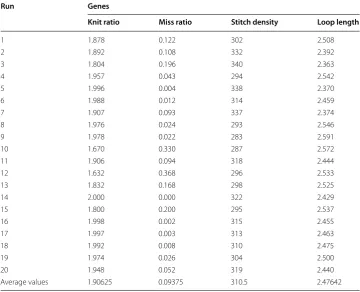
In optimization by genetic algorithm, chromosomes with four genes and the primary population with 10 individuals were used. In each generation the mean fitness values and the best fitness values were calculated. After 20 generations, the gene values of the best individual of the last generation were considered as the values of optimized param-eters. Figure 7 shows the fitness values for all generations in one run. Table 3 shows the results of genetic algorithm output for 20 times running of the algorithm.
Double jersey fabrics have more strength and impact resistance as appose to sin-gle jersey ones. Since loops can stretch after the impact, increasing knit ratio causes more energy waste in loops. Consequently, by increasing loop density work of rupture increases. As a result, it is expected to observe more impact resistance in high density double jersey fabrics. As it can be seen from Table 3 and Fig. 8, the results are in a good compliance with reality.
Table 2 continued
Sample
code Tensile strength (N) Work of rupture (N m) Impact resistance (KJ) Course
direction Wale direction Course direction Wale direction
CSL 109 102 3.9 2.94 5.9
111 106 3.96 2.99 6.1
115 108 4 3.05 6.2
120 110 4.2 3.12 6.5
116 109 4.07 3.09 6.4
Average 114.2 107 4.026 3.038 6.22
SD 4.324 3.162 0.115 0.073 0.239
cv% 3.787 2.955 2.862 2.412 3.838
CSH 113 123 3.99 4.24 7.5
120 132 4.23 4.31 8.4
112 119 3.98 4.16 7.3
118 127 4.1 4.46 8
115 125 4.01 4.3 7.9
Average 115.6 125.2 4.062 4.294 7.82
SD 3.362 4.817 0.105 0.110 0.432
cv% 2.908 3.847 2.590 2.570 5.530
CDL 109 187 4.78 5.42 9.5
106 183 4.73 5.39 9
110 192 4.8 5.52 10.1
112 195 4.86 5.6 10.8
108 191 4.79 5.49 9.8
Average 109 189.6 4.792 5.484 9.84
SD 2.236 4.669 0.047 0.083 0.673
cv% 2.051 2.463 0.972 1.518 6.840
CDH 127 206 6.19 6.24 13.6
124 201 6.08 6 13.3
128 215 6.22 6.39 13.8
132 220 6.32 6.61 14.1
126 212 6.11 6.35 13.5
Average 127.4 210.8 6.184 6.318 13.66
SD 2.966 7.463 0.095 0.223 0.305
Conclusion
Properties of weft knitted fabrics were determined by yarn properties, fabric structure and any mechanical and chemical process which were performed about fabric and yarn. Since weft knitted fabrics have various behaviors in the course and the wale directions, mechanical tests were carried out in the above mentioned directions.
Fig. 5 Network performance
For Double Jersey Cross Miss, the work of rupture and the tensile strength in course direction were maximum. Work of rupture and tensile strength in wale direction and impact resistance were maximum for Rib patterns. As for impact resistance, double sey patterns and high stitch density fabrics showed better results as appose to single jer-sey and low stitch density fabrics correspondingly.
Fig. 7 The fitness values
Table 3 The results of genetic algorithm
Run Genes
Knit ratio Miss ratio Stitch density Loop length
1 1.878 0.122 302 2.508
2 1.892 0.108 332 2.392
3 1.804 0.196 340 2.363
4 1.957 0.043 294 2.542
5 1.996 0.004 338 2.370
6 1.988 0.012 314 2.459
7 1.907 0.093 337 2.374
8 1.976 0.024 293 2.546
9 1.978 0.022 283 2.591
10 1.670 0.330 287 2.572
11 1.906 0.094 318 2.444
12 1.632 0.368 296 2.533
13 1.832 0.168 298 2.525
14 2.000 0.000 322 2.429
15 1.800 0.200 295 2.537
16 1.998 0.002 315 2.455
17 1.997 0.003 313 2.463
18 1.992 0.008 310 2.475
19 1.974 0.026 304 2.500
20 1.948 0.052 319 2.440
It is concluded that, fabrics with very high knit ratio, low miss ratio, high stitch density and short loop length, have the most optimized impact resistance, tensile strength and work of rupture in both course and wale direction.
In general, high stitch density Rib showed better impact resistance and had better ten-sile strength and work of rupture in both directions as appose to other patterns which is in compliance with the results driven from genetic algorithm prediction.
Authors’ contributions
FH carried out the experiments and rounded up data. DS supervised the whole process. MH and FH developed the literature review, coded. MH and DS conducted genetic algorithm and neural network. PRT guided the analysis of the results and conclusions and contributed to the formatting and editing of the manuscript. All authors read and approved the final manuscript.
Competing interests
The authors declare that they have no competing interests.
Received: 15 December 2015 Accepted: 2 June 2016
References
ASTM D5034-09. (2013). Standard test method for breaking strength and elongation of textile fabrics (Grab Test). West Conshohocken, PA: ASTM International, 2013. www.astm.org.
Barauskas, R., & Abraitiene, A. (2007). Computational analysis of impact of a bullet against the multilayer fabrics in LS-DYNA. International Journal of Impact Engineering,34(7), 1286–1305.
Bazhenov, S. (1997). Dissipation of energy by bullet proof aramid fabric. Journal of Material Science,32(15), 4167–4173. Billon, H. H., & Robinson, D. J. (2001). Models for the ballistic impact of fabric armor. International Journal of Impact
Engi-neering,25(4), 411–422.
Briscoe, B. J., & Motamedi, F. (1992). The ballistic impact characteristics of aramid fabrics the influence of interfacial fric-tion. Wear,158(1–2), 229–247.
Cheeseman, B. A., & Bogetti, T. A. (2003). Ballistic impact into fabric and compliant composite laminates. Composite Structure,61(1–2), 161–173.
Cunniff, P. M. (1992). An analysis of the system effects in woven fabrics under ballistic impact. Textile Research Journal, 62(9), 495–509.
Duana, Y., Keefe, M., & Bogetti, T. A. (2006a). A numerical investigation of influence of friction on energy absorption by high strength fabric subjected to ballistic impact. International Journal of Impact Engineering,32, 1299–1312. Duana, Y., Keefe, M., Bogetti, T. A., & Cheeseman, B. A. (2005). Modeling friction effects on Ballistic impact behavior of a
single ply high strength fabric. International Journal of Impact Engineering,31(8), 996–1012. 0
5 10 15 20 25 30
PSL PSH RDL RDH CSL CSH CDL CDH
course work of rapture(N.m) wale work of raptur (N.m) impact resistance (KJ) wale strength (dN) course strength (dN)
Duana, Y., Keefe, M., Bogetti, T. A., Cheeseman, B. A., & Powers, B. (2006b). A numerical investigation of friction effect on the energy absorption of a high strength fabric subjected to ballistic impact. International Journal of Impact Engi-neering,32(8), 1299–1312.
Field, J. E., & Sun, Q. (1990). A high speed photographic study of impact on fibers and woven fabrics. In Proceedings of 19th international congress on high speed photography and photonic (pp. 703–712).
ISO 179-1:2000. (2000). Plastics—Determination of Charpy impact properties—Part 1: non-instrumented impact test. International Organization for Standardization
Lim, C. T., Shim, V. P. W., & Ng, Y. H. (2003). Finite-element modelling of the ballistic impact of fabric armor. International Journal of Impact Engineering,28(1), 13–31.
Mamivand, M., & Liaghat, G. H. (2010). A model for ballistic impact on multilayer fabric targets. International Journal of Impact Engineering,37(7), 1056–1071.
Nilakantan, G., Keefe, M., Bogetti, T. A., & Gillespie, J. W. (2010). Multiscale modeling of the impact of textile fabric based on hybrid element analysis. International Journal of Impact Engineering,37(10), 1056–1071.
Nilakantan, G., Keefe, M., & Wetzel, E. D. (2011). Computational modeling of the probabilistic impact response of flexible fabrics. Composite Structure,93, 3163–3170.
Novotny, W. R., Cepus, E., Shahkarami, A., Vaziri, R., & Poursartip, A. (2007). Numerical investigation of the ballistic efficiency of multi ply fabric armors during the early stage of impact. International Journal of Impact Engineering,34(1), 71–88. Parga-Landa, B., & Hernandez-Olivares, F. (1995). An analytical model to predict impact behavior of soft armors.
Interna-tional Journal of Impact Engineering,16(3), 455–466.
Roylance, D. (1977). Ballistics of transversely impacted fibers. Textile Research Journal,47(10), 679–684.
Shim, V. P. W., Tan, V. B. C., & Tay, T. E. (1995). Modelling deformation and damage characteristics of woven fabric under small projectile impact. International Journal of Impact Engineering,16(4), 585–600.
Shocky, D. A., Erlich, D. C., & Simons, J. W. (2011). Improved barriers to turbine engine fragments. US Department of Trans-portation Federal Aviation Administration. DOT/FAA/AR-99/8 III.
Starratt, D., Sanders, T., Cepus, E., & Poursartip, A. (2000). An efficient method for continuous measurement of projectile motion in ballistic impact experiments. International Journal of Impact Engineering,24(2), 155–170.
Tan, V. B. C., & Ching, T. W. (2006). Computational simulation of fabric armor subjected to ballistic impacts. International Journal of Impact Engineering,32(11), 1737–1751.
Tan, V. B. C., Lim, C. T., & Cheong, Ch. (2003). Perforation of high strength fabric by projectiles of different geometry. Inter-national Journal of Impact Engineering,28(2), 207–222.
Tan, V. B. C., Shim, V. P. W., & Zeng, X. (2005). Modelling crimp in woven fabrics subjected to ballistic impact. International Journal of Impact Engineering,32(1–4), 561–574.
Wilde, A. F. (1974). Photographic investigation of high speed missile impact upon nylon fabric. Part II: Retarding force on missile and transverse critical velocity. Textile Research Journal,44(10), 772–778.
Wilde, A. F., Roylance, D. K., & Rogers, J. M. (1973). Photographic investigation of high speed missile impact upon nylon fabric. Part I: Energy absorption and cone radial velocity in fabric. Textile Research Journal,43(12), 753–761. Zheng, D., Binienda, W. K., Cheng, J., & Staniszewski, M. (2006). Numerical modeling of friction effects on the ballistic