w w w . i j m r e t . o r g I S S N : 2 4 5 6 - 5 6 2 8 Page 1
A Solution to Problem of Limited Resources in Education
Using Semantic Web and Interoperability of Cloud
Computing
Alshiply Tarek
Dept. Computer Engineering, Kırıkkale University, Edlib, Syria
Emiroğlu Bülent Gürsel
Dept. Computer Engineering, Kırıkkale University, Kırıkkale, Turkey
Abstract: Educational Institutions Continue To Search For Opportunities To Rationalize Its Resources Because Of The Negative Impact Of Financial Crises On Educational Institutions. In Addition, to Lack of Government Support for Educational Institutions to Provide their Requirements. Cloud Computing Changed The Way In Which Development and Access To Applications And Infrastructure Provision, Which Covers All The Cloud Services. In This Article, It Is Likely That Cloud Computing Is One Of Those Opportunities That Can Help Educational Institutions To Face Their Problems. Consequently, Educational Institutions Can Take Advantage Of Cloud Applications And Services To Provide Alternatives To Free Or Cost-Effective Through Cloud Services. Use of Indications in Cloud Computing Helped To Create A Platform Independent Of Statute. In This Article, We Analyze How Can Cloud Computing Affect the Limits of Educational Resources in the Background of Semantic Web through Use of Experimental and Semantic Platforms. We Offer A Technical Solution Using Digital Cloud Services.
Keywords: limits of software, Cloud computing, Semantic Web Technologies.
I. INTRODUCTİON
There are resources in every educational institution, and these resources have limits, the limits meanthat the resources will be not enough, if all users are severed. The solution is providing of more resources, but this solution is very expensive, and it is only a combination of resources and may be useless because it is not enough. As a new and effective solution which has made the University of California in Berkeley city (UC) very attractive from faculties of cloud computing applications, so the UC was able to migrate from locally-owned infrastructure to the cloud using Amazon Web Services (AWS).
One of the main reasons was the ability to acquire a large amount of servers within a few minutes. Indeed, cloud computing can prove to be attractive to academic institutions, colleges and universities are always looking for software and information technology hardware to attract students and keep pace with rapid developments in digital technologies. Cloud computing can provide these institutions with access to these ambitions at affordable prices. In
addition, shifting responsibility to external providers to manage some aspects of software and hardware infrastructures can result in cost savings in relation to labor, as there will be fewer information technology service workers than ever before.
Cloud computing also leads to higher education institutions in the UK, such as Leeds Metropolitan
University, Glamorgan University, Aberdeen
University, Westminster University, the University Of London School Of Oriental and African Studies and the Royal College of Art [1].
w w w . i j m r e t . o r g I S S N : 2 4 5 6 - 5 6 2 8 Page 2 from the resources of another suitable institution
when the institution cannot provide the service. II. WHAT İS CLOUD COMPUTİNG?
Interaction with cloud computing is a model to provide optional network access to a pool of configurable computational resources for example (networks, servers, storage, applications and services) that can be quickly supplied and released with minimum management effort or service provider. According to the American Standards Institute (NIST): The idea of cloud computing has emerged so that the user can use various software and platforms even if they are not on the computer. a model that allows the network to be accessed properly and optionally.
Cloud computing is defined as an automated data center that can be accessed via the web, and through this center, large calculations, storage and network services can be used at any time without human intervention. [2]
III. CHARACTERISTICSOF CLOUD
COMPUTING
On-demand self-service:
A consumer can provide one-sided information processing capabilities, such as server time and network storage, as needed automatically without the need for human interaction with each service provider.
Broad network access:
Capabilities are available through the network and can be accessed through standard mechanisms that support the use of heterogeneous thin or thick client platforms (eg, mobile phones, tablets, laptops and workstations).
Resource pooling:
The provider's computing resources are collected to serve multipleconsumers using a multi-tenant model, different physical and virtual resources are dynamically assigned and reassigned according to consumer demand. There is a sense of place independence because the customer does not have any control or information on the exact location of the resources generally provided, but can determine a position at a higher level of abstraction (eg, country, state or data center). Examples of resources include
storage, processing, memory, and network
bandwidth. Rapid elasticity:
In some cases, the capabilities can be provided and released in an elastic manner in order to be able to
quickly outward and inward scaling according to the demands. The capabilities available to the consumer for provisioning often appear to be unlimited and can be allocated at any time at any time.
Measured service:
Provide the emergence of cloud computing. Cloud services and computer platforms computed by the clouds are among various concerns such as scalable
geographic locations, hardware performance,
software configurations. Computing platforms Be flexible to accommodate the diverse requirements of a wide range of users. [3]
IV. CLOUD SERVİCE MODELS
Cloud computing is a network access model that hosts specific services in general and presents it to its users with flexible adjustability. This model has three main services. These services are the Software as a Service, Platform as a Service and Infrastructure as a Service.
A. Software as a Service (SaaS)
It is the service that users benefit from by accessing applications via any platform connected to the internet without any installation. Users of the service do not have the right to manage or control any of the components such as network, server, operating system, and storage devices. This service user can make adjustments and changes on the application on which the user benefits, provided that they are limited to the permissions defined on the web browser interface. Web-based e-mail services such as Google Mail, Hotmail or Yahoo Mail are the most popular and familiar SaaS services. The giscloud.com site, which has various Geographical Information Systems tools, allows users to publish raster and vector data models on a web-based basis and can perform spatial inquiries and buffer zone analyzes. It is an important SaaS application for use in cloud computing in GIS. B. Platform as aService (PaaS)
It is a user-specific application infrastructure using cloud computing from software languages used, libraries, services and software tools that the provider can provide to the user. The user is not responsible
for managing and monitoring the service
infrastructure used by the network, servers, operating systems or storage space which is occupied by its application, but is solely responsible for controlling the application running the platform it is using and adjusting its settings.
w w w . i j m r e t . o r g I S S N : 2 4 5 6 - 5 6 2 8 Page 3 application deployment stages, all of which are
managed and monitored by the platform.
The PaaS services are flexible with their
environments, platforms, ease of handling and data privacy in terms of securing data backups or security data.
C. Infrastructure as a Service (IaaS)
The physical services provided to the user, such as processors, servers, networks, and memory, as well as many computing resources, allow the customer to run software using these services, which may contain their own operating systems and applications. The type of service should be responsible for controlling the sources it uses unlike SaaS and PaaS.
IaaS services are provided to the user regardless of their geographical location, i.e. once there is an Internet connection, the service is delivered properly. There is no point of failure to deliver the service, i.e. when the switch is damaged, the data is not affected. Companies use IaaS services as follows:[4]
Corporate Infrastructure (EI): Many companies benefit from cloud computing by storing their data and running applications that need to be run daily and expanding their use of infrastructure in line with the expansion of their business and applications.
Hosting by Computing (CS): This is done by hosting websites through virtual servers that are located above the real servers of the computing companies. Virtual Data Centers (VDCs): Consists of a network of virtual infrastructure that provides high-capacity infrastructure and infrastructure for IT companies.
V. INTEROPERABİLİTY İN CLOUD
COMPUTİNG
Cloud computing occupies an important center in the commercial market and has the potential to make a substantial contribution to the future growth of the commercial market in order to make the expected benefits should be easy to use and economic, this means that the customers of the use of cloud computing services and products and can integrate within their system through simple adjustments.The inability to transfer the components of the special system from the customer of the cloud service provider to another provider and the inability of the ınteroperabitity effectively mean that we did not reach the optimal use of cloud computing.[5].
VI. CHALLENGES OF CLOUD COMPUTING
In 2010, Word Economic Forum (WEF) published a
valuable report about the impact of cloud computing techniques and this report explained the big benefit expected from use of cloud computing technologies, which are ranging between economic growth and the
improvement of employment to enable the
development and cooperation.
But one of the challenges is the fear of failure on the data between different service providers. The fear of the link service provider does not stimulate many users to move to the cloud where the service providers are trying to maintain their competitiveness in the market of cloud computing, and all of them were issued special techniques.These concerns should be removed to users can transfer data or applications between providers of cloud computing quickly and easily cheap. Although data portability is the most important problem facing cloud computing, but application portabilityis very important too. [6]
VII. INTEROPERABILITY AND DATA
PORTABILITY
Interoperability: It is a way to run more than one cloud at a service level so that it appears to end customer as a single cloud.
Data portability: An idea that expresses a standard data format that enables all applications to read it in standard form, such as XML standard.
Data interoperability and portabilityare associated with the ability to build reusable systems and work together without modification. Stability on a service provider or moving from one service provider to another is important for cloud computing users. The common problem with cloud computing is the inability to move some components of the system cloudily because of data incompatibilities or corporate policies. [7]
VIII. SEMANTİC WEB İN İNTEROPERABİLİTY
We can say that semantic web is a network of meanings, it can be said that the computers can understand people and informing them in a way that people can understand.Semantic web depends on identifying the relations for example(A part of B and X is a member of Z) and also description of things such as size, weight, price, age and other, so it is a network of data that can be processed directly machinery.
IX. CONCEPTS OF SEMANTIC WEB
w w w . i j m r e t . o r g I S S N : 2 4 5 6 - 5 6 2 8 Page 4
Uniform Resource Identifier (URI): It is a series
of characters that are used to determine a physical or mere resource.
Resource Description Framework (RDF): It is a language to represent the data of resources in web.
SPARQL1: It is a query language and it’s used to query about RDF and diffrent data resources.
Ontology Web Language (OWL): It is used to
describe Inverses, Unambiguous Properties, UniqueProperties, and Constraints.
Inference: It is a derivation of new data from known data.
Logic: It is a compiling expressions of each other
and measuring by them using logic
vocabulary.[8]
X. RESOURCE DESCRİPTİON FRAMEWORK
(RDF)
To understand Semantic Web and its mechanism of work, it is important to understand how data is stored by Semantic Web. RDF defines a special database model called Graph Database, which is the data model used to store data in Semantic Web, while RDF is the formula in which data is written.
Although RDF is the basis to definition the data structure related to semantic web, but it does not describe the indications or meaning to this data, and the data is addressed based on formula of grammar, such as RDF2 and OWL3.
RDF relies on selection of resources through URIs. Thus, RDF enables representation of resource data through nodes and links which are representing resources and their characteristics. The RDF relies on a triples data model consisting of Resource-Property-Value.
Resource: An entity that can be accessed through a Web URI such as (HTML document, XML document).
Property: A binary relationship between resources and / or specific values, so that data can be attached to resources.
Value: A simple string of characters or a resource. In this way, data can be represented using RDF and published on the Web, enabling applications to search, discover, collect, analyze and process these data. Here are some basic features of RDF:
1http://www.w3.org/TR/rdf-sparql-query/
2
http://www.w3.org/TR/rdf-schema/
3http://www.w3.org/TR/owl-features/
Linking things, not just documents, and therefore
not linking RDF between data segments, but also between entities that are specified in these data. RDF allows explicit expression of nature / style
of links between data and we call it RDF links. Linking data from different sources:RDF model
can create RDF links between data from different sources, allowing data from more than one provider.
There are three main types of RDF links:
Relationship Links: refer to related things in other data sources, such as other people or places, for example, these links provide information about where someone lives.
Identity Links: Refer to aliases for URIs used by other data sources to identify the same object. These links allow retrieval of more descriptions of a particular entity from other data sources. These links have an important social function to allow for the expression of different perspectives on the world through data.
Vocabulary Links: allows the creation of links from data to definitions of vocabulary terms used in data representation, as well as from these definitions to definitions of related terms in other vocabulary groups. These links allow for self-defined data. [9]
XI. IMPORTANCE OF SEMANTİC WEB İN
CLOUD COMPUTİNG
The technologies used in cloud are based on the Semantic Web, which provides a way to add "meaning and correlation" to objects on Web. To achieve this, it defines a system or properties that normalize the meaning in terminology and this normalization is called an Ontology [7].As the basic part of semantic web, Ontologies provide the means of expressing the meanings of different terms or concepts with their relations. They are directed to represent semantic information instead of content and there are different languages can explain the properties of on to logies. [10]
The System Test Method
w w w . i j m r e t . o r g I S S N : 2 4 5 6 - 5 6 2 8 Page 5 the system was created, it was tested and corrected in
the virtual environment using VMware software. XII. THE USED ARCHİTECTURESINTHIS
SYSTEM
A. InterCloudArchitecture
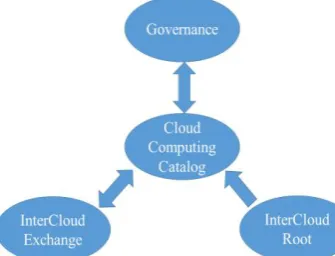
We consider that the Provider Cloud is a cloud computing company and it provides PaaS and IaaS services while the consumer cloud is another IaaS service provider.This Architecture is based on several components as shown in Figure 1:
Governance: It is the provider of standards that every provider must comply with as a condition and limitation of operation within the cloud computing operating environment. Governance provides and determines all standards that ensure proper and complete implementation of the sharing process between the service consuming company and the service providers to prevent any conflicts or differences between computing companies at any level of a service-sharing process whether at the level of service delivery, management, or communication.
Intercloud Root:It plays the key role in hosting process of computing companies wishing to join interoperability environment. If Any computing company wants to join cloud computing environment,it will request the permit from InterCloud Root and during a correspondence process of required information by this company, InterCloud Root verifies the standards that the
company must achieve, which are the same standards we spoke about in Governance section. If all requirements are met, InterCloud Root stores the company's information within Cloud Computing Catalog and describes it in appropriate methodologies.
Intercloud Exchange providers will facilitate the negotiation communication and collaboration
between different heterogeneous cloud
environments, working in accordance with Intercloud Roots as described earlier. Intercloud Root instances will host root XMPP servers that contain all asset information for Intercloud Root instances, Intercloud Exchange Instances, and Cloud instances with Intercloud visible instances on the Internet. Intercloud Exchanges will host second-tiered XMPP servers. Intercloud-enabled Clouds Intercloud Roots and Intercloud will communicate with each other as XMPP clients through the XMPP server environment hosted by Exchange.
Cloud Computing Resources Catalog is required
for Intercloud-enabled Cloud instances to work with a source federation or other means. This catalog is a holistic and summary image of
computing resources in different cloud
environments. Individual clouds will use this catalog to determine the matching cloud source by applying specific Preferences and Constraints to resources in the catalog of computation
resources [11].
Figure 1:InterCloud Architecture B. Unified Cloud Interface (UCI)
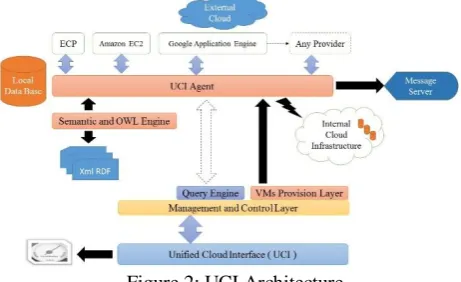
UCI is used to merge various cloud APIs and put it behind an open and standardized cloud interface. The key driver of the Unified Cloud Interface (UCI) is to create an API about other APIs. The aim is to serve as a common interface for interaction between remote platforms, networks, systems, applications, services,
w w w . i j m r e t . o r g I S S N : 2 4 5 6 - 5 6 2 8 Page 6 model will take on both platform and infrastructure
cloud platforms as service offerings. It will provide a decentralized, expandable and secure hybrid cloud computing environment. The primary goal is undoubtedly to create an abstraction layer for any cloud API, platform, or infrastructure. The architecture consists of layers and components with the usage state described in the UCI project requirement page. Architecture summarizes the use of any cloud API and merges them into a single layer. This is done with the help of the semantic web and OWL, which has an anatomically understood and
defined resource pool. This allows the user to use whatever resources they have. Having an interface combined with the common definitions of these resources helps to perform operations such as the allocation, separation, provision of virtual machines, or management through the UCI layer using the agent component. Assuming that the UCI interface is provided to the user through a web browser or UCI cloud client, the UCI must provide some kind of dashboard that shows the status of all allocated resources and running VMs. A component on the left side of Figure 2 is used to illustrate this. [12]
Figure 2: UCI Architecture XIII. OWL-SONTOLOGY
OWL ontology provides vocabulary to identify services, automatic service finding, service composition and operation.
The main OWL-S ontology consists of three sub-ontologies:
"Service Profile","Service Model" and "Service Ground" as shown in figure 3.
The service profile is a high-level description of the service. Mostly, it is used by agents to identify what the services are doing and it is used to determine whether services provide needs.
The service model gives a detailed description of how the service works, and it includs: The semantic content of the inputs and outputs of the Service.
The conditions under which the Service can be carried out. Step-by-step processes leading to the outcome of the Service.
Service grounding explains how to access a service and it Specifies other specific details, such as communication protocols, message formats, and the port used to access the service. The OWL-S has a structure which can then be used with WSDL (Christensen et al., 2001) by extending existing bonds. [13]
w w w . i j m r e t . o r g I S S N : 2 4 5 6 - 5 6 2 8 Page 7 XIV. COCOON ONTOLOGY
This protocol is one of the OWL protocols and it defines cloud infrastructure services.Although the IaaS cloud computing model is currently focused, CoCoOn creators believe that the future CocoOn approach can be extended to understand the PaaS and SaaS models.The CocoOn methodology proposed in this study consists of the following:
Functional cloud service configuration information. Non-functional service configuration information.
In the Functional cloud configuration information section, the concepts that define IaaS model are defined as a classification. For example, IaaS concept is divided into three subcategories, and account, network and storage are analyzed and categorized.
The non-functional cloud configuration information section describes the characteristics of ontology concepts and distinguishes between known cloud resources such as deployment model providers and features that can be registered only after at least one cloud execution cycle such as endurance or performance.
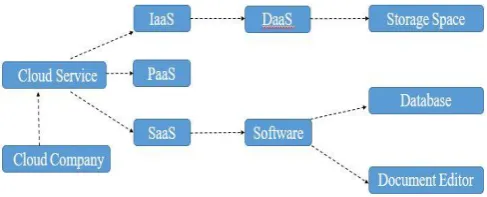
Based on ontology service explanation, the service discovery system was implemented using CoCoOn methodology to search for existing infrastructure services.CocoOn's methodology is used by well-known cloud service providers such as (Amazon, Microsoft Azure, Google, etc.).Figure 4 illustrates the main concepts in the IAAS layer that are used in CocoOn methodology. [14]
Figure 4: CoCoON Ontology XV. THE SELECTED ONTOLOGY
Although the OWL-S ontology is the best to our system based on classes and subclasses representing the most important parts of the system, this ontology is not sufficient to create some details in the desired system. Therefore, it was necessary to design another ontology in the required and non-existent classes of OWL-S ontology to provide the system requirements and then integrate with OWL-S ontology as in figure 5.
w w w . i j m r e t . o r g I S S N : 2 4 5 6 - 5 6 2 8 Page 8 XVI. RESULTS
To know the real effect of system, we examined the percentage of system's success, so we had found that the problem of reduce resource usage was found to be 93.5% solved, and the reason of missing 6.5% is that some cloud computing models can’t work together as shown in “Tab. 1”.Using semantic web in cloud computing increased the performance of system about 56.9%.
Service SaaS PaaS IaaS
SaaS Yes Yes Yes
PaaS Yes No No
IaaS Yes No Yes
Table 1. Interoperability in Cloud Computing and Service Models
XVII. CONCLUSION
Compared with previous researches on cloud computing and search of interoperability in cloud computing, educational institutions have preferred to use the interoperability environment, and they used the increasing resources to provide the required services from customers. The results were developed by using semantic web techniques to look for the best service from service providers. However, during this study, we found that PaaS and SaaS service models could not work in interoperability architecture with the PaaS model. We found that the addition of interoperability architecture to cloud computing had improved the quality of system's reliability.
REFERENCES
[1] Sultan, Nabil. "Cloud computing for education:
A new dawn?." International Journal of
Information Management 30.2 (2010): 109-116.
[2] ARORA, Rachna; PARASHAR, Anshu;
TRANSFORMING, Cloud Computing Is. Secure user data in cloud.
[3] Elitaş, Cemal, and Serkan Özdemir. "Bulut bilişim ve muhasebede kullanımı." (2014).
[4] Armutlu, H. and Akçay, M., 2013. Bulut
bilişimin bireysel kullanımı için örnek bir uygulama. Akademik Bilişim Konferansı-2013, pp.23-25.
[5] Öztürk, Metin. "Web tabanlı uzaktan eğitimde teknolojiye ilişkin yeni eğilimler." Abant İzzet
Baysal Üniversitesi Eğitim Fakültesi
Dergisi (2014).
[6] Lewis, G. A. (2013, January). Role of standards
in cloud-computing interoperability. In 2013
46th Hawaii International Conference on System Sciences (pp. 1652-1661). IEEE. [7] Di Martino, B. (2014). Applications portability
and services interoperability among multiple clouds. IEEE Cloud Computing, 1(1), 74-77. [8] Komesli, Murat, O. Ünalır, and Vahap Tecim.
"Anlamsal Coğrafi Bilgi Sistemleri." Review of Social, Economic and Business Studies, Yıl 9 (2008): 333-354.
[9] Ma, Zongmin, Miriam AM Capretz, and Li Yan.
"Storing massive Resource Description
Framework (RDF) data: a survey." The
Knowledge Engineering Review 31, no. 4 (2016): 391-413.
[10] Anshari, Muhammad, Yabit Alas, and Lim Sei Guan. "Developing online learning resources: Big data, social networks, and cloud computing to support pervasive knowledge." Education and Information Technologies 21, no. 6 (2016): 1663-1677.
[11] D. Bernstein & D. Vij (2011), Intercloud Exchanges and Roots Topology and Trust Blueprint, Huawei Technologies, Ltd, Santa Clara, California, USA
[12] Parameswaran, A.V. and Chaddha, A., 2009.
Cloud interoperability and
standardization. SETlabs briefings, 7(7), pp.19-26.
[13] Stravoskoufos, Kostas, et al. "A Survey on Approaches for Interoperability and Portability of Cloud Computing Services." CLOSER. 2014.
[14] Zhang, Miranda, Rajiv Ranjan, Dimitrios