Original article
1: Immunobiochemistry Lab, Immunology Research Center, Avicenna Research Institute, Mashhad University of Medical Sciences, Mashhad, Iran
2: Razi Vaccine & Serum Research Institute, Mashhad, Iran
3: Immunology Research Center, Mashhad University of Medical Sciences, Mashhad, Iran
*Corresponding author: Abdol-Reza Varasteh; Tel: +98 511-7112410; Fax: + 98 511-7112616; E-mail: [email protected] Received: May 21, 2012; Accepted: Aug 6, 2012
www.RBMB.net
Validity of Using Recombinant Melon Profilin,
Cuc m 2, for Diagnosis of Melon Allergy
Mojtaba Sankian
1, Yaser Bagheri
1, Fatemeh Vahedi
2,
Farahzad Jabbari Azad
3, Abdol-Reza Varasteh*
11Abstract
Background: Allergy is a clinical disorder affecting humans worldwide. Allergenic extracts prepared from natural source materials remain heterogeneous in composition and content, but are regularly used for diagnosis and immunotherapy. Recombinant allergens are suitable candidates to use in place of natural allergens; however, the recombinant allergens should be assessed and compared with the natural ones. Cuc m 2 (profilin), one of the most important allergens of melon (Cucumis melo), has been cloned and was expressed in Escherichia coli (E. coli). We aimed to evaluate the validity of recombinant Cuc m 2 (rCuc m 2) in the diagnosis of melon allergy and investigate whether rCuc m 2 could be used as a replacement for natural Cuc m 2 (nCuc m 2). Methods: nCuc m 2 was purified by immuno-affinity chromatography and rCuc m 2 was purified by metal-affinity chromatography. SDS-PAGE and western blotting were carried out to evaluate the purification methods. Skin prick tests (SPT), and enzyme immunoassays to determine specific IgE, were performed with the natural and recombinant purified allergens on 53 patients with melon allergy.
Results: rCuc m 2 elicited no significantly different responses in skin compared with nCuc m 2. All patients' sera showed similar ODs in ELISAs with natural and recombinant profilin.
Conclusion: rCuc m 2 evoked strong immuno-reactivity equivalent to nCuc m 2, and has potential for diagnosis of melon allergy.
Keywords: Allergy, Cuc m 2, Melon, Natural allergen, Recombinant allergen
Introduction
Food allergies are important allergies induced foods, and are identified by symptoms in skin, the gastrointestinal (GI) tract, or the respiratory system. The most allergenic foods are fruits and vegetables (1-3).
Melon, or Common Melon (Cucumis melo spp.), belonging to the Cucurbitaceae family, is an important allergen capable of eliciting allergic responses. Oral allergy syndrome is a significant indicator in melon allergy (2, 4-5).
Diagnosis of a food allergy, after taking a full clinical history and performing a clinical
examination, can be confirmed by appropriate tests. The first test is usually an assay for the detection of food-specific IgE antibodies. Skin prick testing (SPT) and blood tests are the main assays used for this purpose (6-8); however, the presence of specific IgE does not necessarily mean that a person will experience symptoms. Therefore, it is normally necessary to perform a provocation or challenge test with the suspect food, which involves introducing the food to the patient in gradually increasing amounts in controlled
conditions (7). Self-diagnosis of food allergy is unreliable.
Skin tests are the most common assays performed, in which the skin is directly exposed to allergens through small scratches or puncture wounds. A positive skin test indicates the presence of allergy (7, 9). Available skin tests are percutaneous and intracutaneous, which are performed using allergenic extracts prepared from natural source materials. These extracts are heterogeneous in composition and content and include many non-allergenic proteins administered together with the main allergens during diagnosis and immunotherapy. This heterogeneity causes difficulties in diagnosis and may cause severe adverse reactions in patients. To overcome these problems, the use of purified allergens has been suggested, but this approach can have complications as well. Purification and standardization processes of natural allergens are difficult and time-consuming (10). In addition, degradation and changes in allergenic molecules are drawbacks that have inhibited the preparation of recombinant allergens (11). Despite these difficulties, recombinant allergens show promise as useful tools in the diagnoses and immunotherapy of allergic diseases (12-13). To date, several recombinant food allergens have been successfully cloned and synthesized (14-18).
Cuc m 2 (profilin), an important melon allergen, has been cloned and expressed in
Escherichia coli (E. coli) (1-2, 19). Its potential to evoke histamine release has been previously reported (19). Our goal was to compare recombinant Cuc m 2 (rCuc m 2) to natural Cuc m 2 (nCuc m 2) in SPT and ELISA assays.
Materials and Methods
Patients and sera
Fifty-three individuals who complained of clinical symptoms after ingestion of melon were included in the study at the Department of Immunology and Allergy of Ghaem Hospital, Mashhad, Iran. Clinical histories and SPT confirmed melon sensitivity in all subjects.
The control group included 16 subjects who tested negative to melon by SPT. Of those 16 subjects, eight non-atopic subjects had no history of allergic disease, while eight atopic subjects were allergic to other allergens but not melon.
Sera were collected from all subjects and sera from each group (allergic to melon vs. non-allergic) were pooled.
Total allergenic extract of melon
After washing the fruits, the seeds were removed and the inner pulp was isolated and homogenized in a blender. The homogenate was extracted in 100 mM phosphate buffer (pH 8.2, 1:10 w/v.), containing 1% w/v polyvinyl pyrrolidone, 10 mM ethylene diamine tetra acetic acid (EDTA), and 10 mM diethyl dithiocarbamate (DIECA). The slurry was subjected to centrifugation at 15,000 x g for 20 min at 4°C and the supernatant was dialyzed against 100 mM phosphate-buffer (pH 8.0) at 4°C for 24 h. Some of the lyophilized samples were reconstituted in distilled water (1:10 w/v) and combined with glycerin (1:1 v:v) for skin testing (2).
Purification of nCuc m 2 and rCuc m2 Total allergenic melon extract was subjected to affinity chromatography on a CNBr-activated sepharose column (Amersham Bioscience) immobilized with a monoclonal antibody against profilin (20). Contents were eluted with 10 volumes of phosphate buffered saline (PBS), and profilin was eluted with 200 mM glycine buffer (pH 2.8). Fractions enriched in profilin were pooled, neutralized with 100 mM Tris-HCl (pH 7.6), dialyzed against 100 mM phosphate buffer (pH 8.0) at 4°C for 24 h, and freeze-dried (2).
rCuc m 2 was expressed in E. coli and purified using metal affinity chromatography as previously described (2).
Purified allergens were quantified by Bradford assay and their integrity was assessed by Coomassie staining in SDS-PAGE and immunoblotting using pooled sera from patients allergic to melon as previously described (2).
Rep. Biochem. Mol. Biol, Vol. 1, No. 1, Oct 2012 16
Determination of total and specific immunoglobulin E levels against Cuc m 2
Total serum IgE levels (kU per liter) were measured using a commercially available ELISA kit according to the manufacturer's instructions (Radim, Pomezia Terme, Italy).
The serum-specific IgE levels in the sera were quantified by ELISA using nCuc m 2 and rCuc m 2, separately. The wells of the ELISA microplate (Nunc Maxi Sorp™, Fisher Scientific, Pittsburg, PA) were incubated overnight with 100 µl (20 µg/ml) of nCuc m 2 or rCuc m 2 in 20 mM bicarbonate buffer (pH 9.6) at 4°C. Nonspecific binding sites were blocked using 2% Bovine Serum Albumin (BSA) in PBS, and after washing three times with PBS the wells were incubated with 100 µl of individual sera diluted 1:5 in 1% BSA for 2 h at 37°C with agitation. In the next step, biotinylated goat anti-human IgE antibody (KPL, US) diluted 1:500 in blocking buffer and 100 µl was added to each well and plate was incubated for 2 h at room temperature (RT). After washing, 100 µl of horseradish peroxidase (HRP)-conjugated streptavidin (Bio-Rad, US) diluted 1:20,000 were added and incubated for 20 min at RT. Finally, the substrate (tetramethyl benzidine, TMB/H2O2) was added, and the optical density was read at 450 nm by ELISA reader.
Prick test
The SPT was performed on all individuals using total melon extract, nCuc m 2, and rCuc m 2. The extracts were sterilized by filtration through 0.1 µm Millipore filters and combined 1:1 with sterile glycerin. Histamine hydrochloride (Stallergen) and PBS were used as positive and negative controls, respectively.
Statistical analysis
Statistical analyses were performed with SPSS software. p<0.05 was considered significant. The non-parametric Mann Whitney U-test was used to compare specific IgE to recombinant allergens and natural extracts. Correlation between variables was assessed by
Spearman’s correlation coefficient (rho=r).
Results
Total melon extract was prepared and nCuc m 2 and rCuc m 2 were purified successfully. SDS-PAGE and silver nitrate staining confirmed the purification process and the expected sizes of the purified proteins (Fig. 1a).
Western blots with allergic sera showed reactivity with purified Cuc m 2 polypeptides (Fig. 1b).
Fig. 1. Comparison of purified recombinant and natural Cuc m 2 with SDS-PAGE and western blotting assays. M: molecular weight marker, size is in kDa. Lane n: natural Cuc m 2. Lane r: recombinant Cuc m 2. a. On 12% SDS-PAGE, a major band of 14 kDa is seen. b. Western blot with pooled serum from patients allergic to melon.
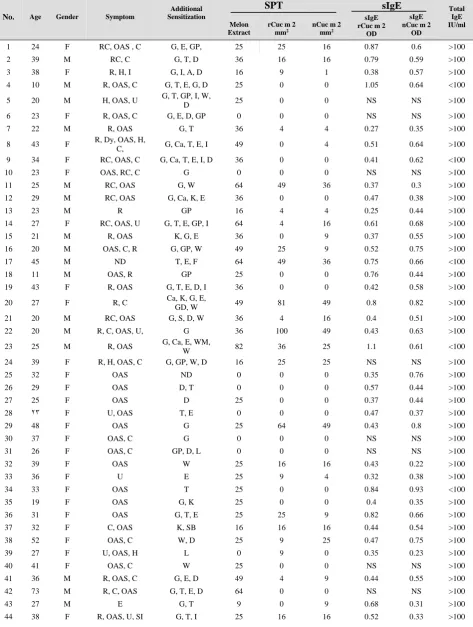
Table 1 shows patients’ profiles including ages, symptoms, additional sensitizations, SPT results to three kinds of melon allergenic extracts (total extract, nCuc m 2, rCuc m 2), total IgE, and specific IgE reactivity to nCuc m 2 and rCuc m 2 in ELISA.
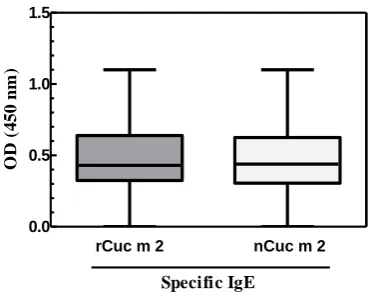
The IgE reactivity of the purified nCuc m 2 was similar to rCuc m 2 by ELISA, and no significant difference between the two was found by the Mann Whitney test (r = 0.73; Fig. 2). A significant correlation between nCuc m 2 and rCuc m 2 was shown by the
Spearman test (p<0.001, r= 0.81, Fig. 2).
Fig. 2. Comparison of average ODs of nCuc m 2 and rCuc m 2 by ELISA to assess specific IgE reactivity.
SPT was performed on all subjects using total extract, nCuc m 2, rCuc m 2, and negative and positive controls. The healthy non-atopic control group showed no allergic reactivity to common allergens in SPT while the atopic control group was sensitive to other allergens but not melon (Table 1). One-Way Anova test confirmed the similarities between reactivities of nCuc m 2 and rCuc m 2. The average wheal sizes caused by nCuc m 2 and rCuc m 2 were equal but the average wheal size caused by total extract was greater than those from either nCuc m 2 or rCuc m 2 (Fig. 3). The positive correlation between the wheal sizes elicited by nCuc m 2 and rCuc m 2 was significant (r= 0.67) (Fig. 3).
Fig. 3. Comparison of average wheal size by SPT with total extract, nCuc m 2, and rCuc m 2.
Discussion
Reliable approaches for diagnosis and treatment of allergic diseases are in high demand. For these approaches to be successful, allergens must be available in high quality and purity. Impurities in allergenic extracts can evoke false-positive results and adverse reactions, and mislead diagnoses (21-22). Molecular biology and improved purification techniques have made available many recombinant allergens(23) and to date, over 100 food allergens have been cloned and are available as recombinant allergens (18, 24-25).
Melon is a known cause of oral allergy and presently, at least 10 melon allergens with different molecular weights from 10 to 80 kDa have been identified. The major melon allergens are proteins of 14, 36, 54, and 67 kDa. The 14-kDa protein is a profilin known as Cuc m 2. Plant profilins are known pan-allergens involved in the cross-reactivities between pollens and plant foods (1, 5, 19, 26-27).
The most commonly-used technique to purify natural profilin is affinity chromatography with poly-L-proline (PLP). Some plant profilins have also been purified with this method (19, 28-30).
In this study, immuno-affinity chromatography with an anti-profilin monoclonal antibody was used to purify nCuc m 2 (20). rCuc m 2 was purified by metal affinity chromatography against the histidine tag in the recombinant protein.
This study demonstrated that rCuc m2 is as functional as the natural form and has acceptable efficacy for use in diagnostic methods such as SPT and ELISA.
The efficacy of recombinant allergens in allergy research, diagnostics, and therapy is well-established and deserves further study.
Acknowledgements
This study has been supported by the Research Council of Mashhad University of Medical Sciences (MUMS), Mashhad, Iran and hereby we acknowledge all persons attending in this research.
rCuc m 2 nCuc m 2 0.0
0.5 1.0 1.5
Specific IgE
O
D
(
4
50 n
m
)
Total Extract rCuc m 2 nCuc m 2 0
50 100 150
Skin Prick Test
W
h
e
a
l
si
ze
(
m
m
2
)
Rep. Biochem. Mol. Biol, Vol. 1, No. 1, Oct 2012 18
Table 1. patients’ profiles including ages, symptoms, additional sensitizations, SPT results to three kinds of melon allergenic extracts
No. Age Gender Symptom
Additional Sensitization
SPT
sIgE rCuc m 2
OD
sIgE nCuc m 2
OD
Total IgE IU/ml Melon
Extract
rCuc m 2 mm2
nCuc m 2 mm2
1 24 F RC, OAS , C G, E, GP, 25 25 16 0.87 0.6 >100
2 39 M RC, C G, T, D 36 16 16 0.79 0.59 >100
3 38 F R, H, I G, I, A, D 16 9 1 0.38 0.57 >100
4 10 M R, OAS, C G, T, E, G, D 25 0 0 1.05 0.64 <100
5 20 M H, OAS, U G, T, GP, I, W, D 25 0 0 NS NS >100
6 23 F R, OAS, C G, E, D, GP 0 0 0 NS NS >100
7 22 M R, OAS G, T 36 4 4 0.27 0.35 >100
8 43 F R, Dy, OAS, H,
C, G, Ca, T, E, I 49 0 4 0.51 0.64 >100
9 34 F RC, OAS, C G, Ca, T, E, I, D 36 0 0 0.41 0.62 <100
10 23 F OAS, RC, C G 0 0 0 NS NS >100
11 25 M RC, OAS G, W 64 49 36 0.37 0.3 >100
12 29 M RC, OAS G, Ca, K, E 36 0 0 0.47 0.38 >100
13 23 M R GP 16 4 4 0.25 0.44 >100
14 27 F RC, OAS, U G, T, E, GP, I 64 4 16 0.61 0.68 >100
15 21 M R, OAS K, G, E 36 0 9 0.37 0.55 >100
16 20 M OAS, C, R G, GP, W 49 25 9 0.52 0.75 >100
17 45 M ND T, E, F 64 49 36 0.75 0.66 <100
18 11 M OAS, R GP 25 0 0 0.76 0.44 >100
19 43 F R, OAS G, T, E, D, I 36 0 0 0.42 0.58 >100
20 27 F R, C Ca, K, G, E,
GD, W 49 81 49 0.8 0.82 >100
21 20 M RC, OAS G, S, D, W 36 4 16 0.4 0.51 >100
22 20 M R, C, OAS, U, G 36 100 49 0.43 0.63 >100
23 25 M R, OAS G, Ca, E, WM,
W 82 36 25 1.1 0.61 <100
24 39 F R, H, OAS, C G, GP, W, D 16 25 25 NS NS >100
25 32 F OAS ND 0 0 0 0.35 0.76 >100
26 29 F OAS D, T 0 0 0 0.57 0.44 >100
27 25 F OAS D 25 0 0 0.37 0.44 >100
28 32 F U, OAS T, E 0 0 0 0.47 0.37 >100
29 48 F OAS G 25 64 49 0.43 0.8 >100
30 37 F OAS, C G 0 0 0 NS NS >100
31 26 F OAS, C GP, D, L 0 0 0 NS NS >100
32 39 F OAS W 25 16 16 0.43 0.22 >100
33 36 F U E 25 9 4 0.32 0.38 >100
34 33 F OAS T 25 0 0 0.84 0.93 <100
35 19 F OAS G, K 25 0 0 0.4 0.35 >100
36 31 F OAS G, T, E 25 25 9 0.82 0.66 >100
37 32 F C, OAS K, SB 16 16 16 0.44 0.54 >100
38 52 F OAS, C W, D 25 9 25 0.47 0.75 >100
39 27 F U, OAS, H L 0 9 0 0.35 0.23 >100
40 41 F OAS, C W 25 0 0 NS NS >100
41 36 M R, OAS, C G, E, D 49 4 9 0.44 0.55 >100
42 73 M R, C, OAS G, T, E, D 64 0 0 NS NS >100
43 27 M E G, T 9 0 9 0.68 0.31 >100
44 38 F R, OAS, U, SI G, T, I 25 16 16 0.52 0.33 >100
sIgE
C, cough; Dy, dyspnea; E, eczema; R, rhinitis; RC, rhinoconjunctivitis; SI, skin itching; U, urticaria; OAS, oral allergy syndrome (OAS; defined as the onset of immediate oral itching with or without angioedema of the lips and oral mucosa); ND, not determined, NS, Not Serum; S, Spice; F, Fig; G, Grape; Ca, Cantaloupe; T, Tomato; E, Egg Plant; Eg, Egg; GP, Grass Pollen; W, Weed Pollen; D, Dust Mite; A, Animal Dander; K, Kiwi; WM, Water Melon; I, Irritation; SB, Strawberry
References
1. Saxena RB. Botany, Taxonomy and Cytology of Crocus sativus series. Ayu. 2010 Jul;31(3):374-81.
2. Abdullaev FI. Biological effects of saffron. Biofactors. 1993 May;4(2):83-6.
3. Abdullaev FI. Inhibitory effect of crocetin on intracellular nucleic acid and protein synthesis in malignant cells. Toxicol Lett. 1994 Feb 1;70(2):243-51.
4. Fornasier VL, Protzner K, Zhang I, Mason L. The prognostic significance of histomorphometry and immunohistochemistry in giant cell tumors of bone. Hum Pathol. 1996 Aug;27(8):754-60.
5. Martinez-Tome M, Jimenez AM, Ruggieri S, Frega N, Strabbioli R, Murcia MA. Antioxidant properties of Mediterranean spices compared with common food additives. J Food Prot. 2001 Sep;64(9):1412-9.
Thatte U, Bagadey S, Dahanukar S. Modulation of programmed cell death by medicinal plants. Cell Mol Biol (Noisy-le-grand). 2000 Feb;46(1):199-214.
6. Nair SC, Pannikar B, Panikkar KR. Antitumour activity of saffron (Crocus sativus). Cancer Lett. 1991 May 1;57(2):109-14.
7. Varasteh A, Rahimzadeh M, Farid R. Determination of saffron (Crocus sativus) allergenicity. Iranian Journal of Basic Medical Sciences. 2000 Jun;3(6):33-7.
8. Farid R, Eskoi M, Varasteh A, Farid F. Allergy to Saffron (Crocus sativus). ACIN. 1994;Supplement 2:304.
9. Feo F, Martinez J, Martinez A, Galindo PA, Cruz A, Garcia R, et al. Occupational allergy in saffron workers. Allergy. 1997 Jun;52(6):633-41.
10. Fereidouni M, Sankian M, Varasteh AR. The prevalence of saffron pollen allergy in
45 32 F RC, OAS, C G, T, I 36 16 0 0.33 0.6 >100
46 28 F RC, OAS, C E, S, Eg, W, D 25 16 4 NS NS >100
47 27 F R, OAS D, W 64 9 16 0.77 1.1 >100
48 50 F R, OAS, U, C G 36 16 36 NS NS >100
49 46 F R, C ND 9 16 25 0.67 0.51 >100
50 18 M R, C D 9 0 0 0.36 0.35 >100
51 39 F OAS, C G, W, D 9 9 0 0.73 0.59 >100
52 50 F R, C G, D, I 25 9 9 0.45 0.38 >100
53 - F ND GP, D 25 16 4 0.35 0.44 >100
54 32 F Healthy - 0 0 0 <0.3 <0.3 <100
55 25 M Healthy - 0 0 0 <0.3 <0.3 <100
56 29 M Healthy - 0 0 0 <0.3 <0.3 <100
57 26 F Healthy - 0 0 0 <0.3 <0.3 <100
58 30 F Healthy - 0 0 0 <0.3 <0.3 <100
59 24 F Healthy - 0 0 0 <0.3 <0.3 >100
60 28 F Healthy - 0 0 0 <0.3 <0.3 >100
61 24 M Healthy - 0 0 0 <0.3 <0.3 <100
62 30 M Control G,T,S 0 0 0 <0.3 <0.3 >100
63 34 F Control G, T, E, W, Ca 3 0 0 <0.3 <0.3 >100
64 24 M Control K, SB 0 0 0 <0.3 <0.3 <100
65 28 F Control A, T, E 0 0 0 0.5 <0.3 >100
66 27 F Control S, W, WM 0 0 0 <0.3 <0.3 >100
67 30 F Control I, G, E 0 0 0 <0.3 <0.3 >100
68 26 F Control Eg, T, E 0 0 0 <0.3 <0.3 >100
69 28 M Control G 9 4 6 0.5 0.4 <100
Rep. Biochem. Mol. Biol, Vol. 1, No. 1, Oct 2012 20
saffron workers of Khorasan (Iran) in 2002. Journal of Kerman University of Medical Sciences,. 2005;12:7-13.
11. Varasteh AR, Kaghazian H, Tayebi D, Moghadam M, Sankian M. Immunoblot analysis of saffron pollen proteins recognized by human IgE antibodies. Iranian journal of Basic Medical Sciences. 2005;7:33-7.
12. Bradford M. A rapid and sensitive method for the quantification of microgram quantities of protein utilizing the principle of protein-day binding. Anal Biochem. 1976;72:248-54. 13. Laemmli UK. Cleavage of structural proteins during the assembly of the head of bacteriophage T4. Nature. 1970 Aug 15;227(5259):680-5.
14. Towbin H, Staehelin T, Gordon J. Electrophoretic transfer of proteins from polyacrylamide gels to nitrocellulose sheets: procedure and some applications. Proc Natl Acad Sci U S A. 1979 Sep;76(9):4350-4. 15. Asturias JA, Arilla MC, Gomez-Bayon N, Martinez J, Martinez A, Palacios R. Cloning and expression of the panallergen profilin and the major allergen (Ole e 1) from olive tree pollen. J Allergy Clin Immunol. 1997 Sep;100(3):365-72.
16. Barderas R, Villalba M, Lombardero M, Rodriguez R. Identification and characterization of Che a 1 allergen from Chenopodium album pollen. Int Arch Allergy Immunol. 2002 Jan;127(1):47-54.
17. Batanero E, Gonzalez De La Pena MA, Villalba M, Monsalve RI, Martin-Esteban M, Rodriguez R. Isolation, cDNA cloning and expression of Lig v 1, the major allergen from privet pollen. Clin Exp Allergy. 1996 Dec;26(12):1401-10.
18. Barderas R, Villalba M, Rodriguez R. Che a 1: recombinant expression, purification and correspondence to the natural form. Int Arch Allergy Immunol. 2004 Dec;135(4):284-92. 19. Pomes A, Vailes LD, Helm RM, Chapman MD. IgE reactivity of tandem repeats derived from cockroach allergen, Bla g 1. Eur J Biochem. 2002 Jun;269(12):3086-92.
20. Twell D, Wing R, Yamaguchi J, McCormick S. Isolation and expression of an anther-specific gene from tomato. Mol Gen Genet. 1989 Jun;217(2-3):240-5.
21. Villalba M, Batanero E, Lopez-Otin C, Sanchez LM, Monsalve RI, Gonzalez de la Pena MA, et al. The amino acid sequence of Ole e I, the major allergen from olive tree (Olea europaea) pollen. Eur J Biochem. 1993 Sep 15;216(3):863-9.
22. Hames BD, Rickwood D. Gel
electrophoresis of proteins. New York: Oxford, Tokyo: IRL Press; 1990.
23. Heiss S, Mahler V, Steiner R, Spitzauer S, Schweiger C, Kraft D, et al. Component-resolved diagnosis (CRD) of type I allergy with recombinant grass and tree pollen allergens by skin testing. J Invest Dermatol. 1999 Nov;113(5):830-7.
24. Hyde HA. Atmospheric pollen and spores in relation to allergy. I. Clin Allergy. 1972 Jun;2(2):153-79.
25. Solomon WR. Airborne pollen: a brief life.
J Allergy Clin Immunol. 2002
Jun;109(6):895-900.