DEMOGRAPHIC RESEARCH
VOLUME 40, ARTICLE 3, PAGES 49
,
60
PUBLISHED 16 JANUARY 2019
https://www.demographic-research.org/Volumes/Vol40/3/ DOI: 10.4054/DemRes.2019.40.3
Descriptive Finding
Stability and change in family time transfers and
workload inequality in Italian couples
Marina Zannella
Alessandra De Rose
© 2019 Marina Zannella & Alessandra De Rose.
This open-access work is published under the terms of the Creative Commons Attribution 3.0 Germany (CC BY 3.0 DE), which permits use, reproduction, and distribution in any medium, provided the original author(s) and source are given credit.
1 Introduction 50
2 Data and methods 51
3 Trends in unpaid work and time transfers 53
4 Workload inequality in couples 56
5 Concluding remarks 58
6 Acknowledgements 58
Demographic Research: Volume 40, Article 3
Descriptive Finding
Stability and change in family time transfers and workload
inequality in Italian couples
Marina Zannella1
Alessandra De Rose2
Abstract
OBJECTIVE
This article analyses changes from 2003 to 2014 in the magnitude and directions of family time (i.e., non-market) transfers and in the gender distribution of total work among Italian couples.
METHODS
The study draws on microdata from the 2003, 2009, and 2014 Italian Time Use Surveys. First, we follow the National Transfer Accounts methodology to estimate gender-specific age profiles of production and consumption of unpaid domestic work and of the related time transfers within families. Then, we focus on couples and build an indicator of workload inequality. Finally, we perform a multivariate statistical analysis to describe the characteristics of the partners associated with gender inequality in the division of work disfavouring women.
RESULTS
Female non-market work decreased by an average of 36 minutes per day during the 2003–2014 period. However, women continue to be net donors of time transfers within the family and to perform the bulk of the work within the couple. Households where both partners do not work in the market or where only the woman has a market job show the highest levels of inequality, with women contributing to about 70% of the couples’ total working time.
CONTRIBUTION
This study sheds light on the provision of informal welfare within Italian families by illustrating, with an age- and gender-specific focus, the recent evolution of time transfers. It also contributes to the literature on the gender division of work both by introducing a new indicator of the workload inequality between partners, and by providing further evidence of the persistency of gender asymmetries in Italian couples.
1. Introduction
Unpaid time for household production and servicing represents a relevant contribution of families and especially of women to welfare. A large body of time use literature has shown the existence of a significant gender gap in unpaid work, especially for couples with young children (Bianchi et al. 2000; Hook 2010; Anxo et al. 2011; Menniti et al. 2015). A recent branch of research has moved beyond the traditional analysis of gender differences in the use of time by estimating the consumption, in addition to the production, of unpaid work and allowing for measures of family time transfers (e.g., Zagheni and Zannella 2013; Hammer, Prskawetz, and Freund 2015). Those studies have shown the existence of large flows of time transferred from women to men during most of the lifecycle, although the magnitude of these transfers varies considerably across countries (Zagheni et al. 2015). The gender gap in domestic work is particularly relevant in Southern European countries, where a lack of social policies combines with traditional gender ideology to result in large-sized unpaid domestic servicing and informal care through the family, the responsibility for which falls disproportionately on women. A recent analysis in Spain showed that, despite rapid shifts toward dual-earner families in recent decades, Spanish women continue to provide considerably more time transfers and thus work longer total hours than men (Rentería et al. 2016). However, that study used a single year (2009) and does not allow for an evaluation of the temporal progression of gender differences in the use of time. Existing research presents evidence for a gradual convergence in levels of paid and unpaid work among men and women over time, but women still do the bulk of routine housework and caring (Kan, Sullivan, and Gershuny 2011).
Demographic Research: Volume 40, Article 3
2. Data and methods
The study builds on microdata from the Italian TUS for 2003, 2009, and 2014 (with sample sizes of 21,075/18,250/19,039 households and 55,773/44,606/44,866 individuals, respectively). In a first step, we use the National Transfer Accounts (NTA) methodological framework in order to estimate gender-specific age profiles of the production and consumption of unpaid domestic work and of the related time transfers (United Nations 2013; Donehower 2014). Productive household activities are identified by relying on the third-party criterion (Reid 1934), that is, whether it is possible to pay somebody else to perform the activity in the market. Then, gender-specific age profiles of time production can be directly calculated from the microdata as the average time devoted to each activity by age and gender. By contrast, time use surveys do not report any direct information on how unpaid domestic time produced within the family is consumed by its members. Time consumption is therefore estimated by assuming that all time produced within a family is consumed by its members and that time consumption varies with age but not with gender. Unpaid domestic activities fall into two main categories: general activities benefiting all members of the household (cleaning, cooking, etc.), and age-targeted activities benefiting specific groups, such as childcare and adult care. The consumption of domestic time for household j (Cj) is thus
expressed as a linear function of the number of household components (Nj) by their age
(x), with age limits (a and b) varying according to the nature of the activity considered:
∋ ( ∋ (
< √ < b a x jj x N x
C , (1)
where a = 0 and b = 90+ for general activities, a = 0 and b = 17 for childcare, and a = 18 and b = 90+ for adult care (Zagheni et al. 2015; Zannella 2017).
difference indicates a time deficit: consumption falls short of production and, hence, must be satisfied trough transfers.
In a second step, we focus on a subsample of 28,742 couples with partners aged 25 years and over and provide estimates of their total working time (including both paid and unpaid family work). We assume that equality in the distribution of the couple’s total workload is achieved when total work is symmetrically distributed between the partners (i.e., each partner performs 50% of the couple’s workload). We therefore calculate our indicator of the workload inequality within the couple (WIC) as follows:
= 100 ∙ . ∙ , (2)
where WTW and CTW are the total hours worked by the female partner and the couple, respectively. Theoretically, indicator values range from –50% to +50%. A value equal to zero indicates that the couple’s total work is equally distributed between genders, whereas positive indicator values mean that total work is disproportionately distributed towards women.
Demographic Research: Volume 40, Article 3
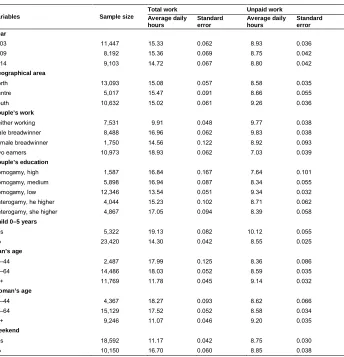
Table 1: Couples’ total and unpaid working time
Variables Sample size
Total work Unpaid work
Average daily hours Standard error Average daily hours Standard error Year
2003 11,447 15.33 0.062 8.93 0.036
2009 8,192 15.36 0.069 8.75 0.042
2014 9,103 14.72 0.067 8.80 0.042
Geographical area
North 13,093 15.08 0.057 8.58 0.035
Centre 5,017 15.47 0.091 8.66 0.055
South 10,632 15.02 0.061 9.26 0.036
Couple’s work
Neither working 7,531 9.91 0.048 9.77 0.038
Male breadwinner 8,488 16.96 0.062 9.83 0.038
Female breadwinner 1,750 14.56 0.122 8.92 0.093
Two earners 10,973 18.93 0.062 7.03 0.039
Couple’s education
Homogamy, high 1,587 16.84 0.167 7.64 0.101
Homogamy, medium 5,898 16.94 0.087 8.34 0.055
Homogamy, low 12,346 13.54 0.051 9.34 0.032
Heterogamy, he higher 4,044 15.23 0.102 8.71 0.062
Heterogamy, she higher 4,867 17.05 0.094 8.39 0.058
Child 0–5 years
Yes 5,322 19.13 0.082 10.12 0.055
No 23,420 14.30 0.042 8.55 0.025
Man’s age
25–44 2,487 17.99 0.125 8.36 0.086
45–64 14,486 18.03 0.052 8.59 0.035
65+ 11,769 11.78 0.045 9.14 0.032
Woman’s age
25–44 4,367 18.27 0.093 8.62 0.066
45–64 15,129 17.52 0.052 8.58 0.034
65+ 9,246 11.07 0.046 9.20 0.035
Weekend
Yes 18,592 11.17 0.042 8.75 0.030
No 10,150 16.70 0.060 8.85 0.038
3. Trends in unpaid work and time transfers
production curve changed, showing a more pronounced shape over time. An M-shaped age pattern of time allocated to household and family care, reflecting lifecycle events with an initial hump at childbearing ages and a second at retirement/grand-parenting ages, is a common finding in comparative studies of time use (Vargha, Gál, and Crosby-Nagy 2017; Zagheni et al. 2015). Our results for men are particularly relevant for childbearing ages, with the first hump being more clearly marked in 2014 compared to previous years. For instance, men aged 25 to 49 years increased their unpaid work by an average of 13 minutes per day from 1h 32min in 2009 to 1h 45min in 2014, whereas the levels of their unpaid work had slightly declined between 2003 and 2009. However, the upward trend in men’s unpaid work at childbearing ages may not solely be an effect of their greater paternal involvement; it can partly be explained as an indirect effect of the economic crisis (Hofferth and Goldscheider 2010). Indeed, Italian men were more likely to be unemployed after 2009 and thus to have more time to spend at home: according to Istat (2016), the average time devoted to paid work decreased by 19 minutes per day between 2009 and 2014, whereas it increased by 13 minutes per day during the previous period (2003–2009).
Demographic Research: Volume 40, Article 3
By contrast, women’s household production shows a decreasing trend and a flattening of the typical M-shape over time. On total, women reduced their non-market work by an average of 36 minutes per day during the considered period. The effects of childrearing were more evident in 2003 than 2014 with women aged 25–34 years devoting 53 minutes less to family work (passing from five to four daily hours, approximately). Previous research has highlighted the existence of relevant gender disparities in the levels of unpaid domestic work performed by male and female Italian children (Istat 2016; Zannella 2017). However, female time production begins to increase slightly later in 2014 than in previous years, indicating an attenuation of gender disparities in unpaid domestic work at young ages.
Figure 2: Per capita gender- and age-specific profiles of net family time transfers (2003, 2009, and 2014)
4. Workload inequality in couples
Demographic Research: Volume 40, Article 3
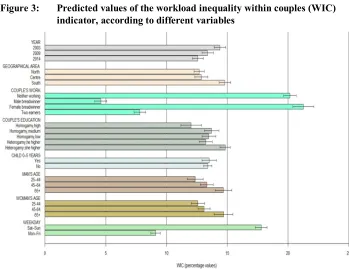
than in couples where both partners are not employed (e.g., retired couples) or where only she works. In these latter typologies, in fact, women contribute more than 70% of the total working hours. Looking at the partners’ educational pairings reveals that total work is the least equally distributed among couples where both partners have low education levels.
Figure 3: Predicted values of the workload inequality within couples (WIC) indicator, according to different variables
Note: Theoretically, indicator values range from –50% to +50%. A value of zero indicates that the couple’s total work is equally distributed between genders, whereas positive indicator values mean that total work is disproportionately distributed towards women. For more details on the calculation of the indicator, see section 2.
age and are particularly high at retirement ages, suggesting that men do not significantly increase their contribution to household chores and care after leaving the labour market. Finally, women’s share of the total workload is higher on weekdays, when they are more likely to combine work and family responsibilities. However, an unequal distribution of the couple’s work unfavourable to women is also found on weekends. All in all, our results document the existence of a robust and persistent workload inequality in Italian couples, which remains even after controlling for all relevant variables that are sources of heterogeneity.
5. Concluding remarks
In this paper, we estimated gender-specific age profiles of non-market production (i.e., time), consumption, and transfers in Italy for the years 2003, 2009, and 2014. Then, we focused on couples and provided a measure of the workload inequality between partners. Consistent with our expectations, the findings show a substantial decrease in women’s non-market work over the period under consideration. However, our results indicate levels of household production to be relatively stable for men, although with relevant differences among age groups. As a consequence, women are still net donors and men net beneficiaries of time transfers within the family. Similarly, the WIC indicator results demonstrate that – despite the existence of a narrowing in gender differences over time – total work continues to be unevenly distributed towards women in Italian couples. Workload inequality is a robust phenomenon; it holds after controlling for different characteristics of couples and of individual partners. Our findings are consistent with previous literature, which suggests that ‘iso-work’ (i.e., similar total hours worked by men and women) does not hold in Mediterranean countries characterised by stringent gender roles (Gimenez-Nadal and Sevilla 2014).
6. Acknowledgements
Demographic Research: Volume 40, Article 3
References
Anxo, D., Mencarini, L., Pailhé, A., Solaz, A., Tanturri, M.L., and Flood, L. (2011). Gender differences in time use over the life course in France, Italy, Sweden, and the US. Feminist Economics 17(3): 159–195. doi:10.1080/13545701.2011. 582822.
Bianchi, S.M., Milkie, M.A., Sayer, L.C., and Robinson, J.P. (2000). Is anyone doing the housework? Trends in the gender division of household labor. Social Forces 79(1): 191–228.doi:10.1093/sf/79.1.191.
Bloemen, H., Pasqua, S., and Stancanelli, E. (2010). An empirical analysis of the time allocation of Italian couples: Are Italian men irresponsive?Review of Economics
of the Household 8(3): 345–369.doi:10.1007/s11150-009-9083-4.
Checchi, D. and Leonardi, M. (2015).Labour market measures in Italy 2008–13: The
crisis and beyond. Geneva: International Labour Organization, Research
Department.
De Rose, A., Racioppi, F., and Zanatta, A.L. (2008). Italy: Delayed adaptation of social institutions to changes in family behaviour. Demographic Research 19(19): 665–704.doi:10.4054/DemRes.2008.19.19.
Donehower, G. (2014). Incorporating gender and time use into NTA: National Time Transfer Accounts methodology [electronic resource]. Berkeley: University of California, Department of Demography. http://www.ntaccounts.org/web/nta/ show/Gender%2c%20Time%20use.
Gimenez-Nadal, J.I. and Molina, J.A. (2014). Regional unemployment, gender, and time allocation of the unemployed. Review of Economics of the Household 12(1): 105–127.doi:10.1007/s11150-013-9186-9.
Gimenez-Nadal, J.I. and Sevilla, A. (2014). Total work time in Spain: Evidence from time diary data.Applied Economics 46(16): 1894–1909.doi:10.1080/00036846. 2014.887194.
Hammer, B., Prskawetz, A., and Freund, I. (2015). Production activities and economic dependency by age and gender in Europe: A cross-country comparison. The
Journal of the Economics of Ageing5: 86–97.doi:10.1016/j.jeoa.2014.09.007.
Hook J.L. (2010). Gender inequality in the welfare state: Sex segregation in housework, 1965–2003.American Journal of Sociology 115(5): 1480–1523.
Istat (2016).I tempi della vita quotidiana. Roma: Istat.
Kan, M.Y., Sullivan, O., and Gershuny, J. (2011). Gender convergence in domestic work: Discerning the effects of interactional and institutional barriers from large-scale data.Sociology 45(2): 234–251.
Menniti, A., Demurtas, P., De Rose, A., and Arima, S. (2015). Housework and childcare in Italy: A persistent case of gender inequality.Genus71(1): 79–108. OECD (2017). The pursuit of gender equality: An uphill battle. Paris: OECD
Publishing.
Reid, M. (1934).Economics of household production. New York: John Wiley.
Rentería, E., Scandurra, R., Souto, G., and Patxot, C. (2016). Intergenerational money and time transfers by gender in Spain: Who are the actual dependents?
Demographic Research 34(24): 689–704.doi:10.4054/DemRes.2016.34.24.
United Nations (2013).National Transfer Accounts manual: Measuring and analyzing
the generational economy. New York: United Nations.
Vargha, L., Gál, R.I., and Crosby-Nagy, M. (2017). Household production and consumption over the life cycle: National Time Transfer Accounts in 14 European countries. Demographic Research 36(32): 905–944. doi:10.4054/ DemRes.2017.36.32.
Zagheni, E. and Zannella, M. (2013). The life cycle dimension of time transfers in Europe. Demographic Research 29(35): 937–948. doi:10.4054/DemRes.2013. 29.35.
Zagheni, E., Zannella, M., Movsesyan, G., and Wagner, B. (2015). A comparative analysis of European time transfers between generations and genders. Netherlands: Springer Brief in Population Studies. doi:10.1007/978-94-017-9591-3.
Zannella, M. (2017). Age and gender in economic activities and transfers within and