I
IJJMMCCMM Original Article A
Auuttuummnn22001122,,VVooll11,,NNoo44
Evaluation of PKM2 and MAPK8IP2 polymorphism in
Ameloblastic Carcinoma: A retrospective quantitative study
Abbas Khodayari1, Seyyed Mohammad Hossein Ghaderian2, Mohammad Jafarian1, Alireza Jahangirnia3, Alireza Nayebi4, Fahimeh Akhlaghi1, Nasim Taghavi5, Reza Akbarzadeh Najar2, Sanaz Tabarestani2, Arash
Khojasteh1, Sarah Aghabozorg Afjeh2
1. Department of Oral and Maxillofacial Surgery, Dental Research Center, Shahid Beheshti University of Medical Sciences,
Tehran, Iran.
2. Department of Medical Genetics, Shahid Beheshti University of Medical Sciences, Tehran, Iran.
3. Department of Oral and Maxillofacial Surgery, Shahid Beheshti University of Medical Sciences, Tehran, Iran.
4. Department of Oral and Maxillofacial Surgery, Shahid Beheshti University of Medical Sciences, Tehran, Iran.
5. Department of oral and maxillofacial pathology, dental faculty, Shahid Beheshti university of medical science,
Tehran,Iran.
Ameloblastic carcinoma (AC) is a rare malignant epithelial odontogenic tumor that histologically retains the
features of ameloblastic differentiation and exhibits cytological features of malignancy in the primary or
recurrent tumor. It may develop within a preexisting ameloblastoma or arise de novo or from an odontogenic
cyst. Epidemiological evidence shows that human cancer is generally caused by genotoxic factors, genes
involved in the susceptibility of cancer, including those involved in metabolism or detoxification of genotoxic
environment and those controlling DNA replication. Nowadays, gene polymorphism has an important role in
development of malignant tumor .We report a case series study of ameloblastic carcinoma and ameloblastoma to
show the role of PKM2 and MAPK8IP2 polymorphisms in these tumors. The DNA was extracted separately
from specimens in paraffin sections of the tumor. Polymorphism of these genes was determined by PCR-RFLP
(Polymerase Chain Reaction-Restriction fragment length polymorphism) method. The allele distributions of all
samples were in Hardy-Weinberg equilibrium. The genotype and allele distribution in these genes were not
statistically different between patients and controls.
Key words: Ameloblastic carcinoma, PKM2, MAPK8IP2, polymorphism
Corresponding author: Department of Medical Genetics, Shahid Beheshti University of Medical Sciences, Tehran, Iran. Emli: [email protected]
meloblastomas are usually benign, locally
aggressive neoplasms derived from the
epithelial odontogenic tissues, which are part of the
tooth-forming apparatus (1). Malignant tumors of
ameloblastic origin are very rare, and appear in two
different scenarios: malignant ameloblastoma,
A
Submmited 8 February 2013; Accepted 3 March 2013
defined as a well-differentiated cytologicaly benign
odontogenic tumor that paradoxically metastasizes,
and ameloblastic carcinoma which refers to
cytologically malignant tumors that may or may not
metastasize (2, 3).
Ameloblastic carcinoma (AC) is a rare
malignant epithelial odontogenic tumor that
histologically retains the features of ameloblastic
differentiation and exhibits cytological features of
malignancy in the primary or recurrent tumor. It
may develop within a preexisting ameloblastoma or
arise de novo or from an odontogenic cyst (4-6).
Due to the relatively high incidence of
ameloblastoma and rarity of ameloblastic carcinoma,
the lack of a specific medical criteria to differentiate
the two from each other, and the malignancies side
effects for patients, finding effective genetic and
immunohistochemical factors for this malignancy, is
considered as a great advance in prevention and
treatment of the disease (7). Many researchers
believe that the accumulation of multiple genetic
defects is necessary for representing malignant
phenotypes (8).
Clinical studies have shown that individuals
who are at significantly increased genetic risk of
ameloblastic carcinoma can be identified through
cancer predisposition genetic testing. The ability to
identify high-risk individuals who may benefit from
cancer prevention and early cancer detection
strategies can improve their length and quality of
life. On the other hand, the lack of clinical methods
for identifying individuals with high risk of oral
cancer, and to answer the question in the case of
different responses of individuals to environmental
carcinogens and differences in genetic
predisposition, make importance of using genetic
tests for ameloblastic carcinoma more
under-standable (9, 10).
During the last few decades, extensive effort
has been invested in identifying sources of genetic
susceptibility to cancer. Both the International
Human Genome Sequencing Project and the
International HapMap Project have generated a
very large amount of data on the location, quantity,
type, and frequency of genetic variants in the
human genome. Facilitated by continuing
technological advances that allow faster and
cheaper genotyping results, a large and increasing
number of observational studies investigating the
association between variants in candidate genes and
cancer risk have emerged (11). Nowadays, gene
polymorphism has an important role in activating
metabolizing enzymes and development of
malignant tumor (Genetic polymorphism is defined
as variations in genome sequences that may be
beneficial or harmful).
Epidemiological evidence shows that human
cancer is generally caused by genotoxic factors,
genes involved in the susceptibility of cancer,
including those involved in metabolism or
detoxification of genotoxic environment and those
controlling DNA replication (12). Although the
molecular and genetic characteristics of
ameloblastoma are still poorly understood, the
cloning and characterization of expression of the
ameloblastin (AMBN) and amelogenin genes in
these tumors supports the hypothesis that
ameloblastomas arise from the dental lamina, the
outer enamel epithelium or the inner enamel
epithelium (13-15).
Studies show that mutations of multiple
genes in different pathways play an important role
in malignancies. In some researches a decrease of
expression of some genes, PKM2 and MAPK8IP2,
and hypermethylation of P53 in AC has been
reported (16, 17). So, it is likely that their lack of
activity is involved in the process of tumor
angiogenesis. PKM2 gene (Pyruvate kinase, muscle
2) is located on chromosome 15 (15q22). This gene
encodes a protein involved in glycolysis. The
encoded protein is a pyruvate kinase that catalyzes
the transfer of a phosphoryl group from
phosphoenolpyruvate to ADP, generating ATP and
pyruvate.
MAPK8IP2 gene (mitogen-activated protein
kinase 8 interacting protein 2) is located on
chromosome 22 (22q13.33). The protein encoded
by this gene is closely related to
MAPK8IP1/IB1/JIP-1, a scaffold protein that is
involved in the c-Jun amino-terminal kinase
signaling pathway. This pathway plays a role in
inflammatory signal transduction.
With the aim of finding new cancer genetic
predisposition factors, we selected these two genes
and evaluated their polymorphism in ameloblastic
carcinoma. According to a variety of amloblastoma
tumor and amloblastic carcinoma in terms of
pathology as well as the symptoms of this tumor, it
seems that the cellular and molecular processes
which contribute to its division could offer early
detection along with exclusive treatments
strategy (18-20).
Materials and Methods
Clinical and histologic information from
available documents in the archives of the
Department of Oral and Maxillofacial Pathology,
Taleghani Hospital and the Department of Oral and
Maxillofacial Pathology, Shahid Beheshti
University of Medical Sciences were reviewed. The
Iranian Center for Dental Research approved all
scientific and ethical issues for this study .We
investigated 18 samples consisting of 6 normal
follicles as controls, 6 samples of ameloblastoma
and 6 samples of ameloblastic carcinoma .The case
series study of ameloblastic carcinoma and
ameloblastoma was identified by clinical and
pathological findings. In these cases we also
investigated c.37G>A polymorphism in PKM2 and
the c.196C>T polymorphism in MAPK8IP2
polymorphism in these tumors. The DNA was
extracted separately from specimens in paraffin
sections of the tumor. Polymorphism of these genes
was determined by PCR-RFLP (Polymerase
Chain Reaction - Restriction fragment length
polymorphism) method (21).
PKM2 genotyping was carried out according to
Dall’Olio et al. method [6] based on the PKM2 gene
GenBank: AM182983.2 and AM182984.2 sequences.
The identified mutation was the transition G>A in the
position of 37. The gene sequence of the length 231 bp
was amplified. The thermal profile of PCR reaction
was following: initial denaturation at 95°C for 5
minutes, 35 cycles for 30 s at 95°C, 30 s at 65°C and
30 s at 72°C and the final extension at 72°C for 5
minutes. The obtained DNA sequence was subject to
digestion with restrictive enzyme ApoI (Fermentas)
for 3.5 h at 37°C (21). To evaluate c.196C>T
polymorphism in MAPK8IP2 gene, appropriate
restriction enzyme, EcoRI, was used. The gene
sequence of the length 210bp was amplified. Primers
sequences used for detection of MAPK8IP2 mutations
were 5'GCCAGCATCCTCTGAGTACC3' (Forward)
and 5'GTGGGCTGTTTCCTCTGG3' (Reverse) (22).
Results
To assess whether PKM2 and MAPK8IP2
polymorphisms are associated with ameloblastic
carcinoma, the patients with ameloblastic
carcinoma were selected and compared to control
individuals. The allele distributions of all samples
were in Hardy–Weinberg equilibrium. The
genotype and allele distribution in these genes were
not statistically different between patients and
controls. The presence of PKM2 and MAPK8IP2
gene expression were determined by PCR in
ameloblastoma and ameloblastic carcinoma
com-paring with normal follicle (controls).c.37G>A
polymorphism in PKM2 and the c.196C>T
polymorphism in MAPK8IP2 were not recognized
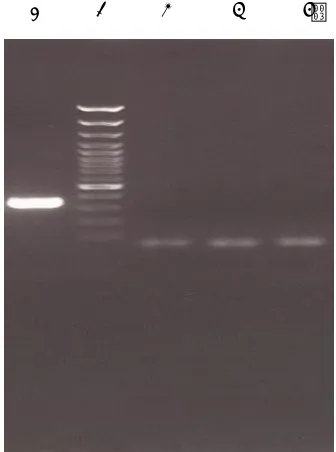
in all of the sample cases. Figures 1 and 2 represent
the electrophoretic pattern of PCR-RFLP evaluation
for PKM2 and MAPK8IP2 respectively.
Discussion
The rare and malignant type of ameloblastoma was mentiond in 1950 in oral pathology book of Dr. Thoma for the first time (18).
Fig 1. Gel electrophoresis for evaluation c.37G>A polymorphism in PKM2 gene. Lane 1: Undigested PCR product (231 bp); Lane 2: .molecular weight marker (50bp); Lane 3: wisdom tooth follicle; Lane 4: Ameloblastoma; Lane 5: Ameloblastic Carcinoma. There isnt any band for c.37G>A polymorphism in PKM2 gene in in the 3 studied samples.
Fig 2. Gel electrophoresis for evaluation c.196C>T polymorphism in MAPK8IP2 gene. Lane 1: molecular weight marker (50bp); Lane 2: wisdom tooth follicle; Lane 3: Ameloblastoma; Lane 4: Ameloblastic Carcinoma; Lane 5: Undigested PCR product (210bp). There isnt any band for c.196C>T polymorphism in the 3 studied samples.
1 2 3 4 5 1 2 3 4 5
Based on the 1971 WHO histological
classification, Ameloblastoma is a benign
Odonto-genic tumor (OTs) that is derived from epithelial,
ectomesenchymal and/or mesenchymal elements of
the tooth-forming apparatus. On the other hand,
regardless of metastatic status, ameloblastic
carcinoma is considered as a malignant neoplasm
(23). However based on Willis descriptions, both
lesions are malignant neoplasms which are
characterized by slow growth and local aggressive
specifications (24). In 2005, Who described
ameloblastoma as a benign tumor again and not a
malignant lesion (25).
According to our comprehensive studies, Dr.
Carcinci's study was the only and the first specific
study on ameloblastic carcinomas affected genes
(18). That was a case-control study and the report
was based on only one sample. Due to freshness of
the sample, RNA was extracted and cDNA was
synthesized. According to Dr. Carcinci's article and
due to PKM2 and MAPK8IP2 genes mutations
report in esophagus, breast and kidney cancers (24,
26, 27) and availability of the genes studying's kit,
genetic study for evaluation of PKM2 and
MAPK8IP2 polymorphisms in Ameloblastic
carcinoma was performed in our study. In 2004,
Koss performed study on the role of PKM 2 and its
expression in esophagus adenocarcinoma and
demonstrated its over expression (27).
In 2008, Shimada proposed the effect of two
PKM2 gene and PML tumor suppressor protein
breast cancer. Results of the study showed that
down-regulation of PKM2 under the effect of PML
and its loss of function causes cancer (28).
We didn’t find c.37G>A polymorphism and
the c.196C>T polymorphism in MAPK8IP2 in our
samples. Studies show that mutation isn’t the only
cause of cancer and other changes as alteration in
protein synthesizing stages may playarole in cancer.
For example defects in post modification of protein
can be the cause of cancer. So, although
Down-Regulation and Up-Down-Regulation of genes are
mentioned in Carcinci study as cause of
Amelo-blastic carcinoma, but our results (not finding any mutation or alteration in the exon) can't
prove lack of mutations, and on the other hand,
other polymorphisms, matter of our population and defects in post modification of protein can
be related to our negative results.
The techniques and the size of samples may also be changed to improve these
investigations. As the PCR-RFLP method has
been used in this study, we cannot exclude consequently any nucleotide changes outside the
recognition sequences of the restriction enzymes
used, in the corresponding genes. Therefore, we suggest sequencing of those genes to find any
SNPs or other changes in the genes.
Conflict of interest: none declared.
References
1. Yanatatsaneejit P, Boonsuwan T, Mutirangura A, et al.
XRCC1 gene polymorphisms and risk of ameloblastoma.
Arch Oral Biol 2012;pii: S0003-9969(12)00377-9.
2. Franca DC, Moreira JM, Jr., SM DEA, et al. Ameloblastic
carcinoma of the maxilla: A case report. Oncol Lett
2012;4:1297-300.
3. Yoon HJ, Jo BC, Shin WJ, et al. Comparative
immunohistochemical study of ameloblastoma and
ameloblastic carcinoma. Oral Surg Oral Med Oral Pathol
Oral Radiol Endod 2011;112:767-76.
4. Carinci F, Palmieri A, Delaiti G, et al. Expression profiling
of ameloblastic carcinoma. J Craniofac Surg 2004;15:264-9.
5. Casaroto AR, Toledo GL, Filho JL, et al. Ameloblastic
carcinoma, primary type: case report, immunohistochemical
analysis and literature review. Anticancer Res
2012;32:1515-25.
6. Pundir S, Saxena S, Rathod V, et al. Ameloblastic
carcinoma: Secondary dedifferentiated carcinoma of the
mandible: Report of a rare entity with a brief review. J Oral
Maxillofac Pathol 2011;15:201-4.
7. Golubovic M, Petrovic M, Jelovac DB, et al. Malignant
ameloblastoma metastasis to the neck - radiological and
pathohistological dilemma. Vojnosanit Pregl 2012;69:444-8.
8. Rocco JW, Sidransky D. P16 (MTS-1/CDKN2/INK4)in
cancer progression. Exp Cell Res 2001;264:42-55.
9. Ram H, Mohammad S, Husain N, et al. Ameloblastic
carcinoma. J Maxillofac Oral Surg 2010;9:415-9.
10. Makiguchi T, Yokoo S, Miyazaki H, et al. Treatment
strategy of a huge ameloblasticcarcinoma. J Craniofac Surg
2013;24:287-90.
11. Dong LM, Potter JD, White E, et al. Genetic
susceptibility to cancer: the role of polymorphisms in
candidate genes. JAMA 2008;299:2423-36.
12. Boffetta P, Islami F. The contribution of molecular
epidemiology to the identification of human carcinogens:
current status and future perspectives. Ann Oncol 2012.
13. Neville B, Damm DD ,Allen CM, et al. Oral and
Maxillofacial Pathology: Saunder; 2009.
14. DeVilliers P, Suggs C, Simmons D, et al. Microgenomics
of Ameloblastoma. J Dent Res 2011;90:463-9.
15. Tsujigiwa H, Nagatsuka H, Han PPG, M. Analysisof
amelogenin gene(AMGX, AMGY) expressionin
ameloblastoma. Oral Oncol 2005;41:843-50.
16. Nodit L, Barnes L, Childers E, et al. Allelic loss of tumor
suppressor genes in ameloblastic tumors. Modern Pathol
2004;17:1062-7.
17. Carinci F, Palmieri A, Delaiti G, et al. Expression
profiling of ameloblastic carcinoma. J Craniofac Surg
2004;15:264-9.
18. Barnes L, Eveson JW, Reichart P, et al. Pathology and
Genetics. Head and Neck Tumours Third Edition ed.
Tumours WCo, editor2005:p.288-290
19. Gomes CC, Duarte AP, Diniz MG, et al. Current concepts
of ameloblastoma pathogenesis. J Oral Pathol Med 2010;39:
585-91.
20. Sauk JJ, Nikitakis NG, Scheper MA. Are we on the brink
of nonsurgical treatment for ameloblastoma? Oral Surgery
Oral Medicine Oral Pathology Oral Radiology and
Endodontology 2010;110:68-78.
21. Marta B, Sławomir M. Polymorphism of LEP, PKM2 and
CSN3 genes in Polish cold-blooded horse population.
Roczniki Naukowe Polskiego Towarzystwa
Zootechnicznego2011;7:9-19.
22. Ensembl database (http: // uswest. ensembl. org/Hom
_sapiens /Gene /Splice ? g = ENSG00000008735; r= 22:
51039114- 51052409).
23. Jing W, Xuan M, Lin Y, et al. Odontogenic tumours: a
retrospective study of 1642 cases in a Chinese population. Int
J Oral Maxillofac Surg 2007;36:20-5.
24. Viswanathan M, Tsuchida N, Shanmugam G. Promoter
hypermethylation profile of tumor-associated genes p16, p15,
hMLH1, MGMT and E-cadherin in oral squamous cell
carcinoma. Int J Cancer 2003;105:41-6.
25. Barnes L, Eveson JW, Reichart P, et al. Pathology and
genetics of head and neck tumors. Third ed. tumors Whoco,
editor. Lyon,France: International Agency for Research on
Cancer IARC Press; 2005:p.283-314
26. Abiko Y, Nagayasu H, Takeshima M, et al. Ameloblastic
carcinoma ex ameloblastoma: report of a case-possible
involvement of CpG island hypermethylation of the p16 gene
in malignant transformation. Oral Surgery Oral Medicine
Oral Pathology Oral Radiology and Endodontology
2007;103:72-6.
27. Koss K, Harrison RF, Gregory J, et al. The metabolic
marker tumour pyruvate kinase type M2 (tumour M2-PK)
shows increased expression along the
metaplasia-dysplasia-adenocarcinoma sequence in Barrett's oesophagus. J Clin
Pathol 2004;57:1156-9.
28. Shimada N, Shinagawa T, Ishii S. Modulation of M2-type
pyruvate kinase activity by the cytoplasmic PML tumor
suppressor protein. Genes Cells 2008;13:245-54.