211
Original Article
The Effect of Breast Self Examination Educational
Program on the Knowledge and Performance of Women
in Yazd
Nooshin Yoshany1, Hamide Mihanpour2, Khair Mohammad Jadgal3, Maryam Dori4
1.
Social Determinants of Health Research Center, Shahid Sadoughi University of Medical Sciences,Yazd, Iran.
2.
Workplace & Occupational Health and Safety Research Center, Shahid Sadoughi University of Medical
SciencesYazd, Iran.
3.
Department of Health Education & Health Promotion, Shahid Sadoughi University of Medical SciencesYazd, Iran.
4.
Shahid Sadoughi hospital, Shahid Sadoughi University of Medical Sciences,Yazd, Iran.
5. Received: 2016/06/05 Accepted: 2016/07/24
Abstract
Introduction: Breast cancer is the most common cancer and one of the major causes of cancer deaths in women. Early diagnosis leads to significant reduction of mortality from breast cancer, in other words it can increase the lifespan of people with this cancer. This study aimed to determine the effect of education on knowledge and performance of 20-60 year old women in Yazd city about Breast Self Examination (BSE). Materials & Methods: In this study, 100 women aged from 20 to 60 years old who referred to Yazd health centers were selected. They were matched in terms of cultural, social, and economical aspects. In this quasi-experimental study, data was collected through administration of questionnaires before and after training in two stages. The collected information were then analyzed using the statistical software SPSS (version 18) by T-tests and ANOVA. The significance level was set at 0.05.
Results: The results of statistical analyses revealed a significant difference between participants' knowledge and performance scores before and after training (0.05> p). In this study, age, marital status, education level, history of breastfeeding, and its duration had a significant relationship with participants' knowledge; also, positive family history of breast cancer had a significant relationship with their performance (0.05> p). Between the subjects' performance was a significant difference in two groups with negative and positive family history of Brest cancer before and after two months of educational program. (0.05> p).
Conclusion: According to the achieved results and the positive impact of education on the increase of knowledge and performance, educational programs in the field of breast cancer and its screening methods are recommended to be held for all age groups. In order to promote women's health from puberty to menopause more attention should be paid to the follow-up and training.
Keywords: Education, Breast self examination, Knowledge, Performance.
Corresponding author:Tel: 09132513816 email: [email protected]
Introduction
Breast cancer is the most common cancer and
one of the major causes of cancer deaths in
women. It covers about one-third of all women
cancers and is the most common cause of
cancer death after lung cancer in women.
However, breast cancer has the highest
incidence among all cancers. According to the
World Health Organization in February 2009,
the annual breast cancer death is 519,000
people around the world [1]. According to the
American Statistics in 2008,a total number of
184450 (182460 women and 1990 men ) new
cases of breast cancer with death rates of about
40480 in women and 450 in men have
emerged[2]. During the past 50 years the
incidence of breast cancer in the US has
increased significantly. Almost one out of
every eight American women suffers from
breast cancer. Fortunately, the mortality rate
has decreased during1993 to1997which
reflects the increased success in early
diagnosis and treatment[3].
Breast cancer is the most common cause of
cancer death around the world [4], the second
common cancer in Iranian women [5], and a
common disease in the developed and
developing countries [6]. Breast cancer patients
in Iran are about 40000 people and annually
more than 7000 patients are added to this
number [7]. According to the previous studies,
by increasing public knowledge, early
diagnosis, and effective treatment, more than
50 % of cancer patients can have long lives.
Due to lack of training programs and facilities,
more than 30 to 80 % of cancers are not
detectable until advanced stages in the
developing countries, while in the
industrialized countries 50% of breast cancers
are diagnosed in the early stages. In order to
recognize breast cancer in asymptomatic
patients, America Cancer Society has
recommended the following screening
methods: 1- Monthly breast self-examination
from age 20 onwards. 2- Clinical breast
examination every 3 years among women in
the age range of 20-40 and older. 3-
Every-year mammography screening starting at the
age of 40-49[9].Among the diagnosis strategies,
breast self-examination isan easy way, without
complications, and free for all women [10].
Low level of women's knowledge about breast
cancer facts, lack of knowledge about Breast
Self Examination (BSE) and its method or
neglecting to do so, social poverty, late
appearing bothersome symptoms in breast
cancer such as skin ulceration and physician
carelessness, are among the main reasons for
late reference to physician when the cancer is
in its advanced stages Performing BSE by
women has an important effect on early
detection of breast cancer and reducing cancer
deaths [9]. BSE in premenopausal age should
be performed 5-7 days after menstruation
period monthly while it can be performed on a
certain day each month after menopause. This
method encourages patients to report any
abnormalities to doctor instantly. Evidences
showed that screening has a satisfactory effect
on cancer mortality [11]. If the disease is in its
early stages, 75 to 90 % of women will have a
215 healthy five-year life. If the detection is in the
second stage of disease, in which the cancer
has invaded to the lymph nodes, five-year
survival rate decreases to 16% [12]. Among the
methods of breast cancer screening, breast
self-examination is one of the main pillars, so
that America Cancer Society recommends
breast self-examination monthly and regularly
for women over 20 years as a healthy,
inexpensive, and non-invasive method to
predict breast cancer [13]. According to
previous studies, women's knowledge about
breast cancer symptoms and its screening
methods, particularly BSE is low and the
psychological and social factors such as cancer
fear, lack of enough time, and forgetfulness are
obstacles in this approach [12]. In order to have
an optimal BSE in terms of quality and
continuity, it is essential to use appropriate
methods of health education and health
promotion [14]. In this study the effect of
educational program on women's knowledge
and practice about breast self-examination is
investigated.
Materials and Methods
This quasi-experimental study was conducted
in the form of pretest –posttest on 90 women
aged between 20-60 years old in 1394, Yazd,
Iran. According to previous study [12], the
samples were selected based on test power
85%, confidence rate 95% and likeliness of
losing 100 women. Stratified sampling was
conducted and four health centers similar in
terms of social, economical, and cultural
aspects were selected among all Yazd health
centers. In the next stage, 25 women were
selected randomly from each center using the
Office Profile households covered by each
health center. Selection criteria for inclusion
were women aged between 20-60 years with
no chronic diseases, neurological disorders,
and impaired consciousness who have not
participated in training programs related to
BSE at least in the past 6 months. Exclusion
criteria included lack of desire to participate in
research or training, and an education degree
below diploma. All participants completed the
study and there were no cases of exclusion.
Data was then collected through a
questionnaire consisted of three parts: the first
part contained demographic in formation while
the second and third parts targeted at
examining participants' knowledge and
performance about breast self-examination.
Demographic information included individual
characteristics such as age, marital status, job,
education, family history of disease, as well as
reproductive and breastfeeding history. The
researcher made questionnaires consisting of
20 questions were administered to assess the
participants' knowledge about breast
self-examination.. In each question the correct
answer got one point while the wrong answer
and I do not know option received zero score.
Total scores ranged between 0-20 and higher
scores indicated better knowledge. In order to
investigate questions' validity, 12 faculty
members of Obstetrics, Midwifery, and Health
Department studied the questionnaire and after
revisions approved it. Further, reliability of the
questionnaire was confirmed by applying test
– retest method. Then, questionnaires were
completed by 10 women within a week and a
Cronbach alpha coefficient of0.78 was
confirmed.
BSE performance was studied through 18
questions dealing with women's breast
self-examination. An answer to each question
received a point while questions with no
answers got zero scores. Total scores ranged
between 0-18 and higher scores showed better
performance. Validity of performance
questions was also confirmed in the same way
as that of knowledge questionnaire; test - retest
method was conducted within a week on 10
people and the reliability of the questionnaire
with the Cronbach's alpha coefficient of 0.81
was confirmed.
In the next stage, participants were informed
about the purpose of study and written
informed consent was obtained from them.
Initially, demographic information
questionnaire and then the knowledge and
performance forms were completed by women
(pre-test). Afterwards, a training program on
the importance of breast cancer screening
methods and an education course on breast
self-examination were conducted by a surgeon
in three 60-minute sessions for women. Next,
two months after completion of the training
sessions, questionnaires were completed again
by the subjects. Data was then fed into the
statistical package SPSS (version 20) and
paired t-test, chi-square, and Pearson
correlation coefficient analytical processes
were conducted on them. A p value of less
than 0.05 was considered as the significance
level.
Results
A total of 100 subjects were selected;43% of
them were aged between30-40 years old while
8% were between 50-60 years old. The mean
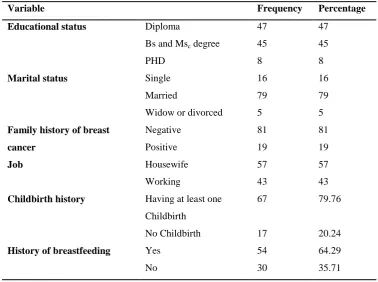
score of age was 43 ± 3/12. Most participants,
i.e., 79%, were married while only 16% of
them were single and 5% were divorced or
widowed. In terms of education, 47% of
women had diplomas, 45% had bachelor and
master's degree, and 8% had PhD degree. Most
participants (81%)reported no history of breast
cancer in their close relatives; however, 19%
of patients had a positive family history of
breast cancer in their first-degree relatives.
Before conductance of the training course 18%
of women had appropriate knowledge about
BSE, 21% had moderate knowledge, and
61%had low knowledge. After the training
course, 53% of subjects reached to the
statistically significant different level of
knowledge (P=0.032). The mean score of
performance before the educational program
was 7/24 ± 4/18while it reached to 12/06 ±
2/11 after the educational program, but there
was no statistically significant difference
between them (P =0.041). According to Tables
3 and 4 the results of the paired t-test showed
that the mean scores of subjects' knowledge
and performance on BSE was significantly
different in those who had positive family
history before and two months after the
educational program (p<0.05). But no
significant difference was observed in the
215 group of women with a negative family history
before and two months after the educational
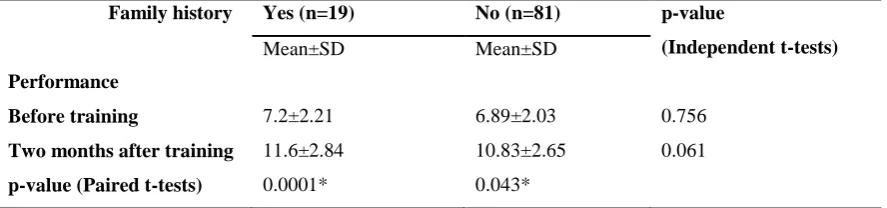
program (p>0.05).The performance mean
scores of women with negative family history
had no significant difference in the pre and
posttests’ results (p >0.05). Results of the
independent t-test showed that the mean scores
of knowledge and performance of women in
the pre-test had no significant difference in
both groups (p>0.05). After the intervention, a
significant difference was observed in the
knowledge of both groups (p<0.005) but the
score of performance was not significantly
different in both groups (p>0.05). In addition,
age, marital status, education level, history of
breastfeeding and its duration had a significant
difference with level of knowledge also, there
was a significant difference between positive
family history of breast cancer and
participants' performance (0.05> p).
Table 1: Frequency of demographic variables
Variable Frequency Percentage
Educational status Diploma 47 47
Bs and Msc degree 45 45
PHD 8 8
Marital status Single 16 16
Married 79 79
Widow or divorced 5 5
Family history of breast
cancer
Negative 81 81
Positive 19 19
Job Housewife 57 57
Working 43 43
Childbirth history Having at least one Childbirth
67 79.76
No Childbirth 17 20.24
History of breastfeeding Yes 54 64.29
No 30 35.71
Table 2: Mean and standard deviation of knowledge and performance on breast self-examination before and after the intervention
Before training After training p-value
Mean core of knowledge 11.08±3.16 15.73±1.97 0.032 Mean score of performance 7.24±4.18 12.06±2.11 0.041
Table 3: Comparison of women's knowledge about BSE before and after the intervention in family history Family history
Knowledge
Yes (n=19) No (n=81) p-value
(Independent t-tests)
Mean±SD Mean±SD
Before training 10.36±2.62 8.95±2.88 0.674
Two months after training 15.08±3.97 9.32±2.69 0.0001*
p-value(Paired t-tests) 0.0001* 0.821
*
Significant level of 0.05
Table 4: Comparison of the women's performance on BSE before and after the intervention in family history Family history
Performance
Yes (n=19) No (n=81) p-value
(Independent t-tests)
Mean±SD Mean±SD
Before training 7.2±2.21 6.89±2.03 0.756
Two months after training 11.6±2.84 10.83±2.65 0.061 p-value (Paired t-tests) 0.0001* 0.043*
*
Significant level of 0.05
Discussion
In this study mean score of age was 43± 3.12
years showing that women in this age range
can be a target group for cancer prevention
programs. The average age of participants in
Mahmoudi et al. study was 28.2± 7.2 [15].
Since among screening programs, breast
self-examination is highly efficient method for
young people [16] and also because Canadian
National Breast Screening Study-2 (CNBSS2)
reported that in countries such as Iran, breast
cancer is a growing problem, learning how to
perform BSE and knowing about breast cancer
risk factors can be a preventive program for
breast cancer [17]. The results showed that 19%
of participants reported a positive family
history of breast cancer which is a high rate
[18]
. According to the result of this study, after
attending the training course knowledge and
performance of women with positive family
history were higher than those of participants
with negative family history that could
indicate their concern about the risk of this
disease. Results of the women study in Turkey
showed that subjects with positive family
history of cancer are almost 12 times more
likely to have BSE than the others [19].In the
current study, a significant relationship was
found between level of education and
knowledge about BSE, which is inconsistent
with findings of the research conducted in
2009by Mahmoudi et al. as well as Simi et
al.(2009),study performed in Shiraz. But these
findings are in the same line with the research
conducted by Avci (2007), in Turkey [19]. Anna
M Miller et al. in their study concluded that
with increasing levels of education to diploma
level, women's resistance to perform breast
cancer screening methods and BSE decreased,
217 but women with a college education are less
likely to perform these examinations[20].In the
present study, conduction of an educational
course about breast self-examination could
significantly increase knowledge and
performance scores of participants. This
finding is in consistence with the results
achieved by firoozeh et al.(2011) [21].
Given the high incidence of breast cancer
among women and the need for better
diagnosis of the disease, these findings suggest
that special attention should be paid to
educational programs for early detection.. Low
level of women's awareness about breast
cancer facts, lack of knowledge about BSE
and its performance, social poverty, late
appearing breast cancer bothersome symptoms
such as skin ulceration, and physicians'
carelessness are among the reasons of late
diagnosis of breast cancer. Performing BSE by
women could have important effects on early
detection of breast cancer and mortality
reduction [9, 22].
In this study, a significant relationship was
found between participants' jobs on the one
hand and the knowledge and performance on
the other hand in the field of BSE. However,
no significant relationship was found between
marital status and the subjects' knowledge and
performance; these results are consistent with
findings of Shokranyan and Karimi [9, 22]. The
significant increase in women's knowledge and
performance represents a positive impact for
education which is according to the results
reported by Karimiet al. (2005),in which the
awareness and knowledge increased 59.1%
and 57.1%, respectively after education[9].In
Akhtari-Zavare et al. study, majority of
participants (97%) reported that they had
heard about breast cancer but only 26% of
them performed BSE [23] and also reported
97% of the participants knew about BSE, only
36.7% performed BSE and among those who
performed BSE, they did it occasionally (50,
57.5%) [24]. Similarly, in another study
conducted in Turkey it was reported than less
than half of the contributors performed BSE
while a few of them did it regularly [25]. All
these studies showed that Asian women have
low to moderate knowledge with poor to
moderate BSE performance.
Conclusion
According to the results, we can plan
Extensive training courses to detect problems
timely and prevent disease development.
Though, breast cancer is the second most
common cancer in Iranian women, but there is
no systematic plan for prevention of this
disease in Iran. Awareness and screening
behaviors among Iranian women is low, so
conducting researches to study the role of
educational plans and establishing intervention
training centers to promote public awareness
are suggested.
Acknowledgement
The authors thank all those who have
cooperated in this research, staffs of Shahid
Sadoughi Health Department of Medical
Sciences, and health centers' personnel for
their kind participation.
References
1. Tazhibi M, Babazadeh SH, Fazeli Z, et al. The study of age trend of breast cancer patients referred to radiotherapy and oncology department of Isfahan hospitals after screening and awareness. Iranian Journal of Breast Disease. 2011; 4(3) :47-51[Persian]
2. Shirazi FHS. Breast cancer. Tehran: nezame parastari; 1389. [Persian]
3. Novak E, Berek JS. Berek & Novak's gynecology: Lippincott Williams & Wilkins; 2007.
4. Demirkiran F, Balkaya NA, Memis S, et al. How do nurses and teachers perform breast self-examination: are they reliable sources of information? BMC Public Health. 2007;7(5):96.
5. Harirchi I, Karbakhsh M, Kashefi A, et al. Breast cancer in Iran: results of a multi-center study. Asian Pacific Journal of Cancer Prevention. 2004;5(1):24-7.
6. Dündar P, Özmen D, Öztürk B, et al. The knowledge and attitudes of breast self-examination and mammography in a group of women in a rural area in western Turkey. BMC cancer. 2006;6(1):1.
7. Biglu MH. Breast Cancer inIran: the trend of Iranian researchers’ studies in MEDLINE database. Basic & Clinical Cancer Research. 2014;6(1):22-32.
8. Koroltchouk V, Stanley K, Stjernswärd J. The control of breast cancer a World Health Organization perspective. Cancer. 1990;65(12);2803-2810
9. Karimi H, Sam S. Effect of breast self-examination (BSE) education on increasing women’s knowledge and practice, Ramsar. Journal of Babol University of Medical Sciences. 2005;7(3):61-8.[Persian]
10. Bibb SC. Access and late-stage diagnosis of breast cancer in the military health system. Military medicine. 2000;165(8):585.
11. Isara A, Ojedokun C. Knowledge of breast cancer and practice of breast self examination among female senior secondary school students in Abuja, Nigeria. Journal of preventive medicine and hygiene. 2011;52(4);186-190.
12. Sadeghnezhad F, Niknami S, Ghaffari M. Effect of health education methods on promoting breast self examination (BSE). Journal of Birjand University of Medical Sciences. 2009;15(4):38-48. [Persian]
13 Didarloo A, Pourali R, Gharaaghaji R, et al. Comparing The Effect Of Three Health Education Methods On The Knowledge Of Health Volunteers Regarding Breast Self-Examination. Journal Of Urmia Nursing And Midwifery Faculty. 2014;12(2):0[Persian].
14. Gorman C. The search for smaller tumors .Breast-cancer studies could lead to better tests and earlier detection. Time. 2000;155(26):50 -.
15. Mahmood A, Ramazani A. Study of knowledge, attitude, and practice of presenting women to Zabol health centers with regard to breast self examination by Using health belief model (in 2009). Modern Care Journal. 2011;8(2):65-72. [Persian]
16. Maurer F. A peer education model for teaching breast self-examination to undergraduate college women. Cancer nursing. 1997;20(1):49-63.
17. Miller AB, To T, Baines CJ, et al. Canadian National Breast Screening Study-2: 13-year results of a randomized trial in women aged 50–59 years. Journal of the National Cancer Institute. 2000;92(18):1490-9. 18. Jarvandi S, Montazeri A, Harirchi I, et al. Beliefs and behaviours of Iranian teachers toward early detection
of breast cancer and breast self-examination. Public Health. 2002;116(4):245-9.
219
19. Avci IA. Factors associated with breast self-examination practices and beliefs in female workers at a Muslim community. European Journalof Oncology Nursing. 2008;12(2):127-33.
20. Miller AM, Champion VL. Attitudes about breast cancer and mammography: racial, income, and educational differences. Women & Health. 1997;26(1):41-63.
21. Firoozeh F, Tabeshian T, Karimabadeh N, et al. The Effect of Instruction on Students’ Knowledge and Attitude towards Breast Self-Examination. Qom Univ Med Sci J . 2011; 4 (4) :21-2. [Persian]
22. Shokraniyan N. Knowledge and practice of female teachers in early detection of breast cancer in the city of Lar. Hormozgan Medical Journal.1999.3(4):5-9. [Persian]
23. Akhtari-Zavare M, Ghanbari-Baghestan A, Latiff LA, et al. Knowledge of breast cancer and breast self-examination practice among Iranian women in Hamedan, Iran. Asian Pacific Journal of Cancer Prevention. 2014;15(16):6531-4.
24. Akhtari-Zavare M, Juni MH, Said SM, et al. Beliefs and behavior of Malaysia undergraduate female students in a public university toward breast self-examination practice. Asian Pacific Journal of Cancer Prevention. 2013;14(1):57-61.
25. Andsoy II, Gul A. Breast, cervix and colorectal cancer knowledge among nurses in Turkey. Asian Pacific journal of cancer prevention: Asian Pacific Journal of Cancer Prevention. 2013;15(5):2267-72.