IJBCP
International Journal of Basic & Clinical Pharmacology
Research Article
Knowledge, attitude and practices of antibiotic usage and
resistance among the second year MBBS Students
Shweta Sharma*, Dhanya Jayakumar, Dhanya S. Palappallil,
Kala P. Kesavan
INTRODUCTION
Antimicrobial resistance (AMR) is an urgent and serious global health problem, demanding considerable attention from health care professionals all over the world. The major chunk of the problem persists in the developing countries. India tops in the irrational and indiscriminate use of antimicrobials.1 Being the country with high infectious disease burden antibiotics are the most widely and frequently prescribed drugs accounting for the alarming increase in AMR.2 The irrational prescription practices by clinicians are mainly governed by the “more drug better doctor” beliefs of patients. Free unchecked
over the counter (OTC) availability of antibiotics for human, animal and industrial consumption, self-medication, lack of knowledge, unjustified demand for antibiotics prescription and unawareness regarding antibiotic resistance are other factors that add up to the current degrading situation.
To curb this emerging horizon of AMR a national antibiotic policy was developed, national surveillance database for antibiotic use was established and national centre for disease control (NCDC) is designated as the focal point for AMR in the country.3,4 Though these well-structured interventional strategies are still in infancy, it ABSTRACT
Background: Social aspect of antibiotic management forms a significant way to overcome the rapidly intensifying problem of antibiotic resistance. Knowledge helps in spreading awareness and understanding while attitude and practices influences health related behaviour. Medical students should not only be made aware of the current emerging health issues but also be directed towards rational antibiotics prescribing behaviour as future medical practitioners. Therefore, present study was undertaken to assess the existing knowledge, attitude and practices (KAP) related to antibiotic usage and resistance among second year (fourth semester) MBBS students.
Methods: This was a cross-sectional, questionnaire based study conducted in department of pharmacology of a government medical college in Kerala, India. Questionnaire was distributed among a batch of 120 second year MBBS students after one of the pharmacology lecture session. Attitude and Practices related questions were assessed using Likert scale. Data was entered in excel and analysed using descriptive statistics of SPSS to generate frequency and percentage.
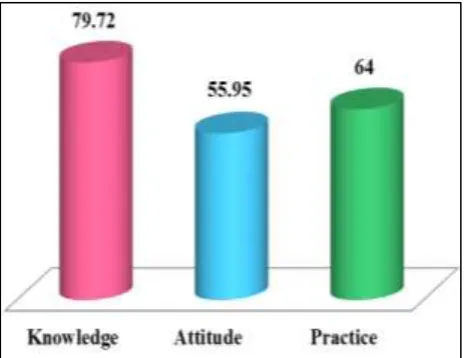
Results: 91.6% (110) were considered valid for analysis. Mean age was 21±1 years. Students had fair knowledge regarding antibiotics usage and resistance with mean correct response 79.72±25.37%. Mean correct responses of attitude and practices related questions were found to be 55.95±25.63% and 64±13.79% respectively.
Conclusions: Most of the students were aware of the antibiotic resistance and its consequences. However, their attitude and practices were found to be a matter of great concern. An educational intervention can be introduced to bring about behaviour changes regarding rational antibiotics prescribing among them.
Keywords: Antibiotic resistance, Rational drug use, KAP, Undergraduate medical student
DOI: http://dx.doi.org/10.18203/2319-2003.ijbcp20161542
Department of Pharmacology, Govt. T. D. Medical College, Alappuzha, Kerala, India
Received: 14 March 2016
Accepted: 15 April 2016
*Correspondence to:
Dr. Shweta Sharma, Email: shwetagmc05 @gmail.com
has started yielding positive changes at national and community level. However, something more specific and directed needs to be done at individual level that influences health related behaviour.
While knowledge plays a significant role in providing an insight about the problems faced, it is the beliefs and attitude that matters most in directing the desired behavioural change. Ultimate aim of all these interventions is to bring out attitude and behavioural changes at the very grass-root level. A strong foundation is of utmost importance for a durable construction hence we need to strengthen the base of the health care system by nipping the problem of resistance in the bud itself. Therefore, the present study was undertaken to assess the existing knowledge, attitude and practices of second year (fourth semester) MBBS students on antibiotics.
METHODS
This was a cross-sectional, questionnaire based study conducted in the department of pharmacology of a government medical college in Kerala, India.
Approval was obtained from the institutional research committee and ethics committee. The study period was for one month September 2015. 120 fourth semester MBBS students, who had not received any beforehand teaching or briefing on antibiotics in any of their second year subject classes, formed the sample population. The questionnaire used was developed by modifying the ones obtained after literature review of similar studies.5,6
It was scrutinized by subject experts for its validity and relevance. It consisted of total 35 questions divided in five parts: first-demography; second-knowledge about antibiotic use and AMR as true/false response; third- participant‟s attitude on antibiotic abuse and its influences recorded on five point Likert scale ranging from strongly agree to strongly disagree; fourth self-reported practices with regard to their antibiotic usage recorded using Likert scale ranging from always to never; fifth suggestions for feasible solutions to curb AMR.
Informed consent was obtained from the participants. Questionnaire was distributed after a pharmacology lecture session which was unrelated to antibiotics and 15 minutes was allotted to complete the questionnaire anonymously. Responses were collected followed by a 20 minutes discussion session with students on most suitable answers to the given questionnaire.
Data was entered in excel and analysed using descriptive statistics of SPSS (statistical package for the social sciences) version 16. To simplify the analysis, strongly agree/agree/usually were considered „positive‟; strongly disagree/disagree/never as „negative‟ and neutral/sometimes as „uncertain‟. The correctness of the response varied according to the question.
RESULTS
[image:2.595.312.546.165.320.2]The response rate was 100% (120), however only 91.6% were valid for analysis (≥80% complete). The age range was 19-28 years with mean age of 21±1 years. Female (58.18 %) predominance was found over males (26.36%) with male: female ratio as 1:2.2.
Figure 1: Participant’s knowledge on antibiotic use and resistance.
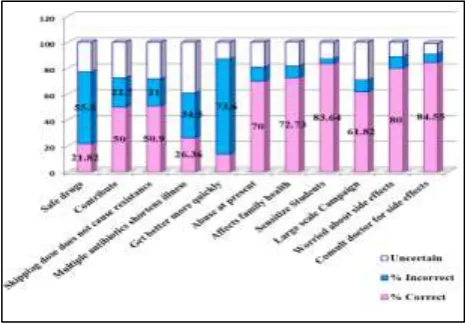
As shown in (Figure 1), students had fair knowledge on antibiotics and issue of AMR. One question tested the ability of students to identify the antibiotics among a group of drugs. All of them identified amoxicillin correctly, 99.1% tetracycline and 95.45% vancomycin. Correct response regarding amoxapine (antipsychotic) and terbinafine (antifungal) was found to be 41.8% and 47.27% respectively.
Figure 2: Attitude of participant’s regarding antibiotic usage and resistance.
[image:2.595.312.545.471.633.2]majority of the students held right attitude towards other concerning areas like the side effects of antibiotics and its management by the treating physician; antibiotic abuse, need for sensitization of students and organizing large scale campaigns.
Self-reported practices among students regarding antibiotics were found to be somewhat satisfactory
[image:3.595.46.551.215.403.2]although not completely convincing as shown in (Table 1). It was satisfying to observe that more than 95% completed the full course of the treatment. Majority of students believed in consulting doctor before starting antibiotics. Almost all of them always check expiry date before using it. However, there were few students who find it normal to ask doctor to prescribe antibiotics for them when they catch common cold or cough.
Table 1: Practices regarding antibiotics usage.
Questions Always/usually Sometimes Never
The Doctor prescribes a course of antibiotic for you. After taking 2-3 doses you start feeling better.
Do you stop taking the further treatment? 24 (21.8%) 25 (22.7%) 61 (55.5%) Do you save the remaining antibiotics for the next time you get
sick?
18 (16.3%) 35 (31.8%) 57 (51.8%)
Do you discard the remaining, leftover medication? 28 (25.4%) 40 (36.4%) 41 (37.3%) Do you give the leftover antibiotics to your friend/roommate if
they get sick?
37 (33.7%) 29 (26.4%) 44 (40%)
Do you complete the full course of treatment? 75 (68.2%) 30 (27.3%) 5 (4.5%) Do you consult a doctor before starting antibiotics? 88 (80%) 17 (15.5%) 4 (3.6%) Do you check the expiry date of the antibiotic before using it? 100(90.9%) 5 (4.5%) 3 (2.7%) Do you prefer to take an antibiotic for cough and sore throat? 45 (40.9%) 50 (45.5%) 15 (13.6%) Will you ask the doctor to prescribe antibiotics for you when you
catch common cold?
[image:3.595.52.285.436.615.2]11 (10%) 28 (25.5%) 71 (64.5%)
Figure 3: Mean correct responses on knowledge, attitude and practices of study participants.
[image:3.595.312.549.539.712.2]Highest mean correct response was seen for questions based on knowledge (79.72±25.37%) as depicted in (Figure 3).
Suggestions from students
Majority of the participants suggested judicious use of antibiotics as the most important step in curbing the resistance as illustrated in (Figure 4). Various other
approaches were to complete full antibiotic course, to consult doctor prior to their use, purchase drug with proper prescription, to perform culture sensitivity testing before prescribing antibiotics and to spread awareness. But again, there were a few students who were either clueless regarding possible solution or suggested ideas like development of new drugs and combined antibiotic therapy.
DISCUSSION
This study surveyed the knowledge, attitude and practice towards antibiotic use and AMR in fourth semester medical undergraduates. The fair knowledge on antibiotic use and resistance, the lackadaisical attitude and passable self-reported practice point towards the urgent need for educational interventions and campaigns.
All the participants had heard of antibiotics and the related resistance problem. More than 95% were well aware of the fact that antibiotics cure bacterial infections and AMR is a serious global public health issue which is mainly caused by its indiscriminate use. Similar responses were obtained in previous studies done worldwide in medical students.5-10 However, there were certain areas where their knowledge was found to be relatively poor. 39.1% felt that newer and costly drugs have got better efficacy. 60% believed that antibiotics can speed up recovery from common cold and cough. 28.2% thought that antibiotics can cure even viral infections.
This is in line with a study in which more than 60% believed that antibiotics should be prescribed for common cold and influenza and in contrast to study by Mahajan et al, where the majority of participants gave thumbs down for antibiotic use in viral illness.6,11 Newer and costlier drugs were thought to be better by only 39.1% whereas in another study less than 20% agreed to the statement.10
The nonchalant attitude of the participants were evident when three quarters considered antibiotics to be wonder drugs that hasten recovery from illness and more than half considered them to be safe drugs. This is comparable to a study in South India where 60% presumed that antibiotics provide quick relief and contrast to a study done in central India were more than 81% disagreed to the statement that injudicious use of antimicrobials shortens the illness duration.6,8 Antibiotics should be used only for bacterial infections and it doesn‟t hasten the recovery from all kinds of illness. Though antibiotics are generally safe drugs it should be always remembered that use of every drug carries a risk of adverse drug reaction which might vary from person to person.
Despite the insouciant attitude of the participants the self-reported practices with regard to use of antibiotics were appreciable. Majority of the participants completed the full course of antibiotics which is in congruence with other studies.6,8,10 The need to consult doctors for mild bacterial illness has been shown to be considered „not essential‟ as there is increased unrestricted availability of antibiotics as OTC drugs without prescriptions.12 Previous studies have shown high rates of self-medication with antibiotics.10,13 However in this study majority of the participants consulted doctor for treatment of bacterial illness and was in the habit of checking the expiry dates which is in line with other studies.5,6,8
Less than a quarter opined that they will stop the antibiotic usage if they felt better after 2-3 doses, would save it for the next time or pass the leftovers to their friends (33.7%) should they fall ill. These are incorrect practices that can further the problem of AMR. The left over antibiotic might not be the right antibiotic for the next illness, its expiry date might have passed and hence ineffective, or it will be only an incomplete course that isn‟t enough to treat a current infection.
The participants suggested a vast variety of plan of actions to curb AMR. Majority of the participants suggested judicious use of antibiotics as the most important step in curbing the resistance. The other suggestions to be handled by the prescribers were to perform culture sensitivity testing before prescribing antibiotics and to spread awareness regarding AMR. The clinical effectiveness of antibiotics has been linked to its correct use by physicians, patients and retailers.6 The role of prescribers in the battle against AMR is important. They should indulge in rational, judicious and safe prescribing behaviour with an equal attempt to educate their patients and future health care workers. Integration of antimicrobial prescribing teaching in the pharmacology lectures with that of other disciplines like microbiology will give a better idea of the spectrum of the drugs and hence a better choice of the drugs.
There should be discussion of patient oriented problem solving exercises which illustrate the occurrence and harmful effects of AMR. Utilisation of such case vignettes with an attempt to teach principles of protocol for antibiotic use in health care facilities will improve the effectiveness of the educational interventions.13,14 These strategies should attempt to influence the students in a positive way encouraging the right attitude and behaviour apart from instilling sound knowledge.
Various other approaches suggestions to be followed by each and every individual were to complete full antibiotic course, to consult doctor prior to their use and to purchase drug with proper prescription. Some suggested ideas like development of new drugs. The research for novel antibiotics has seen minimal success with less than ten in market since 1960s, less than twenty in the late-stage development.16 This decrease in antibiotic research and development is owed to several factors like economic disincentives, confounding of measurable benefits and difficulty in finding patients with infections caused by microbes of interest.16 New research into effective antibiotic regimens has to be encouraged. There were a few students who were clueless regarding possible solutions.
CONCLUSION
This study provides an important insight regarding the knowledge, attitudes and practices regarding antibiotic resistance and usage among the future doctors. AMR is an epidemic that should be fought by everyone the prescribers, the patients and the regulators. Adoption of appropriate educational interventions and strategies is the key that can unlock the initial step to curb the alarming increase in resistance.
ACKNOWLEDGEMENTS
The authors express our sincere gratitude to all undergraduate students who participated in the study. We also thank other junior residents and staff members of department of pharmacology, Govt. T.D. Medical College, Alappuzha.
Funding: No funding sources Conflict of interest: None declared
Ethical approval: The study was approved by the Institutional Ethics Committee
REFERENCES
1. Kumar SG, Adithan C, Harish BN, Sujatha S, Roy G, Malini A. Antimicrobial resistance in India: a review. J Nat Sci Biol Med. 2013;4:286-9.
2. World health organization. Prevention and containment of antimicrobial resistance. Available at http://www.ino.searo.who.int/LinkFiles/Other_Conte nt_WHD11-Seminar_Presentation-WRpdf. Accessed 15 February 2016.
3. World health organization. Prevention and containment of antimicrobial resistance. Available at http://www.searo.who.int/entity/antimicrobial_resista nce/sea_cd_273.pdf?ua=1. Accessed 15 February 2016.
4. Directorate general of health service. National policy for containment of antimicrobial resistance India.
Available at
http://www.ncdc.gov.in/writereaddata/linkimages/am r_policy1600931343.pdf. Accessed 15 February 2016.
5. Scaioli G, Gualano MR, Gill R, Masucci S, Bert F, Siliquini R. Antibiotic use: A cross-sectional assessing the knowledge, attitudes and practices amongst students of a school of medicine in Italy. PLoS ONE. 2015;10:0122476.
6. Mahajan M, Dughgaonkar S, Deshmukh S. A questionnaire based survey on the knowledge, attitude and practises about antimicrobial resistance and usage among the second year MBBS students of a teaching tertiary care hospital in central India. International Journal of Pharmacological Research 2014;4:175-9.
7. Abbo LM, Cosgrove SE, Pottinger PS, Pereyra M, Sinkowitz-Cochran R, Srinivasan A. Medical student‟s perceptions and knowledge about antimicrobial stewardship: how are we educating our future prescribers? Clin Infect Dis. 2013;57:631-8. 8. Khan AK, Banu G, KK R. Antibiotic resistance and
usage-a survey on the knowledge, attitude, perceptions and practices among the medical students of a Southern Indian teaching hospital. J Clin Diagn Res. 2013;7:1613-6.
9. Huang Y, Gu J, Zhang M, Ren Z, Yang W, Chen Y, et al. Knowledge, attitude and practice of antibiotics: a questionnaire study among 2500 Chinese students. BMC Medical Education. 2013;13:163.
10. Tarao SM, Nulla P, Zingpi M, Agatha G. A study on the knowledge, attitude, perceptions and practices of antibiotic usage and resistance among the medical students of JNIMS, Imphal, Manipur. Journal of Evidence Based Medicine and Healthcare. 2015;2:5262-8.
11. Steinberg I. Clinical choices of antibiotics: judging judicious use. The American Journal of Managed Care. 2000;6:1178-88.
12. Rathnakar UP, Sharma NK, Garg R, Unnikrishnan B, Gopalakrishnan HN. A study on the sale of antimicrobial agents without prescriptions in pharmacies in an urban area in South India. J Clin Diagn Res. 2012;6:951-4.
13. Wester CW, Durairaj L, Evans AT, Schwartz DN, Husain S, Martinez E. Antibiotic resistance-a survey of physician perceptions. Arch Intern Med. 2002;162:2210-6.
14. Nathwani D, Davey P. Antibiotic prescribing is there lessons for physicians? J med. 1999;92:287-92. 15. Spellberg B, Powers J, Brass E, Miller LG, Edwards
JE. Trends in antimicrobial drug development: implications for the future. Clin Infect Dis. 2004;38:1279-86.
16. McCoy DM, Toussaint K, Gallagher JC. The pharmacist‟s role in preventing antibiotic resistance. US Pharm. 2011;36:42-9.