
Ames Laboratory Accepted Manuscripts Ames Laboratory
5-2018
Hydrogen adatom interaction on graphene: A first
principles study
Wei Zhang
Ames Laboratory
Wen-Cai Lu
Jilin University
Hong-Xing Zhang
Jilin University
Kai-Ming Ho
Iowa State University and Ames Laboratory, [email protected]
Cai-Zhuang Wang
Iowa State University and Ames Laboratory, [email protected]
Follow this and additional works at:https://lib.dr.iastate.edu/ameslab_manuscripts
Part of theAtomic, Molecular and Optical Physics Commons
This Article is brought to you for free and open access by the Ames Laboratory at Iowa State University Digital Repository. It has been accepted for inclusion in Ames Laboratory Accepted Manuscripts by an authorized administrator of Iowa State University Digital Repository. For more information, please [email protected].
Recommended Citation
Zhang, Wei; Lu, Wen-Cai; Zhang, Hong-Xing; Ho, Kai-Ming; and Wang, Cai-Zhuang, "Hydrogen adatom interaction on graphene: A first principles study" (2018).Ames Laboratory Accepted Manuscripts. 142.
Hydrogen adatom interaction on graphene: A first principles study
Abstract
Interaction between two hydrogen adatoms on graphene was studied by first-principles calculations. We showed that there is an attraction between two H adatoms on graphene. However, the strength of interaction between two hydrogen adatoms and magnetic properties of graphene are strongly dependent on the residence of the two adatoms on the graphene sublattices. Hydrogen adatoms introduce lattice distortion and electron localization in graphene which mediate the attractive interaction between the two H adatoms.
Keywords
Hydrogen adsorption on graphene, Adatom interaction energy, Lattice distortion, Electron localization, Magnetic moment
Disciplines
Atomic, Molecular and Optical Physics | Physics
Hydrogen adatom interaction on graphene: a first principles
study
Wei Zhang,
1,2Wen-Cai Lu,
1,3Hong-Xing Zhang
1,
K. M. Ho
2, and C. Z.
Wang
2,*1International Joint Research Laboratory of Nano-Micro Architecture Chemistry and
Institute of Theoretical Chemistry, Jilin University, Changchun, Jilin 130023,
People’s Republic of China
2Ames Laboratory-U.S. DOE and Department of Physics and Astronomy, Iowa State
University, Ames, Iowa 50011, USA
3Department of Physics and State Key Laboratory Cultivation Base of Advanced
Fibers and Textile Materials, Qingdao University, Qingdao, Shandong 266071,
People’s Republic of China
ABSTRACT
Interaction between two hydrogen adatoms on graphene was studied by
first-principles calculations. We showed that there is an attraction between two H
adatoms on graphene. However, the strength of interaction between two hydrogen
adatoms and magnetic properties of graphene are strongly dependent on the residence
of the two adatoms on the graphene sublattices. Hydrogen adatoms introduce lattice
interaction between the two H adatoms.
Keywords: Hydrogen adsorption on Graphene; Adatom interaction energy; Lattice
1. Introduction
Graphene is a material of only one atomic layer thick so it is completely exposed to its
environment. Therefore many atoms and molecules can easily adsorb to its surface
and alter the physical properties by disturbing single planar sheet of sp2-bonded carbon atoms. For example, graphene can be transformed from a semimetal into a
semiconductor, with a band gap width that can be tuned by controlling the level of
functionalization. There are several different adsorbates that can be used to
functionalize graphene such as gas molecules and radicals [1-3].A variety of elements
are known to absorb to graphene, such as N, O, H, Fe and Si. Among them, hydrogen
has been the most elusive to study due to its small atomic mass.
Recently, hydrogen adsorption on graphene has attracted enormous attention due
to its unique properties that imply great potential in various kinds of applications [4,
5]. The interaction of atomic hydrogen with graphene is of fundamental interest. A
hydrogen atom is expected to saturate a single carbon pz orbital, forming a local sp3
atomic arrangement, which should significantly alter the local electronic structure due
to the breaking of symmetry within the 2-atom honeycomb unit cell of graphene [6].
The hydrogen-induced changes include a transition from sp2 to sp3 hybridization
which makes graphene-like electronic structure more “diamond-like” at the hydrogen
absorption site but the electronic structures away from the absorption sites are very
close to electronic structure of pure graphene [7]. At high coverage, a band-insulating
behavior has been predicted [8] and possibly observed [2]. On the other hand, low
magnetism [9, 10] or a localized insulating state [11-14] depending on whether the H
is arranged orderly or not. Boukhvalovet al. showed the most stable configuration of
low hydrogenated graphene layer corresponds to the non-magnetic pair hydrogen
atoms attached to the different A-B sublattices of graphene [7].
Understanding the basic mechanisms of hydrogen adsorption, interaction,
diffusion and desorption on graphite surfaces is important to understand and solve a
number of scientific and technological problems in fields as diverse as astrophysics
[15, 16], fusion reactor design, and hydrogen storage [17]. In the past decade, H atom
adsorption properties induced structural, electronic, magnetic and chemical
modifications at the graphene sheet have been extensively investigated by various
experiments and theoretical calculations [7, 18-29]. In this paper, using first principles
calculations, we investigate the interaction between two hydrogen adatoms on the
same sublattice and different sublattice of graphene. We show that interaction between
two hydrogen adatoms on graphene is attractive. However, we found that interaction
between two H adatoms on different sublattice of graphene is much stronger than that
on the same sublattice of graphene. The origin of the interactions is also analyzed. We
show that hydrogen adatoms introduce lattice distortion and electron localization in
graphene which mediate the attractive interaction between the two H adatoms.
2. Computational Methods
The primitive cell of graphene is a parallelogram with two carbon atoms per unit cell.
experimental value. Our calculations for the interaction of two hydrogen adatoms ion
graphene are carried out using a 10×10 graphene supercell which contains 200 carbon
atoms and two H atoms. The 10×10 supercell ensures a large distance of about 38Å
for the separation the H adatoms and their neighboring images in the x-y plane due to
periodic boundary conditions. The dimension of the supercell in the z direction is 15
Å which allows a vacuum region of about 12 Å. We found that the top-site (T) is
energetically favored for H atom adsorption in comparison with the adsorption on
[image:7.595.160.441.483.647.2]either hollow (H) or bridge (B) sites, in agreement with the previous results in Refs.
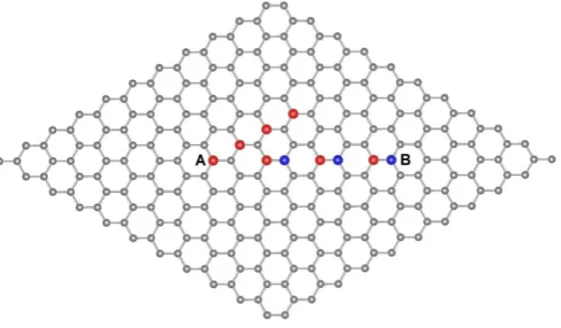
[10, 30]. The supercell of graphene has two sublattices A (red) and B (blue) as shown
in Fig. 1. Two hydrogen adatoms are placed at different distances on different
sublettices sites (AB) or on the same sublittices sites (AA) in order to study the
distance and sublattices dependence of the interaction.
Fig. 1 The 10×10 supercell structure of graphene. Red and blue show A and B
sublattices, respectively.
theory (DFT) with generalized gradient approximation (GGA) in the form of
Perdew-Burke-Ernzerhof (PBE) [31] for the exchange-correlation energy functional
implemented in VASP code [32, 33], including spin polarization and dipole moment
corrections [34, 35].The wave functions in the present calculation are expanded in a
plane wave basis set with an energy cutoff of 600 eV. A k-point sampling of 4×4×1
Monkhorst-Pack grids in the first Brillouin zone of the supercell and a Gaussian
smearing with a width of σ=0.05 eV are used in the calculations. All atoms in the
supercell are allowed to relax until the forces on each atom are smaller than 0.01
eV/Å.
Hydrogen dimer on graphene in different configurations such as ortho- (A-B),
meta-(A-A) and para- (A-B) dimers have been the subject of many studies in the
literature Refs. [9, 21, 22, 36-40]. The absorption structures and properties of the
dimer configurations obtained from our calculations using the set up described above
are consistent with those in the literature. In particular, the absorption energies of the
ortho- (A-B), meta-(A-A) and para- (A-B) dimers obtained from our calculations are
2.77, 1.87 and 2.76 eV respectively, which agree well with the results of 2.75, 1.65,
and 2.72 eV from Ref. 9. These comparisons indicate that the calculation set up we
used can accurately describe the behaviors of adsorption of two hydrogen atoms on
graphene.
3. Results and Discussions
The interaction energy between the two H adatoms on graphene is defined as:
Eint = Ea2− 2Ea1 (1)
Here, Ea2 is the adsorption energy of two H adatoms simultaneously on graphene, and
Ea1 is the adsorption energy of a single H adatom. Ea2 and Ea1 are the absorption
energy of a pair of hydrogen atoms and a single hydrogen atom respectively defined
by Ea2 = E2H+gra – (Egra+2μH) and Ea1 = EH+gra – (Egra+μH) with E2H+gra, EH+gra, Egra,
and μH being the total energies of two H-adsorbed graphene, one H-adsorbed
graphene, pure graphene and the chemical potential of a H atom respectively. The
chemical potential can be chosen as either ½ of the energy of molecular hydrogen or
the energy of hydrogen atom, which will not affect the interaction energy between the
two hydrogen atoms defined in Eq. (1).
To minimize the k-point sampling error in the adsorption energy calculations, the
energies of the isolated perfect graphene sheet and the isolated atom are also
calculated using the same supercell, energy cutoff, and k-point sampling as those in
the calculations for the adatom/graphene systems.
The interaction energy as a function of the distance (Å) between the two
absorbed atoms is shown in Fig. 2. Only the interaction energies between two
hydrogen atoms with the separation distance larger than 4.0 Å are shown in Fig. 2
because we would like to focus more the interaction that is mediated by the graphene
rather than direct bonding between the two hydrogen atoms. We found that the
attraction between two H atoms on different sublattices (AB) is much stronger than
whether they site on the same sublattices or on different sublattices, as long as the
distance is larger than 4 Å. We note that the calculation based on a theoretical model
by Shytov et al. showed the interaction is attractive for two H on AB sublattices but
repulsive for two H on the same sublattice [41]. The former is consistent with our
[image:10.595.154.399.277.456.2]calculation but the latter is not. While our calculations are based first-principles
Fig. 2 The distance dependence of the interaction energy for two H adatoms occupied
the different adsorption positions AA and AB along zigzag direction (AA-zz) and
armchair direction (AA-ac and AB-ac).
density function theory where most of the important interactions are considered, not
every interaction term is included in the model of Ref. 41. For example, the effect of
graphene lattice distortion is not explicitly included in the model calculation while
this effect is important as will be discussed in more details below. We also note that
the trend of the interaction energy of our calculation is consistent with the results of
interaction between the two H adatoms are very long-range, extended well beyond 14
Å. Obviously such a long-range interaction must be mediated by the underlying
graphene such as elastic distortions and electronic structure modulations discussed
below.
3.2. Lattice distortion in graphene induced by two H atoms adsorption
Adatoms on graphene can induce significant distortions to the graphene lattice. Such
[image:11.595.91.507.325.629.2]distortions can spread a certain distance from H atom because most of the distortions
Fig. 3. Bond length distortion with respect to that of perfect graphene (1.42 Å) induced by the two
H atoms reside on different sublattices and different distances. The magnitude and the sign of the
are elastic in nature. It is very useful to study the structure distortion caused by
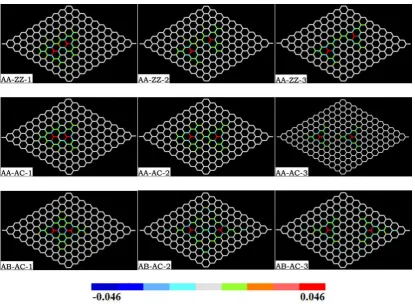
adatoms on graphene. In Fig. 3, we show bond length variation with respect to that of
perfect graphene (1.42 Å) induced by the two H adatoms reside on different position
along ZZ or AC direction. The bonds are found to be compressed in some directions
(cyan) and stretched in other directions (light green). When the distance between two
H atoms is less than 10 Å, large lattice distortions can be well seen at the vicinity of
the two H atoms, some bonds are stretched (red) and some are compressed (blue)
which can also be seen clearly in Fig. 3. Away from the adatoms or the distance of the
[image:12.595.92.482.370.502.2]two H atoms is about 13 Å, the distortions become negligible in the scale of the plot.
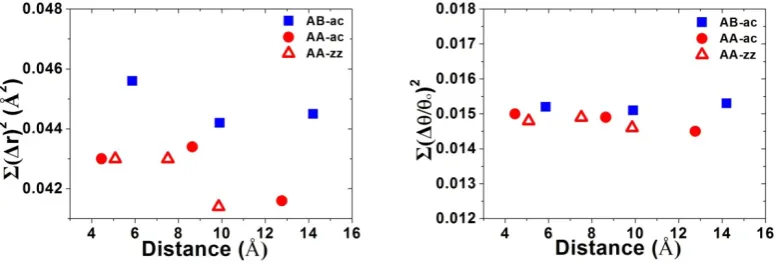
Fig. 4. Bond length distortion and bond-angle distortions with respect to that of perfect graphene
induced by the two H atoms reside on different distance (Å) along AC and ZZ direction.
We performed a quantitatively calculation of bond length and bond-angle
changes caused by the adatoms. The overall bond length distortions and bond-angle
distortions with respect to that of perfect graphene induced by the two H atoms
residing on different sublattices and different distances are shown in Fig 4. We found
sublattices (AB) along armchair direction. Bond length distortions due to the two H
adatoms on the same sublattice (AA) are relatively small. The overall bond-angle
distortions are less sensitive to the sublattice and distance of the two H adatoms
although the band-angle distortions on different sublattices are slightly bigger. More
details about the lattice distortions induced by adatom can also be found in Table 1
where the sum of square of deviation in bond length and relative bond angles are
presented.
In general, larger distortion to the graphene lattice will cost larger elastic energy.
The elastic energy cost by the graphene lattice distortion can be calculated as
o Elastic Gra Gra
E =E −E
(2)
where EGra is the total energy of distorted graphene which is calculated by removing
the two hydrogen atoms from the optimized hydrogen-adsorbed structure and keeping
the position of the relaxed carbon atoms fixed. EoGra is the energy of perfect graphene.
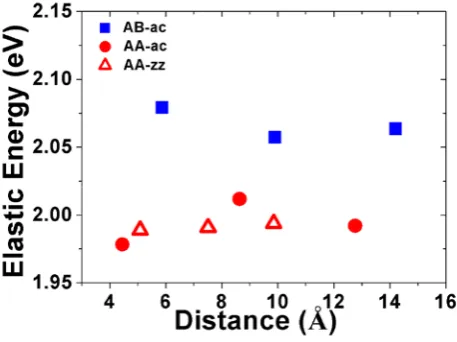
In Fig. 5, we show the elastic energy with respect to distance decrease between two H
atoms along AC and ZZ direction. The elastic energy obtained from our calculation is
about 2 eV for 200 carbon atoms (or ~10 meV per carbon atom) and the variation of
elastic energy with respect to different sublattices and different distances is consistent
to that of the bond length and bond-angle from our calculation discussed above. In
other word, two H adatoms on different sublattices cost more elastic energy. However,
from our DFT calculations discussed above, the energy for two H adatoms on AB
sublattices is about 0.3 eV lower than that on AA sublattices. In order to see if there is
the induced electronic dipole moments on the two H adatoms. The results show that
Fig. 5. The elastic energy induced by two H adatoms on AB and AA sublattices as the function of
the distance between the two H adatoms along AC and ZZ directions.
the dipole moment induced by the two H atom absorption is almost zero. These
results suggest that larger lattice distortion in graphene would cause stronger indirect
electronic attraction between the two H adatoms in favor of AB absorption.
3.3Electron density variation induced by hydrogen adatoms
In order to gain a better understanding on the gain of bonding energy, we investigated
the variation of electron density induced by two H adatom on graphene by
first-principles calculations. Because the change in the electron density on graphene is
very small, in order to see the change due to the two H adatom adsorption more
clearly, we calculated the change in the electron density Δρ(r) due to the
Δρ(r) = ρ(r) −ρgra(r) – ρ2H (3)
where ρ(r) is the charge density of the H/graphene system, ρgra(r) is the charge
densities of the distorted graphene and ρ2H is the charge density of the two H atoms.
The Δρ(r) defined in this way accounts for the electron redistribution due to the
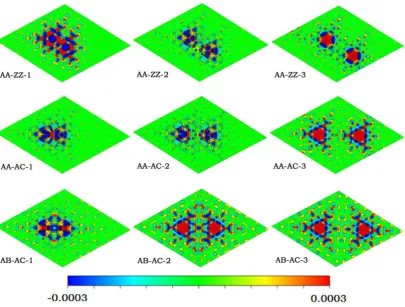
interaction between two H adatom and graphene. In Fig. 6, the interaction electron
Fig. 6. (Color online) The interaction electron density Δρ(r) in the plane through the graphene
layer, the color scale from−0.0003 to 0.0003 e/ Å3.
density Δρ(r) in the plane through the graphene layer is plotted. As shown in Fig. 6,
the interaction charge density Δρ(r) is dependent on where the two H atoms residing
[image:15.595.97.503.258.565.2]much more localized when the two H atoms residing on same sublattices (AA). In
comparison, the induced interaction charge density is much more delocalized for the
two H atoms residing on different sublattices (AB). This charge density distribution is
consistent with above discussed picture that the induced long range electronic
attraction is stronger for two H adatoms on AB sublattices than in AA sublattices.
3.4 Magnetic moments induced by hydrogen adatoms
We also have investigated the effects of hydrogen adsorption on the magnetic
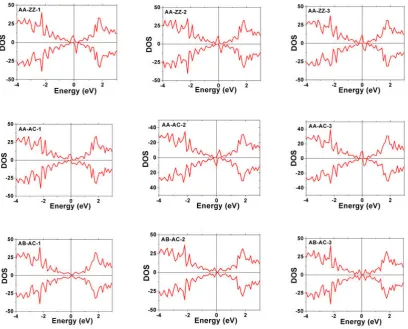
properties of graphene. The spin-polarized density--of-states (DOS) of the
adatom/graphene systems are shown in Fig. 7. The DOS were calculated using a
4×4×1 Monkhorst-Pack grid for Brillouin-zone sampling. Fig. 7 shows the total DOS
of the adatom/graphene systems in the neighborhood of the Fermi level (EF = 0 eV).
From the DOS plots, we can see that two H atoms residing on same sublattices (AA)
introduce some magnetic moment, while there is no the magnetic moments when two
H atoms on different sublattices (AB). The results from our present calculation is
consistent with recent experimental observation that two H atoms chemisorbed on the
same sublattices (AA) show ferromagnetic coupling, whereas for two H atoms on
different sublattices (AB) is nonmagnetic [42].
The magnetic moments from our calculations are summarized in Table 1. We
can see that the largest magnetic moment on a single carbon atom due to two H atoms
adsorbing on same sublattices (AA) graphene is about 1.06 μB. For the adsorbing on
is considered for all possible H-H arrangements up to the largest distances about 15 Å.
The results of our calculation also agree with the study by Boukhvalov et al. [7].
Fig. 7. (Color online) The spin polarized electronic density-of-states induced by the two hydrogen
atoms reside on different sublattices (AA or AB) and at different distance (Å) along AC and ZZ
directions.
In order to further understand the distribution of magnetic moments induced by
two H adatoms on graphene, we show in Fig. 8 the distribution of the induced
magnetic moments in graphene layer. We can see that carbon atoms around the H
[image:17.595.92.501.172.501.2]localized, extend a few shell away from the hydrogen atoms.
Fig. 8. (Color online) The distribution of magnetic moments induced by the adsorption of two H
atoms on graphene. Arrow length represents amplitudes of magnetic moments and arrow direction
represents the direction of magnetic moments. The arrows have been enlarged by a factor of 20 for
a clear visualization. There are no visible magnetic moments for two H atoms on different
sublattices (AB).
4. Conclusion
In summary, the adsorption of two H adatoms on graphene is studied by the
first-principles density-functional calculations. The interaction energies between the
two H adatoms, the lattice distortion on graphene, the interaction electron density and
magnetic properties of hydrogen adsorption are studied. We found that there is a
stronger attractive interaction between two H atoms residing on different sublattices
(AB) than on same sublattices (AA). We further explored the origin of attraction
betwwen the two H adatoms on graphene. We showed two H atoms in graphene
[image:18.595.91.507.137.289.2]energy for the supercell with 200 carbon atoms (or ~10 meV/atom). Through the
study of bond length and bond-angle variation, we found the distortion of AB is larger
than that of AA. We demonstrated the attractive interactions between the two H
adatoms are electronic interaction mediated through graphene due to the graphene
lattice distortion. We also showed that two H atoms residing on the same sublattices
(AA) on graphene introduce magnetic moments while there is no magnetic moment
when two H atoms are sited on different sublattices (AB).
■ Author information
Corresponding Author
*E-mail: [email protected] (CZ.W.); [email protected] (W.Z.)
.
■
Acknowledgments
Work at Ames Laboratory was supported by the US Department of Energy, Office of
Science, Basic Energy Sciences, Division of Materials Science and Engineering,
including a grant of computer time at the National Energy Research Supercomputing
Centre (NERSC) in Berkeley, CA. Ames Laboratory is operated for the U.S. DOE
by Iowa State University under contract # DE-AC02-07CH11358. W. Zhang also
acknowledges the support by the National Natural Science Foundation of China
(Grant No. 21173096), and supported by the State Key Development Program for
■ REFERENCES
[1] RabtiA, Raouafi N, Merkoçi A. Carbon 2016; 108; 481-514.
[2] Elias DC, Nair RR, Mohiuddin TMG, Morozov SV, Blake P, Halsall MP, FerrariAC, Boukhvalov DW,
KatsnelsonM I, GeimAK, NovoselovKS. Science 2009; 323; 610.
[3] Bostwick A, McChesney JL, Emtsev KV, Seyller T, Horn K, Kevan SD and Rotenberg E. Phys. Rev. Lett.
2009; 103; 056404.
[4] Duzenli, D. J. Phys. Chem. C 2016; 120; 20149−20157.
[5] Lee C, Leconte N, Kim J, Cho D, Lyo IW, Choi EJ. Carbon 2016; 103; 109-114.
[6] DuplockEJ, SchefflerM and LindanPJD. Phys. Rev. Lett. 2004; 92; 225502.
[7] BoukhvalovDW, KatsnelsonM I, LichtensteinAI. Phys. Rev. B 2008; 77; 035427.
[8] SofoJO, ChaudhariAS and BarberGD. Phys. Rev. B 2007; 75; 153401.
[9] SljivancaninZ, RaulsE, HornekaerL, XuW, BesenbacherF, HammerB. J. Chem. Phys. 2009; 131; 084706.
[10] DuplockEJ, SchefflerM, and LindanPJD. Phys. Rev. Lett. 2004; 92; 225502.
[11] SuzuuraH and AndoT. J. Phys. Soc. Jpn. 2002; 72; 69.
[12] Suzuura H, and AndoT, Phys. Rev. Lett. 2002; 89; 266603.
[13] NaumisGG, Phys. Rev. B 2007; 76; 153403.
[14] RobinsonJP, SchomerusH, Oroszlany L, and Fal’koVI. Phys. Rev. Lett. 2008; 101; 196803.
[15] HollenbachD, SalpeterEE. Astrophys. J. 1971; 163; 155.
[16] KruegelE, The Physics of Interstellar Dust, Institute of Physics, Bristol, UK, 2003.
[17] SchlapbachL, ZüttelA. Nature (London) 2001; 414; 353.
[18] BreyL, Fertig HA, SarmaSD. Phys. Rev. Lett. 2007; 99; 116802.
[19] SaremiS. Phys. Rev. B 2007; 76; 184430.
[20] YazyevOV, HelmL. Phys. Rev. B 2007; 75; 125408.
[21] HornekaerL, SljivancaninZ, XuW, OteroR, RaulsE, StensgaardI, LaegsgaardE, HammerB, Besenbacher
F. Phys. Rev. Lett. 2006; 96; 156104.
[22] HornekaerL, RaulsE, XuW, SljivancaninZ, OteroR, StensgaardI, LaegsgaardE, HammerB, Besenbacher
F. Phys. Rev. Lett. 2006; 97; 186102.
[23] HenwoodD, CareyJD. Phys. Rev. B 2007; 75; 245413.
[24] KerwinJ, JacksonB. J. Chem. Phys.2008; 128; 084702.
[25] Ferro Y, Marinelli F, Allouche A, Chem. Phys. Lett. 2003; 368; 609.
[26] HuangLF, NiMY, ZhengXH, ZhouWH, LiYG, ZengZ. J. Phys. Chem. C 2010; 114; 22636.
[27] CasoloS, LovvikOM, MartinazzoR, TantardinaGF. J. Chem. Phys. 2009; 130; 054704.
[28] KayanumaM, NagashimaU, NishikaraH, KyotaniT, OgawaH. Chem. Phys. Lett. 2010; 495; 251.
[29] Huang LF, Cao TF, Gong PL, Zeng Z, Zhang C, Phys. Rev. B 2012; 86; 125433.
[30] Li C, Yu OY, Pan HZ, Sun YY, Li DY. Journal of Magnetism and Magnetic Materials 2011; 323; 547-551.
[31] Perdew JP, Burke K, and ErnzerhofM, Phys. Rev. Lett. 1996; 77; 3865. [32] Kresse G, and HafnerJ, Phys. Rev. B 1993; 47; 558.
[33] KresseG and FurthmüllerJ, Phys. Rev. B 1996; 54; 11169.
[34] Makov G, and PayneMC, Phys. Rev. B 1995; 51; 4014.
[35] Neugebauer J, and SchefflerM, Phys. Rev. B 1992; 46; 16067.
[36] Ruffieux P, Gröning O, Schwaller P, Schlapbach L, Gröning P, Phys. Rev. Lett. 2000; 84; 4910.
[37] Miura Y, Kasai H, Dino W, Nakanishi H, Sugimoto T, J. Appl. Phys. 2003; 93; 3395.
[39] Hornekær L, Xu W, Otero R, Laegsgaard E, Besenbacher F, Chem. Phys. Lett. 2007; 446; 237.
[40] Rougeau N, Teillet-Billy D, Sidis V, Chem. Phys. Lett. 2006; 431; 135.
[41] ShytovAV, AbaninDA, and LevitovLS,Phys. Rev. Lett.2009; 103; 016806.
Table 1. Bond-length and bond-angle distortions with respect to perfect graphene, as well as the magnetic moment M (µB) and elastic energy (eV) induced by the two H adatoms are also shown.
Σ(Δr)2 Σ(Δθ/θ
o)2 Distance(Å) M(µB) Elastic E(eV)
AA-ZZ-1 0.0430 0.0148 5.09 1.059 1.99
AA-ZZ-2 0.0430 0.0149 7.51 1.057 1.99
AA-ZZ-3 0.0414 0.0146 9.85 1.058 1.99
AA-AC-1 0.0430 0.0150 4.46 1.057 1.98
AA-AC-2 0.0434 0.0149 8.64 1.056 2.01
AA-AC-3 0.0416 0.0145 12.77 1.063 1.99
AB-AC-1 0.0456 0.0152 5.87 0 2.08
AB-AC-2 0.0442 0.0151 9.90 0 2.06



tris(nitrato κ2O,O′)samarium(III)](data:image/gif;base64,R0lGODlhAQABAIAAAP///wAAACH5BAEAAAAALAAAAAABAAEAAAICRAEAOw==)