DOI: 10.22059/poll.2018.252226.392
Print ISSN: 2383-451X Online ISSN: 2383-4501 Web Page: https://jpoll.ut.ac.ir, Email: [email protected]
Facile Synthesis of Zn-TiO
2Nanostructure, Using Green Tea as
an Eco-Friendly Reducing Agent for Photodegradation of Organic
Pollutants in Water
Tavakoli, F. and Badiei, A*
School of Chemistry, College of Science, University of Tehran, Tehran, Iran
Received: 08.02.2018 Revised: 20.05.2018
ABSTRACT: The present study synthesizes Zn-TiO2 photocatalyst via a simple and
economic green rout, in which Green Tea is applied as a green reducing agent due to the presence of polyphenols Molecules. Polyphenol molecules in green tea act as a reductant, thus changing Zn2+ to metallic Zn. The by-produced nanocmposites are characterized by using XRD, FESEM, EDS, and DRS. Zn-TiO2 photocatalyst possesses great efficient
charge separation properties. In order to investigate the presence of Zn, different weight ratio of Zn to TiO2 (viz. 5 wt%, 10 wt%, 15 wt%, 20 wt%, 25 wt%, 30 wt%, 35 wt%, 40
wt%, 45 wt%, and 50 wt%) have been synthesized and their performance in Acid Orange 7 (AO7) photodegradation, compared with pure TiO2. According to the results, the compound
with 25 wt% Zn shows 97% degradation of AO7 as a model pollutant. Also, it has been shown that after three tests with EDTA, benzoic acid, and under Ar gas, photodegradation of AO7 with Zn-TiO2 photocatalyst mainly depends on photogenerated holes.
Keywords: Zn-TiO2; Green Synthesis; Green Tea; Photocatalyst; Acid Orange 7.
INTRODUCTION
Water is essential to life, being especially necessary for human beings, first for his food, then for his health, and finally for his agricultural and industrial activities (Shen et al., 2010). Consequently, human population's settlement on earth is based on freshwater resources. In order to degrade organic pollutants effectively, TiO2-based
photocatalysts have been widely investigated as a disinfection agent in the past few decades (Sabet & Salavati, 2012; Sabet & Salavati, 2014; Sangsefidi et al., 2016; Sabet & Salavati, 2015; Sabet & Jahangiri, 2017; Ayni, 2016). The TiO2
nanoparticles have been used for photodegradation of organic pollutants, thanks to their extraordinary optical
* Corresponding Author , Email: abadiei@ ut.ac.ir (A. Badiei)
properties (Shiravand, 2012; Eskandarloo & Badiei, 2016a; Eskandarloo & Badiei, 2016b). The photocatalytic degradation mechanism of TiO2 nanoparticles has been
addressed in many papers (Fujishima, 2008; Hashimoto, 2005; Roig, 2003; Neelakandeswari, 2011; Masoumi, 2016). However, its application is limited due to its narrow photocatalytic region (l < 400 nm) and ability to absorb a small fraction of incident solar irradiation and indoor light, resulting from its relatively large band gap (anatase, ~3.2 eV). Furthermore, the rapid recombination of electrons and holes is one of the main reasons for low photodegradation efficiency of TiO2
TiO2 nanoparticles, e.g. doping of carbon,
metals, and nonmetals along with surface organic modification. Therefore, the doping of TiO2 and metals such as Ag, Cu,
Zn, Au, etc. is promising to improve photocatalytic performance of TiO2 due to
enhancing the photoinduced charge transfer (Lin, 2007; Wang, 2007).
Recently, there has been great effort to use green and environmentally-friendly methods for synthesis of nanosized materials, which involves the use of plant or fruit extracts as a stabilizer, reducing agent or capping agent to control crystal growth (Tavakoli & Salavati, 2013; Tavakoli & Salavati, 2015). Here, we use Green Tea as a natural reducing agent to synthesize Zn-TiO2 to demonstrate a green and economic
method for preparation of Zn-TiO2. Green
Tea is a rich source of polyphenols molecules. Plants with polyphenols can act as reducing agent, thus they have antioxidant property. Some of these plants can be used in the synthesis of nanoparticles due to the presence of polyphenols such as catechins, flavonols, flavanones, phenolic acid, and glycosids. Examples of plants, capable of acting as reducing agent, include pomegranate, cerasus pranus, mulberry, green tea, garlic, etc. Polyphenols are water-soluble vacuolar molecules. Odorless and nearly flavorless, they contribute to the taste as a moderately astringent. No wonder that they manage to reduce Zn2+ to metallic Zn. In this work, Zn-TiO2 compound has been
prepared through coprecipitation and then thermal method in the presence of Green Tea as reducing agent. The photocatalytic performance of this compound has been investigated for photodegradation of acid orange 7 (AO7) as a pollutant model. In order to check the presence of Zn metal in photodegradation performance of AO7, bare TiO2 have been tested in the
photodegradation of AO7. On the other hand, the weight ratio of Zn in TiO2 as a
crucial effect on photodegradation performance has been investigated and the
by-produced Zn-TiO2, characterized by
means of XRD, FESEM, TEM, EDS, and DRS.
MATERIAL AND METHODS
All reagents for synthesis of Zn-TiO2, such
as zinc nitrate and titanium dioxide, were purchased from Merck and employed without any further purification. The Green Tea was obtained from Lahijan, Iran. The synthesis was carried out at atmospheric pressure and ambient temperature with an ultrasonic irradiation, provided by a probe sonicator (Qsonica Q700, Newtown, CT, US). FT-IR spectra, ranged between 400 and 4000 cm-1 on Rayleigh WQF-510a spectrometer. Patterns of Powder X-ray Diffraction (XRD) were collected from a diffractometer, madeby Philips Company with X’pertpro monochromatized Cu Kα
radiation (λ = 1.54 Å). Microscopic morphology of products was visualized by SEM (MIRA3 TESCAN). TEM images were obtained on a CM30 transmission electron microscope with an accelerating voltage of 300 kV. Energy Dispersive Spectrometry (EDS) analysis was studied by XL30, Philips microscope with the sample's DRS obtained by means of AvaSpec 2048 TEC spectrometer in order to determine the optical band gap (Eg) of
Zn-TiO2 compound. For determination of
the Eg Eq. (1) was used:
α(ℎυ) = B(ℎυ-Eg)1/2 (1)
where α is optical absorption coefficient; B, a constant dependent on transition probability; ℎ, the Plankˊs constant; and υ, the radiation frequency. The Eg values
were calculated by plotting (αℎυ)2
versus
ℎυ, followed by extrapolation of the linear part of the spectra to the energy axis.
Zn-TiO2 nanostructures were prepared
by the following experimental sequence: Frstly, a certain amount of zinc nitrate was added drop by drop into TiO2 solution (i.e.,
2gr of TiO2 dispersed in 50 mL of distilled
followed by 50ml Green Tea (20gr green tea in 50 ml water) to be added into the above solution, again in drops. The obtained mixture was stirred at room temperature for 12h and the resultant precipitates were filtered, washed with distilled water and absolute ethanol, and dried at 60ºC in vacuum. Finally, the product was treated at 450ºC under Ar gas. The experiment was carried out by using 5wt%, 10wt%, 15wt%, 20wt%, 25wt%, 30wt%, 35wt%, 40wt%, 45wt%, and 50wt% of Zn to TiO2 at the same
conditions, respectively.
The photocatalytic degradation processes were carried out at room temperature in a batch quartz reactor. Artificial irradiation was provided by an 8W (UV-C) mercury lamp (Philips, Holland), which emitted around 254 nm, positioned on top of the batch quartz reactor. In each run, 40 mg of the catalyst was dispersed in 100 ml water. Afterwards, the desired concentration of AO7 (20 mg.L-1) and photocatalyst (400 mg.L-1) were transferred into the batch quartz reactor to be stirred for 30 min and reach the adsorption equilibration in the dark before irradiation. The photocatalytic reaction was initiated by turning on the light source. At given irradiation time intervals, the samples (5 ml) were retrieved, centrifuged (Sigma 2-16p), and then the AO7 concentration was analyzed by UV-vis spectrophotometer (Rayleigh UV-1600) at 𝜆max = 485 nm. All experiments were performed at initial pH of dye solution (pH = 6.1). The degradation efficiency was calculated by Eq. (2):
Degradation efficiency (DE (%)) = (C0 – Ct/C0)⨯100
(2)
where C0 and C are concentrations of AO7
(mg.L-1) at the time 0 and t, respectively.
RESULTS AND DISCUSSION
Fig.1 (a, b) shows the XRD pattern of TiO2
and Zn-TiO2. According to Fig.1a, for the
TiO2 compound, the XRD diffraction
reflections at 2θ of 25.8°, 38°, 39.5°, 48°, 55°, 62.6°, 69.7°, and 75.7° can be indexed to the characteristic reflections of (101), (004), (112), (200), (211), (213), (220), and (215) plane reflections of anatase crystal structure TiO2. On the other hand, XRD
pattern of Zn-TiO2 shows the reflections at
2θ of 24.7°, 35.1°, 38.4°, 39.3°, 48.1°, 54.5°, 62.6°, 69.7°, and 75.7°, corresponding to (101), (202), (004), (112), (200), (204), (213), (220), and (215), respectively. The reflections at 2θ of 35.1° and 54.5° were due to the presence of Zn on the surface of anatase TiO2. Since the metal
was doped during the TiO2 synthesis
process, resulting in a difference of ionic radius between zinc and titanium ions (which accounted to 0.74Aº and 0.068nm, respectively), TiO2 crystalline structure
became defective. As the cations got exchanged with one another, TiO2 had
cationic defect. In some cases, by adding a metal, the anatase phase of TiO2 is
converted into a rutile phase, though this phenomenon did not happen here, according to the XRD pattern of TiO2 and Zn-TiO2.
Fig. 2 shows the SEM and SEM mapping images of TiO2 and Zn-TiO2.
According to SEM images, the best distribution of Zn metals belonged to the surface of spherical TiO2, whereas SEM
mapping confirmed the presence of Zn on TiO2 surface.
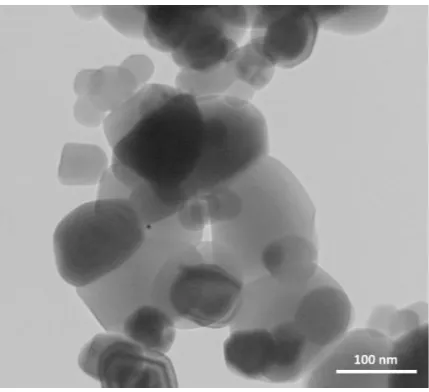
Fig. 3 shows the TEM image of TiO2
and Zn-TiO2 compounds, according to
which, Zn nanoparticles had been well distributed on TiO2 nanoparticles. As
shown in TEM images, the particle size of TiO2 and Zn nanoparticles were (80-120)
nm and (20-30) nm, respectively.
In order to get information on the elements, the Zn-TiO2 compound was
examined by EDX analysis, illustrated in Fig. 4. In the EDX spectrum of Zn-TiO2
Fig.1.XRD pattern of TiO2andZn-TiO2compounds
Fig. 2(a) SEM images ofZn-TiO ,2(b(,)c)and (d) SEM mapping images ofZn-TiO2
Fig. 4. EDX spectra ofZn-TiO2
Fig. 5. Diffuse Reflectance Spectra (DRS) of (a)Zn-TiO2and (b) TiO2
UV-visible, diffused reflectance spectra of TiO2 and Zn-TiO2 can be observed in
Fig. 5. The calculated band gap energies of TiO2 and Zn-TiO2 were 2.9 and 2.65 eV,
respectively. The slight reduction in the band gap of Zn-TiO2 nanostructures
implies that unpaired π electrons from Zn may bond with free electrons of TiO2.
So the calculated band gap of Zn-TiO2
was about 2.65, indicating that of the band gap of TiO2 did narrow down and this
narrowing should be attributed to the Ti-O-Zn bonds. Electrons have a tendency to flow from higher to lower Fermi levels in order to adjust the Fermi energy levels. The calculated conduction band position of anatase TiO2 was about -4.21 eV with a
band gap of about 2.9 eV, zinc can accept the photoexcited electrons from TiO2.
Thus, the photoinduced electron-hole pairs
got effectively separated and the probability of electron-hole recombination was decreased.
The valence band (VB) and conduction band (CB) potentials of semiconductors are two important factors for effective separation of photogenerated electron-hole pairs to generate OH radicals and superoxide anions. The VB and CB potential edges were calculated, using the following empirical formula (Eskandarloo & Badiei, 2014; Huang, 2013):
EVB = X - Ee + 0.5 (Eg)
ECB = EVB - Eg
where EVB and ECB are the valence and
of the electronegativities of constituent atoms; Ee, the energy of free electrons on the hydrogen scale (~ 4.5 eV); and Eg, the
band gap energy of the semiconductor. Overall mechanism for the formation of Zn0 via polyphenols in green tea can be seen in the equation below, in which Ar represents the aromatic ring and n stands for the number
of groups, oxidized by Zn2+.
nZn2++2(Ar-OH)n nZn0 + 2n(Ar=O) + 2nH+
The photocatalytic performance of Zn-TiO2 and bare TiO2 hybrid were investigated,
using aqueous AO7 dye as a model compound under UV light irradiation.
Fig. 6.Degradation curve of AO7 aqueous dye with UV light withoutphotocatalyst ,TiO2,and different weight ratio ofZnto TiO2
As shown in Fig. 6, when the only AO7 dye was exposed to UV light, no degradation of AO7 was observed. According to this observation, degradation of AO7 is only due to the presence of the photocatalyst. In order to evaluate the effect of Zn loading, different weight ratios of Zn (viz. 5wt%, 10wt%, 15wt%, 20wt%, 25wt%, 30wt%, 35wt%, 40wt%, 45wt%, and 50wt%), loaded on TiO2 photocatalyst,
were prepared and their photocatalytic performance tested as well (Fig. 6). The sample with 25wt% Zn showed higher photocatalytic degradation, compared to pure TiO2 nanoparticles, while 5wt% and
50wt% Zn-loaded TiO2 photocatalyst
decreased the photocatalytic activity. As shown in Fig. 6, by increasing the weight ratio of Zn to TiO2, the photocatalytic
performance of coupled nanoparticles for AO7 degradation was decreased. The first
reason for the reduction in
photodegradation was that higher loading of Zn could increase the recombination rate of electrons and holes, thus preventing the charges from getting separated. The second reason was that higher loading of Zn may decrease the active sites of TiO2 and
adsorptivity of coupled nanoparticles for adsorbed dye molecules on the surface of TiO2, thereby affecting the photocatalytic
performance and preventing the light from arriving at active sites of TiO2. It can be
seen in Fig. 6 that TiO2 with 25wt% Zn
exhibits 97% AO7 degradation within 50 min, though only 61% of degradation was shown in the presence of bare TiO2.
photocatalytic performance of Zn-TiO2
coupled nanoparticles, several samples with different weight ratios of Zn were synthesized and their performance in AO7 photodegradation was investigated. According to Fig. 6, by increasing the weight ratio of Zn from 5 wt% to 10 wt%, 15 wt%, 20 wt%, and 25 wt%, photodegradation was increased from 38% to 43%, 63%, 75%, and 97%, respectively; however, increasing this parameter from 25 wt% to 30wt%, 35wt%, 40wt%, 45wt%, and 50 wt%, photodegradation plummeted
from 97% to 71%, 62%, 51%, 35%, and 21%, respectively. According to these results, the weight ratio of Zn was a crucial factor for AO7 photodegradation.
In general, during photocatalysis, hydroxyl radicals, superoxide anions (O2-.), and holes (h+) are the reactive species for degradation of organic pollutants. In order to understand the photocatalytic activity of Zn-TiO2 compound for AO7 degradation, a series of free radicals trapping experiments were carried out, as shown in Fig. 7.
Fig. 7. Seriesoftrappingexperiments(a) BenzoicAcid ,(b) EDTA,and (c)Argas forAO7 degradation duringZn-TiO2photocatalystsunder UV6 light irradiation
In the presence of a hydroxyl radical scavenger such as benzoic acid (0.5mM), as much as 78% degradation was observed. In case of benzoic acid, only 19% degradation was decreased than that of the scavenger-free photocatalytic system for AO7, as shown in Fig. 7, clearly suggesting that photocatalytic degradation of AO7 dye was not mediated through OH radical reaction, solely. In order to further examine the exact reactive species, involved in AO7 degradation, 10ml EDTA (0.01M), as an effective h+ scavenger got added into the AO7 reaction solution. The rate of AO7 degradation was drastically suppressed, i.e. only 19% of AO7 degradation was noticed (Fig. 7b), which
degradation percentage (~9%) in the presence of Ar gas shows that O2-∙ radicals were not reactive species for AO7 degradation, clearly emphasizing that AO7 degradation mainly depended on photogenerated holes only.
Fig. 8 shows the graphical abstract for green synthesis of Zn-TiO2 via
Pomegranate as a green reducing agent and
photocatalytic performance of Zn-TiO2
photocatalyst in degradation of AO7 as an organic pollutant in water.
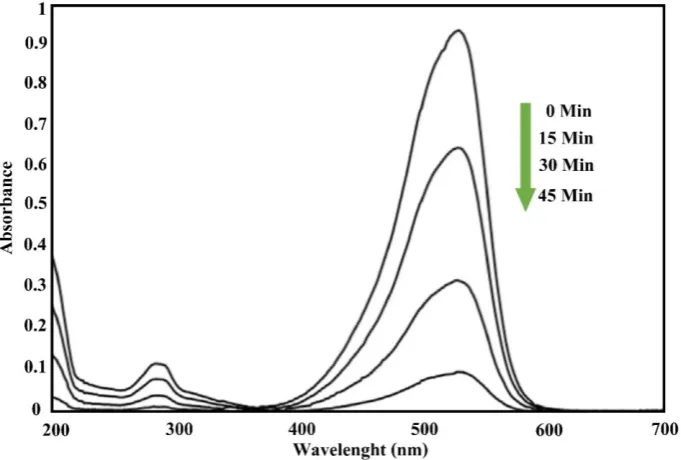
Mineralization of AO7 during the photocatalytic degradation in the presence of Zn-TiO2 nanoparticles was studied
through disappearance of UV–vis with Fig. 9 illustrating the changes in the UV–vis.
Fig. 8. graphical abstract for green synthesis ofZn-TiO2viapomegranateas a green reducing agent and
photocatalytic performance ofZn-TiO2photocatalystinAO7 degradationasanorganicpollutantinwater
Absorption spectra of AO7 solution declined during photocatalytic degradation. The decrease in the absorption peak of AO7 at λ = 530 nm indicates a rapid degradation of dye. The decrease is also meaningful with respect to the nitrogen-to-nitrogen double bond (–N = N–) of azo dye, as the most active site for oxidative attack. The absorbance of AO7 at λ = 254 nm is responsible for aromatic ring content attached to the –N = N– group in the AO7 molecular structure. The disappearance of AO7 aromatic ring content in the aqueous solution was measured, using the band intensity at 254 nm after 30 min irradiation time and results showed 78.82% reduction at 254 nm absorbance intensity, indicative of degradation and mineralization of AO7 aromatic ring.
CONCLUSION
Zn-TiO2 compounds were prepared in the
presence of Green Tea as a green reducing agent. The byproducts were characterized, using XRD, FESEM, EDS, and DRS. Zn-TiO2 compound with 25wt% Zn showed
higher photocatalytic performance in photodegradation of AO7 than bare TiO2.
In order to investigate the presence of Zn, different weight ratios of Zn to TiO2
(5wt%, 10wt%, 15wt%, 20wt%, 25wt%, 30wt%, 35wt%, 40wt%, 45wt%, and 50wt%) were synthesized and their performance in AO7 photodegradation was compared with pure TiO2. According to the
results, 25wt% Zn-loaded TiO2
nanoparticle exhibited high photocatalytic activity for the degradation of AO7 dye. Results showed that the significant enhancement in photodegradation efficiency of AO7 degradation was due to the presence of Zn metal, which possessed effective charge carrier separation properties. Finally, results clearly emphasized that AO7 degradation mainly depended on photogenerated holes only.
ACKNOWLEDGEMENT
Authors are grateful to Council of the University of Tehran for providing financial support to undertake this work.
REFERENCES
Ayni, S., Sabet, M. and Salavati-Niasari, M. (2016) Synthesis and Characterization of Lead Molybdate Nanostructures with High Photocatalytic Activity Via Simple Co-recipitation Method. Journal of Cluster Science., 27(1); 315-326.
Eskandarloo, H., Badiei, A. and Haug, C. (2014). Enhanced photocatalytic degradation of an azo textile dye by using TiO2/NiO coupled
nanoparticles: Optimization of synthesis and operational key factors. Mater. Sci. Semicond. Process., 27(1); 240-253.
Eskandarloo, H., Badiei, A., Behnajadi, M. A. and Mohammadi Ziarani, G. (2016a). Ultrasonic-assisted degradation of phenazopyridine with a combination of Sm-doped ZnO nanoparticles and inorganic oxidants. Ultrason Sonochem., 28(1); 169-177.
Eskandarloo, H., Badiei, A., Behnajadi, M. A., Tavakoli, A. and Mohammadi Ziarani, G. (2016b). Ultrasonic-assisted synthesis of Ce doped cubic– hexagonal ZnTiO3 with highly efficient
sonocatalytic activity. Ultrason Sonochem., 29(1); 258-269.
Fujishima, A., Zhang, X. and Tryk, D. A. (2008). TiO2 photocatalysis and related surface phenomena.
Surf Sci., 63(12); 515-582.
Hashimoto, K., Irie, H. and Fujishima, A. (2005). TiO2 Photocatalysis: A Historical Overview and
Future Prospects. Jpn J Appl Phys., 44(12); 8269-8285.
Huang, Q., Tian, S., Zeng, D., Wang, X., Song, W., Li, Y., Xiao, W. and Xie, C. (2013). Enhanced Photocatalytic Activity of Chemically Bonded TiO2/Graphene Composites Based on the Effective
Interfacial Charge Transfer through the C–Ti Bond. ACS Catal., 3(7); 1477-1485.
Lin, J. and Zhu, Y. F. (2007). Controlled Synthesis of the ZnWO4 Nanostructure and Effects on the
Photocatalytic Performance. Inorg. Chem., 46(20); 8372-8378.
Pollution is licensed under a" Creative Commons Attribution 4.0 International (CC-BY 4.0)" Masoumi, S., Nabiyouni, G. and Ghanbari, D.
(2016). Photo-degradation of Congored, acid brown and acid violet: photo catalyst and magnetic investigation of CuFe2O4–TiO2–Ag
nanocomposites. J. Mater. Sci. - Mater. Electron., 27(10); 11017-11033.
Nayak, J., Lohani, H., Bera, T.K. (2011). Observation of catalytic properties of CdS–ZnO composite nanorods synthesized by aqueous chemical growth technique. Curr. Appl. Phys., 11(1); 93-97.
Neelakandeswari, N., Sangami, G., Dharmaraj, N., Taek, N. K. and Kim, H. Y. (2011). Spectroscopic investigations on the photodegradation of toluidine blue dye using cadmium sulphide nanoparticles prepared by a novel method. Spectrochim. Acta, Part A., 78(5); 1592-1598.
Roig, B., Gonzalez, C. and Thomas, O. (2003). Monitoring of phenol photodegradation by ultraviolet spectroscopy. Spectrochim. Acta, Part A., 59(2); 303-307.
Sabet, M. and Salavati-Niasari, M. (2015). Deposition of Lead Sulfide Nanostructure Films on TiO2 Surface via Different Chemical Methods due to Improving Dye-Sensitized Solar Cells Efficiency. Electrochimica Acta., 169(1); 168-179.
Sabet, M., Jahangiri, H. and Ghashghaei, E. (2017). Improving microwave absorption of the polyaniline by carbon nanotube and needle-like magnetic nanostructures. Synthetic Metals., 224(1); 18-26.
Sabet, M., Salavati-Niasari, M., Ashjari, M., Ghanbari, D. and Dadkhah, M. (2012). CuIns2/Cus
Nanocomposite: Synthesis via Simple Microwave Approach and Investigation Its Behavior in Solar Cell. Journal of Inorganic and Organometallic Polymers and Materials., 22(5); 1139-1145.
Sabet, M., Salavati-Niasari, M., Ghanbari, D., Amiri, O., Mir, N. and Dadkhah, M. (2014). Synthesis and characterization of CuInSe2 nanocrystals via facile microwave approach and study of their behavior in solar cell. Materials Science in Semiconductor Processing., 25(1); 98-105.
Sangsefidi, F. S., Sabet, and Salavati-Niasari, M. (2016) Synthesis and characterization of ceria nanostructures with different morphologies via a simple thermal decompose method with different cerium complexes and investigation the photocatalytic activity. Journal of Materials Science: Materials in Electronics., 27(8); 8793-8801.
Shen, J., Hu, Y., Shi, M., Li, N., Ma, H. and Ye, M. (2010). One Step Synthesis of Graphene Oxide−Magnetic Nanoparticle Composite. J. Phys. Chem. C., 114(3); 1498-1503.
Shiravand, G., Badiei, A., Mohammadi Ziarani, G., Jafarabadi, M. and Hamzehloo, M. (2012). Photocatalytic Synthesis of Phenol by Direct Hydroxylation of Benzene by a Modified Nanoporous Silica (LUS-1) under Sunlight. Chin. J. Catal., 33(7-8); 1347-1353.
Tavakoli, F., Salavati Niasari, M. and Mohandes, F. (2013). Green synthesis of flower-like CuI microstructures composed of trigonal nanostructures using pomegranate juice. Mater. Lett., 100(1); 133-136.
Tavakoli, F., Salavati Niasari, M., Badiei, A. and Mohandes, F. (2015). Green synthesis and characterization of graphene nanosheets. Mater. Res. Bull., 63(1); 51-57.
Wang, X., Hu, P., Li, Y.F. and Yu, L. (2007). Preparation and Characterization of ZnO Hollow Spheres and ZnO−Carbon Composite Materials Using Colloidal Carbon Spheres as Templates. J. Phys. Chem. C., 111(18); 6706-6712.
Xie, W., Li, Y., Sun, W., Huang, J., Xie, H. and Zhao, X. (2010). Surface modification of ZnO with Ag improves its photocatalytic efficiency and photostability. J. Photochem. Photobiol., A. Chem., 216(2-3); 149-155.