University of South Carolina
Scholar Commons
Theses and Dissertations
2017
Antecedents of Adolescents’ Gratitude: Personality,
Social Support, and Stressful Life Events
Hannah Reckart
University of South Carolina
Follow this and additional works at:https://scholarcommons.sc.edu/etd Part of theSchool Psychology Commons
This Open Access Dissertation is brought to you by Scholar Commons. It has been accepted for inclusion in Theses and Dissertations by an authorized administrator of Scholar Commons. For more information, please [email protected].
Recommended Citation
A
NTECEDENTS OFA
DOLESCENTS’
G
RATITUDE:
P
ERSONALITY,
S
OCIALS
UPPORT,
ANDS
TRESSFULL
IFEE
VENTSby
Hannah Reckart
Bachelor of Science Clemson University, 2012
Master of Arts
University of South Carolina, 2015
Submitted in Partial Fulfillment of the Requirements
For the Degree of Doctor of Philosophy in
School Psychology
College of Arts and Sciences
University of South Carolina
2017
Accepted by:
E. Scott Huebner, Major Professor
Kimberly Hills, Committee Member
Scott Decker, Committee Member
Robert Valois, Committee Member
ACKNOWLEDGEMENTS
I would like to extend my deepest appreciation to my husband, my parents, my
brother, and my cohort for helping to make this paper possible. Thanks to my graduate
school twin, Kristin Otis, who has been my partner in crime for the past five years. I
would also like to thank Drs. Scott Huebner and Kim Hills for their continued support
and feedback throughout this process, as well as express appreciation to Drs. Scott
Decker and Skip Valois for their participation and support on this paper. All of the glory
in the completion of this project belongs to God, who brought me to this program and
ABSTRACT
An increase in the emphasis of positive aspects of functioning has led to expanded
attention paid to the field of positive psychology. Within in this arena, the construct of
gratitude has emerged as a factor of interest, specifically in adults; however, while a basis
for research of gratitude in children exists, it is lacking in breadth. Support for gratitude’s
significant relations with psychosocial, psychological, and academic factors has been
shown in prior research, and presumed personal and environmental antecedents of
gratitude have been indicated. The present study was exploratory in nature and included a
sample of 1506 students from four middle schools in the Southeastern United States. We
investigated the relations between gratitude and several previously examined variables
across studies of children and adults, including extraversion, neuroticism, social support,
and stressful life events. Results of a hierarchical multiple regression analysis indicated
that after controlling for gender, SES, and self-identification as Hispanic, the reported
occurrence of major stressful life events added statistically significant variance beyond
the temporally precedent personality variables (extraversion and neuroticism) and social
support (parents, peers, and teachers) to the explanation of gratitude differences. Contrary
to expectations, students’ levels of social support and neuroticism did not appear to add
statistical significance to the explanation of gratitude. Implications of these results are
discussed. Future research should focus on clarifying the antecedents of gratitude, as
research-related interest in this variable is continually surfacing and gaps remain in the
TABLE OF CONTENTS
ACKNOWLEDGEMENTS ... iii
ABSTRACT ... iv
LIST OF TABLES ... vi
CHAPTER 1INTRODUCTION ...1
CHAPTER 2METHOD ...31
CHAPTER 3RESULTS ...37
CHAPTER 4DISCUSSION ...51
REFERENCES ...60
APPENDIX A–GRATITUDE QUESTIONNAIRE-6 ...74
APPENDIX B–ABBREVIATED JUNIOR EYSENCK PERSONALITY QUESTIONNAIRE ...75
APPENDIX C–CHILD AND ADOLESCENT SOCIAL SUPPORT SCALE ...76
LIST OF TABLES
Table 2.1 Frequencies for the Demographic Variables ...31
Table 3.1 Descriptive Statistics ...40
Table 3.2 Intercorrelations Among Variables ...41
CHAPTER
1
INTRODUCTION
Introduction to Positive Psychology
Differing from a traditional approach to psychology, positive psychology promotes the
presence of positive qualities within individuals’ lives, rather than focusing solely on the
reduction of negative qualities. The role of positive psychology in the lives of youth and
adolescents is becoming increasingly apparent in existing literature (e.g., Seligman &
Csikszentmihalyi, 2000). Researchers are now recognizing individual differences both
within the separate populations comprised of youth and adolescents and between these
two populations and adults.
Positive psychology can be defined as the study of positive emotions, positive
character traits, and the institutional features that facilitate optimal functioning in
individuals and groups (Seligman & Csikszentmihalyi, 2000). This field of study alters a
traditionally pathology-based perspective in psychology by endorsing a strengths-based
assessment of individual characteristics and environmental assets. Because of an
increased emphasis on positive psychology over the past 50 years (Suldo, Huebner,
Savage, & Thalji, 2011), a focus has begun shifting to enhancement of individuals’
thriving in all arenas of life (Bird & Markle, 2012).
Related to growth of positive psychology is an increased consideration of positive
characterizes the occurrence and growth of positive psychology variables and generally
takes place in the home, in peer groups, and in out-of-home contexts, such as schools
(Gilman, Huebner, & Buckman, 20 08). For example, research indicates that the quality
of school experiences at an early age contributes to achievement of developmental
milestones, such as identity development in racially diverse students (e.g., Gonzales,
2009), achievement motivation (vanGrinsven & Tillema, 2006), and overall academic
success (Cohen, McCabe, Michelli, & Pickeral, 2009). These experiences may also
influence the choices youth and adolescents make when they become adults (Gilman,
Huebner, & Furlong, 2014). Because children spend the majority of their time in schools,
the school setting is arguably an effective avenue to provide children with mental health
services (Weist, Evans, & Lever, 2003). Unfortunately, most models of service delivery
in schools follow a problem-focused approach, which may not adequately highlight
positive areas of students’ lives. With the problem-focused approach, students are
variously diagnosed with anxiety, depression, behavior problems, and other mental-health
disorders, but the targeting of strengths such as hope, optimism, gratitude, positive affect,
and other constructs related to positive psychology is either minimally considered or
bypassed altogether (Gilman et al., 2014). Therefore, the consideration of positive
psychology constructs in the school setting may be especially beneficial, offering a more
comprehensive view of children and approaches to mental health promotion (Antaramian,
Huebner, Hills, & Valois, 2010; Greenspoon & Saklofske, 2001; Suldo & Shaffer, 2008).
Introduction to Gratitude
Research on the construct of gratitude represents an emergent aspect of the field of
to date focuses on adults, some research is surfacing regarding gratitude in youth,
continually expanding the field. The extant literature indicates that high levels of
gratitude in youth can be beneficial in a variety of ways, and this empirical support is
emerging in adolescent research as well (e.g., Froh, Bono, & Emmons, 2010; Froh,
Sefick, & Emmons, 2008; Layous & Lyubomirsky, 2014; McCullough, Emmons, &
Tsang, 2002). The remainder of the chapter that follows critically reviews contemporary
literature regarding gratitude in youth and adolescents, including the benefactors,
beneficiaries, and benefits of gratitude. A benefit can be considered to be a behavior that
is advantageous or good and occurs between at least two parties. A benefactor can be
defined as the person who is providing the benefit and a beneficiary can be characterized
as the person who receives the benefit (e.g., Froh, 2010; Froh, Kashdan, Ozimkowski, &
Miller, 2009).
Defining gratitude. Though numerous researchers have presented several
definitions of gratitude, there is currently no commonly accepted definition among the
researchers in the field. However, a distinction is clear in the literature separating
benefit-induced gratitude and generalized gratitude.
Benefit-induced gratitude. A number of scholars consider gratitude to be
connected to prosocial behavior, such as expression of empathy, willingness to help
others, and forgiveness of others (McCullough et al., 2002). Emmons and McCullough
(2003) define gratitude as an emotional response to a gift or benefit from another person.
For instance, an individual might react intrinsically with gratitude (as an emotion or
feeling) when she receives concrete advice from someone, accepts sympathy from
2003). Similarly, gratitude has been defined as the appreciation experienced by
individuals when someone does something kind or helpful for them (Froh, Fan et al.,
2011) as well as a person’s reaction upon receiving a benefit from another person’s
intentional action (Algoe, Haidt, & Gable, 2008). These definitions emphasize the
beneficiary’s response, rather than that of the benefactor. In these cases, a person would
often outwardly express his or her gratitude upon recognition of another’s purposeful
benevolent behavior.
Generalized gratitude. Contrasting with a prosocial behavioral conceptualization
of the construct, gratitude is also variously considered to be a mood, a moral virtue, a
personality trait, a coping response, and a way of life that is mostly an innate reaction
(Emmons, 2008). As a personality trait, gratitude is understood in terms of the grateful
disposition. This disposition represents a generalized tendency to recognize beneficence
and respond with an emotion of gratitude to the actions of other people’s benevolence,
resulting in positive experiences (McCullough et al., 2002). Gratitude is characterized by
Haidt (2003) as a moral emotion that is other-praising and is related to other people’s or
society’s welfare. As an intrinsic value, gratitude can be felt beyond an interpersonal
context (e.g., gratitude for a work of art, toward God, or for a scene in nature; Bono et al.,
2014). Gratitude that is expressed as a result of an affective trait is considered to produce
a stable predisposition toward certain emotional responses and thresholds for those
responses (McCullough et al., 2002; Rosenberg, 1998). These scholars hold that gratitude
must originate internally before it can be expressed externally.
Taken together, the conceptualizations defining gratitude can be collapsed into the
following theories explaining the development and trajectory of gratitude and related
constructs. Extant theories related to the phenomenon of gratitude do not clearly posit an
explanation about the origin of gratitude, though various scholars have proposed an array
of theories that could explain the nature and consequences of individual differences in
levels of gratitude among people. These theories range from considering gratitude to be a
personality trait to focusing mostly on behavioral and environmental features of gratitude,
much like the definitions presented in the above section. The reader is reminded that the
theories are largely dependent upon studies including adult samples, rather than studies
including youth and/or adolescent samples.
Affective trait theory of gratitude. One widely accepted theory of gratitude
considers it to be an affective trait or a character strength (Gillham et al., 2011; Ma,
Kibler, & Sly, 2013; McCullough et al., 2002). Unlike moods, affective traits are “stable
predispositions toward certain types of emotional responding” that establish the way(s)
an individual responds emotionally to different situations (Rosenberg, 1998, p. 249).
McCullough and colleagues (2002) consider gratitude to be relatively trait-like in nature,
referring to the affective trait of gratitude as the “grateful disposition” or “disposition
toward gratitude” (p. 112), which reduces the threshold for recognizing and responding
with gratitude after experiencing an act of benevolence.
McCullough and colleagues’ (2002) grateful disposition consists of four facets:
intensity, frequency, span, and density. A dispositionally grateful person will likely feel
more intensely grateful than a person who is less disposed toward gratitude. Additionally,
during the day, and gratitude may be easily elicited by simple favors or acts of kindness
from a benefactor. Conversely, individuals who are low in dispositional gratitude will
report feeling less grateful during the day and will require more substantial favors to elicit
gratitude. A dispositionally grateful person has higher rates of life circumstances for
which he or she feels grateful at a given time (e.g., feeling simultaneously grateful for
family, job, friends, health, life itself, etc.). Finally, the dispositionally grateful person is
grateful to a larger number of people for a single positive outcome, attributing a
benevolent occurrence to more people than does the person who has a less grateful
disposition (McCullough et al., 2002).
Froh and colleagues (2010) indicate that gratitude theories should incorporate
attribution theory by recognizing that for gratitude to be experienced after a positive
outcome has been obtained, the individual must attribute the happiness caused by this
outcome to an external source, and label this happiness as gratitude. This process may
become habitual as a person increasingly engages in these behaviors over time, but the
beginning behaviors are first extrinsically and then, through habit and practice,
intrinsically motivated by a personality trait. This evolution results in tending individuals
toward specific reactions to benevolent behaviors, stimulating upward spirals of
emotional and social well-being (Froh, et al., 2010). Ergo, while the relationship between
the environment and an individual may spark gratitude growth, the maturation of a
person’s internal appreciation of gratitude is fostered intrinsically. Descriptions of the
postulated environmental and personal factors that influence the emergence of this trait
The find-remind-and-bind theory of gratitude. Algoe (2012) developed the
find-remind-and-bind theory of gratitude, which proposes that individuals identify
beneficial social opportunities within the social environment and react in specific ways
that improve relationships, social opportunities, and social benefits. This approach
promotes a relational and behavioral focus in the explanation of gratitude. First, an
individual must find value in relationships, social opportunities, and benefits. Next, the
individual must remind himself or herself of important traits to seek, depending on
previous observations. Finally, individuals are bound together in didactic relationships
due to their positive interactions (Algoe, 2012). This theory presumes a
cognitive-behavioral basis for gratitude. As individuals observe positive effects of gratitude in the
lives of others, they mimic the behaviors observed, which increases positive relationships
rooted in gratitude expression. The value of gratitude here is largely focused on fostering
positive social interactions, which has the potential to promote positive youth
development across areas of functioning (Gilman et al., 2008).The find-remind-and-bind
theory includes the components of observational learning and reproduction of behaviors
with expected benefits. These elements are reflective of Bandura’s (1977) social learning
theory and are observed in a separate but comparable theory explaining gratitude’s
development, which is presented below.
The moral paradigm theory of gratitude.A similar relational and behavioral
approach to gratitude is that taken by McCullough, Kilpatrick, Emmons, and Larsen
(2001). These scholars deem gratitude to be a moral paradigm, considering that gratitude
plays three essential roles: that of a moral barometer, that of a moral motive, and that of a
model for the occurrence of altruistic behaviors in a society. Essentially, this theory
indicates that individuals learn how to increase altruistic behaviors and levels of gratitude
by observing others and recognizing valuable social relationships, partially reflecting the
nature of Algoe’s (2012) perspective (McCullough et al., 2001).
In the first tier of the model, gratitude acts as a moral barometer by distinguishing
more valuable moral relationships from those that may be less valuable. This tier
showcases the pressure of society to act in a specific manner, given benevolence from
one person to another. For example, it is traditionally appropriate to say, “thank you”
upon receiving a gift in a number of cultures. The expression of gratitude is also often
deemed fitting when a benefactor provides a favor or kind act for a beneficiary (e.g.,
holding a door open or stopping to converse briefly). The responses are posited to have
been created via the characteristics of gratitude reflected in the moral barometer level of
the moral paradigm model (McCullough et al., 2001). When individuals believe that a
specific reaction is merited in response to certain occurrences, they often abide by these
norms.
The second tier of the model of gratitude as a moral paradigm is that of a moral
motive or moral motivator. In both youth and adults, gratitude has been identified as a
moral barometer and as a moral motive (Bono et al., 2014). As a moral motive, the
expression of gratitude is suggested to produce prosocial behavior. Acts of benevolence,
such as the giving of gifts or engagement in altruistic behaviors, often result in a response
of thanks from the beneficiary to the benefactor. This expression of gratitude can
manifest in a variety of forms, but the inclusion of this communication is the basis upon
gratitude will increase the likelihood that the benefactor will act kindly again in the
future. The benefactor, therefore, is motivated to respond altruistically in future similar
situations. Considering gratitude to partially represent a moral motive supports the
concept that expressions of appreciation continually increase future prosocial acts
(McCullough et al., 2001).
The final tier of the model of gratitude as a moral paradigm is that of moral
reinforcer. As a moral reinforcer, gratitude increases prosocial behavior by motivating the
beneficiary to respond altruistically in the future. In other words, when a beneficiary
expresses gratitude in response to a benefit, she can see how the benefactor is reinforced
for her benevolent behavior. The benefactor, then, acts as a model for the beneficiary,
who is more likely to enact such benevolence in the future (McCullough et al., 2001). It
is possible that this is true mostly because individuals find expressions of gratitude and
other types of approval to be highly reinforcing (Eisenberg, Miller, Shell, McNalley, &
Shea, 1991). Even so, ingratitude is considered to be aversive for benefactors and
beneficiaries, leading them to decrease acts of benevolence after engaging in prosocial
behavior and not experiencing gratitude from as a result of the interaction. While the
motive underlying gratitude does not always co-occur with the expression of gratitude,
the actual expression of thanks or appreciation seems to continually motivate
beneficiaries to behave similarly in the future (McCullough et al., 2001).
Theories of gratitude indicate that the construct may either evolve via interactions
in an individual’s environment or may develop as the result of a naturally occurring
predisposition. Various affective trait theories of gratitude posit that feelings or
manner. From these perspectives, gratitude is fostered intrinsically, and the environment
simply sparks individual growth of an already present factor (e.g., Froh et al., 2010;
McCullough et al., 2002; Rosenberg, 1998). Conversely, the find-remind-and-bind
(Algoe, 2012) and moral paradigm (McCullough et al., 2001) theories of gratitude
suggest that gratitude expression is fostered by an individual’s interaction with his or her
environment. These theories of gratitude reflect Bandura’s (1977) social learning theory,
though the moral paradigm theory breaks down social learning components into three
tiers: gratitude as a moral barometer, motivator, and reinforcer (McCullough et al., 2001).
Taken together, the latter two theories seem most consistent with one another and will be
used as the basis for further discussion of the gratitude construct in the present paper.
Presumed Consequences of Gratitude
Research regarding the antecedents and consequences of individual differences in trait
gratitude in children and adolescents has been limited to date. Nevertheless, a body of
literature is accumulating, supporting the importance of the construct. In this section,
studies of the presumed consequences of differences among children’s and adolescents’
levels of both state and trait gratitude are summarized. Many of the studies of the
consequences of gratitude focus on psychosocial, psychological, and academic outcomes.
These studies are discussed in the following section.
Psychosocial. In cross-sectional, longitudinal, and experimental studies, gratitude
has been correlated with and predictive of higher levels of prosocial behaviors. The
participants included in these studies extend across ages 4 years through early adulthood,
between gratitude and several psychosocial variables have specifically been investigated
in youth and adolescents.
Social relationships, social interactions, and gratitude. In a study composed of
elementary school students, gratitude was investigated by observing beneficiaries’
reactions to short vignettes (consisting of scenarios in which a child received either a
satisfactory or an unsatisfactory gift from an adult) as a consequence of differences in
empathy among the students. Results also indicated that gratitude predicted both giver
effort for undesirable gifts (such as a melted ice cream cone or a trip to a closed bowling
alley) and ratings regarding how much the individual enjoyed the gift he or she received
(i.e., the desirability of the gifts; Poelker & Kuebli, 2014). In a sample of middle school
students of ages 11 to 13 years, Froh, Yurkewicz, and Kashdan (2009) examined the
cross-sectional interplay of several variables, including gratitude and social relationships.
In this study, the construct of relational fulfillment (a composite of family satisfaction,
friend satisfaction, family support, and friend support) was included as a mediator of
gratitude and physical symptoms. Results showed that gratitude related positively to
relational fulfillment (β = .33).
In a sample of African American adolescents (ages 12 to 14 years), the
relationship between gratitude and family relationships was assessed. These scholars
conceptualized gratitude using the Values in Action (VIA) Inventory of Strengths, which
separates gratitude into two constructs: life-orientation gratitude and moral affect
gratitude. Results indicated that both constructs were related to positive family
Prosocial behaviors and gratitude. In an investigation of Chinese children
(grades 4 to 6), Tian, Du, and Huebner (2015) found a statistically significant relationship
between gratitude and prosocial behavior for both boys (r = .29), and girls (r = .23).
Additionally, gratitude predicted higher levels of prosocial behavior in a cross-sectional
mediation model design (Tian et al., 2015).Furthermore, in a sample of older Chinese
adolescents (mean age of 18.10 years), Li and Chow (2015) examined whether value
orientations and dispositional gratitude mediated the relations between religiosity and
spirituality on prosocial behaviors among adolescents. The findings of this study
supported the hypothesis that gratitude mediated the relationship between spirituality and
self-reported peer-helping behaviors (β = .08; Li & Chow, 2015). These authors’
findings, thus, suggested that prosocial behaviors are inspired by gratitude in samples of
Chinese adolescents.
Social integration and gratitude. Research with a sample of middle school
students of ages 10 to 14 years has also been conducted to investigate whether gratitude
is longitudinally related to social integration, which is considered an indicator of
psychological and social well-being. Froh and colleagues (2010) conceptualize social
integration as motivation to use one’s strengths to help others and feel connected to their
communities. This study specifically examined whether gratitude and social integration
serially enhance one another. Gratitude at Time 1 was related to prosocial behavior at
Time 2 (r = .30), social integration at Time 1 (r = .49), life satisfaction at Time 2 (r =
.30), and social integration at Time 3 (r = .45). After controlling for various factors, the
effect of gratitude on social integration was mediated by prosocial behavior and life
on gratitude was mediated by prosocial behavior and life satisfaction. Because gratitude
and social integration were bidirectionally related in this study, gratitude and social
integration appear to mutually build on one another (Froh et al., 2010).
Froh, Emmons, Card, Bono, and Wilson (2011) also conducted a cross-sectional
study with high school students of ages 14 to 19 years to determine whether gratitude
related positively to social integration. Their results indicated that social integration was
statistically significantly correlated with gratitude (r = .76).
In sum, the existing studies suggest a robust association between gratitude and
multiple psychosocial variables, including prosocial behavior and social integration in
youth and adolescents across ages. Because gratitude seems to promote production and
maintenance of positive social ties, it has been considered a “prime candidate” for
improving students’ school satisfaction and the quality of their peer relationships (Bono
et al., 2014, p. 70). Higher levels of gratitude may thus be especially important as
students enter into high school, when autonomy becomes more important and students
are generally less dependent on family members for social support (Hill & Holmbeck,
1986).
Psychological. Gratitude has been incorporated into several studies with youth
and adolescents involving various psychological factors. Results from such studies are
presented below.
Subjective well-being and gratitude. The extant gratitude literature tends toward
acceptance of a tripartite definition of subjective well-being (SWB; e.g., Froh et al., 2008;
components: life satisfaction, positive affect, and negative affect (Diener, Suh, Lucas, &
Smith, 1999). The tripartite definition of SWB will be utilized in the current paper, and
findings in current gratitude literature are presented using this definition.
Life satisfaction and gratitude. Gratitude has been incorporated into studies
assessing younger students’ (ages 9 to 11 years) relations of gratitude and life satisfaction
to those of their parents. Hoy, Suldo, and Mendez (2012) found that mothers’ gratitude
was significantly correlated with their children’s gratitude (r = .23), and mothers’ life
satisfaction was also significantly related to children’s gratitude (r = .18). Although
fathers’ gratitude was not related to children’s gratitude, fathers’ life satisfaction was
correlated with children’s gratitude (r = .22).
Regarding older children, Froh and colleagues (2008) conducted an experimental
investigation with middle school students in grades 6 and 7 to determine whether a
gratitude induction (i.e., counting blessings) was related to greater subjective well-being
and appreciation toward aid when compared to participants who either were asked to
focus on hassles or received no treatment, serving as controls. Results indicated that
students in the gratitude condition reported greater gratitude and noted greater life
satisfaction in the past few weeks compared to students in the hassles (but not the
control) condition during the post-test. Additionally, grateful emotions in response to aid
were uniquely related to several aspects of life satisfaction at post-tests; these emotions
were also noted to mediate the relationship between the gratitude intervention condition
In a separate study of middle school students (ages 11 to 13 years), Froh,
Yurkewicz, and colleagues (2009) investigated relations between gratitude and various
domains of life satisfaction. They obtained the following correlations between gratitude
and five domains: family satisfaction (r = .33), friend satisfaction (r = .23), school
satisfaction (r = .30), community satisfaction (r = .22), global life satisfaction (r = .37).
Froh, Fan et al., (2011) also found statistically significant relations between results on the
Gratitude Questionnaire-6 (GQ-6) and life satisfaction (r = .46 to .59) in students ranging
in age from 10 to 16 years old. Additionally, positive correlations between gratitude and
overall life satisfaction have been reported in samples of US high school students (Froh,
Emmons et al., 2011) and students of ages 10 to 17 years in Hong Kong (Chan, 2012).
Affect and gratitude. Froh, Yurkewicz, and colleagues (2009) reported a
statistically significant positive relationship between gratitude and positive affect (r =
.67) in a sample of middle school students, which is consistent with the findings of other
studies (e.g., Froh et al., 2008). In their study of gratitude induction in middle school
students, Froh and colleagues (2008) found that grateful emotions in response to aid were
uniquely related to positive affect. In a separate study of middle school students, Froh,
Fan, and colleagues, (2011) observed that gratitude, as measured by the GQ-6, was
related in expected ways to positive affect (r = .28 to .44) and negative affect (r = -.21 to
-.35).
Froh, Kashdan, and colleagues (2009) also used a gratitude induction procedure to
determine whether secondary school students in the gratitude condition who reported low
positive affect would report higher levels of gratitude and positive affect at a later time
to a deserving individual. This study also investigated whether increases in positive affect
and gratitude were maintained at one-month and two-month follow-ups, favoring those in
the gratitude condition with low positive affect. Finally, the researchers examined
whether students in the gratitude condition who reported low levels of positive affect
would report less negative affect at the follow up times when compared with the control
group. Regarding gratitude, results indicated that there were no significant differences in
gratitude, positive affect, or negative affect across grades (3, 8, and 12) or conditions.
However, it was noted that positive affect moderated the effect of the gratitude
intervention on well-being. Students low in positive affect at Time 1 who received the
gratitude intervention reported higher gratitude at Time 2, higher positive affect at Time
2, and higher positive affect at Time 4 compared with those low in positive affect at Time
1 who participated in the control condition (Froh, Kashdan, et al., 2009).
Hope, optimism, self-esteem, and gratitude. In two separate samples of
adolescents, the relationship between gratitude and hope has been investigated. Firstly,
gratitude significantly predicted hope and a sense of meaning four years after initial data
collection occurred in high school students (Bono, Froh, & Emmons, 2012). Additionally,
students’ gratitude and hope have been related to the gratitude and hope of their parents
in present literature. In younger students (ages 9 to 11 years), mothers’ (r = .24) and
fathers’ (r = .19) reported levels of gratitude were correlated with their children’s
reported levels of hope (Hoy et al., 2012).Furthermore, Froh, Yurkewicz, and colleagues
(2009) observed a statistically significant positive association between gratitude and
optimism (r = .35) in their study of American middle school students (ages 11 to 13
association between gratitude and self-esteem (β = .17) in Chinese middle school
students.
Mental health problems, physical symptoms, and gratitude. Results from Li and
colleagues’ (2012) investigation of gratitude, stressful life events, and negative outcomes
surrounding suicide indicated that gratitude predicted both suicidal ideation and suicide
attempts. For adolescents who reported a low incidence of stressful life events, increased
gratitude demonstrated buffering effects on their suicidal ideation and suicide attempts
because of an increase in self-esteem. However, increased gratitude had smaller effects
on students who experienced high levels of stressful life events during the year prior to
the data collection. Namely, gratitude was observed as having protective qualities in
adolescents who did not experience frequent stressful life events in the infrequent event
that those adolescents did experience stressful life events (Li et al., 2012).
Gillham and colleagues (2011) studied the longitudinal impact of character
strengths (including gratitude) on several psychological aspects of adolescents in high
school. Findings indicated that adolescents who reported higher levels of temperance and
other-directed strengths (the category under which gratitude falls) at the beginning of
ninth grade reported fewer depressive symptoms through tenth grade while other
character strengths did not predict these depressive symptoms (Gillham et al., 2011).
Another sample of high school students (ages 14 to 19 years) was examined to
determine whether materialism negatively predicted outcomes and whether gratitude
positively predicted life satisfaction and negatively predicted depression and envy over a
and life satisfaction (r = .69) were related to gratitude in expected ways. Additionally,
when controlling for materialism, gratitude uniquely predicted higher life satisfaction and
lower envy and depression (Froh, Emmons et al., 2011).
Additionally, in a sample of African American students (ages 12 to 14), risk
behaviors related to gratitude were examined. In their results, higher levels of
life-orientation gratitude were associated with lower risk on each risk behavior assessed
(including sexual activities and use of drugs and/or alcohol; Ma et al., 2013).
Finally, the aforementioned study by Froh, Yurkewicz, and colleagues (2009)
included a sample of middle school students of ages 11 to 13 years. Results from this
study showed that gratitude had an effect on physical symptoms (such as headaches,
stomach aches, chest pain, sore throat, etc.; β = .16), but this relationship was only
significant when controlling for relational fulfillment. Furthermore, the relationship
between gratitude and physical symptoms was mediated by relational fulfillment (Froh,
Yurkewicz, et al., 2009). Thus, taken together with previous studies, these findings
suggest that lower levels of gratitude may be a precursor of both mental and physical
health problems.
Psychological variables in athletes and gratitude. Various research has been
conducted to explore the nature of gratitude specifically in athletes. One such study
included Taiwanese senior high school athletes (ages 15 to 18 years) and results indicated
that dispositional gratitude was positively related to team satisfaction (r = .43) and life
satisfaction (r = .30) and negatively related to reduced sense of accomplishment (r = -.32)
satisfaction (β = .43) and life satisfaction (β = .30) and negatively predicted a reduced
sense of accomplishment (β = -.32), devaluation (β = -.31), and emotional and physical
exhaustion (β = -.17; Chen & Kee, 2008). Another study involving Taiwanese adolescent
athletes investigated why athletes’ dispositional gratitude has an impact on their
well-being. These findings indicated a positive effect of gratitude on perceived coach support
(β = 51), teammate support (β = .50), and team satisfaction (β = .17). Additionally, both
perceived coach support and perceived teammate support mediated the effects on the
relationship between gratitude and team satisfaction (Chen, 2013).
In sum, the literature reveals meaningful relations between gratitude and a variety
of psychological constructs, such as SWB, hope, optimism, depression, and physical
health reports. As would be expected, indicators of positive mental health tend to have a
positive relationship with gratitude whereas indicators of mental illness tend to have a
negative relationship with gratitude. Though causal studies are limited in this area,
gratitude has been supported in having buffering effects on negative life outcomes (such
as suicidal ideation) when faced with challenging life events, indicating that the presence
of gratitude precedes positive life outcomes after experiences of stressful life events in
certain adolescents who only experience these events infrequently.
Academic. Few studies have investigated the relations between gratitude and
academic variables.In a study by Tian and colleagues (2015), Chinese boys (grades 4 to
6 years) showed statistically significant relationships between gratitude and school
satisfaction (r = .38) and positive affect in school (r = .27). In girls, statistically
positive affect in school (r = .34), and negative affect in school (r = -.14). Additionally,
gratitude predicted school satisfaction and positive affect in school (Tian et al., 2015).
In the sample of African American adolescents (ages 12 to 14 years) mentioned
previously, the relationships between gratitude and both protective and risk factors were
assessed. In the results, moral affect gratitude was the only variable that was related to
academic interest in typical school subjects (e.g., math or English), academic
performance (the average of each participant’s most recent report card grades in math and
English), and participation in extra-curricular activities (Ma et al., 2013).
Froh, Emmons, and colleagues (2011) examined high school students (ages 14 to
19 years) and found that both grade point average (GPA; r = .28) and absorption
(described as engagement in a task or feelings of being “in the zone” during a task; r =
.34) were related to gratitude. Additionally, when controlling for materialism, gratitude
uniquely predicted higher GPA and absorption, which is similar to results presented in
Ma and colleagues’ (2013) findings.
Although research relating gratitude to academic outcomes is quite scarce, the
findings suggest meaningful relations between gratitude and several important academic
outcomes. Even so, it is important to consider not only the presumed consequences of
gratitude, but also the presumed antecedents of gratitude. Present research indicating
factors that may precede development of individual differences in gratitude in children
and adolescents is presented in the following section.
Presumed personal antecedents. Research regarding the potential antecedents of
gratitude is limited in the extant literature. In elementary school students, Poelker and
Kuebli (2014) investigated gratitude as a consequence of empathy regarding reactions to
short vignettes. Findings reflected empathetic reactions from the participants when
children in the stories had strong feelings regarding both the likability of gifts and effort
on the part of the gift giver. Additionally, likability (i.e., whether the vignette told of a
child who received either a desirable or undesirable gift) predicted gratitude. Higher
likability ratings for the desirable gifts predicted higher levels of gratitude, and lower
likability ratings predicted lower levels of gratitude (Poelker & Kuebli, 2014). This is the
only study of this nature reported currently in the literature.
Several studies have been conducted that relate gratitude to religion in one aspect
or another in adults; though only one study involved adolescents. Recently, gratitude has
been investigated as a dependent variable, derived indirectly from the interactions of
Chinese adolescents (ages 15 to 21 years) with religious mentors. In this study, religious
mentors’ influence on gratitude was mediated through psychological (i.e., self-esteem)
and religious (i.e., understanding of Christianity and spirituality) routes (Li & Chow,
2015).
In a sample of Taiwanese athletes with a mean age of 16.14 years (SD = .79
years), gratitude was investigated along with athletes’ senses of accomplishment. Results
suggested a negative relationship between dispositional gratitude at Time 2 and sense of
accomplishment (r = -.46), sport devaluation (r = -.42), and emotional/physical
significant inverse association was shown between gratitude and age (β = -.14),
suggesting that gratitude decreases with adolescents’ age (Chen & Chang, 2014).
Presumed environmental antecedents. The majority of research relating
gratitude to stressful life events in children and adolescents has been conducted in
countries outside the United States.In China, for instance, adolescent survivors (ages 12
to 20 years) of the Wenchuan earthquake were assessed to examine the relationship
between gratitude, deliberate rumination, and posttraumatic growth (PTG; a construct of
positive psychological change). Results indicated that gratitude at Time 1 predicted PTG
at Time 2, gratitude at Time 2 predicted PTG at Time 3, and gratitude at Time 1 predicted
PTG at Time 3. PTG, though, did not predict gratitude at any time points. Gratitude at
Time 1 predicted deliberate rumination at Time 2 but not at Time 3 (Zhou & Wu, 2015).
Thus, gratitude is supported as a potential mechanism through which adolescents might
positively change their perceptions of negative situations, developing their skills in
responding positively to stressful life events in a manner reflective of Fredrickson’s
(2001) broaden-and-build theory of positive emotions.
Isreal-Cohen, Uzefovsky, Kashy-Rosenbaum, and Kaplan (2015) worked with
Israeli adolescents from a low to middle socioeconomic status (SES) area under a missile
attack two and a half years prior to their study. Because gratitude has previously been
found as a buffer against negative effects of stressful life events (e.g., Kashdan, Uswatte,
& Julian, 2006; Lies, Mellor, & Hong, 2014; Zheng, Fan, & Lou, 2011; PTSD symptoms
in this study), these researchers sought to investigate whether or not those buffering
effects were mediated by positive affect, negative affect, and life satisfaction in this
relationship between gratitude and PTSD symptoms was no longer significant
(Isreal-Cohen et al., 2015). Thus, it is possible that gratitude’s potential to buffer against
negative effects of stressful life events is actually directed by the mediating variables of
positive affect, negative affect, and life satisfaction.
There is also support for an influence of social integration on gratitude, though
this relationship is defined as being transactional, rather than explicitly unidirectional in
adolescents of ages 12 to 14 years (Froh et al., 2010). Gratitude is surmised to be
especially influential in positive social relationships (Poelker & Kuebli, 2014; Froh,
Yurkewicz et al., 2009; Froh et al., 2010; Froh, Emmons et al., 2011). The nature of the
present research base, though, focuses largely on improved social relations as
consequences of gratitude.
Demographic Findings in Adolescents
Gender. A few reports also include findings regarding gender differences in the levels of
gratitude among youth and adolescent. In a study investigating gratitude and subjective
well-being in middle school students of ages 11 to 13 years, girls reported slightly
elevated levels of gratitude compared to boys (Froh, Yurkewicz, et al., 2009). Several
reports support these results, indicating that students from various countries (such as
Hong Kong, and the United States) and in a wide range of ages (5 to 17 years)
demonstrate gender differences in reported levels of gratitude, indicating that girls tend to
express higher mean levels of gratitude than boys, especially when considering social
relations as opposed to material objects (e.g., Chan, 2012; Gordon, Musher-Eizenman,
Holub, & Dalrymple, 2004). Tian and colleagues (2015) also found that females (M =
Age. Only one study has addressed age effects related to gratitude in youth and
adolescents. Froh, Kashdan, and colleagues’ (2009) results indicated that non-significant
differences in gratitude across grades (3, 8, and 12), and Froh, Emmons, and colleagues
(2011) also indicated no differences in gratitude across adolescents of ages 14 to 19
years. Additional reports are unavailable, providing little understanding regarding the
relation between age and gratitude.
Race, ethnicity, and SES. No studies have addressed the relations between race,
ethnicity, or SES in youth.
Summary and Critique of Literature
Trait gratitude development is thought to appear as early as age 8 (Froh et al., 2014) and
can play an integral role in identity development (Bono et al., 2014). Research involving
gratitude in youth and adolescents has only recently emerged in the literature, and the
results presented are limited in their generalizability given the nature of the samples and
lack of breadth in subject matter, among other concerns. The review concludes with a
summary and critique of existing literature, followed by a discussion of the specific
research questions and hypotheses suggested by the review.
The research to date with youth and adolescents has focused primarily on
assessing the consequences of individual differences in gratitude. The extant findings
support the notion that gratitude is related to various positive psychosocial,
psychological, school-related, and physical health-related outcomes (see Bono et al.,
number of psychosocial factors in adolescents, such as relational fulfillment (Froh,
Yurkewicz et al., 2009), prosocial behavior, and social integration (Froh et al., 2010),
suggesting that gratitude plays a role in the production and maintenance of social ties.
Furthermore, gratitude is associated with multiple psychological variables. For instance,
gratitude has shown positive relations with life satisfaction, hope (e.g., Hoy et al., 2012),
positive affect (e.g., Froh, Yurkewicz et al., 2009), and self-esteem (Li et al., 2012).
Conversely, gratitude has shown negative relations with negative affect (e.g., Froh,
Yurkewicz et al., 2009), depressive symptoms (e.g., Gillham et al., 2011), and
materialism (e.g., Froh, Emmons et al., 2011) Additionally, gratitude appears associated
with important school-related factors such as GPA (Froh, Emmons et al., 2011; Ma et al.,
2013), academic interest (Ma et al., 2013), and positive and negative affect in school
(Tian et al., 2015). Finally, gratitude is negatively related to physical symptoms, such as
headaches, stomachaches, chest pain, and a sore throat (Froh, Yurkewicz et al., 2009). It
seems apparent, then, that expanding the gratitude literature as it relates to youth and
adolescents would be quite beneficial for advancement of the field.
In contrast to studies of the consequences of individual differences in gratitude
among youth and adolescents, studies of the presumed antecedents of individual
differences in youth gratitude have been sparse, especially in relation to the studies of
consequences. Nevertheless, the extant literature suggests several personal factors and
environmental factors that may be involved in the development of individual differences.
These possible personal factors include personality variables, such as extraversion and
More specifically, the nature of the relations between personality characteristics
and gratitude has been minimally addressed in the present literature. In adults, gratitude
has been positively related to extraversion and inversely related to neuroticism suggesting
the importance of biologically-based personality determinants of gratitude in adults (e.g.,
McCullough, Tsang, & Emmons, 2004; Wood, Joseph, & Maltby 2008; Wood, Joseph, &
Maltby, 2009). Studies with youth and adolescents seems warranted given the robust
associations between personality variables and a variety of related positive psychology
variables, such as hope (Otis, Huebner, & Hills, 2016) and life satisfaction (e.g., Fogle,
Huebner, & Laughlin, 2002; Heaven, 1989) in children.
Regarding social support, gratitude is surmised to have relations with adolescents’
positive social relationships (Poelker & Kuebli, 2014; Froh, Yurkewicz et al., 2009; Froh
et al., 2010; Froh, Emmons et al., 2011), though the directionality of this relation is
unclear. Given that Froh and colleagues (2010) found a bidirectional relationship between
social support and gratitude, though, it seems fitting to include social support as a
potentially important antecedent of individual differences in future studies of the origins
of gratitude in youth and adolescents.
The occurrence of major stressful life events has also been implicated as a
potential key antecedent of gratitude differences in children. Some research has suggested
that gratitude serves as a buffer against the negative impact of stressful life events for
some students (Li et al., 2012; Isreal-Cohen et al., 2015), although this buffering effect
was not observed for students who experience multiple stressful life events. One study
has also suggested that gratitude is a reinforcer of positive growth after stressful life
In sum, there is a great lack of research regarding the personal and environmental
antecedents of gratitude differences, especially in youth and adolescents. Further
investigation seemed warranted to address the potential relationships surrounding
stressful life events, psychosocial variables, and personality related to gratitude in youth
and adolescents.
The Current Study
The present exploratory study aimed to address the gap in the literature related to
understanding the origins of individual differences in gratitude among adolescents by
simultaneously exploring several possible antecedents of trait gratitude among middle
school students. Lacking a theoretical model of the origins of gratitude, I investigated the
effects of several previously examined variables across studies of children and adults in
an exploratory fashion. Based on the literature, these variables represented potential
individual and environmental antecedents of gratitude in early adolescents. Given the
extant database, I examined two major personality variables (extraversion and
neuroticism), one chronic environmental variable (social support), and one acute
environmental variable (i.e., occurrence of stressful life events). In the present study,
personality was represented by the Big Five domains of neuroticism and extraversion
largely because these domains of the Big Five personality model have robust support
throughout the literature with inclusion in all of the major three- and five-factor models
of personality (McAdams, 2009; Zuckerman, 1994).
This exploratory study examined the relations between trait gratitude and a
following research questions (and associated hypotheses) were addressed in a sample of
early adolescent students:
1. What are the relations between gratitude and key demographic variables (gender,
grade, ethnicity, and SES)?
2. When controlling for key demographic variables, what is the relationship between
gratitude and the personality characteristic of extraversion? Specifically, it was
hypothesized that gratitude would be positively related to extraversion.
3. When controlling for key demographic variables, what is the relationship between
gratitude and the personality characteristic of neuroticism? Specifically, it was
hypothesized that gratitude would be negatively related to neuroticism.
4. When controlling for key demographic variables, what are the relationships between
gratitude and social support from parents, peers, and teachers? It was hypothesized that
gratitude would be positively related to social support from parents, peers, and teachers.
5. When controlling for key demographic variables, what is the relationship between
gratitude and the occurrence of major stressful life events? It was hypothesized that
gratitude would be inversely related to the occurrence of major stressful life events.
6. Does the occurrence of major stressful life events add statistically significant variance
beyond the temporally precedent personality variables (extraversion and neuroticism) and
social support (parents, peers, and teachers) to the explanation of gratitude differences? It
stressful life events above and beyond temporally precedent personality variables
(extraversion and neuroticism) and social support (parents, peers, and teachers).
7. Does the presence of social support moderate the relationship between gratitude and
stressful life events? Some research has suggested that gratitude has a robust relation with
psychosocial factors (e.g., Bono et al., 2014). Taken together with the limited support for
a relation between gratitude and stressful life events (e.g., Li et al., 2012; Israel-Cohen et
al., 2015), it was hypothesized that the association between the occurrence of major life
stressors and gratitude would be lower among early adolescents who are high in social
support than among early adolescents who are low in social support.
8. Does the personality trait of neuroticism moderate the relationship between gratitude
and stressful life events? Although speculative, some research has suggested that
emotional stability (i.e., low neuroticism) serves as a buffer against the effects of stressful
life events (e.g., de Beurs, Comijs, Twisk, Sonnenberg, Beekman, & Deeg, 2005). It was
hypothesized that the association between the occurrence of major life stressors and
gratitude would be lower among early adolescents who are low in neuroticism than
among early adolescents who are high in neuroticism.
This study extended beyond previous studies by investigating a wider array of
possible personal and environmental antecedents of gratitude in early adolescents.
Furthermore, this study investigated possible interrelations among the personal and
environmental variables. By further investigating the antecedents of gratitude in youth
and adolescents, child health professionals may not only develop a deeper understanding
specific individual and environmental factors (e.g., social support) and/or moderators
(e.g., personality) to consider in developing empirically-informed programs to promote
CHAPTER 2
METHOD
Participants
Questionnaires were distributed to students at four middle schools in the Southeastern
United States as part of a school-based, school-wide monitoring of school climate,
well-being, and engagement by the school administration. The final sample consisted of 1506
students in grades 6 through 8. This sample represented a response rate of approximately
68.45% out of eligible students in the schools of interest. Those students not included in
the data collection were either absent from school on one or more of the days when data
were collected or did not participate due to unknown extraneous causes. Students ranged
in age from 10 to 16 years and were distinguished as African American, Caucasian, Asian
American or Pacific Islander, Biracial, or another racial identity. Students were also
asked to self-report their gender, grade level, and whether they received free or reduced
lunch prices as a proxy for parental SES. The demographic characteristics of the sample
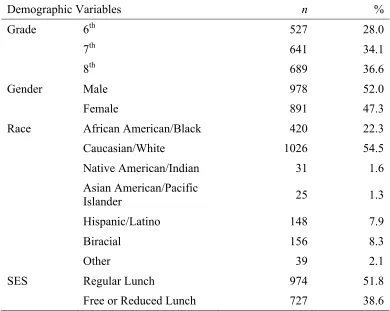
are further presented in Table 2.1.
Procedures
Surveys were distributed to all students in four middle schools in the Southeastern United
States. The survey reflected a school-based assessment of school climate and student
well-being. School teachers administered the surveys in homerooms during October of
for the subsequent data analysis for this research. A total of 27.09% of the students in the
four schools were absent on at least one of the days of data collection. Approval for this
study was granted from the University of South Carolina Institutional Review Board.
Measures. Gratitude.Gratitude was assessed usingthe Gratitude Questionnaire-6
(GQ-6; McCullough et al., 2002; see Appendix A). This scale is a 6-item measure of trait
gratitude based on McCullough and colleagues’ (2002) theory that four qualities
distinguish people who have a grateful disposition (intensity, frequency, span, and
density). In its development, the GQ-6 investigated 39 items the authors believed to
encompass these four qualities. However, factor loadings indicated that one large factor
explained 27% of the total item variance while ten smaller factors each accounted for no
more than 7% of the total item variance. Thus, the six items that loaded strongly on the
large factor and assessed unique aspects of the grateful disposition were retained. The
GQ-6 has support for internal consistency (α = .76 to .85 in participants of ages 10 to 19
years), convergent validity with the Gratitude Adjective Checklist (GAC; McCullough et
al., 2002) and Gratitude Resentment Appreciation Test-short form (GRAT-short;
Watkins, Woodward, Stone, & Kolts, 2003) across participants ages 10 to 13 years (r =
.22 to .61) and with the GAC in adolescents ages 14 to 19 years (r = .42 to .57), and
factorial validity using confirmatory factor analyses when used with youth and
adolescents (see Froh, Fan et al., 2011).Additionally, the GQ-6 has support for test–retest
reliability over a 3-month interval (r = .59; Wood, Maltby, Gillett, Linley, & Joseph,
2008).In recent literature, the GQ-6 has been indicated as more effective for measuring
gratitude in youth and adolescents when only the first five items were used due to weak
al., 2011). Formal interviews with adolescents revealed that the sixth item was “difficult
to understand” and “very abstract” (Froh, Fan et al., 2011, p. 314). This item was deemed
inappropriate for use with children adolescents when developmental level is taken into
account; therefore, the present study used only the first five items. Example items are “I
have so much to be thankful for,” and “I am grateful to a wide variety of people.”
Participants were asked to respond to these statements using a 7-point Likert scale
ranging from “strongly disagree” to “strongly agree.”
Extraversion and neuroticism.Extraversion and neuroticism were assessed using
the Abbreviated Junior Eysenck Personality Questionnaire (JEPQR-A; Francis, 1996; see
Appendix B). The JEPQR-A is an 11-item self-report scale that measures extraversion
and neuroticism based on Eysenck’s theory of personality. Students responded to items in
a “yes; no” format, and higher scores on domains indicated greater levels of extraversion
or neuroticism. This scale has support for internal consistency on both the extraversion (α
= .66) and neuroticism subscales (α = .70). Concurrent validity is also supported by
correlations between the JEPQR-A and the JEPQR-S extraversion (r = .91) and
neuroticism (r = .92) scales (Francis, 1996). On the JEPQR-A, three-month test-retest
reliabilities of .66 for extraversion and .65 for neuroticism have been reported (Roy,
2012). It should be noted that items on the Abbreviated Junior Eysenck Personality
Questionnaire Revised were coded from the original scale such that 1=0 and 2=1 in order
to create composite variables.
Social support.Social support was assessed using the Child and Adolescent
Social Support Scale (CASSS; Malecki & Demaray, 2002; see Appendix C). The CASSS
sources of social support: Parents (12 items), Teachers (12 items), Classmates (12 items),
and Close Friend (4 items). These items measure four types of social support based on
Tardy’s (1985) model of social support: emotional, informational, appraisal, and
instrumental. Participants were asked to respond to items using a 6-point Likert scale
ranging from “never” to “always.” This scale has support for overall internal consistency
(α = .66) and also internal consistency on the subscales (α = .93 to .96). Convergent
validity is also supported by correlations between the CASSS and the Social Support
Scale for Children (Harter, 1985; Malecki & Demaray, 2002; r = .70). Additionally,
construct validity has been supported via positive correlations with adaptive skills,
teacher-rated social skills, and self-esteem and negative correlations with internalizing
and externalizing problems (Malecki & Demaray, 2002). Test-retest reliability is
supported for an 8-week period for both the Total scale (r = .70) and the subscales (r =
.60 to .76). For the purposes of the school survey, the items on the Close Friend subscale
were not included.
Stressful life events.Stressful life events were assessed using the Stressful Life
Event Scale (SLES; Johnson & McCutcheon, 1980; see Appendix D). The SLES is a
45-item self-report scale in which students indicate whether or not they have experienced
specific stressful life events in the past year. The scale includes items referring to both
controllable and uncontrollable life events, but the present study will use only the
uncontrollable life event items (total of 18 items). This is largely because school
administration, teachers, psychologists, and other school professionals cannot otherwise
change the occurrences of these stressful life events; rather, they may be able to
Students responded to items using “no, it did not happen,” “yes, it was good” and “yes, it
was bad” answer options so that it is possible to distinguish between stressful life events
that cause eustress versus distress. With all items included, Johnson and McCutcheon
(1980) reported test-retest reliability coefficients of .69 to .72 over a two-week period.
Meaningful associations with measures of locus of control (r = .21), trait anxiety (r =
.22), and depression (r = .22) also support concurrent validity. Additionally, discriminant
validity is supported via a non-significant correlation with a measure of social desirability
(Johnson & McCutcheon, 1980). It should be noted that items on the Life Events
Checklist were initially rated as “1= no it did not happen;” “2 = yes, it was good;” and “3
= yes, it was bad.” These responses were recoded to determine the frequency of items
marked as “3,” indicating that events occurred and were negative. Brand and Johnson
(1982) were the first to utilize the scale in this manner. For events which were indicated
as negative, Brand and Johnson (1982) found test-retest correlations of .66 over a
two-week period. Additionally, other scholars (e.g., Greene, Walker, Hickson, & Thompson,
1985; Huber, Sifers, Houlihan, & Youngblom, 2012; Ondersma, Lumley, Corlis, &
Tojek, 1997; Walker & Greene, 1991) have reported using this scale and have indicated
similar results regarding reliability and validity adequate for use with children and
Table 2.1 Frequencies for the Demographic Variables
Demographic Variables n %
Grade 6th 527 28.0
7th 641 34.1
8th 689 36.6
Gender Male 978 52.0
Female 891 47.3
Race African American/Black 420 22.3
Caucasian/White 1026 54.5
Native American/Indian 31 1.6
Asian American/Pacific
Islander 25 1.3
Hispanic/Latino 148 7.9
Biracial 156 8.3
Other 39 2.1
SES Regular Lunch 974 51.8
Free or Reduced Lunch 727 38.6
CHAPTER
3
RESULTS
Preliminary Analyses
Before conducting analyses, the data were assessed for possible violations of model
assumptions. This examination revealed that missingness across scales ranged from 0%
to 7.9%, which can influence results by way of standard errors and significance (Cohen,
Cohen, West, & Aiken, 2003). Missing data were managed using multiple imputation,
which predicts and replaces any missing values using existing values within the dataset,
in R 3.0.3 (Rose & Fraser, 2008). Forty new datasets were created in order to achieve the
most realistic dataset, and one dataset was chosen for analysis using a random number
generator. All subsequent analyses were conducted using IBM SPSS Statistics for
Windows, Version 22.0.
The present dataset consisted of data from four separate schools. To determine
appropriateness for collapsing data across schools into one dataset, several preliminary
analyses were conducted. The data were examined for clustering within schools. The
intraclass correlation (ICC) for gratitude was -.07, suggesting that variance within
schools was larger than variance between schools. These findings indicated that
clustering across the schools would not downwardly bias the standard errors in the
present study, and therefore a multi-level model was not utilized in subsequent analyses.
Skewness, kurtosis, histograms, and Q-Q plots were examined to screen for normality
and further violation of model assumptions after multiple imputations were conducted.
The assessments of skewness revealed no statistically problematic features in the dataset,
as the magnitude of skewness for each of the predictor and criterion variables was within
the acceptable range (between -2 and 2; Lomax, 2001). The assessments of kurtosis
revealed possible statistically problematic features in the dataset, as the kurtosis values
for extraversion (2.72) and stressful life events (2.28) exceeded the acceptable range of
between -2 and 2 (Lomax, 2001). However, when these variables were transformed,
correlation coefficients reflecting the association between predictors and the criterion
variable did not significantly differ from correlation coefficients using the original dataset
using logarithmic, t(5) = -1.02, p = .36, square root, t(5) = -1.33, p = .24, and inverse
transformations, t(5) = -.13, p = .90. Because these results indicated satisfactory integrity
within the data set, further analyses were conducted using the original dataset.
Descriptive Statistics
The frequencies of demographic variables for the total sample are presented in Table 2.1,
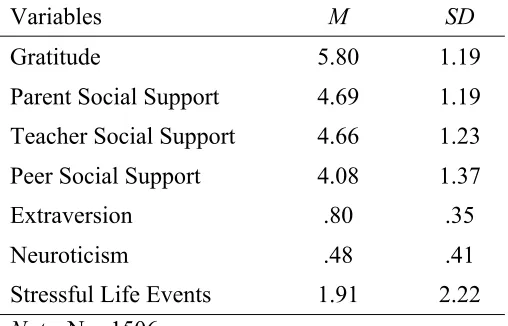
and the means and standard deviations for the variables are presented in Table 3.1. The
mean for parent social support was 4.69 on a 6-point scale (from 1 to 6), suggesting a
relatively high level of parental support reported by students in this sample. Prior studies
have indicated lower parental support in a diverse sample of seventh and eighth grade
students (M=3.72, Rueger, Malecki, & Demaray, 2010). The mean for teacher support
was 4.66 on a 6-point scale (from 1 to 6), suggesting a relatively high level of teacher
support reported by students in this sample. An earlier study indicated lower teacher