International Journal of COPD
Lung function decline in COPD
Claudio Tantucci Denise Modina
Unit of Respiratory Medicine, Department of Medical and Surgical Sciences, University of Brescia, Brescia, Italy
Correspondence: Claudio Tantucci Clinica di Medicina Interna I, Spedali Civili di Brescia, Piazzale Spedali Civili 1, 25100 Brescia, Italy Tel +39 030 39 80 69 Fax +39 030 39 80 69 Email [email protected]
Abstract: The landmark study of Fletcher and Peto on the natural history of tobacco
smoke-related chronic airflow obstruction suggested that decline in the forced expiratory volume in the first second (FEV1) in chronic obstructive pulmonary disease (COPD) is slow at the beginning, becoming faster with more advanced disease. The present authors reviewed spirometric data of COPD patients included in the placebo arms of recent clinical trials to assess the lung function decline of each stage, defined according to the severity of airflow obstruction as proposed by the Global Initiative for Chronic Obstructive Lung Disease (GOLD) guidelines. In large COPD populations the mean rate of FEV1 decline in GOLD stages II and III is between 47 and 79 mL/year and 56 and 59 mL/year, respectively, and lower than 35 mL/year in GOLD stage IV. Few data on FEV1 decline are available for GOLD stage I. Hence, the loss of lung function, assessed as expiratory airflow reduction, seems more accelerated and therefore more relevant in the initial phases of COPD. To have an impact on the natural history of COPD, it is logical to look at the effects of treatment in the earlier stages.
Keywords: chronic obstructive pulmonary disease, decline, forced expiratory volume in
1 second, FEV1
Introduction
Assumptions about lung function decline occurring in chronic obstructive pulmonary disease (COPD) have been greatly influenced by the landmark study of Fletcher and Peto1 on the natural history of tobacco smoke–related chronic airflow obstruction.2
More than 30 years ago, Fletcher and Peto1 measured the forced expiratory volume
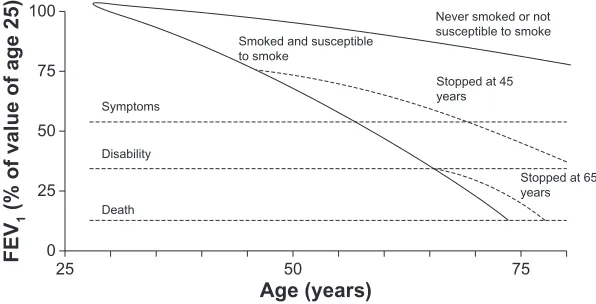
in 1 second (FEV1) every 6 months for an 8-year follow-up period in a cohort of 792 working men, drawing the well-known graph of FEV1 decline over time in COPD (Figure 1). FEV1 was originally expressed as a percentage of the value calculated by extrapolation back to the age of 25 years, made equal to 100, and time in years from age 25 to age 75.
A lot of information arose from Fletcher and Peto’s1 pioneering work: the individual
susceptibility to smoking-related lung functional damage, the unavoidable progression of the airflow obstruction once COPD is established, the large variability of the abnormal lung function decline among different subjects, the possible reduction of the excessive FEV1 decline after smoking cessation at all times, and the paucity of self-reported symptoms when the airflow reduction is mild to moderate. However, among the various messages offered by their analysis, the most retained was that the rate of FEV1 decline increased progressively with time in susceptible smokers. In other words, in the COPD
Dovepress
R E v I E w open access to scientific and medical research
Open Access Full Text Article
International Journal of Chronic Obstructive Pulmonary Disease downloaded from https://www.dovepress.com/ by 118.70.13.36 on 22-Aug-2020
For personal use only.
Number of times this article has been viewed
This article was published in the following Dove Press journal: International Journal of COPD
patients who smoked, the lower the FEV1, the greater its subsequent decline for similar intervals of time.
Some limitations must be acknowledged in the work of Fletcher and Peto.1 All subjects were male, their recruitment
age was between 30 and 59 years only, and the follow-up period was relatively short compared with the large time range shown on the x-axis of Fletcher and Peto’s1 graph
(Figure 1). Therefore, the curves shown in the graph were largely extrapolated backward and forward with inherent inaccuracies, possibly leading to an erroneous picture of the phenomenon. Because of this, the present authors believe that a false idea of lung function decline in COPD has been inculcated in pulmonologists, suggesting that the disease pro-gresses slowly at the beginning and that the loss of function markedly increases only when a given degree of severity has been reached. As a consequence, major therapeutic efforts have been focused on severe to very severe airflow obstruction in COPD patients. Recently, large amounts of data have been collected to challenge Fletcher and Peto’s1 hypothesis.
In the framework of the classification of airflow obstruc-tion severity proposed by Global Initiative for Chronic Obstructive Lung Disease (GOLD) guidelines,3 the authors
analyzed the spirometric data of COPD patients enrolled in recent prospective clinical trials and randomized in the placebo arms to assess the natural rate of FEV1 decline of each stage.
Methods
The authors searched the PubMed database and collected the data available after 1990 on the average rate of FEV1 decline found in large observational studies and in recently published prospective randomized control trials on COPD patients and measured in the respective placebo arms with a follow-up of at least 3 years.
Results
The most important data concerning the average rate of FEV1 decline prospectively measured in large COPD cohorts are shown in Table 1.
Only one large study was found about COPD patients with FEV1 higher than 80% of the predicted value (GOLD stage I). A total of 430 COPD patients recruited in the first stage of the Swiss Study on Air Pollution and Lung Diseases in Adults exhibited an average annual decline in FEV1 of about 40 mL/year over 11 years.4 Within this cohort, the
sub-group of asymptomatic patients had a slightly slower decline than those with chronic cough and phlegm.4 A much smaller
cohort of GOLD stage I and II COPD patients was followed for 3 years in the Copenhagen City Heart Study,5 and this
cohort showed a similar annual reduction in FEV1. Further studies are urgently needed to establish firmly how FEV1 declines in GOLD stage I COPD patients. Data collected on COPD patients recruited in GOLD stage II (with FEV1 between 79% and 50% of the predicted value) by Anthonisen et al (for the Lung Health Study [LHS]),6 Pauwels et al,7
Anthonisen et al (for the LHS-3),8 the LHS Research Group,9
and Jenkins et al10 are consistent, reporting a mean annual
FEV1 decline of 56, 69, 53, 47, and 60 mL/year, respectively. However, it should be noted that in the post hoc analysis from the TORCH (TOwards a Revolution in COPD Health) study the placebo group did not faithfully represent the whole of GOLD stage II, because the inclusion criteria required a pre-bronchodilator FEV1 value of less than 60% of the pre-dicted value.10 Accordingly, the COPD patients included in
this placebo group had a baseline pre-bronchodilator FEV1 between 60% and 50% of the predicted value. Recently published data in the Groningen Leiden Universities Cor-ticosteroids in Obstructive Lung Disease (GLUCOLD) study showed a decline in the placebo group greater than
100
75
50
25
0
25 50 75
Age (years)
FEV
1
(% of value of age 25)
Symptoms
Disability
Death
Smoked and susceptible to smoke
Never smoked or not susceptible to smoke
Stopped at 45 years
Stopped at 65 years
Figure 1 Modified version of Fletcher and Peto’s1 graph showing the decline in the forced expiratory volume in the first second (FEV 1).
Dovepress
Tantucci and Modina
International Journal of Chronic Obstructive Pulmonary Disease downloaded from https://www.dovepress.com/ by 118.70.13.36 on 22-Aug-2020
that found in previous studies, in average amounting to 79 mL/year.11 A secondary analysis of the Understanding
Potential Long-term Impacts on Function with Tiotropium (UPLIFT) study evaluated the effects of long-term treat-ment with tiotropium in GOLD stage II COPD patients.12
Pre-bronchodilator FEV1 declined by a mean of 49 mL/year in the control group. However, this group was not a true placebo group, because all respiratory medications, except other inhaled anticholinergic drugs, were allowed during the trial and about 65% of these patients in the control arm were taking two active drugs. Because of this, the lower mean FEV1 decline in the UPLIFT control group cannot be considered as truly representative of GOLD stage II COPD. Therefore, it is reasonable to estimate that the mean post-bronchodilator FEV1 decline of GOLD stage II COPD patients amounts to 61 ± 12 mL/year, with a little bias toward the lowest initial FEV1 values in this stage. Lung function decline of COPD patients recruited in GOLD stage III is much better defined. In fact, Jenkins et al10 and Burge et al13
had very homogeneous data with a mean FEV1 decline from 56 to 59 mL/year. Interestingly, the FEV1 decline reported by Anzueto et al14 in a 1-year follow-up study performed in the
same stage of COPD severity amounted in the placebo arm to 58 mL/year. The average FEV1 decline found by Decramer et al12 in GOLD stage III in the control arm of the UPLIFT
study, amounting to 38 mL/year, is likely underestimated for the same reason mentioned above. A few data available
about COPD patients recruited with FEV1 less than 30% of the predicted value have shown a much slower mean FEV1 decline at GOLD stage IV than at other stages.10,12
Dawkins et al15 published interesting data about lung
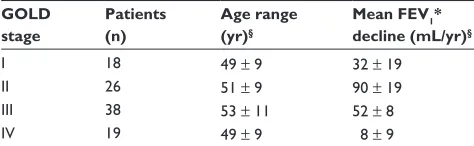
function decline in patients with alpha-1-antitrypsin deficiency-related emphysema stratified according to the GOLD guidelines (Table 2). In emphysematous COPD patients with the PiZ phenotype, the mean annual FEV1 decline was higher in moderate disease, corresponding to GOLD stage II, and was greater than in the general COPD population. These data suggest that COPD patients suffering from panlobular emphysema have the highest rate of FEV1 decline occurring in the early phase of the disease. This has
Table 1 Rate of annual decline in the forced expiratory volume in the first second (FEV1) recorded in Global Initiative for Chronic
Obstructive Lung Disease (GOLD) stage I–IV chronic obstructive pulmonary disease patients randomized in the control arm during
longitudinal studies with a follow-up period of at least 3 years
Reference Study GOLD stage Patients (n) Age range (yr) Follow-up period (yr) Mean FEV1 decline (mL/yr)*
Bridevaux et al4 SAPALDIA 1 I 430 18–60 11 40 ± 37†
vestbo et al5 CCHS I–II 145 59 ± 10§ 3 42††
Anthonisen et al6 LHS II 1964 35–60 5 56††
Pauwels et al7 EUROSCOP II 643 30–65 3 69††
Anthonisen et al8 LHS-3 II 1357 30–60 11 53††
LHS Research Group9 LHS-2 II 557 40–69 3 47††
Jenkins et al10 TORCH II 535 40–80 3 60††
Lapperre et al11 GLUCOLD II 24 45–75 3 79††
Decramer et al12 UPLIFT II 1355 64 ± 9§ 4 49††
Burge et al13 ISOLDE III 375 40–75 3 59††
Jenkins et al10 TORCH III 775 40–80 3 56††
Decramer et al12 UPLIFT III 1331 65 ± 8§ 4 38††
Jenkins et al10 TORCH Iv 214 40–80 3 34††
Decramer et al12 UPLIFT Iv 271 63 ± 8§ 4 23††
Notes:§Mean age plus or minus the standard deviation; *standard deviation is shown when available; †pre-bronchodilator FEv
1; ††post-bronchodilator FEv1.
Abbreviations: CCHS, Copenhagen City Heart Study; EUROSCOP, European Respiratory Society Study on Chronic Obstructive Pulmonary Disease; GLUCOLD, Groningen Leiden Universities Corticosteroids in Obstructive Lung Disease study; ISOLDE, Inhaled Steroids in Obstructive Lung DiseasE study; LHS, Lung Health Study; LHS-2, Lung Health Study 2; LHS-3, Lung Health Study 3; SAPALDIA 1, first stage of the Swiss Study on Air Pollution and Lung Diseases in Adults; TORCH, TOwards a Revolution in COPD Health study; UPLIFT, Understanding Potential Long-term Impacts on Function with Tiotropium study; yr, year.
Table 2 Rate of annual decline of the forced expiratory volume in
the first second (FEV1) in Global Initiative for Chronic Obstructive
Lung Disease (GOLD) stage I–IV chronic obstructive pulmonary disease patients with alpha-1-antitrypsin deficiency-related
emphysema measured during a longitudinal study with a 3-year follow-up period15
GOLD stage
Patients (n)
Age range (yr)§
Mean FEV1*
decline (mL/yr)§
I 18 49 ± 9 32 ± 19
II 26 51 ± 9 90 ± 19
III 38 53 ± 11 52 ± 8
Iv 19 49 ± 9 8 ± 9
Notes:§Data are presented as mean plus or minus the standard error of the mean;
*pre-bronchodilator FEv1.
Abbreviation: yr, year.
Dovepress Lung function decline in COPD
International Journal of Chronic Obstructive Pulmonary Disease downloaded from https://www.dovepress.com/ by 118.70.13.36 on 22-Aug-2020
also been reported by Vestbo et al16 in a recently published
paper on the change in FEV1 over time in the large COPD population enrolled in the Evaluation of COPD Longitudi-nally to Identify Predictive Surrogate Endpoints (ECLIPSE) observational study. In this study patients with computerized tomography scan evidence of emphysema exhibited the larg-est rate of FEV1 decline over a 3-year follow-up period.
Discussion
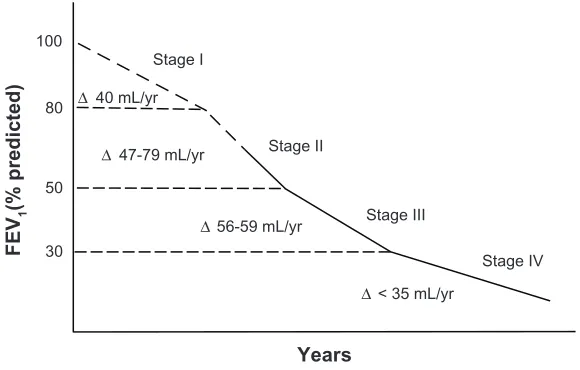
According to the evidence produced, it is clear that the loss of lung function, assessed as expiratory airflow reduction, is more accelerated and therefore more relevant in the early stages of COPD than in the late stages, with some reservation regarding GOLD stage I where consistent information is still lacking. Therefore, a different trend of the FEV1 decline in COPD can be envisaged (Figure 2), showing an opposite view to that of Fletcher and Peto’s diagram ( Figure 1). This is likely because COPD patients in the early stages have more to lose than those in the most advanced stage. In addition, some of the FEV1 loss can be partly buffered by the increase in total lung capacity in GOLD stage IV COPD patients.
Based on these findings, it seems that any attempt to positively interfere with the natural history of COPD by using different therapeutic options should logically be focused on COPD patients in at least GOLD stage II. This is suggested by the subgroup analysis of the treatment group in the GOLD stage II COPD patients of the UPLIFT study.12 Of course,
this approach should be tested and proved by adequate randomized clinical trials.17
It must be acknowledged that most of the recent large COPD trials studied had a 3- to 4-year follow-up period, which is much shorter than the follow-up period in Fletcher and Peto’s1 analysis; this could be a limitation in the accuracy
of the FEV1 decline.
Furthermore, in many of these studies the percentage of dropouts was higher in the placebo arm, meaning that the average rate of FEV1 decline of healthier COPD patients is known rather than that of the true COPD population. As a consequence, the natural rate of FEV1 decline could be underestimated by the existing data. It is reasonable that this could be accentuated in the sicker COPD patients recruited in GOLD stage IV. However, the withdrawal from these studies is essentially because of symptoms and/or exacerbations. Since FEV1 is poorly related to symptoms18
and even to exacerbations,19 it is plausible that this reasoning
may similarly be applied to each COPD stage, leaving the message of a greater loss of function in the early phase of the disorder still valid.
Finally, it should be recognized that the natural history of lung function, not only in healthy never smokers and smokers but also in COPD patients, has been essentially assessed in terms of expiratory airflow reduction, looking at the FEV1 annual change as the primary measure to track the progressive decline of lung function. This could be a limitation, especially in very sick patients.
Stage I
FEV
1
(% predicted)
Stage IV Stage II
Stage III
Years ∆ 47-79 mL/yr
∆56-59 mL/yr
∆< 35 mL/yr 30
50 80 100
∆ 40 mL/yr
Figure 2 Range of average rate of decline in the forced expiratory volume in the first second (FEV1) of chronic obstructive pulmonary disease patients according to initial
severity of airflow reduction.
Notes: Thedashed segment of the line highlights any stage or part of it where consistent information is still lacking; control data from the UPLIFT (understanding Potential Long-term Impacts on Function with Tiotropium) study were not considered in the analysis.
Abbreviation: yr,year.
Dovepress
Tantucci and Modina
International Journal of Chronic Obstructive Pulmonary Disease downloaded from https://www.dovepress.com/ by 118.70.13.36 on 22-Aug-2020
International Journal of COPD
Publish your work in this journal
Submit your manuscript here: http://www.dovepress.com/international-journal-of-copd-journal
The International Journal of COPD is an international, peer-reviewed journal of therapeutics and pharmacology focusing on concise rapid reporting of clinical studies and reviews in COPD. Special focus is given to the pathophysiological processes underlying the disease, intervention programs, patient focused education, and self management protocols.
This journal is indexed on PubMed Central, MedLine and CAS. The manuscript management system is completely online and includes a very quick and fair peer-review system, which is all easy to use. Visit http://www.dovepress.com/testimonials.php to read real quotes from published authors.
Conclusion
In summary, the authors have shown that information provided in recent years about the rate of FEV1 decline in COPD patients strongly supports the concept that the faster progression of functional impairment in COPD occurs early and it particularly occurs in GOLD stage II. This is in contrast with Fletcher and Peto’s1 analysis. In the present
authors’ view it seems more logical to make efforts for an early (spirometric) detection of COPD, based on risk factors rather than symptoms, and to plan randomized clinical trials to show the efficacy of an early strategy of intervention on the natural history of such a disorder.
Disclosure
The authors report no conflicts of interest in this work.
References
1. Fletcher C, Peto R. The natural history of chronic airflow obstruction.
Br Med J. 1977;1(6077):1645–1648.
2. Fletcher C, Peto R, Tinker CM, Speizer FE. The Natural History of
Chronic Bronchitis and Emphysema. London: Oxford University Press;
1976.
3. Global Initiative for Chronic Obstructive Lung Disease. Global strategy for the diagnosis, management and prevention of chronic obstructive
pulmonary disease. Bethesda, MD: National Heart, Lung and Blood
Institute. April 2001 (revised 2007).
4. Bridevaux PO, Gerbase MW, Probst-Hensch NM, Schindler C, Gaspoz JM, Rochat T. Long-term decline in lung function, utilisation of care and quality of life in modified GOLD stage 1 COPD. Thorax. 2008;63(9):768–774.
5. Vestbo J, Sørensen T, Lange P, Brix A, Torre P, Viskum K. Long-term effect of inhaled budesonide in mild and moderate chronic obstructive pul-monary disease: a randomised controlled trial. Lancet. 1999;353(9167): 1819–1823.
6. Anthonisen NR, Connett JE, Kiley JP, et al. Effects of smoking intervention and the use of an inhaled anticholinergic broncodila-tor on the rate of decline of FEV1: the Lung Health Study. JAMA. 1994;272(19):1497–1505.
7. Pauwels RA, Löfdhal CG, Laitinen LA, et al. Long-term treatment with inhaled budesonide in persons with mild chronic obstructive pulmonary disease who continue smoking: European Respiratory Society study on chronic obstructive pulmonary disease. N Engl J Med. 1999;340(25):1948–1953.
8. Anthonisen NR, Connett JE, Murray RP. Smoking and lung function of Lung Health Study participants after 11 years. Am J Respir Crit Care Med. 2002;166(5):675–679.
9. Lung Health Study Research Group. Effect of inhaled triamcinolone on the decline in pulmonary function in chronic obstructive pulmonary disease. N Engl J Med. 2000;343(26):1902–1909.
10. Jenkins CR, Jones PW, Calverly PM, et al. Efficacy of salmeterol/flu-ticasone propionate by GOLD stage of chronic obstructive pulmonary disease: analysis from the randomised, placebo-controlled TORCH study. Respir Res. 2009;10:59.
11. Lapperre TS, Snoeck-Stroband JB, Gosman MM, et al. Effect of fluticasone with and without salmeterol on pulmonary outcomes in chronic obstructive pulmonary disease. Ann Intern Med. 2009;151(8): 517–527.
12. Decramer M, Celli B, Kesten S, Lystig T, Mehra S, Tashkin DP. Effect of tiotropium on outcomes in patients with moderate chronic obstruc-tive pulmonary disease (UPLIFT): a prespecified subgroup analysis of a randomised controlled trial. Lancet. 2009;374(9696):1171–1178. 13. Burge PS, Calverley PMA, Jones PW, Spencer S, Anderson JA,
Maslen TK. Randomised, double blind, placebo controlled study of fluticasone propionate in patients with moderate to severe chronic obstructive pulmonary disease: the ISOLDE trial. BMJ. 2000;320(7245):1297–1303.
14. Anzueto A, Tashkin D, Menjoge S, Kesten S. One-year analysis of longitudinal changes in spirometry in patients with COPD receiving tiotropium. Pulm Pharmacol Ther. 2005;18(2):75–81.
15. Dawkins PA, Dawkins CL, Wood AM, Nightingale PG, Stockley JA, Stockley RA. Rate of progression of lung function impairment in alpha1-antitrypsin deficiency. Eur Respir J. 2009;33(6):1338–1344. 16. Vestbo J, Edwards LD, Scanlon PD, et al. Changes in forced
expi-ratory volume in 1 second over time in COPD. N Engl J Med. 2011;365(13):1184–1192.
17. Decramer M, Cooper CB. Treatment of COPD: the sooner the better?
Thorax. 2010;65(9):837–841.
18. Curtis RJ, Deyo RA, Hudson LD. Pulmonary rehabilitation in chronic respiratory insufficiency: 7. Health-related quality of life among patients with chronic obstructive pulmonary disease. Thorax. 1994;49(2):162–170.
19. Hurst JR, Vestbo J, Anzueto A, et al. Susceptibility to exacerba-tion in chronic obstructive pulmonary disease. N Engl J Med. 2010;363(12):1128–1138.
Dovepress
Dovepress
Lung function decline in COPD
International Journal of Chronic Obstructive Pulmonary Disease downloaded from https://www.dovepress.com/ by 118.70.13.36 on 22-Aug-2020