Does Media Literacy Mitigate Risk for Reduced Body Satisfaction Following Exposure to
Thin-ideal Media?
Siân A. McLean
a, Susan J. Paxton
b& Eleanor H. Wertheim
ca
Corresponding author: Siân A. McLean, School of Psychology and Public Health, La Trobe
University, Melbourne, Australia 3086, [email protected]
b
Susan J. Paxton, School of Psychology and Public Health, La Trobe University,
Melbourne, Australia 3086
c
Eleanor H. Wertheim, School of Psychology and Public Health, La Trobe University,
Abstract
Exposure to thin-ideal media can contribute to increased body dissatisfaction in adolescent girls. Understanding
the factors that may prevent or exacerbate the negative effects of media exposure on body satisfaction is
important to facilitate prevention of these problems. This study evaluated the effects of exposure to thin-ideal
media images on body image in three instructional set experimental conditions: appearance comparison, peer
norms, and control. An important aim was to examine baseline levels of media literacy as a protective factor and
trait thin-ideal internalization and trait upward appearance comparison as risk factors. Early adolescent girls (N
= 246) completed baseline measures and one week later viewed thin-ideal media images, before and after which
they rated their state body satisfaction. Participants in the appearance comparison instruction but not peer norms
instruction condition had significantly reduced body satisfaction. Media literacy, particularly high levels of
critical thinking, mitigated the negative effects of trait thin-ideal internalization and trait upward appearance
comparison on body satisfaction outcomes. These findings provide evidence for the role of media literacy as a
protective factor against the negative effects on body satisfaction of exposure to thin-ideal media images, and
also provide evidence to support the development and implementation of media literacy-based body image
interventions.
Keywords: media literacy; thin-ideal internalization; appearance comparison; media; body satisfaction;
Introduction
Exposure to thin-ideal media images in experimental studies has consistently been shown to reduce
body satisfaction, and effects have been confirmed in meta-analyses (Groesz et al. 2002; Want 2009). Adverse
effects are, however, not universal. Stability, or even improvement in body satisfaction following thin-ideal
media exposure, has been observed (Durkin and Paxton 2002; Knobloch-Westerwick and Crane 2012). Authors
have argued that effects are weak (Holmstrom 2004) or apparent only for those with existing vulnerability
(Ferguson 2013). The aim of this study was to examine factors that predict change or stability in body
satisfaction in early adolescent girls following exposure to thin-ideal media. The study investigated media
literacy as a potential protective factor, and both trait internalization of the thin-ideal and upward appearance
comparison tendencies as potential risk factors.
Body satisfaction problems are serious concerns, particularly for adolescent girls for whom body
dissatisfaction is prevalent (Micali et al. 2014). Along with the distress that accompanies these concerns
(Johnson and Wardle 2005), serious negative consequences can arise from body dissatisfaction. These include
overweight and obesity (Haines et al. 2010; Loth et al. 2015), depressive symptoms and low self-esteem
(Goldschmidt et al. 2016; Paxton et al. 2006), and disordered eating and the development of clinical eating
disorders (Allen et al. 2015; Stice et al. 2011). Adolescence has been identified as a period of particular
vulnerability for transition from body dissatisfaction to disordered eating (Rodgers et al. 2015a; Rohde et al.
2014). Thus, it is important to identify and understand the role of factors that may moderate or exacerbate the
impact of negative influences, such as exposure to thin-ideal media, on body dissatisfaction in adolescent girls.
Examination of protective and risk factors can contribute to such understanding.
Protective Factors: Media Literacy
The literature examining factors that protect against the negative effects of thin-ideal media is in its
infancy. To date, only body appreciation, defined simply as acceptance of one’s body, has been examined as a
protective factor. Initial evidence supports its protective nature (Andrew et al. 2015; Halliwell 2013). Another
factor that may be protective is media literacy. High levels of media literacy, characterised by the ability to think
critically about media in general (Silverblatt 2001), and in particular the ability to make an assessment about
how realistic or unrealistic a media image is, are proposed to reduce the credibility and persuasive influence of
media (Berel and Irving 1998). It would then follow that individuals with high media literacy would be less
likely to compare themselves with thin-ideal images that are perceived to be unrealistic, thus reducing body
Cross-sectional studies provide some support for these proposed relationships. The self-reported
tendency to engage in protective media strategies, such as thinking critically about techniques used to produce
highly stylised thin-ideal images, has been found to be associated with positive body image (Andrew et al.
2015). In addition, high scores on a media literacy measure capturing scepticism about the realism of media
images (realism scepticism) were related to low body dissatisfaction in adolescent girls (McLean et al. 2013). In
experimental studies, post-exposure reports of protective media strategies used while viewing thin-ideal images
did not predict change in body dissatisfaction following media viewing (Andrew et al. 2015) and perceptions of
the realism of thin-ideal images were not found to differ between experimental conditions in which participants
did, or did not, view warning labels highlighting digital alterations of images (Tiggemann et al. 2013). Although
these results were not supportive of media literacy as a protective factor, the design of these experiments was
not optimal for that purpose. To our knowledge, no experimental studies have been conducted that have
specifically examined the effect of pre-exposure levels of media literacy as a protective factor.
Risk Factors: Internalization of the Thin-Ideal and Upward Appearance Comparison Tendencies
In contrast to protective factors, risk factors have been extensively investigated as moderators of
thin-ideal media induced body dissatisfaction. Internalization of the thin-thin-ideal, in which societal thin-ideals for
appearance (an unrealistically thin-ideal for females) are adopted as personal standards, is proposed to increase
risk for negative outcomes following thin-ideal media viewing. Although internalization of the thin-ideal is most
commonly conceptualized and investigated as a predictor of increases in body dissatisfaction (Dakanalis et al.
2015; Rodgers et al. 2015b) or as a mediator of the media exposure-body dissatisfaction relationship (Thompson
et al. 1999), recent advances have proposed that trait internalization of the thin-ideal could also be a moderator
of sociocultural influences, such as media, on body dissatisfaction (Karazsia et al. 2013). In this vein,
individuals high in thin-ideal internalization would be more vulnerable to thin-ideal media exposure. This
outcome has been shown in experimental research, including with young adult females (Dittmar et al. 2009) and
middle-adolescent girls (Durkin and Paxton 2002) exposed to thin-ideal images, and with college-aged females
and males following exposure to sexually objectifying thin-ideal images (Krawczyk and Thompson 2015).
Trait appearance comparison, the tendency to compare one’s appearance with others, has also been
consistently demonstrated to be a moderator of body image outcomes following thin-ideal media viewing. For
example, in middle-adolescent girls, higher levels of appearance comparison, assessed prior to media exposure,
predicted lower body satisfaction following thin-ideal media viewing (Durkin and Paxton 2002). Similar
satisfaction after viewing muscular and slender idealized media images (Galioto and Crowther 2013). It is
assumed from these findings that appearance comparison tendencies predict poorer outcomes for body
satisfaction because individuals engage in “upward” appearance comparisons whereby they compare themselves
to superior targets and perceive that their appearance is inadequate, thus resulting in body dissatisfaction. The
present study will extend previous research by specifically examining upward appearance comparison
tendencies, rather than general appearance comparison tendencies, as a predictor of effects of thin-ideal media
on body satisfaction.
Interaction between Protective and Risk Factors
The effects of protective and risk factors have been examined in isolation but, as recent research
highlights, it is also informative to consider their interaction. Using post-test only designs, interaction effects,
between two risk factors or between protective and risk factors, have been shown to be different from the effect
of the individual factor on body image following media viewing. Young adult women with high appearance
comparison, and high internalization of the thin-ideal had poorer body image after viewing images of attractive
average-sized models than did women with high appearance comparison but low internalization of the thin-ideal
(Dittmar and Howard 2004). Similarly, the presence of both high body mass index (BMI) and high neuroticism
was associated with greater body dissatisfaction following media viewing than the presence of high BMI but
low neuroticism (Dalley et al. 2009). Interactions between the protective factor, body appreciation, and the risk
factor, thin-ideal internalization, have also been investigated (Halliwell 2013). College-age women with high
thin-ideal internalization and low body appreciation had negative body image outcomes following thin-ideal
media viewing but this was not the case for individuals with high thin-ideal internalization and high body
appreciation for whom there was no negative effect of media exposure on body image (Halliwell 2013). Thus,
body appreciation mitigated the impact of internalization of the thin-ideal. The studies described above were
limited by using post-test only designs, which do not allow for examination of the effects of risk and protective
factors on change in body satisfaction following media exposure. Thus, the present study will extend these
approaches by using a pre-post experimental design and examining the effect on change in body satisfaction of
the interaction between protective and risk factors.
Image Processing: Appearance Comparison
As well as pre-existing levels of protective and risk factors, the ways in which individuals think about,
or process the images they are viewing, has been found to influence body satisfaction outcomes of thin-ideal
critical to body image outcomes. Giving college-age women a simple instruction to compare their appearance
with people in experimental stimuli prior to viewing television commercials featuring thin-ideal models led to
an increase in appearance dissatisfaction relative to participants who did not receive such an instruction
(Cattarin et al. 2000). Tiggemann and colleagues have also manipulated the extent to which appearance
comparison processing is undertaken during media viewing through use of a subtle instructional set procedure.
This subtle procedure manipulates processing of images by asking participants to rate their agreement with a
series of statements, such as how thin they are compared with the person in the media images, while they are
viewing thin-ideal images. Findings from one (Tiggemann et al. 2009), but not other studies (Tiggemann and
McGill 2004; Tiggemann and Polivy 2010), demonstrated that, in an appearance comparison processing
condition relative to a control condition, greater body dissatisfaction was reported following thin-ideal media
viewing. Although the outcomes for experimental conditions were not consistent in these studies, levels of
reported appearance comparison processing have been shown to impact body dissatisfaction outcomes.
Specifically, post-viewing body dissatisfaction was related to greater appearance comparison during the viewing
of thin-ideal images for college-age women (Tiggemann and McGill 2004; Tiggemann and Polivy 2010) and
muscular-ideal images for college-age men (Galioto and Crowther 2013; Hargreaves and Tiggemann 2009),
further strengthening evidence for the role of appearance comparison processing in body image outcomes during
media viewing.
Image Processing: Peer Appearance Norms
Consideration of perceived peer norms for appearance, that is, interpretation of subcultural (or peer
group) standards for appearance (Mills et al. 2012), may also influence the media exposure-body dissatisfaction
relationship. It has been argued that media is a powerful source of influence on prevailing appearance norms
(Hesse-Biber et al. 2006; López-Guimerà et al. 2010) and, further, that individuals are aware of the impact of
media on others. Regarding perceptions of ideal body weight, an indicator of appearance norms, college-age
women believe that their peers’ ideal body weight perceptions are influenced by media exposure to a greater
extent than their own perceptions (Chia 2007; David et al. 2002). It is perhaps this third person effect, the
tendency to believe that others are more affected by media than oneself (Davison 1983; Perloff 2009), coupled
with the negative effect that perceived peer appearance norms have on body satisfaction (Bair et al. 2014;
Krcmar et al. 2008; Lin et al. 2015), that contributes to findings of interactions between perceptions of peers’
appearance norms and media influence. Specifically, it has been found that the beliefs of women that others
(Park 2005). Mock peer comments about models’ body size paired with thin-ideal images on a YouTube page
were found to influence adolescent girls’ post-exposure body dissatisfaction (Veldhuis et al. 2014).
Furthermore, comments by adolescent girls in a qualitative study that they perceive they are judged by their
peers against the standards for appearance presented in media (Milkie 1999) offer further insight into the
interaction between media and peer appearance norms.
The Current Study
The current study examined effects of thin-ideal media exposure on body satisfaction in adolescent
girls, a developmental period characterized by identity formation (Erikson 1968). Ecological perspectives
highlight the universality of media as sources of information, including about societal attitudes such as
appearance ideals, that shape adolescents’ identity (Lloyd 2002). In addition, peer relationships provide a
contextual influence through which adolescents interact with media. Peers may offer a reference point through
which media is interpreted (McHale et al. 2009) and peers may also reinforce values and attitudes presented in
media (Lloyd 2002). In light of the centrality of both media and peers to the adolescent developmental period
(Erikson 1968; Lloyd 2002), the current study aimed to examine the effects of media exposure in the context of
the ecological factor, peer appearance norms, as well as in the context of the individual factor, appearance
comparisons.
Thus, the aim of this study was to evaluate the effects of exposure to thin-ideal media images on body
satisfaction in three experimental conditions: appearance comparison, peer norms, and control. It was predicted
that body satisfaction would be lower after viewing thin-ideal images and that the effect would be more
pronounced when participants had been indirectly prompted to compare their appearance to thin-ideal media
images (appearance comparison condition) or to consider their peers’ tendency to do so (peer norms condition)
compared to a control condition. An additional important aim was to examine whether protective and risk
factors assessed at baseline, media literacy, and internalization of the thin-ideal and upward appearance
comparison respectively, moderate the effects of exposure on body satisfaction. Media literacy was predicted to
have a protective effect such that participants with higher levels of critical thinking and realism scepticism were
expected to experience less negative change in body satisfaction following exposure to thin-ideal media images
than participants with low levels of critical thinking and realism scepticism. Both thin-ideal internalization and
upward appearance comparison were predicted to increase risk; participants with higher baseline levels of
internalization and upward appearance comparison were expected to experience greater negative effects on body
upward appearance comparison. In line with the postulated role of media literacy outlined above, it was
predicted that media literacy would interact with both risk factors, internalization and upward appearance
comparison, to mitigate their negative effects on body satisfaction.
Method Participants
Participants were early adolescent girls from four secondary schools in Melbourne, Australia. Written
parental consent and informed consent was obtained from all individual participants (N = 259) included in the
study. The final sample for analysis was N=246 (Mage = 13.11 years, SD = 0.46). Data from three participants
were excluded because they had made multiple attempts to access the online experiment and had been exposed
to more than one experimental condition. Ten participants (appearance comparison n = 4, peer norms n = 3,
control n = 3) did not complete the experiment. Reasons for non-completion were not given. The majority of
participants were born in Australia or New Zealand (85.4%), and others were born in European (5.7%),
South-East Asian (4.9%), or a diverse range of countries (4.1%).
Materials
Media images. The experimental stimuli were ten full length, or three-quarters body length,
advertisements depicting thin-ideal images of young women. A pool of 25 advertisements were selected by the
first author from the most popular magazines for female teenage readers (Roy Morgan 2012). The final ten
images were selected on the basis of responses from a group of body image researchers (N = 8) who rated the
images for consistency with the sociocultural thin-ideal and from responses of a group of early adolescent girls
who took part in a pilot study (N = 10) and rated the images for attractiveness. Advertisements were modified
slightly to remove distracting text.
Experimental manipulation. Subtle means, rather than overt direction, were used to facilitate appearance comparison and peer processing of images, which formed the experimental manipulation for the
study. This approach has been used in previous research to prompt comparison processing (Mills et al. 2002;
Tiggemann and Polivy 2010) and was the preferred approach as direct instructions have been found to be less
effective (Want 2009). Following Tiggemann and Polivy (2010), six questions were presented alongside each
image and participants responded to the questions in relation to each image they viewed. The questions were
embedded in a “consumer response survey” to support the cover story that the study was about opinions on
advertising. For the appearance comparison condition three of the six questions were designed to prompt
compared to the person in the ad?” For the peer norms condition, three of the six questions were designed to
stimulate consideration of peer norms about appearance and the ways in which peers may use media to evaluate
others within their environment. A sample item is “How much do girls in your class compare the shape of their
friends’ bodies to the body shape of the person in the ad?” For the control condition, all six questions were
designed to ensure that participants attended to the stimulus materials, but they did not provoke a particular type
of image processing. A sample item is “How much do you like the overall design of the ad?” The three
additional questions in each of the appearance comparison and peer norms conditions were also designed to
focus attention on the overall image. A sample item is “How much does the ad catch your attention?” For each
question, participants indicated their responses on a visual analogue scale (VAS) from 0 (not at all) to 100 (very
much so). Item responses were not analysed. The six questions for each image were presented in rotation to
prevent order effects.
Measures
Participants completed demographic information (age, country of birth) and frequency of media
exposure (magazine reading and digital media).
Independent variables.
Media literacy. Two measures assessed different aspects of media literacy and media processing. The
Critical Thinking about Media Messages (CTMM) scale (Scull et al. 2010), assessed general critical thinking
about media with six items, such as “I think about the things the advertisers do to get my attention”. Responses
were indicated on a 6-point scale from 0 (never) to 5 (always) and responses were summed to form a total score,
ranging from 0 to 30. Higher scores reflect higher frequency of critical thinking about media. Cronbach’s alpha
in the current study was high (α = .90).
Perceived realism of media images was assessed with the two item version of the Realism subscale of
the Media Attitudes Questionnaire (Irving et al. 1998; McLean et al. 2015). Participants responded to items
“Normally women (in real life) look like models in ads” and “Normally women (in real life) are as thin as the
models in ads” on a 5-point scale from 1 (completely disagree) to 5 (completely agree). Responses were reverse
coded and summed to form a total score, ranging from 2 to 10. For the purposes of the current study the realism
subscale is referred to as realism scepticism to indicate that higher scores reflect higher scepticism about the
realism of media images. Internal consistency for the current study was high (Spearman Brown coefficient =
.81).
have good test-retest reliability, and have adequate construct validity in early adolescent girls. The factor
structure of the scales was also supported (McLean et al. 2015).
Internalization of the thin-ideal. Four items from the Internalization - General subscale of the
Sociocultural Attitudes Towards Appearance Questionnaire (SATAQ; Thompson et al. 2004) assessed
internalization of the thin-ideal from media sources. Items that explicitly assessed comparison with people in
media, such as “I compare my body to the bodies of TV and movie stars” were omitted from the current study to
minimize confounding with assessment of upward appearance comparison. Participants responded to items such
as “I would like my body to look like the people who are on TV” on a 5-point scale from 1 (strongly disagree)
to 5 (strongly agree). Item responses were summed to form a total scale score ranging from 4 to 20, with higher
scores reflecting higher internalization of the thin ideal. Scores on this scale have shown high internal
consistency in young adolescent girls (Ross et al. 2013), and convergent validity in college age samples
(Thompson et al. 2004). In the current study, scores from the 4-item version of the scale correlated highly with
scores on the body dissatisfaction subscale of the Eating Disorders Inventory (Garner 1991), and the Physical
Appearance Comparison Scale (Thompson et al. 1991) (r (246) = .59, p < .001; r (246) = .68, p < .001,
respectively), supporting construct validity. Cronbach’s alpha in the current study was high (α = .91).
Upward appearance comparison tendencies. Five items from the ten item Upward Physical
Appearance Comparison Scale (O'Brien et al. 2009) were used to assess upward appearance comparison
tendencies. Scores on this scale have shown adequate test-retest reliability and construct validity in a young
adult female sample (O'Brien et al. 2009). Five items with lower factor loadings (O'Brien et al. 2009) were
omitted for the current study to reduce participant burden. Participants responded to items such as “I compare
my body to people who have a better body then me” on a 5-point scale from 1 (strongly disagree) to 5 (strongly
agree). A mean score of item responses was calculated to form a scale score ranging from 1 to 5, with higher
scores reflecting greater tendency to compare appearance with physically attractive targets. Supporting construct
validity in early adolescent girls, in the current study scores from the upward appearance comparison measure
were strongly positively correlated (r(243) = .79, p < .001) with scores on the physical appearance comparison
scale (Thompson et al. 1991). Cronbach’s alpha in the current study was high (α = .97).
Dependent variable. State body satisfaction was assessed with visual analogue scales (VAS) (Heinberg and Thompson 1995) immediately before and after exposure to thin-ideal media images. Previous
research has found VAS to yield reliable and valid body satisfaction scores (Durkin and Paxton 2002; Heinberg
shape, with weight, with appearance and feelings of attractiveness were used. An example item is “I feel
satisfied with my body shape”. Participants were asked to indicate how they “feel right now” and responses
were indicated on a 100-point line from 0 (not at all) to 100 (very much so). A mean score across the four items
was calculated to represent the scale score, which ranged from 0 to 100 with higher scores indicating higher
state body satisfaction. Supporting construct validity, in the current study pre-exposure state body satisfaction
was strongly inversely correlated with scores on the body dissatisfaction subscale of the Eating Disorders
Inventory (Garner 1991) at baseline (r (246) = .77, p < .001). Internal consistency values were high in the current
study (pre-exposure α = .94; post-exposure α = .96).
Distractor questions. Three additional VAS items were included before and after participants viewed the thin ideal images. These asked about participants’ opinions of viewing advertisements, such as “I like ads
that make me laugh”. These items were included as distractor questions and also supported the cover story for
the study. Responses to these items were not analysed.
Manipulation check. Following (Tiggemann and Polivy 2010), two questions assessed the degree to which the instructional set, embedded in the consumer response survey, resulted in the intended type of image
processing. Participants rated the extent to which they compared themselves with how the model looked in the
ad, consistent with the appearance comparison instruction set, and how much they thought about friends
comparing one another to how the model looked in the ad, consistent with the peer norms instruction set. Items
were presented in random order and responses were indicated from 0 (none) to 100 (a lot).
Procedure
Ethics approval was given by the University Human Ethics Committee. Participants were asked to take
part in a study to evaluate adolescents’ opinions on advertising. The cover story was used to mask the purpose
of the study. Participants completed all study requirements using online survey software. Sessions were
supervised by a researcher and a teacher was present. Independent variables and questions about magazine and
digital media use were assessed in an initial session, and one week later, participants took part in the
experimental study. For the experimental study, participants completed the pre-exposure body satisfaction and
distractor VAS and were then randomly assigned to experimental condition (appearance comparison n = 82;
peer norms n = 81; control n = 83). Participants then viewed the 10 thin-ideal images, which were presented in
the same order for each experimental condition, and responded to questions about the images in the consumer
response survey according to random assignment to experimental condition. Following image viewing,
manipulation check questions. Participants’ progress through the experiment was self-paced to allow for
different reading and response speeds of the adolescent participants and to simulate natural viewing settings.
Data Analysis
A series of mixed between-within repeated measures analyses of variance (ANOVA) were conducted
to test for effects on body satisfaction of exposure to thin-ideal media images across time, experimental
conditions and baseline levels of risk (thin-ideal internalization and upward appearance comparison tendencies)
and protective (critical thinking and realism scepticism) factors. Four separate ANOVAs were conducted, each
with a 2 (time) x 3 (experimental condition) x 2 (baseline protective factor: high, low) x 2 (baseline risk factor:
high, low) design. For each ANOVA, state body satisfaction was the dependent variable, time
(pre-post-exposure) was the within-subjects factor, and experimental condition (appearance comparison, peer norms,
control) a between subjects factor. Additional between subjects’ factors were: ANOVA 1) critical thinking
(high, low) and thin-ideal internalization (high, low), ANOVA 2) critical thinking (high, low) and upward
appearance comparisons (high, low), ANOVA 3) realism scepticism (high, low) and thin-ideal internalization
(high, low), and ANOVA 4) realism scepticism (high, low) and upward appearance comparisons (high, low).
Protective and risk factors were converted to dichotomous variables, based on a median split, to form high and
low score groups. Post-hoc pairwise comparisons with Bonferroni adjustments were interpreted for multivariate
and between subjects’ effects that were significant and marginally significant.
Results Participant Characteristics
Participants in the three experimental conditions did not differ in age, F (243) = 0.39, p = .680, ƞ2 <
.01, frequency of magazine reading, F (243) = 0.65, p = .524, ƞ2 < .01, or time spent on digital media, F (243) =
0.44, p = .643, ƞ2 < .01. There were also no differences between groups in thin-ideal internalization F (243) =
0.42, p = .657, ƞ2 < .01, upward appearance comparison, F (243) = 0.52, p = .595, ƞ2 < .01, or realism
scepticism, F (243) = 0.526, p = .592, ƞ2 < .01. There was, however, a difference between groups in critical
thinking, F (243) = 4.37, p = .014, ƞ2 = .03, with post-hoc tests revealing that the peer norms condition had
significantly higher levels of critical thinking than the appearance comparison condition, p = .011.
Manipulation Check
One-way ANOVAs tested the difference between experimental conditions of self-ratings of the degree
to which participants engaged in different types of image processing, as per the instruction set, embedded in the
the appearance comparison processing item, F (242) = 3.97, p = .020, ƞ2 = .03, with post-hoc tests revealing that
the appearance comparison condition had significantly higher ratings of appearance comparison processing than
the control condition, p = .015. The difference between conditions for the peer norms processing item was
marginally significant, F (242) = 2.49, p = .085, ƞ2 = .02, with post-hoc tests revealing that the peer norms
condition had marginally significantly higher ratings of peer norms processing than the control condition, p =
.069. These outcomes generally support the success of the experimental manipulations, particularly that of
appearance comparison, although the appearance comparison and peer norms conditions were not significantly
differentiated on comparisons of self to media images and comparisons by friends to media images.
Effects of Thin-ideal Media Exposure on Body Satisfaction
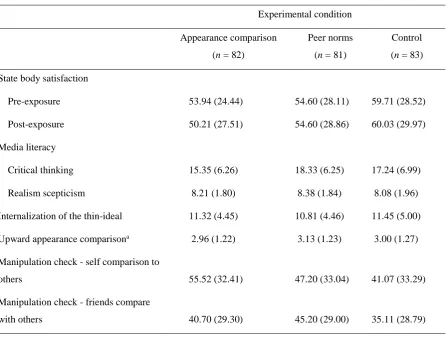
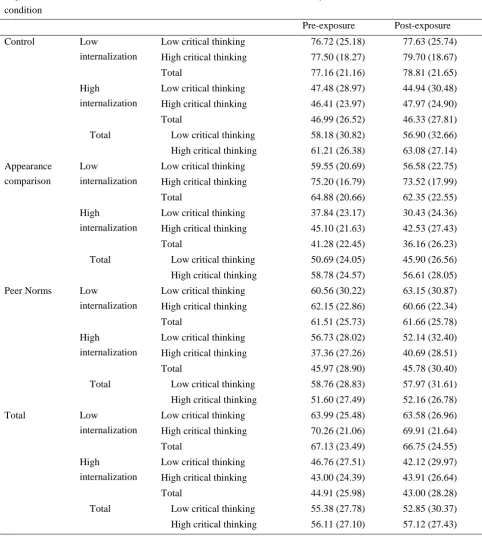
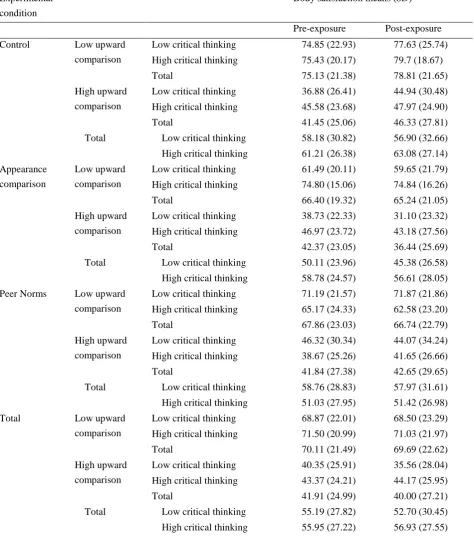
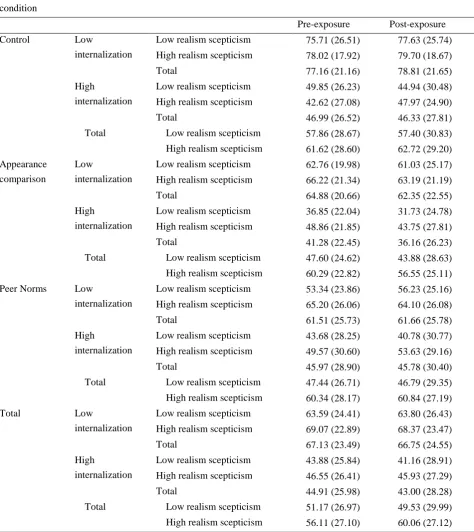
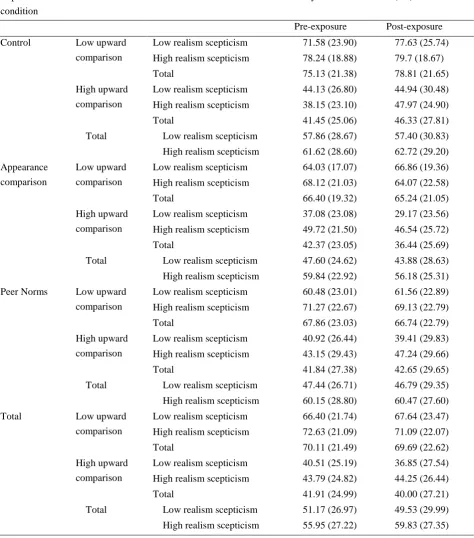
Means and standard deviations for pre- and post-exposure body satisfaction scores and baseline
protective and risk factors for each experimental condition are shown in Table 1. Body satisfaction means and
standard deviations, according to pre-and post-exposure, experimental condition, media literacy, and risk factors
are shown in Appendices A through D.
Repeated Measures (Time) Effects
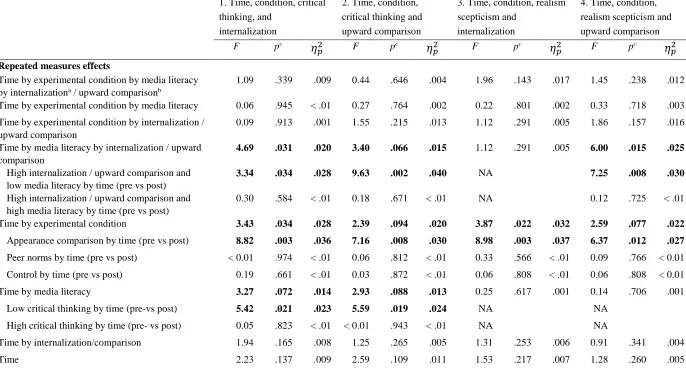
Effects of experimental condition. Change in body satisfaction across time and across experimental conditions was apparent in the significant 2-way interactions between time and experimental condition. None of
the 4-way interactions between time, experimental condition, media literacy, and internalization/upward
comparison or the 3-way interactions between time, experimental condition and media literacy, or between time,
experimental condition, and internalization/upward comparison were significant. See Table 2 for summary
statistics for interaction and main effects.
For the 2-way interaction effects between time and experimental condition that were significant (with
internalization as a between-subjects risk factor; ANOVA 1. F (234) = 3.43, p = .034, 𝜂𝜂𝑝𝑝2 = .028; ANOVA 3. F
(234) = 3.87, p = .022, 𝜂𝜂𝑝𝑝2 = .032) and marginally significant (with upward appearance comparison as a
between-subjects risk factor: ANOVA 2. F (234) = 2.39, p = .094, 𝜂𝜂𝑝𝑝2 = .020; ANOVA 4. F (234) = 2.59, p =
.077, 𝜂𝜂𝑝𝑝2 = .022), post-hoc pairwise comparisons with Bonferroni adjustments were interpreted (see Table 2).
These showed that participants in the appearance comparison condition but not participants in the peer norms or
control conditions, reported significantly lower post-exposure body satisfaction than pre-exposure body
satisfaction.
These interactions between time and experimental condition showed that experimental condition had an
of risk factor, or their interaction. Effects were observed only in the appearance comparison condition whereby
participants experienced reduced body satisfaction following media viewing. No change in body satisfaction
was observed for participants in the peer norms or control conditions.
Effects of protective and risk factors and their interaction. Change in body satisfaction across time and across level of protective or risk factors was apparent in the significant 3-way interactions between time,
media literacy, and internalization/ upward appearance comparison. In addition, marginally significant 2-way
interactions between time and media literacy (critical thinking only) were revealed.
In relation to the 3-way interactions, there were significant interactions between time, critical thinking,
and internalization, ANOVA 1. F (234) = 4.69, p = .031, 𝜂𝜂𝑝𝑝2 = .020, and time, realism scepticism, and upward
comparisons, ANOVA 4. F (234) = 6.00, p = .015, 𝜂𝜂𝑝𝑝2 = .025, and a marginally significant interaction between
time, critical thinking, and upward comparisons, ANOVA 2. F (234) = 3.40, p = .066, 𝜂𝜂𝑝𝑝2 = .015. The interaction
between time, realism scepticism, and internalization was not significant, ANOVA 3. F (234) = 1.12, p = .291,
𝜂𝜂𝑝𝑝2 = .005. For each significant, or marginally significant interaction effect, post-hoc pairwise comparisons with
Bonferroni adjustments were interpreted (see Table 2). For the 3-way interactions, these revealed significantly
lower post-exposure compared with pre-exposure body satisfaction for participants with low levels of media
literacy, either critical thinking or realism scepticism, and high levels of either risk factor, internalization or
upward comparison. In contrast, hoc comparisons showed no differences between pre-exposure and
post-exposure levels of body satisfaction for participants with high levels of media literacy and high risk factors
levels, which indicates a protective effect of high media literacy in participants with high internalization or high
upward comparison tendencies. To illustrate this effect, Figures 1 and 2 show change in body satisfaction
according to level of protective and risk factors.
For the marginally significant 2-way interactions between time and critical thinking, ANOVA 1. F
(234) = 3.27, p = .072, 𝜂𝜂𝑝𝑝2 = .014; ANOVA 2. F (234) = 2.93, p = .088, 𝜂𝜂𝑝𝑝2 = .013, post-hoc pairwise
comparisons were interpreted. Results revealed that participants with low critical thinking, but not high critical
thinking, reported significantly lower body satisfaction at post-exposure, compared with pre-exposure (see
Table 2).
These interactions between time and protective and risk factors showed that body satisfaction was
adversely affected by thin-ideal media viewing for participants low in media literacy and high in internalization
of the thin-ideal or high in upward appearance comparison. In contrast, body satisfaction did not change
conferred a protective effect for media viewing of thin-ideal images.
Between Subjects’ Effects
The between subjects’ effects examining experimental condition, protective and risk factors, and their
interactions, regardless of change across time, did not address the central aims of the study which were to
evaluate change in state body dissatisfaction following media viewing. Thus those results are not presented in
text but are available from the authors upon request.
Discussion
Media is a pervasive influence on adolescents’ development, affecting attitudes, decision making and
behaviors (Strasburger et al. 2010). Attitudes towards, and evaluation of one’s body image have consistently
been found to be adversely affected by exposure to thin-ideal media, although studies do also find that some
individuals are unaffected by such exposure (Durkin and Paxton 2002; Knobloch-Westerwick and Crane 2012).
Understanding the factors that protect against, or that heighten, the negative effects of media exposure is
important to facilitate efforts to prevent body dissatisfaction. The current study aimed to examine effects on
state body satisfaction of exposure to thin-ideal media images in three experimental conditions: appearance
comparison, peer norms, and control. An important aim was to also examine the moderating influences on body
satisfaction of the interaction between protective (media literacy: critical thinking and realism scepticism) and
risk (trait internalization of the thin-ideal and upward appearance comparison tendencies) factors. The results
showed significant decreases in body satisfaction following media viewing for participants in the appearance
comparison but not peer norms or control experimental conditions, for participants low in critical thinking and
high in trait thin-ideal internalization, and for participants low in critical thinking or low in realism scepticism
and also high in upward appearance comparison tendencies. High critical thinking was protective for
participants with high internalization of the thin ideal and both high critical thinking and high realism scepticism
were protective for participants with high upward appearance comparison. Overall, the pattern of results
suggests that critical thinking is highly important in determining the response to media viewing for body
satisfaction.
The findings of this study add to the body of evidence suggesting that individuals are differentially
affected by exposure to thin-ideal media (Ferguson 2013). Of most interest are the novel findings relating to
media literacy that show contrasting effects for participants with high and low levels of this protective factor.
Consistent with predictions, media literacy produced a protective effect. Participants with low critical thinking
at post-exposure, compared with pre-exposure. In contrast, body satisfaction for participants with high critical
thinking did not differ across time. In addition, as predicted, both critical thinking and realism scepticism
mitigated the negative effects of pre-existing levels of risk related to thin-ideal internalization and upward
comparison. In participants with high thin-ideal internalization or high upward comparison, only those with low
critical thinking or low realism scepticism reported lower body satisfaction following media viewing. Those
with high media literacy were protected from the negative impact of high levels of risk factors.
Although media literacy has not previously been examined as a protective factor for thin-ideal media
viewing effects, the pattern of results is similar to research that has looked at the protective effects of body
appreciation. College-age women with low body appreciation experienced an increase in body dissatisfaction
following exposure to thin-ideal advertising images, whereas those with high body appreciation did not
experience this negative effect (Andrew et al. 2015). Examining interactions between body appreciation, and the
risk factor thin-ideal internalization, Halliwell (2013) found negative effects of media viewing on body image
for women with high internalization and low body appreciation. In line with the findings of the current study,
women with high internalization who also had high levels of the protective factor, body appreciation, did not
experience any effects of media exposure (Halliwell 2013). The interaction effects demonstrated in the current
study and in previous research show that protective factors, either media literacy or body appreciation, have a
mitigating, but not enhancing, effect. In other words, the presence of high levels of protective factors mitigates
the negative effects of high levels of pre-existing risk, but do not interact with low levels of risk.
Unexpectedly, the interactions between and time and internalization of the thin-ideal from media
sources, and time and upward comparison were non-significant, whereas the inclusion of media literacy in these
interactions produced significant effects. This demonstrates that poor body satisfaction outcomes for participants
with high levels of risk were apparent only if they also had low media literacy, as discussed above. Previous
research has typically found that thin-ideal internalization and appearance comparison tendencies predict change
in body image following media viewing (Dittmar et al. 2009; Dittmar and Howard 2004; Durkin and Paxton
2002; Krawczyk and Thompson 2015); however, this is not always the case. The mitigating effects of media
literacy, or other protective factors, may explain the current, and previous null findings (Durkin and Paxton
2002, grade 7 girls; Homan et al. 2012). Future research employing experimental manipulation of media literacy
and examining additional outcomes, such as drive for thinness and disordered eating, may differentiate these
effects and contribute to the understanding of causal effects of protective factors on body satisfaction following
may have influenced results. The time-span between pre- and post-exposure assessments of body satisfaction
was brief, and the baseline measures of protective and risk factors were assessed one week prior to the
experimental component of the study. Alterations in the timing of the experimental protocol may have produced
different results.
The negative effects for body satisfaction in the appearance comparison processing condition were
consistent with our predictions and with past research. The current study is the first to establish these effects in
adolescent girls, having previously been demonstrated with college-age women (Cattarin et al. 2000; Tiggemann
et al. 2009). The findings reinforce the notion described above that the processing of images is a crucial
determinant of the effects on body image. However, in contrast to our predictions, only appearance comparison
processing, not peer norms processing, led to lower body satisfaction following thin-ideal media viewing. The
reasons for these findings are unclear but one explanation is that the procedure to prompt peer norms processing
was not sufficiently potent. Although participants in the peer norms condition engaged in marginally greater
peer norm processing than the control condition, as evidenced by the manipulation check, this may not have
been adequate to prompt consideration of the evaluation of one’s appearance by others. Another explanation is
that the peer norms prompts used in the current study were inconsistent with the ways in which adolescents
integrate peer appearance norms into their processing of thin-ideal media images in natural settings. Refined
procedures may facilitate understanding of the effects of peer norms on media exposure. In addition, assessing
levels of recognition and internalization of peer appearance norms at a baseline assessment may provide further
understanding of the interaction between peer norms and effects of exposure to thin-ideal media on body
satisfaction.
Alternatively, the lack of effects for the peer norms condition may have resulted from a buffering effect
in some participants. The intended outcome of the peer norms processing instruction set was for participants to
consider the ways in which their peers may use thin-ideal media to evaluate others’ appearance, including the
appearance of the participant. However, in line with suggestions by Hillard et al. (2016), the inclusion of items
to engage participants in consideration of their peers’ appearance comparison behaviors or desires to look like
media images, which were used to set up the premise that peers use media to compare themselves and others,
could have produced a feeling of cohesion, or bonding between participants and their perceptions of their peers
(Bassett Greer et al. 2015; Hillard et al. 2016), which reduced negative outcomes for some participants.
In light of the findings of previous research that some participants experience increased body
2012), it is perhaps unsurprising that participants in the control condition, in the absence of prompts to compare
themselves to the images, or to engage other appearance related processes, did not have reduced body
satisfaction after thin-ideal media viewing. A number of possibilities may account for this null effect. First, as
has been suggested in previous research in which some participants have been found to rate their own
appearance more highly after viewing thin-ideal images (Mills et al. 2002), some participants in the control
condition of the current study may also have been inspired towards self-enhancement by viewing thin-ideal
images (Mills et al. 2002), resulting in greater body satisfaction. Second, the experimental images were
conservative relative to other studies (Krawczyk and Thompson 2015), and did not show the extreme levels of
thinness that may be required to produce body satisfaction changes, or third, the ubiquity of thin-ideal media
images in Western cultures may have reduced their impact such that presentation of ten thin-ideal images in a
controlled setting is not sufficient to change body satisfaction (Perloff 2014).
This study, with a young female adolescent sample, is the first to have examined the relationship
between media literacy and change in body satisfaction following exposure to thin-ideal media. It is unclear
whether the same outcomes would be replicated with an older sample. At present no data exist that have
examined the relationship between age or developmental stage and media literacy skills, thus we cannot be
certain whether young adolescents, relative to their older counterparts, have particularly low levels of media
literacy, and are generally accepting of the images they view. It may be that critical thinking skills naturally
develop with age in parallel with the development of operational thinking. Higher levels of critical thinking, if
they are present in older adolescents and young adults, may result in different interactions with levels of risk
factors.
The findings of this study have clear implications for prevention. In particular, they provide evidence to
support the use of media literacy interventions (Espinoza et al. 2013; Wilksch et al. 2015). The results of this
study indicate that facilitating the development of critical thinking skills, in addition to highlighting the lack of
realism in thin-ideal media images, as is typically done in some media literacy interventions, may be crucial in
enhancing the impact of media literacy-based approaches. Although both critical thinking and realism
scepticism mitigated the impact of risk factors, the patterns of interactions between each media literacy variable
and the risk factors, internalization of the thin-ideal and upward appearance comparison, were slightly different.
This suggests that different media literacy skills and processes may be used to target particular outcomes. Less
clear is our understanding of how critical thinking and realism scepticism develop in the context of body image,
in media, are also important for reducing risk of developing body dissatisfaction. Prevention efforts would
benefit from understanding this development and the differential impact of separate media literacy constructs in
order to effectively enhance media literacy, leading to positive outcomes for body satisfaction.
The current study also has some limitations. Height and weight measures were not collected, therefore
BMI could not be used as a covariate in the analyses. Although the inclusion of BMI as a covariate may have
changed the pattern of results, previous research has found that BMI did not predict change in body satisfaction
following exposure to thin-ideal images for early- and mid-adolescent girls (Durkin and Paxton 2002). In
addition, neither eating disorder nor dieting status were assessed and also could not be included as covariates. It
is unclear how the inclusion of these variables may have affected outcomes. In order to simulate natural viewing
processes, participants viewed images at their own pace, so the length of exposure to stimuli (photos) varied.
Replication involving measuring self-selected viewing time could clarify possible mediating effects of exposure
time. Alternatively, standardizing length of exposure could control for this variable. We also did not assess
whether participants were aware of the specific nature of the study, and it is possible that expectancy effects
occurred for some participants. Further, the study may have been underpowered to detect 4-way interaction
effects and a large number of comparisons were conducted so it is possible that some findings were spurious.
Conclusion
Addressing the adverse impact of media exposure on adolescents is crucial in light of the importance
that values portrayed in media play in the development of adolescents’ sense of self (Lloyd 2002), an important
component of which is body image (Markey 2010). Understanding the factors that lead to change in body
satisfaction following thin-ideal media exposure has been limited by a focus on examining risk factors, rather
than on also examining protective factors. The current study addressed this limitation by concurrently examining
the impact of media literacy as a protective factor, and both trait internalization of the thin-ideal and upward
appearance comparison tendencies as risk factors in early adolescence. The novel findings, that media literacy,
and tendency to engage in critical thinking in particular, mitigated the negative impact of high levels of risk
factors on change in body satisfaction, provide the first experimental evidence for the role of media literacy as a
protective factor for body satisfaction against the negative effects of exposure to thin-ideal images. In addition,
the results of adverse outcomes for body satisfaction in the appearance comparison condition, but not the peer
norms or control conditions further emphasise that pre-existing characteristics and appearance comparison
processing are key contributors to the link between media exposure and reductions in body satisfaction. Future
skills develop, but under what circumstances adolescents utilize their skills when confronted with potentially
References
Allen, K. L., Byrne, S. M., & Crosby, R. D. (2015). Distinguishing between risk factors for bulimia nervosa,
binge eating disorder, and purging disorder. Journal of Youth and Adolescence, 44(8), 1580-1591,
doi:10.1007/s10964-014-0186-8.
Andrew, R., Tiggemann, M., & Clark, L. (2015). The protective role of body appreciation against
media-induced body dissatisfaction. Body Image, 15, 98-104, doi:10.1016/j.bodyim.2015.07.005.
Bair, A., Steele, J. R., & Mills, J. S. (2014). Do these norms make me look fat? The effect of exposure to others’
body preferences on personal body ideals. Body Image, 11(3), 275-281,
doi:10.1016/j.bodyim.2014.04.004.
Bassett Greer, K., Campione-barr, N., & Lindell, A. K. (2015). Body talk: Siblings' use of positive and negative
body self-disclosure and associations with sibling relationship quality and body-esteem. Journal of
Youth and Adolescence, 44(8), 1567-1579, doi:10.1007/s10964-014-0180-1.
Berel, S., & Irving, L. M. (1998). Media and disturbed eating: An analysis of media influence and implications
for prevention. Journal of Primary Prevention, 18(4), 415-430, doi:10.1023/a:1022601625192.
Cattarin, J. A., Thompson, J. K., Thomas, C., & Williams, R. (2000). Body image, mood, and televised images
of attractiveness: The role of social comparison. Journal of Social and Clinical Psychology, 19(2),
220-239.
Chia, S. C. (2007). Third-person perceptions about idealized body image and weight-loss behavior. Journalism
& Mass Communication Quarterly, 84(4), 677-694.
Dakanalis, A., Carrà, G., Calogero, R., Fida, R., Clerici, M., Zanetti, M. A., et al. (2015). The developmental
effects of media-ideal internalization and self-objectification processes on adolescents’ negative
body-feelings, dietary restraint, and binge eating. European Child and Adolescent Psychiatry, 24(8),
997-1010, doi:10.1007/s00787-014-0649-1.
Dalley, S. E., Buunk, A. P., & Umit, T. (2009). Female body dissatisfaction after exposure to overweight and
thin media images: The role of body mass index and neuroticism. Personality and Individual
Differences, 47(1), 47-51, doi:10.1016/j.paid.2009.01.044.
David, P., Morrison, G., Johnson, M. A., & Ross, F. (2002). Body image, race, and fashion models: Social
distance and social identification in third-person effects. Communication Research, 29(3), 270-294,
Davison, W. (1983). The third-person effect in communication. Public Opinion Quarterly, 47(1), 1-15,
doi:10.1086/268763.
Dittmar, H., Halliwell, E., & Stirling, E. (2009). Understanding the impact of thin media models on women's
body-focused affect: The roles of thin-ideal internalization and weight-related self-discrepancy
activation in experimental exposure effects. Journal of Social and Clinical Psychology, 28(1), 43-72.
Dittmar, H., & Howard, S. (2004). Thin-ideal internalization and social comparison tendency as moderators of
media models' impact on women's body-focused anxiety. Journal of Social and Clinical Psychology,
23(6), 768-791.
Durkin, S. J., & Paxton, S. J. (2002). Predictors of vulnerability to reduced body image satisfaction and
psychological wellbeing in response to exposure to idealized female media images in adolescent girls.
Journal of Psychosomatic Research, 53(5), 995-1005, doi:10.1016/s0022-3999(02)00489-0.
Erikson, E. H. (1968). Identity: Youth and crisis. New York: Norton.
Espinoza, P., Penelo, E., & Raich, R. M. (2013). Prevention programme for eating disturbances in adolescents.
Is their effect on body image maintained at 30 months later? Body Image, 10(2), 175-181,
doi:10.1016/j.bodyim.2012.11.004.
Ferguson, C. J. (2013). In the eye of the beholder: Thin-ideal media affects some, but not most, viewers in a
meta-analytic review of body dissatisfaction in women and men. [Meta Analysis]. Psychology of
Popular Media Culture, 2(1), 20-37, doi:10.1037/a0030766.
Galioto, R., & Crowther, J. H. (2013). The effects of exposure to slender and muscular images on male body
dissatisfaction. [Empirical Study; Quantitative Study]. Body Image, 10(4), 566-573,
doi:10.1016/j.bodyim.2013.07.009.
Garner, D. M. (1991). Eating Disorder Inventory-2 manual. Odessa, FL: Psychological Assessment Resources,
Inc.
Goldschmidt, A. B., Wall, M., Choo, T.-H. J., Becker, C., & Neumark-Sztainer, D. (2016). Shared risk factors
for mood-, eating-, and weight-related health outcomes. Health Psychology, Advance online
publication, doi:10.1037/hea00002.
Groesz, L. M., Levine, M. P., & Murnen, S. K. (2002). The effect of experimental presentation of thin media
images on body satisfaction: A meta-analytic review. International Journal of Eating Disorders, 31(1),
Haines, J., Kleinman, K. P., Rifas-Shiman, S. L., Field, A. E., & Austin, S. B. (2010). Examination of shared
risk and protective factors for overweight and disordered eating among adolescents. Archives of
Pediatrics and Adolescent Medicine, 164(4), 336-343.
Halliwell, E. (2013). The impact of thin idealized media images on body satisfaction: Does body appreciation
protect women from negative effects? Body Image, 10(4), 509-514, doi:10.1016/j.bodyim.2013.07.004.
Hargreaves, D. A., & Tiggemann, M. (2009). Muscular ideal media images and men's body image: Social
comparison processing and individual vulnerability. Psychology of Men & Masculinity, 10(2), 109-119.
Heinberg, L. J., & Thompson, J. (1995). Body image and televised images of thinness and attractiveness: A
controlled laboratory investigation. Journal of Social and Clinical Psychology, 14(4), 325.
Hesse-Biber, S., Leavy, P., Quinn, C. E., & Zoino, J. (2006). The mass marketing of disordered eating and
eating disorders: The social psychology of women, thinness and culture. Women's Studies International
Forum, 29(2), 208-224.
Hillard, E. E., Gondoli, D. M., Corning, A. F., & Morrissey, R. A. (2016). In it together: Mother talk of weight
concerns moderates negative outcomes of encouragement to lose weight on daughter body
dissatisfaction and disordered eating. Body Image, 16, 21-27, doi:10.1016/j.bodyim.2015.09.004.
Holmstrom, A. J. (2004). The effects of the media on body image: A meta-analysis. Journal of Broadcasting &
Electronic Media, 48(2), 196-217, doi:10.1207/s15506878jobem4802_3.
Homan, K., McHugh, E., Wells, D., Watson, C., & King, C. (2012). The effect of viewing ultra-fit images on
college women's body dissatisfaction. Body Image, 9(1), 50-56, doi:10.1016/j.bodyim.2011.07.006.
Irving, L. M., DuPen, J., & Berel, S. (1998). A media literacy program for high school females. Eating
Disorders: The Journal of Treatment & Prevention, 6(2), 119-132, doi:10.1080/10640269808251248.
Johnson, F., & Wardle, J. (2005). Dietary restraint, body dissatisfaction and psychological distress: A prospect
analysis. Journal of Abnormal Psychology, 114, 119-125.
Karazsia, B. T., van Dulmen, M. H. M., Wong, K., & Crowther, J. H. (2013). Thinking meta-theoretically about
the role of internalization in the development of body dissatisfaction and body change behaviors. Body
Image, 10(4), 433-441, doi:10.1016/j.bodyim.2013.06.005.
Knobloch-Westerwick, S., & Crane, J. (2012). A losing battle: Effects of prolonged exposure to thin-ideal
images on dieting and body satisfaction. Communication Research, 39(1), 79-102,
Krawczyk, R., & Thompson, J. K. (2015). The effects of advertisements that sexually objectify women on state
body dissatisfaction and judgments of women: The moderating roles of gender and internalization.
Body Image, 15, 109-119, doi:10.1016/j.bodyim.2015.08.001.
Krcmar, M., Giles, S., & Helme, D. (2008). Understanding the process: How mediated and peer norms affect
young women's body esteem. Communication Quarterly, 56(2), 111-130,
doi:10.1080/01463370802031844.
Lin, L., McCormack, H., Kruczkowski, L., & Berg, M. B. (2015). How women’s perceptions of peer weight
preferences are related to drive for thinness. Sex Roles, 72(3-4), 117-126,
doi:10.1007/s11199-015-0446-4.
Lloyd, B. T. (2002). A conceptual framework for examining adolescent identity, media influence, and social
development. Review of General Psychology, 6(1), 73-91, doi:10.1037//1089-2680.6.1.73.
López-Guimerà, G., Levine, M. P., Sànchez-Carracedo, D., & Fauquet, J. (2010). Influence of mass media on
body image and eating disordered attitudes and behaviors in females: A review of effects and
processes. Media Psychology, 13(4), 387-416, doi:10.1080/15213269.2010.525737.
Loth, K. A., Watts, A. W., van den Berg, P., & Neumark-Sztainer, D. (2015). Does body satisfaction help or
harm overweight teens? A 10-year longitudinal study of the relationship between body satisfaction and
body mass index. Journal of Adolescent Health, 57(5), 559-561, doi:10.1016/j.jadohealth.2015.07.008.
Markey, C. (2010). Invited commentary: Why body image is important to adolescent development. Journal of
Youth and Adolescence, 39(12), 1387-1391, doi:10.1007/s10964-010-9510-0.
McHale, S. M., Dotterer, A., & Kim, J.-Y. (2009). An ecological perspective on the media and youth
development. American Behavioral Scientist, 52(8), 1186-1203, doi:10.1177/0002764209331541.
McLean, S. A., Paxton, S. J., & Wertheim, E. H. (2013). Mediators of the relationship between media literacy
and body dissatisfaction in early adolescent girls: Implications for prevention. Body Image, 10(3),
282-289, doi:10.1016/j.bodyim.2013.01.009.
McLean, S. A., Paxton, S. J., & Wertheim, E. H. (2015). The measurement of media literacy in eating disorder
risk factor research: Psychometric properties of six measures. Manuscript submitted for publication.
Micali, N., Ploubidis, G., De Stavola, B., Simonoff, E., & Treasure, J. (2014). Frequency and patterns of eating
disorder symptoms in early adolescence. Journal of Adolescent Health, 54(5), 574-581,
Milkie, M. A. (1999). Social comparisons, reflected appraisals, and mass media: The impact of pervasive beauty
images on black and white girls' self-concepts. Social Psychology Quarterly, 62(2), 190-210.
Mills, J. S., Jadd, R., & Key, B. L. (2012). Wanting a body that's better than average: The effect of manipulated
body norms on ideal body size perception. Body Image, 9(3), 365-372,
doi:10.1016/j.bodyim.2012.03.004.
Mills, J. S., Polivy, J., Herman, C. P., & Tiggemann, M. (2002). Effects of exposure to thin media images:
Evidence of self-enhancement among restrained eaters. Personality and Social Psychology Bulletin,
28(12), 1687-1699, doi:10.1177/014616702237650.
O'Brien, K. S., Caputi, P., Minto, R., Peoples, G., Hooper, C., Kell, S., et al. (2009). Upward and downward
physical appearance comparisons: Development of scales and examination of predictive qualities. Body
Image, 6(3), 201-206, doi:10.1016/j.bodyim.2009.03.003.
Park, S.-Y. (2005). The influence of presumed media influence on women’s desire to be thin. Communication
Research, 32(5), 594-614, doi:10.1177/0093650205279350.
Paxton, S. J., Neumark-Sztainer, D., Hannan, P. J., & Eisenberg, M. E. (2006). Body dissatisfaction
prospectively predicts depressive mood and low self-esteem in adolescent girls and boys. Journal of
Clinical Child & Adolescent Psychology, 35(4), 539-549, doi:10.1207/s15374424jccp3504_5.
Perloff, R. M. (2009). Mass media, social perception, and the third-person effect. In J. Bryant, & M. B. Oliver
(Eds.), Media effects: Advances in Theory and Research (3rd ed., pp. 252-268). New York: Routledge.
Perloff, R. M. (2014). Social media effects on young women’s body image concerns: Theoretical perspectives
and an agenda for research. Sex Roles, 71, 363-377, doi:10.1007/s11199-014-0384-6.
Richardson, S. M., & Paxton, S. J. (2010). An evaluation of a body image intervention based on risk factors for
body dissatisfaction: A controlled study with adolescent girls. International Journal of Eating
Disorders, 43(2), 112-122, doi:10.1002/eat.20682.
Rodgers, R. F., McLean, S. A., Marques, M., Dunstan, C. J., & Paxton, S. J. (2015a). Trajectories of body
dissatisfaction and dietary restriction in early adolescent girls: A latent class growth analysis. Journal
of Youth and Adolescence, Advance online publication, doi:10.1007/s10964-015-0356-3.
Rodgers, R. F., McLean, S. A., & Paxton, S. J. (2015b). Longitudinal relationships among internalization of the
media ideal, peer social comparison, and body dissatisfaction: Implications for the tripartite influence
Rohde, P., Stice, E., & Marti, C. N. (2014). Development and predictive effects of eating disorder risk factors
during adolescence: Implications for prevention efforts. International Journal of Eating Disorders,
n/a-n/a, doi:10.1002/eat.22270.
Ross, A., Paxton, S. J., & Rodgers, R. F. (2013). Y's Girl: Increasing body satisfaction among primary school
girls. Body Image, 10(4), 614-618, doi:10.1016/j.bodyim.2013.06.009.
Roy Morgan (2012). Young Australians Readership: 12 Months to December 2011.
http://www.roymorgan.com/news/press-releases/2012/1586/. Accessed 11 July 2012.
Scull, T. M., Kupersmidt, J. B., Parker, A. E., Elmore, K. C., & Benson, J. W. (2010). Adolescents'
media-related cognitions and substance use in the context of parental and peer influences. Journal of Youth
and Adolescence, 39(9), 981-998, doi:10.1007/s10964-009-9455-3.
Silverblatt, A. (2001). Media Literacy: Keys to Interpreting Media Messages (2nd ed.). Westport, CT: Praeger
Publishers.
Stice, E., Marti, C. N., & Durant, S. (2011). Risk factors for onset of eating disorders: Evidence of multiple risk
pathways from an 8-year prospective study. Behaviour Research and Therapy, 49(10), 622-627,
doi:10.1016/j.brat.2011.06.009.
Strasburger, V. C., Jordan, A. B., & Donnerstein, E. (2010). Health effects of media on children and
adolescents. Pediatrics, 125(4), 756-767, doi:10.1542/peds.2009-2563.
Thompson, J. K., Heinberg, L. J., Altabe, M., & Tantleff-Dunn, S. (1999). Exacting beauty: Theory, assessment,
and treatment of body image disturbance. Washington, DC, USA: American Psychological
Association.
Thompson, J. K., Heinberg, L. J., & Tantleff, S. (1991). The Physical Appearance Comparison Scale (PACS).
The Behavior Therapist, 14, 174.
Thompson, J. K., van den Berg, P., Roehrig, M., Guarda, A. S., & Heinberg, L. J. (2004). The Sociocultural
Attitudes Towards Appearance Scale-3 (SATAQ-3): Development and validation. International
Journal of Eating Disorders, 35(3), 293-304, doi:10.1002/eat.10257.
Tiggemann, M., & McGill, B. (2004). The role of social comparison in the effect of magazine advertisements on
women's mood and body dissatisfaction. Journal of Social & Clinical Psychology, 23(1), 23-44.
Tiggemann, M., & Polivy, J. (2010). Upward and downward: Social comparison processing of thin idealized
Tiggemann, M., Polivy, J., & Hargreaves, D. (2009). The processing of thin ideals in fashion magazines: A
source of social comparison or fantasy? Journal of Social and Clinical Psychology, 28(1), 73-93.
Tiggemann, M., Slater, A., Bury, B., Hawkins, K., & Firth, B. (2013). Disclaimer labels on fashion magazine
advertisements: Effects on social comparison and body dissatisfaction. Body Image, 10(1), 45-53,
doi:10.1016/j.bodyim.2012.08.001.
Veldhuis, J., Konijn, E. A., & Seidell, J. C. (2014). Negotiated media effects. Peer feedback modifies effects of
media’s thin-body ideal on adolescent girls. Appetite, 73(0), 172-182, doi:10.1016/j.appet.2013.10.023.
Want, S. C. (2009). Meta-analytic moderators of experimental exposure to media portrayals of women on
female appearance satisfaction: Social comparisons as automatic processes. Body Image, 6(4), 257-269,
doi:10.1016/j.bodyim.2009.07.008.
Wilksch, S. M., Paxton, S. J., Byrne, S. M., Austin, S. B., McLean, S. A., Thompson, K. M., et al. (2015).
Prevention Across the Spectrum: A randomized controlled trial of three programs to reduce risk factors
for both eating disorders and obesity. Psychological Medicine, 45(9), 1811-1823,
Table 1
Means (standard deviations) for state body satisfaction, and baseline media literacy, internalization of the thin
ideal, and appearance comparison for each experimental condition
Experimental condition
Appearance comparison
(n = 82)
Peer norms
(n = 81)
Control
(n = 83)
State body satisfaction
Pre-exposure 53.94 (24.44) 54.60 (28.11) 59.71 (28.52)
Post-exposure 50.21 (27.51) 54.60 (28.86) 60.03 (29.97)
Media literacy
Critical thinking 15.35 (6.26) 18.33 (6.25) 17.24 (6.99)
Realism scepticism 8.21 (1.80) 8.38 (1.84) 8.08 (1.96)
Internalization of the thin-ideal 11.32 (4.45) 10.81 (4.46) 11.45 (5.00)
Upward appearance comparisona 2.96 (1.22) 3.13 (1.23) 3.00 (1.27)
Manipulation check - self comparison to
others 55.52 (32.41) 47.20 (33.04) 41.07 (33.29)
Manipulation check - friends compare
with others 40.70 (29.30) 45.20 (29.00) 35.11 (28.79)
a Sample sizes for upward appearance comparisons were: appearance comparison condition (n = 81), peer norms
condition (n = 79), control condition (n = 83)