International Journal of Nanomedicine
Effects of a novel pH-sensitive liposome
with cleavable esterase-catalyzed and
pH-responsive double smart mPEG
lipid derivative on ABC phenomenon
Daquan Chen1,2
Wanhui Liu1,2
Yan Shen3
Hongjie Mu1,2
Yanchun Zhang4
Rongcai Liang1,2
Aiping Wang1,2
Kaoxiang Sun1,2
Fenghua Fu1,2
1School of Pharmacy, Yantai University,
Yantai, People’s Republic of China;
2State Key Laboratory of
Long-acting and Targeting Drug Delivery System, Yantai, People’s Republic of China; 3College of Pharmacy, China
Pharmaceutical University, Nanjing, People’s Republic of China; 4College
of Pharmacy, Anhui University of Traditional Chinese Medicine, Hefei, People’s Republic of China
Correspondence: Kaoxiang Sun School of Pharmacy, Yantai University, Qingquan Road 32, Yantai, 264005, People’s Republic of China Tel. +86 535 6706021 Fax +86 535 6706021 E-mail [email protected]
Background: The ABC phenomenon is described as a syndrome of accelerated clearance of polyethylene glycol (PEG)-modified liposomes from the bloodstream when repeatedly injected, with their increased accumulation in the liver and spleen.
Methods: To clarify this immune response phenomenon, we evaluated a novel modified pH- sensitive liposome with a cleavable double smart PEG-lipid derivative (mPEG-Hz-CHEMS). Results: The ABC phenomenon in mice was brought about by repeated injection of conventional PEG-PE liposomes and was accompanied by a greatly increased uptake in the liver. However, a slight ABC phenomenon was brought about by repeated injection of mPEG-CHEMS liposomes and was accompanied by only a slightly increased uptake in the liver, and repeated injection of mPEG-Hz-CHEMS liposomes did not induce the ABC phenomenon and there was no increase in liver accumulation. This finding indicates that the cleavable mPEG-Hz-CHEMS derivative could lessen or eliminate the ABC phenomenon induced by repeated injection of PEGylated liposomes.
Conclusion: This research has shed some light on a solution to the ABC phenomenon using a cleavable PEG-Hz-CHEMS derivative encapsulated in nanoparticles.
Keywords: accelerated blood clearance, double smart, cleavable, mPEG-lipid derivates, pH-sensitive liposome
Introduction
Many liposome studies have been undertaken to develop a wide variety of amphiphilic-associated conjugates containing a polyethylene glycol (PEG) segment as a modifier,
such as PEG bonded to dimyristoyl phosphatidylethanolamine (DMPE-PEG)1 or to
distearoyl phosphatidylethanolamine/methoxypolyethylene glycol (DSPE-PEG).2
PEG enhances blood levels of the conjugate, but when the drug carrier is intended for intracellular penetration, PEG often prevents normal interaction of the conjugated
drug with cells.3 According to the recent literature, PEGylated liposomes have also
been shown to induce a significant immune response, known as the accelerated blood clearance (ABC) phenomenon, when repeatedly injected into the same animal. The ABC phenomenon is described as a syndrome of accelerated blood clearance whereby repeated injection of PEGylated nanoparticles can cause their rapid clearance from the
bloodstream, with increased accumulation in the liver and spleen.4–6
The ABC phenomenon represents a barrier in research and the clinical use of PEGylated nanocarriers, such as liposomes, nanoparticles, microemulsions, or even
Dove
press
O R I G I N A L R E S E A R C H open access to scientific and medical research
Open Access Full Text Article
International Journal of Nanomedicine downloaded from https://www.dovepress.com/ by 118.70.13.36 on 23-Aug-2020
For personal use only.
Number of times this article has been viewed
This article was published in the following Dove Press journal: International Journal of Nanomedicine
PEGylated proteins. Lu et al7 found that cationic bovine
serum albumin-conjugated polyethyleneglycol-polylactide (PEG-PLA) nanoparticles could induce the ABC phenomenon with repeated injection of PEGylated nanoparticles. Ishihara
et al8 also found that the ABC phenomenon could appear when
PEG-PLA-modified nanoparticles were administered. Many researchers have studied the ABC phenomenon, but there has not yet been any feasible solution to avoid or
alleviate this problem. Judge et al9 and Semple et al10 used
PEGylated lipids with smaller C14 lipid anchors in modi-fied liposomes and found that the PEG dissociating from the particles increased and the ABC phenomenon was avoided. Some researchers have made efforts to alter the linkage between the lipids and PEG and use them in the liposome.
Romberg et al11 have replaced PEG-modified liposomes with
polyamino acid polyhydroxyethyl-L-asparagine (PHEA). PHEA liposomes have shown favorably long circulation times compared with PEGylated liposomes, and a second dose of PHEA liposomes given seven days after the first injection is more slowly cleared from the blood circulation than a second dose of PEG liposomes.
Esterase belongs to the group of plasma functionality
enzymes that include carboxylesterase and cholinesterase.12
Mammalian esterases distribute widely in the plasma and many organs and tissues. They efficiently catalyze the break-age of ester bonds or thioester bonds to free acids from
endogenous or exogenous materials.13,14 Xu et al15,16
synthe-sized two PEG-lipid derivatives that linked via a single ester band so that PEG could be cleaved by esterase in plasma. The vesicles or liposomes modified by different PEG-lipid derivates (PEG-CHEMS or PEG-CHMC) could reduce or avoid occurrence of the ABC phenomenon. However, the capacity of PEG-CHEMS with a single ester bond is still not strong and requires further investigation.
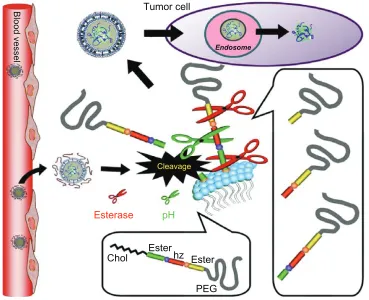
In this study, we prepared modified pH-sensitive lipo-somes with mPEG-Hz-CHEMS, a cleavable PEG-lipid
derivative and control mPEG-CHEMS.17–19 A schematic
diagram of the strategy is shown in Figure 1. The modified pH-sensitive liposomes accumulate in tumor via the enhanced permeability and retention effect. We linked PEG to choles-terol by two ester bonds and one pH-sensitive hydrazone, with the expectation that the chemical bond would gradually be cleaved in serum and at lower pH conditions in vivo. The PEG was then detached from the surface of the liposome, allowing the liposome to associate with the tumor cell sur-face, followed by cellular uptake. We assume that because
Tumor cell
Chol Esterhz Ester
PEG
Esterase pH
Cleavage
Endosome
Blood vesse
l
Figure 1 Schematic diagram of the strategy for double cleavable smart mPEG-Hz-CHEMS-modified liposomes.
Abbreviation: mPEG-Hz-CHEMS, methoxy polyethylene glycol 2000-hydrazone-cholesteryl hemisuccinate.
Dovepress
Chen et al
International Journal of Nanomedicine downloaded from https://www.dovepress.com/ by 118.70.13.36 on 23-Aug-2020
PEG dissociates from the surface of the particle, the ABC phenomenon is avoided. Compared with mPEG-CHEMS, mPEG-Hz-CHEMS could have novel dual features, both at a lower pH and as an esterase. In addition, cleavable mPEG-Hz-CHEMS-modified liposomes have a long circulation time. Therefore, the purpose of this study was to design double smart mPEG-Hz-CHEMS-modified liposomes to reduce the likelihood of the ABC phenomenon.
Materials and methods
Soybean phosphatidylcholine (S100PC) was purchased from Dongshang Co Ltd (Shanghai, China). mPEG-DSPE was obtained from Lipoid (Ludwigshafen, Germany). Cholesterol (Chol) was obtained from China Medicine Shanghai Chemical Reagent Corporation (Shanghai, China). Paclitaxel (PTX) was supplied by Taihua Natural Plant Pharmaceuti-cal Co Ltd (Xi’an Shaanxi, China). PEG2000-CHEMS and PEG2000-Hz-Chol were synthesized in our laboratory. All other chemicals were of analytical grade.
Animals
Five-week-old female BALB/c mice were obtained from Shanghai SLAC Laboratory Animal Co Ltd (Shanghai, China). The animals had free access to water and rat chow. All the animal experiments were in accordance with the Guide for the Care and Use of Laboratory Animals published by the National Institutes of Health.
Preparation of liposomes
Conventional PEG-DSPE liposomes composed of S100PC/ Chol/PEG-DSPE/PTX (90:10:3:3), mPEG-CHEMS lipo-somes composed of S100PC/Chol/PEG-CHEMS/PTX (90:10:3:3), and pH-sensitive mPEG-Hz-CHEMS liposomes composed of S100PC/Chol/ mPEG2000-Hz-CHEMS/PTX (90:10:3:3) were prepared by the thin-film hydration method. Briefly, the hydrophobic excipients, PTX, cholesterol, and lipids were dissolved in chloroform and transferred into a suitable conical flask. The flask was evaporated under reduced pressure. The dry lipid formed was hydrated with phosphate-buffered saline (pH 7.4). The liposomal
suspen-sion was filtered through 0.2 µm polycarbonate filters and
stored at 4°C until use.
Pharmacokinetic and tissue
distribution study
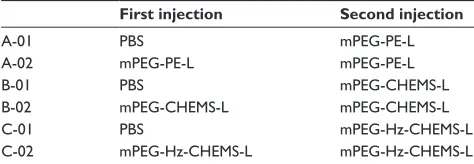
To assess the effect of different liposomes on the pharma-cokinetic and tissue distribution of PTX, BALB/c mice (18–22 g) were used in following formulations (Table 1)
after intravenous administration via the caudal vein at the dose of 20 mg/kg bodyweight. The first injection used empty PEGylated liposomes, which were injected via the tail vein. Control animals received phosphate-buffered saline instead of the liposomes. The interval between the two injections was three days. For the second injection, liposomes were injected intravenously via the tail vein. Injection protocols for the liposomes are presented in Table 1. A-01 represents the first injection using empty mPEG-PE liposomes instead of phosphate-buffered saline, while the second injection comprised mPEG-PE lipo-somes via the tail vein. A-02 represents the first injection using mPEG-PE liposomes, and the second injection also comprised mPEG-PE liposomes. B-01 denotes the first injection using empty mPEG-CHEMS liposomes instead of phosphate-buffered saline, while the second injection was of mPEG-CHEMS liposomes via the tail vein. B-02 denotes the first injection using mPEG-PE liposomes, while the second injection was also of mPEG-CHEMS liposomes. C-01 represents the first injection using empty mPEG-Hz-CHEMS liposomes instead of phosphate-buffered saline, while the second injection was of mPEG-Hz-CHEMS liposomes via the tail vein. C-02 denotes the first injection using mPEG-Hz-CHEMS liposomes, while the second injection also contained mPEG-PE liposomes.
At hours 0.25, 0.5, 1, 2, 4, 6, 8, and 12 following injection, blood samples were collected from the eyes of six mice in each group, after which the mice were sacrificed by cervical dislocation. Plasma was obtained by centrifugation at 5000 rpm for 10 minutes. The liver and spleen were removed and washed twice with physiological solution (0.9% NaCl), weighed, and homogenized. The plasma and tissue samples
were kept at −20°C until analysis.
Analytical procedure
A 140 µL aliquot blood sample, 10 µL of internal standard
(Diazepam in methanol), and 290 µL of acetonitrile were
Table 1 Injection protocols for liposomes
First injection Second injection
A-01 PBS mPEG-PE-L
A-02 mPEG-PE-L mPEG-PE-L
B-01 PBS mPEG-CHEMS-L
B-02 mPEG-CHEMS-L mPEG-CHEMS-L
C-01 PBS mPEG-Hz-CHEMS-L
C-02 mPEG-Hz-CHEMS-L mPEG-Hz-CHEMS-L
Abbreviations: mPEG-Hz-CHEMS, methoxy polyethylene glycol 2000-hydrazone-cholesteryl hemisuccinate; mPEG-CHEMS, methoxypolyethylene glycol 2000-2000-hydrazone-cholesteryl hemisuccinate; mPEG-PE, methoxypolyethylene glycol 2000-distearoyl phosphatidyl- ethanolamine; CHEMS, cholesteryl hemisuccinate; L, liposomes.
Dovepress pH-sensitive liposomes and ABC phenomenon
International Journal of Nanomedicine downloaded from https://www.dovepress.com/ by 118.70.13.36 on 23-Aug-2020
added to a protein precipitation tube. The mixture was vortexed for five minutes and centrifuged at 8000 rpm for
10 minutes. Then 20 µL of the solution were injected into
a high-pressure liquid chromatography (HPLC) system.
A 150 µL aliquot of homogenate from the liver and spleen,
10 µL of internal standard (Diazepard in methanol) and
290 µL of acetonitrile were added. The mixture was
vor-texed for five minutes and centrifuged at 15,000 rpm for
10 minutes, and 20 µL of the supernatant was then injected
into the HPLC system.
The concentrations of PTX in plasma and tissue samples were assayed by an HPLC method. The HPLC was equipped
with a reverse-phase column (4.6 mm × 250 mm, Hanbon,
Jiangsu, China) at 35°C and an ultraviolet
spectrophotom-eter (Agilent Technologies, Palo Alto, CA). The mobile phase was a mixture of methanol and water (72:28 v/v). The samples were delivered at a flow rate of 1.0 mL/min and detected at a wavelength of 227 nm.
Statistical analysis
Statistical comparisons were performed using the Student’s
t-test for the two groups, and one-way analysis of variance
for multiple groups. P, 0.05 was considered to be
statisti-cally significant.
Results and discussion
Effect of repeated injections on
pharmacokinetics of PEGylated liposomes
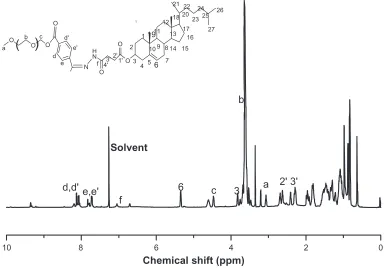
The structure and 1H-NMR spectrum of mPEG-Hz-CHEMS
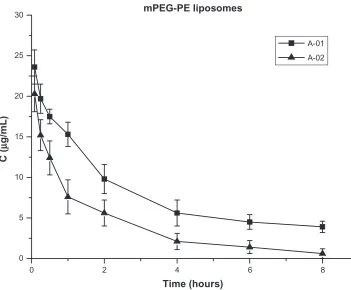
is shown in Figure 2. The pharmacokinetics of PEG-lipid-modified liposomes in mice were evaluated after the first and second injections. There was an obvious ABC phenomenon with the conventional mPEG-PE modified liposomes. The plasma PTX concentration decreased significantly
(P, 0.05) after repeated injections of mPEG-PE liposomes
(Figure 3A-02).
There was a sharp increase in plasma clearance rate after repeated injections of the mPEG-PE liposomes (Figure 3 and Table 3). However, the cleavable PEG-lipid derivative-modified liposomes showed different pharmacokinetics after the repeat injection compared with the conventional mPEG-PE liposomes. The plasma PTX concentration did not decrease significantly after repeated injections, either in the mPEG-CHEMS liposomes and pH-sensitive mPEG-Hz-CHEMS liposomes (Figures 4 and 5, Table 3).
As shown in Figure 4, the plasma PTX concentration in the B-01 group at each time point was slightly higher than that in the B-02 group (mPEG-CHEMS liposomes). The dif-ferent PEGylated liposomes have difdif-ferent characteristics.
10 8 6 4 2 0
O O
O H N N O
O O O
Chemical shift (ppm)
1
1 2
3 4 56
8 9 10
11 12
13
14 15 16 17 18
19
20 21 22
23
7
24 25 26
27
1' 2' 3' 4'
Solvent
2' 3' 6
)
(
ab c
d
e f
f d'
e'
d,d' e,e'
b
c 3 a
Figure 2 Structure and 1H-NMR spectra of mPEG-Hz-CHEMS in CDCl
3. Mean particle size of different liposomes ranged in size from 100 to 200 nm with no significant
differences. The mean zeta potential of the different liposomes were also similar. The entrapment efficiency of the different liposomes was determined to be above 90%
(see Table 2).
Abbreviation: mPEG-Hz-CHEMS, methoxy polyethylene glycol 2000-hydrazone-cholesteryl hemisuccinate.
Dovepress
Chen et al
International Journal of Nanomedicine downloaded from https://www.dovepress.com/ by 118.70.13.36 on 23-Aug-2020
mPEG-Hz-CHEMS have double pH-sensitive hydra-zone and esterase-sensitive ester, which could be easily cleavable. mPEG-CHEMS has only esterase-sensitive ester, while mPEG-PE is not steady under lower pH and esterase conditions. The main pharmacokinetic parameters of different liposomes also indicate this phenomenon (Table 3).
However, as shown in Figure 5 and Table 3, there was no significant difference between the C-01 and C-02 groups (mPEG-Hz-CHEMS liposomes). Blood clear-ance curves and plasma clearclear-ance rate in the C groups were basically the same. That is, mPEG-CHEMS-modified liposomes could alleviate the ABC phenomenon, while mPEG-Hz-CHEMS-modified liposomes could avoid the ABC phenomenon.
Effect of repeated injections on
biodistribution of PEGylated liposomes
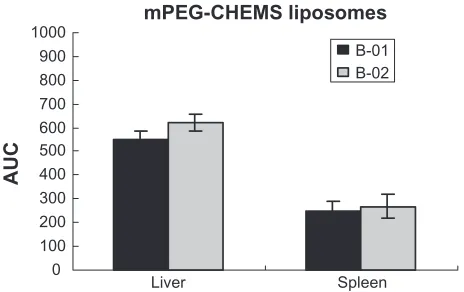
With regards to biodistribution of the mPEG-PE liposomes, there was a markedly increased uptake in the liver after the second dose, but no significant difference in the spleen. As shown in Figure 6, the accumulated amount of PTX in the
liver increased after the second dose (P, 0.05). However,
compared with mPEG-PE liposomes, the accumulated amount of PTX in the liver and spleen was not changed in mPEG-CHEMS liposomes and mPEG-Hz-CHEMS liposomes. As shown in Figure 7, mPEG-CHEMS modified liposomes only induced a slight ABC phenomenon which could alleviate the ABC phenomenon. As shown in Figure 8, repeated injection of mPEG-Hz-CHEMS liposomes caused no increase in liver and spleen accumulation. From the results above, mPEG-Hz-CHEMS-modified liposomes could avoid the ABC phenomenon.
Table 2 Physicochemical parameters of different liposomes
Liposomes Particle
size (nm)
Zeta potential (mV)
Entrapment efficiency (%)
mPEG-PE-L 113.2 ± 8.3 −19.6 ± 4.0 92.6 ± 3.6 mPEG-CHEMS-L 125.4 ± 7.2 −24.1 ± 3.6 91.2 ± 3.4 mPEG-Hz-CHEMS-L 120.3 ± 4.6 −21.2 ± 3.4 94.4 ± 4.2
Abbreviations: mPEG-Hz-CHEMS, methoxy polyethylene glycol 2000- hydrazone-cholesteryl hemisuccinate; mPEG-CHEMS, methoxypolyethylene glycol cholesteryl hemisuccinate; mPEG-PE, methoxypolyethylene glycol 2000- distearoyl phosphatidylethanolamine; L, liposomes.
0 2 4 6 8
0 5 10 15 20 25 30
C
(
µ
g/mL)
Time (hours)
A-01 A-02
mPEG-PE liposomes
Figure 3 Blood clearance of paclitaxel in mice after a first and second injection of mPEG-PE liposomes (n = 6). Abbreviation: mPEG-PE, methoxy polyethylene glycol 2000-distearoyl phosphatidylethanolamine.
Table 3 Main pharmacokinetic parameters of different liposomes
Parameters A-01 A-02 B-01 B-02 C-01 C-02
t1/2α (hours) 1.01 0.23 0.31 0.32 0.29 0.26 t1/2β (hours) 12.73 2.89 5.88 4.05 4.77 4.54
Clearance (µg/mL/hour) 0.18 0.60 0.32 0.48 0.23 0.22
Dovepress pH-sensitive liposomes and ABC phenomenon
International Journal of Nanomedicine downloaded from https://www.dovepress.com/ by 118.70.13.36 on 23-Aug-2020
0 2 4 6 8 0
5 10 15 20 25 30
C
(
µ
g/mL)
Time (hours)
B-01 B-02
mPEG-CHEMS liposomes
Figure 4 Blood clearance of paclitaxel in mice after a first and second injection of mPEG-CHEMS liposomes (n = 6). Abbreviation: mPEG-CHEMS, methoxy polyethylene glycol 2000-cholesteryl hemisuccinate.
0 2 4 6 8
0 5 10 15 20 25 30
C
(
µ
g/mL)
Time (hours)
C-01
C-02
mPEG-Hz-CHEMS liposomes
Figure 5 Blood clearance of paclitaxel in mice after a first and second injection of mPEG-Hz-CHEMS liposomes (n = 6). Abbreviation: mPEG-Hz-CHEMS, methoxy polyethylene glycol 2000-hydrazone-cholesteryl hemisuccinate.
Dovepress
Chen et al
International Journal of Nanomedicine downloaded from https://www.dovepress.com/ by 118.70.13.36 on 23-Aug-2020
Discussion
The ABC phenomenon is important for the development of drug delivery systems, especially for nanoparticles in the case of repeated injection of nanomedicines. Researchers have used different animal models to investigate the mechanism of the ABC phenomenon, including rats, mice, rhesus mon-keys, and rabbits, among others. Dams et al demonstrated that rhesus monkeys and rats could bring out the ABC phe-nomenon after repeated injection of PEGylated liposomes,
whereas mice could not.20 Ishida et al have studied the first
liposomal characteristics that affect the ABC phenomenon and demonstrated that an intense accelerated clearance can
be induced in mice.21
Although the conclusion from animal experiments might not be fully consistent with the clinical manifestations of liposomes, when there is a need for repeated injections, thorough study of their distribution in the body and their pharmacokinetics is necessary. Many researchers have sought
a possible solution for the ABC phenomenon. Xu et al have
investigated16 vesicles or liposomes modified by different
PEG-lipid derivatives (PEG-CHEMS or PEG-CHMC) that could reduce or avoid the ABC phenomenon. In our stud-ies, pH-sensitive liposomes modified by PEG-lipid deriva-tives (PEG-Hz-CHEMS) showed better PEG cleavage rates when incubated in serum. The PEG-Hz-CHEMS was easily degraded at pH 5.5 (half-life 6.7 hours), while it has higher
stability at physiological pH (half-life 40.9 hours).17
Due to the pH-sensitive hydrazone bond, the degree of PEG cleavage from PEG-Hz-CHEMS was higher than that from PEG-CHEMS, based on pH-insensitive ester bands and noncleavable PEG-CHOL and PEG-DSPE. This is consistent
with the conclusion reached by Xu et al.16 When rats received
repeated injections of PEG-CHEMS-modified liposomes, there were minor occurrences of the ABC phenomenon, which disappeared with PEG-Hz-CHEMS. However, PEG-PE and PEG-CHOL-modified liposomes produced a significant ABC phenomenon. Our results showed that the phenomenon was more obvious with lower degrees of PEG cleavage
(PEG-Hz-CHEMS . PEG-CHEMS . PEG-CHOL . PEG-DSPE).
Therefore, our hypothesis was that a first injection of cleavable PEG-lipid derivative-modified liposomes could reduce or avoid the ABC phenomenon.
When we adopted the cleavable pH-sensitive PEG-Hz-CHEMS to modify liposomes, the ABC phenomenon was almost eliminated. In studies of the ABC phenomenon, the sec-ond injected liposomes have usually been tracer-labeled with
technetium (99 mTc-PEG)6,10 or 3H-CHE. However, because
this method needs to be carried out by skilled personnel and with strict security precautions, its applications are limited. Xu
et al17 used calcein, a water-soluble fluorescence probe, to mark
mPEG-PE liposomes
0 200 400 600 800 1000
Liver
AUC
A-01 A-02
*
Spleen
Figure 6 Biodistribution of paclitaxel in mice after a first and second injection of
mPEG-PE liposomes (n = 6).
Abbreviation: mPEG-PE, methoxypolyethylene glycol 2000-distearoyl phosphatid-ylethanolamine.
mPEG-CHEMS liposomes
0 100 200 300 400 500 600 700 800 900 1000
AUC
B-01 B-02
Liver Spleen
Figure 7 Biodistribution of paclitaxel in mice after a first and second injection of
mPEG-CHEMS liposomes (n = 6).
Abbreviation: mPEG-CHEMS, methoxypolyethylene glycol 2000-cholesteryl hemisuccinate.
mPEG-Hz-CHEMS liposomes
0 100 200 300 400 500 600 700 800 900 1000
Liver
AU
C
C-01 C-02
Spleen
Figure 8 Biodistribution of paclitaxel in mice after a first and second injection of
mPEG-Hz-CHEMS liposomes (n = 6).
Abbreviation: mPEG-Hz-CHEMS, methoxypolyethylene glycol 2000-hydrazone-cholesteryl hemisuccinate.
Dovepress pH-sensitive liposomes and ABC phenomenon
International Journal of Nanomedicine downloaded from https://www.dovepress.com/ by 118.70.13.36 on 23-Aug-2020
the inner water phase of liposomes and vesicles to investigate the ABC phenomenon. Compared with radioimmunoassay, fluorescence labeling has no radioactive contamination and is easy to perform. Moreover, the calcein marker can reflect overall changes in liposomes in the body, while a tracer marker can only express the changes in membrane components. How-ever, the calcein marker also has some limitations, especially in that it does not reflect the characteristics of a poorly water soluble drug, as is the case with many antitumor drugs. PTX, the first of the microtubule-stabilizing agents, is one of the most successful anticancer drugs and shows potency against a broad spectrum of cancers, especially carcinomas of the breast, ovary
and lung.22,23 It is currently marketed in a vehicle composed of
Cremophor® EL (polyethoxylated castor oil) and ethanol due
to its low aqueous solubility.24,25 Comparing 3H-CHE
label-ing and fluorescence labellabel-ing, the PTX marker could better reflect its real pharmacokinetic behavior in terms of the ABC phenomenon. In this study, we studied the effect on the ABC phenomenon of novel pH-sensitive liposomes with cleavable pH-sensitive PEG-Hz-CHEMS liposomes containing PTX.
Conclusion
We modified liposomes by mPEG-Hz-CHEMS via cleav-able pH-responsive hydrazone and esterase-catalyzed ester linkages so that the PEGylated coating can be efficiently removed by the lower pH and esterase in the serum. This is the first time hydrazone and ester esterase-cleavable linkers have been utilized simultaneously as an effective strategy for PEG-lipid cleavage. The ABC phenomenon was induced by repeated injection of PEGylated liposomes into the rat and was accompanied by substantially increased uptake into the liver. Repeated injection of the conventional and noncleavable PEG-lipid derivative-modified microparticles induced the ABC phenomenon. We used cleavable esterase-catalyzed and pH-responsive double smart mPEG-Hz-CHEMS to modify liposomes and showed that the ABC phenomenon became weaker or disappeared. Therefore, cleavable esterase- catalyzed and pH-responsive double smart mPEG-Hz-CHEMS can not only prolong the circulation time of liposomes, but also avoid or weaken the ABC phenomenon. These studies have paved the way for a solution to the ABC phenomenon using cleav-able PEG-lipid derivatives in nanoparticles.
Acknowledgments
This work was supported by Yantai University Research Program and Enterprise state key laboratory of 973 Research Program (China, 2010CB735600). The authors also thank
Professor Qineng Ping, Can Zhang, and Changli Wang for their efforts and collaboration in this research.
Disclosure
The authors report no conflicts of interest in this work.
References
1. Georgiev GA, Sarker DK, Al-Hanbali O, Georgiev GD, Lalchev Z. Effects of poly (ethylene glycol) chains conformational transition on the properties of mixed DMPC/DMPE-PEG thin liquid films and monolayers. Colloids Surf B Biointerfaces. 2007;59(2):184–193. 2. Lasic DD, Martin FJ, Gabizon A, Huang SK, Papahadjopoulos D. Sterically
stabilized liposomes: A hypothesis on the molecular origin of the extended circulation times. Biochim Biophys Acta. 1991;1070(1): 187–192. 3. Shin J, Shum P, Thompson DH. Acid-triggered release via
dePEGyla-tion of DOPE liposomes containing acid-labile vinyl ether PEG-lipids. J Control Release. 2003;91(1–2):187–200.
4. Dams ET, Laverman P, Oyen WJ, et al. Accelerated blood clearance and altered biodistribution of repeated injections of sterically stabilized liposomes. J Pharmacol Exp Ther. 2000;292(3):1071–1079. 5. Laverman P, Carstens MG, Boerman OC, et al. Factors affecting the
accelerated blood clearance of polyethylene glycol-liposomes upon repeated injection. J Pharmacol Exp Ther. 2001;298(2):607–612. 6. Ishida T, Atobe K, Wang X, Kiwada H. Accelerated blood clearance of
PEGylated liposomes upon repeated injections: Effect of doxorubicin-encapsulation and high-dose first injection. J Control Release. 2006; 115(3):251–258.
7. Lu W, Wan J, She Z, Jiang X. Brain delivery property and accelerated blood clearance of cationic albumin conjugated pegylated nanoparticle. J Control Release. 2007;118(1):38–53.
8. Ishihara T, Takeda M, Sakamoto H, et al. Accelerated blood clear-ance phenomenon upon repeated injection of PEG modified nanoparticles. Pharm Res. 2009;26(10):2270–2279.
9. Judge A, McClintock K, Phelps JR, MacLachlan I. Hypersensitivity and loss of disease site targeting caused by antibody responses to PEGylated liposomes. Mol Ther. 2006;13(2):328–337.
10. Semple SC, Harasym TO, Clow KA, Ansell SM, Klimuk SK, Hope MJ. Immunogenicity and rapid blood clearance of liposomes containing polyethylene glycol-lipid conjugates and nucleic acid. J Pharmacol Exp Ther. 2005;312(3):1020–1026.
11. Romberg B, Oussoren C, Snel CJ, Carstens MG, Hennink WE, Storm G. Pharmacokinetics of poly(hydroxyethyl-L-asparagine)-coated liposomes is superior over that of PEG-coated liposomes at low lipid dose and upon repeated administration. Biochim Biophys Acta. 2007;1768(3): 737–743. 12. Munger JS, Shi GP, Mark EA, Chin DT, Gerard C, Chapman HA.
A serine esterase released by human alveolar macrophages is closely related to liver microsomal carboxylesterases. J Biol Chem. 1991; 266(28):18832–18838.
13. Maxwell DM, Brecht KM, O’Neill BL. The effect of carboxylesterase inhibition on interspecies differences in soman toxicity. Toxicol Lett. 1987;39(1):35–42.
14. Maxwell DM, Lenx DF, Groff WA, Kaminskis A, Froehlich HL. The effect of blood flow and detoxification on in vivo cholinesterase inhibi-tion by soman in rats. Toxicol Appl Pharmacol. 1987;88(1):66–76. 15. Xu H, Deng Y, Chen D, Hong W, Lu Y, Dong X. Esterase-catalyzed
dePEGylation of pH-sensitive vesicles modified with cleavable PEG-lipid derivatives. J Control Release. 2008;130(3):238–245.
16. Xu H, Wang KQ, Deng YH, Chen da W. Effects of cleavable PEG-cholesterol derivatives on the accelerated blood clearance of PEGylated liposomes. Biomaterials. 2010;31(17):4757–47563.
17. Chen D, Jiang X, Huang Y, Zhang Can, Ping Q. pH-Sensitive mPEG-Hz-cholesterol conjugates as a liposome delivery system. J Bioact Compat Polym. 2010;25(5):5527–55242.
Dovepress
Chen et al
International Journal of Nanomedicine downloaded from https://www.dovepress.com/ by 118.70.13.36 on 23-Aug-2020
International Journal of Nanomedicine
Publish your work in this journal
Submit your manuscript here: http://www.dovepress.com/international-journal-of-nanomedicine-journal
The International Journal of Nanomedicine is an international, peer-reviewed journal focusing on the application of nanotechnology in diagnostics, therapeutics, and drug delivery systems throughout the biomedical field. This journal is indexed on PubMed Central, MedLine, CAS, SciSearch®, Current Contents®/Clinical Medicine,
Journal Citation Reports/Science Edition, EMBase, Scopus and the Elsevier Bibliographic databases. The manuscript management system is completely online and includes a very quick and fair peer-review system, which is all easy to use. Visit http://www.dovepress.com/ testimonials.php to read real quotes from published authors. 18. Chen D, Jiang X, Liu J, Jin X, Zhang C, Ping Q. In vivo evaluation
of novel pH-sensitive mPEG-Hz-Chol conjugate in liposomes: Pharmacokinetics, tissue distribution, efficacy assessment. Artif Cells Blood Substit Immobil Biotechnol. 2010;38(3):136–142.
19. Liu J, Li H, Chen D, et al. In vivo evaluation of novel chitosan graft polymeric micelles for delivery of paclitaxel. Drug Deliv. 2011;18(3):181–189. 20. Dams ET, Laverman P, Oyen WJ, et al. Accelerated blood clearance
and altered biodistribution of repeated injections of sterically stabilized liposomes. J Pharmacol Exp Ther. 2000;292(3):1071–1079. 21. Ishida T, Ichikawa T, Ichihara M, Sadzuka Y, Kiwada H. Effect of the
physicochemical properties of initially injected liposomes on the clear-ance of subsequently injected PEGylated liposomes in mice. J Control Release. 2004;95(3):403–412.
22. Panchagnula R. Pharmaceutical aspects of paclitaxel. Int J Pharm. 1998;172:1–15.
23. Singla AK, Garg A, Aggarwal D. Paclitaxel and its formulations. Int J Pharm. 2002;235(1–2):179–192.
24. Gelderblom H, Verweij J, Nooter K, Sparreboom A. Cremophor EL: the drawbacks and advantages of vehicle selection for drug formulation. Eur J Cancer. 2001;37(13):1590–1598.
25. Zhang JA, Anyarambhatla G, Ma L, et al. Development and character-ization of a novel Cremophor EL free liposome-based paclitaxel (LEP-ETU) formulation. Eur J Pharm Biopharm. 2005;59(1):177–187.
Dovepress
Dove
press
pH-sensitive liposomes and ABC phenomenon
International Journal of Nanomedicine downloaded from https://www.dovepress.com/ by 118.70.13.36 on 23-Aug-2020