Biometric Identification System based on
Hand Geometry
Nashwan M. S. Hussein 1, Sipan M. Hammed 2, Burhan Ergen3,
P.G. Student, Department of Computer Engineering, Faculty of Engineering, Firat University, Elazığ, Turkey 1
Department of Computer Engineering, Faculty of Engineering, Near East University, Nicosia, Cyprus 2 Associate Professor, Department of Computer Engineering, Faculty of Engineering, Firat University, Elazığ, Turkey 3
ABSTRACT: In this paper, an effective biometric method based on hand geometry is presented for biometric identification or verification systems. Feature vectors have been constructed from measurable hand geometrics such as length, width and area of fingers. After low-pass filter input hand images for noise reduction, curvature of the shapes is computed. Then, the valleys of a hand are extracted for identification as feature vector. Twenty-four measurement from a hand shape geometry are used as effective features. Artificial neural network and k-nearest neighbors algorithm are used as classifiers for Identification. The experimental result reaches to the performance of 95.3% for neural network and 91.2% for k-nearest neighbors algorithm as correct recognition rates.
KEYWORDS: Hand geometry, biometry, curvature features.
I. INTRODUCTION
The term biometrics has been coming from Greek roots “bios” meaning life and “metrics” meaning measurement. In recent years, the researchers study biometric technology to identify person individually in especially security field applications. Biometric identification uses physiological or behavioral of human characteristic[1]. A development of various biometrics technologies is preferred because of its uniqueness, stability, permanence and ease of acquisition. A biometric identification system can be defined as system recognition of difference in pattern of human characteristics, which is called as personal authentication or access control. The idea to create a biometric system for personal identification can collect measurable characteristics of human body like face, iris, palm print, hand geometry, fingerprint, hand vein, signature etc. in order to constitute feature vector. The kind of biometric systems is chosen according to the security type. This study focuses on hand geometry to construct a biometric identification system. The recent progress of various technologies in computer field in many areas it was been needs and has become an absolute necessary to develop new methods for authentication or identification of a personal in services link internet Account registration form or ATM cards and other password required password form, the biometric Identification based system will good alternative to the classical username and password registration form in all kind of communication and authentication applications. The internet account been proven to be weak and broken, social network and emails been widely cracked. password cracking been appeared widely because of rising technic of guess password and other statistical tools, because of that IT field must focus on alternative solution for information security authentication and access control [2], Additional to that biometric measure is easy to use.
Next is create classifier and modelling the experiment prepare to the test, two classifiers been suggested Neural network and k-Nearest Neighbors, then the model was being ready for test. It been notices that features of hand were very effect on recognition accuracy, therefor the experiment was being repeated many times to define and select best feature. in the end, it was 24 feature been select to create a final classifier model.
II. DATA PREPROCESSING
Data collecting is a first step for many researches after define a problem, the process of collecting Data was done from 35 person hands, each person with 10 samples. The data been collected by scanning hands. This samples are stored as an image package. The Total number being 350 samples, to prepare images for extracting feature it must be filtered from noise, MATLAB Software Package been used in this experiment[8].many steps are essential to prepare images to define and select feature, the basic idea it to normalize all samples of image to be measurable by any algorithms. The following step are process to be prepared.
1. Image Acquisition
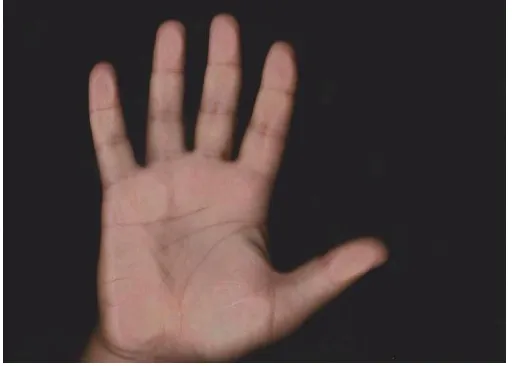
At first, we must obtain our data, image acquisition is first stage, the images data collection stored as a PNG Data format, Figure 1 shows one hand sample. Dataset contain 350 sample from 35 people’s hand, each person with 10 samples.
2. Image Thresholding
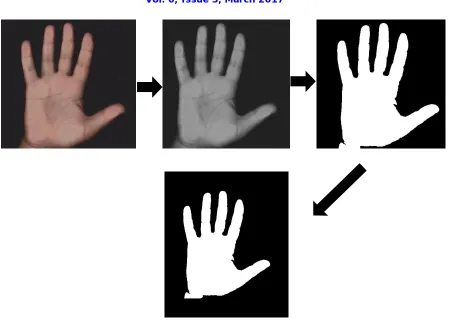
Threshold process been applied to obtain Binary image, the first step is convert color image to Grayscale image, then to Binary image, its essentials to do this steps to define and select hand shape. Pixels in binary image either 0 or 1, therefor it will be easy to recognize hand object in image using algorithm to detect it, figure 2 show all steps how image are converted to binary image. Cropping and Resizing are last step of converting images to be normalize of specific size. The last image product size 1459 by 1650. It’s high resolution image and its fit the requirement and ready for extract all features from it.
Hand Boundary
Hand Trace object in binary image is a search process, it applied to traces the outline of an object, because binary image contains only 0 or 1, it easy to specify the object by search a connected component, nonzero pixels are belonging to object and zero pixels are non, an efficient way to define an object boundary that the maximum number of boundary pixels to be object outline[9]. because of images normalization size, it’s easy to trace to all images boundary. the boundary been find as a sequence of points (x, y) that represent an outline around the boundary of the shape in order.
2. Low-pass filter
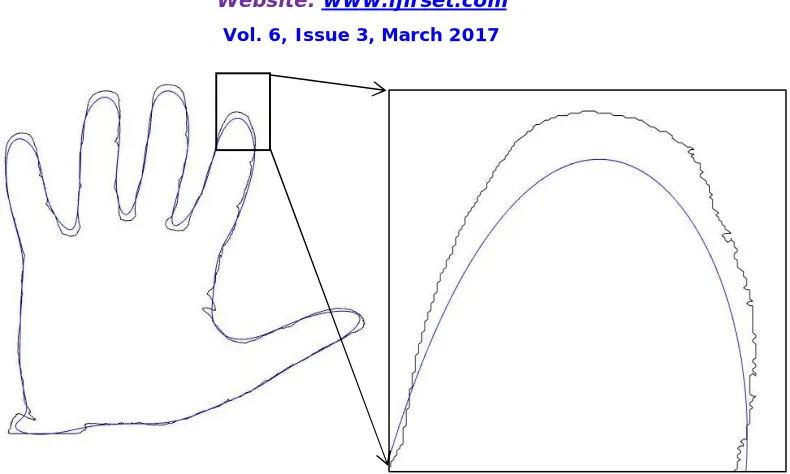
Images required smoothing, therefor we need low pass filter, at first the boundary of sequence set (x, y) been converted to frequencies domain. The fast Fourier transform can be used to turn this sequence into a trigonometric polynomial in frequency domain, we must deal with pixel effects that will show up as high frequency components in the FFT. Its appear looking closely at the boundary that been traced, jagged due to the discrete pixels. To the FFT, this high frequency component of the shape boundary need to be removed. oscillations all over the boundary been removed by equal to zero. After that image been converting from frequencies domain to time domain. Figure 3 shows
3. Feature Extraction
Dataset are represented in sequence of (x, y) form, the dataset is easy to compute because it’s in matrix form in MATLAB Package, after low-pass filter that shown above, the features been extracted, the proposed method is to compute curvature of shape[10], as show as below: -
=
−
(
+
)
we need a parametric function in form x=x(t) and y=y(t) to compute the curvature at any point along the boundary of the shape. The variable , , are required as shown in formula above. useful property of Fourier transform relationship to derivatives of functions given in a function x(t) form as follow: -
ℱ ( ) = ( ) ( )
where:
( ) = [ ( )]
That convenient relationship of Fourier transform in the parametric function appear. First the Fourier transform of the parametric function can be taken, then the derivatives [11][12][13][14]. The derivative can be produce by perform multiplications in the frequency domain, then use the inverse Fourier transform as shown in formula below: -
( ) =ℱ [( ) ( )]
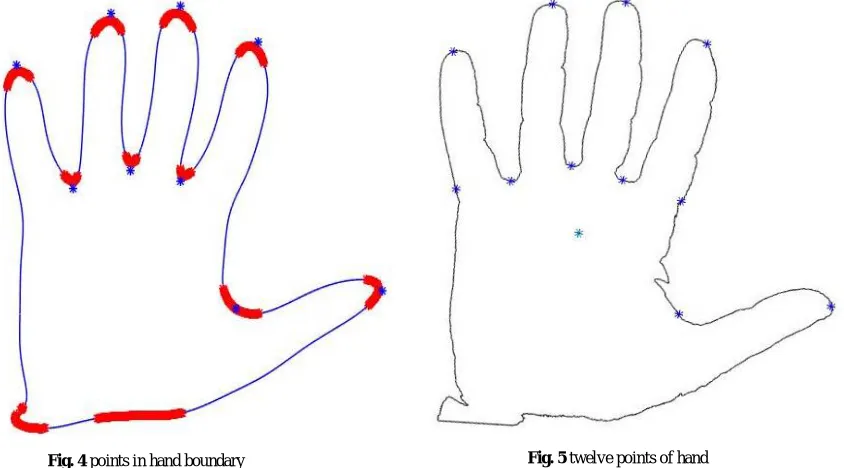
The curvature can be computed with all (x, y) points of boundary, then the threshold of curve values been filter, all values less than 0.001 has been deleted, the remain pointswill appear as a cluster points of figure tips and hand valleys, to specify and select each figure, dents and blobby in the shape, the midpoint of cluster been calculated. Figure 4 show how the points are appearing and distributed in red stars and blue stars. The nine points of fingers tips and valleys are not enough, therefore three additional points been calculated and defined using Euclidian distance and midpoint of hand boundary as shown in figure 5.the features been extracted after specify these twelve points. All
figures length and area been extracted and the distance among many points are calculated using Euclidian distance, the total number of features was 24, all features been appearing to be very effective in testing phase, therefore it been noticed these features were being enough to create a classifier.
III.CREATE CLASSIFIER
the problem of identification is the key point of biometric system, the features being label for each hand.in this paper we proposer two classifiers, Artificial neural network and k-nearest neighbors algorithm, a neural network consists of units called artificial neurons or nodes, the NN nodes arranged in specific way called layers, typically backpropagation NN consist of three layers input, hidden and output[15], The input layers represent number of features, in this experiment it been 24 nodes in input layer, the output Layer been representing number of labels (persons) witch was 35 people, there are many parameters of NN for example in hidden layer the number of nodes, learning rate, epoch…etc.in our experiment there been many test of different parameter to create better classifier as possible. to classifiers its need two level, training and test, the data been split as 70% for training and 30% for test, which convert an input vector into some output.
IV.EXPERIMENTALRESULT
There been many test of neural network and k-nearest neighbors algorithm, the dataset was 350 samples from 35
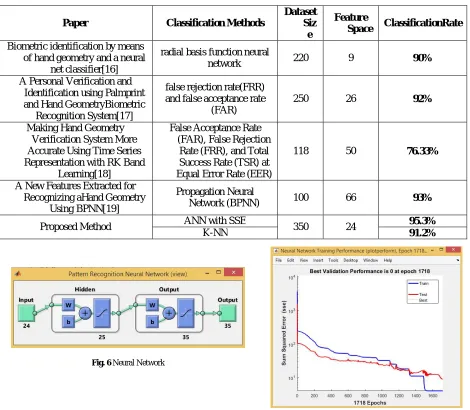
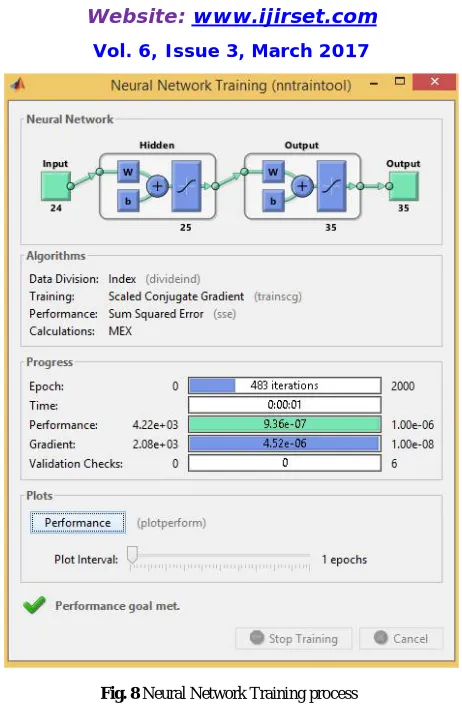
are affect classification rate, in the ANN,Sum squared error(SSE)use as performance function and Scaled conjugate gradient backpropagation method use for train neural network. Figure 6 shows Neural network design in MATLAB software and Figure 7 show performance and SSE curve of train and test. Figure 8 show training ANN process.
Paper Classification Methods
Dataset Siz
e
Feature
Space ClassificationRate
Biometric identification by means of hand geometry and a neural
net classifier[16]
radial basis function neural
network 220 9 90% A Personal Verification and
Identification using Palmprint and Hand GeometryBiometric
Recognition System[17]
false rejection rate(FRR) and false acceptance rate
(FAR)
250 26 92%
Making Hand Geometry Verification System More Accurate Using Time Series Representation with RK Band
Learning[18]
False Acceptance Rate (FAR), False Rejection
Rate (FRR), and Total Success Rate (TSR) at Equal Error Rate (EER)
118 50 76.33%
A New Features Extracted for Recognizing aHand Geometry
Using BPNN[19]
Propagation Neural
Network (BPNN) 100 66 93% Proposed Method ANN with SSE 350 24 95.3%
K-NN 91.2%
Table 1. Comparisons with Other Experiment Work
Fig. 7 SSE curve
V. CONCLUSION
In this paper, hand geometry based biometric technique for Identification and verification has been proposed. It has been demonstrated how features been extracted through curvature of shape, the curvature calculation is simple and easy way for an effective and simple defining hand fingers points and valleys, then features like figure length, width, area, and distances are extracted. This approach produces a quite well and accurate features for identification each individual.
REFERENCES
[1] A. Jain, P. Flynn and A. A. Ross, Handbook of biometrics, Springer Science & Business Media, 2007.
[2] N. Al Mutawa, I. Baggili and A. Marrington, “Forensic analysis of social networking applications on mobile devices,” Digital Investigation, vol. 9, pp. 24-33, 2012.
[3] R. L. Zunkel, “Hand geometry based verification,” in Biometrics, Springer, 1996, pp. 87-101.
[4] A. L. N. Wong and P. Shi, “Peg-Free Hand Geometry Recognition Using Hierarchical Geomrtry and Shape Matching,” in MVA, 2002. [5] P. Varchol and D. Levicky, “Using of hand geometry in biometric security systems,” RADIOENGINEERING-PRAGUE-, vol. 16, p. 82, 2007. [6] R. Sanchez-Reillo, C. Sanchez-Avila and A. Gonzalez-Marcos, “Biometric identification through hand geometry measurements,” IEEE Transactions on pattern analysis and machine intelligence, vol. 22, pp. 1168-1171, 2000.
[7] S. B. Kotsiantis, D. Kanellopoulos and P. E. Pintelas, “Data preprocessing for supervised leaning,” International Journal of Computer Science, vol. 1, pp. 111-117, 2006.
[8] R. Gonzalez, Digital image processing using MATLAB, Delhi: Tata McGraw Hill Education, 2010.
[13] M. R. Spiegel, Advanced mathematics, McGraw-Hill, 1991.
[14] J. Casey, Exploring curvature, Springer Science & Business Media, 2012. [15] S. S. Haykin, Neural networks and learning machines, 3 ed., Pearson, 2009.
[16] M. Faundez-Zanuy and G. M. N. Mérida, “Biometric identification by means of hand geometry and a neural net classifier,” in International Work-Conference on Artificial Neural Networks, 2005.
[17] A. Kumar, D. C. M. Wong, H. C. Shen and A. K. Jain, “Personal verification using palmprint and hand geometry biometric,” in International Conference on Audio-and Video-Based Biometric Person Authentication, 2003.
[18] V. Niennattrakul and C. A. Ratanamahatana, “Making Hand Geometry Verification System More Accurate Using Time Series Representation with RK Band Learning,” arXiv preprint arXiv:0905.1385, 2009.