Modeling Seismic Incoherence Effects on NPP Structures: Unifying CLASSI and
SASSI Approaches
Dr. James J. Johnson1, Stephen A. Short2, Gregory S. Hardy2
1) James J. Johnson and Associates, Alamo, CA 2) ARES Corporation, Santa Ana, CA
ABSTRACT
Seismic wave incoherence has been recognized for many years. Lack of an adequately large set of recorded data in the free-field has prevented quantification of the phenomenon. Recently, such a data base has been assembled. The data base provides the basis for the ground motion coherency functions necessary to assess the effect of incoherence on nuclear power plant structures. The capability to analyze incoherence has been implemented in two soil-structure interaction (SSI) analysis methodologies: CLASSI and SASSI. These two SSI methodologies were validated through the comparison of in-structure response spectra calculated on the foundation and in the structure for a simplified model of an advanced reactor. The ground motion coherency functions, SSI methodologies, validation process, and results are summarized in this paper. In addition, the effect of incoherency on structure response compared to coherent input is shown to be significant for high frequencies (greater than 10 Hz).
INTRODUCTION
EPRI and the US DOE initiated the New Plant Seismic Issues Resolution Program to address emerging seismic issues as they relate to the design of new nuclear power plants. Hardy and Kassawara [1] discuss the principal elements of this overall Program along with general results. Task S2.1 of the EPRI/DOE New Plant Seismic Issues Resolution Program is a multi-phase research project to assess the effects of seismic wave incoherence on the response of foundations and structures similar to those being considered for advanced reactor designs. The initial phases of this task focused on the objective of systematically studying seismic wave incoherence effects on structures/foundations. These phases were documented by Short et al.[2]
The final phase of Task S2.1 is documented by Short et al.[3] This final phase entails the validation of analytical methods and their implementation in the soil-structure interaction (SSI) computer programs CLASSI and SASSI. The objective of this final phase is to demonstrate that CLASSI [4] and SASSI [5], as modified, adequately calculate the seismic response of foundations and structures when subjected to seismic wave fields including incoherence effects.
Validation of CLASSI and SASSI to treat seismic wave incoherence in SSI analyses is accomplished by:
• Comparison of results computed using CLASSI and SASSI to those available from published literature.
• Comparison of CLASSI computed incoherent seismic response with SASSI computed incoherent seismic
response for an example rock/structure model
CLASSI and SASSI computed incoherent seismic response were compared and shown to be in good agreement by Short et al.[2] However, the example rock/structure model considered in those benchmark analyses did not produce significant incoherency-induced torsion and rocking response. The example rock/structure model used for benchmark comparisons in this final phase has offsets of mass centers from the shear centers and significant “outriggers” (nodes extended from the mass center to simulate the response at the perimeter of the building) to overemphasize seismic response from incoherency-induced rotations. It is judged that the example rock/structure model utilized in this phase provides an extreme (conservative) level of torsion and rocking response induced by seismic wave incoherence that validates the use of either CLASSI or SASSI for seismic analysis.
Incoherency induced rotations are a random phenomena resulting from the horizontal spatial variation of ground motion over the foundation area. For response quantities where several components of foundation motion contribute significantly, the phasing of those components must be adequately represented in order to produce reasonable seismic response. As a result, enhancements to the CLASSI and SASSI approaches as described by Short et al. [3] were required to capture the random nature of multi-component seismic response. A summary of this validation effort is presented herein.
BACKGROUND ON SEISMIC WAVE INCOHERENCE
Seismic wave incoherence consists of spatial variation of horizontal and vertical ground motion. Two sources of incoherence or horizontal spatial variation of ground motion are:
b. Wave passage effects: Systematic spatial variation due to difference in arrival times of seismic waves across a foundation due to inclined waves.
The focus of all phases of Task S2.1 is on local wave scattering.
The effect of seismic wave incoherence is that motions recorded on foundations of structures differ from those measured in the adjacent free-field. Generally, the motion measured on the foundation is less than the motion recorded in the free-field, especially at high-frequencies. Two aspects of soil-structure interaction contribute to the observations of
foundation motion being less than the free-field: kinematic and inertial interaction. Kinematic interaction is due to the spatial variation of the free-field ground motion over the portion of the foundation/structure system abutting the soil or rock. Generally, the motion measured on the foundation is less than the motion recorded in the free-field, especially at high frequencies. Johnson [6] and Chang et al. [7] summarize many of the efforts to document these phenomena. Kim and Stewart [8] investigate the isolation of the effects of seismic wave incoherence from other aspects of kinematic interaction based on recorded data. The study was very successful in evaluating the effects of incoherence on foundation translational response; for foundation rotations, a much more difficult problem is encountered due to the lack of appropriate recorded data. For nuclear power plant structures, which have large and stiff foundation mats, the amplitudes of high-frequency seismic response of the foundation mat are expected to be significantly less than those in the free-field due to horizontal spatial variation of ground motion including incoherence.
PARAMETERS OF THE STUDY Ground Motion Coherency Functions
The phenomenon of seismic wave incoherence has been recognized for many years, but the lack of an adequately large set of recorded data prevented quantification of the phenomenon and the development of approaches for the
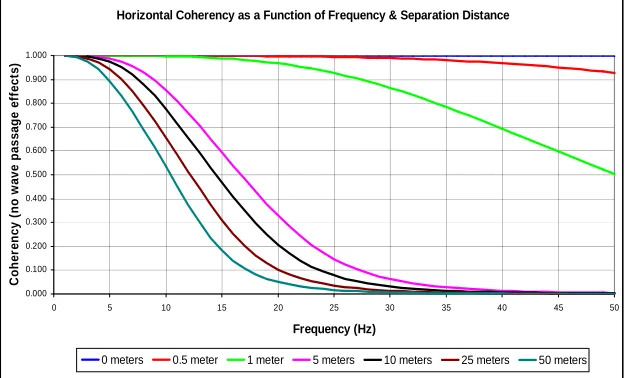
incorporation of the effect into the dynamic analysis of nuclear power plant (NPP) structures. Dr. Norm Abrahamson has developed state-of-the-art representations of the coherency functions based on the most applicable data available[9]. These coherency functions are based on a large number of densely spaced ground motion recordings. Coherency functions define the relationships between ground motion at separate locations as a function of the separation distance between the locations and the frequency of the ground motion. Coherency of motion decreases significantly with increasing frequency and increasing distance between points of interest. The coherency functions account for this effect of incoherence at all frequencies of interest and all discretized points on the foundation.
For the purposes of this research study, the coherency functions developed by Dr. Abrahamson [9] for soil sites have been utilized. Modifications to these coherency functions have been developed for embedded foundations on soil sites and for hard rock sites. The coherency functions used in the present study contain less coherency than the recently developed rock site coherency model. They were judged to be appropriate for benchmarking methods of calculating structural response to incoherent ground motion. In fact, for the example structure analyzed, these coherency functions provide a more severe test in terms of validation than other alternatives. Figure 1 shows the coherency function for horizontal ground motion; for vertical ground motion, the shape is similar.
Horizontal Coherency as a Function of Frequency & Separation Distance
0.000 0.100 0.200 0.300 0.400 0.500 0.600 0.700 0.800 0.900 1.000
0 5 10 15 20 25 30 35 40 45 50
Frequency (Hz)
C
o
h
e
re
n
c
y
(
n
o
w
a
v
e
p
a
s
s
a
g
e
e
ff
e
c
ts
)
0 meters 0.5 meter 1 meter 5 meters 10 meters 25 meters 50 meters
Figure 1. Coherency Function for Horizontal Ground Motion
Rock Site Profile and Ground Motion
Initial phases of the program evaluated soil and rock sites subjected to site specific ground motion [2]. The soil site was subjected to site specific motions rich in low frequencies as appropriate. The effects of incoherence of ground motion on foundation and structure response for the soil site were much less than for the rock site, which was subjected to high
frequency ground motions typical of recent Probabilistic Seismic Hazard Assessments. The effect of incoherence is most significant for frequencies greater than 10 Hz. The rock site profile was selected for this validation study. The rock site profile is characterized by shear wave velocities smoothly varying from 3300 fps near the surface to 9200 fps at 130 ft. in depth.
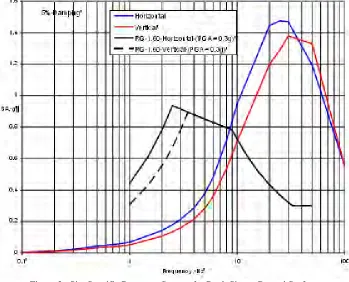
The appropriate site specific ground motion for this rock site profile was specified for the study. Figure 2 shows the horizontal and vertical components of the site specific motion, including the US NRC Regulatory Guide 1.60 response spectra anchored to 0.3g PGA for comparison purposes. Ground motion acceleration time histories matching the site specific response spectra were provided by Dr. Abrahamson. These ground motion time histories were statistically independent.
Figure 2. Site Specific Response Spectra for Rock Site at Ground Surface
Model Foundation/Structure Properties
The subject structure for the validation studies evolved from a simple model of the Westinghouse AP1000. A stick model with three sticks representing the Coupled Auxiliary and Shield Building (ASB), the Steel Containment Vessel (SCV), and the Containment Internal Structure (CIS) comprised the original model [10]. Modifications to the original model were made: (i) Mass centers for horizontal masses were offset from the shear centers at locations in the auxiliary building and the CIS to introduce natural torsion for these structures. The shear centers of the three sticks lie on the Z-axis. (ii) At various locations in the models, massless outrigger nodes were added to permit calculation of response at points away from the centerline. The ASB and CIS outriggers extend 75 feet from the centerline in the X-direction. The SCV outrigger extends 65 feet from the centerline in the X-direction. In cases (i) and (ii), massless rigid links connected the nodes to the shear centers. The model has limited inter-connectivity of the sticks in the upper elevations. Figure 3 shows a schematic of the structure model.
The fixed-base modes of the structures provide insight into their behavior: ASB – horizontal frequencies 3 Hz (X) and 3.2 Hz (Y), vertical 9.9 Hz; SCV – horizontal frequencies 5.5 Hz, 9.5 Hz, 9.9 Hz (X) and 6.1 Hz (Y), and vertical 16 Hz; and CIS – horizontal frequencies 13.3 Hz, 20.1 Hz, and 28.9 Hz (X) and 12 Hz, 14.9 Hz, and 17.5 Hz (Y) and vertical 41.4 Hz.
The structure is founded on an idealized square foundation 150 ft by 150 ft and 15 ft thick.
Figure 3. Advanced Reactor Structure Stick Model with Outriggers and Mass Offsets shown.
CLASSI AND SASSI
To incorporate seismic wave incoherence into SSI seismic analyses, two approaches were presented by Tseng and Lilhanand[11]: a stochastic approach following the work of Luco and Wong[12] and others; and the “deterministic
approach.” The former is the basis for the development and implementation of the treatment of incoherence in the CLASSI family of codes. The latter is the basis for the implementation in various versions of SASSI. Short et al. [2, 3] present the full derivation for CLASSI and summaries of the derivations for SASSI.
Coherency Matrix
For CLASSI and SASSI, the footprint of the foundation is subdivided into sub-regions for analysis purposes. Centroids of the sub-regions are key locations in the CLASSI formulation; interaction nodes are key locations in the SASSI
formulation. The starting point for both approaches is the matrix [γ(ω)], a 3N by 3N matrix of the Abrahamson coherency
function based on the separation distances between the “N” CLASSI sub-region centroids or the SASSI interaction node point DOFs. The factor three is for the three directions of free-field ground motion. The effects of incoherence of ground
motion are uncoupled for the three directions of free-field ground motion. At each discrete frequency, the matrix [γ] is
identical when the centroids of the sub-regions of the CLASSI analysis coincide with the locations of the SASSI interaction node points.
The CLASSI approach applies the constraint of the rigid foundation behavior to determine the amplitude of the tractions on each of the sub-regions which produce the rigid body motion and the Cross Power Spectral Density functions of
the motion of the rigid massless foundation. The SASSI approach utilizes the characteristics of the matrix [γ(ω)], specifically
the assurance that it can be decomposed into its eigensystem (termed spatial modes), to provide computational efficiency in the SSI analysis. Whereas the CLASSI approach requires determination of the scale factors for the sub-region tractions, the SASSI approach proceeds along a parallel path where a number of analysis decisions are required with respect to the treatment of the spatial modes, as summarized described in the ensuing text and in more detail in by Short et al.[3]
CLASSI
The CLASSI program modules generate the complex impedance and scattering matrices at each frequency considered. The impedance matrix represents the stiffness and energy dissipation of the underlying soil medium. The foundation input motion is related to the free-field ground motion by means of a transformation defined by a scattering matrix. The term “foundation input motion” refers to the result of kinematic interaction of the foundation with the free-field ground motion. In general, the foundation input motion differs from the free-field ground motion in all cases, except for surface foundations subjected to vertically incident coherent waves. The soil-foundation interface scatters waves because points on the foundation are constrained to move according to its geometry and stiffness. Modeling of incoherent ground
In essence, the incoherency transfer function may be interpreted as a scattering matrix accounting for the effects of seismic wave incoherency over the dimensions of the foundation. For this application, a 6 by 6 complex incoherency transfer function matrix [ITF] is evaluated by taking the square root of the diagonal terms of the 6 by 6 complex cross PSD matrix of rigid massless foundation motion to unit PSD input for each direction of translational input. The CPSD is determined by applying the rigid foundation constraints. The CLASSI scattering matrix (6 x 3) is comprised of 3 vectors each of which determines the foundation input motion for the three components of free-field ground motion. Each vector of the scattering matrix is replaced by the incoherency transfer function vectors that correspond to each component of free-field ground motion. Each frequency is treated independently. CLASSI SSI analyses are then performed in a conventional manner to evaluate the structure and foundation in-structure response spectra. CLASSI solves the SSI problem in the frequency domain. Ground motion time histories are transformed into the frequency domain, SSI parameters (impedances and scattering matrices) are complex-valued, frequency-dependent, and the structure is modeled using its fixed-base eigen-systems.
Two variations of the CLASSI approach have been implemented and applied to the example structure. The difference in the two approaches is the treatment of the phase of the foundation scattering terms or ITFs. The following describes the two approaches:
• CLASSIinco – Retain the deterministic phasing of the foundation scattering functions as determined from
the complex square root of the diagonal terms of the CPSD matrix. This is most appropriate for the case of phenomena, such as wave passage. However, the benchmarking of Short et al. [2, 3] demonstrates its validity in producing engineering acceptable solutions for seismic wave incoherence effects.
• CLASSIinco-SRSS – SRSS combination of the structure response induced by the individual foundation
scattering terms (ITFs) applied independently, i.e., assuming the relationship between the phases of the scattering terms behaves randomly. This results in performing six SSI analyses for each direction of ground motion and SRSSing the end quantity of interest. The end items of interest reported herein are in-structure response spectra.
SASSI
The SASSI approach to SSI analysis applies a “flexible-volume substructuring technique” to formulate the problem. As with CLASSI, it then solves the problem in the frequency domain using complex frequency response transfer functions and Fast Fourier Transform methods. The supporting media (soil or rock) is modeled as a uniform or layered viscoelastic material overlying a half-space. The soil dynamic stiffnesses are modeled using complex moduli which implies frequency dependent hysteresis damping. The soil/rock is modeled by finite elements in the region near the foundation; other layering is modeled by semi-infinite layers. The flexible volume substructuring approach partitions the total soil-structure system into three substructures: free-field soil medium before excavating for embedment; the soil volume to be replaced by the structural embedment; and the complete structural system (including the foundation). The method is conceptually based on linear superposition. SASSI has the distinct advantages of being capable on treating flexible foundations and embedded foundation/partial structures.
SASSI is organized into a set of modules, which include SITE, POINT, HOUSE, ANALYS, COMBIN, MOTION, and STRESS. These modules are common to all available versions of SASSI. These modules are organized in such a way that each handles the calculation of a few analysis steps so that the site response analysis, the impedance analysis, the formation of the complex dynamic stiffness and mass matrices of the complete soil/structure system, the calculation of transfer functions, and the convolution of transfer functions with the input motion to obtain structural responses can all be performed separately with the results being stored on intermediate files. This is particularly advantageous in the treatment of incoherence by techniques that require multiple runs.
In terms of performing SSI analysis of NPP structures including the effects of incoherence, a parallel approach to the stochastic approach described above, denoted “Deterministic Method” by Tseng and Lilhanand[11] forms the basis for the implementations in several versions of SASSI. The key elements of the treatment of incoherency are summarized here and follow directly the Tseng and Lilhanand derivation. Ghiocel[13] presents theoretical aspects of the approach itemized in Tseng and Lilhanand[11] and provides the basis for the ACS SASSI treatment of the phenomena [14].
As noted above, the coherency matrix [γ(ω)] possesses special characteristics and thereby produces the following
solution to the incoherent response at each SASSI interaction node, which follows the generalized solution denoted Karhunen-Loeve (KL) based on the spectral factorization of the coherency kernel [14]. Further, given the coherency kernel eigensystem decomposition, the resulting expression for the incoherent motion at SASSI interaction node points is:
{Ug
l
} = [φ(ω)] [λ(ω)] {ηθ(ω)} U0(ω) (1)
Where {ηθ(ω)} is a (N x 1) random phase vector of the form e[iθ(ω)] for each spatial mode and θ is uniformly
distributed from -π to π - therefore a median value of η is unity, and U0(ω) is the single ground motion component of interest.
In very general terms, this expression defines the transfer function of the input free-field ground motion to the interaction node points’ degrees of freedom due to incoherence without effects of soil-structure interaction (SSI).
Each frequency is treated independently and eigensystems or spatial modes are calculated independently for each frequency of solution. Therefore, in general, for N interaction degrees of freedom, there will be N spatial modes calculated at each solution frequency. Three approaches have been identified as possible solution techniques.
• Stochastic Approach or Randomization (denoted Simulation Mean in the results presentation) entails
Monte Carlo simulation of the SSI analysis process by: (i) randomly sampling θ for each spatial mode and
at each frequency of solution; (ii) performing a complete SSI analysis resulting in one sample of the end response quantity of interest, in this study ISRS; and (iii) upon completion of the simulations, calculate the mean of the response as the end product. Sensitivity studies reported by Short et al. [3] demonstrate that as few as 5 simulations may be adequate to calculate a reasonable mean value.
• SRSS (denoted SASSI-SRSS in the results presentation) may be applied at the transfer function level or at
the dynamic response quantity of interest level. Ostadan and Deng[15] provide the derivation at the transfer function level. Tseng and Lilhanand[11] suggest its application at the end response quantity level. Only results for the transfer function application were considered in this study. The approach is to
calculate transfer functions at locations of interest on the foundation or in the structure for each solution
frequency treating each spatial mode independently assuming θ = 0 ( Eq. 1) for each spatial mode, and
SRSSing the resulting individual transfer functions as the last step before calculating SSI response.
• Linear Algebraic Combination (denoted SASSI-AS in the results presentation) corresponds to one
simulation as described above in Randomization, but assuming θ = 0. Sophisticated numerical techniques
are applied in this method to improve its accuracy [3].
RESULTS
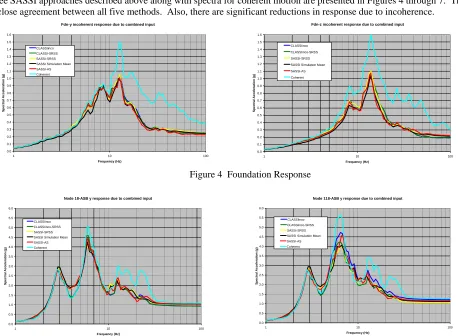
Representative in-structure response spectra for incoherent ground motion by the two CLASSI approaches and the three SASSI approaches described above along with spectra for coherent motion are presented in Figures 4 through 7. There is close agreement between all five methods. Also, there are significant reductions in response due to incoherence.
Fdn-y incoherent response due to combined input
0.0 0.1 0.2 0.3 0.4 0.5 0.6 0.7 0.8 0.9 1.0 1.1 1.2 1.3 1.4 1.5 1.6
1 10 100
Frequency (Hz) S p e c tr a l A c c e le ra ti o n ( g ) CLASSIinco CLASSI-SRSS SASSI-SRSS SASSI Simulation Mean SASSI-AS Coherent
Fdn-z incoherent response due to combined input
0.0 0.1 0.2 0.3 0.4 0.5 0.6 0.7 0.8 0.9 1.0 1.1 1.2 1.3 1.4 1.5 1.6
1 10 100
Frequency (Hz) S p e c tr a l Ac c e le ra ti o n ( g ) CLASSIinco CLASSIinco-SRSS SASSI-SRSS SASSI Simulation Mean SASSI-AS Coherent
Figure 4 Foundation Response
Node 18-ASB y response due to combined input
0.0 0.5 1.0 1.5 2.0 2.5 3.0 3.5 4.0 4.5 5.0 5.5 6.0
1 10 100
Frequency (Hz) S p e c tr a l A c c e le ra ti o n ( g ) CLASSIinco CLASSIinco-SRSS SASSI-SRSS SASSI Simulation Mean SASSI-AS Coherent
Node 118-ASB y response due to combined input
0.0 0.5 1.0 1.5 2.0 2.5 3.0 3.5 4.0 4.5 5.0 5.5 6.0
1 10 100
Frequency (Hz) S p e c tr a l A c c e le ra ti o n ( g ) CLASSIinco CLASSIinco-SRSS SASSI-SRSS SASSI Simulation Mean SASSI-AS Coherent
Figure 5 Shield Building Response
Node 29-CIS z response due to combined input 0.0 0.5 1.0 1.5 2.0 2.5 3.0 3.5 4.0 4.5 5.0 5.5 6.0 6.5 7.0 7.5 8.0
1 10 100
Frequency (Hz) S p e c tr a l A c c e le ra ti o n ( g ) CLASSIinco CLASSIinco-SRSS SASSI-SRSS SASSI Simulation Mean SASSI-AS Coherent
Node 229-CIS z response due to combined input
0 5 10 15 20 25 30 35
1 10 100
Frequency (Hz) S p e c tr a l A c c e le ra ti o n ( g ) CLASSIinco CLASSIinco-SRSS SASSI-SRSS SASSI Simulation Mean SASSI-AS Coherent
Figure 6 Containment Internal Structure Response
Node 45-SCV y response due to combined input
0 1 2 3 4 5 6 7 8 9 10 11 12
1 10 100
Frequency (Hz) S p e c tr a l A c c e le ra ti o n ( g ) CLASSIinco CLASSIinco-SRSS SASSI-SRSS SASSI Simulation Mean SASSI-AS Coherent
Node 145-SCV y response due to combined input
0 1 2 3 4 5 6 7 8 9 10 11 12
1 10 100
Frequency (Hz) S p e c tr a l A c c e le ra ti o n ( g ) CLASSIinco CLASSIinco-SRSS SASSI-SRSS SASSI Simulation Mean SASSI-AS Coherent
Figure 7 Steel Containment Vessel Response
SUMMARY AND CONCLUSIONS
A review of the representative results presented in Figs. 4 – 7 shows very good comparisons between the ISRS calculated by each of the five methods evaluated. It may be noted that spectra compared were those used in the seismic design/qualification process – specifically, the combined effects of three components of ground motion were considered. Comparisons of ISRS for each direction of excitation considered independently are provided by Short et al.[3], Appendix A, show good correlation, but in some cases differences do occur.
The following conclusions may be drawn:
• Soil-structure interaction (SSI) analysis is important to calculating seismic response to structures mounted
on rock sites and subjected to frequency ground motion. SSI produces significant reductions in high-frequency response for these conditions.
• CLASSIinco and CLASSIinco-SRSS are computationally efficient methods for conducting SSI analyses
including incoherency, but are limited to rigid surface foundations. For structures with foundations for which the combined behavior of foundation/structure is deemed flexible and for embedded
foundations/partial structure, a version of SASSI is required to accurately capture seismic response.
• Utilization of SASSI-AS to compute the response for incoherent input requires computational effort
comparable to standard SASSI analysis for coherent input. SASSI-SRSS and SASSI Simulation require significantly greater computational effort to analyze the incoherent response for complex structural models.
• The SSI analysis programs CLASSIinco, CLASSIinco-SRSS, SASSI-SRSS, SASSI-Simulation, and
SASSI-AS have been validated to treat the phenomena of incoherency for nuclear power plant structures when applied in the seismic design/qualification process. The bases of the validation are:
o Agreement of results computed using CLASSI and SASSI to those available from published
literature.
o Comparison of CLASSI computed incoherent seismic response with SASSI computed incoherent
seismic response for an example rock/structure model with agreement within engineering accuracy.
of the analyses where the three input directions are treated independently demonstrates that the agreement between these three is excellent even for this case.
• The more simplified approaches of CLASSIinco and SASSI-AS may be shown to capture all important
aspects of SSI response and, therefore, may be used for final design/qualification purposes. Examples include:
o The rock/structure model analyzed and reported herein.
o The relatively simple model used in the validation effort of Short et al., Appendix C [2].
o Other examples likely include structure configurations where it can be demonstrated that induced
rotation effects are adequately treated with these methodologies, e.g., large plan dimension/low height structures.
Sensitivity studies may be performed to demonstrate this applicability.
REFERENCES
1. Hardy, G.S. and Kassawara, R.P., “Recent Seismic Research Programs for New Nuclear Power Plants,” SMiRT 19,
Paper K01/1, August 2007.
2. Short, S.A., Hardy, G.S., Merz, K.L., and Johnson, J.J., “Program on Technology Innovation: Effect of Seismic Wave
Incoherence on Foundation and Building Response,” EPRI, Palo Alto, CA and the U.S. Department of Energy, Germantown, MD, Report No. TR-1013504, November 2006.
3. Short, S.A., Hardy, G.S., Merz, K.L., and Johnson, J.J., “Validation of CLASSI and SASSI to Treat Seismic Wave
Incoherence in SSI Analysis of Nuclear Power Plant Structures,” EPRI, Palo Alto, CA, to be published, 2007.
4. Wong, H.L. and Luco, J.E., “Soil-Structure Interaction: A Linear Continuum Mechanics Approach (CLASSI),” Dept. of
Civil Engineering, University of Southern California, Los Angeles, CA Report CE, 1980.
5. Lysmer, J.M., Tabatabaie-Raissi, M., Tajirian, F., Vahdani, S., and Ostadan, F., “SASSI-A System for Analysis of
Soil-Structure Interaction,” Dept. of Civil Engineering, University of California, Berkeley, CA, Report UCB/GT/81-02, April 1981.
6. Johnson, J.J., “”Soil Structure Interaction,” Earthquake Engineering Handbook, Chap. 10, W-F Chen, C. Scawthorn,
eds., CRC Press, New York, NY, 2003.
7. Chang, C.-Y., Power, M.S., Idriss, I.M., Sommerville, P., Silva, W., and Chen, P.C., “Engineering Characterization of
Ground Motion, Task II: Observational Data on Spatial Variations of Earthquake Ground Motion,” US NRC, Washington DC, NUREG/CR-3805, Vol.3, 1986.
8. Kim, S. and Stewart, J.P., “Kinematic Soil-Structure Interaction from Strong Motion Recordings,” J. of Geotechnical and
Geoenvironmental Engineering, ASCE, April 2003.
9. Abrahamson, N.A., “Program on Technology Innovation: Spatial Coherency Models for Soil Structure Interaction,”
EPRI, Palo Alto, CA and the U.S. Department of Energy, Germantown, MD, Report No. 1014101, December 2006.
10. Orr, R. (Westinghouse Corp.) to Hardy, G. (ARES Corp.), Personal e-mail communication on AP1000 Model Properties,
August 2006.
11. Tseng, W.S. and Lilhanand, K.I., “Soil-Structure Interaction Analysis Incorporating Spatial Incoherence of Ground
Motions,” EPRI, Palo Alto, CA, Report TR-102631 2225, November 1997.
12. Luco, J.E. and Wong, H.L., “Response of a Rigid Foundation to a Spatially Random Ground Motion,” Earthquake
Engineering and Structural Dynamics, Vol. 14, 891-908, 1986.
13. Ghiocel, D., “Stochastic Simulation Methods for Engineering Predictions,” Engineering Design Reliability Handbook,
Chap. 20, CRC Press, New York, NY, 2004.
14. Ghiocel Predictive Technologies, Inc., “ACS-SASSI, An Advanced Computational Software for 3D Dynamic Analysis
Including Soil-Structure Interaction, Version 2.1, Pittsford, NY, 2006.
15. Ostadan, F. and Deng, N., “SASSI-SRSS Approach for SSI Analysis with Incoherent Ground Motions,” Bechtel
National, San Francisco, CA 2007.
ACKNOWLEDGEMENTS
The authors wish to acknowledge the support of the Electric Power Research Institute and Dr. Robert P. Kassawara, EPRI Project Manager. The authors wish to acknowledge the direction, support, and interaction with Dr. Robert P. Kennedy. The authors wish to acknowledge the support of Dr. Dan Ghiocel in the implementation of the SASSI-Simulation and the SASSI-AS approaches. The authors wish to acknowledge the support of Dr. Farhang Ostadan, Bechtel National Corp., for providing the results for the SASSI-SRSS methodology.