Credit based Scheduling using Genetic
Algorithm for Resource Allocation on Clouds
Supriya S. Bichkule1, Prof. R. V. Mante2
Master of Technology Scholar, Dept. of CSE, Government College of Engineering, Amravati, India1
Assistant Professor, Dept. of CSE, Government College of Engineering, Amravati, India2
ABSTRACT: Nowadays, Cloud computing plays an important role in providing good service policies. In order to achieve good services from a cloud, the need for a number of resources arose. But cloud providers are limited by the amount of resources they have, and are thus compelled to strive to maximum utilization. Thus research favors scheduling algorithms that consider both user satisfaction and resources availability. Hence the credit based scheduling (CBS) algorithm is useful to calculate credit of each task based on two parameters, namely Task length and Task priority. Virtualization is the concept of providing efficientsolution to the cloud computing paradigm by facilitating creationOf Virtual Machines (VMs) over the underlying physical servers, leading to improved resource utilization and abstraction. The Elephant herding optimization (EHO) makes use of virtualization technology to allocate resources based on user demand for a large scale cloud environment. This paper presents the remarkable way to allocate resources on cloud environment.
KEYWORDS: cloud computing, credit based scheduling ,elephant herding optimization, virtualization
I. INTRODUCTION
In cloud computing, Resource Allocation (RA) is the process of assigning available resources to the needed cloud applications over the internet. If theResource allocation is not managed properly then there may be chances for service starvation. The real strength of the cloud lies in the ability to distribute the workload over multiple nodes. Scheduling means the set of policies for controlling the order of work to be performed by a computing system.
Scheduling is a vital task in a cloud computing environment. In cloud computing environment datacentres take care of task. The datacentres receive tasks from the datacentre brokers which arrived from different users. In some cases these tasks may be associated with priorities. If so, a broker should consider these priorities and it is responsible for assigning the task. The algorithms like Min-Min [1] will not consider user priority. A better scheduling algorithm is needed to get full utilization of resources.
The problem is to manage different tasks on clouds via some scheduling and optimization strategy, so that performance will increase and give better result as per customer requirements. The solution to this problem is to use credit based scheduling algorithm and elephant herding Optimization for resource allocation on cloud. This paper introduces a combination of CBS[2] and EHO[3] to get rid of optimal resource allocation problem for tasks on cloud.
II.RELATEDWORK
based scheduling, Energy efficient optimization methods, Activity based costing, Reliability Factor Based, Context aware scheduling, Dynamic slot based scheduling. Among these parameters task length and priority are quite important. The effective utilization of resources can be increased by using a load balancing algorithm. This is achieved bymaking use of resources of an unused (idle) processor while release the resources of processors having heavy load. The load balancing algorithm distributes the load among all the resources which are available. This type of algorithm also minimize the make span with the valuable use of resources [4]. Min Min algorithm starts with a set of tasks. There is a task set T. Along with the task set there are some resources too. After implementing the algorithm, task set will be allocated or mapped to resource set. The algorithm chooses the task having minimum size. The main issue of this algorithm is its consideration is only to task length and not to user priority. There may be a situation where high priority tasks exist. Priority has its own importance so this also should be considered for scheduling.
Hadoop is a concept that deals with big data. Map Reduce function is used for handling this big data. In[5] this papereach task gets a time slot. During that period task gets executed. This approach checks the utilization of resources. This is a complex approach because it needs migration of tasks. Task migration is difficult when we deal with big data.There are plenty of algorithms present for the scheduling of the tasks and utilization of resources. The bigquestion comes when we think about how to do scheduling. From the literature survey it is evident that various parameters can be considered for the scheduling of tasks such as resource cost, priority, etc. From the study of various approaches for scheduling, the task length and priority are considered as the parameters for detailed investigation in the proposed approach.
Virtualization provides powerful management of resources. Placement of virtual machine is the most critical part. In [6] agent based architecture was developed for allocating VMs to cloud servers and a broker. In [6] dynamic consolidation management was developed.Maria and Rajkumar[7],presents an algorithm based on the meta-heuristic optimization technique, particle swarm optimization (PSO), which aims to minimize the overall workflow execution cost while meeting deadline constraints. They worked on deadline based resource allocation scheduling and PSO optimization strategy.
Vishnupriya et al.[6], presents an automatic resource management system that makes use of virtualization technology to allocate resources based on application demand for a large scale cloud environment. Additionally Robust Cloud Resource Provisioning (RCRP) algorithm is used in order to achieve the best advance reservation of resources in order to reduce the cost. Antony et al.[2],proposes credit based scheduling algorithm which is based on two parameters task length and task priority as credits. It gives better results rather than other scheduling algorithms.
III.PROPOSED APPROACH
The proposed approach consists mainly two parts credit based scheduling algorithm and Elephant herding optimization.
A. Credit based scheduling: We calculate credit of each task based on 2 parameters:
1) Task length 2) Task priority
Step 1: Find task length.
1. Find length of each task
2. Then calculate average of task length. (If there are 5 task then divide total sum of 5 task by 5). 3. Calculate the difference between task length & average of task length.
4. After finding difference between task length & average of task length, assign the output value to that particular task.
5. Repeat step 4 & 5 for the amount of task you have.
1. Each task may have different priority.
2. Choose division factor , to calculate Pri_fact ( if value of priority is between 0 to 99, then division factor will be 10, if value of priority is between 100 to 999, then division factor will be 100) and so on .
3. The same way calculate pri_fact for each task.
Step 3: Find total credit.
1. Total credit =Task length * Pri_fact. (Calculate for each task.) 2. Sort the tasks based on their total credit.
3. The task which has highest credit will execute first & so on.
In this way, Credit based scheduling is mainly used to schedule various tasks on clouds.
B. Elephant Herding Optimization:
step1: Set Length and Deadline of the cloudlets and group of cloudlets is known as herd.
step2: Find the greatest Length and Deadline of cloudlets from the herd whose threshold values is exceeding. step3: we will take out that cloudlet from the herd
step4: Now we check, whether that cloudlet's job can be performed by splitting the job according to situation or we have to provide new VM.
Step5: and remaining herd will pass to CBS algorithm to perform the job.
In this manner resource is allocated to the job to perform the task in a given deadline.
IV.SYSTEM ARCHITECTURE
The system is distributed in multiple sub modules as described in following architecture. As per architecture, the first module of the proposed system is user login. If user is already registered then he has to login directly to system. The second module is to configure datacenter so that the user can configure different tasks. After that the virtual machines are configured as resources to serve given tasks. The third module is the implementation of credit based scheduling algorithm which will successfully allocates VMs to tasks. The problem is that if the available VMs are not capable to serve tasks in given deadline then there is need to merge CBS with Elephant herding optimization to create new VMs, so that tasks will be served in specified deadlines.
Before getting the final output of the system user have to configure cloudlets with their length and deadline. Depending on length and deadline given by the user, credit based scheduling works and gives final output with start and finish time of cloudlets and with the help of elephant herding optimization technique it manages new virtual machines, if available virtual machines are not capable to complete tasks within specified deadlines.
Login / Register
Client Selects Task
Task 3
EHO Algorithm
It decides whether we require another VM Main Server
It calculates the load of all VM Task 2
Task 1
VM2 VM3
VM1
CBS Algorithm It will schedule task
V.EXPERIMENTAL RESULTS Results
Initially system suggest to register for new user but if user is already registered then user have to login directly.The login form consists of two fields namely User Name and Password as shown in figure 1. After successful login user goes to cloudsim window which consists mainly two parts namely provider and customers.
Figure 1: User login page
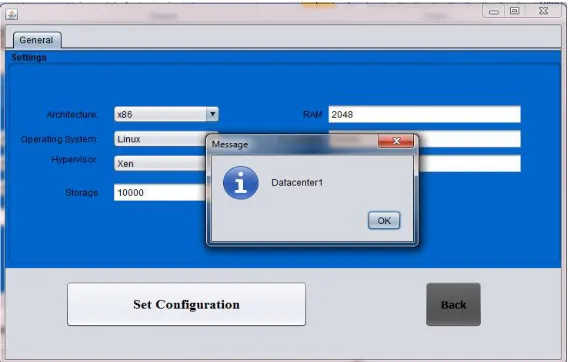
When user double clicks on provider menu, user gets a general setting window as given in figure 2. This window provides predefined setting of datacenter. When user clicks on button, named set configuration, the datacenter1 get configured.
The customers menu provides VM configuration and customer utilization.When user clicks on virtual machine, user can configure predefined three VMs by clicking on button set configuration as shown infigure 3. It is the necessary step to schedule and allocate resources to tasks.
Figure3: VM configuration
After VM configuration ,user goes to customer utilization as shown in figure 4.The customer utilization profile provides 10 cloudlets and user has to configure all cloudlets with their corresponding length and deadline.In such a way cloudlet get configured.
After successful cloudlet configuration, user has to submit all actions.As soon as user clicks on button submit, the message will appear on screen i.e credit based scheduling as shown below in figure 5.
Figure5: Submit tasks length and deadlines
After credit based scheduling, the result comes out as shown in figure 6.It consists mainly four fields namely, instruction, mips, start time and finish time.
Figure6: Final Output Mathematical calculation
Credit based scheduling
Example:if there are 3 cloudlets with their length and deadline
C1: length 10000 deadline 10, C2:length 15000 deadline 50,C3:length 9000 deadline 100 Step 1:Calculate average length
Avg_length=10000+15000+9000/3=11333
Step3:Calculatepri_fact for deadline,if deadline is between 0-99 then it is 10,else if between 100-999 then 100 and so on.
Pri_factC1=10 pri_factC2= 10 pri_factC3=100 Step4:Calculate total credit
Toatal credit=pri_fact*difference
Calculate total credit for all cloudlets
C1:10*1333=13330 C2:10*3667=36670 C3:100*2333=233300 Step5:Schedule tasks on the basis of highest credit first
C3 C2 C1 get schedule with their corresponding length ,mips ,considering start time 0.10. calculate finish time based on formula:
Finish time=instruction/mips. In this manner final output get generated.
VI. CONCLUSION
This paper represents credit based scheduling and elephant herding optimization. It will give better result for scheduling different tasks and allocating resources to these tasks. This will improve performance of the resource allocation strategy on clouds. It will be flexible solution, because it uses the concept of virtualization.
REFERENCES
[1] T Kokilavani, GA DI. “Load Balanced Min-Min Algorithm for Static Meta-Task Scheduling in Grid Computing”. International Journal of Computer Applications.Number 2 - Article 7; 2011.
[2] Antony Thomas, Krishnalal G, Jagathy Raj V P,” Credit Based Scheduling Algorithm in Cloud Computing Environment”, International Conference on Information and Communication Technologies (ICICT 2014)
[3] Gai-Ge Wang, Suash Deb, Leandro Coelho,”Elephant Herding Optimization”, 3rd International Symposium on Computational and Business Intelligence 978-1-4673-8501-5/15 $31.00 © 2015 IEEE
[4] Dantong Yu and Thomas G. Robertazzi .“Divisible Load Scheduling for Grid Computing”.PDCS; 2003, 15th Int’l Conf. Parallel and Distributed Computing and Systems.IASTED.pp. 1 – 9; 2003.
[5] J. Dean and S. Ghemawat.”MapReduce: Simplified data processing on large clusters”, in USENIX Symposium on Operating Systems Design and Implementation, San Francisco: CA; Dec 2004. pp. 137–150.
[6] Vishnupriya, Saranya, Suganya,” Effective Management of Resource Allocation and Provisioning Cost using Virtualization in Cloud” 2014 IEEE International Conference on Advanced Communication Control and Computing Technologies (lCACCCT), ISBN No. 978-1-4799-3914-5/14/$31.00 ©2014 IEEE
[7] Maria Alejandra Rodriguez and RajkumarBuyya, “Deadline Based Resource Provisioning and Scheduling Algorithm for Scientific Workflows on Clouds”, IEEE Transactions On Cloud Computing, Vol. 2, No. 2, April-June 2014
[8] N. Bobroff, A. Kochut, and K. Beaty, "Dynamic Placement of Virtual Machines for Managing SLA Violations," Proc. IFlPl IEEE Int'l Symp. Integrated Network Management (1M '07), pp. 119- 12S, May 2007.
[9] R. Sukumar, “The Asian elephant: ecology and management”, Cambridge University Press, New York, 1993.
[10] S. Pandey, L. Wu, S. M. Guru, and R. Buyya, “A particle swarm optimization-based heuristic for scheduling workflow applications in cloud computing environments,” in Proc. IEEE Int. Conf. Adv. Inform.Netw. Appl., 2010, pp. 400–407.