Realizing Chosen Ciphertext Security Generically in
Attribute-Based Encryption and Predicate Encryption
Venkata Koppula
Weizmann Institute of Science
∗Brent Waters
UT Austin
†February 25, 2019
Abstract
We provide generic and black box transformations from any chosen plaintext secure Attribute-Based Encryption (ABE) or One-sided Predicate Encryption system into a chosen ciphertext secure system. Our transformation requires only the IND-CPA security of the original ABE scheme coupled with a pseudorandom generator (PRG) with a special security property.
In particular, we consider a PRG with an n bit input s ∈ {0,1}n
and n·` bit outputy1, . . . , yn where each yi is an `bit string. Then for a randomly chosens the following two distributions should be computationally indistinguishable. In the first distributionri,si=yiandri,s¯i is chosen randomly for
i∈[n]. In the second distribution allri,bare chosen randomly fori∈[n], b∈ {0,1}.
1
Introduction
In Attribute-Based Encryption [SW05] (ABE) every ciphertext CT that encrypts a messagemis associated with an attribute string x, while each secret, as issued by an authority, will be associated with a predicate functionC. A user with a secret keyskthat is associated with functionCwill be able to decrypt a ciphertext associated withxand recover the message if and only if C(x) = 1. Additionally, security of ABE systems guarantees that an attacker with access to several keys cannot learn the contents of an encrypted message so long as none of them are so authorized.
Since the introduction of Attribute-Based Encryption and early constructions [GPSW06] over a decade ago, there have been many advances in the field ranging from supporting expressive functionality [GVW13, BGG+14], to techniques for adaptive security[Wat09, LOS+10, OT10, LW12, Att14, Wee14, CGW15], short
sized ciphertexts[ALdP11], multi-authority [Cha07, CC09, LW11] and partially hiding attributes [GVW15, GKW17, WZ17] to name just a few. In almost all of these cases and in most other papers, the treatment of ABE focused on the chosen plaintext (IND-CPA) definition of ABE. This is despite the fact that chosen ciphertext security [NY90, RS91, DDN91] — where the attacker can make oracle decryption queries to keys it does not have — is arguably the right definition of security for the same reasons it is the right definition for standard public key cryptography[Sho98]. Likely, most of these works target IND-CPA security since the authors already have their hands full with putting forth new concepts and techniques in manuscripts that often run for many pages. In these circumstances it seems reasonable for such works to initially target chosen plaintext definitions and then for later works to circle back and build toward chosen ciphertext security.
Unfortunately, closing the loop to chosen ciphertext security can be tricky in practice. First, there are a rather large and growing number of ABE constructions. Writing papers to address moving each of these to chosen ciphertext security seems burdensome to authors and program committees alike. One line of work [GPSW06, YAHK11, NP15, BL16] to mediate this problem is to identify features in ABE constructions,
∗
E-mail:[email protected]
†
which if present mean that CPA security implies chosen ciphertext security. Yamada et. al [YAHK11] showed that certain delegability or verifiability properties in ABE systems imply chosen ciphertext security by the Canetti-Halevi-Katz[CHK04] transformation.
Their generality, however, is limited by the need to manually inspect and prove that each construction has such a property. In fact, many schemes might not have these properties. Recent trends for both functionality and proofs techniques might actually work against these properties. For example, an ABE scheme has the verification property roughly if it is possible to inspect a ciphertext and determine if it is well formed and what keys can decrypt it. This property emerged naturally in many of the pairing-based schemes prominent at the time, but is less obvious to prove in LWE-based constructions and actually can runs contrary to the predicate encryption goal of hiding an attribute string xfrom users that cannot decrypt. See for example the one-sided predicate encryption constructions of [GVW15, GKW17, WZ17].
If we desire a truly generic transformation to chosen ciphertext security, then there are essentially two pathways available. The first option is to apply some variant of the Fujisaki-Okamoto [FO99] transformation (first given for transforming from IND-CPA to IND-CCA security in public key encryption). Roughly, the encryption algorithm will encrypt as its message the true message m appended with a random bitstring r using the random coins H(r) where H is a hash function modeled as a random oracle. The CCA-secure decryption algorithm will apply the original decryption algorithm to a ciphertext CT and recoverm0|r0. Next,
it re-encrypts the ciphertext under H(r0) to get a ciphertext CT0 and outputs the message if CT = CT0;
otherwise it rejects. The upside of this approach is that the added overhead is fairly low as it just adds one additional call to encryption as part of the decryption routine. On the downside the security analysis of this technique appears intrinsically tied to the random oracle model [BR93].
The second option is to augment encryption by appending a non-interactive zero knowledge proof [BFM88] that a ciphertext was well formed. This approach has been well studied and explored in the context of stan-dard public key encryption [NY90] and should translate to the ABE context. Additionally, there are stanstan-dard model NIZK proof assumptions under factoring and pairing-based and lattice based [PS19] assumptions.1 A
drawback of this approach is that applying any generic gate by gate NIZK to an encryption system will be quite expensive in terms of computational overhead— this will be needed for any generic conversion.
1.1
Our Contribution
In this work we provide a black box transformation for chosen ciphertext security of any ABE or one-sided predicate encryption system.2
Our transformation requires only the existence of a IND-CPA secure ABE system as well as a pseudo-random generator (PRG) with a special security property which we call the hinting property. This special security property can either be assumed for an “ordinary” (e.g., AES-based) PRG or provably obtained from either the Computational Diffie-Hellman assumption or the Learning with Errors assumption. Our transformation increases ciphertext size by roughly a factor of the security parameter — it requires 2·n sub-ciphertexts for a parametern. Additionally, it requires about 2nadditional encryptions of the original system for both the new encryption and decryption routines. While this overhead is an increase over the original CPA system and will likely incur more overhead than hand-tailored CCA systems, it is a significant performance improvement over NIZKs that operate gate by gate over the original encryption circuit.
We also wish to emphasize that our transformation applies to ordinary public key encryption as well as ABE. While chosen ciphertext security for PKE has been known for sometime from the CDH and LWE assumptions, we believe that our work provides new insights into the problem and might lead to furthering the understanding of whether IND-CPA security ultimately implies chosen ciphertext security.
1The realization of NIZKs from the Learning with Errors assumption is a very recent and exciting development[PS19] and
occured after the initial posting of this work.
2The original definition of predicate encryption [BW07, KSW08] required hiding whether an attribute string of a challenge
ciphertext wasx0 orx1 from an attacker that had a keyC whereC(x0) =C(x1). A weaker form of predicate encryption is
where this guarantee is given only ifC(x0) =C(x1) = 0, but not whenC(x0) =C(x1) = 1. This weaker form has been called
Hinting Property for PRGs : LetPRGbe a function that mapsnbits to (n+ 1)·nbits (output to be parsed as n+ 1 strings, each of length n). Consider the following experiment between a challenger and an adversary. The challenger chooses an n bit strings, computes PRG(s) =z0z1z2. . . zn (each zi ∈ {0,1}n).
Next, it chooses n uniformly random strings v1, v2, . . . , vn each from {0,1}n. It then constructs a 2×n
matrixM as follows: if theithbit ofsis 0, thenM
0,i=zi, M1,i=vi, elseM0,i=vi, M1,i=zi.3 Finally, the
challenger either outputsz0together withM, or it outputs 2n+1 uniformly random strings. A pseudorandom
generator is said to satisfy the hinting property if any polynomial time adversary has negligible advantage in this experiment. Note that the seedsis used at two places : first to compute the stringsz0, z1, z2, . . . , zn,
and then to decide where to place each zi in the matrix M. Hence, the second piece of information (i.e.
the position ofzi strings serves as an extra hint on the PRG). One could simply assume this property of a
particular pseudo random generator. Indeed, this seems rather plausible that ordinary types of PRGs would have it. Alternately, we show how to construct PRGs that provably have this property under either the Computational Diffie-Hellman assumption or the LWE assumption. Our constructions of these PRGs use techniques that closely follow previous works [DG17a, DG17b, BLSV18, DGHM18, GH18] for a related group of primitives going under a variety of names: Chameleon Encryption, One-Time Signature with Encryption, Batch Encryption, One Way Function with Encryption. We note that while the technical innards for the CDH and LWE realizations of our PRG are similar to the above works, (unlike the above examples) our definition itself does not attach any new functionality requirements to PRG; it simply demands a stronger security property.
Next, we present an overview of our CCA construction. As a warm-up, we will first show how to use any CPA-secure public key encryption (PKE) scheme, together with hinting PRGs to construct a CCA-1 secure PKE scheme. Recall, CCA-1 security is a weaker variant of the CCA security game where the adversary is allowed decryption queries only before sending the challenge messages. After sending the challenge messages, the adversary receives the challenge ciphertext, and must send its guess.
CCA-1 secure PKE from CPA-secure PKE and hinting PRGs The construction also uses a (stan-dard) pseudorandom generator G with sufficiently long stretch. Let (Setup,Enc,Dec) be any CPA secure scheme, andH :{0,1}n→ {0,1}(n+1)·n a hinting PRG. We require the CPA scheme to have two properties
which can be obtained ‘for free’. First, we require that the scheme should have perfect decryption correctness for most public/secret keys. This can be obtained via the transformation of [DNR04]. Next, we require that any ciphertext can be decrypted given the encryption randomness. This is also easily obtained by choosing a random stringrduring encryption, and appending a one-time pad of the message usingr.
The setup of our CCA-1 scheme runs the PKE setup 2ntimes, obtaining 2npublic key/secret key pairs
pkb,i,skb,i i∈[n],b∈{0,1}. The new public key consists of the 2npublic keys
pkb,i
i∈[n],b∈{0,1}, while the new
secret key includes only ofnout of the 2nsecret keys, namely{sk0,i}i∈[n] (thissecret hiding principle[FS90]
has been used in many CCA constructions, including the initial CCA systems [NY90, DDN91]). To encrypt a messagem, the encryption algorithm first chooses a uniformly random tagt=t1t2. . . tn, where eachti is
a sufficiently long string. Next, it chooses a seeds← {0,1}n and computesH(s) =z
0z1. . . zn. It usesz0 to
mask the messagem; that is, it computesc=m⊕z0. The remaining ciphertext will containn‘signals’ that
help the decryption algorithm to recovers bit by bit, which in turn will allow it to computez0 and hence
unmaskc.
The ith signal (for each i ∈[n]) has three components c
0,i, c1,i, c2,i. If the ith bit ofs is 0, then c0,i is
an encryption of a random stringxi using the public key pk0,i and randomness zi, c1,i is an encryption of
0n using pk
1,i (encrypted using true randomness), andc2,i =G(xi). If the ith bit ofs is 1, thenc0,i is an
encryption of 0nusing public keypk0,i(encrypted using true randomness),c0,iis an encryption of a random
stringxi using public keypk1,iand randomnesszi, andc2,i=G(xi) +ti(recalltiis theithcomponent in the
tag). So half the ciphertexts are encryptions of zero, while the remaining are encryptions of random strings (with blocks of the hinting PRG output being used as randomness), and the positioning of the zero/random encryptions reveals the seeds.
3More compactly,M
The final ciphertext includes the tagt= (t1t2. . . tn), the ‘main’ componentc, andnsignals (c0,i, c1,i, c2,i).
A noteworthy point about the ciphertext: first, the components {c2,i}i serve as a perfectly-binding
com-mitment to the seed s. However, this commitment also has certain ‘non-malleability’ feature; given a ciphertext/commitment with tagt, an adversary cannot obtain a ciphertext/commitment for some other tag t0 - this feature is necessary for the scheme to be CCA secure.
To decrypt, the decryption algorithm first decrypts eachc0,i(recall the secret key is{sk0,i}i∈[n]) to obtain
y1y2. . . yn. It then checks ifG(yi) = c2,i. If so, it guesses that si = 0, else it guesses that si = 1. With
this estimate fors, the decryption algorithm can compute H(s) = z0z1. . . zn and then compute c⊕z0 to
learn the messagem. While this decryption procedure works correctly, we would like to prevent malicious decryption queries (made during the CCA/CCA-1 experiment), and hence the decryption algorithm needs to enforce additional checks. In particular, the decryption algorithm therefore needs to check that the guess forsis indeed correct. If theithbit ofsis guessed to be 0, then the decryption algorithm checks that c
0,i
is a valid ciphertext - it simply re-encryptsyi and checks if this equals c0,i. If theith bit ofsis guessed to
be 1, then the decryption algorithm first recovers the messaage underlying ciphertext c1,i. Note that c1,i
should be encrypted using randomness zi, hence usingzi, one can recover message ˜yi from c1,i (using the
randomness recovery property of the PKE scheme). It then re-encrypts ˜yi and checks if it is equal toc1,i,
and also checks that c2,i = G(˜yi) +ti. Finally, if all these checks pass, the decryption algorithm outputs
z0⊕c.
To summarize, at a very high level, we build a partial trapdoor where the decryption algorithm will recover some of the coins used for encryption. These are then used to partially re-encrypt the ciphertext and test for validity. Influenced by Garg and Hajiabadi[GH18], we will prove security not by removing the signals for each bit position, but by adding misinformation that drowns out the original signal. Note that to prove security, we need to remove the information ofz0 (and hence information ofs) from two places - first, from
the commitment{c2,i}i; second, from the positions where thezivalues are used for encrypting. For the first
one, in the proof, we set the challenge tagt∗such that the signal is ambiguous at each index. More formally, in the challenge ciphertext c∗0,i is an encryption of yi, c∗1,i is encryption of ˜yi, and G(yi) = G(˜yi) +t∗i.
Replacing the encryptions of zeroes with encryptions of these carefully chosen strings involves a delicate argument, which crucially relies on the perfect correctness of our scheme (see discussion in Section 4 for more details).
When this is done for all indices, all information aboutswill be lost from the message space and we are almost done; however, one loose end remains. Each ciphertext at position (si, i) will be encrypted under
randomness ri which came from running the pseudorandom generator on s; whereas each ciphertext at
position (¯si, i) will be encrypted under fresh random coins. To complete the proof we need a computational
assumption that will allow us to change all the encryption coins to being chosen freshly at random. Here, we use the security of hinting PRGs, and that completes our proof.
CCA Security To achieve CCA security, we need to make a few tweaks to the above scheme. The setup algorithm also chooses n pairwise independent hash functions h1, h2, . . . , hn. The encryption algorithm
chooses a signing/verification key for a (one-time) signature scheme. Next, instead of choosing a tag t uni-formly at random, it sets ti =hi(vk) (wherevk is the verification key). Finally, the encryption algorithm
computes a signature on all the ciphertext components, and the final ciphertext consists of all these compo-nents together with the signature and the verification key. To prove security, we first ensure that none of the decryption queries correspond to the challenge ciphertext’s verification key (this follows from the security of the signature scheme). After this point, the proof follows along the lines of the CCA-1 scheme.
Moving to Attribute Based Encryption/Predicate Encryption - For ABE/PE, the scheme is al-tered as follows. First, the public key consists ofnABE/PE public keys andnPKE public keys. Letpk0,i
denote theithABE/PE public key, andpk1,itheithPKE public key. The master secret key only consists of
masked usingz0 as before, and thec0,icomponent is an encryption of zero/random message for attributex
using public keypk0,iand randomness being truly random/zi, depending on theithbit of seeds.
We conclude by remarking that while this work focuses on Attribute-Based Encryption and One-sided Predicate Encryption, we believe our transformation could apply to other specialized forms of encryption. For example, we believe it should immediately translate to any secure broadcast encryption [FN94] system. As another example, we believe our technique should also apply to ABE systems that are IND-CPA secure under a bounded number of key generation queries. Our technique, however, does not appear to apply to standard predicate encryption as defined in [BW07, KSW08] (notions very similar to full blown functional encryption). The core issue is that to test the validity of a ciphertext our decryption algorithm needs to obtain the attribute string xto perform re-encryption. In one-sided predicate encryption, if a user has a secret key forC andC(x) = 1 we essentially give up on hidingxand allow this to be recovered; whereas for full hiding we might want to still hide information aboutxeven ifC(x) = 1.
Finally, we note that even if we cast the notions of ABE aside our work might provide another path to exploring the longstanding open problem of achieving chosen ciphertext security from chosen plaintext security. The primary barrier is in how to achieve a PRG with this hinting security.
1.2
Additional Comparisons
It is instructive to take a closer look at how our work relates to and builds upon the trapdoor function construction of Garg and Hajiabadi[GH18]. Briefly and in our terminology, Garg and Hajiabadi gave a framework where the evaluation algorithm chooses an inputs∈ {0,1}nand use this to first produces a value
ythat produces part of the output. Next, for each position (si, i) the evaluation algorithm produces a signal
usingsand the public parameters of the TDF using a primitive called “one way function with encryption”. At the opposite position (¯si, i) the evaluation algorithm outputs a random stringriof sufficient length. With
very high probability the random string zi will not correspond to the valid signal for y at position (¯si, i).
The inversion algorithm will use knowledge of the TDF secret key plusy to go recover the input sbit by bit. At each positioniif a signal is present at (0, i) it recordssi= 0 and setssi= 1 if the signal is at (1, i).
If the signal is at both 0 and 1, then recovery fails. One can observe that for almost all choices of public parameters there exist some valid inputs that will cause failure on inversion. To prove security the reduction algorithm at each position change the stringzi from random to a signal undery. The security properties of
the one way function with encryption make this undetectable. Once, this is done the only information about swill be contained in y. Since many choices ofswill map to y, inverting to the chosens at this point will be statistically infeasible.
Our work as described above follows a similar approach in that a seed s is signaled bit by bit. And that a step of proving security is to add misinformation in by adding a counter signal in at positions (¯si, i).
An important distinction is that in the work of Garg and Hajiabadi the signaling and inversion process is very tightly coupled in the one way function with encryption primitive. One could imagine trying to build an Attribute-Based version of one way function with encryption and then try to yield a CCA encryption from the resulting trapdoor. This runs into two problems. First, it would require a tailored construction for each type of ABE scheme that we want and then we are back to hacking CCA into each type of ABE variant. Second, since the GH scheme allows for ambiguous inputs, it can be difficult for mapping into chosen ciphertext secure schemes. In particular, this issue caused GH to need an adaptive version of one way function with encryption to bridge from TDFs to CCA security and this adaptive version was not realizable from the CDH assumption.
We also believe that it might be interesting to swing some of our techniques back to the trapdoor function regime. For example, consider the GH TDF, but where we added valuesa1, . . . , an to the public parameters.
We could modify the evaluation algorithm such that at positioni, the algorithm gives the one-way function with encryption outputei ifsi= 0 and givesei⊕ai ifsi= 1. This modification would allow us to drop the
additionalzi values from the GH construction and make the output of the TDF shorter. In addition, while
there would still be a negligible correctness error, it could be possible to rest this error solely in the choice of public parameters and for a “good” choice of parameters there would be no further error from evaluation. This last claim would require making sure that theai values were sufficiently long relative toy. We believe
the techniques from [RS10] can be used here to achieve CCA security.
We finally remark again that our realizations of our hinting PRG largely follow in line with recent works [DG17a, DG17b, BLSV18, DGHM18, GH18]. In particular, our CDH realization follows closely to [DG17a] and our LWE realization to [BLSV18, DGHM18]. It may have been possible to build our hinting PRG from one of the previous abstractions, but we chose to provide direct number theoretic realizations. We believe that one important distinction is that our hinting PRG is simply a PRG with stronger security properties; unlike the above abstractions our definition in of itself does not ask for expanded functionality. An intriguing open question is if this can be leveraged to obtain further instances with provable security.
Independent Work Independently, Garg, Gay and Hajiabadi [GGH18] recently built upon the work of [GH18] to build trapdoors from one way function with encryption that has improved correctness proper-ties. In particular, the base construction of [GGH18] generates parameters that with high probability will allow inversion on all inputs, whereas any parameters generated from the [GH18] construction will always have inversion failure on some small fraction of inputs. They then build upon using erasure codes and a “smoothness” property to get CCA secure determinstic encryption with shorter ciphertexts. In addition, they show a modification to the Peikert-Waters [PW08] DDH-based Lossy TDF that gets a better ciphertext rate. The initial direction of getting better correctness in TDFs is similar to our “swinging techniques back” comment above, but otherwise the works pursue separate goals and techniques.
1.3
Toward Bridging Chosen Ciphertext Security in PKE
One classical open problem in cryptography is whether chosen plaintext security implies chosen ciphertext security in standard public key encryption. From a cursory glance one can see that it is easy to swap out the ABE system from our construction for a plain old public key encryption system and the same proof will go through — this time for obtaining chosen ciphertext secure public key encryption. Thus the “only” barrier for moving from IND-CPA to IND-CCA security is in the hinting PRG.
An interesting open question is just how strong this barrier is. From our viewpoint, the hinting security is something that most natural PRGs would likely have. In trying to understand whether it or something similar could be built from general assumptions (e.g. PKE or one way functions) it could be useful to first try to build a separation from our hinting PRG and a standard one. Do there exist PRGs that do not meet the security definition of hinting PRG?
As a first stab at the problem, one might consider PRGs where there is an initial trusted setup algorithm that produces a set of public parameters, which are then used for every subsequent evaluation. In this setting one could imagine a counterexample where the public parameters produced by the setup algorithm include an obfuscated program which will assist in breaking the hinting security, but not be helpful enough to break standard security. Using obfuscation in a similar manner has been useful for achieving other separation results. If we consider PRGs that do not allow for such setup, the task appears to be more challenging. One could try to embed such an obfuscated program in the first block of the PRG output, but this block would need to still look random for standard PRG security.
has each of its bits given out in the clear exactly once. And where the rest of the bits of the output are generated pseudorandomly from the rest of the seed.
Altogether we believe that our work opens up a new avenue for exploring the connection of chosen plaintext and ciphertext security.
2
One-sided Predicate Encryption
A predicate encryption (PE) scheme PE, for set of attribute spaces X = {Xλ}λ∈N, predicate classes C =
{Cλ}λ∈Nand message spacesM={Mλ}λ∈N, consists of four polytime algorithms (Setup,Enc,KeyGen,Dec)
with the following syntax.
Setup(1λ)→(pp,msk). The setup algorithm takes as input the security parameter λand a description of
attribute space Xλ, predicate classCλ and message space Mλ, and outputs the public parameterspp
and the master secret key msk.
Enc(pp, m, x)→ ct. The encryption algorithm takes as input public parameters pp, a message m ∈ Mλ
and an attributex∈ Xλ. It outputs a ciphertextct.
KeyGen(msk, C)→skC. The key generation algorithm takes as input master secret keymskand a predicate
C∈ Cλ. It outputs a secret keyskC.
Dec(skC,ct)→mor⊥. The decryption algorithm takes as input a secret key skC and a ciphertext ct. It
outputs either a message m∈ Mλ or a special symbol⊥.
Correctness. A key-policy predicate encryption scheme is said to be correct if for allλ∈N, (pp,msk)←
Setup(1λ), for allx∈ X
λ,C∈ Cλ, m∈ Mλ,skC←KeyGen(msk, C),ct←Enc(pp, m, x), the following holds
Correctness for decryptable ciphertexts :C(x) = 1⇒Pr [Dec(skC,ct) =m] = 1,
Correctness for non-decryptable ciphertexts :C(x) = 0⇒Pr [Dec(skC,ct) =⊥]≥1−negl(λ),
wherenegl(·) are negligible functions, and the probabilities are taken over the random coins used during key generation and encryption procedures.
Recovery from Randomness Property. A key-policy predicate encryption scheme is said to have recov-ery from randomness property if there is an additional algorithmRecoverthat takes as input public param-eterspp, ciphertextct, stringrand outputsy∈(Mλ× Xλ)∪ {⊥}and satisfies the following condition: for
allλ∈N, (pp,msk)←Setup(1λ), for allx∈ Xλ,m∈ Mλ,ct=Enc(pp, m, x;r),Recover(pp,ct, r) = (m, x).
If there is no (m, x, r) tuple such thatct=Enc(pp, m, x;r), thenRecover(pp,ct, r) =⊥.
Security. In this work, we will be considering predicate encryption systems with one-sided security. One can consider both security against chosen plaintext attacks and chosen ciphertext attacks. First, we will present one-sided security against chosen plaintext attacks.
Definition 2.1 (One-Sided Security against Chosen Plaintext Attacks). A predicate encryption scheme
PE = (Setup,Enc,KeyGen,Dec) is said to be one-sided secure against chosen plaintext attacks if for every stateful PPT adversaryA, there exists a negligible functionnegl(·), such that the following holds:
Pr
A
KeyGen(msk,·)(ct) =b:
(pp,msk)←Setup(1λ)
((m0, x0),(m1, x1))← AKeyGen(msk,·)(pp)
b← {0,1}; ct←Enc(pp, mb, xb)
− 1 2
≤negl(λ)
The notion of one-sided security against chosen plaintext attacks could alternatively be captured by a simulation based definition [GVW15]. Goyal et al. [GKW17] showed that if a PE scheme satisfies Defini-tion 2.1, then it also satisfies the simulaDefini-tion based definiDefini-tion of [GVW15].
Next, we present the definition for capturing chosen ciphertext attacks on predicate encryption schemes. Here, we will assume that the key generation algorithm is deterministic.
Definition 2.2 (One-Sided Security against Chosen Ciphertext Attacks). A predicate encryption scheme
PE = (Setup,Enc,KeyGen,Dec) with deterministic key generation is said to be one-sided secure against
chosen ciphertext attacks if for every stateful PPT adversary A, there exists a negligible function negl(·), such that the following quantity
Pr
AKeyGen(msk,·),ODec(msk,·,·)(ct∗) =b:
(pp,msk)←Setup(1λ)
((m0, x0),(m1, x1))← AKeyGen(msk,·),ODec(msk,·,·)(pp)
b← {0,1}; ct∗←Enc(pp, mb, xb)
− 1 2
is at mostnegl(λ), where
• the oracleODec(msk,·,·) takes as input a ciphertextctand a circuitC. It computesskC=KeyGen(msk, C)
and outputsDec(skC,ct).
• every predicate queryC, made by adversaryAto theKeyGen(msk,·) oracle, must satisfy the condition that C(x0) =C(x1) = 0.
• every post-challenge query (C,ct) made by the adversary A to ODec must satisfy the condition that
either ct6=ct∗ or ifct=ct∗, then C(x0) =C(x1) = 0.
Remark 2.1. Note that the above definition addresses chosen ciphertext attacks against systems with deterministic key generation. An analogous definition for general schemes (that is, with randomized key generation) would involve maintaining key handles and allowing the adversary to choose the key to be used for the decryption queries. We choose the simpler definition since any scheme’s key generation can be made deterministic by using a pseudorandom function. In particular, the setup algorithm chooses a PRF keyK which is included as part of the master secret key. To derive a key for circuitC, the algorithm first computes r= PRF(K, C) and then usesras randomness for the randomized key generation algorithm.
2.1
ABE schemes with ‘recovery from randomness’ property
Any ABE scheme satisfying one-sided CPA security can be transformed into another ABE scheme that is also one-sided CPA secure, and has the ‘recovery from randomness’ property. The encryption algorithm simply uses part of the randomness to compute a symmetric key encryption of the message and attribute, with part of the randomness as the encryption key.
More formally, letE= (Setup,Enc,KeyGen,Dec) be an ABE scheme that satisfies one-sided CPA security (see Definition 2.1), and let (SKE.Setup,SKE.Enc,SKE.Dec) be a symmetric key CPA secure encryption schceme. consider the following scheme E0 = (Setup0,Enc0,KeyGen0,Dec0,Recover), where Setup0 = Setup
andKeyGen0 =KeyGen.
Enc0(pk, m, x): The encryption algorithm first samples three random strings r1, r2, r3. It computes ct1 =
Enc(pk, m, x;r1). Next, it computesske.sk=SKE.Setup(1λ;r2). Finally, it computesct2=SKE.Enc(ske.sk,
(m, x);r3) and outputs (ct1,ct2).
Dec0(sk,(ct1,ct2)): The decryption algorithm simply decrypts ct1 using sk, and ignores ct2. It outputs
Dec(sk,ct1).
Recover((ct1,ct2), r = (r1, r2, r3)): The recovery algorithm first computes ske.sk = SKE.Setup(1λ;r2). It
outputsy←SKE.Dec(ske.sk,ct2).
3
Hinting PRGs
A hinting PRG scheme is a PRG with a stronger security guarantee than standard PRGs. A hinting PRG takesnbits as input, and outputsn·`output bits. In this security game, the challenger outputs 2nstrings, each of`bits. In one scenario, all these 2nstrings are uniformly random. In the other case, half the strings are obtained from the PRG evaluation, and the remaining half are uniformly random. Moreover, these 2n strings are output as a 2×nmatrix, where in the ithcolumn, the top entry is pseudorandom if theith bit
of the seed is 0, else the bottom entry is pseudorandom. As a result, these 2n strings give a ‘hint’ about the seed, and hence this property is stronger than regular PRGs. Note, if this hint is removed and the top entries in each column were pseudorandom (and the rest uniformly random), then this can be achieved using regular PRGs.
Below, we define this primitive formally. The informal description above had two simplifications. First, the definition below considers PRGs with setup (although one can analogously define such a primitive without setup). Second, we assume the PRG outputs (n+ 1)·` bits, where the first`bits do not contain any extra hint about the seed. Finally, for our CCA application, we introduce some notation in order to represent the n+ 1 blocks of the PRG output. Instead of describing the PRG as a function that outputs (n+ 1)·` bits, we have an evaluation algorithm that takes as input an indexi∈ {0,1, . . . , n}, and outputs theith block of
the PRG output.
Let n(·,·) be a polynomial. A n-hinting PRG scheme consists of two PPT algorithmsSetup,Evalwith the following syntax.
Setup(1λ,1`): The setup algorithm takes as input the security parameterλ, and length parameter `, and outputs public parameterspp and input lengthn=n(λ, `).
Eval(pp, s∈ {0,1}n, i∈[n]∪ {0}): The evaluation algorithm takes as input the public parameterspp, ann
bit strings, an indexi∈[n]∪ {0} and outputs an`bit stringy.
Definition 3.1. A hinting PRG scheme (Setup,Eval) is said to be secure if for any PPT adverasry A, polynomial`(·) there exists a negligible functionnegl(·) such that for allλ∈N, the following holds:
Pr
1←A
pp,
y0β,nyi,bβ o
i∈[n],b∈{0,1}
:
(pp, n)←Setup(1λ,1`(λ)), s← {0,1}n,
β← {0,1}, y0
0← {0,1}`, y10=Eval(pp, s,0),
y0
i,b← {0,1}` ∀i∈[n], b∈ {0,1},
y1
i,si=Eval(pp, s, i), y
1
i,si← {0,1}
` ∀i∈[n]
−1
2
≤negl(·)
4
CCA Secure Public Key Encryption Scheme
Let PKECPA = (CPA.Setup, CPA.Enc, CPA.Dec) be a IND-CPA secure public key encryption scheme with
randomness-decryptable ciphertexts and perfect decryption correctness, S = (ss.Setup,ss.Sign,ss.Verify) a strongly unforgeable one time signature scheme and HPRG = (HPRG.Setup,HPRG.Eval) a hinting PRG scheme. We will assume that our encryption scheme has message space{0,1}λ+1. Let `
PKE(·) be a
polyno-mial repesenting the number of bits of randomness used byCPA.Enc, and `vk(·) the size of verification keys
output by ss.Setup. For simplicity of notation, we will assume `(·) = `PKE(·),4 `out(λ) = `vk(λ) + 3λ and PRGλ:{0,1}λ→ {0,1}`out(λ)a family of secure pseudorandom generators.
We will now describe our CCA secure public key encryption scheme PKECCA = (CCA.Setup, CCA.Enc,
CCA.Dec) with message space Mλ={0,1}`(λ). For simplicity of notation, we will skip the dependence of`
and`out onλ.
CCA.Setup(1λ): The setup algorithm performs the following steps.
1. It chooses (HPRG.pp,1n)←HPRG.Setup(1λ,1`).
2. It chooses 2ndifferentPKECPAkeys. Let (cpa.skb,i,cpa.pkb,i)←CPA.Setup(1λ) for eachb∈ {0,1},
i∈[n].
3. It then choosesai← {0,1}`out for eachi∈[n] andB← {0,1}`out.
4. It setscca.pk=HPRG.pp, B, ai,cpa.pkb,i
b∈{0,1},i∈[n]
andcca.sk= (cpa.sk0,i)i∈[n].
CCA.Enc(cca.pk, m, x): Let cca.pk = HPRG.pp, B, ai,cpa.pkb,i
b∈{0,1},i∈[n]
. The encryption algorithm
does the following:
1. It first chooses s← {0,1}n. It sets c=HPRG.Eval(HPRG.pp, s,0)⊕m.
2. Next, it chooses signature keys (ss.sk,ss.vk)←ss.Setup(1λ).
3. For eachi∈[n], it choosesvi← {0,1}λ andri← {0,1}`, setsrei=HPRG.Eval(HPRG.pp, s, i).
4. Next, for eachi∈[n], it does the following:
• If si = 0, it sets c0,i = CPA.Enc(cpa.pk0,i,1|vi;rei), c1,i = CPA.Enc(cpa.pk1,i,0
λ+1;r
i) and
c2,i=PRG(vi).
• If si = 1, it sets c0,i = CPA.Enc(cpa.pk0,i,0λ+1;ri), c1,i = CPA.Enc(cpa.pk1,i,1|vi;rei) and
c2,i=PRG(vi) +ai+B·ss.vk.5.
5. Finally, it setsM =c,(c0,i, c1,i, c2,i)i∈[n]
, computesσ←ss.Sign(ss.sk, M) and outputs (ss.vk, M, σ) as the ciphertext.
CCA.Dec(cca.sk,cca.pk,cca.ct): Let the ciphertextcca.ctbe parsed asss.vk,c, M= (c0,i, c1,i, c2,i)i∈[n]
, σ
andcca.sk=(cpa.sk0,i)i∈[n]
. The decryption algorithm does the following:
1. It first verifies the signatureσ. It checks ifss.Verify(ss.vk, M, σ) = 1, else it outputs ⊥.
2. Next, the decryption algorithm computes d=PKE.Find(cca.pk, cca.sk, cca.ct) (wherePKE.Find
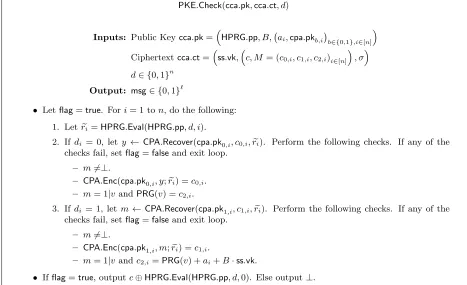
is defined in Figure 1), and outputsPKE.Check(cca.pk, cca.ct,d) (wherePKE.Checkis defined in Figure 2).
PKE.Find(cca.pk,cca.sk,cca.ct)
Inputs: Public Keycca.pk=HPRG.pp, B, ai,cpa.pkb,i
b∈{0,1},i∈[n]
Secret Keycca.sk= (cpa.sk0,i)i∈[n]
Ciphertextcca.ct=ss.vk,c, M = (c0,i, c1,i, c2,i)i∈[n]
, σ Output: d∈ {0,1}n
• For eachi∈[n], do the following: 1. Letmi=CPA.Dec(cpa.sk0,i, c0,i).
2. Ifmi= 1|viandPRG(vi) =c2,i, setdi= 0. Else setdi= 1.
• Outputd=d1d2. . . dn.
Figure 1: RoutinePKE.Find
5Here, we assume the verification key is embedded in
PKE.Check(cca.pk,cca.ct, d)
Inputs: Public Keycca.pk=HPRG.pp, B, ai,cpa.pkb,i
b∈{0,1},i∈[n]
Ciphertextcca.ct=ss.vk,c, M = (c0,i, c1,i, c2,i)i∈[n]
, σ d∈ {0,1}n
Output: msg∈ {0,1}`
• Letflag=true. Fori= 1 ton, do the following: 1. Letrei=HPRG.Eval(HPRG.pp, d, i).
2. If di = 0, let y ←CPA.Recover(cpa.pk0,i, c0,i,rei). Perform the following checks. If any of the checks fail, setflag=falseand exit loop.
– m6=⊥.
– CPA.Enc(cpa.pk0,i, y;rei) =c0,i.
– m= 1|vandPRG(v) =c2,i.
3. If di = 1, letm ←CPA.Recover(cpa.pk1,i, c1,i,rei). Perform the following checks. If any of the checks fail, setflag=falseand exit loop.
– m6=⊥.
– CPA.Enc(cpa.pk1,i, m;rei) =c1,i.
– m= 1|vandc2,i=PRG(v) +ai+B·ss.vk.
• Ifflag=true, outputc⊕HPRG.Eval(HPRG.pp, d,0). Else output⊥.
Figure 2: RoutinePKE.Check
4.1
Discussion
We will now make a few observations about our construction and then proceed to give a brief overview our proof that appears in the next subsection.
First, for each i∈ [n] if si = 0 the encryption algorithm will choose a randomvi and signal that this
bit is a 0 by encrypting 1|vi to the position (0, i) and giving c2,i =PRG(vi) in the clear. In the opposite
position of (1, i) it will encrypt the all 0’s string. Likewise, ifsi= 1 it will signal a 1 by encrypting 1|vi to
the position (1, i) and givingc2,i=PRG(vi) +ai+B·ss.vkin the clear. With all but negligible probability
it is impossible to signal both 0 and 1 simultaneously for an index i. This follows from the fact thatai is
chosen randomly and that the space of verification keys is much smaller than 2`out(λ). We observe that this argument has some flavor of Naor’s bit commitment scheme [Nao89].
Second, we observe that even though one is supposed to encrypt the all 0’s string to position (¯si, i) the PKE.Find routine will not immediately quit if discovers something else. Instead it simply sets di = 0 if
decryption outputs 1|vi and c2,i = PRG(vi); otherwise it sets di = 1. Thus, the decryption routine may
refrain from immediately aborting even though when it “knows” the ciphertext was not formed entirely correctly. This will be critical to a proof step.
Our proof of security will be organized as a sequence of security games which we show to be indistin-guishable. In the first proof step we apply a standard argument using strongly unforgeable signatures to change the decryption oracle to reject all ciphertexts corresponding toss.vk∗ wheress.vk∗ is the verification key used by the challenge ciphertext.
Next, for eachi we choose the public parameter valuesai such that it is possible for one to signal both
0 and 1 at indexi, but that this ambiguity is only possible for a ciphertext corresponding to ss.vk∗. To do this it chooses uniformly random wi ← {0,1}λ, and setsai = PRG(vi∗)−PRG(wi)−ss.vk∗·B if s∗i = 0,
else ai = PRG(wi)−PRG(v∗i)−ss.vk
∗
signaling at both 0 and 1 in the challenge ciphertext. However, for all possible decryption queries where
ss.vk6=ss.vk∗this remains impossible.
Our next goal will be to use the IND-CPA security of the underlying PKE scheme to introduce signals on the opposite paths∗. To do this, however, for alliwheres∗
i = 1 we must first change the decryption routine
to use cpa.sk1,i to decrypt the sub-ciphertext at position (1, i) instead of usingcpa.sk0,i (at position (0, i)).
Consider a particular ciphertext query and letdi be the bit reported by the original find algorithm on that
ciphertext query andd0ibe the bit reported by a the new decryption procedure on that same ciphertext. We want to argue that ifdi 6=d0i then thePKE.Checkprocedure will abort and output ⊥on both encryptions.
The first possibility is thatdi = 0 andd0i= 1; however, that should be information theoretically impossible
as it would entail signaling both a 0 and 1 for a query with ss.vk 6= ss.vk∗. The other possibility is that di = 1 and d0i = 0; i.e. that there is not a signal present at either side. In this case the first decryption
routine will havedi= 1, but then when running PKE.Checkit will fail to find a signal at position (1, i) and
abort. Likewise, the second decryption routine will have d0i = 0, but then fail to find a signal at position (0, i), so both routines will behave identically in this case as well.
Once the oracle decryption is set to follow the seed s∗ we can straightforwardly use CPA security to introduce ambiguous signals in the messages for all positions (s∗
i, i). Once this change is made we can
change the oracle decryption routine again. This time it will only decrypt at positions (1, i) for alli ∈[n] and only usecpa.sk1,i. A similar argument to before can be applied to make this change.
All information about s is gone except to the lingering amount in the random coins used to encrypt. We can immediately apply the hinting PRG to change to a game where these values can be moved to be uniformly at random. At this point the message will be hidden.
4.2
Security Proof
We will now show that the above construction satisfies the CCA security definition. Our proof proceeds via a sequence of hybrids. First, we will describe all hybrids, and then show that the hybrids are computationally indistinguishable.
4.2.1 Hybrids
Hybrid H0 : This corresponds to the original security game.
• Setup Phase
1. The challenger first chooses (HPRG.pp,1n)←HPRG.Setup(1λ,1`).
2. Next it chooses 2n different PKECPA keys. Let (cpa.skb,i,cpa.pkb,i) ← CPA.Setup(1λ) for each
i∈[n],b∈ {0,1}.
3. The challenger chooses s∗ ← {0,1}n, v∗
i ← {0,1}λ for each i ∈ [n], and (ss.sk
∗,ss.vk∗) ← ss.Setup(1λ). It sets
e
ri∗ =HPRG.Eval(HPRG.pp, s∗, i). (These components will be used during
the challenge phase.)
4. It then choosesai← {0,1}`out for eachi∈[n] andB← {0,1}`out.
5. It sends cca.pk=HPRG.pp, B, ai,cpa.pkb,i
b∈{0,1},i∈[n]
toA, and sets the secret keycca.sk=
(cpa.sk0,i)i∈[n].
• Pre-challenge Query Phase – Decryption Queries
1. For each query ct= ss.vk, M = c,(c0,i, c1,i, c2,i)i, σ, the challenger first checks the
sig-nature σ.
• Challenge Phase
1. The adversary sends two challenge messages (m∗
0, m∗1).
2. The challenger chooses a bitβ ∈ {0,1}. 3. It setsc∗=HPRG.Eval(HPRG.pp, s,0)⊕m∗β. 4. It sets (c∗0,i, c∗1,i, c∗2,i) as follows.
– If s∗i = 0, it sets c∗0,i = CPA.Enc(cpa.pk0,i,1|vi∗;rei∗), c∗1,i ← CPA.Enc(cpa.pk1,i,0λ+1) and
c∗2,i=PRG(vi∗).
– If s∗i = 1, it sets c∗0,i ← CPA.Enc(cpa.pk0,i,0λ+1), c∗
1,i = CPA.Enc(cpa.pk1,i,1|v∗i;rei
∗) and
c∗2,i=PRG(vi∗) +ai+B·ss.vk∗.
5. Finally, it computes a signatureσ∗onM∗= c∗, c∗
0,i, c∗1,i, c∗2,i
usingss.sk∗and sends (ss.vk∗, M, σ∗)
to A.
• Post-challenge Query Phase
– Decryption Queries These are handled as in the pre-challenge phase, with the restriction that all queries (ct, C) must satisfy thatct6=ct∗.
• Finally, the adversary sends its guess b.
Hybrid H1 : This hybrid is similar to the previous one, except that during the decryption queries, the
challenger checks ifss.vk=ss.vk∗. If so, it rejects.
HybridH2 : In this hybrid, the challenger changes Step 4 of the setup phase. It chooses uniformly random
wi← {0,1}λ, and setsai=PRG(v∗i)−PRG(wi)−ss.vk∗·Bifs∗i = 0, elseai =PRG(wi)−PRG(vi∗)−ss.vk
∗ ·B.
Hybrid H3 : This hybrid is similar to the previous one, except that the challenger modifies the way
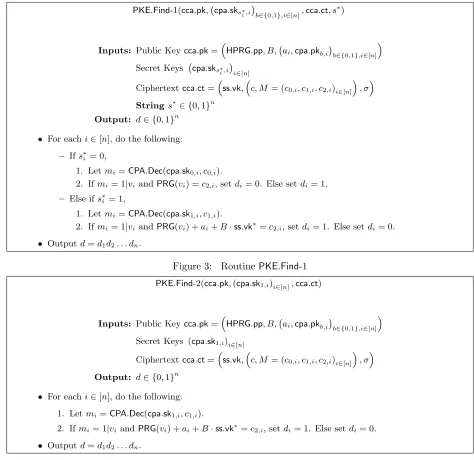
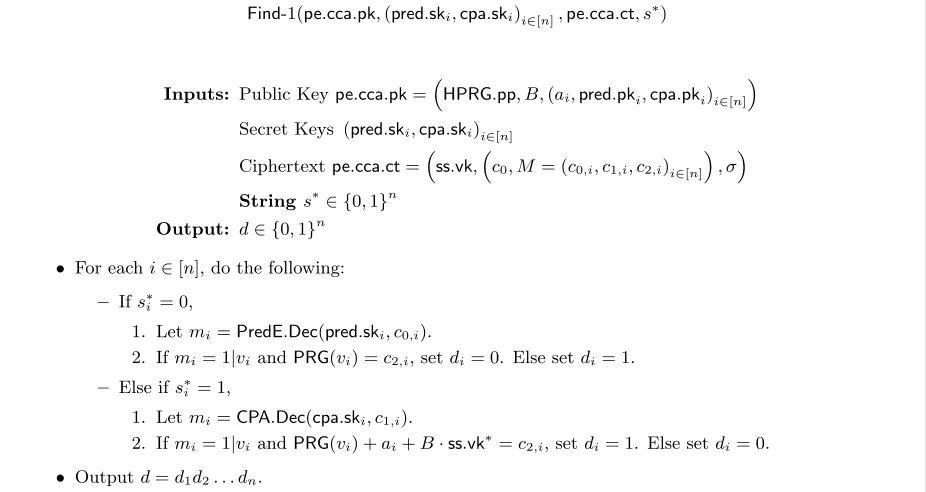
decryption queries are handled. Instead of using PKE.Find, the challenger uses PKE.Find-1 (defined in Figure 3). The PKE.Findroutine decrypts only thec0,i values. If decryption works, it guessesdi = 0, else
it guessesdi = 1. ThePKE.Find-1 routine decrypts eitherc0,i or c1,i, depending on theith bit ofs∗. Note
that thePKE.Checkroutine is identical in both experiments.
HybridH4 : In this step, the challenger modifies the challenge ciphertext. For alli∈[n] such thats∗i = 0,
the challenger setsc∗1,i←CPA.Enc(cpa.pk1,i,1|wi).
HybridH5 : In this step, the challenger modifies the challenge ciphertext. For alli∈[n] such thats∗i = 1,
the challenger setsc∗0,i←CPA.Enc(cpa.pk0,i,1|wi). 6
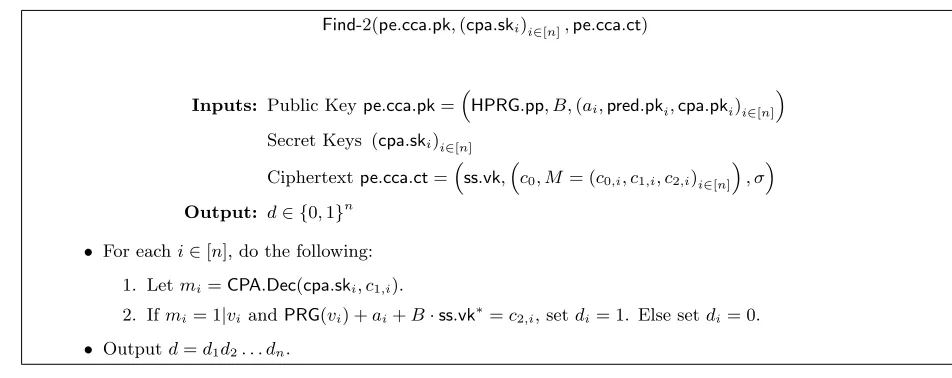
Hybrid H6 : This step is similar to the previous one, except for the decryption queries in the
pre-challenge/post-challenge phase. Instead of using PKE.Find-1, the challenger uses PKE.Find-2 (defined in Figure 4). Note that this routine does not require any of the predicate encryption secret keys.7
6Note that hybridsH
4 andH5could have been clubbed into a single hybrid. We chose this distinction so that the hybrids
for the PKE CCA proof are similar to the hybrids for our Predicate Encryption security proof.
7We could have simplified this step by usingPKE.Findinstead of usingPKE.Find-2. However, looking ahead, our proof for
PKE.Find-1(cca.pk, cpa.sks∗ i,i
b∈{0,1},i∈[n],cca.ct, s ∗
)
Inputs: Public Keycca.pk=HPRG.pp, B, ai,cpa.pkb,i
b∈{0,1},i∈[n]
Secret Keys cpa.sks∗ i,i
i∈[n]
Ciphertextcca.ct=ss.vk,c, M = (c0,i, c1,i, c2,i)i∈[n]
, σ Strings∗∈ {0,1}n
Output: d∈ {0,1}n
• For eachi∈[n], do the following:
– Ifs∗i = 0,
1. Letmi=CPA.Dec(cpa.sk0,i, c0,i).
2. Ifmi= 1|viandPRG(vi) =c2,i, setdi= 0. Else setdi= 1.
– Else ifs∗i = 1,
1. Letmi=CPA.Dec(cpa.sk1,i, c1,i).
2. Ifmi= 1|viandPRG(vi) +ai+B·ss.vk∗=c2,i, setdi= 1. Else setdi= 0.
• Outputd=d1d2. . . dn.
Figure 3: RoutinePKE.Find-1
PKE.Find-2(cca.pk,(cpa.sk1,i)i∈[n],cca.ct)
Inputs: Public Keycca.pk=HPRG.pp, B, ai,cpa.pkb,i
b∈{0,1},i∈[n]
Secret Keys (cpa.sk1,i)i∈[n]
Ciphertextcca.ct=ss.vk,c, M = (c0,i, c1,i, c2,i)i∈[n]
, σ
Output: d∈ {0,1}n
• For eachi∈[n], do the following: 1. Letmi=CPA.Dec(cpa.sk1,i, c1,i).
2. Ifmi= 1|viandPRG(vi) +ai+B·ss.vk∗=c2,i, setdi= 1. Else setdi= 0.
• Outputd=d1d2. . . dn.
Figure 4: RoutinePKE.Find-2
HybridH7 : This hybrid is identical to the previous one, and the only difference here is change of variable
names. In particular, we will swap the variable namesv∗i andwi ifs∗i = 1. This change affects the setup
phase (where the ai values are set), and the challenge phase (where we set c∗0,i and c∗1,i). Also, we rename
therei∗ andr∗i variables tori,∗0andri,∗1, depending ons∗i. For clarity, we will present the entire setup phase
and challenge phase below. Note that with this change, the challenger only usess∗ to setrei∗.
• Setup Phase
1. The challenger first chooses (HPRG.pp,1n)←HPRG.Setup(1λ,1`).
3. The challenger choosess∗← {0,1}n,v∗
i ← {0,1} λ,w
i← {0,1}λfor eachi∈[n], and (ss.sk∗,ss.vk∗)← ss.Setup(1λ). It setsr∗i,s∗
i =HPRG.Eval(HPRG.pp, s
∗, i) andr∗
i,s∗ i
← {0,1}`. (These components
will be used during the challenge phase.) 4. It then choosesB← {0,1}`out and setsa
i=PRG(vi∗)−PRG(wi)−B·ss.vk∗ for eachi∈[n].
5. It sendscca.pk=HPRG.pp, B, ai,cpa.pkb,i
b∈{0,1},i∈[n]
toA, and sets the secret keycca.msk=
(cpa.sk1,i)i∈[n].
• Challenge Phase
1. The adversary sends two tuples (m∗0, m∗1).
2. The challenger chooses a bitβ ∈ {0,1}. 3. It setsc∗=HPRG.Eval(HPRG.pp, s,0)⊕m∗
β.
4. It sets (c∗0,i, c∗1,i, c∗2,i) as follows.
– It sets c∗0,i = CPA.Enc(cpa.pk0,i,1|vi∗;r∗i,0), c∗1,i = CPA.Enc(cpa.pk1,i,1|wi;r∗i,1) and c∗2,i = PRG(vi∗) =PRG(wi) +ai+B·ss.vk∗.
5. Finally, it computes a signatureσ∗onM∗= c∗, c0∗,i, c∗1,i, c∗2,i
usingss.sk∗and sends (ss.vk∗, M, σ∗) to A.
Hybrid H8 : In this hybrid, the challenger chooses bothr∗i,buniformly at random from{0,1} `.
4.2.2 Analysis
LetadvxAdenote the advantage of an adversaryAin HybridHx.
Lemma 4.1. Assumingss is a strongly unforgeable one-time signature scheme, for any PPT adversaryA, there exists a negligible functionnegl(·) such that for allλ∈N,|adv0A−adv
1
A| ≤negl(λ).
Proof. This proof follows from the security of ss. The only difference between these two hybrids is that the challenger, on receiving a decryption query, rejects if it contains ss.vk∗. Suppose there exists a PPT adversary A such that |adv0
A−adv1A| is non-negligible. We can use A to break the security of ss. The
reduction algorithmB receives a verification keyvk∗ from the signature scheme’s challenger. The reduction algorithm chooses all other components by itself. Next, during the pre-challenge decryption queries, if any decryption query has vk∗ in it and the signature verification passes, then the reduction algorithm outputs this as a forgery.
During the challenge phase, the reduction algorithm receives (m∗0, m∗1). It chooses β, and computes M∗ = c∗0, c∗0,i, c∗1,i, c∗2,i as in H0. Finally, it sends M∗ to the challenger, and receives signatureσ∗. It
sends (vk∗, M∗, σ∗) toA.
The adversary then makes polynomially many decryption/key generation queries. If there exists some de-cryption query with verification keyvk∗that verifies, then the reduction algorithm outputs the corresponding message and signature as a forgery.
Clearly,B0sadvantage is at leastadv1
A−adv
2
A.
Lemma 4.2. AssumingPRGis a secure pseudorandom generator, for any PPT adversaryA, there exists a negligible functionnegl(·) such that for allλ∈N,|adv1
A−adv2A| ≤negl(λ).
Proof. The proof of this lemma follows from the security of PRG. The only difference between the two hybrids is the choice of ai. In H1, all ai are chosen uniformly at random. In H2, the challenger chooses
wi← {0,1}λfor eachi, and setsaias eitherPRG(v∗i)−PRG(wi)−ss.vk∗·BorPRG(wi)−PRG(vi∗)−ss.vk
∗·B,
depending on si. Since wi is not used anywhere else in both these hybrid experiments, we can use PRG
security to argue that any PPT adversary has nearly identical advantage inH1 andH2.
Lemma 4.3. Assuming correctness for decryptable ciphertexts forPKEscheme, for any adversaryA, there exists a negligible functionnegl(·) such that for allλ∈N,|adv2A−adv
3
Proof. This is an information-theoretic step, and holds for all adversaries (not necessarily polynomial time). The only difference between these two hybrids is with respect to the decryption queries. InH2, the challenger
uses the routine PKE.Find to get a string d, and then checks if dis valid (using PKE.Check). In H3, the
challenger usesPKE.Find-1 to compute the stringd. In fact, one can prove a more general statement: note that PKE.Find corresponds to PKE.Find-1 with last input set to be 0n. We can show that for any two
strings s∗ and s0, decryption using PKE.Find-1(·,·,·, s∗) is statistically indistinguishable from decryption using PKE.Find-1(·,·,·, s0). For simplicity, we will present indistinguishability of H2 and H3, where in H2,
the challenger usesPKE.Findfor decryption queries.
We will argue that with overwhelming probability, for any decryption query ct, either PKE.Find and
PKE.Find-1 output the samed, or they outputdandd0respectively butPKE.Checkrejects both. In particular, it suffices to show that there exists a negligible functionnegl(·) such that for allλ∈N, s∗∈[n] andss.vk∗, the following event’s probability (denoted byp, parameterized bys∗ andss.vk∗) is at mostnegl(λ):
∃cts.t.
ct= (ss.vk,(c0,(c0,i, c1,i, c2,i)), σ),ss.vk6=ss.vk∗ PKE.Find(pk,sk,ct) =d
PKE.Find-1(pk,sk0,ct, s∗) =d0
PKE.Check(pk,ct, d)6=PKE.Check(pk,ct, d0)
HPRG.pp←HPRG.Setup(1λ,1`), B← {0,1}`out vi∗, wi← {0,1}λ,
ai= (PRG(v∗i)−PRG(wi))·(−1)s
∗
i −B·ss.vk∗,
(cpa.pkb,i,cpa.skb,i)←CPA.Enc(1λ) sk= (cpa.sk0,i)i,sk0= cpa.sks∗
i,i i
where the probability is over the random coins used inPredECCA.Setup. Now,p≤p0+p1, wherepbis defined
as the following event’s probability:
∃cts.t.
ct= (ss.vk,(c0,(c0,i, c1,i, c2,i)), σ),ss.vk6=ss.vk∗ PKE.Find(pk,sk,ct) =d
PKE.Find-1(pk,sk0,ct, s∗) =d0 i: first index s.t. s∗i = 1, di=b, d0i=b PKE.Check(pk,ct, d)6=PKE.Check(pk,ct, d0)
HPRG.pp←HPRG.Setup(1λ,1`), B← {0,1}`out vi∗, wi← {0,1}λ,
ai= (PRG(v∗i)−PRG(wi))·(−1)s
∗
i −B·ss.vk∗,
(cpa.pkb,i,cpa.skb,i)←CPA.Enc(1λ) sk= (cpa.sk0,i)i,sk
0= cpa.sk
s∗ i,i i
We will show thatpb≤negl(·) for bothb∈ {0,1}. To prove this, let us first consider the following event:
pPRG= Pr∃α1, α2∈ {0,1}λ, i∈[n],ss.vks.t. PRG(α1) =PRG(α2) +ai+B·ss.vk
where the probability is over the choice ofB← {0,1}`out andv∗
i, wi← {0,1}λ. Thenpb ≤pPRG+p0b, where
p0b is likep0b, except for an additional condition that ∀γ, δ,PRG(γ)6=PRG(δ) +ai+B·ss.vk. It is formally
defined as the following event’s probability:
∃cts.t.
ct= (ss.vk,(c0,(c0,i, c1,i, c2,i)), σ),ss.vk6=ss.vk∗ PKE.Find(pk,sk,ct) =d
PKE.Find-1(pk,sk0,ct, s∗) =d0 i: first index s.t. s∗i = 1, di=b, d0i=b ∀γ, δ,PRG(γ)6=PRG(δ) +ai+B·ss.vk PKE.Check(pk,ct, d)6=PKE.Check(pk,ct, d0)
HPRG.pp←HPRG.Setup(1λ,1`), B← {0,1}`out vi∗, wi← {0,1}λ,
ai= (PRG(v∗i)−PRG(wi))·(−1)s
∗
i −B·ss.vk∗,
(cpa.pkb,i,cpa.skb,i)←CPA.Enc(1λ) sk= (cpa.sk0,i)i,sk
0= cpa.sk
s∗ i,i i
Hence, it suffices to show thatpPRG≤negl(λ),p00≤negl(λ) andp01≤negl(λ).
Claim 4.1. pPRG≤negl(λ).
Proof. We will prove a stronger statement: for allss.vk∗,s∗ and {vi, wi}i∈[n], the following probability is at
mostn·2−λ:
Pr
∃ γ, δ∈ {0,1}λ, i∈[n],ss.vk6=ss.vk∗ s.t.
PRG(γ) =PRG(δ) + (PRG(vi)−PRG(wi))·(−1)s
∗
i +B·ss.vk
where the probability is over the choice ofB. Fix any integeri∈[n]. Consider the following sets.
S=
PRG(x) :x∈ {0,1}λ
S−=
PRG(x)−PRG(y)−(PRG(vi)−PRG(wi))·(−1)s
∗
i :x, y∈ {0,1}λ
Svk− ={ PRG(x)−PRG(y)−(PRG(vi)−PRG(wi))·(−1)s
∗
i/(ss.vk−ss.vk∗) :
x, y∈ {0,1}λ,ss.vk∈ {0,1}`vk}
The setS has size at most 2λ. As a result, the set S− has size at most 22λ. Finally, the set Svk− has size at most 22λ+`vk. If we choose a uniformly random element from{0,1}`out ≡ {0,1}3λ+`vk, then this element falls
inS−vkwith probability at most 2−λ. This concludes our proof.
Claim 4.2. p00= 0.
Proof. This follows from the definitions ofPKE.Find, PKE.Find-1 and p0
0. Note that PKE.Findsets di = 0
only if the decrypted value 1|vi satisfiesPRG(vi) =c2,i, and PKE.Find-1 sets di = 1 only if the decrypted
value 1|wi satisfies PRG(wi) +ai+B·ss.vk =c2,i. This, together with the requirement inp00 that ∀ γ, δ,
PRG(γ)6=PRG(δ) +ai+B·ss.vk, implies that p00= 0.
Claim 4.3. Assuming correctness for decryptable ciphertexts ,p01= 0.
Proof Intuition. We will first present an overview of the proof, and discuss a subtle but important point in the construction/proof.
Let E01 denote the event corresponding to p01. For this event to happen, there exists an index i such that s∗i = 1, and theith iteration of bothPKE.FindandPKE.Find-1 fail to find a signal (that is, either the decryption fails, or the PRG check fails). Letdbe the string output byPKE.Find, and d0 the string output by PKE.Find-1 (therefore di = d0i = 1). We need to show that PKE.Check outputs ⊥ for both d and d0.
SupposePKE.Checkdoes not output⊥ford. Then, this means that there exists avsuch thatc1,iis a PKE
encryption of 1|v andPRG(v) +ai+B·ss.vk=c2,i. In this case, theithiteration ofPKE.Find-1 should set
d0
i= 1, which is a contradiction.
The other case, wherePKE.Checkdoes not output⊥ford0, is similar. This means there existsv, xsuch
that c0,i is an encryption of 1|v for attributex,C(x) = 1 andPRG(v) =c2,i. Using perfect correctness of
the PKE scheme, we can argue thatPKE.Findshould have setdi= 0, which is a contradiction.
Proof. Suppose s∗i = 1, di = 1, di0 = 0, and PKE.Check outputs different value for both d and d0. Let
e
ri=HPRG.Eval(HPRG.pp, d, i),rei0 =HPRG.Eval(HPRG.pp, d0, i),m←CPA.Recover(cpa.pk1,i, c1,i,rei),m0← CPA.Recover(cpa.pk0,i, c0,i,rei
0). SincePKE.Checkoutputs different values fordandd0, it does not output⊥
for at least one of them in theithiteration. We will consider two cases.
Case 1: PKE.Checkdoes not output ⊥fordin theithiteration: As a result,m= 1|v,c
1,i=CPA.Enc(cpa.pk1,i,
m;rei) andPRG(v) +ai+B·ss.vk=c2,i. This means thatCPA.Dec(sk1,i, c1,i) = 1|v (by perfect correctness
of thePKEdecryption algorithm). However, this meansd0i= 1 (by definition ofPKE.Find-1). Hence Case 1 cannot occur.
Case 2: PKE.Checkdoes not output ⊥ford0 in theith iteration: As a result,m= 1|v,c0,i=CPA.Enc(cpa.pk0,i,
m;rei), andPRG(v) =c2,i. This means thatCPA.Dec(cpa.sk0,i, c0,i) = 1|v(since we have perfect correctness
forPredEdecryption).However, by definition ofPKE.Find,di= 0. Hence Case 2 cannot occur.
Lemma 4.4. AssumingPKEisIND-CPAsecure, for any PPT adversaryA, there exists a negligible function
negl(·) such that for allλ∈N,|adv3
A−adv
4
A| ≤negl(λ).
Proof. The only difference in the two hybrids is with respect to the challenge ciphertext. InH3, the challenger
setsc∗1,ito be encryption of 0λ+1for alli∈[n] such thats∗
i = 0. InH4, the challenger setsc∗1,ito be encryption
of 1|wi. Note that the decryption queries requirecpa.sk1,i only if s∗i = 1. As a result, using the IND-CPA
Lemma 4.5. AssumingPKEisIND-CPAsecure, for any PPT adversaryA, there exists a negligible function
negl(·) such that for allλ∈N,|adv4A−adv
5
A| ≤negl(λ).
Proof. The proof of this lemma is similar to the proof of the previous lemma (Lemma 4.4). In H4, the
challenger setsc∗0,i to be encryption of 0λ+1 for alli∈[n] such thats∗
i = 1. InH5, the challenger setsc∗0,i
to be encryption of 1|wi. Note that the decryption queries requirecpa.sk0,ionly ifs∗i = 0. As a result, using
theIND-CPAsecurity ofPKE, it follows that the two hybrids are computationally indistinguishable.
Lemma 4.6. Assuming correctness for decryptable ciphertexts forPKEscheme, for any adversaryA, there exists a negligible functionnegl(·) such that for allλ∈N,|adv5A−adv
6
A| ≤negl(λ).
Proof. This proof is similar to the proof of Lemma 4.3. In particular, recall that the proof of Lemma 4.3 works for anys∗, s0, and note thatPKE.Find-2 simply corresponds toPKE.Find-1(·,·,·,1n).
Lemma 4.7. adv6A=adv7A.
Proof. This follows from the definition of the two hybrids. The only difference betweenH6 and H7 is that
the variable names v∗i and wi are swapped ifs∗i = 1. As a result, any adversary has identical advantage in
both hybrids.
Lemma 4.8. Assuming HPRGsatisfies Definition 3.1, for any PPT adversary A, there exists a negligible functionnegl(·) such that for allλ∈N,|adv7
A−adv
8
A| ≤negl(λ).
Proof. Suppose there exists a PPT adversaryAsuch that|adv7A−adv8A|=. We will useAto build a PPT reduction algorithmBthat breaks the security ofHPRG.
The reduction algorithm first receives HPRG.pp and
r0∗,r∗b,i
i∈[n],b∈{0,1}
from the challenger. It
chooses{vi∗, wi}, (ss.sk∗,ss.vk∗), sets{ai}, choosesB← {0,1}`out,
(cpa.pkb,i,cpa.skb,i)←PredE.Setup(1λ)
and sends HPRG.pp, B, ai,cpa.pkb,i
toA. Next, it receives decryption queries, which can be handled using
{cpa.sk1,i}(as inH6/H7). For the challenge ciphertext, it choosesβ← {0,1}, sets c∗0=m∗b⊕r∗0, computes
c∗0,i = CPA.Enc(cpa.pk0,i,1|vi∗;r0∗,i), c∗1,i =CPA.Enc(cpa.pk1,i,1|wi;r∗1,i), c∗2,i = PRG(v∗i) = PRG(wi∗) +ai+
B·ss.vk∗ and finally computes a signature on c∗, c0∗,i, c∗1,i, c∗2,i
. It sends the ciphertext to the adversary. The post-challenge queries are handled as the pre-challenge queries. Finally, the adversary sends its guess β0. If β6=β0, the reduction algorithm guesses that allr∗b,i are uniformly random. This reduction algorithm has advantagein the hinting PRG security game.
Lemma 4.9. For any adversaryA,adv8A= 0.
Proof. Note that in hybrid H9, there is no information about mβ in the challenge ciphertext, since c∗0 is
uniformly random and the
c∗0,i components are encryptions to attributex∗0. Hence, there is no information aboutβ in the challenge ciphertext, and any adversary has zero advantage inH9.
5
CCA Secure Predicate Encryption Scheme
Let PredE = (PredE.Setup, PredE.Enc, PredE.KeyGen, PredE.Dec) be a predicate encryption scheme with randomness-decryptable ciphertexts and one-sided security against chosen plaintext attacks,PKE= (CPA.Setup,
CPA.Enc, CPA.Dec) an IND-CPA secure public key encryption scheme with randomness-decryptable ci-phertexts, S = (ss.Setup,ss.Sign,ss.Verify) a strongly unforgeable one time signature scheme and HPRG=
(HPRG.Setup,HPRG.Eval) a hinting PRG scheme. We will assume both our encryption schemes have
mes-sage space {0,1}λ+1. Let `
PredE(·) be a polynomial repesenting the number of bits of randomness used by PredE.Enc,`PKE(·) the number of random bits used byCPA.Enc, and`vk(·) the size of verification keys output
byss.Setup. For simplicity of notation, we will assume`(·) =`PredE(·) =`PKE(·),8 `out(λ) =`vk(λ) + 3λand PRGλ:{0,1}λ→ {0,1}`out(λ)a family of secure pseudorandom generators.
We will now describe ourCCA-one-sided secure predicate encryption schemePredECCA= (PredECCA.Setup,
PredECCA.Enc,PredECCA.KeyGen,PredECCA.Dec) with message spaceMλ ={0,1}`(λ). For simplicity of
no-tation, we will skip the dependence of` and`out onλ.
PredECCA.Setup(1λ): The setup algorithm first chooses (HPRG.pp,1n) ← HPRG.Setup(1λ,1`). Next it
choosesndifferentPredEkeys andPKEkeys. Let (pred.mski,pred.pki)←PredE.Setup(1λ), (cpa.ski,cpa.pki)← CPA.Setup(1λ) for eachi∈[n]. It then choosesa
i← {0,1}`out for eachi∈[n] and B ← {0,1}`out. It
sets pe.cca.pk=HPRG.pp, B,(ai,pred.pki,cpa.pki)i∈[n]
andpe.cca.msk= (pred.mski,cpa.ski)i∈[n].
PredECCA.Enc(pe.cca.pk, m, x): Let pe.cca.pk = HPRG.pp, B,(ai,pred.pki,cpa.pki)i∈[n]
. The encryption
algorithm first chooses s ← {0,1}n. It sets c
0 = HPRG.Eval(HPRG.pp, s,0)⊕m. Next, it chooses
signature keys (ss.sk,ss.vk)←ss.Setup(1λ). For eachi∈[n], it choosesv
i← {0,1}λ andri← {0,1}`,
sets rei=HPRG.Eval(HPRG.pp, s, i) and does the following:
• Ifsi = 0, it setsc0,i=PredE.Enc(pred.pki,1|vi, x;rei),c1,i=CPA.Enc(cpa.pki,0λ+1;ri) andc2,i= PRG(vi).
• Ifsi = 1, it setsc0,i=PredE.Enc(pred.pki,0λ+1, x;ri),c1,i=CPA.Enc(cpa.pki,1|vi;rei) andc2,i= PRG(vi) +ai+B·ss.vk.9.
Finally, it setsM =c0,(c0,i, c1,i, c2,i)i∈[n]
, computesσ←ss.Sign(ss.sk, M) and outputs (ss.vk, M, σ)
as the ciphertext.
PredECCA.KeyGen(pe.cca.msk, C): Letpe.cca.msk= (pred.mski,cpa.ski)i∈[n]. The key generation algorithm
computespred.ski←PredE.KeyGen(pred.mski, C) and outputspe.cca.sk=
C,(pred.ski)i∈[n]
.
PredECCA.Dec(pe.cca.sk,pe.cca.pk,pe.cca.ct): Let the ciphertextpe.cca.ctbe parsed asss.vk,c0, M = (c0,i, c1,i, c2,i)i∈[n]
, σ
and pe.cca.sk=C,(pred.ski)i∈[n]
. The decryption algorithm first verifies the signatureσ. It checks
ifss.Verify(ss.vk, M, σ) = 1, else it outputs ⊥.
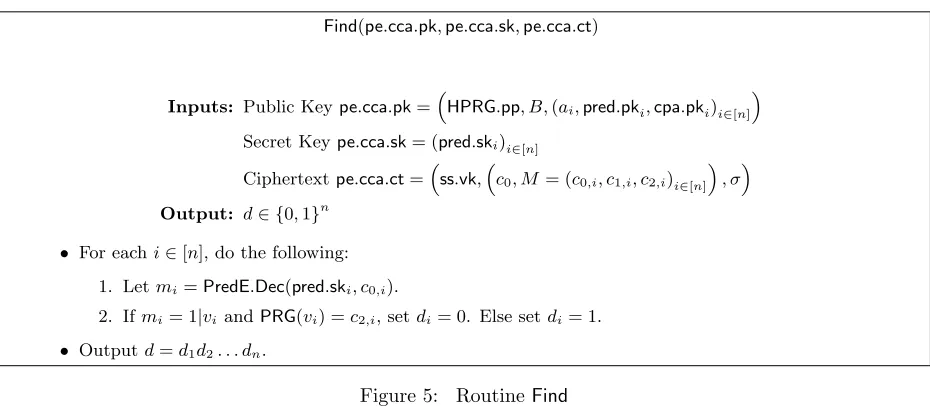
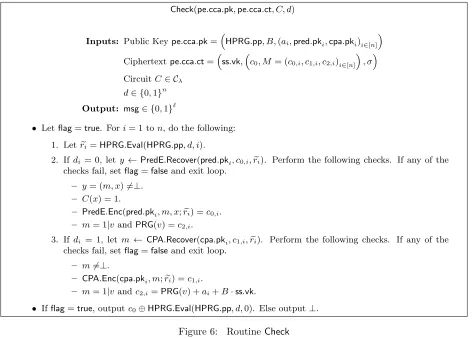
Next, the decryption algorithm computesd=Find(pe.cca.pk,pe.cca.sk,pe.cca.ct) (whereFindis defined in Figure 5), and outputsCheck(pe.cca.pk,pe.cca.ct,C,d) (whereCheckis defined in Figure 6).
Find(pe.cca.pk,pe.cca.sk,pe.cca.ct)
Inputs: Public Keype.cca.pk=HPRG.pp, B,(ai,pred.pki,cpa.pki)i∈[n]
Secret Keype.cca.sk= (pred.ski)i∈[n]
Ciphertextpe.cca.ct=ss.vk,c0, M = (c0,i, c1,i, c2,i)i∈[n]
, σ Output: d∈ {0,1}n
• For eachi∈[n], do the following: 1. Letmi=PredE.Dec(pred.ski, c0,i).
2. Ifmi= 1|viandPRG(vi) =c2,i, setdi= 0. Else setdi= 1.
• Outputd=d1d2. . . dn.
Figure 5: RoutineFind
9Here, we assume the verification key is embedded in
Check(pe.cca.pk,pe.cca.ct, C, d)
Inputs: Public Keype.cca.pk=HPRG.pp, B,(ai,pred.pki,cpa.pki)i∈[n]
Ciphertextpe.cca.ct=ss.vk,c0, M = (c0,i, c1,i, c2,i)i∈[n]
, σ
CircuitC∈ Cλ d∈ {0,1}n
Output: msg∈ {0,1}`
• Letflag=true. Fori= 1 ton, do the following: 1. Letrei=HPRG.Eval(HPRG.pp, d, i).
2. If di = 0, lety ←PredE.Recover(pred.pki, c0,i,rei). Perform the following checks. If any of the checks fail, setflag=falseand exit loop.
– y= (m, x)6=⊥.
– C(x) = 1.
– PredE.Enc(pred.pki, m, x;rei) =c0,i.
– m= 1|vandPRG(v) =c2,i.
3. If di = 1, letm ← CPA.Recover(cpa.pki, c1,i,rei). Perform the following checks. If any of the checks fail, setflag=falseand exit loop.
– m6=⊥.
– CPA.Enc(cpa.pki, m;rei) =c1,i.
– m= 1|vandc2,i=PRG(v) +ai+B·ss.vk.
• Ifflag=true, outputc0⊕HPRG.Eval(HPRG.pp, d,0). Else output⊥.
Figure 6: RoutineCheck