Fuzzy and PI Controller based Load Frequency Control of
Thermal -Hydro Power System
Ratnesh Chaturvedi1
Bharti Dwivedi2
1
Dept. of Electrical Engineering, M. Tech Student, Institute of Engineering & Technology, Lucknow Meerut, U.P., India
2
Professor & Head, Dept. of Electrical Engineering, Institute of Engineering & Technology, Lucknow Lucknow, U.P, India
Abstract: This paper deals with Load Frequency Control of two area thermal-hydro system with conventional PI Controller and Fuzzy Logic Controller. The simulation is realized by using Matlab/Simulink software. The investigation revealed that the Fuzzy Logic Controller performs better than the conventional PI Controller.
Keywords: Fuzzy Logic Controller, PI Controller, Load Frequency Control, Automatic Generation Control.
1. Introduction
Automatic Generation Control (AGC) or Load Frequency Control (LFC) is a very important issue in power systems for supplying reliable electric power with good quality [1, 2]. For successful operation of interconnected power system total generation should be equal to the total load demand plus system losses. A sudden load change in any area of interconnected power system causes the deviation of frequencies of all the areas. The main objectives of AGC are to maintain the megawatt output and the nominal frequency in an interconnected power system [3, 4]. Different types of control techniques such as classical control, variable structure control and robust control have been applied to the LFC problem [5]. Conventional PI controller is simpler for implementation but its settling time is more and it produces large frequency deviation. As an alternative to conventional PI controller, Fuzzy Logic Controller has been widely used for nonlinear and complex systems. This paper presents the performance of two area interconnected thermal hydro system with conventional PI and FL Controllers. Simulation results show that the FLC greatly reduces the overshoot and settling time.
II. Two Areas Power System (Thermal-Hydro)
In a two area system, two single areas are connected through a tie line. Each area is represented by an equivalent set of turbine, generator and governor. Symbol used with suffix 1 refer to area 1 and those with suffix 2 to area 2. Each area feeds its user pool, and the tie line allows electric power to flow between the areas. In the primary LFC loop, a change in the system load will result in a steady state frequency deviation, depending on the governor speed regulation. In order to reduce the frequency deviation to zero, we must provide a reset action. The reset action can be achieved by introducing an integral controller to act on the load reference setting to change the speed set point. The integral controller increases the system type by 1 which forces frequency deviation to zero. The LFC system, with the addition of the secondary loop, is shown in figure (1)
.
The integral controller gain Ki mustbe adjusted for a satisfactory transient response.
…… (1) And we know that
…… (2) .
Hence by using the integral controller the steady state change in frequency has been reduced to zero. ∆f reaches steady state only when ∆PC = ∆PE = constant.
In a given control area, the change in frequency is known as Area Control Error (ACE). Using above equations, the changes in the tie- line power and frequency of each area converge to zero under steady state condition.
III. Fuzzy Logic Controller
Conventional Proportional plus Integral Controller (PI) provides zero steady state frequency deviation, but it exhibits poor dynamic performance (such as more number of oscillation and more settling time), especially in the presence of parameters variation and non-linearity [7]. If the system robustness and reliability are more important, Fuzzy Logic Controllers can be more useful in solving a wide range of control problems since conventional controllers are slower and also less efficient in nonlinear system applications [6].
Fuzzy logic controller has following stages- (i) Fuzzification (ii) Knowledge base
(iii) Decision making logic (iv) Defuzzification interface
Fig.2 Block Diagram of Fuzzy Logic Controller
(i) Fuzzification
(b)Performs the function of fuzzification that converts input into suitable linguistic values.
(ii) Knowledge Base
It consists of data base and linguistic control rule base. (a)The database provides necessary definitions,
which are used to define linguistic control rules and fuzzy data, manipulation in an FLC.
(b)The rule base characterizes the control goals and control policy of the domain experts by means of set of linguistic control rules.
(iii) Decision Making Logic
It is the kernel of an
FLC;
it has the capability of simulating human decision making basedon
fuzzy concepts and of inferring fuzzy control actions employing fuzzy implication and the rules of inference in fuzzy logic.(iv) Defuzzification
Defuzzification yields a non-fuzzy control action from an inferred fuzzy control action.
The error „e‟ and change in error „ce‟ are inputs of FLC. Two input signals are converted to fuzzy number first using fuzzifier using five membership functions: Positive Big (PB), Positive Mediunl (PM), Zero (ZE), Negative Big (NB), Negative Mediuml (NM).
Fuzzy logic control utilizes the fuzzy set theory where infinite number of memberships is allowed. In this paper triangular membership functions are used. In this study, 25 rules are used. The fuzzy set rules are given in Table 1. For converting linguistic variables to crisp values, deffuzzification process is used using normalized membership functions and output gains.
Input e(k)
ce(k)
NB NM ZE PM PB
NB NB NB NM NM ZE
NM NB NB ZM ZE ZE
ZE NM NM ZE PM PM
PM ZE PM PM PB PB
PB ZE ZE PM PB PB
Table 1 Fuzzy Logic Rules for Proposed Controller
IV. Simulation and Result
In this work, Thermal- Hydro interconnected power system is considered with PI controller and Fuzzy Logic Controller. The parameters are used for simulation are given in appendix. The simulink models developed are shown in the Figures (Figure-4 and Figure-6).
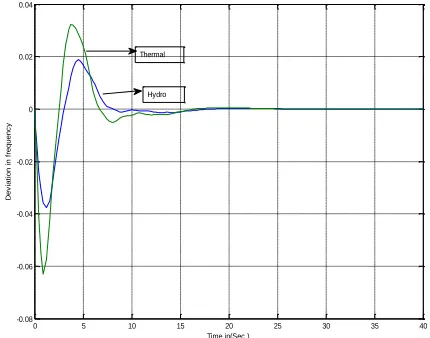
For model given in Figure-4, frequency deviation (
Δ
f
) plot of Thermal – Hydro system for 1% step load increase (Figures 5) indicates that the steady state error is zero and the settling time for Thermal and Hydro system are 23 sec and 17 sec respectively. The maximum peak overshoot for Thermal and Hydro system are 0.03pu and 0.02pu respectively.With 1%(0.01pu) step load increase in Thermal-Hydro system with Fuzzy Logic Controller (Figure-6), the steady state error is minimized to zero with settling time nearly of 15 sec (Figure-7). The maximum peak overshoot for both Thermal and Hydro area reduced to zero.
120 20s+1 Transfer Fcn9
1 2.4Transfer Fcn8
0.445 sTransfer Fcn7
4s +s+52 4s +26s+52 Transfer Fcn6 120 20s+1 Transfer Fcn4 -s+1 0.5s+1 Transfer Fcn3 1 0.3s+1 Transfer Fcn2 1 2.4Transfer Fcn11
-0.35 s Transfer Fcn10 1 0.08s+1 Transfer Fcn1 -0.35 s Transfer Fcn output To Workspace Scope1 Scope 1Gain2 -1 Gain1 1Gain
0.01 Constant2 0.01 Constant1
Fig.4 Simulink Model of Thermal Hydro Plant with PI Controller
0 5 10 15 20 25 30 35 40
-0.08 -0.06 -0.04 -0.02 0 0.02 0.04 Time in(Sec.) D e v ia ti o n i n f re q u e n c y Thermal Hydro
Fig.5 Frequency Deviation of Two Area Thermal- Hydro System with PI Controller
Frequency deviation of a two area Thermal – Hydro power system with PI controller is shown in Figure 7 and there is no steady state error in the response.
In1Out1
fuzzy controller 2 120 20s+1 Transfer Fcn7 4s +s+52
4s +26s+52 Transfer Fcn6 -s+1 0.5s+1 Transfer Fcn5 0.545 s Transfer Fcn4 1 0.3s+1 Transfer Fcn3 1 0.08s+1 Transfer Fcn2 1 2.4 Transfer Fcn13 1 2.4 Transfer Fcn1 120 20s+1 Transfer Fcn ra To Workspace1 output To Workspace Step2 Step 0.65 Slider Gain1 0.425 Slider Gain Scope2 Scope1 Scope -1 Gain3 -1 Gain2 -1 Gain In1Out1
Fuzzy controller 1
0 5 10 15 20 25 30 35 40 45 50 -14
-12 -10 -8 -6 -4 -2 0 2x 10
-3 Two area Thermal- Hydro Fuzzy control
Time(sec.)
D
e
v
i
a
t
i
o
n
i
n
f
r
e
q
u
e
n
c
y
(
H
z
)
Fig.7 Frequency Deviation of Two Area Thermal-Hydro System with Fuzzy Controller
4. Conclusion
The implementation of the proposed Fuzzy Logic Controller provides better dynamic performance and reduces the oscillation of the frequency deviation as compared to the conventional PI controller, with 1% (0.01p.u) step load increment in power system.
Appendix
The various parameters used are as follows.
f = 50 Hz,
R1 = R2 = 2.4 Hz/ per unit MW,
TG = 0.08 sec, Tp1 = Tp2= 20 sec,
P tiemax = 200 MW,
Tr = 10 sec, kr = 0.5,
Tt = 0.3 sec, Kp1= Kp2 = 120 Hz.p.u/MW,
Kd = 4.0,
Ki1 = Ki2= 0.35,
Tw = 1.0 sec,
T12 = 0.0867 p.u.MW/Hz
Where, Tt: Turbine time constant, TG: Governor Time
constant, Tp: Power system time constant, R: Regulation
parameter, Kp: Power system gain, T12: Synchronizing
coefficient, B: Frequency bias parameter, PD: load disturbance, Ki: Integration gain
References
[1] DK Chaturvedi, PS Satsangi PK Kalra, “Load frequency control: a generalized neural network approach”, Int J Electric Power Energy Sysem, Elsevier Sci 1999; 21:405– 15.
[2] Panda Gayadhar, Panda Sidhartha, Ardil C., “Hybrid neuro fuzzy approach for automatic generation control of two-area interconnected power system”, Int J Comput Int 2009; 5(1):80–4.
[3]O.I.Elgerd, “Electric Energy Systems Theory: An
Introduction”, NewYork, McGraw-Hill, 1982.
[4] Kundur, P., “Power system stability and control”, McGraw– Hill, Inc., 1994.
[5] Prabhat Kumar, Ibraheem, and P. Kothari, “Recent Philosophies of automatic generation control strategies in power Systems”, IEEE Transactions on Power Systems, Vol. 20, No. 1, February 2005, 20(1): 346-57.
[6] L. H. Hassan, H. A. F. Mohamed, M. Moghavvemi, S. S. Yang, "Automatic Generation Control of Power System with Fuzzy Gain Scheduling Integral and Derivative Controller", International Journal of Power, Energy and Artificial Intelligence vol. 1(1), (ISSN: 1985-6431), pp. 29-33, August 2008.
[7] Q. P. Ha. 1998, “A Fuzzy sliding mode controller for Power
System Load Frequency Control”, 2 nd
International Conference of Knowledge based Intelligent Electronic System, Adelaide, Australia, 21-23 April.
Peak Overshoot
(pu) Settling Time(sec)
Two area Thermal Hydro Thermal Hydro
Thermal – Hydro PI Controller
0.03 0.02 23 17
Thermal – Hydro Fuzzy Logic Controller
First Author Ratnesh Chaturvedi has obtained B.Tech degree in 2006 and is presently pursuing M.Tech in Electrical and Electronics Engineering. He is working as a Lecturer in IIMT Engineering College, Meerut, affiliated to Uttar Pradesh Technical University Lucknow.
Second Author Bharti Dwivedi has obtained B E (1979), M Tech (1985) and PhD (2001) degrees in Electrical Engineering. She served at GCET Raipur, GEC Rewa for more than 07 years before joining IET, Lucknow in 1987,