Review
On Consensus-based Distributed Blind Calibration of
Sensor Networks
Miloš S. Stankovi´c1*, Srdjan S. Stankovi´c2, Karl Henrik Johansson3, Marko Beko4and Luis M. Camarinha-Matos5
1 Innovation Center, School of Electrical Engineering, University of Belgrade, Serbia; Vlatacom Institute, Belgrade, Serbia; and School of Technical Sciences, Singidunum University, Belgrade, Serbia;
2 School of Electrical Engineering, University of Belgrade, Serbia; and Vlatacom Institute, Belgrade, Serbia; [email protected]
3 ACCESS Linnaeus Center, School of Electrical Engineering, KTH Royal Institute of Technology, Stockholm, Sweden; [email protected]
4 COPELABS, Universidade Lusófona de Humanidades e Tecnologias, Campo Grande 376, 1749-024 Lisboa, Portugal; and CTS/UNINOVA, Campus da FCT/UNL, Monte de Caparica, 2829-516 Caparica, Portugal; [email protected]
5 Faculty of Sciences and Technology and UNINOVA CTS, NOVA University of Lisbon, Portugal; [email protected]
* Correspondence: [email protected]
Abstract: This review paper deals with recently proposed algorithms for distributed blind macro-calibration of sensor networks based on consensus (synchronization), not requiring any fusion center. The basic algorithm, performing the estimation of the local calibration parameters, is derived commencing from appropriate local criteria, and developing the corresponding gradient descent scheme. It is shown that the estimated parameters of the calibration functions asymptotically converge, in the mean-square sense and with probability one (w.p.1), to such values that ensure consensus on calibrated sensor gains and calibrated sensor offsets. For the more realistic case in which additive measurement noise, communication dropouts and additive communication noise are present, two algorithm modifications are introduced: one using a simple compensation term, and a more robust one based on an instrumental variable. By utilizing stochastic approximation arguments it is shown that the modified algorithms also achieve asymptotic agreement for calibrated sensor gains and offsets, in the mean-square sense and w.p.1. Convergence rate is analyzed in terms of an upper bound of the mean-square error. It is also shown that the communications between nodes can be completely asynchronous, which is of substantial importance for real-world applications. Suggestions for design ofa prioriadjustable weights are given. Finally, it is shown that, if there is a subset of (precalibrated) reference sensors with fixed calibration parameters, the calibrated sensor gains and offsets of the rest of the sensors do not achieve consensus - they converge to different points dictated by the reference sensors and the network characteristics. Wide applicability and efficacy of these algorithms are illustrated on several simulation examples.
Keywords: Blind Calibration, Macro Calibration, Distributed Estimation, Sensor Networks, Consensus, Synchronization, Stochastic Approximation
1. Introduction
Recently emerged technologies dealing with networked systems, such as Internet of Things (IoT), Networked Cyber-Physical Systems (CPS), and Sensor Networks (SN), still have many conceptual and practical challenges intriguing to both researchers and practitioners [1–6]. New classes of problems in this area continuously arise driven by many new real-world applications. Particularly for the case of SNs, application examples include environment monitoring, wildfires detection, shop-floor
manufacturing, smart cities, etc. One of the most important challenges, limiting the performance, robustness and time-to-market of these new technologies, issensor calibration. Micro-calibration can be performed only in relatively small SNs where every sensor is individually calibrated in a controlled environment. Typical SNs are of large scale, functioning in dynamic and partially unobservable environments, thus demanding new methods and algorithms for efficient calibration. The idea of macro-calibrationis to calibrate the entire SN based on the total system response, so that there is no requirement to individually calibrate every sensor node. The typical approach is to formulate the calibration problem as a parameter estimation problem (e.g., [7,8]). Of significant interest are methods for automatic calibration of SNs which succesfully perform even if there are no reference signals/sensors, or other sources of groundthruth information about the measured process. In these situations, the goal of the calibration is to achieve homogeneous behavior of all the nodes, possibly enforcing dominant influence of sensors that area prioriknown to provide sufficently good (calibrated) measurements. These types of calibration problems are known as theblind calibration problems [9–13]. Furthermore, in many applications of SNs, it is of essential importance that the network functions in a completely decentralized fashion, without the requirement for any kind of centralized information fusion. Hence, completelydistributed and decentralized calibration algorithms are of paramount importance.
In this paper, we analyze recently proposed algorithms which posses all the mentioned desirable properties: they deal withblind macro-calibrationof SNs based on completelydecentralized, real-time and recursive estimationof the parameters of linearcalibration functions[14–18]. Another advantageous property of these algorithms is that it is assumed that the underlying SN havedirectedcommunication links between neighboring nodes. A basic algorithm is developed by using a distributed optimization problem setup, with the local objectives formulated as weighted sums of mean-square differences between the corrected sensor readings of neighboring nodes. Consequently, the basic distributed calibration algorithm is derived by constructing a correspondingdistributed gradient recursive scheme. A direct consequence of this problem setup is that the obtained algorithm can be studied as ageneralized consensusproblem. Hence, for the convergence analysis, it is not sufficient to use only standard arguments used in the consensus literature (e.g., [19]). Additionall utilization of techniques dealing with the stability of diagonally quasi-dominant dynamical systems [20–22] is needed to demonstrate that the basic algorithm provides asymptotic agreement (consensus, synchronization) for both corrected sensor gains and corrected sensor offsets, in the mean-square sense and with probability one (w.p.1). The basic algorithm is extended by assuming presence of several factors which are of essential importance for practical applicability of the proposed method: 1) additive communication noise, 2) communication dropouts, 3) additive measurement noise, and 4) asynchronous communication.
Two possible modifications of the basic algorithm are introduced for solving the problems posed in the cases 1)–3). The first is based on the assumption that the noise variance is known a priori, which is used to design an appropriate compensation term. The second modification is more robust and is based on an instrumental variable usage [17]. In both cases, the attainment of the asymptotic consensus in the mean-square sense and w.p.1 are shown based on stochastic approximation arguments. In the case of completely asynchronous communication scenario, which is particularly important, we show how the algorithm can be implemented assuming a broadcast gossip communication scheme, which does not require clock synchronization among the agents, or any type of centralized information or coordination [15].
which depend on the information dictated by the reference sensors and the network properties [15]. In the case of only one reference sensor, the corrected gains and offsets of the rest of the sensors converge to the same point imposed by the reference sensor.
Finally, an analysis is given which clarifies the influence of initially selected weights corresponding to particular nodes in the analyzed calibration parameters estimation recursions. Guidelines are formulated on how these weights should be chosen so that given requirements are satisfied. General discussion of the described results is provided from both theoretical and practical points of view, based on which several future research directions are proposed.
The outline of the rest of the paper is as follows. The following section briefly discusses related work. In Section3we introduce the distributed blind macro-calibration problem and derive the basic algorithm for the noiseless case. Section4is devoted to the analysis of the convergence properties of the base algorithm. In Section5certain assumptions about the measured signals, communication errors, and communication protocol are relaxed, and the appropriate algorithm modifications are introduced, together with their convergence analysis. In Section6a discussion on the convergence rate, the case of presence of reference sensors with fixed characteristics, and some design guidelines are presented. In Section7we present illustrative simulation results. Finally, Section8presents some conclusions.
2. Related Work
Macro-calibrationis based on the idea of calibrating the whole SN based on the responses of all the nodes. The most frequent approaches to this problem are based on parameter estimation techniques (e.g., [8]). If controlled stimuli are not available the problem is usually referred to asblind calibrationof SNs. In general, it is a difficult problem, which has certain similarities with more general problems of blind estimation, equalization, and deconvolution (e.g., [23–25] and references therein). In [9,10] a centralized and non-recursive blind calibration algorithm was analyzed assuming restrictive signal and sensor properties. In [26] the authors proposed to use sparsity and convex optimization for blind estimation of calibration gains. In [12] an approach to blind sensor calibration is adopted based on centralized consistency maximization at the network level assuming very dense deployment and only pairwise inter-node communications. In [13], the authors proposed a method which can manage situations in which density requirements are not met. The problem of distributed blind macro-calibration may have certain similarities with the clock synchronization approaches based on local data processing and communications with neighbors [27–34]. Finally, certain extended consensus algorithms have been applied to SN calibration problems, but in different settings than the one treated in this paper [35–38]. This paper is focused on the algorithms proposed recently in [14–18] representing the only completely distributed and decentralized blind macro-calibration algorithms for SNs having satisfactory performance under diverse deteriorating conditions.
3. Problem Definition and the Basic Algorithm
Assume that the SN to be calibrated consists ofnnodes/sensors. In the base setup, it is assumed that each sensor is measuring the same signalx(t)in discrete-time instantst=. . . ,−1, 0, 1, . . .; this signal can be considered as a realization of a stochastic process{x(t)}. Note that we have implicitly assumed that the sensor nodes are functioning synchronously, since all the sensor nodes perform measurements in the same time instancest. We will relax this assumption in Subsection5.3. The output (measurement) of thei-th node can be written as
yi(t) =αix(t) +βi, (1)
Calibration of a sensor is performed by applying an affinecalibration functionto the raw readings (1) which results in the following calibrated sensor output
zi(t) =aiyi(t) +bi=gix(t) + fi, (2) where ai andbi are the calibration parameters to be obtained,gi = aiαi is the corrected gain and
fi = aiβi+bithe corrected offset. The calibration objective is, ideally, to find parametersai andbi for whichgiis equal to one and fi equal to zero. In general, if we assume that there are no sensors which give perfect readingszi(t) =x(t)and that the signalx(t)is unknown and cannot be obtained or measured by some other means, this objective is impossible to achieve. Hence, in our decentralized real-time blind macro-calibration problem setup, this ideal objective must be alleviated: we require that the calibration process asymptotically achieves equal calibrated outputszi(t)for all the nodes
i=1, ...,n. In order to approach as close as possible to the ideal goal of achievinggi =1 and fi =0, we could use certain a priori knowledge about the underlying SN, and try to adjust the algorithm, such that, loosely speaking, the “good” sensors (e.g., precalibrated or higher-quality sensors) correct, using the consensus strategy, the response of the rest of the sensors. For example, if, in a given SN, there is ana priorigiven perfectly calibrated reference sensor, the ideal asymptotic calibration (gi =1 and
fi=0) of the rest of the sensor nodes will be achieved if the consensus goal is achieved.
It is assumed that the underlying SN have a predefined communication topology, defining possible inter-sensor communications, represented by adirected graphG = (N,E), whereN is the set of nodes (sensors) andEthe set of communication links (arcs). Define the adjacency matrixA= [aij],
i,j =1, . . . ,n, whereaij = 1 if thej-th node is able to send messages to thei-th sensor, andaij =0 otherwise. LetNibe the set of in-neighboring nodes (or just neighbors) of thei-th node,i.e., the nodes jfor whichaij =1. Similarly, letNioutbe the set of out-neighboring nodes of thei-th node, i.e., the nodesjfor whichaji=1.
Let us now derive the basic calibration algorithm. The idea is to start with local criteria for each node, whose local minimization would lead to a network-level consensus on the corrected sensor outputs:
Ji =
∑
j∈NiγijE{(zj(t)−zi(t))2}, (3)
i=1, ...,n, whereγijare nonnegative scalar weights whose influence on the properties of the algorithm will be discussed later. Denotingθi= [ai bi]T, the following expression is obtain for the gradient of (3):
gradθ
iJi=
∑
j∈NiγijE
(zj(t)−zi(t))
yi(t) 1
. (4)
From (4) we obtain the following stochasticgradient recursionfor estimatingθ∗i minimizing (3):
ˆ
θi(t+1) =θiˆ(t) +δi(t)
∑
j∈Niγijeij(t)
yi(t) 1
, (5)
where ˆθi(t) = [aˆi(t) bˆi(t)]T, eij(t) = zˆj(t)−zˆi(t), ˆzi(t) = aˆi(t)yi(t) +bˆi(t), and δi(t) > 0 is a time-varying gain whose influence on the convergence properties of the algorithm will be discussed later. The initial conditions are assumed to be ˆθi(0) = [1 0]T,i=1, . . . ,n. We expect that the set of recursions (5) asymptotically achieve that all the local estimates of corrected gains ˆgi(t) =aˆi(t)αiand corrected offsets ˆfi(t) =aˆi(t)βi+bˆi(t)converge to thesame valuesg¯and ¯f, respectively; this implies that the corrected sensor outputs of all the nodes are also equal ˆzj(t) =zˆi(t),i,j=1, . . . ,n.
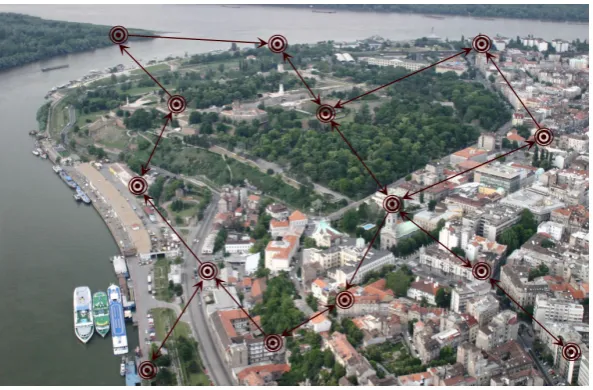
Figure 1. An example sensor network used in smart-city applications with decentralized communication topology. The inter-node communication is performed according to the depicted directed graph. The introduced distributed calibration algorithm achieves asymptotic calibration of all the sensor nodes in the network without using any type of fusion center.
on the mutual node distances, transmission power of individual nodes, channel conditions, presence of obstacles, etc. Each node in the network is equipped with the same type of sensor which measures certain physical quantity (e.g., certain atmospheric condition or air quality indicator). At each time instantt, a nodeiperforms local reading of the raw sensor outputyi(t), calculation of the corrected sensor output ˆzi(t)according to (2) using current local estimates of the calibration parameters ˆai(t) and ˆbi(t), transmission of the corrected value ˆzi(t)to the out-neighborsNiout, reception of the values
ˆ
zj(t)from the in-neighborsj∈ Ni, and calculation of the updated estimates of the local calibration parameters ˆai(t+1) and ˆbi(t+1) using (5). In the initial presentation we will assume that, at each iteration of the algorithm (5), local sensor measurementyi(t)and the current messages of the neighboring nodes’ corrected outputs ˆzj(t)are available at nodei. Possible communication dropouts and/or faulty/noisy sensor readings will be treated later. Local computational cost for each agent is minor since only two parameters are being estimated. Communication complexity depends on the number of neighboring agents, which is small in typical SNs with decentralized architecture.
For the sake of compact notations, suitable for convergence analysis of the derived algorithm, let us introduce
ˆ φi(t) =
" ˆ gi(t)
ˆ fi(t)
#
=
" αi 0
βi 1 #
ˆ
θi(t), (6)
and
eij(t) = h
x(t) 1i(φˆj(t)−φˆi(t)), (7) so that (5) becomes
ˆ
φi(t+1) =φˆi(t) +δi(t)
∑
j∈Niwhere
Ωi(t) = "
αiyi(t)x(t) αiyi(t)
[1+βiyi(t)]x(t) 1+βiyi(t) #
(9)
=
"
αiβix(t) +α2ix(t)2 αiβi+α2ix(t)
(1+β2i)x(t) +αiβix(t)2 1+β2i +αiβix(t) #
,
with the initial conditions ˆρi(0) = [αi βi]T,i=1, . . . ,n. Therefore, the following compact form for the recursions (8) is obtained
ˆ
φ(t+1) = [I+ (∆(t)⊗I2)B(t)]φˆ(t), (10) where ⊗ is the Kronecker product, I is the identity matrix of dimension 2n, I2 is the dimension 2 identity matrix, ˆφ(t) = [φˆ1(t)T· · ·φnˆ (t)T]T,∆(t) = diag{δ1(t), . . . ,δn(t)}, diag{. . .}denotes the corresponding block diagonal matrix,
B(t) =Ω(t)(Γ⊗I2),
Ω(t) =diag{Ω1(t), . . . ,Ωn(t)},
Γ= −
∑
j,j6=1
γ1j γ12 · · · γ1n
γ21 −
∑
j,j6=2
γ2j · · · γ2n
. .. γn1 γn2 · · · −
∑
j,j6=n γnj ,
whereγij =0 whenj∈ N/ i, and the initial condition is ˆφ(0) = [φˆ1(0)T· · ·φnˆ (0)T]T, according to (8). From the way in which we have constructed the vector ˆφ(t)we conclude that the asymptotic value of
ˆ
φ(t)should be such that all of its odd components are equal, and all of its even components are equal. In the next section, it will be shown that, under certain general assumptions, for any choice of the weightsγij ≥0 forj∈ Ni(andγij=0 whenj∈ N/ i) the algorithm achieves convergence to consensus. However, if the underlying calibration objective is to achieve absolute calibration of the sensors (i.e., ¯g close to one and ¯f close to zero), this can be done by trying to exploit sensors that area prioriknown to have good characteristics. In a large SN, this can be achieved in two ways: 1) if the large number of sensors are “good” sensors, thenγij-s in all neighborhoodsNishould be approximately the same, or 2) if there is a set ofa priorichosen good sensorsj∈ Nf ⊂ N the goal is to enforce their dominant influence to the rest of the nodes. There are two possibilities to achieve this: a) to set high values of γijto all neighborhoodsNiin which nodei∈ Njout, or b) to set allγjk,k=1, ...,n,k6=j, to be small (which prevents large changes of ˆφj(t)). Subsection6.3deals with the guidelines on weights tuning, while Subsection6.4treats the case in which a set of reference sensors is kept with fixed calibration parameters.
4. Convergence Analysis
A1)δi(t) =δ=const, for alli=1, . . . ,n.
For clearer initial presentation of the convergence results, we now adopt a simplifying assumption: A2){x(t)}is independent and identically distributed (i.i.d.) sequence, withE{x(t)}=x¯<∞
andE{x(t)2}=s2<∞.
In practice, when the SNs are used to measure certain physical quantities, the assumption that {x(t)}is i.i.d. is almost never satisfied; hence it will be relaxed later.
Based on A1) and A2), the expectation of the parameter estimates ¯φ(t) = E{φ(t)}satisfies the following recursion
¯
φ(t+1) = (I+δB¯)φ¯(t), (11) where ¯φ(0) =φ(0), ¯B=Ω¯(Γ⊗I2)and ¯Ω=E{Ω(t)}=diag{Ω¯1. . . ¯Ωn}, with
¯
Ωi = "
αiβix¯+α2is2 αiβi+α2ix¯
(1+β2i)x¯+αiβis2 1+β2i +αiβix¯ #
. (12)
The following assumption, typical for consensus-based algorithms, is introduced: A3) GraphGhas a spanning tree.
It implies that the matrixΓhas one zero eigenvalue and the rest eigenvalues with negative real parts,e.g., [19]. Hence, from the structure of matrix ¯B, we directly conclude that it has at least two zero eigenvalues. Its remaining eigenvalues can be characterized starting from the following assumption:
A4)s2−x¯2=var{x(t)}>0.
This assumption guarantees that the estimation recursions are sufficiently excited by the signal x(t). Its important consequence is that−Ω¯idefined by (12) is Hurwitz, for alli=1, . . . ,n. Indeed, using some simple algebra it can be derived that−Ω¯iis Hurwitz iff
α2i(s2−x¯2)>0, 2αiβix¯+α2is2+1+β2i >0. (13) Both inequalities hold if and only if A4) holds. This greatly simplifies further derivations which depend on somewhat complicate expression (12) for the 2×2 diagonal blocks of the matrix ¯Ω.
Because of the block structure of matricies ¯Ωand ¯B, the properties of the main recursion (11) cannot be analyzed using standard linear consensus methodologies (see,e.g., [19,39] and references therein). To cope with this problem, a methodology based on the concept ofdiagonal quasi-dominance of matrices decomposed into blockshas been used [14,18,20–22] to obtain the following important result characterizing all the eigenvalues of the matrix ¯B.
Lemma 1([14,18]). Assume that the assumptions A3) and A4) hold. Then, matrixB in (¯ 11) has two zero eigenvalues and the rest eigenvalues have negative real parts.
Observe that vectorsi1= [1 0 1 0 . . . 1 0]T∈R2nandi2= [0 1 0 1 . . . 0 1]T∈R2n, whereR
is the set of real numbers, are the right eigenvectors of ¯Bcorresponding to the eigenvalue at the origin. Letρ1andρ2be the corresponding normalized left eigenvectors, satisfying
ρ1 ρ2
i1 i2
= I2. The following lemma deals with a similarity transformation important for all the remaining derivations throughout the paper.
Lemma 2([14,18]). Let T=hi1 i2 T2n×(2n−2)
i
, where T2n×(2n−2)is an2n×(2n−2)matrix, such that span{T2n×(2n−2)}= span{B¯}(span{A}denotes a linear space spanned by the columns of matrix A). Then, T is nonsingular and
T−1BT¯ =
" 0
2×2 02×(2n−2)
0(2n−2)×2 B¯∗ #
, (14)
Notice that
T−1=
ρ1 ρ2 S(2n−2)×2n
, (15)
whereS(2n−2)×2ncan be determined from the definition ofT.
From the structure of the matrices in (11), it can be concluded that the transformationT from Lemma2, when applied to the original matrixB(t), will produce a matrix which has the same structure as the transformed matrix given in equation (14).
Lemma 3([14,18]). For the matrix B(t)in (10) it holds that, for all t,
T−1B(t)T=
"
02×2 02×(2n−2)
0(2n−2)×2 B(t)∗ #
, (16)
where B(t)∗is an(2n−2)×(2n−2)matrix and T is given in Lemma2. The following convergence theorem can now be formulated.
Theorem 1([18]). Assume that Assumptions A1)–A4) hold. Then there existsδ0 >0such that for allδ≤δ0
in (10)
lim
t→∞φˆ(t) = (i1ρ1+i2ρ2)φˆ(0) (17) in the mean square sense and w.p.1.
Note here that the limit vector in (17)(i1ρ1+i2ρ2)φˆ(0)have all the odd elements equal, and all the even elements equal, which means that the corrected gains of all the nodes converge to the same value, and the corrected offsets of all the nodes converge to the same value. It can be shown [14] that this value only depends on the unknown sensor parametersαiandβi, and the weightsγijinJi,
i,j=1, . . .n. For given initial conditions in (5),ρ1φˆ(0)andρ2φˆ(0)are in the form of weighted sums of αiandβi, 1, . . . ,n, respectively. Assuming that the weightsγijare the same for all the nodes, and that αihave a distribution centered around one, andβiaround zero, these weighted sums will be close to one and zero, respectively.
The value ofδ0 >0 in Theorem1, which ensures convergence, may be restrictive. In practice, the choice of step sizeδin A1) should be based on the actual properties of the underlying SN; its value needs to be small enough to achieve convergence, but it should also be sufficiently large to achieve acceptable rate of convergence (as in the standard parameter estimation recursions [40])..
After clarifying the main structural properties of the algorithm, we now extend the analysis to the more realistic case of correlated sequences{x(t)}. We replace A2) with:
A2’) The random process{x(t)}is weakly stationary, bounded w.p.1, and with bounded first and second moments,i.e.,|x(t)| ≤ K <∞,E{x(t)} = x¯ < ∞,E{x(t−d)x(t)}= m(d) < ∞for all d ∈ {0, 1, 2, . . .}(E{·}is a sign of the mathematical expectation),m(0) =s2 <∞. It also holds that (w.p.1,)
a) |E{x(t)|Ft−τ} −x¯|=o(1), (w.p.1) (18)
b) |E{x(t−d)x(t)|Ft−τ} −m(d)|=o(1), (w.p.1) (19)
whenτ → ∞, for alld ∈ {0, 1, 2, . . .}, τ > d (Ft−τ denotes the minimalσ-algebra generated by
{x(0),x(1), . . . ,x(t−τ)}, ando(1)denotes a function that converges to zero whenτ→∞).
The following theorem examines the convergence of the algorithm (11) under assumption A2’):
Theorem 2([17]). Assume that the assumptions A1), A2’), A3) and A4) hold. Then there existsδ00>0such
that for allδ≤δ00in (10)limt→∞φˆ(t) = (i1ρ1+i2ρ2)φˆ(0)in the mean square sense and w.p.1.
5. Extensions of the Main Algorithm
In this section, we introduce several modifications and generalizations of the main algorithm (5), so that it is possible to achieve distributed calibration under more challenging conditions, typically present in real-life SNs: communication dropouts, additive communication noise, measurement noise, and asynchronous communication. Convergence analyzes of the introduced modifications is presented in details.
5.1. Communication Errors
In this subsection, we assume that inter-node communication errors can be manifested in two ways: 1) communication dropouts (outages) and 2) additive communication noise. Communication dropouts typically occur in SNs using digital communication; additive noise can, in this case, model quantization effects. For example, in the case of smart city sensor networks, depicted in Fig.1, the dropouts will happen relatively often because of the dynamic environment, where both physical obstacles and electronic interference can be persistent. In certain, less frequent practical situations, SNs can use analog communication (e.g., when certain types of energy harvesting are used [41]), when additive communication noise is dominant, and dropouts appear less frequently.
The communication errors are formally introduced using the following assumptions:
A5) The weightsγijin the algorithm (5) are now randomly time-varying, according to stochastic processes given by{γij(t)}={uij(t)γij}, where{uij(t)}are i.i.d. binary random sequences, such that
uij(t) =1 with probability pij(pij>0 whenj∈ Ni), anduij(t) =0 with probability 1−pij.
A6) Instead of receiving ˆzj(t) from the j-th node, thei-th node receives ˆzj(t) +ξij(t), where {ξij(t)}is an i.i.d. random sequence withE{ξij(t)}=0 andE{ξij(t)2}= (σijξ)2<∞.
A7) Processes{x(t)},{uij(t)}and{ξij(t)}are mutually independent.
Based on the above assumptions, the communication dropout at any iterationt, when nodejis sending to nodei, will happen with probability 1−pij, independently of the additive communication noise process{ξij(t)}and the measured signal{x(t)}.
Denoting
νi(t) =
∑
j∈Niγij(t)ξij(t) "
αiyi(t) 1+βiyi(t)
#
,
andν(t) = h
ν1(t) . . . νn(t) i
, one obtains from (10) that
ˆ
φ(t+1) = [I+ (∆(t)⊗I2)B0(t)]φˆ(t) +∆(t)ν(t), (20) whereB0(t) =Ω(t)(Γ(t)⊗I2), andΓ(t)is obtained fromΓby applying A5).
Convergence analyzes of the recursion (20), under the additional assumptions A5)–A7), is based on the results of the previous subsection. Due to the mutual independence of the random variables inB0(t), it can be concluded thatE{B0(t)} = B¯0 = Ω¯(Γ¯⊗I2), where ¯Γ = E{Γ(t)}is the same as Γ but withγij replaced byγijpij. Also, it follows that ˜B0(t) =. B0(t)−B¯0, is a martingale difference sequence (sinceE{B˜0(t)|F
t−1} =0). Furthermore, it can be concluded that ¯B0 = Ω¯(Γ¯⊗I2)has the same spectrum as ¯Bin (11): it has two zero eigenvalues and the rest eigenvalues are with negative real part.
Since the additive noise is now present in the recursions (20), A1) needs to be replaced with the following assumption, typical in the stochastic approximation literature (e.g., [42]):
Intuitively, A1’) introduces diminishing gainsδi(t)which converge to zero slowly enough, so that the additive noise can be averaged out while asymptotic convergence to a consensus point is achieved (despite the presence of noise).
Therefore, we have
ˆ
φ(t+1) = (I+δ(t)B¯0)φˆ(t) +δ(t)B˜0(t)φˆ(t) +δ(t)ν(t). (21) Similarly as in the noiseless case, let as introduce the similarity transformation
T0=hi1 i2 T20n×(2n−2)
i ,
whereT20n×(2n−2)is an 2n×(2n−2)matrix, such that span{T20n×(2n−2)}=span{B¯0}. Then,(T0)−1=
ρ01
ρ02
S0(2n−2)×2n
, whereρ01andρ02are the left eigenvectors of ¯B0corresponding to the eigenvalue at the
origin. By applying transformationT0to (21), and using stochastic Lyapunov stability arguments, along with the arguments typically used in analyzing stochastic approximation algorithms [14,18,43,44], the following theorem can be proved:
Theorem 3([14,18]). Let Assumptions A1’), A2)–A7) be satisfied. Then,φˆ(t)generated by (21) converges to i1w1+i2w2in the mean square sense and w.p.1, where w1and w2are scalar random variables satisfying E{w1}=ρ01φˆ(0)and E{w2}=ρ02φˆ(0).
The theorem essentially states that, again, all the corrected drifts converge to the same point, and all the corrected offsets converge to the same point; however, because of the additive communication noise, these points arerandomand depend on the noise realization. Themeanvalues of these possible convergence points depend on the sensor parametersαiandβi, the design parametersγij, as well as on the dropout probabilitiespij,i,j=1, . . .n.
5.2. Measurement Noise
In this subsection we, additionally to communication errors, assume that the signal x(t) is measured with additive measurement noise. This situation is of essential importance for practical applications since practically all the existing sensors contain certain measurement errors which are typically modeled using stochastic processes [3].
Formally, we model the additive noise stochastic process using the following assumption: A8) Instead ofyi(t)given by (1), the sensor measurements are now contaminated by noise, and given by
yηi(t) =αix(t) +βi+ηi(t),
where{ηi(t)},i=1, . . .n, are zero mean i.i.d. random sequences withE{ηi(t)2}= (σiη)2, independent of the measured signalx(t).
By replacingyηi(t)instead ofyi(t)in the base algorithm (5), one obtains the following “noisy” version of (8):
ˆ
φi(t+1) =φˆi(t) +δi(t)
∑
j∈Niwhere Ψi(t) = ηi(t) "
αix(t) αi βix(t) βi
#
, Nij(t) =
ηj(t)
αj "
αiyi(t) 0 βiyi(t) 0
#
+
ηj(t)ηi(t) αj
0
0 0
and Nii(t) =
ηi(t)
αi "
αiyi(t) 0 βiyi(t) 0 #
+
ηi(t)2
αi 0
0 0
, assumingαi 6= 0, i = 1, ...,n. It is important to observe here that
E{Ψi(t)}=0,E{Nij(t)}=0; howeverE{Nii(t)}=
(σiη)2 αi 0 0 0 .
Assuming again that the step sizesδi(t),i=1, . . . ,n, satisfy A1’), one can obtain the following equation analog to (10):
ˆ
φ(t+1) = (I+δ(t){[Ω(t) +Ψ(t)](Γ⊗I2) +N˜(t)})φˆ(t), (23) whereΨ(t) =diag{Ψ1(t), . . . ,Ψn(t)}and ˜N(t) = [N˜ij(t)]with ˜Nij(t) =−∑k,k6=i γikNii(t)fori = j and ˜Nij(t) =γijNij(t)fori6=j,i,j=1, . . . ,n.
In an analogous way as in the previous section, instead of (11), the following equation is obtained for the mean of the corrected calibration parameters
¯
φ(t+1) = [I+δ(t)(B¯+Ση)]φ¯(t), (24)
where ¯Bis as in (11) andΣη =−diag{
(σ1η)2
α1 ∑jγ1j, 0, . . . ,
(σnη)2
αn ∑jγnj, 0}. Because of the additional term
Ση, the sums of the rows of the matrix ¯B+Σηare not equal to zero anymore, so that the convergence
to consensus (as in Theorem1) cannot be achieved in this case.
However, it can be seen from the structure of the recursion (24) that, if we assume that the measurement noise variances(σiη)2area prioriknown, we can use them to modify the basic algorithm (5) in the following way, ensuring again the asymptotic convergence to consensus:
ˆ
θi(t+1) =θˆi(t) +δ(t){
∑
j∈Niγijeηij(t) "
yηi(t) 1
#
+
(σiη)2
∑
j∈Niγij 0
0 0
θˆi(t)}, (25)
whereeijη(t) =zˆηj(t)−zˆηi(t)and ˆzηi(t) =aˆi(t)yηi(t) +bˆi(t),i=1, . . . ,n.
The following theorem deals with the convergence of the above modification of the main algorithm, when the measurement noise is present together with the communication errors. The convergence points will again depend on the measurement and communication noise realizations, in a similar way as in Theorem3.
Theorem 4([18]). Assume that the assumptions A1’), A2)–A8) hold. Then,φˆ(t), given by (25), converges to i1w1+i2w2in the mean square sense and w.p.1, where w1and w2are scalar random variables satisfying E{w1}=ρ01φˆ(0)and E{w2}=ρ02φˆ(0).
have the basic property of being correlated with the measured signal, and uncorrelated with noise. If {ζi(t)}is the instrumental variable sequence of thei-th agent, one has to ensure thatζi(t)is correlated withx(t)and uncorrelated withηj(t),j=1, . . . ,n. Under A2’) a logical choice is to take the delayed sample of the measured signal as an instrumental variable,i.e., to takeζi(t) =yiη(t−d), whered≥1. Consequently, we present the following generalcalibration algorithm based on instrumental variablesable to cope with measurement noise:
ˆ
θi(t+1) =θˆi(t) +δ(t)
∑
j∈Niγijeηij(t) "
yηi(t−d) 1
#
, (26)
where d ≥ 1 and eijη(t) = zˆjη(t)−zˆηi(t), ˆziη(t) = aˆi(t)yηi(t) +bˆi(t), i = 1, . . . ,n. Following the derivations from Section3, one obtains from (26) the following relations involving explicitlyx(t)and the noise terms:
ˆ
φi(t+1) =φˆi(t) +δ(t)
∑
j∈Niγij{(Ωi(t,d) +Ψi(t,d))(φˆj(t)−φˆi(t))
+Nij(t,d)φjˆ(t)−Nii(t,d)φiˆ (t)}, (27) where
Ωi(t,d) = "
αiβix(t) +α2ix(t)x(t−d) αiβi+α2ix(t−d)
(1+β2i)x(t) +αiβix(t)x(t−d) 1+β2i +αiβix(t−d) #
,
Ψi(t,d) =ηi(t−d) "
αix(t) αi βix(t) βi
#
,
Nij(t,d) = ηj(t)
αj "
αiyi(t−d) 0 βiyi(t−d) 0 #
+
ηj(t)ηi(t−d)
αj 0
0 0
and
Nii(t,d) = ηi(t)
αi "
αiyi(t−d) 0 βiyi(t−d) 0
#
+
ηi(t)ηi(t−d) αi
0
0 0
.
In the same way as in (23), we have
ˆ
φ(t+1) = (I+δ(t){[Ω(t,d) +Ψ(t,d)](Γ⊗I2) +N˜(t,d)})φˆ(t), (28) where Ω(t,d) = diag{Ω1(t,d), . . . ,Ωn(t,d)}, Ψ(t,d) = diag{Ψ1(t,d), . . . ,Ψn(t,d)}, ˜N(t,d) =
[N˜ij(t,d)], where ˜Nij(t,d) = −∑k,k6=i γikNii(t,d) for i = j and ˜Nij(t,d) = γijNij(t,d) for i 6= j,
i,j=1, . . . ,n.
In order to formulate a convergence theorem for (28), the following modification of A4) is needed: A4’)m(d)>x¯2for somed=d0≥1.
This assumption implies that the correlationm(d0)should be large enough. Similarly as in the case of A4), it can be concluded that A4’) implies that−Ω¯(d) =−E{Ωi(t,d)}is Hurwitz. Similarly as in the above cases, let as introduce the similarity transformation
T00=hi1 i2 T200n×(2n−2)
where T200n×(2n−2) is an 2n×(2n−2) matrix, such that span{T200n×(2n−2)} = span{B¯(d)00}. Then,
(T00)−1=
ρ001
ρ002
S00(2n−2)×2n
, whereρ100andρ002are the left eigenvectors of ¯B(d)00=E{Ω(t,d)(Γ(t)⊗I2)}=
¯
Ω(d)(Γ¯⊗I2)corresponding to the zero eigenvalue. The following theorem deals with the convergence of the instrumental variable algorithm (26). The convergence point, again, depends on the noise realization.
Theorem 5([17]). Assume that the assumptions A1’), A2’), A3), A4’), A5)–A8) hold. Thenφˆ(t), given by
(28) with d=d0, converges to i1w1+i2w2in the mean square sense and w.p.1, where w1and w2are scalar random variables satisfying E{w1}=ρ001φˆ(0)and E{w2}=ρ200φˆ(0).
5.3. Asynchronous Broadcast Gossip Communication
So far we have shown how to deal with most of the practical challenges which emerge when dealing with real life SNs, such as communication dropouts, communication additive noise and measurement noise. However, in all of the above discussed algorithms we have implicitly assumed that all the nodes in the network share a common clock, based on which the recursions in (5), (25) or (26) can be implemented synchronously. Indeed, when introducing the main algorithm we have assumed that the signalx(t)is being measured in discrete-time instancestby all the nodes. These instances are also used as time indexes of synchronous recursions of the above algorithms. Yet, there are many practical cases of SNs for which it is impossible or impractical to function synchronously. A typical example is the case when the nodes follow certain sleeping policies in order to minimize power consumption (e.g., [3]). For example, the nodes in SN shown in Fig.1, measuring air pollution or atmospheric conditions, may be programmed to make measurements less often during periods in which there is less traffic in the city. These types of situations are rigorously treated in the rest of this subsection.
Instead of the problem setup introduced in Section3, assume now that the sensors are measuring acontinuous-time signal x(t)at discrete pointstk,tk ∈R+,k=1, 2, . . .,tk+1>tk, producing the sensor outputs
yi(tk) =αix(tk) +βi+ηi(tk), (29) where theαiandβiare the same unknown parameters as in the previous subsections, and we also assume that the measurement noiseηi(tk),i=1, . . . ,n, is present in the sensor readings.
Furthermore, since the goal is to remove dependence on a common global clock, it is now assumed that every nodej∈ N has its ownlocal clock. For the sake of compact notation and simpler derivations, a single clock, called globalvirtual clock, is introduced, which ticks when any of the local clocks ticks. Hence,tkin (29) can be considered as the time in which thek-th tick of the virtual clock happend. To have a well defined situation, it is formally assumed that the ticks of the local clocks are independent, and that the intervals between any two consecutive ticks are finite w.p.1. It is also assumed, for the sake of simpler derivations, that the unconditional probability that thej-th clock ticked at an instance tk isqj > 0, independently ofk. It is easy to verify that these conditions are satisfied for a typical model used in SNs, where it is assumed that the local clocks tick according to independent Poisson processes with ratesµj(as in,e.g., [47,48]). This case will be adopted throughout this subsection. It directly follows that, in this case, the virtual global clock ticks according to a Poisson process with the rate∑n
j=1µj.
According to the above assumptions, let us denote withtjlthe ticks of the local clockj,l=1, 2, . . .. The communication protocol can then be defined in the following way. At each local clock tick, a nodejmakes the local sensor measurement, calculates the corrected sensor outputzj(t
j
We assume also that communication dropouts can happen, i.e., each nodei ∈ Nout
j receives the transmitted message with probabilitypij >0. For the sake of clarity of presentation, we do not treat additive communication noise in this subsection. It is also assumed that the communication delay is negligible, so that, practically at the same time instant all the nodes which have received the broadcast, perform the local sensor reading, calculate their corrected outputszi(tjl), and update the local estimates of their calibration parametersaiandbi. This procedure is repeated for any local clock tick. The index of the node whose clock has ticked at instanttkis denoted by j(k), and letJ(k)be the subset of the out-neighborsi∈ Nout
j(k)which have received the broadcast message. Also, letx(k) =x(tk) =x(t
j(k)
l ),
yi(k) = yi(tk) = yi(t j(k)
l ),yj(k) = yj(tk) = yj(k)(t
j(k)
l ),zi(k) = zi(tk) = zi(t j(k)
l ),zj(k) = zj(tk) =
zj(k)(t
j(k)
l ),ηi(k) =ηi(tk) =ηi(t j(k)
l )andηj(k) =ηj(tk) =ηj(k)(t
j(k)
l )for somel.
The measurement noise is treated as in the previous subsection, by using the delayed measurement yi(di(k))as the instrumental variable
ζi(k) =yi(di(k)), (30)
wheredi(k)is the global iteration number that corresponds to the closest past measurement of the nodei. By using the same local criteria as in (3) and gradients as in (4), the following new recursion for updating the calibration parameters at nodeiis formulated:
ˆ
θi(k) =θˆi(k−1) +δi(k)γi,j(k)ei,j(k)(k)
yi(di(k)) 1
, (31)
where:
• θˆi(k) = [aˆi(k) bˆi(k)]T,
• δi(k)is the step size given byδi(k) =νi(k)−c, whereνi(k) =∑km=1I{i∈ J(m)}is the number of parameter updates of nodeiup to the iterationk, with 1/2<c≤1 (I{·}denotes the indicator function),
• ei,j(k)(k) =zˆj(k)(k)−zˆi(k), where ˆ
zj(k)(k) =aˆj(k)(k−1)yj(k)(k) +bˆj(k)(k−1), (32) ˆ
zi(k) =aˆi(k−1)yi(k) +bˆi(k−1) (33) are the corrected outputs of nodej(k)and nodei.
The initial conditions are adopted to be ˆθi(0) = [1 0]T. Note that, according to the problem setup, at a given iterationkonly the nodesi∈ J(k)perform the above parameters update; for the rest of the nodes it holds that ˆθi(k) =θˆi(k−1).
Computationally, the algorithm is as simple as the basic one, requiring only a few additions and multiplications in one iteration. Information needed at nodeiare: the local sensor measurement, the local instrumental variable, and the current output sent by an in-neighborj. Knowledge of the global iteration indexk(ordi(k)) is not needed.
From the above definition of the step sizeδi(k)it can be concluded that it depends only on the number of local clock ticks, which makes the algorithm completely decentralized.
It should also be noticed that the instrumental variables in (31) can be selected in several ways. For example, instead of choosing (30), it can be practical to chooseζi(k) =yi(t¯lj,i), where ¯tlj,iis the time instant of a supplementary measurement of nodei, just after the last step of the recursion (31) has been locally performed. This scheme is not assumed in the below analyzed setting, because of much more complicated notation; all the results can be easily transferred to this case.
Similarly as in the synchronous case, we introduce:
ˆ φi(k) =
" ˆ gi(k)
ˆ fi(k)
#
=
" αi 0
βi 1 #
ˆ
and
ei,j(k)(k) =
h
x(k) 1i(φˆj(k)(k)−φˆi(k)) +aˆj(k)(k)ηj(k)(k)−aˆi(k)ηi(k). (35) Consequently, we have
ˆ
φi(k) =φˆi(k−1) +δi(k)γi,j(k){(Ωi(k) +Ψi(k))(φˆj(k)(k−1)−φˆi(k−1))
+Ni,j(k)(k)φˆj(k)(k−1)−Nii(k)φˆi(k−1)}, (36) where
Ωi(k) = "
αiβix(k) +α2ix(k)x(di(k)) αiβi+α2ix(di(k))
(1+β2i)x(k) +αiβix(k)x(di(k)) 1+β2i +αiβix(di(k)) #
Ψi(k) =ηi(di(k)) "
αix(k) αi βix(k) βi
#
,
Ni,j(k)(k) = ηj(k)(k)
αj(k) "
αiy0i(di(k)) 0 βiy0i(di(k)) 0 #
+
ηj(k)(k)ηi(di(k)) αj(k)
0 0 0 and
Nii(k) = ηi(k)
αi "
αiy0i(di(k)) 0 βiy0i(di(k)) 0
#
+
ηi(k)ηi(di(k)) αi
0
0 0
,
wherey0i(k) =αix(k) +βi, with the initial conditions ˆφi(0) = [αi βi]T,i∈ J(k). Recursions (36) fori=1, ...,n, can be written compactly as
ˆ
φ(k) ={I+ [Ω(k) +Ψ(k)](∆(k)Γ(k)⊗I2) + (∆(k)⊗I2)N˜(k)}φˆ(k−1), (37) where:
• φˆ(k) = [φˆ1(k)T. . . ˆφn(k)T]T,
• ∆(k) =diag{δ1(k), . . . ,δn(k)},
• Ω(k) =diag{Ω1(k), . . . ,Ωn(k)},
• Γ(k) = [Γ(k)lm], with Γ(k)ll = −γl,j(k) and Γ(k)l,j(k) = γl,j(k) for all l ∈ J(k), Γ(k)lm = 0, otherwise,
• Ψ(k) =diag{Ψ1(k), . . . ,Ψn(k)},
• N˜(k) = [N˜lm(k)], where ˜Nll(k) =−γl,j(k)Nll(k)and ˜Nl,j(k)(k) =γl,j(k)Nl,j(k)(k), for alll∈ J(k), ˜
N(k)lm=0, otherwise.
The initial condition is ˆφ(0) = [φˆ1(0)T. . . ˆφn(0)T]T= [[α1β1]T. . .[αn βn]T]T.
Since we have formulated a slightly different problem setup than in the Section3, we introduce a new set of assumptions, and denote them using letter B:
B1) {x(k)} is a stationary random sequence, bounded w.p.1, and satisfying the φ−mixing condition.
B2) Let{ti,l},l=1, 2, ... represent time instants in which nodeiperforms measurements. Then, minir¯i>m2, wherem=E{x(k)}and ¯ri =E{x(ti,l)x(ti,l−1)},i=1, . . . ,n.
B3) GraphGhas a spanning tree.
B4){ηi(k)},i =1, . . .n, are zero-mean sequences of independent and bounded w.p.1 random variables. {ηi(k)}is independent of the process{x(t)}, withE{ηi(k)2}= (σiη)2for allk.
Assumptions B3) and B4) are essentially the same as A3) and A8).
Assumption B2) represents an extension of the assumption A4), adapted to the presence of the instrumental variableyi(di(k))in (31). It guarantees the persistence of excitation in the sense that the variance ofx(k)must be greater than zero (for allk, because of stationarity) so that constant signals are not allowed [14,40]. However, it also ensures sufficent correlation between the instrumental variable and the current measurement, so thate.g., white noise signals are also not allowed. It can be easily derived [15] that B2) is satisfied if the autocovariance function ofx(t)is positive in a sufficiently large interval around zero. Also, if the ratesµjare adjustable we can chooseµmin=minj∈Nµjlarge enough, such that B2) is always satisfied. Therefore, B2) is, in general, not restrictive for processes having dominant low frequency spectrum, which is typical in practical applications of SNs.
Based on the above modified problem definition, the following result was proved in [15], stating that both corrected gains and corrected offsets will converge to consensus points (which depend on the realizations of the stochastic processes) for all the nodes.
Theorem 6 ([15]). Let Assumptions B1)–B4) be satisfied. Then φˆ(k) given by (37) converges to φˆ∞ =
χ1i1+χ2i2in the mean square sense and w.p.1, whereχ1andχ2are random variables with bounded second moments.
6. Discussion
6.1. Rate of Convergence
In the above subsections we didn’t analyze how quickly the presented algorithms can achieve convergence to the specified points. Since the basic equations (5) have constant step size, it can be concluded that the asymptotic convergence rate in the noiseless case is exponential. In the cases of measurement and additive communication noise, the convergence rate of the algorithms can be obtained following general methodology applied to the analysis of standard stochastic approximation algorithms. The following result gives an upper bound of the mean-square error with respect to the consensus point:
Theorem 7([18]). Under the assumptions of any of the Theorems3, 4or5, together withlimt→∞(δ(t+ 1)−1−δ(t)−1) =d ≥0, there exists such a positive numberσ0 <1that for all0<
σ<σ0the asymptotic
consensus is achieved by the analyzed algorithms with the convergence rate o(δ(t)σ).
It might be problematic to obtain the precise value ofσ0in concrete applications. However, it can be shown that it directly depends on the sensor and network properties (encoded by matrixB(t) orB(t,d)) and on the connectivity of the underlying communication graph [52]. On one hand, if the number of nodes is increased without increasing network connectivity, the rate of convergence will decrease; however, if the graph connectivity is increased, the convergence rate will also increase. For example, if the graph is fully connected, the convergence rate will be high at the expense of very large number of communication links. In practice, a compromise between the rate of convergence and the network complexity needs to be found.
Another compromise to be found is between algorithm’s noise immunity and convergence rate. Indeed, according to [53], assuming thatδ(t)is given asδ(t) =m1/(m2+tµ),m1,m2>0, 12<µ≤1, the values ofµcloser to12 give larger rate of convergence but higher sensitivity to noise; the values of µcloser to 1 give the opposite effect.
6.2. Stationarity of the measured signal
real signals. This assumption is not essential for proving convergence of the presented algorithms: it has been introduced primarily for the sake of focusing on the essential structural aspects of the algorithm and avoiding complex notation [14,15,18]. Notice, according to Lemmas2and3, that the similarity transformationTcan be applied in the above analysis even in the case of time varying matrix ¯B(t), owing to its specific structure; namely, we have T−1B¯(t)T =
"
02×2 02×(2n−2)
0(2n−2)×2 B¯(t)∗ #
,
where ¯B(t)∗is Hurwitz andT is obtained from ¯B(t)for any selectedt = t0. Moreover, notice that the conclusions of Theorem1hold, in general, provided the following unrestrictive condition holds: limt∏τ(I−B¯(t−τ)
∗) =0. Also, it is possible to conclude directly that the applied methodology of
convergence analysis, the results of the above theorems hold for changes of ¯B(t)∗sufficiently slow. Moreover, it is not difficult to prove that the above convergence results exactly hold when the signal is asymptotically stationary.
6.3. Network Weights Design
As already discussed in the previous subsections, the implicit goal of the analyzed calibration scheme is to exploit the sensors witha priorigood calibration properties by enforcing their dominating effect in the final consensus value to which all the nodes converge. This can be done in two ways, by adjusting the design weightsγij: 1) if the majority of sensors are “good”, we can set allγijfor the neighborhood of any nodeito the same value, or 2) if there is a smaller subsetNf ⊂ N ofa priori “good” sensors in the network we should appropriately tune the values ofγij. For this scenario, in this subsection, we give a detailed analysis of the weights adjusting problem for the case of asynchronous communications treated in Subsection5.3.
According to the theoretical analysis presented in details in [15], the dominant component of the random variables[χ1χ2]in Theorem6is given by a weighted sum of the unknown sensor parameters αiandβi. The positive weights are determined by the left eigenvectorsw1andw2of ¯Bcorresponding to the zero eigenvalue. In turn, these weights are functions of the design parametersγij, the wake-up probabilitiesqj, and the dropout probabilities pji,i,j=1, . . . ,n. Therefore, it is clear that the initial characteristics of a selected sensoriwill have larger influence on the asymptotic consensus value if the appropriate elements ofw1andw2are increased. This can be achieved in two ways:
1. By reducing the values of all the elements in thei-th row of ¯Γ, or
2. By increasing the valuesγji,j6=i, from thei-th column (keeping in mind that ¯Γmust be row stochastic).
Probabilitiesqjcan in certain situations also be adjusted since they depend on the rate of the local clock of nodej. By increasing the clock rate of the nodej, the influence of that node on the asymptotic calibration parameter values achieved at consensus, is also increased. Adjusting dropout probabilities 1−pjimight also be possible in certain situations: by decreasing the probability of a nodeiof receiving a message from a neighbor, we increase its influence on the asymptotic consensus. Hence, there are several design variables which can be adjusted so that the desired convergence point is achieved.
6.4. Macro Calibration for Networks with Reference Nodes
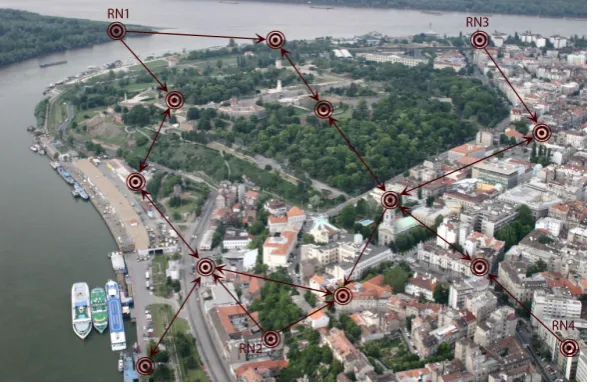
Figure 2.An example sensor network used in smart-city applications with multiple (four) reference nodes. The reference nodes (RNs) have fixed calibration parameters: only the rest of the nodes implement the given distributed sensor calibration recursions.
First, we analyze the special case in which|Nf|=1,i.e., there is only one reference sensor, and we want to calibrate the rest of the SN so that their calibrated outputs converge to the output of the reference sensor. For this case, all of the above results still hold, since the resulting communication graph will again have a spanning tree (with the reference node as a center node), which implies that B3) (and A3)) holds. Therefore, by applying the above convergence theorems, one concludes that the corrected gains and offsets ˆφi(k),i=1, . . . ,n, will converge to the same value, dictated by the “leader”.
In the general case, assume, without loss of generality, thatNf ={1, 2, . . . ,n
f},nf =|Nf|>0, is the set of reference senors which have fixed parameters: φif =
gif fif
, i ∈ Nf. Assume that ¯
φf = [φ1f T. . .φnf Tf ]
T. The calibration algorithms above are now applied in the same way, except that
the reference nodes do not change the calibration parameters: ˆθi(k) =θˆi(k−1)for alli ∈ Nf. Let N − Nf ={n
f +1, . . . ,n}and let ˆφv(k) = [φˆnf+1(k) T. . . ˆφ
n(k)T]Tbe the vector of all the calibration parameters to be tuned. In this case, all of the above theorems do not hold anymore, since, when nf >1, the communication graph does not necessarily satisfy B3) (the graph doesn’t have a center node anymore, since two or more reference nodes are not mutually reachable). Hence, a separate convergence theorem is needed which treats this case:
Theorem 8([15]). Let Assumptions B1)–B4) be satisfied and let all the nodes fromN − Nf be reachable from
all the nodes inNf. Then the algorithm (31), in which
γij=0for all i∈ Nf, provides convergence ofφˆv(k)in
the mean square sense and w.p.1 to the limit defined by ˆ
φv∞=−(Γ¯v⊗I2)−1(Γ¯f,v⊗I2)φ¯f, (38)
where matricesΓ¯vandΓ¯f,vare(n−nf)×(n−nf)and(n−nf)×nf submatrices of matrix P−cΓ¯, with
indices i,j=nf+1, . . . ,n and i=nf +1, . . . ,n, j=1, . . . ,nf, respectively; P=diag{p1, . . . ,pn}and c is
defined in(31).
converge to different values. These values will be typically dictated by the reference sensors which are the closest to a given node.
6.5. Autonomous Gain Correction and Relationship with Time Synchronization
After presenting the most important aspects of the presented blind calibration methodology encompassing both noiseless and noisy environments, we will now make a few comments on the problem of its relationship with the algorithms fortime synchronizationin sensor networks, which has attracted a lot of attention (e.g., [27–34,54–56] and the references therein). Indeed, after coming back to the main measurement model, one easily realizes that in the case of time synchronization one has the form (1) with the absolute timetreplacing the signal valuex(t). The estimation schemes used in the mentioned analogous time synchronizaion algoroithms are, indeed, related to the estimation of the parameters of the calibration functions (2) based on the utilization of local time measurements, but, however, consists of one separate recursion for the relative drift estimation and one separate recursion for the estimation of offsets, relying on the obtained relative drifts. In [57] this scheme was reformulated in the light of the calibration problem and the above described methodology. One starts from the difference model∆yi(t) = yi(t+1)−yi(t) = αi∆x(t), where∆x(t) =x(t+1)−x(t), and construct a gradient recursion for ˆai following the above methodology, having in mind that∆yi(t) does not depend onβi. On the other hand, the estimation ofbihas to start from (1); it has the form of the recursion for ˆbiin (5), but should use ˆaigenerated by first recursion. Such a combined gradient algorithm based on utilization of∆yi(t)resembles typical time synchronization algorithms. In general, it is important to observe that the introduction oftinstead ofx(t)in the basic relation (1) suffers from the very basic problem that unboundedness of the linear function contradicts the requirements for boundedness of the second order moments ofx(t)(typical for stochastic approximation algorithms) and that it is not possible to guarantee convergence of the obtained recursions. This indicates that formal transfers of methodologies from one domain to the other should be done with extreme caution.
7. Simulation Results
In this section we present the results of extensive simulations, illustrating the above described properties of the analyzed algorithms. In all of the simulations, a SN with ten nodes, with randomly generated communication graph satisfying assumption A3), has been chosen. The sensor parametersαi andβihave been generated randomly from uniform distribution with means one and zero, respectively, and with standard deviation 0.3.
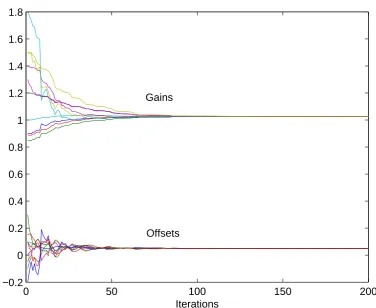
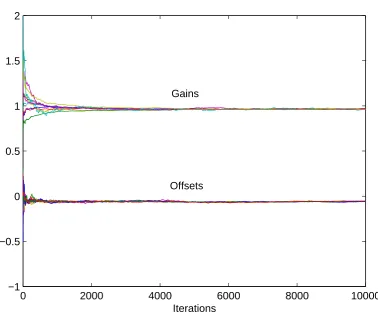
In Fig.3the corrected gains ˆgi(t)and offsets ˆfi(t)obtained by the presented algorithm (5) in the noiseless case are presented, for a preselected step size, equal for all the nodes,δ=0.01. It is clear from the figure that the convergence to consensus, and, hence, implicit asymptotic calibration is achieved with the asymptotic values close the desired (one for corrected gains, and zero for corrected offsets).
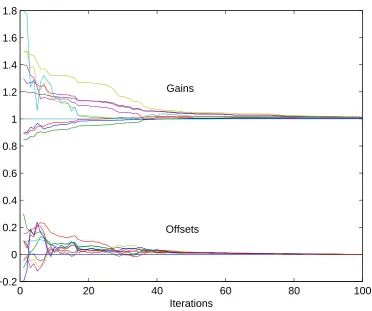
In Fig.4the simulation results are presented for the situation in which the first node is set to be a reference node (“leader”) with perfect parametersα1=1 andβ1=0. Obviously, all of the rest of the nodes converge to this ideal characteristic.
0 50 100 150 200 −0.2
0 0.2 0.4 0.6 0.8 1 1.2 1.4 1.6 1.8
Iterations Offsets
Gains
.
0 20 40 60 80 100 −0.2
0 0.2 0.4 0.6 0.8 1 1.2 1.4 1.6 1.8
Iterations Gains
Offsets
0 2000 4000 6000 8000 10000 −1
−0.5 0 0.5 1 1.5 2
Iterations Offsets
Gains
Iterations
200 400 600 800 1000 1200 1400 1600 1800 2000 -1.5
-1 -0.5 0 0.5 1 1.5
Gains
Offsets
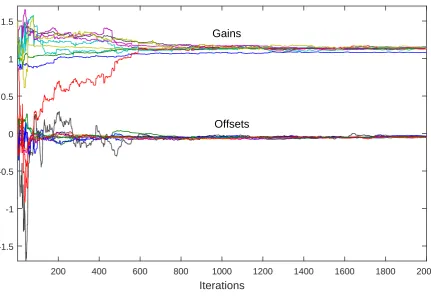
Figure 6. The asynchronous algorithm based on instrumental variables without reference sensors: convergence to consensus is achieved for corrected gains and corrected offsets.
Next we simulate the asynchronous algorithm (31) which includes instrumental variables. It is assumed that the local clocks of all the nodes are driven by Poisson processes with the same rates. In Fig.6, the corrected gains ˆgi(k)and offsets ˆfi(k)generated by (31) are depicted assuming the steps δ(k) =0.01/k0.6and the presence of communication dropouts with probabilitiespij=0.2 for each link. The measurement noises and the signalx(k)are assumed to be the same as in Fig.5.
In Fig.7the necessity of introducing the instrumental variables is demonstrated when the noise is present. The basic algorithm (5), without instrumental variables, has been simulated and the convergence is not achieved in this case. It can be seen that all the corrected gains ˆgi(k) slowly converge to zero which is very undesirable.
Fig.8illustrates the case discussed in Subsection6.4in which there are two reference sensors in the given SN. It can be seen from the figure that, as predicted by Theorem8, the consensus is not achieved, and that all the calibration parameters converge to different values, determined by equation (38).
8. Conclusion
Iterations
1000 2000 3000 4000 5000 6000 7000 8000 -0.2
0 0.2 0.4 0.6 0.8 1 1.2 1.4
Gains
Offsets
Figure 7.Stochastic gradient algorithm: convergence to consensus is not achieved.
Iterations
200 400 600 800 1000 1200 1400 1600 1800 2000 -0.2
0 0.2 0.4 0.6 0.8 1 1.2 1.4 1.6
Offsets
Gains
networks with multiple reference nodes. Extensive simulation results illustrating the behavior of the analyzed algorithms have been presented.
8.1. Future Work
The presented results can be extended in several directions.
The first future direction, which is imposed naturally, is to extend the presented algorithms, or develop new ones, for the case when the nodes measure spatially varying but correlated signals. Treating this situation would drastically increase the practical applicability of the described methodology. The performance of such a scheme would highly depend ona prioriknowledge about the interrelatedness of the measurements of different nodes.
Another direction of possible future work is to extend the results to include the possibility that individual nodes measure vector values (instead of scalars treated in this review). This case would arise in practically frequent situations when there are multiple diverse sensors on each node, and when each sensor possibly measures different (overlapping) subsets of all the available sensed values. One possible idea for treating these situations is to use the wide existing literature in overlapping decentralized estimation (e.g. [21,58–61]). One typical example where this situation arises are networks of cameras with different view angles and scene coverage.
Third future direction emerges if one interprets the above results not in the context of calibration, but as pure synchronization (consensus) results for certain special types of linear time-varying systems. Indeed, the derivations and results of the presented convergence theorems open up a possibility of extending them to the case of synchronization of general higher order linear parameter-varying systems, which is a topic of high theoretical importance (e.g. [62] and references therein).
Finally, sensor networks often operate in hostile environments where battery usage and power consumption of the sensor nodes are of crucial importance. In this context it would be of high importance to analyze, for a given particular sensor network mission, how to formulate optimization problem and achieve optimal compromise between sensor network calibration and the nominal operation dictated by the given mission.
This work was partially supported by Fundação para a Ciência e a Tecnologia under Project UID/EEA/00066/2013, Project foRESTER PCIF/SSI/0102/2017, and Program Investigador FCT under Grant IF/00325/2015.
References
1. Kim, K.D.; Kumar, P.R. Cyber–physical systems: A perspective at the centennial. Proc. IEEE2012, 100, 1287—-1308.
2. Holler, J.; Tsiatsis, V.; Mulligan, C.; Avesand, S.; Karnouskos, S.; Boyle, D.From Machine-to-machine to the Internet of Things: Introduction to a New Age of Intelligence; Academic Press, 2014.
3. Akyildiz, I.F.; Vuran, M.C.Wireless sensor networks; John Wiley & Sons, 2010. 4. Proceedings of the IEEE, Special issue on sensor networks and applications; Vol. 91, 2003.
5. Akyildiz, I.F.; Su, W.; Sankarasubramaniam, Y.; Cayirci, E. Wireless sensor networks: a survey.Computer Networks2002,38, 393–422.
6. Speranzon, A.; Fischione, C.; Johansson, K.H. Distributed and collaborative estimation over wireless sensor networks. Proc. IEEE Conf. on Decision and Control, 2006, pp. 1025–1030.
7. Whitehouse, K.; Culler, D. Calibration as parameter estimation in sensor networks. Proc. 1st ACM International Workshop on Wireless sensor networks and applications, 2002, pp. 59–67.
8. Whitehouse, K.; Culler, D. Macro-calibration in sensor/actuator networks. Mobile Netw. Applicat.2003, 8, 463–472.
9. Balzano, L.; Nowak, R. Blind calibration. Technical Report TR-UCLA-NESL-200702-01, Networked and Embedded Systems Laboratory, UCLA, 2007.