Eleventh Floor, Menzies Building
Monash University, Wellington Road
C
LAYTONVic 3800 A
USTRALIATelephone:
from overseas:
(03) 9905 2398, (03) 9905 5112
61 3 9905 2398 or
61 3 9905 5112
Fax:
(03) 9905 2426
61 3 9905 2426
e-mail:
[email protected]
Internet home page:
http//www.monash.edu.au/policy/
Labour Market Forecasting,
Reliability and Workforce
Development
by
G.A.
MEAGHER
and
F
ELICITY
PANG
Centre of Policy Studies
Monash University
General Paper No. G-225 September 2011
ISSN 1 031 9034
ISBN 978 1 921654 32 9
i
ABSTRACTA primary motivation for providing education and training is to equip the workforce with the skills it requires to meet the needs of industry. Furthermore, as training takes some time to accomplish, the training that is provided today must be targeted at the needs of industry at some time in the future. Hence workforce development requires access to a labour market forecast of some kind.
Formal labour market forecasts produced using an economy-wide model have several features which ought to make them attractive to policy makers. For example, they embody modern economic theory and large amounts of relevant economic data, they are comprehensive and coherent, and they can be updated regularly at reasonable cost. Yet many training professionals are reluctant to avail themselves of formal forecasts, preferring instead to rely on more informal methods such case studies, graduate destination surveys and surveys of business opinion. Formal forecasts are held to be too unreliable for most policy purposes. It is argued in this paper that the reluctance is misplaced and, indeed, that it constitutes an unnecessary barrier to efficient workforce development.
The discussion draws on a detailed analysis of the performance of a labour market forecasting system built around the MONASH applied general equilibrium model of the Australian economy. Using forecasts published over the last thirteen years, the paper reviews their accuracy for industries, occupations and regions, and compares them with forecasts derived from time series extrapolation.
The paper also reviews various qualitative arguments concerning reliability that have been advanced in the literature. Finally it considers the system adopted for allocating training resources in Australia, noting particularly that it fails to deliver a suitably articulated view of the future state of the economy which it is designed to service. (289 words)
Key words: labour market forecasting, computable general equilibrium, workforce development, skill mismatch, Australia
ii
Contents
1. Introduction 1
2. The MONASH Forecasting System 2
3. Performance of the MONASH System 10
4. Forecasting and Workforce Development 18
5. Concluding Remarks 32
References 35
List of Tables
1. Employment Weighted Average Percentage Errors, Monash Forecasts, Australia 11
2. Employment Weighted Average Percentage Errors, Monash Forecasts, 158 Industries 11
3. Employment Weighted Average Percentage Errors, Alternative Methodologies,
158 Industries, Australia 12
4. Employment Weighted Average Percentage Errors, Monash Forecasts,
158 Industries, Australia 14
5. Employment Weighted Average Percentage Errors, 7 Levels of Educational
Attainment, Occupation Based Forecasts, Australia 26
6. Employment Weighted Average Percentage Errors, 7 Levels of Educational
Attainment, Industry Based Forecasts, Australia 26
7. Employment Weighted Average Percentage Errors, 71 Major Fields of Study,
Occupation Based Forecasts, Australia 27
8. Employment Weighted Average Percentage Errors, 71 Major Fields of Study,
Industry Based Forecasts, Australia 27
iii
List of figures
1.
The MONASH Forecasting System for Slack Labour Markets 42.
Skill Transformations between Occupations 73.
Substitution between Occupations in Industries 84.
The MONASH Forecasting System for Tight Labour Markets
9
5.
Employment, School Education 166.
Employment, Machinery and Equipment Wholesaling 167.
Employment, Computer Services 178.
Excess Demand for Labour 30Appendix
1. Assessing the Reliability of the MONASH Labour Market Forecasts:
1
LABOUR MARKET FORECASTING, RELIABILITY AND WORKFORCE DEVELOPMENT1
G.A.Meagher and Felicity Pang
Centre of Policy Studies, Monash University.
1. Introduction
A primary motivation for providing education and training is to equip the workforce with the skills it
requires to meet the needs of industry. Furthermore, as training takes some time to accomplish, the
training that is provided today must be targeted at the needs of industry at some time in the future.
Hence policy makers with a responsibility for the allocation of training resources require access to a
labour market forecast of some kind.
Formal labour market forecasts produced using an economy-wide model have several features
which ought to make them attractive to policy makers. For example, they embody modern
economic theory and large amounts of relevant economic data, they are comprehensive and
coherent, and they can be updated regularly at reasonable cost. Yet many training professionals are
reluctant to avail themselves of formal forecasts, preferring instead to rely on more informal
methods such case studies and opinion surveys. Formal forecasts are held to be too unreliable for
most policy purposes. It is argued in this paper that the reluctance is misplaced and, indeed, that it
constitutes an unnecessary barrier to the efficient promulgation of training policy.
The discussion is predicated on a detailed analysis of the performance of a labour market forecasting
system built around the MONASH computable general equilibrium (CGE) model of the Australian
economy. Section 2 of the paper contains an outline of the MONASH forecasting system. Using
forecasts published over the last thirteen years, section 3
reviews their accuracy for industries, occupations and regions; compares their accuracy at various levels of aggregation;
compares their accuracy for various time horizons from one to eight years;
compares their accuracy with forecasts derived from time series extrapolation; and
identifies the role of sampling errors in the Labour Force Survey (the source of the historical
values against which the forecasts are assessed).
1
2
In section 4, the paper reviews various criticisms that have been made of the MONASH forecasts in
published assessments by independent government and private sector agencies. It includes a
consideration of the role that has been accorded to formal forecasts by Skills Australia in the
development of workforce policy.
Section 5 contains some concluding remarks.
2. The MONASH Forecasting System
The MONASH forecasting system has been used to produce labour market forecasts in Australia for
more than 15 years. During much of that time, the forecasts were actually forecasts of the demand
for labour for a given scenario about the average wage rate and constant relative wage rates. In
other words, the forecasts could only be construed as employment forecasts on the assumption that
there was excess supply of all types of labour under the stated wage rate regime. In recent years,
the unemployment rate in Australia has been maintained at around five per cent of the work force,
and the economy can be considered to be operating at close to full employment in the sense of the
non-accelerating inflation rate of unemployment (NAIRU). Hence the assumption of slack labour
markets became untenable for an employment forecast and labour supply constraints were
introduced. In this section, both versions of the forecasting system are briefly described and the
implications for assessing the reliability of the system are reviewed.
Forecasting with slack labour markets
The demand for labour depends on many factors. It depends on the state of macroeconomic health
of the domestic economy and of the economies of trading partners. It depends on the amount of
capital investment and on its allocation between industries. It depends on the rate of technical
change and on changes in government policy. Moreover, all these factors are interconnected.
Developments in one industry affect the demand for labour in other industries. In its slack markets
version, the MONASH forecasting system (MFS) incorporates all these factors in a set of formal
economy-wide forecasts for labour demand.
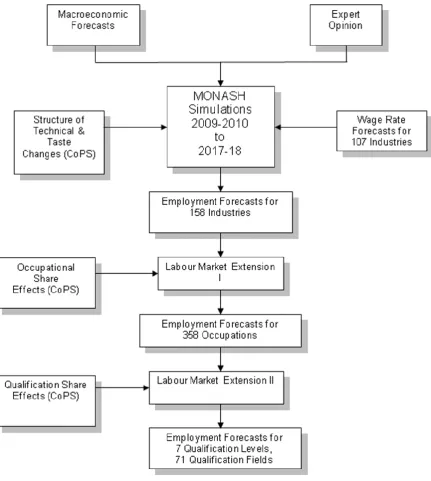
The elements of the 2010 MFS are set out in Figure 1. As a formally specified system, an important
part of its role is to supply a framework for incorporating large amounts of data relevant to the
forecasts. Published data accessed by the system include the national accounts, input/output
tables, State accounts, population censuses, foreign trade statistics, capital stock statistics, and
3
Bureau of Statistics especially for the system. Moreover the MFS requires all its data to be
consistent. If any inconsistencies do exist in the primary sources, they must be reconciled before the
data can be included. This consistency requirement makes the system especially powerful as a
framework for organising data.
As well as data about the past, formal or model-based forecasts usually rest upon informed opinion
about future changes in variables that are exogenous to (i.e., determined outside) the system. The
MFS is quite adaptable in this regard. It incorporates the views of numerous expert bodies and can
accommodate more detailed exogenous forecasts as they become available. The most important
sources of exogenous expert opinion have been:
the private forecasting agency, Deloitte Access Economics (which contributes information about
the future state of the macro economy),
the Australian Bureau of Agricultural and Resource Economics and Sciences (export prices and
volumes for primary products),
the Tourism Forecasting Committee of the Department of Resources, Energy and Tourism
(prospects for tourism),
the Productivity Commission (changes in protection implied by government industry policy), and
the Centre of Policy Studies (changes in technology and consumer tastes).
The system can also produce alternative forecasts corresponding to competing views about the
future. Just as for historical data, all opinions formally incorporated in a particular forecast must be
consistent with each other. A forecaster using the MFS must either seek a consensus between the
expert bodies involved in forecasting the exogenous variables or impose his/her own judgment to
resolve any outstanding differences before the forecast can proceed. In other words, the MFS
provides a framework for coordinating both historical data and expert opinion about the future that
bear on the future demand for labour.
An MFS forecast of the demand for labour proceeds in five stages. It begins with a macroeconomic
scenario derived from the Business Outlook published quarterly by Deloitte Access Economics. At
the second stage the forecasts for GDP and its components are converted into forecasts of output
and employment by industry. The structural forecasts supplied by the expert bodies indicated in
Figure 2 are incorporated at this stage. In particular, the array of exogenous information is treated
as a set of constraints which governs a simulation using the MONASH applied general equilibrium
4
Figure 1 : The MONASH Forecasting System for Slack Labour Markets
The output and employment forecasts are related by production functions which determine the
increase in output associated with given increases in inputs (capital and labour) and a given rate of
primary factor saving technical change. The influence of capital growth and technical change can
5
inputs depends critically on whether an industry was under- or over-capitalised in the base period of
the forecast (i.e., on whether the rate of return in the industry was above or below the average
across industries). An industry with a relatively high rate of return attracts investment and enjoys a
relatively high rate of capital growth. For a given rate of output growth and technical change, this
implies a relatively low rate of employment growth. Similarly an industry with a relatively rapid rate
of technical change will tend to have a relatively low rate of growth in employment.
At the third stage, the national forecasts for output and employment are converted into regional
forecasts using the MONASH top-down regional model (MTDRM), a derivative of the ORANI regional
equation system (Dixon et al., 1982, Chapter 6). The regionalisation process takes account of:
differences in industrial structures,
inter-regional trade flows,
region-specific industry effects, such as mine closures,
population movements,
expected expenditures by regional governments, and
local multipliers.
Regional forecasts are produced at two levels of aggregation, namely, eight State and Territories and
56 Statistical Divisions.
At the fourth stage, the employment forecasts are converted from an industry basis to an
occupational basis. Employment growth (measured in persons) for a particular occupation can be
decomposed into:
a component due to the growth in aggregate employment (measured in hours),
a component (the industry share effect) due to changes in the distribution between industries,
a component (the occupational share effect) due to changes in the distribution of employment
between occupations within industries, and
a component due to changes in the number of hours per worker.
The industry share effects are computed from the growth rates in employment by industry using an
industry-by-occupation matrix derived from the Population Census and the Labour Force Survey.
The occupational share effects are treated as a type of technical change and are forecast by
6
detail in Meagher (1997). Changes in the number of hours per worker in an occupation are also
derived by extrapolating past trends.
At the final stage, the forecasts for employment by occupation in persons are used to determine the
employment outlook for workers identified by age, sex, qualifications and hours worked per week.
The method is analogous to that used to determine the occupational forecasts from the industry
forecasts.
Forecasting with tight labour markets
As already indicated, the MONASH forecasts originally assumed that excess labour would always be
available at the average wage rate predicted by Deloitte Access Economics as part of its macro
scenario. Commensurately, relative wage rates across industries, occupations and skills were
assumed to remain constant. As labour markets tightened during the long boom leading up to the
Global Financial Crisis in 2008, these assumptions became increasingly untenable and labour supply
constraints were introduced.
In particular, labour supply is now determined by progressively projecting the following variables:
adult population,
labour force participation rates,
labour force measured in persons,
unemployment rates,
employment measured in persons,
average hours worked,
employment measured in hours.
All these projections are differentiated by age and sex. A skill dimension is then incorporated using
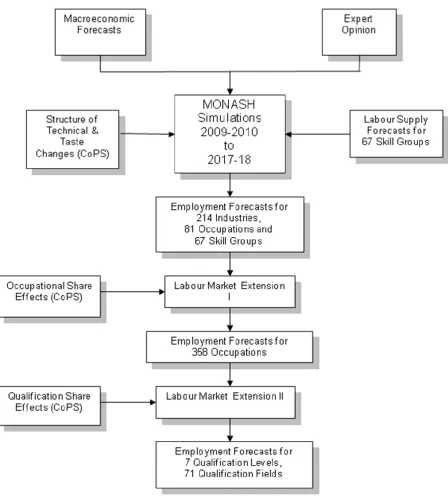
data from the Labour Force Survey and the Survey of Education and Work. At present 67 skill groups
defined on categories from the Australian Standard Classification of Education are identified. They
comprise six levels of educational attainment cross-classified with eleven major fields of study plus
7
In addition, labour markets for 81 occupations, the minor groups of the Australian Standard
Classification of Occupations2, have been incorporated in the MONASH model. On the supply side of
these markets, labour by skill can be converted into labour by occupation according to Constant
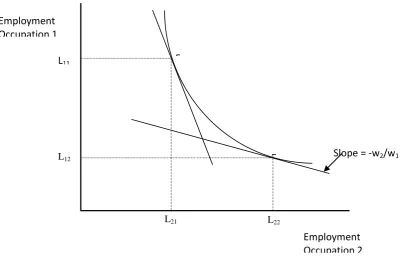
Elasticity Transformation (CET) functions. Figure 2 presents the idea diagrammatically. The position
of the transformation curve is determined by the supply of the skill. If the wage rate of occupation 2
increases relative to that of occupation 1, the isorevenue line becomes steeper, and the owners of
the skill can increase their income by transforming some of occupation 1 into occupation 2. Hence,
they change the occupational mix from E1 to E2. In principle, each of the 67 skills can be transformed
into any of the 81 occupations. However, if none of a particular skill is used in a particular
occupation in the base period, none of it will be used in that occupation in any of the forecasts.
Figure 2 : Skill Transformations between Occupations
2
As not all the required data sources have yet been converted to the new ANZSCO and ANZSIC06 classifications, the MONASH forecasts are also carrying along the old ASCO and ANZSIC03 classifications for the time being.
Employment
Occupation 1
Slope = -w2/w1
E2
E1
L21 L22
Employment Occupation 2
L11
8
Labour of different occupations can be converted, in turn, into effective units of industry
specific labour according to Constant Elasticity Substitution (CES) functions. In Figure 3,
the position of the isoquant is determined by the demand for labour in the industry. If the
wage rate of occupation 2 decreases relative to that of occupation 1, the isocost line becomes
flatter, and the producers in the industry can reduce their costs by substituting some of
occupation 2 for occupation 1. Hence they change the occupational mix from E
1to E
2. In
principle, each of the 107 MONASH industries can employ any of 81 occupations but, as
before, none of a particular occupation will be used by an industry in a forecast if none of it
was used by that industry in the base period.
Figure 3: Substitution between Occupations in Industries
These modifications are sufficient to support the current forecasting methodology in which
relative wage rates are assumed to adjust to clear the occupational labour markets. The
revised system is shown in Figure 4. In future versions, lagged adjustment will be
introduced in the labour markets.
EmploymentOccupation 1
Slope = -w2/w1
E2
E1
L21 L22
Employment Occupation 2 L11
9
10
3. Performance of the MONASH System3Table 1 shows the errors associated with employment forecasts for Australia produced using the
MONASH forecasting system in a typical year, namely, 2001-02. Consider first the errors in the
forecasts for 158 3-digit industries one year out, i.e., for the year 2002-03. For each industry, the
absolute percentage error is calculated from the difference between the employment forecast and
the employment outcome as represented by the estimate obtained subsequently from the Labour
Force Survey (LFS). The 158 errors are then averaged using employment weights. That is, the errors
in large industries are accorded more importance in the average than similar errors in small
industries. The result is the employment-weighted average percentage error or EWAPE4. Thus, on
average, the error in the forecasts for 158 industries was 4.99 per cent. As the number of years of
the forecasting time horizon increases, the error increases but not monotonically so. Eight years
out, i.e., in 2009-10, it has risen to 15-16 per cent.
The first panel of Table 1 shows the EWAPEs for industry classes (158 industries), groups (54
industries) and divisions (18 industries). The errors decline as the level of aggregation increases.
The same trends are evident in the second panel which shows the EWAPEs for occupational unit
groups (340 occupations), minor groups (81 occupations), and major groups (9 occupations).
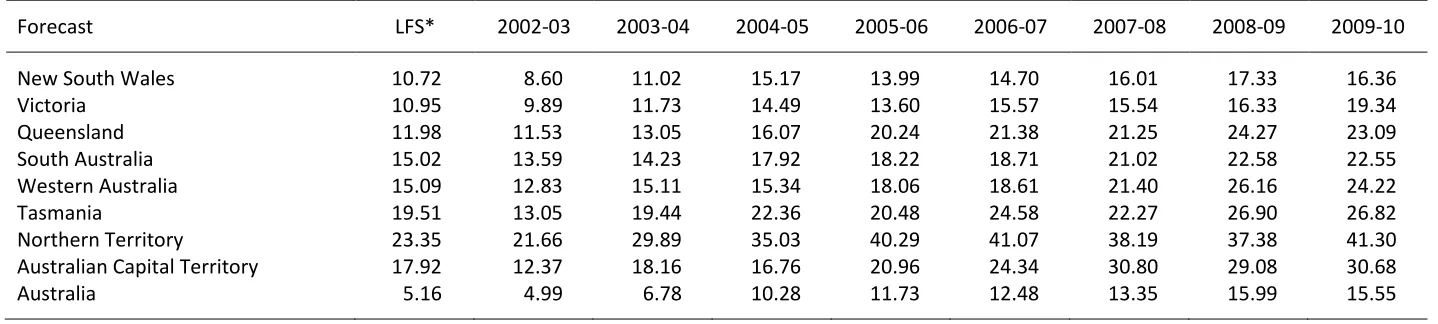
Table 2 presents EWAPEs corresponding to the first row of Table 1 but disaggregated by region,
namely, Australia’s States and Territories. The errors increase as the population of the region
declines. For the Northern Territory, which has the smallest population, the errors are relatively
large.
As the future is inherently uncertain and all forecasts are subject to some level of error, the question
arises as to whether the MONASH errors should be regarded as being large or small. One way of
answering this question is to compare the MONASH errors with those obtained by alternative
forecasting methods. Table 3 provides one such alternative in the form of time series extrapolation
conducted on an industry-by-industry basis. Trends derived from historical LFS data of various
lengths from 3 years to 9 years are reported. The accuracy of the forecasts improves as the number
of years included in the database increases, reflecting a reduction in the influence of the sampling
errors in the Survey. The MONASH forecasts perform better than all the trend extrapolations.
Moreover, unlike the trend extrapolations, the MONASH forecasts are coherent and can be
3 Note that it is the forecasting system, rather than the MONASH model, whose performance is assessed here.
For an assessment of the reliability of a related CGE model, see Dixon and Rimmer (2009).
4 Because of the variability of the accuracy of the forecasts across industries, occupations and skills, and because
11
Table 1. Employment Weighted Average Percentage Errors, Monash Forecasts, Australia
Forecast LFS* 2002-03 2003-04 2004-05 2005-06 2006-07 2007-08 2008-09 2009-10
158 industries 5.16 4.99 6.78 10.28 11.73 12.48 13.35 15.99 15.55
54 industries 3.40 1.99 4.05 6.56 7.28 8.35 8.91 10.58 10.56
18 industries 1.63 0.00 2.28 5.05 6.42 7.10 7.67 9.33 8.87
340 occupations 7.10 7.89 8.93 13.50 14.11 15.28 16.68 18.30 19.63
81 occupations 4.07 4.61 5.71 9.70 10.71 12.57 13.53 14.99 16.53
9 occupations 1.50 2.05 2.24 3.32 4.78 6.20 7.46 8.59 9.42
Table 2. Employment Weighted Average Percentage Errors, Monash Forecasts, 158 Industries
Forecast LFS* 2002-03 2003-04 2004-05 2005-06 2006-07 2007-08 2008-09 2009-10
New South Wales 10.72 8.60 11.02 15.17 13.99 14.70 16.01 17.33 16.36
Victoria 10.95 9.89 11.73 14.49 13.60 15.57 15.54 16.33 19.34
Queensland 11.98 11.53 13.05 16.07 20.24 21.38 21.25 24.27 23.09
South Australia 15.02 13.59 14.23 17.92 18.22 18.71 21.02 22.58 22.55
Western Australia 15.09 12.83 15.11 15.34 18.06 18.61 21.40 26.16 24.22
Tasmania 19.51 13.05 19.44 22.36 20.48 24.58 22.27 26.90 26.82
Northern Territory 23.35 21.66 29.89 35.03 40.29 41.07 38.19 37.38 41.30
Australian Capital Territory 17.92 12.37 18.16 16.76 20.96 24.34 30.80 29.08 30.68
Australia 5.16 4.99 6.78 10.28 11.73 12.48 13.35 15.99 15.55
12
Table 3. Employment Weighted Average Percentage Errors, Alternative Methodologies, 158 Industries, Australia
Forecast 2002-03 2003-04 2004-05 2005-06 2006-07 2007-08 2008-09 2009-10
3-year trend extrapolation 7.92 10.79 16.50 19.08 22.58 25.17 27.57 29.50
4-year trend extrapolation 7.35 9.98 14.29 16.16 19.62 21.64 26.14 27.39
5-year trend extrapolation 7.04 9.51 13.39 15.17 18.11 19.67 24.12 25.27
6-year trend extrapolation 6.98 9.27 13.08 14.73 17.15 18.39 22.36 23.31
7-year trend extrapolation 6.85 9.02 12.73 14.34 16.38 17.48 20.80 21.59
8-year trend extrapolation 6.80 8.79 12.47 13.94 15.71 16.58 19.81 20.71
9-year trend extrapolation 6.78 8.73 12.33 13.86 15.46 16.33 19.03 20.09
Hodrick-Prescott filter 3.42 3.81 3.97 2.97 3.45 3.85 4.05 2.24
13
rationalised in terms of an explicitly-stated and defensible view about the future state of the
economy.
Another way of answering the accuracy question is to use the published standard errors associated
with the Labour Force Survey employment estimates. In particular, if it is assumed that each LFS
estimate is a drawing from a normally distributed employment distribution with a mean equal to the
published level of employment and a standard deviation equal to the associated standard error,
alternative drawings from the distribution can be made and compared. The corresponding EWAPEs
are recorded in the column labelled LFS in Tables 1 and 2. Thus, from the first row of Table 1, when
alternative random drawings were made for 158 industries for the year 2002-03 and those estimates
compared with the published LFS employment estimates, an EWAPE of 5.16 per cent was obtained.5
This is to be compared to the MONASH error of 4.99 per cent for 2002-03. In other words, the
EWAPE due to the sampling error associated with LFS employment estimates exceeds the EWAPE
associated with the MONASH forecast one year out. As the LFS sampling error is routinely ignored
by most, if not all, of the users of the MONASH forecasts, the result suggests that the magnitude of
the MONASH forecasting errors is not a cause for particular concern.
Finally, based on quarterly LFS data for the period 1987-88 to 2009-10, an employment series was
constructed using the Hodrick-Prescott filter. This series can be regarded as representing the
underlying employment once all the transients, including those due to the LFS sampling error, have
been removed. The EWAPEs obtained when this series is compared with the published LFS
employment estimates are shown in Table 3. Thus, one year out, the EWAPE associated with the
MONASH forecast is 4.99 per cent. However, the HP-filtered series produces an EWAPE of 3.42 per
cent for the same year. Hence, a significant share of the MONASH error can be attributed to
transients about which the MONASH system has nothing to say and, indeed, about which it cannot
be expected to have anything to say. An implication of this result is that, in future work, the
forecasting system should address a filtered employment series, such as the HP series, rather than
the LFS employment estimates.
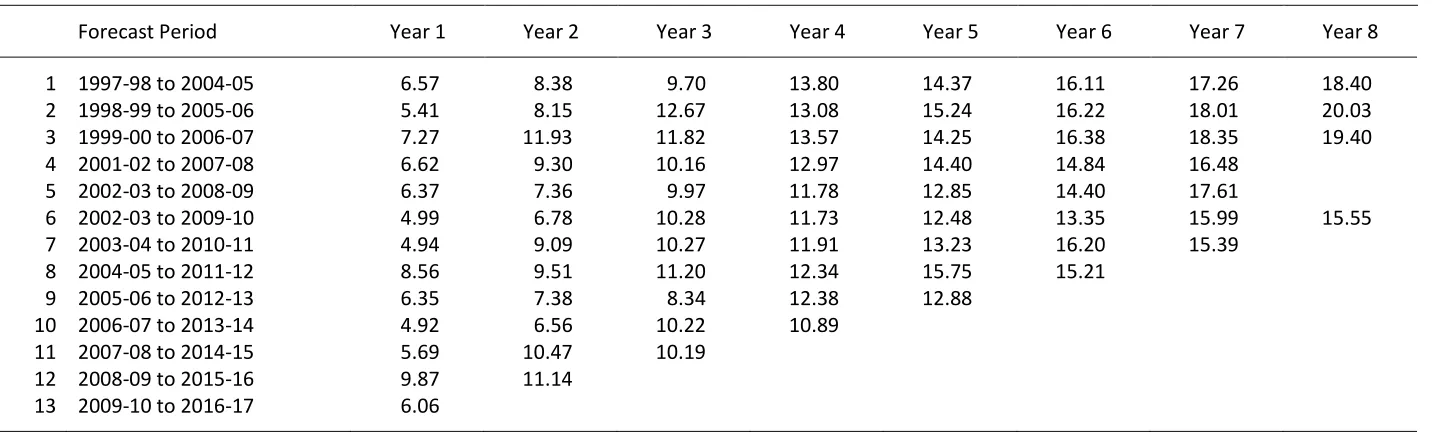
Table 4 shows the EWAPEs for Monash forecasts made between 1996-97 and 2008-09. In general,
the trends evident in the results for the typical year 2001-02 are repeated in the other years,
although the performance is sometimes patchy. Consider first the forecast for the years 2004-05 to
2011-12 (forecast 8 in Table 4). The EWAPE for the first year of the forecast (8.56 per cent) is
relatively large. When the individual contributions of each of the 158 industries are examined, the
5 Of course, the EWAPE will be different for each set of random drawings, but its magnitude will not vary much
14
Table 4. Employment Weighted Average Percentage Errors, Monash Forecasts, 158 Industries, Australia
Forecast Period Year 1 Year 2 Year 3 Year 4 Year 5 Year 6 Year 7 Year 8
1 1997-98 to 2004-05 6.57 8.38 9.70 13.80 14.37 16.11 17.26 18.40
2 1998-99 to 2005-06 5.41 8.15 12.67 13.08 15.24 16.22 18.01 20.03
3 1999-00 to 2006-07 7.27 11.93 11.82 13.57 14.25 16.38 18.35 19.40
4 2001-02 to 2007-08 6.62 9.30 10.16 12.97 14.40 14.84 16.48
5 2002-03 to 2008-09 6.37 7.36 9.97 11.78 12.85 14.40 17.61
6 2002-03 to 2009-10 4.99 6.78 10.28 11.73 12.48 13.35 15.99 15.55
7 2003-04 to 2010-11 4.94 9.09 10.27 11.91 13.23 16.20 15.39
8 2004-05 to 2011-12 8.56 9.51 11.20 12.34 15.75 15.21
9 2005-06 to 2012-13 6.35 7.38 8.34 12.38 12.88
10 2006-07 to 2013-14 4.92 6.56 10.22 10.89
11 2007-08 to 2014-15 5.69 10.47 10.19
12 2008-09 to 2015-16 9.87 11.14
15
main contributor is found to be the industry School Education, which accounts for about seven per
cent of the error. Figure 5 shows the employment estimates for this industry as published by the LFS
and after applying the HP filter. Evidently it is the reduction in the LFS estimate from 450 thousand
to 425 thousand between 2003-04 and 2004-05 which accounts for the large EWAPE. As
employment in the industry recovered in the next year, the large error would appear to be due to
sampling error in the LFS rather than any limitation in the MONASH forecast.
Now consider year 2 of forecast 3 (i.e., the forecast for the years 1999-00 to 2006-07), for which the
EWAPE is again relatively large at 11.93 per cent. This time there are two significant contributors,
the first being the industry Machinery Equipment and Wholesaling which accounts for about 5 per
cent of the error. The employment estimates for the industry are given in Figure 6. They show that
the reduction in the LFS estimate from 140 thousand to 110 thousand between 1999-00 and
2000-01 is partly responsible for the large EWAPE. As the drop in employment is sustained, the EWAPE
represents a failure of the forecasting system. The cause of the sudden decline in the fortunes of
the industry between 1998-99 and 2000-01 is not known but it could presumably be revealed by
further investigation.
The second important industry is Computer Services which also contributes about 5 per cent to the
error. Figure 7 shows that the proximate cause is the rapid increase in employment from 121
thousand to 164 thousand between 1999-00 and 2000-01. Here the underlying phenomenon is
more obvious. The MONASH forecast in 1998-99 underestimated the surge in the employment of
computer specialists prompted by fear of the possible effects of Y2K bug.
The discussion suggests that variations in the performance of the forecasting system over time can
be traced either to unlikely employment estimates obtained from the Labour Force Survey or to
discreet economic events which the forecasts failed to account for adequately. Further investigation
18
4. Forecasting and Workforce DevelopmentAs already mentioned, it is usually considered that a primary objective of workforce development is
to equip the workforce with the skills it will need to meet the future needs of industry. In its report
on Australian Workforce Futures: A National Workforce Development Strategy, Skills Australia (2010)
expresses this kind of objective as being to “sustain economic growth and raise productivity by
increasing skills and avoiding future skills shortages” (p.8). That being the case, there are several
reasons for thinking that the MONASH forecasts would be attractive to policy makers such as Skills
Australia concerned with workforce development.
The MONASH forecasts are coherent. Whatever their level of detail, all MONASH forecasts are
consistent with each other, and with an articulated, defensible view about the future of the
Australian economy.
The MONASH forecasts embody very large amounts of relevant economic data and expert
opinion. As a formal modelling system, MONASH provides a framework for incorporating data
from a wide variety of sources in a consistent manner.
The MONASH forecasts are updated regularly.
The MONASH forecasts are subject to relatively good quality control. The forecasts and the
models used in their derivation come under constant, and often intense, scrutiny from the
numerous subscribers to the former and from the participants in regular training courses in the
use of the latter.
The MONASH forecasts are comprehensive and relatively cheap. As the forecasts cover the
whole economy, the cost of producing them can be spread over a relatively large number of
subscribers.
The MONASH forecasts are progressive. The MONASH forecasting system is supported by an
ongoing program of economic research which leads to improvements in the forecast
methodology over time.
The MONASH forecasts are transparent in the sense that the economic processes that
determine a particular forecast can always be traced and each step in each process can be
understood intuitively.
Yet Skills Australia, and many other contributors to discussions on workforce development, are
reluctant to concede that formal labour market forecasts have anything much to offer. The main
19
this position are reviewed. One problem which confronts such a review is that the preferred
alternatives often do not provide any forecasts that can be tested directly against the empirical
evidence. In that case, reliability must be assessed according to qualitative arguments which tend to
be imprecise and open to interpretation. Nevertheless, as the perceptions of the reliability of formal
forecasts (such as the MONASH forecasts) are usually based on such arguments, it is appropriate
that they be considered here.
The MONASH forecasts have been independently reviewed several times over the years, the most
important assessments being due to Burns and Shanahan (2000), Access Economics (2005), Peng et
al. (2005), Richardson and Tan (2008), Hoeckel et al. (2008) and Lewis (2008). However, to contain
the discussion, particular attention will be paid to the reports by Skills Australia (2010) and the OECD
(Hoeckel et al., 2008), and to the paper by Richardson and Tan (2008) whose ideas appear to have
exerted a special influence on the other two reports6. Each of the three components of the national
strategy advanced by Skills Australia will be explicitly considered. They are
a scenario analysis using a formal forecasting model ,
a common planning framework which recognises that skills and workforce planning is a
shared enterprise between a range of players, and
a focus on specialised occupations which targets occupations that cannot be left to market
mechanisms alone.
Taken together, the three reports provide a useful summary of a commonly-held view within the
education and training community in Australia concerning the role of formal labour market forecasts
in workforce development. The discussion is organised around five propositions.
Proposition 1. In choosing between different forecasting methodologies, all alternatives should be
subject to the same criteria regarding reliability.
On the basis of a handful of ill-considered comparisons between MONASH forecasts and historical
outcomes7, Richardson and Tan conclude “that it is not at present possible to project future skill
needs with much accuracy” (p.30). Further, the forecasts are sufficiently unreliable as to raise the
6 In this paper, only the qualitative arguments advanced by Richardson and Tan are considered. Their
accompanying quantitative arguments have already been reviewed in Meagher (2008). The latter paper is available on the NCVER website but, somewhat ironically, under the guise of “supporting documents” to the paper of Richardson and Tan. For convenience, it is reproduced here as an Appendix.
7 Insofar as it purports to be a quantitative assessment of the reliability of the MONASH forecasts, the paper by
20
question of ”whether, at the level of disaggregation that is needed for VET capacity planning, the
forecasts are robust enough to be better than no forecasts” (p.27).
Because of their supposed unreliability, Richardson and Tan maintain that only a restricted
subset of the MONASH occupational forecasts are suitable for VET planning. In particular,
the forecasts should only be used “at a fairly broad level”, they should be confined to “around
five years”, and they should retain “an Australia-wide focus” (p.33). For other purposes (i.e.,
detailed occupational forecasts, planning horizons of more than five years and regional
forecasts), other ways of looking forward are to be preferred. These “other ways” include
using “local information from employers’ associations, graduate destination surveys andrecruitment agencies”, and
undertaking separate, bottom-up, high-quality studies of expected skills demands for those
major skills that take a long time to learn and gear up to teach—it is for these that the ability to
make accurate projections is of most importance” (p.34).
An important feature of the “other ways” is that they are to be used instead of, rather that in
addition to, the MONASH forecasts. Since the reason for relegating the MONASH forecasts to a
strictly limited role is their perceived unreliability, this recommendation can only mean that
Richardson and Tan believe the “other ways” are more reliable than MONASH. They present no
evidence to support this contention. When it comes to the reliability or otherwise of the “other
ways”, they are completely silent. Indeed, to judge from their discussion, unreliability would appear
to be a condition which is somehow peculiar to the MONASH forecasts.
Hoeckel et al., likewise, are at pains to warn their readers about the unreliability of “skills
forecasting” but offer no comment as to the reliability of their preferred alternatives. Indeed, as
evidence of the unreliability of skills forecasting, they rely mainly on the following opinion of
Richardson and Tan: “Our own comparisons of projections with outcomes for the MONASH model
confirm that, over a nine-year period, its projections diverged substantially from the actual
outcomes for a number of occupations. Indeed, even at the major occupational group level, the
direction of change was in some cases incorrect projecting growth when there was decline and vice
versa (p.26 of Hoeckel et al.)”. That they have chosen to highlight the direction of change issue is
curious. Firstly, one of the more egregious errors committed by Richardson and Tan in their
assessment of the MONASH forecasts was to attribute uniform growth to the forecasts over the
forecast period. That is, Richardson and Tan misrepresented the MONASH forecasts in such a way as
to preclude any changes in direction. In any case, a failure to forecast the direction of change does
21
time, so that in some periods it increases a little and in other periods it decreases a little, it is entirely
possible for a forecast to get the direction of change wrong in every period but still predict the level
of employment to a high degree of accuracy. In other words, despite their repeated warnings,
Hoeckel et al. are unable to offer anything but highly dubious evidence concerning the unreliability
of skills forecasting.
It is simply illogical to reject one forecasting method on the grounds that it is unreliable and to
espouse an alternative method whose reliability is unknown. As the future is inherently uncertain,
all forecasts are unreliable to some extent. Hence a “reliable” forecast can only be considered to be
one which is less unreliable than the best available alternative.
Proposition 2. If a workforce development strategy is to equip the workforce with the skills it will
need to meet the future needs of industry, the strategy must identify what the future needs of
industry are going to be.
As indicated earlier, the Skills Australia development strategy includes an analysis of a number of
alternative scenarios concerning the future of the Australian economy8. Each scenario identifies a
view about future industry needs and determines the allocation of training resources which are
appropriate to those needs. If the scenario changes, so too does the appropriate allocation. A
forecast can be thought of as an analysis of the particular scenario considered most likely to
eventuate. As with the other scenarios, there is a particular allocation appropriate to the forecast.
This is not to say that the workforce will be impotent if it embodies skills that are better suited to an
economy that is different to the one which actually eventuates. Whatever the needs of industry
turn out to be, the economy will adjust to accommodate the workforce which is available. However,
to the extent that the workforce has acquired skills that are not particularly appropriate for industry
needs, there will be a cost in the form of reduced output. A development plan, based on a reliable
forecast, can help to minimise such costs.
However, in the Skills Australia strategy, the allocation of training resources is not determined by
any scenario, forecast or otherwise; it is determined by the common planning framework. This
network is an ongoing collaborative planning effort involving:
Skills Australia;
the Department of Education, Employment and Workplace Relations;
8 It should be noted that the scenarios were not conducted using the MONASH forecasting system. For that
22
the states and territories;
industry;
education providers; and
Industry Skills Councils.
In other words, the allocation of resources is to be decided as an exercise in bureaucratic decision
making. It is essentially a political system designed to afford a voice to all those with an interest in
the allocation. It is not a system which will deliver an economic analysis of how the future skill
needs of industry will be met. It will certainly deliver an allocation of resources but it will not
identify in any detailed, quantitative way the industry needs which the allocation is supposed to
service. Hence it cannot be argued or, at least, it cannot be plausibly argued, that the allocation will
meet future industry needs.
Skills Australia advances the following argument. “Decentralised engagement can be the most
effective way to ‘plan’: New skill demands may flow from the changing skill composition of existing
occupations, resulting from new technology, services or products, rather than from industry or
occupational growth and decline. Such demands will vary from firm to firm, depending on their
innovation intensity and business strategy. The responsiveness of education providers to changing
industry needs, and ongoing dialogue between education and industry, may therefore be more
important than centralised planning efforts” (p.18). According to this view, businessmen know best
what the future needs of industry will be. Hence the workforce development strategy should focus
on surveying business opinion via the common planning framework and then reallocate training
resources as quickly as possible to conform to changes in that opinion.
The immediate problem with this approach is that a committee of businessmen can be expected to
disagree about future industry needs. The committee then has the unenviable task of forming a
consensus view from disparate, and possibly contradictory, opinion. There are no rules to govern
this process. Perhaps the opinion of the person with the most bureaucratic authority is the one that
will prevail. However it is done, it will not be free of a considerable measure of uncertainty. This
kind of “unreliability” is routinely ignored because the process is not transparent and, the costs
associated with bad decision making cannot be easily identified.
A second problem with a system like the common planning framework, but not one canvassed by
Skills Australia, is rent seeking behaviour. In the context of skills shortages, Richardson (2007) has
23
“The usual way of learning that there is a shortage of particular skills is to ask (or be told by)
employers. For several reasons, this is not very reliable.
Employers have every incentive to exaggerate the problem of shortage in the hope that
someone else will assist them to find the skills they want without their having to make the jobs
more attractive for their workers and hence more costly for them as employers.
Employers interpret shortage in a variety of ways and do not act consistently when dealing with
an environment they characterise as one of shortage.
This is one area where we expect unions and employers to have common cause. It is in the
interests of both groups to exaggerate the problem of shortage.” (p.27)
The common planning framework is just an institutionalised system for asking (or being told by)
employers about how to allocate training resources. It can be expected to be prone to exactly the
same limitations as employer advice on skills shortages and, on Richardson’s assessment, it is “not
very reliable”.
Proposition 3. In determining what skills are required to meet the future needs of industry, structural
linkages are important.
Once a view has been adopted about what the future needs of industry are going to be, it remains to
determine the associated skill requirements. In this process, structural linkages are important. Here,
the term “structural linkages” refers, firstly, to the composition of the cost and sales shares of each
industry and, secondly, to the way industries interact with each other via the markets for
commodities and factors.
Richardson and Tan “emphasise that the labour market is dynamic. People are constantly changing
their jobs, learning new skills from their work, moving to new locations, moving in and out of the
labour force, changing the number of hours per week they work. At the same time, firms are being
born, growing, dying, declining, altering the size and skill set of their workforce, recruiting strategic
new skills, training some of their existing staff with the additional skills they find they need. ... In all
of this, formal vocational education has an important, but modest role to play. It is a
misunderstanding of how the labour market adjusts to think that there is a direct, one-to-one
relation between an expansion in output, the associated increase in skills needed to produce that
extra output, and a requirement for the VET system to provide those extra skills. Indeed, there is
only a loose match between the qualifications that people have and the jobs they do. Many people
24
have no formal qualification. (Hence) VET planners should not try to match vocational education and
training to projected skills needs in any precise way.” (p.9)
These sentiments are dutifully recycled by Skills Australia. In deciding where to direct planning
efforts, Skills Australia nominates the following “labour market facts” to be of particular significance.
People change jobs frequently: 45 per cent of the workforce changes their employer within a
three-year period, and many people change not just their employer but also their industry and
occupation.
Job destinations are varied: The job destinations people arrive at following training are often
quite different to the jobs for which they initially trained.
Employer requirements change: Labour market conditions lead employers to adapt their
requirements for workers, varying the quality of those they are prepared to employ, and
increasing their tolerance for people learning on the job.
Non-accredited and informal learning can supplement or substitute for formal education: Skills
are often learned on the job, through experience and unaccredited structured training, rather
than by formal study for a qualification. (p.17)
In fact what matters is whether particular industries employ particular occupations and skills more
intensively than other industries and, if they do, whether the differences in intensity persist over
time. This is an empirical question which can be tested directly with quantitative evidence rather via
a suggestive qualitative argument. That evidence is presented in Tables 5 to 8.
Consider the first row of Table 5. For this row, employment shares for 7 levels of educational attainment
(3 higher education levels, 3 VET levels and the unskilled level No Post-School Qualification) are
determined for each of 358 occupations from 2001-02 employment data published by the Australian
Bureau of Statistics (ABS). Assuming the 2001-02 shares remain constant over time, forecasts of
employment by qualification level in 2002-03 are derived from published LFS estimates for employment
by occupation in 2002-03. These forecasts are then compared with published ABS estimates of
employment by level of educational attainment for 2002-03 and the EWAPE computed. The result is an
error of 3.70 percent. In other words, a forecast of employment by qualification level based only on a
knowledge of
(a) the intensity with which each occupation uses each qualification and
(b) employment by occupation
is more than 96 per cent accurate on average. Using the same 2001-02 shares but updating the LFS
25
and to 7.08 per cent after eight years. Rows 2 to 8 of Table 5 show the EWAPEs when more up-to-date
estimates of the qualification intensities are used.
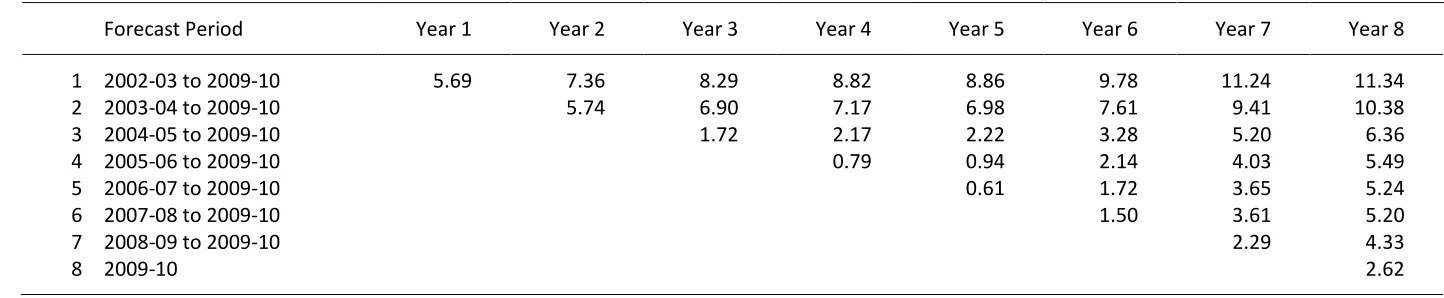
Table 6 shows the results of analogous computations in which the qualification intensities are defined for
214 industries rather than 358 occupations. Tables 7 and 8 show the corresponding results when the 7
qualification levels are replaced with 71 qualification fields (i.e., the narrow fields of major study defined
in the Australian Standard Classification of Education (ASCED)). In no case does the EWAPE rise above 12
per cent.
These results flatly contradict the conjecture of Richardson and Tan and Skills Australia. Notwithstanding
their characterisation of labour markets as being in a state of constant turmoil, employment by
occupation and/or industry remains a powerful determinant of employment by skill (represented here by
qualification). At least part of the failure of their conjecture can be attributed to their misplaced concern
with which persons hold down which jobs. It is the amount of labour (measured in hours) of various
types delivered to the production process which matters here. Whether or not a particular worker has
changed jobs often is not important. Likewise the production process is indifferent to whether a
particular job meets the past aspirations of the worker who holds it.
The OECD take on this issue is as follows. “Even when it is possible to forecast the future
occupational mix – e.g. so many cooks and so many childcare workers – this does not necessarily
translate into an equivalent mix of training requirements, except on the assumption that all cooks
need training as cooks, and all childcare workers need training as childcare workers. In fact, people
trained in one field often work in another, and this may be a good thing, as it allows for the
evolution and development of careers and for the cross-fertilisation of fields and ideas” (Hoeckel et
al.,p.26). The assertion is misleading. All that is required for an informative skills forecast is that
the occupation Cooks employs persons with the relevant training (a qualification with the major
field of study Food, Hospitality and Personal Services in the ASCED classification) relatively more
intensively than other occupations, the occupation Child Carers employs persons with the
relevant training (in this case a qualification with the major field of study Society and Culture)
relatively more intensively than other occupations, and
the relative intensities remain reasonably stable over time.
26
Table 5. Employment Weighted Average Percentage Errors, 7 Levels of Educational Attainment, Occupation Based Forecasts, Australia
Forecast Period Year 1 Year 2 Year 3 Year 4 Year 5 Year 6 Year 7 Year 8
1 2002-03 to 2009-10 3.70 4.36 4.77 4.82 4.74 4.86 5.97 7.08
2 2003-04 to 2009-10 1.99 2.18 2.25 2.14 4.51 5.47 7.22
3 2004-05 to 2009-10 0.44 0.47 0.43 2.51 3.47 5.21
4 2005-06 to 2009-10 0.08 0.08 2.32 3.28 5.02
5 2006-07 to 2009-10 0.13 2.25 3.21 4.95
6 2007-08 to 2009-10 2.37 3.33 5.08
7 2008-09 to 2009-10 1.75 2.70
8 2009-10 2.31
Table 6. Employment Weighted Average Percentage Errors, 7 Levels of Educational Attainment, Industry Based Forecasts, Australia
Forecast Period Year 1 Year 2 Year 3 Year 4 Year 5 Year 6 Year 7 Year 8
1 2002-03 to 2009-10 3.64 4.52 5.09 5.42 5.48 6.42 8.23 9.87
2 2003-04 to 2009-10 2.38 3.37 3.77 3.76 6.49 7.99 10.09
3 2004-05 to 2009-10 1.33 1.69 1.59 4.11 5.78 7.71
4 2005-06 to 2009-10 0.42 0.40 3.11 4.64 6.71
5 2006-07 to 2009-10 0.27 2.71 4.22 6.31
6 2007-08 to 2009-10 2.72 4.24 6.32
7 2008-09 to 2009-10 2.40 3.71
27
Table 7. Employment Weighted Average Percentage Errors, 71 Major Fields of Study, Occupation Based Forecasts, Australia
Forecast Period Year 1 Year 2 Year 3 Year 4 Year 5 Year 6 Year 7 Year 8
1 2002-03 to 2009-10 5.64 7.11 7.81 7.85 7.81 8.21 9.31 8.78
2 2003-04 to 2009-10 5.48 5.84 5.96 5.91 6.27 7.63 7.74
3 2004-05 to 2009-10 1.18 1.22 1.14 1.64 2.98 3.75
4 2005-06 to 2009-10 0.15 0.19 0.98 2.53 3.94
5 2006-07 to 2009-10 0.21 0.94 2.48 3.87
6 2007-08 to 2009-10 1.04 2.61 3.97
7 2008-09 to 2009-10 1.79 3.26
8 2009-10 2.66
Table 8. Employment Weighted Average Percentage Errors, 71 Major Fields of Study, Industry Based Forecasts, Australia
Forecast Period Year 1 Year 2 Year 3 Year 4 Year 5 Year 6 Year 7 Year 8
1 2002-03 to 2009-10 5.69 7.36 8.29 8.82 8.86 9.78 11.24 11.34
2 2003-04 to 2009-10 5.74 6.90 7.17 6.98 7.61 9.41 10.38
3 2004-05 to 2009-10 1.72 2.17 2.22 3.28 5.20 6.36
4 2005-06 to 2009-10 0.79 0.94 2.14 4.03 5.49
5 2006-07 to 2009-10 0.61 1.72 3.65 5.24
6 2007-08 to 2009-10 1.50 3.61 5.20
7 2008-09 to 2009-10 2.29 4.33
28
Proposition 4. To the extent that the distribution of training resources is left to market forces, labour
market forecasting has a valuable role to play in providing the economic agents involved with information
on which to base their decisions.
According to Richardson and Tan, “There is no need to put serious effort into forecasting the demand for
skills that are quite quickly and easily learned. The demand for these skills can be met at the time, if the
need actually eventuates. Rather than attempting to forecast, with all the attendant errors in over- or
underestimating the true outcomes, it is preferable to have effective systems for rapidly identifying
emerging trends and for responding to them” (p.9). This view is endorsed by Skills Australia, which
attaches particular significance to the last sentence in determining where to direct research efforts.
In the context of the discussion by both Richardson and Tan and Skills Australia, the “forecast” they
advise against attempting refers to a formal labour market forecast such as a MONASH forecast. In
the MONASH forecasts, and they are not atypical in this regard, the minimum skill level considered
is ASCED Certificate I or II9, and the minimum time horizon for a forecast is one year. Hence, when
put into context, the Richardson and Tan position is that
(a) a Certificate I or II qualification is to be considered “quickly and easily learned” and
(b) a person considering undertaking such training to meet expected demand can conveniently
wait one year before starting the training to see if the expected demand eventuates.
Neither of these propositions is particularly plausible in the absence of supporting evidence.
Furthermore, the dichotomy they pose is false. “Emerging trends” are not of interest unless they are
expected to continue into the future. But, in that case, the identification of emerging trends is
simply another way of making a forecast and, presumably, it comes with the same “attendant errors
in over- or underestimating the true outcomes” as any other forecast. Tedious though it becomes, it is
necessary to continually unpick this kind of argument because it is just this kind of argument which Skills
Australia and others advance for rejecting formal forecasting methods.
If no forecasting (and, by implication, no planning) is to be undertaken for skills which are “quickly and
easily learned”, the question arises as to how economic agents are to decide whether to acquire such
skills. In this regard Richardson and Tan believe “there is much to be said for focusing on what people
want to study, as well as on what future employers are anticipated to need. Individuals themselves will
have a feel not only for what they like and are good at, but where the future job opportunities lie.” (p. 9).
To the extent that workforce development is to be directed at personal development objectives rather
than training for jobs, labour market forecasting is not relevant and its reliability not an issue. However
29
the idea that students “will develop a feel for where the future job opportunities will be” is very strange
indeed and is not supported by any evidence or argument. By their own assessment, “It is extremely
difficult, in both theory and practice, to forecast how the demand for labour is going to evolve—beyond a
few years into the future. Economies are complex and dynamic and are affected by many forces that
cannot be predicted with any confidence” (p.8). Yet Richardson and Tan imply that students are able to
accomplish this feat satisfactorily without the benefit of any economic training or analysis, and with little
or no experience in the labour market. The idea is fanciful.
Fanciful or not, the idea is also given credence by the OECD, at least to a limited extent. Hoeckel et
al. assert “The entitlement model opens the choice of field of study and of qualification to the
market, so that within certain limits, students may choose their training in response to their own
assessments of future labour market needs” (p.24). In contrast to their treatment of skills
forecasting, Hoeckel et al. advance no warnings about the reliability of “student assessments of
future skill needs”. However, they do concede that “despite their methodological problems10, skills
forecasts can provide some useful information to labour market actors who remain free to make
their own decisions” (p.27). Neither Richardson and Tan nor Skills Australia countenance any role
for labour market forecasting in informing the economic agents operating in the markets for labour.
One thing that can be said about leaving things to the market is that the costs of bad decisions will
be borne by the persons who make the decisions rather than by somebody else. However, it does
not follow that the market participants will make good decisions or that they will quickly rectify bad
decisions. Without good information, they may simply make one bad decision after another. Hence
an assessment of the advisability of leaving labour market outcomes to market forces without
providing the participants with good forward-looking information (i.e., without providing them with
labour market forecasts) ought to be importantly concerned with the costs of bad decisions. Neither
Richardson and Tan nor Skills Australia consider the issue.
Proposition 5. Whether or not a particular occupation (or skill) constitutes a bottleneck to economic
growth is a property of the state of the economy and not a property of the occupation.
The final component of the Skills Australia strategy is a focus on specialised occupations.
Specifically, “Skills Australia in its review of research found that for most occupations there is no
clear link with any specific qualifications and also that many workers are highly mobile. As a
consequence, the existing labour market mechanisms and demand monitoring by education
providers work adequately for meeting the skill needs for these occupations. However, there are a
10 The methodological “problems” to which Hoeckel et al. refer are the turning-points issue and the cook/child
30
significant number of jobs that cannot be left to market mechanisms alone. These occupations
include ones where:
the preparation time for development is long and it is therefore difficult for employer demand to
quickly translate into workers with the requisite skills
there is a strong connection between the education or training undertaken and the destination
occupation (so that government intervention has a reasonable likelihood of being effective)
the jobs are central to the achievement of other national economic and social priorities, or cause
significant supply bottlenecks.
Skills Australia has developed and tested a set of criteria to determine where planning attention is
best targeted. Stakeholders were overall in favour of an approach that targets specialised
occupation groups where government intervention is most appropriate and potentially effective”
(p.20). The first two of these criteria have already been discussed, at least in part. The third will be
considered here.
Suppose there is excess demand for labour belonging to a particular occupation at the wage rate w1.
One measure of the structural pressure on the occupation (or the extent to which it poses a supply
31
of labour required to establish equilibrium at the wage rate w1. An alternative measure is the
percentage change 100 (w0-w1)/w1 in the wage rate required to establish equilibrium at the wage
rate w0. The wage rate measure is a better indicator of the extent of the bottleneck because it
shows the value of the additional output that could be produced with an additional unit of labour of
the kind under consideration11.
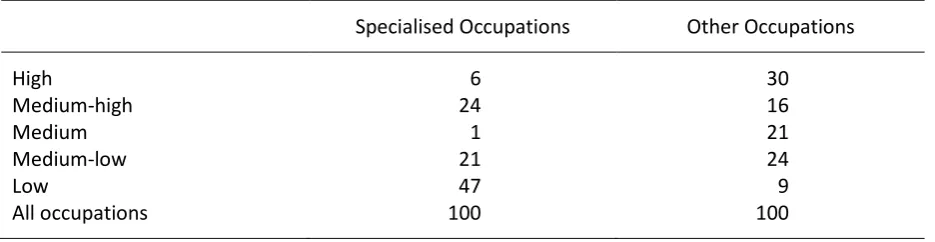
Using wage rates obtained from the 2010 MONASH forecasts, 81 minor group occupations were
ranked according to the wage rate measure and divided into five groups: those under high structural
pressure, medium-high, medium, medium-low and low. Each group contained 16 occupations
except the last which contained 17. Each of the 4-digit “specialised occupations” defined by Skills
Australia and each of the residual 4-digit occupations were then assigned to the appropriate
structural pressure group. The results are shown in Table 9.
Table 9. Structural pressure on specialised occupations, per cent
Specialised Occupations Other Occupations
High 6 30
Medium-high 24 16
Medium 1 21
Medium-low 21 24
Low 47 9
All occupations 100 100
Only 6 per cent of the “specialised” occupations appear in the high structural pressure group
whereas nearly 50 per cent appear in the low pressure group. Conversely, 30 per cent of the
“non-specialised” occupations appear in the high pressure group and only 9 per cent in the low pressure
group. In other words, the set of criteria developed by Skills Australia to identify occupations
causing supply bottlenecks would appear to have largely identified the wrong set of occupations.
The problem is that the occupations which cause supply bottlenecks can only be identified in terms
of the state of the economy. An Australian mining occupation may constitute a future bottleneck if
the Chinese economy continues to grow strongly but not if Chinese growth falters. The Skills
Australia strategy tries to determine the issue using a bottom-up, largely bureaucratic classification
11 This assertion rests on the assumption, adopted in the MONASH model, that labour is paid its marginal