MISTY1
Achiya Bar On1? 1 Department of Mathematics
Bar Ilan University Ramat Gan, 52900, Israel
Abstract. MISTY1 is a block cipher designed by Matsui in 1997. It is widely deployed in Japan, and is recognized internationally as an Eu-ropean NESSIE-recommended cipher and an ISO standard. Since its introduction, MISTY1 was subjected to extensive cryptanalytic efforts, yet no attack significantly faster than exhaustive key search is known on its full version. The best currently known attack is a higher-order differ-ential attack presented by Tsunoo et al. in 2012 which breaks a reduced variant of MISTY1 that contains 7 of the 8 rounds and 4 of the 5F L
layers in 249.7 data and 2116.4 time.
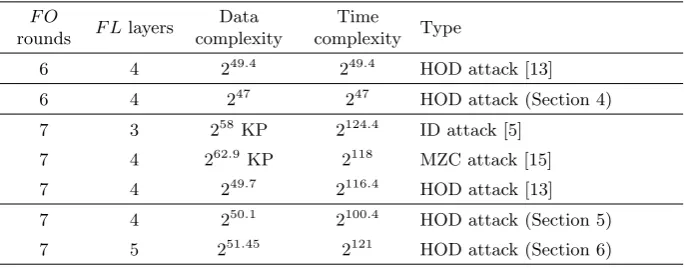
In this paper, we present improved higher-order differential attacks on reduced-round MISTY1. Our attack on the variant considered by Tsunoo et al. requires roughly the same amount of data and only 2100.4 time (i.e., is 216 times faster). Furthermore, we present the first attack on a MISTY1 variant with 7 rounds and all 5 F L layers, requiring 251.4 data and 2121 time. To achieve our results, we use a new higher-order differential characteristic for 4-round MISTY1, as well as enhanced key recovery algorithms based on thepartial sumstechnique.
1
Introduction
MISTY1 [10] is a 64-bit block cipher with 128-bit keys designed in 1997 by Mat-sui. In 2002, MISTY1 was selected by the Japanese government to be one of the CRYPTREC e-government ciphers, and since then, it became widely deployed in Japan. MISTY1 also gained recognition outside Japan, when it was selected to the portfolio of European NESSIE-recommended ciphers, and approved as an ISO standard in 2005. Furthermore, the block cipher KASUMI [1] designed as a slight modification of MISTY1 is used in the 3G cellular networks, which makes it one of the most widely used block ciphers today.
MISTY1 has an 8-round recursive Feistel structure, where the round function F Ois in itself a 3-round Feistel construction, whose F-functionF Iis in turn a 3-round Feistel construction using 7-bit and 9-bit invertible S-boxes. The specific choice of S-boxes and the recursive structure ensure provable security against
?This research was partially supported by the Israeli Ministry of Science, Technology
differential and linear cryptanalysis. In order to thwart other types of attacks, after every two rounds an F L function is applied to each of the two halves independently. TheF Lfunctions are key-dependent linear functions which play the role of whitening layers.
Since its introduction, MISTY1 was subjected to extensive cryptanalytic ef-forts using a variety of techniques, which resulted in numerous attacks on its reduced variants. The best currently known attacks are the following:
– A higher-order differential (HOD) attack on 6-round MISTY1 with 4 of the 5F Llayers, with a semi-practical complexity of 249.4chosen plaintexts and
time [13].
– An impossible differential attack on 7-round MISTY1 with 3F Llayers, that requires 258 known plaintexts and 2124.4 time [5].
– A zero-correlation linear attack on 7-round MISTY1 with 4F Llayers, that requires 262.9known plaintexts and 2118 time [15].
– A HOD attack on 7-round MISTY1 with 4 of the 5F Llayers, that requires 249.7 chosen plaintexts and 2116.4 encryptions [13].
– A related-key differential attack on the full MISTY1, that requires 261
cho-sen ciphertexts and 290.9 encryptions, and applies under a weak key class
assumption [9].
– A meet-in-the-middle attack which allows to speed up exhaustive key search on the full MISTY1 [6] by a factor of between 2 and 4.
Examination of the best currently known attacks on MISTY1 suggests that up to date, the technique that provided the strongest results against reduced-round MISTY1 is the higher-order differential attack. In this paper, we examine the currently known HOD attacks on MISTY1 thoroughly and show that they can be improved, both in the exact characteristic used for the attack and in the key-recovery algorithm. The results we obtain are the following:
1. The 44-order differential characteristic for 4-round MISTY1 introduced and deployed in [13] can be replaced by more efficient 43-order differentials. This allows to reduce the data and time complexities of the attacks of [13] on 6-round MISTY1 from 249.4 to 247. As we explain in Section 4, the order of
the differential cannot be reduced further unless an entirely different char-acteristic is introduced.
2. The time complexity of the attack of [13] on 7-round MISTY1 can be re-duced by a factor of 216 by using thepartial sumstechnique [4], along with
optimizations exploiting the exact structure of MISTY1.
3. Despite the fact that 7-round MISTY1 with all 5F Llayers uses 64 additional subkey bits (compared to the variant attacked in [13]), we can break this variant in data 251.4 and time 2121 using a complex key-recovery procedure
based on the partial sums technique.
Table 1: Summary of the best known single-key attacks on MISTY1
F O
rounds F Llayers
Data complexity
Time
complexity Type
6 4 249.4 249.4 HOD attack [13]
6 4 247 247 HOD attack (Section 4)
7 3 258 KP 2124.4 ID attack [5]
7 4 262.9 KP 2118 MZC attack [15]
7 4 249.7 2116.4 HOD attack [13]
7 4 250.1 2100.4 HOD attack (Section 5)
7 5 251.45 2121 HOD attack (Section 6)
ID attack: Impossible Differential attack HOD attack: Higher Order Differential attack
MZC attack: Multi-Dimensional Zero Correlation attack
The paper is organized as follows. In Section 2 we describe the structure of MISTY1 and introduce some notations that will be used throughout the paper. Since our attack is based heavily on the HOD attacks of [14, 13], we describe these attacks briefly in Section 3. Our improved attack on 6-round MISTY1 is presented in Section 4. The attacks on 7-round MISTY1 with 4 and 5 F L layers are presented in Sections 5 and 6, respectively. Finally, in Section 7 we summarize the paper.
2
Brief Description of MISTY1
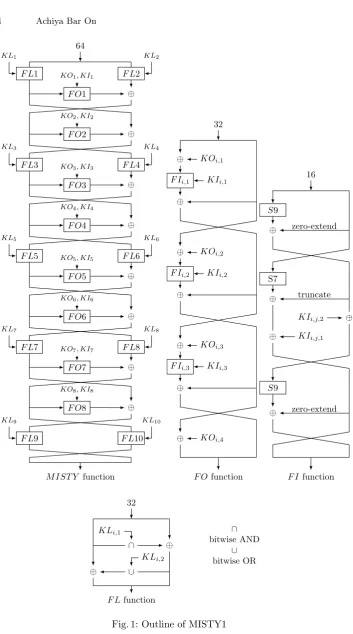
MISTY1 is an 8-round Feistel construction, where the round function,F O, is in itself a variant of a 3-round Feistel construction, defined as follows. The input toF Ois divided into two halves. The left one is XORed with a subkey, enters a keyed permutationF I, and the output is XORed with the right half. After the XOR, the two halves are swapped, and the same process (including the swap) is repeated two more times. After that, an additional swap and an XOR of the left half with a subkey is performed (see Figure 1).
64
F L1
KL1
F L2
KL2
⊕ F O1
KO1, KI1
⊕ F O2
KO2, KI2
F L3
KL3
F L4
KL4
⊕ F O3
KO3, KI3
⊕ F O4
KO4, KI4
F L5
KL5
F L6
KL6
⊕ F O5
KO5, KI5
⊕ F O6
KO6, KI6
F L7
KL7
F L8
KL8
⊕ F O7
KO7, KI7
⊕ F O8
KO8, KI8
F L9
KL9
F L10
KL10
M IST Y function
32
⊕ KOi,1
F Ii,1 KIi,1
⊕
⊕ KOi,2
F Ii,2 KIi,2
⊕
⊕ KOi,3
F Ii,3 KIi,3
⊕
⊕ KOi,4
F Ofunction
16 S9 ⊕ S7 ⊕ ⊕ KIi,j,2
⊕ KIi,j,1
S9
⊕
zero-extend
truncate
zero-extend
F I function
32
⊕
⊕
∩ KLi,1
∪ KLi,2
F Lfunction
∩
bitwise AND
∪
bitwise OR
Every two rounds, starting before the first one, each of the two 32-bit halves enters an F Llayer. TheF Llayer is a simple linear transformation. Its input is divided into two halves of 16 bits each, the AND of the left half with a subkey is XORed to the right half, and the OR of the updated right half with another subkey is XORed to the left half. We outline the structure of MISTY1 and its parts in Figure 1.
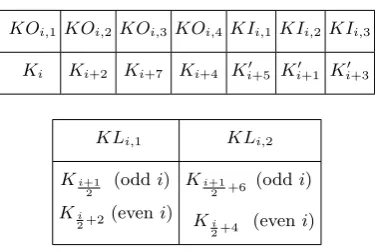
The key schedule of MISTY1 takes the 128-bit key, and treats it as eight 16-bit words K1, K2, . . . , K8. From this sequence of words, another sequence of
eight 16-bit words is generated, according to the ruleK0
i =F IKi+1(Ki). In each round, seven words are used as the round subkey, and each of theF L functions accepts two subkey words. We give the exact key schedule of MISTY1 in Table 2.
Table 2: The Key Schedule of MISTY1
KOi,1 KOi,2 KOi,3 KOi,4 KIi,1 KIi,2 KIi,3
Ki Ki+2 Ki+7 Ki+4 Ki0+5 Ki0+1 Ki0+3
KLi,1 KLi,2
Ki+1
2 (oddi)
Ki
2+2(eveni)
Ki+1
2 +6 (oddi)
Ki
2+4 (eveni)
2.1 Notations Used in the Paper
Throughout the paper, we use the following notations for intermediate values during the MISTY1 encryption process.
– The plaintext and the ciphertext are denoted, as usual, byP andC=E(P). – The input of the i’th round (1 ≤ i ≤ 8) is denoted by Xi. If we want to emphasize that the intermediate value corresponds to the plaintext P, we denote it byXi(P).
– For odd rounds, we denote byXi0the intermediate value after application of theF Lfunctions.
– The output of theF Ofunction of roundiis denoted Outi.
– For any intermediate valueZ,Z[k−l] denotes bits fromktol(inclusive) of Z.
3
Brief Description of the HOD attacks of Tsunoo et
al. [14, 13] on Reduced-Round MISTY1
In this section we present a brief description of the attacks of Tsunoo et al. [14, 13], that serve as the basis for our results.
3.1 General Outline of the Attack
The higher order differential attack was presented by Knudsen [7] in 1994 (see also [8]). The basic idea behind the attack is as follows.
Letf :{0,1}n
→ {0,1} be a Boolean function. Suppose that the degree off (as a multivariate polynomial) isdand thatV ⊆ {0,1}n is a vector subspace of dimensionk. Then it is easy to show that Equation (1) holds, independently of x.
M
y∈V
f(x⊕y) =
(
const ifk=d
0 ifk > d. (1)
Suppose now that for some block cipherE, the mapping from the plaintext to a single bit in some intermediate state, that is,Xi[j], can be represented by a (key-dependent) Boolean functionfK of a low degree. Then by Equation (1), we have
M
y∈V
Xi[j](x⊕y) =
(
const(K) ifk=d
0 ifk > d. (2)
Note that const(K) depends only on K and not on the choices of x and V. Equation (2) can be used to mount the following attack onE. Denote by E1−1 the Boolean function that represents the mapping from the ciphertext of E to the intermediate state bit Xi[j]. Then Equation (2) can be rewritten as
M
y∈V
E1−1(E(x⊕y)) =
(
const(K) if k=d
0 ifk > d. (3)
The adversary asks for the encryption of several structures of plaintexts of the form{x⊕y|y∈V}, wherexis arbitrary andV is an arbitrary vector subspace of degreed, partially decrypts the corresponding ciphertexts (by guessing the key material used in E1−1), and checks whether Equation (3) holds. The dimension dofV is calledthe order of the differential.
As guessing the key material used in E1−1 may be very time consuming,
various other techniques are used to approach Equation (3). The technique used in [14, 13] is linearization, which allows to exploit the low algebraic degree of a single MISTY1 round.
equation by replacing each non-linear expression in the key bits (e.g., k1·k2)
with a new variable. In such a way, Equation (3) for each structure of plaintexts contributes a linear equation, where the total amountmof variables is the num-ber of non-linear terms inf0. If the equations we obtain are independent (which is usually the case), mequations are sufficient for obtaining a unique solution. Every extra equation can be used as a filtering condition. Hence, if the amount of key bits used inE1−1 iss, thenm+sstructures are sufficient for determining
all of them.
In summary, the HOD attack of [14, 13] on MISTY1 consists of three stages. The first stage is detecting a HOD of order as small as possible that “predicts” a bit as close as possible to the ciphertext. The second stage is to create a system of linear equations by linearization of the corresponding functionE1−1. The third
stage is solving the equation system.
Before presenting the three stages in some more detail, we introduce a nota-tion that will be used throughout the paper to describe higher-order differentials of MISTY1.
Consider a partial encryption of MISTY1, which starts at the stateXj and ends at the stateXk, where we are interested only in the bitsXk[`−m]. Denote this encryption function byE0
K:Xj →Xk[`−m]. We denote byVX(dj)[i1,...id]Xk[`− m] the d’th order differential that starts in Xj, where V =span{ei1, . . . eid} is
the vector subspace of{0,1}64 spanned by the unit vectorse
i1, . . . eid. In other
words,
VX(d)
j[i1,...id]Xk[`−m] =
M
y∈span{ei1,...ein}
E0K(x⊕y).
3.2 A 44’th order differential for 4-round MISTY1
The 44’th order differential of 4-round MISTY1 found in [13] is a culmination of a series of observations.
The basic observation is a 7’th order differential of 3-round MISTY1 without F Lfunctions discovered by Babbage and Frisch [2].
Theorem 1. For any three consecutive rounds of MISTY1 without F L func-tions, the equation
VX(7)i[0−6]Xi+3[57−63] = 0x6d
holds, independently of the (fixed) value of the key and of the (constant) value of Xi[7−63].
As noted in [2], the theorem fails for MISTY1 withF L layers. In order to overcome this obstacle, Tsunoo et al. [14] suggested the notion of neighbor bit positions.
Tsunoo et al. showed that when we accompany each bit position in the 7’th order differential with its neighbor position, the resulting differential can bypass theF Llayers.
Theorem 3. For any three consecutive rounds of MISTY1 with F Lfunctions that start at an even round2j, the equation
VX2(14)j[0−6,16−22]X20j+3[57−63] = 0
holds, independently of the (fixed) value of the key and of the (constant) value of X2j[7−15,23−63].
Due to the Feistel structure of MISTY1, the 3-round 14’th order differential can be extended to a 4-round 46’th order differential by taking all the 232possible
values in the previous round. We obtain:
Theorem 4. For any four consecutive rounds of MISTY1 with F L functions that start at an odd round2j+ 1, the equation
VX2(46)j+1[0−31,32−38,48−54]X20j+5[57−63] = 0
holds, independently of the (fixed) value of the key and of the (constant) value of X2j+1[39−47,55−63].
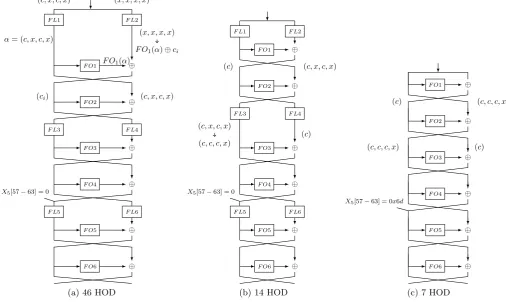
The 7’th, 14’th and 46’th order differentials are illustrated in Fig 2. The proof of the theorems can be found in [2, 14].
The last observation, made by Tsunoo et al. in [13], is that each of the 14’th order differentials for 3-round MISTY1 presented above contains 28 12’th order differentials that also can be shown to sum up to zero (due to a non-maximal algebraic degree of the underlying function). These are all possible differentials obtained by taking any six of the 7 bitsX2j[0−6], along with their neighbors. As some of these 12’th order differentials are linearly dependent, it turns out that only 22 of them can be used in parallel.
The observation of Tsunoo et al. in [13] allows to reduce the data and time complexities of the HOD attacks based on the 46’th round differential of 4-round MISTY1 by a factor of 22. Indeed, while in the previous attacks, each data structure of 246 plaintexts contributes a single linear equation, Tsunoo et
al.’s observation allows to use it to obtain 22 linearly independent equations (each coming from an extension by one round of a 12’th order differential). This obviously reduces the data complexity by a factor of 22, and if partial encryption/decryption of all the data is the most time consuming operation in the attack (as is the case for the attacks of [14], as we shall see below), the time complexity of the attacks is reduced by the same factor.
F L1 F L2
⊕ F O1
⊕ F O2
F L3 F L4
⊕ F O3
⊕ F O4
F L5 F L6
⊕ F O5
⊕ F O6
(c, x, c, x) (x, x, x, x)
α= (c, x, c, x) (x, x, x, x)
F O1(α)⊕ci
F O1(α)
(ci) (c, x, c, x)
X5[57−63] = 0
(a) 46 HOD
F L1 F L2
⊕ F O1
⊕ F O2
F L3 F L4
⊕ F O3
⊕ F O4
F L5 F L6
⊕ F O5
⊕ F O6
(c) (c, x, c, x)
(c) (c, x, c, x)
(c, c, c, x)
X5[57−63] = 0
(b) 14 HOD
⊕ F O1
⊕ F O2
⊕ F O3
⊕ F O4
⊕ F O5
⊕ F O6
(c) (c, c, c, x)
(c) (c, c, c, x)
X5[57−63] = 0x6d
(c) 7 HOD
The form (∗,∗,∗,∗) represents division of a 32-bit state into sets of (9,7,9,7) bits. Thex’s denote bit positions that are active in the differential. Thec’s denote “constant” bits. In Figure 2a, the symbolci, for 1≤i≤232, denotes a 32-bit value
that is constant for each sub-structure of size 214.
into several 11’th order differentials. While these differentials do not hold for MISTY1 withF Lfunctions, we show that they can be applied in a more sophis-ticated way, and result in a reduction in the data and time complexities of the attacks on 6-round MISTY1 by a factor of 5. As far as we checked, our results cannot be pushed further, in the sense that no other sub-differential of the 12’th order differential of [14] sums up to zero, even for 3-round MISTY1 withoutF L functions.
3.3 HOD attacks on 6-round and 7-round MISTY1
The attack of Tsunoo et al. [14] on 6-round MISTY1 uses the 46’th order differential illustrated in Figure 2a. The equation given by the differential is VP(46)[0−31,32−38,48−54]X5[57−63] = 0. In order to bypass the layerF L5, we note
that if one of the bits inKL5,2[9−15] is equal to 1, sayKL5,2[15] = 1, then by the
structure ofF L, we obtainVP(46)[0−31,32−38,48−54]X0
5[63] = 0, and similarly for the
other bits. Since for a vast majority of the keys, at least one bit ofKL5,2[9−15]
equals 1, we can repeat the attack 7 times, each time assuming that one of the bits equals 1, so that with an overwhelming probability the attack will succeed in one of the times.
Assume, w.l.o.g., that KL5,2[15] = 1, and hence, we have the
equa-tion VP(46)[0−31,32−38,48−54]X0
5[63] = 0. By the Feistel structure, it follows that VP(46)[0−31,32−38,48−54]X6[31] = 0. Note that X6[31] = F L7−1(C)[63]⊕Out6[31].
SinceF L7−1 acts as 16 parallel applications of a function from two bits to two
bits, F L7−1(C)[63] for all ciphertexts can be computed easily given a guess of
two key bits. Hence, all we need to do in order to check whether the differential is satisfied is to compute
M
y∈span{e0,e1,...,e38,e48,...,e54}
Out6[31](x⊕y).
It turns out that when we represent the bit Out6[31] as a function of X6L, its
degree as a multilinear polynomial is only 3, and moreover, many of the possible second and third degree terms do not appear. As a result, after the linearization of this function we obtain only 189 variables.1 Hence, 220 linear equations are
sufficient to filter out all wrong suggestions of the subkey used in round 6. As each structure of size 246 contributes 22 equations as described above, 10 structures,
or 249.4 chosen plaintexts are sufficient for the attack.
The time complexity of solving the equations (in all 7 attack attempts to-gether) is at most 7·2203= 226.2operations. As for the time required for creating
the linear equation, the most naive way is to consider the ciphertexts one by one 1 It should be noted that the number of variables depends on the exact bit inX6[25−
and check the contribution of each ciphertext to the equations. Even in this way, the time complexity of the attack is dominated by encrypting the plaintexts. (As we show in Section 4, this part can be performed very efficiently using the
partial sums technique). Hence, the attack requires 249.4 chosen plaintexts and
its time complexity is 249.4 encryptions.
The attack of Tsunoo et al. [14] on 7-round MISTY1 without the last F L layer is an easy extension of the 6-round attack. Most naively, one guesses all key material used in round 7, peels off the 7th round and applies the 6-round attack. As shown in [14], it is sufficient to guess 75 of the 96 key bits used in round 7, as the remaining key bits can be absorbed into the linear equations, at the price of slightly increasing the number of variables. In total, the data complexity is increased to 249.7 chosen plaintexts, and the time complexity is
249.4·275= 2116.4encryptions.
4
Improved Attack on 6-round MISTY1 Using a 43’th
Order Differential
In this section we show that the attack of Tsunoo et al. on 6-round MISTY1 can be improved by a factor of 5 in the data and time complexities, by using an improved higher-order differential, along with a refined key recovery technique. In order to find out whether the differential of Tsunoo et al. can be improved, we first examined the simpler variant of MISTY1 without theF Lfunctions and used an experimental approach. We considered the 12’th order differentials on 3-round MISTY1 used in [13], e.g., VX2(12)j[0−5,16−21]X20j+3[57−63], and checked
whether replacingV =span{e0, e1, . . . , e5, e16, . . . , e21}with any of its subspaces
of the formV0=span{e
i1, . . . eid} yields a higher-order differential. The
exper-iment was performed for all the options of 6 out the 7 bitsX2j[0−6] with their
neighbors. For each such choice of a 12’th order differential, several random keys and random constants were taken.
The experiments showed the existence of 11’th order differentials, of the form VX(11)
2j[S,S0]X 0
2j+3[57−63], whereSis any subset of [0−6] of size 6, andS0 consists
of 5 among the 6 neighbors of the elements ofS. It turns out that all differentials of this form are indeed 11’th order differentials for 3-round MISTY1 withoutF L functions. On the other hand, the experiment showed that all other subspaces V0 do not yield HODs, which implies that our improved differential cannot be improved further, unless entirely different HODs are used.
The obvious obstacle in exploiting the 11’th order differential is that it cannot bypassF Llayers. However, it turns out that we can overcome this obstacle, using a careful key guessing procedure that exploits the exact structure of the F L’s. We start with a 12’th order differential of 3-round MISTY1, like those used in [13] and show how to divide it into two 11’th order differentials. For sake of simplicity, we exemplify the process for the differentialVX2(12)[0−5,16−21]X0
5[57−63].
way that the corresponding structure after F L3 will beVX(11)0
3,L[0−5,16−20]. If this
is achieved, the continuation of the differential will hold like in the differentials found for MISTY1 without theF Lfunctions.
AsF Lacts like 16 2-bit to 2-bit invertible functions applied in parallel, it is clear that the structure inX2containsV =span{e0, e1, . . . , e4, e16, . . . , e20}, and
it is only left to determine which two of the four elements 0, e5, e21, e5⊕e21 we
should add. Now, we observe that there are only three possible pairs of elements (along with their complements), and one of them must lead to the desired form after theF L. Hence, it is sufficient to try 3 structures in X2 to ensure that the
HOD equation holds for one of them. Note that the structures we use are not standard HODs, as they do not correspond to an affine subspace.
In order to exploit all possible 11’th order differentials, we have to try 3 op-tions for each of the 6 pairs of neighbor bit posiop-tions (0,16),(1,17), . . . ,(5,22), and thus, to repeat the attack 36 times. As we show below, all the steps of
the attack can be performed very efficiently, such that even when they are re-peated 36 times, the overall time complexity is still dominated by encrypting
the plaintexts. We obtain 12 11’th order differentials, but due to linear depen-dence, we can use only 7 of them simultaneously. By using the same arguments (withF L3◦F L1 in place of F L3), we can divide the 44’th order differential of 4-round MISTY1 used in [13] into 12 43’th order differentials and use 7 of them simultaneously.
It is important to note that the “correct” structure in X2 depends only on
the secret key bits of theF L’s, and hence, is common toall structures. We also note that an alternative way to overcome theF Llayers is to guess the relevant subkey bits (e.g., bits KL3,1[5] andKL3,2[5] in the above example). However,
such a guess for all 6 relevant pairs of neighbor positions requires to repeat the attack 46 times if the 12’th order differential is used, and 166 times if the 44’th
order differential is used (as F L3◦F L1 has 4 key bits in each 2-bit to 2-bit function). Hence, our strategy of overcomingF Lis significantly more efficient.
Now, we consider the time complexity of the improved attack. The stage of solving the linear equation system requires now at most 7·2203
·36 = 235.6
operations, which is negligible compared to the time required for encrypting the plaintexts. We show now that the stage of constructing the linear equations can be also performed very efficiently, using thepartial sumstechnique.
We observe that the 188 coefficients of the linear equations (except for the constant coefficient) can be divided into two groups of 130 and 58 coefficients, such that the first group depends only on bitsX6[0−6] and their neighbors, and
the second group depends only on bits X6[7−15] and their neighbors. Such a
“separation” property of the MISTY1 round function was already used in [11, 12, 3]. As a result, we can compute these sets of coefficients separately.
Consider the computation of the 130 coefficients that depend only onX6[0−
L
y∈span{e0,e1,...,e38,e48,...,e54}
Out6[31](x⊕y) cancel each other. Hence, before
com-puting the contribution of each ciphertext to the coefficients, we can reduce the structure into a list of size 214 that represents the information on which of the
214possible values ofX
6[0−6,16−22] appears an odd number of times in the
structure. Furthermore, this reduction (or most of it, to be precise) can be per-formed before the guess of the exact structures in X2, and hence it has to be
performed only once for each structure. After the reduction is performed, we go over all 214 values in the list and collect their contributions to the coefficients
of the equations. (As shown in the next section, this part can also be performed more efficiently). The total time complexity of this step for each structure is
7·36·(130·214+ 58·218)243,
and hence, the overall time complexity is dominated by the encryption of the plaintexts.
Summarizing the attack, the data and time complexities of the attack are 247
chosen plaintexts and time, an improvement by a factor of 5 in both data and time complexities over the results of Tsunoo et al. (Note that the improvement is only by a factor of 5 and not by a factor of 7, since in order to exploit the structures optimally, we have to use “full” structures of size 246. Since a
single structure is not sufficient, we must use two structures, and thus, the data complexity is 247.)
5
Improved Attack on 7-round MISTY1 with 4
F L
Layers
In this section we describe an attack on 7-round MISTY1 with all F L layers except the last layer (F L9, F L10), that improves the attack presented in [14].
As the attack on 6-round MISTY1, our attack is based on the 46’th order differentialVP(46)[0−31,32−38,48−54]X6[25−31] = 0 and the attack equation derived
from it:
M
y∈span{e0,e1,...,e38,e48,...,e54}
Out6[31](x⊕y).
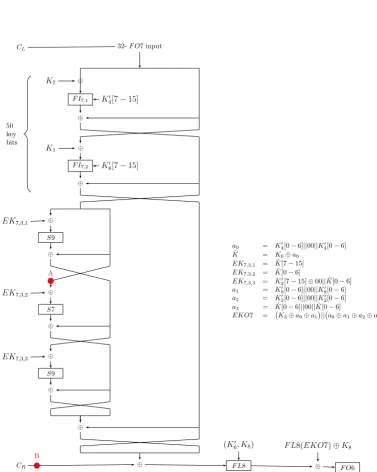
However, in the case of the 7-round MISTY1 we have to guess some key material before creating the linear system. Since the attack procedure is a bit complex, we illustrate it in Figure 3 which includes the order of the steps, as well as equivalent subkeys that we will use.
32-F O7 input
⊕
K7
F I7,1 K40[7−15]
⊕
⊕
K1
F I7,2 K80[7−15]
⊕
⊕
EK7,3,1
S9
⊕
⊕
EK7,3,2
S7
⊕
⊕
EK7,3,3
S9
⊕
⊕
⊕ CL
CR F L8
(K0
6, K8)
⊕
F L8(EKO7)⊕K8
F O6
A
B
50 key bits
a0 = K40[0−6]||00||K04[0−6]
˜
K = K6⊕a0
EK7,3,1 = K˜[7−15]
EK7,3,2 = K˜[0−6]
EK7,3,3 = K20[7−15]⊕00||K˜[0−6]
a1 = K80[0−6]||00||K08[0−6]
a2 = K20[0−6]||00||K02[0−6]
a3 = K˜[0−6]||00||K˜[0−6]
EKO7 = K3⊕a0⊕a1||a0⊕a1⊕a2⊕a3
Calculation of the coefficients related to the bits of X6[7−15]. The
procedure consists of several steps.
1. We guess the 50 key bits marked in the figure and decrypt all 244ciphertexts
through the first twoF Ilayers of round 7. At this stage, we note that if two intermediate values agree on 34 bit positions, which are the 16 bits of the input toF I7,3and the 18 bitsCR[7−15,23−31], then their contributions to
the sum L
y∈span{e0,e1,...,e38,e48,...,e54}
Out6[31](x⊕y) cancel each other. Hence,
as in the 6-round attack, we can reduce the list of ciphertexts into a list of size 234 that shows for each of the 234 values of these 34 bits, whether it
appears an odd number of times in the structure.
2. We guess 18 bits of EK7,3,1, EK7,3,3 and partially encrypt our list of 234
values through F I7,3. After this stage, we note that if two intermediate
values agree on 25 bits positions (7 bits in the input toS7 ofF I7,3, marked
byA, and 18 bits inCR, marked byB), then their contributions to the sum cancel out. Hence, we can further reduce the list to 225 values.
3. At this stage, when only one S7 (along with a 7-bit subkey) is left, we do not guess the remaining subkey, but rather represent the sum in the attack equation as a function of the current intermediate state and linearize this representation. The number of variables we obtain is 771≈29.6, and we can
compute the coefficients efficiently using precomputed tables of size 225 ·771 that store the contribution of each possible value of the 25 bits to the 771 coefficients.
4. We guess the 7 key bits ofEK7,3,2and reduce the number of variables to 153.
(Note that the number of variables is much higher than 58. This happens since when we guess part of the key after we constructed the equations, we cannot unify linearly dependent variables, and thus, the total number of variables is increased). This reduction can be performed by direct calculation in time complexity of 29.6·153 for each key guess.
We note that guessing the key of the secondS9 inF I7,3 can be done in time
complexity of 25 (instead of 29) by a somewhat complex procedure described in
the full version of the paper. Combining all parts of the algorithm together, the time complexity of this part is
TX6[7−15] = 250·244+ 250+9·234+ 250+9+5·234
+268·225·2 9.6
26 ·7 + 2 75
·29.5·153 = 294+ 293+ 298+ 299.4+ 292.3 ≈299.9
operations.
Calculation of the coefficients related to the bitsX6[0−6]. In this case,
1. We guess the 50 key bits marked in the figure and partially decrypt all 244
ciphertexts through the first twoF Ifunctions of round 7 (like in the previous case). At this point, if two intermediate values agree on 30 bit positions, which are the 16 bits of the input toF I7,3and the 14 bitsCR[0−6,16−22],
then their contributions to the sum cancel each other. Thus, we can reduce the data to a list of length 230.
2. We guess the 16 bits ofEK7,3,1, EK7,3,2, and reduce the data list to a size
of 223, and then guess the 9 bits ofEK
7,3,3 and further reduce the list to
only 214values.
3. We calculate the 130 coefficients of the linear equation using precomputed tables of size 214·130.
The time complexity for this part is
TX6[0−6]= 250·244+ 250+16·230+ 266+9·223+ 274·214·
130 26 ·7 ≈294+ 296+ 298+ 293.8≈298.5
operations.
Combining the calculations. By combining the sets of coefficients computed in the two calculations described above, we create a system of linear equations. Since we guess 75 key bits overall, we have 7·275 linear systems to create and
solve. The maximum number of variables for each system is 130 + 153 = 283. To filter out wrong keys and add a safety factor, we take 283 + 75 + 10≈ 28.55 structures of 44’th order differentials. As each structure corresponding to
a 46’th order differential contains 22 structures of 44’th order differentials, we need 283+75+1022 ≈17 ≈ 24.1 structures of 46’th order differentials to complete
the attack. (Note that in this attack we cannot use our improved 43’th order differentials, since repeating the attack several times (as required for them) would increase the time complexity.) Thus, the total data complexity isD= 24.1·246=
250.1.
The time complexity is composed from encryption of the required data, cre-ation of the linear systems and their solution. The time required for encryption of the data is negligible. The time of creation the linear systems is
28.55·(TX6[7−15]+TX6[0−6])≈28.55·2100.3= 2108.85.
The time of solving the 275 linear systems is 275·(28.55)3≈2100.65 operations.
Hence, the total time complexity of the attack is T = 2108.85+ 2100.65≈2108.85
simple operations. Assuming that each round of MISTY1 encryption is com-parable to 50 simple operations like was assumed in [14], the time complexity is
T =2
108.85
7·50 ≈2
100.4
6
New Attack on 7-round MISTY1 with All
F L
Layers
Present
In this section we describe an attack on 7-round MISTY1 with allF Lfunctions, which is the first attack on this variant that is significantly faster than exhaus-tive key search. The attack uses the same 44’th order differential and the same same division into two types of linear coefficients like the attack presented in Section 5. However, in order to handle the 64 subkey bits that are added in this variant, we must perform a more careful procedure, that also takes into consid-eration the exact MISTY1 key schedule. As in the previous attack, we describe the calculations made for a single structure that corresponds to a 44’th order differential. The reference figure to this attack is Figure 4.
Calculation of the coefficients related to the bits of X6[7−15]. The
procedure consists of several steps.
1. We guess the 57 key bits of K1, K7, K8, K40[7−15] and partially decrypt all
244ciphertexts throughF L10 and the first twoF I functions of round 7. At
this stage, we can reduce the data to a list of length 243(the 43 relevant bits
correspond to 18 bits inCR, 9 bits in the point B and the 16-bit input to F I7,3).
2. We guess the 9 bits ofEK7,3,1. After this guess, the size of the list remains
243 as before, but now the 43 bits correspond to 18 bits in CR, 9 bits in B
and all bits ofA.
3. At this point, we perform linearization. Due to the amount of key material which we haven’t guessed yet, the maximal possible number of variables is 2713 ≈ 211.4. Using directly a precomputed table for computing the
coef-ficients requires a table of size 243·211.4. Instead of this table, we will use
three smaller tables. We note that out of the 2713 coefficients, there are 2269 coefficients in which only the bits ofA, B and CR[7−15] are involved and 424 coefficients in which only the bits inA, B andCR[24−31] are involved. Only 20 variables are left which depend on all the 43 bits. Hence, we can use for the computation three smaller tables of sizes 234
·2269,234 ·424, and 243
·20. Hence, the memory complexity required for the linearization is 234
·2269 + 234
·424 + 243
·20≈247.66.
4. We guess the 16 + 9 key bits ofEK7,3,2, EK7,3,3 andK30[7−15]. Using the
guessed key bits, and the fact thatK8 andKL8 are known, we can reduce
the number of variables. (As in Section 5, guessing the key at this point forces us to not unify linearly dependent variables.) The number of the new variables is only 213. This transformation is done by a direct calculation in time complexity of 211.4·213 for each key guess (there is 291guesses at this
point).
32-F O7 input
⊕
K7
F I7,1 K40[7−15]
⊕
⊕
K1
F I7,2 K80
⊕
⊕
EK7,3,1
S9
⊕
⊕
EK7,3,2
S7
⊕
⊕
EK7,3,3
S9
⊕
⊕
⊕ F L10
(K0
7, K1)
CL
F L9
(K5, K03)
CR F L8
(K0
6, K8)
⊕
F L8(EKO7)⊕K8
F O6
A B
C
a0 = K40[0−6]||00||K40[0−6]
˜
K = K6⊕a0
EK7,3,1 = K˜[7−15]
EK7,3,2 = K˜[0−6]
EK7,3,3 = K20[7−15]⊕00||K˜[0−6]
a1 = K20[0−6]||00||K20[0−6]
a2 = K˜[0−6]||00||K˜[0−6]
EKO7 = K3⊕a0
||a0⊕a1⊕a2
TX6[7−15] = 257·244+ 257+9·243+ 266·243·
211.4
26 ·7 + 2 91
·211.4·213 = 2101+ 2109+ 2117.2+ 2110.14
≈2117.22 operations.
Calculation of the coefficients related to the bitsX6[0−6]. In this case,
the procedure is simpler:
1. We guess the 57 key bits of K1, K7, K8, K40[7−15] and partially decrypt all
the 244ciphertexts throughF L10 and the first twoF I layers of round 7. At
this stage, the data can be reduced to a list of size 237, where the 37 bits are
14 bits ofCR, 7 bits inB and the input toF I7,3.
2. We guess the 25 bits ofEK7,3,i i= 1,2,3. After this guess, the size of the list is reduced to 228, which corresponds to 14 bits in C
R (after F L9) and
14 bits beforeF L9.
3. At this point we perform linearization. The maximum number of variables is 684≈29.42. We calculate them using a precomputed table of size 228
·684. The time complexity for this part is
TX6[0−6] = 257·244+ 257+25·237+ 282·228·
29.42
26 ·7 ≈2101+ 2119+ 2116.22≈2119.2
operations.
Combining the calculations. We create the system of linear equations using the two previous calculations. We have 7·291linear systems to create and solve.
The maximum number of variable for each system is 213 + 684 = 897. (Note that this time, the number of variables is significantly larger than in the previous attacks, due to the amount of key material which we absorb into the equations.) To filter out wrong keys and add a safety factor, we take 897 + 91 + 10≈ 29.97 structures that correspond to 44’th order differentials. Therefore, we need
897+91+10
22 ≈ 43.6 ≈ 2
5.45 structures of 46’th order differentials, which means
that the total data complexity is
D= 25.45·246= 251.45.
The time complexity is composed from encryption of the required data, cre-ation of linear systems and their solution. The time of data encryption is negli-gible. The time of creation the linear systems is 29.97·(T
X6[7−15]+TX6[0−6])≈
291
·(29.97)3
≈2120.91operations. The total time complexity is thusT = 2129.53+
2120.91
≈2129.53 simple operations. Assuming that each round of MISTY1
en-cryption is comparable to 50 simple operations, the time complexity is
T =2
129.53
7·50 ≈2
121
7-round encryptions.
7
Summary and Conclusions
In this paper we investigated higher-order differential attacks on MISTY1. We improved the 44’th order differential used in the best previously known attack of Tsunoo et al. [13] into a 43’th order differential, and used it to reduce the data and time complexities of the best known attack on 6-round MISTY1 from 249.3
to 246.5. We gave evidence that our 43’th order differential cannot be further
improved using current techniques.
We also considered the best known higher-order differential attacks on 7-round MISTY1, also by Tsunoo et al. We showed that by using the partial sums technique and other techniques, the time complexity of the attack can be reduced from 2116.4to 2100.4– a reduction by a factor of 216. Finally, we presented
an attack on 7-round MISTY with allF Lfunctions present that requires 251.5
chosen plaintexts and 2121encryptions. This is the first known attack on a variant
of MISTY1 with allF Llayers.
As a problem for further research, it will be interesting to find out whether our techniques can be used also to improve higher-order differential attacks on KASUMI. It seems that the case of KASUMI will be harder, due to the higher algebraic degree of the modified F I function KASUMI uses.
References
1. 3rd Generation Partnership Project. Specification of the 3GPP Confidentiality and Integrity Algorithms - Document 2: KASUMI Specification (Release 6). Technical Report 3GPP TS 35.202 V6.1.0 (2005-09), September 2005.
2. Steve Babbage and Laurent Frisch. On MISTY1 higher order differential cryptanal-ysis. In Information Security and Cryptology - ICISC 2000, Third International Conference, Seoul, Korea, December 8-9, 2000, Proceedings, pages 22–36, 2000. 3. Orr Dunkelman and Nathan Keller. Practical-time attacks against reduced variants
of MISTY1. IACR Cryptology ePrint Archive, 2013:431, 2013.
4. Niels Ferguson, John Kelsey, Stefan Lucks, Bruce Schneier, Michael Stay, David Wagner, and Doug Whiting. Improved cryptanalysis of rijndael. InFSE’00, pages 213–230, 2000.
6. Keting Jia, Hongbo Yu, and Xiaoyun Wang. A meet-in-the-middle attack on the full kasumi. IACR Cryptology ePrint Archive, 2011:466, 2011.
7. Lars R. Knudsen. Truncated and higher order differentials. In Bart Preneel, editor, FSE, volume 1008 ofLecture Notes in Computer Science, pages 196–211. Springer, 1994.
8. Xuejia Lai. Higher Order Derivatives and Differential Cryptanalysis. In Richard E. Blahut, Daniel J. Costello Jr, Ueli Maurer, and Thomas Mittelholzer, editors, Com-munications and Cryptography, volume 276 ofThe International Series in Engi-neering and Computer Science, pages 227–233. Spinger, 1994.
9. Jiqiang Lu, Wun-She Yap, and Yongzhuang Wei. Weak keys of the full misty1 block cipher for related-key differential cryptanalysis. In Proceedings of the 13th International Conference on Topics in Cryptology, CT-RSA’13, pages 389–404, Berlin, Heidelberg, 2013. Springer-Verlag.
10. Mitsuru Matsui. New block encryption algorithm MISTY. InFast Software En-cryption, 4th International Workshop, FSE ’97, Haifa, Israel, January 20-22, 1997, Proceedings, pages 54–68, 1997.
11. Kouichi Sakurai and Yuliang Zheng. On non-pseudorandomness from block ci-phers with provable immunity against linear cryptanalysis. In Proceedings of AAECC 1999, Lecture Notes in Computer Science 1719, pages 19–24. Springer-Verlag, 1999.
12. Xiaorui Sun and Xuejia Lai. Improved integral attacks on MISTY1. In Michael J. Jacobson Jr., Vincent Rijmen, and Reihaneh Safavi-Naini, editors,Selected Areas in Cryptography, Lecture Notes in Computer Science, pages 266–280. Springer. 13. Yukiyasu Tsunoo, Teruo Saito, Takeshi Kawabata, and Hirokatsu Nakagawa.
Find-ing higher order differentials of misty1. IEICE Transactions, 95-A(6):1049–1055, 2012.
14. Yukiyasu Tsunoo, Teruo Saito, Maki Shigeri, and Takeshi Kawabata. Higher or-der differential attacks on reduced-round MISTY1. In Information Security and Cryptology - ICISC 2008, 11th International Conference, Seoul, Korea, December 3-5, 2008, Revised Selected Papers, pages 415–431, 2008.