Volume 7, No. 5, September-October 2016
International Journal of Advanced Research in Computer Science
RESEARCH PAPERAvailable Online at www.ijarcs.info
AN
INTEGRATED
APPROACH
OF
MULTI-CRITERIA
GROUP
DECISION
MAKING
TECHNIQUES
TO
EVALUATE
THE
OVERALL
PERFORMANCE
OF
TEACHERS
Sukarna Dey Mondal* Department of Mathematics
Dr. B.C Roy Engineering College, Jemua Road, Fuljhore, Durgapur-713206
West Bengal, India
Dipendranath Ghosh Department of Mathematics
Dr. B.C Roy Engineering College, Jemua Road, Fuljhore, Durgapur-713206
West Bengal, India
Abstract: Teaching is not just an act of intelligence; it is a legacy of association, legacy of effort, legacy of priority and legacy of moral and ethical standards. A person is nurtured by his parents since his birth, school mates, society and others. It is very essential for an education institution to focus on the realistic insight of a student. The very essence to comprehend purely depends on the basis of how a teacher imprints the impact of learning into an understandable status for a student. To be a teacher, knowledge of a sphere is not only the requirement for representation, but also a supporting plan for an individual to remain in the sphere of learning. Continued learning is the key tool for teachers, since updating the knowledge has to be the basic criterion for a teacher to discover his/her credibility. So, higher education learning institutions and the government in particular, has increasingly wanted to be assured of the quality in overall performances of a teacher. In getting this assurance, universities, therefore have to produce tangible evidence of the quality of teachers they provide. Analysing the performance of a teacher is an important part of education system. It plays a crucial role in improving overall qualities and arousing enthusiasm of the teacher. Therefore it is one of the great implication to design a new mathematical model to analyze the performance of a teacher based on the existing information system. In this paper a study has been made by using multi-criteria decision making with the help of six methodologies containing AHP, Fuzzy AHP, COPRAS, TOPSIS, Cooperative Game Theory and Compromise Programming. Several expert opinions are considered to compare between the teachers and at last determines the rank using group decision making method.
Keywords: AHP, Fuzzy AHP, COPRAS, TOPSIS, Cooperative Game Theory, Compromise Programming, Spearman’s Rank Correlation
Coefficient and Group Decision Making .
I. INTRODUCTION
Agrell and Steuer [1] developed a multi-criteria decision support system for the performance review of individual faculty. They proposed a multi criteria evaluation system for individual faculty member’s performance. Mesak and Jauch [2], developed a model by which college and university administrators might evaluate performances of major components of a faculty work, i.e., research, teaching, and service. Ellington and Ross [3] proposed a teaching evaluation scheme to assess the university teachers in the Robert Gordon University. This scheme was based on a teaching skills profile that enables academic staff to undertake self-rating in respect of a set of basic criteria for effective performance in teaching and related activities.
The report of the National Accreditation and Assessment Council (NAAC, 2008), shows that only 30 percent of universities and 10 percent of the colleges are with ‘A’ grade or “Five star” institutions and the rest are tolerable or poor. Maintaining and improving quality of higher education is a great challenge in India (Muzammil.M, 2010). Performance linked development system having validity and reliability will be a key factor for quality assurance and quality sustainability in engineering colleges. The performance appraisal system plays a major role in retaining quality faculty in the institution (Pandit, R.K. 2008). Enrichment of overall academic and research standards of Higher Educational Institutions can be
achieved through changes in Performance Appraisal practices [4].
methodology to evaluate the ranking of best engineering college and evaluation of performance of faculty in engineering college and [11, 12]. Compromise Programming (CP) and Cooperative Game Theory (CGT) both defines the best/suitable solution whose point is at the least from an ideal point (Zeleny, 1982; Gershon and duckstein et al., 1983; Duckstein et al., 1994).
The paper is equipped as follows: Section II emphases about the Experts’ opinion, Section III focuses about MCDM techniques using six methodologies for ranking the interview candidates on the basis of several experts’ judgment followed by the comparison between the results, Section IV illustrates the final ranking by group decision analysis method and Section V concludes the paper.
II. EXPERTS’ OPINION
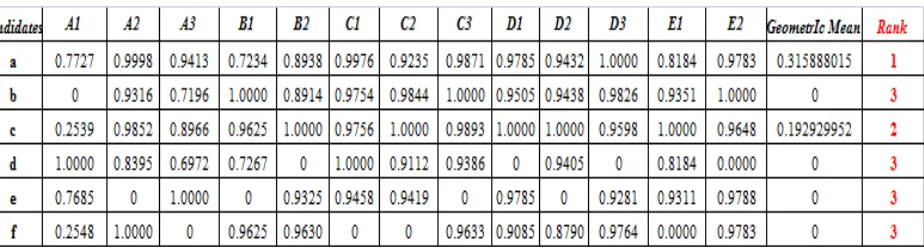
In this research, the proposed method is applied to analyze the performance of a teacher of an educational institution. Six teachers were examined and randomly selected for the present study. A preliminary literature survey was carried out to identify the criterias and sub criterias. To shortlist the criterias and sub criterias another survey was conducted among Experts’ (X,Y), in this field for adding/removing of
criterias and sub-criterias. The identified of criterias and sub-criterias are listed below
Criterias: A. Qualification
B. Knowledge of Subject
C. Leadership and managing power D. Research and Project production E. Past Experience
Sub Criterias: A1. Ph.D completed A2. Ph.D Pursuing A3. Non Ph.D B1. Theoretical B2. Practical
C1. Communication Skill C2. Self Development C3. Mental Stress D1. Achievement D2. Project Guidance
D3. Periodic arrangement of seminar and workshop E1. Academic
E2. Industry
Table I. Experts’ opinion against each candidate
III. TECHNIQUES USED & PROPOSED METHODOLOGY
A. AHP
In literature review we have seen that there are several MCDM techniques in evaluating influencing factors. In this study, we have chosen the evaluation process of influencing factors based on AHP. Analytical Hierarchy Process (AHP) is used to calculate the relative importance between the criterion based on expert opinion with the help of Saaty’s 9-point linear scale and the detailed steps of AHP was described in our previous work named as “Non-Teaching Staff Performance Analysis Using Multi-Criteria Group Decision Making Approach” [13].
B. Fuzzy AHP
Saaty’s AHP method was modified by introducing the fuzzy analysis (i.e. Fuzzy AHP) by Chang’s in 1992 [14] and the main drawback of Chang’s extent analysis is that the degree of possibility of some criteria was zero. To overcome this problem, Hesham A and et.al. used Gaussian
fuzzy number persist of triangular fuzzy number [15] Gaussian functions have the advantage of being fully determined using only two parameters, i.e. center (µ) and width ( ) and its value never equals to zero. Thus, the intersection must be existed between every fuzzy number and all the others. In this case, shortages of the triangular fuzzy number are overcome. We modified the steps of Hesham’s Gaussian extent to calculate the relative importance between criteria with the help of the following steps of Figure II.
The definition of Gaussian function is as follows:
Gaussian (x:
At any level , as in Fig.1, it is shown that
x1 = and
x2 =
an approximation is useful for performing the fuzzy arithmetic operations to get Si as shown below
Si =
[image:3.612.84.259.66.293.2]
i j j i j i j i j j i j i j i i j ij j ijN
M
L
N
M
L
G
G
)
,
,
(
)
,
,
(
where and 1Figure I. Gaussian function A and its approximated triangle B.
To get good triangular approximation, we choose a low level for . Once, we get Si’s as triangle fuzzy numbers,
they can be returned back to Gaussian to present the ranking step.
Several MCDM methods like TOPSIS, COPRAS and Compromise Programming are used in our proposed methodology. The detailed steps of TOPSIS, COPRAS and Compromise Programming are described in our same previous published research work “Non-Teaching Staff Performance Analysis Using Multi-Criteria Group Decision Making Approach” [13].
C. Co-operative Game Theory
Co-operative Game Theory (CGT) is another distance-based approach. In this approach the best suitable alternative is that which maximizes the distance from some reference point of minimum level rather than minimizing the distance to a goal (Gershon and Duckstein, 1983). The distance measure used in CGT is the geometric distance and expressed as
j W J
j
j
j
a
f
f
a
g
1 * *)
(
)
(
,where
g
(
a
)
= Geometric distance for alternative ,is negative ideal value of criterion j.
The detailed steps of Co-operative Game Theory are described by the following proposed methodology.
With the help of above techniques, finally Spearman correlation and coefficient ranking method to determine group decision multi criteria analysis we propose a new technique which provides the perfect result in every case.
D. Spearman rank correlation coefficient
Spearman rank correlation coefficient
is useful to determine the measure of association/correlation (includingpositive or negative direction of a relationship) between ranks achieved by different MCDM methods and/or different decision-makers and/or different scenarios for a given set of alternatives. If
U
aandV
a denote the ranks achieved by above situation(s) for the same alternative a, then
is defined as [14] :n
n
d
n a a
3 1 26
1
Where da = difference between ranks
U
aandV
aachievedby the same alternative ,
n = number of alternatives and
1
1
.
Various critical values for Spearman rank correlation coefficient for various significance level is provided in [15]. Numerous case studies have used the Spearman rank correlation method for computation of correlation coefficient values [16].
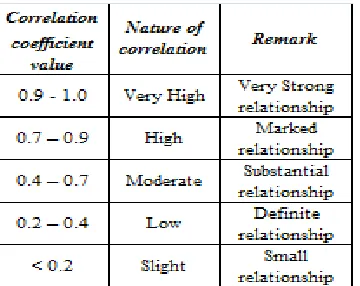
Characteristics of correlation coefficient can be explained in Table II. as:
Table II. Characteristics of Co-efficient R
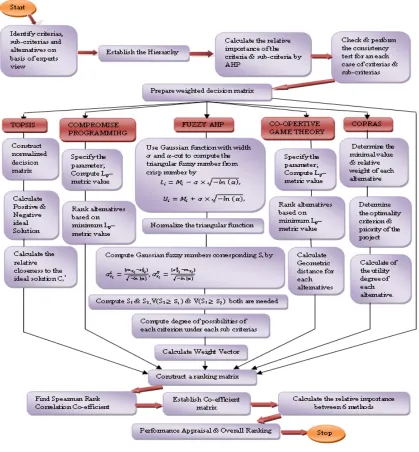
Our proposed methodology is described in the following Figure II.
IV. RESULTS & DISCUSSION
After using the opinions which are collected by the experts we prepare pay-off matrix and calculate the weights of the attribute by AHP which is shown in Table III.
[image:3.612.328.508.336.479.2]Figure II. Proposed Methodology.
Table IV. Ranking of candidates in Fuzzy AHP method
[image:5.612.64.273.350.453.2]The input of TOPSIS is the weighted normalized matrix which is obtained from AHP (Table III). Calculate the relative closeness to the ideal solution, rank the alternatives according to ideal solution values in descending order in the following Table V.
Table V. Ranking of candidates in TOPSIS method.
In COPRAS, Calculate weighted normalized decision matrix using the Table III. The influence of maximizing and minimizing criteria on the evaluation result is considered separately. This method presented here, uses a
stepwise ranking and evaluating procedure of the alternatives in terms of significance and utility degree which is shown below in Table VI.
Table VI. Ranking of candidates in COPRAS method.
In Compromise Programming specify the parameter;
compute Lp–metric value from Table III. Rank alternatives
based on minimum Lp –metric value which is presented in
Table VII.
Table VII. Ranking of candidates in Compromise Programming method
Compute Lp–metric value from Table III using Co-operative
Game Theory (CGT).The best suitable alternative is that which maximizes the distance from some reference point of
[image:5.612.63.542.545.648.2]Table VIII. Ranking of candidates in Co-operative Game Theory method
Ranking of alternatives in different method are shown in Table IX.
Spearman Co-relation Co-efficient between the methods are shown in Table X.
[image:6.612.325.570.244.364.2]Calculate the relative closeness between the methods. Finally determine the Ranking of the methods according to Spearman Correlation Coefficient are shown in the Table XI.
Table IX. Ranking of different methods.
Table X. Correlation Coefficient Ranking by Spearman.
It is noted from Table IX that different techniques provide different ranking for the same set of problems which is the main drawback of MCDM methods. To overcome these, a group decision making method is implemented to get a single ranking structure.
After getting ultimate ranking of six methods according to Spearman Correlation Coefficient in Table XI, it is very clear that Compromise Programming is more suitable method to evaluate the proper ranking of teacher with respect to their overall performance as compared to rest of techniques.
V. CONCLUSIONS
The creation and perfection of teaching evaluation system is a very important part of teaching work in recent years. In this paper, a new scientific model is proposed to evaluate teachers’ overall performance. It is a superior method that enables the attribute-based aggregation for heterogeneous group of experts.
Each method has some advantages and disadvantages that affect the results of rating.
A. Advantages
In this proposed model according to Hesham A and et.al. we introduce Gaussian Fuzzy Number instead of triangular fuzzy number to overcome the drawback of Chang’s Extent Analysis.
This proposed work eradicates the main drawback of multi-criteria decision analysis that is different multi multi-criteria methods present different ranking for the same problem with same multiple attributes and same multiple alternatives although same decision maker.
In this model Spearman correlation coefficient methods are used to find the relative closeness between the different MCDM methods and the result of this work shows that the new model is scientifically and mathematically error free and generate accurate outcome in every time.
In final ranking it can be concluded that six methods share a strong, marked, substantial and definite relationship between them respectively as established by Spearman Rank Correlation Method. From Table XI, the final values are slightly differ from each other. That’s why, we can also utilize rest of 5 existing methods to evaluate the performance of teachers.
B. Disadvantages
The restrictions of the study are shown in the first stage of the methodology that is data collection. The accuracy and
exactness of data collected may not be sent percent. Here the number of experts’ opinions for ranking of the criterias/sub criterias, alternatives is very few. Though in such a study, no minimum number fixed, we feel that a sample of 50-70 would have been better.
The presented method concludes that there is no suspicion about the 4th, 5th & 6th positions taken byteacher f, teacher
d and teacher e respectively but teacher a, teacher b and teacher c all are strong contenders for the best position. Teacher a and teacher b, in spite of having a very strong Academic Qualification, industry experience and Periodically arrange seminar and workshop are not chosen as the best choice as they are extensively weak in Knowledge of subject, Communication skill, Self development, Mental stress and Research & Project production than teacher c. In comparison to this, which although has comparatively not so strong Academic Qualification, industry experience and Periodically arrange seminar and workshop but are very strong in depth of Knowledge, Communication skill, Self development, Mental stress and Research & Project production which are more essential criterias in an educational institution than others. Hence, teacher c is the best choice for his/her performance in an educational institution.
Finally this article introduces an approach that integrates AHP with Fuzzy AHP, TOPSIS, COPRAS, Compromise Programming and Cooperative Game Theory algorithm to sustain teachers’ performance evaluation decisions.
VI. ACKNOWLEDGMENT
We would like to thank our guide, Dr. Dipendranath Ghosh for his never-ending support in helping us to build up this and letting us follow our vision.
VII. REFERENCES
[1] P. J. Agrell, R. E. Steuer, “ACADEA-A decisionsupport system for faculty performance reviews,” Journal of Multi-Criteria decision analysis, 9, pp. 191-204, 2000. [2] H.I. Mesak, and L.R. Jauch, “Faculty performance evaluation: modeling to improve personnel decisions,” Decision Sciences, Vol. 222, pp. 1142-1157, 1991. [3] H. Ellington, and G. Ross, “Evaluating teachingquality throughout a university: A practical scheme based on self-assessment,” Quality Assurance in Education, Vol.2,No. 2, pp. 4-9, 1994.
AMET Journal of Management July – Dec 2011.
[5] T. L. Saaty, The Analytic Hierarchy Process, McGraw- Hill, New York, 1980.
[6] T. L. Saaty,"Priority Setting in Complex Problems," IEEE Transactions on Engineering Management, Vol.30, No.3, pp.140- 155, 1983.
[7] Debmallya Chatterjee and Dr.Bani Mukherjee, “Study of Fuzzy-Ahp Model To Search The Criterion In The Evaluation Of The Best Technical Institutions: A Case Study”, International Journal of Engineering Science and Technology, Vol. 2(7), 2010, 2499-2510.
[8] Pin-Chang Chen, “A Fuzzy Multiple Criteria Decision Making Model in Employee Recruitment”, IJCSNS International Journal of Computer Science and Network Security, VOL.9 No.7, pp:113-117, July 2009.
[9] P. Kousalya, V. Ravindranath, and K. Vizayakumar, “Student Absenteeism in Engineering Colleges: Evaluation of Alternatives Using AHP”, Journal of Applied Mathematics & Decision Sciences, Vol. 2006, Article ID 58232, Pages 1–26.
[10] C.L. Hwang, K. Yoon, “Multiple Attribute Decision Making Methods and Applications”, Springer, Berlin Heidelberg, 1981.
[11] D.N.Ghosh, “Analytic Hierarchy Process & TOPSIS Method to Evaluate Faculty Performance in
Engineering Education”, UNIASCIT, VOL 1, NO. 2, pp: 63-70, 2011
[12] SonuRana, Pabitra Kumar Dey&DipendraNath Ghosh, “Best Engineering College Selection Through Fuzzy Multi- Criteria Decision Making Approach:A Case Study”,UNIASCIT, Vol 2(2), 2012,246-256. [13] Sukarna Dey and DipendraNath Ghosh “ Non- Teaching Staff Performance Analysis Using Multi- Criteria Group Decision Making Approach” International Journal of Education and Learning Vol.4, No.2 (2015), pp.35-50.
[14] C. Spearman, The Proof and Management of Association Between Two Things, American Journal of Psychology, 15, pp. 72-101 (1904).
[15] G. Woodbury, Introduction to Statistics , Thomson Learning, USA (2002).
[16] K.S. Raju, and D. Nagesh Kumar, Multi-criterion Decision-Making in Irrigation Planning, Agricultural Systems, 62(2), pp. 117- 129 (1999).
[17] Hefny, H.A., Elsayed, H.M., Aly, H.F., “Fuzzy multi- criteria decision making model for different scenarios of electrical power generation in Egypt”, Egyptian
Informatics Journal (2013) Vol. 14, pp.125–133, 2013. [18] Chang D. Extent analysis and synthetic decision. Optimization techniques and applications,
vol.1.Singapore: World Scientific;1992, p. 352.
[19] Pabitra Kumar Dey, Saindhab Chattaraj and Dipendra Nath Ghosh,”Faculty Selection in Engineering
Organization using AHP & TOPSIS”, International Journal of Information and Computing Science (IJICS) 06/2012; 15(1),(2012)
[20] Dipendra Nath Ghosh,”Analytic Hierarchy Process & TOPSIS Method to Evaluate Faculty Performance in Engineering Education”, UNIASCIT, Vol. 1(2), 2011, 63-70 (2011).
[21] Hesham A. Hefny , Hamed M. Elsayed , Hisham F. Aly ” Fuzzy multi-criteria decision making model for different scenarios of electrical power generation in Egypt” Egyptian Informatics Journal (2013) 14, 125– 133.
[22] Pabitra Kumar Dey, Dipendra Nath Ghosh, Abhoy Chand Mondal “Modified Group Decision Algorithm for Performance Appraisal of Indian Premier League Cricketers” WSEAS TRANSACTIONS on INFORMATION SCIENCE and APPLICATIONS, Issue 10, Volume 10, October 2013.
[23] Dr. Manas Kumar Sanyal, Abhijit Pramanik “Assessment of Influencing Factors in West Bengal Engineering Colleges by Analytical Hierarchy Process and Evaluations of Proposed Alternatives” IRACST- International Journal of Research in Management & Technology (IJRMT), ISSN: 2249-9563.
[24] Pabitra Kumar Dey, Dipendra Nath Ghosh, Abhoy Chand Mondal “IPL Team Performance Analysis: A Multi-Criteria Group Decision Approach in Fuzzy Environment”, I.J. Information Technology and Computer Science, 2015, 08, 8-15.
[25] J. Ch. Pomerol and S. B. Romero, “Multicriterion Decision in Management: Principles and Practice”, Kluwer Academic, Netherlands, (2000).
[26] K. S. Raju and D. Nagesh Kumar, “Multi-criterion Decision-Making in Irrigation Planning”, Agricultural Systems, vol. 62, no. 2, (1999), pp. 117-129.
[27] P. H. Liu and C. C. Wei, “A Group Decision-Making Method for Appraising the Performance of