Volume 6, No. 1, Jan-Feb 2015
International Journal of Advanced Research in Computer Science
RESEARCH PAPER
Available Online at www.ijarcs.info
ISSN No. 0976-5697
Substitutive Wavelet Based Image Fusion using Improved Nonlinear IHS Transform
Mahesh P. Chakkarwar
M. Tech. Scholar GCOE, Amravati, IndiaProf. A. V. Deorankar
Head of Information TechnologyGCOE, Amravati, India
Prof.Vrushali A. Chakkarwar
Assistant Professor GCOE, Aurangabad, IndiaAbstract: Satellite with different sensors generates images with different characteristics such as, images with spatial resolution such as panchromatic (PAN) images and images with high spectral resolution such as multispectral (MS) images. But for feature extraction, land cover analysis etc. requires images with high spatial and spectral characteristics. Several image fusion methods have been discovered, but each of the methods generates gamut problem. In this paper gamut problem is analyzed visually, a new model improved nonlinear IHS model is used to solve the gamut problem. This model solves gamut problem occurred during image fusion. While image fusion using improved nonlinear IHS transformation, it shows good special resolution but spectral quality deviates from its original colors. The color distortion occurs due to the large intensity differences between PAN and MS image. This paper solves color distortion, by injecting special information from the PAN image into MS image instead of directly replacing intensity. This paper solves color distortion by using substitutive wavelet based image fusion.
Keywords: Image Fusion; wavelet; substitution; IHS.
I. INTRODUCTION
Satellites like IKONOS and Quick bird have different sensors which generates images with different resolution. The results of the different remote sensing systems are diverse in spatial, spectral and temporal resolutions. Spatial resolution corresponds to pixel size covering the earth surface. The satellite image is said to be high spatial resolution such as it detects object of size least 0.41m to 4m and it is called low resolution image if it detects object of size, greater than 30m to 1000m called as low resolution image. The pixel size of high and low resolution images is in the following figure;
Figure1. Pixel of low resolution and high resolution image
Sensors spectral resolution specifies the no. of spectral bands in which sensors collect reflected radiance. But not only the no. of bands is important aspect but the position of bands is also important aspect of spectral resolution. A sensor can generate high resolution spectral images if it has
220 bands, medium spectral resolution if it has 3-15 bands and low spectral resolution if it has less than 3 bands. The different spatial, temporal and spectral resolutions are the limiting factors for the utilization of the satellite image data for different applications. Due to the technical constraint, satellite’s remote sensing system has the relationship such as high spatial resolution associated with low spectral resolution. That means images generated by the satellite sensor with high spectral resolution have low spatial resolution. It is necessary to find compromises between these two types of images i.e. images with high spatial resolution and images with high spectral resolution depends on the application. Another way is to generate images with high spectral and spatial resolution by fusing image with high spatial resolution and image with high spectral resolution. Different image fusion methods have been proposed till date such as IHS (Intensity, hue saturation), PCA (Principle Component Analysis), Brovey Analysis etc. However, these all the image fusion methods not touched gamut problem occurred while image fusion. Gamut problem is nothing but value of pixel falls out of RGB cube. These all the methods solve the gamut problem using color clipping. This leads to color distortion in the image. This paper visualizes the gamut problem and solves it using improved nonlinear IHS transform.
A. Traditional IHS image Fusion method:
Figure2. Illustration of Image Fusion using IHS Transformation using intensity substitution
There are two methods of IHS image fusion; one is linear IHS image fusion and other is nonlinear IHS image fusion also called HSI image fusion. Linear and Nonlinear model derived from RGB cube is shown in the following figure;
(a) (b)
Figure3. a) Linear IHS model b) Nonlinear IHS model
B. Linear IHS transformation:
Linear IHS transformation in the RGB cube is nothing but the direct color shifting [2]. The graphical model for linear IHS color space is shown in fig. 3(a).
a. RGB to IHS Conversion.
Where,
b. IHS to RGB conversion
Where,
By the above transformations, the effect of conducting intensity substitution i’= i + δ in the IHS space may be shown to be just a direct color shifting in the originalRGB space as follows [2]:
C. Nonlinear IHS transformation:
Nonlinear IHS transformation in the RGB cube is nothing but the scaling operation [2]. The graphical model
for nonlinear IHS color space is shown in fig. 3(b). The nonlinear IHS transformation also called HSI color transformation is defined as fallows [3];
1. RGB to HSI Conversion
2. HSI to RGB Conversion
% SECTION RG
%SECTION GB
% SECTION BR
II. IMPROVED NONLINEAR IHS TRANSFORM
Conversion of RGB to improved nonlinear IHS transformation is defined as fallows [2];
a. The boundary surface two halves is given as;
b. The algorithm for RGB to iNIHS is as fallows;
then
% Pixel C is in
% RGB to IHS transformation
% Pixel C is in
% CMY to IHS transformation
III. EXPERIMENTAL RESULTS AND DISCUSSION
A. Visual Analysis:
The multispectral images are downloaded from Quick Bird. Artificial dataset for image fusion i.e. multispectral (MS) and panchromatic (PAN) images are derived from given satellite multispectral image. The generation of dataset for image fusion is as fallows;
a. Let the given satellite image be I. b. Transform the image Iinto gray image G.
c. Equalize the histogram of image G, and take the result as PAN image.
d. Down-sample I to its original resolution to get generated MS image I’.
e. Darken I’ or brighten G so that the intensity values of PAN (G) image are higher than the MS (I’).
f. Image fusion is carried out on PAN (G) and MS (I’) image.
(a) (b)
(c) (d)
(e) (f)
Figure 4.a) Multispectral MS image b) Panchromatic PAN image c) Fusion of MS and PAN using IHS Transformation d) Gamut Pixels in the image
using IHS Transformation e) Gamut Pixels in the image using iNIHS Transformation.
Image fusion is carried out using both nonlinear IHS transformation and improved nonlinear IHS transformation on the Multispectral (MS) image shown in Fig. 4(a) and panchromatic (PAN) image shown in Fig. 4(b). Fusion results of IHS image fusion is shown in Fig. 4(c) and gamut pixels which falls out of RGB cube shown in Fig. 4(d). Improved nonlinear IHS fusion solves the gamut problem, results shown in Fig. 4(e), with no gamut pixels shown in Fig. 4(f).
B. Quantitative Analysis:
The quantitative analysis of methods of image fusion is carried out by the measures Spatial Coefficient (SC),Root Mean Square Error (RMSE), Correlation Coefficient (CC).
The RMSE between original MS image and fused image is given as;
The Correlation Coefficient between MS image and result of image fusion is given as;
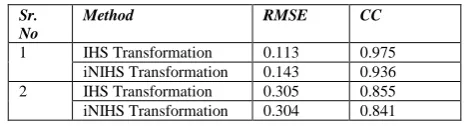
The comparative results of IHS Transformation which has out of gamut problem and improved nonlinear IHS transform which solves the gamut problem for the two images with Sr. No. 1 and 2 are as shown in the following table;
Table1.Quantitative Results of Image Fusion of given Panchromatic and Multispectral Images using Intensity Substitution.
Sr. No
Method RMSE CC
1 IHS Transformation 0.113 0.975 iNIHS Transformation 0.143 0.936 2 IHS Transformation 0.305 0.855 iNIHS Transformation 0.304 0.841
From the above results, iNIHS solves the gamut problem and iNIHS image fusion gives same results as that IHS. The same experiment carried out, keeping the intensity of MS image constant and brightening PAN image step by step. Visually results are analyzed, it come to know that as the intensity difference between PAN image and MS image increases, the spectral quality deviates from the original image. The results are shown in Fig 5;
IV. PROPOSED METHOD
[image:3.595.320.554.310.373.2]Figure5. Substitutive Wavelet Based Image Fusion using improved nonlinear IHS Transformation.
The results of the image fusion using Substitutive wavelet are shown as below;
a) b)
c) d)
e) f)
g)
Figure6. a) Original MS image b) Original PAN image derived from MS image c) Fusion of images a and b d) Darkened image with Alpha=0 e) Brightened image with Beta=0.4 f) Fusion result of images d and e using
intensity substitution g) Fusion result of images d and e using wavelet substitution.
The results wavelet based substitution in which horizontal, vertical and diagonal components of the MS image are replaced by the corresponding components of the PAN image are analyzed visually and quantitatively and compared with results of the direct intensity substitution are shown in the following table;
Table2. Quantitative Results of image fusion of given Panchromatic and Multispectral Images using waveletsubstitution.
Sr. No .
Method Intensit
y Differen ce
Spatial Coefficie nt
RMS E
Correlatio n Coefficien t 1. iNIHS
Intensity Substitutio n
0 0.827 0.022 0.98 0.4 0.790 0.184 0.96
2. iNIHS Wavelet Substitutio n
0 0.829 0.016 0.99 0.4 0.826 0.017 0.99
V. ABBREVIATIONS
MS: Multispectral image PAN: Panchromatic image
IHS: Intensity, hue and saturation transform
HSI: Nonlinear intensity, hue and saturation transform iNIHS: improved nonlinear IHS
RMSE: Root mean square error r: correlation coefficient
VI. CONCLUSION
Both linear RGB to IHS and nonlinear RGB to IHS used for image fusion leads to gamut problem. These methods solve the gamut problem using color clipping that leads to color distortion and contrast reduction. In this paper gamut problem is analyzed visually and solved using improved nonlinear IHS transformation. Though the gamut problem is solved, there is color distortion when there is a large intensity difference between the multispectral image and panchromatic image. This paper proposes, rather than direct intensity substitution only the spatial information from the PAN image is injected into the multispectral image. This paper analyzed the results of substitutive wavelet based image fusion visually and quantitatively, also compared with direct intensity substitution in MS image by PAN image. Substitutive wavelet based image fusion solves color distortion due to the large intensity differences between MS and PAN image, keeping special coefficient same and improved correlation coefficient and lowering root mean square error. In this way Substitutive wavelet based image fusion solves color distortion. Future work will be based on improving the spectral quality of the fused image.
VII. REFERENCES
[1]. Y. Zhang, “Understanding image fusion,” Photogramm. Eng. Remote Sens., vol.70, no. 6, pp. 657–661, 2004.
[3]. R. C. Gonzalez and R. E. Woods, Digital Image Processing. UpperSaddle River, NJ, USA: Prentice-Hall,2007.
[4]. C. K. Munechika, J. S. Warnick, C. Salvaggio, and J. R. Schott, “Resolution enhancement of multispectral image data to improve classification accuracy”, Photogramm. Eng. Remote Sens., vol. 59, no. 1, pp. 67–72, Jan. 1993.
[5]. T. M. Tu, S. C. Su, H. C. Shyu, and P. S. Huang, “A new look at IHS-like image fusionmethods,” Inf. Fusion, vol. 2, no. 3, pp. 177–186, Sep. 2001.
[6]. P. S. Chavez and A. Y. Kwarteng, “Extracting spectral contrast in Landsat Thematic Mapper image data using
selective principal component analysis,” Photogramm. Eng. Remote Sens., vol. 55, pp. 339–348,Mar. 1989.
[7]. E. M. Schetselaar, “Fusion by the IHS transform: Should we use cylindrical or spherical coordinates?”Remote Sens., vol. 19, no. 4, pp. 759– 765, Mar. 1998.