Fast, Easy, and Cheap: Construction of
Statistical Machine Translation Models with MapReduce
Christopher Dyer, Aaron Cordova, Alex Mont, Jimmy Lin
Laboratory for Computational Linguistics and Information Processing University of Maryland
College Park, MD 20742, USA
Abstract
In recent years, the quantity of parallel train-ing data available for statistical machine trans-lation has increased far more rapidly than the performance of individual computers, re-sulting in a potentially serious impediment to progress. Parallelization of the model-building algorithms that process this data on computer clusters is fraught with challenges such as synchronization, data exchange, and fault tolerance. However, the MapReduce programming paradigm has recently emerged as one solution to these issues: a powerful functional abstraction hides system-level de-tails from the researcher, allowing programs to be transparently distributed across potentially very large clusters of commodity hardware. We describe MapReduce implementations of two algorithms used to estimate the parame-ters for two word alignment models and one phrase-based translation model, all of which rely on maximum likelihood probability esti-mates. On a 20-machine cluster, experimental results show that our solutions exhibit good scaling characteristics compared to a hypo-thetical, optimally-parallelized version of cur-rent state-of-the-art single-core tools.
1 Introduction
Like many other NLP problems, output quality of statistical machine translation (SMT) systems in-creases with the amount of training data. Brants et al. (2007) demonstrated that increasing the quantity of training data used for language modeling signifi-cantly improves the translation quality of an Arabic-English MT system, even with far less sophisticated
backoff models. However, the steadily
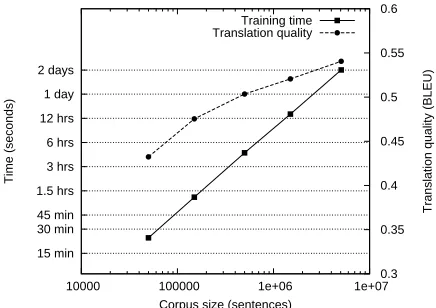
increas-ing quantities of trainincreas-ing data do not come with-out cost. Figure 1 shows the relationship between the amount of parallel Arabic-English training data used and both the translation quality of a state-of-the-art phrase-based SMT system and the time re-quired to perform the training with the widely-used
Moses toolkit on a commodity server.1 Building
a model using 5M sentence pairs (the amount of Arabic-English parallel text publicly available from
the LDC) takes just over two days.2 This represents
an unfortunate state of affairs for the research com-munity: excessively long turnaround on experiments is an impediment to research progress.
It is clear that the needs of machine translation re-searchers have outgrown the capabilities of individ-ual computers. The only practical recourse is to dis-tribute the computation across multiple cores, pro-cessors, or machines. The development of parallel algorithms involves a number of tradeoffs. First is that of cost: a decision must be made between “ex-otic” hardware (e.g., large shared memory machines, InfiniBand interconnect) and commodity hardware. There is significant evidence (Barroso et al., 2003) that solutions based on the latter are more cost ef-fective (and for resource-constrained academic in-stitutions, often the only option).
Given appropriate hardware, MT researchers must still contend with the challenge of developing software. Quite simply, parallel programming is dif-ficult. Due to communication and synchronization
1
http://www.statmt.org/moses/ 2
All single-core timings reported in this paper were per-formed on a 3GHz 64-bit Intel Xeon server with 8GB memory.
15 min 30 min 45 min 1.5 hrs 3 hrs 6 hrs 12 hrs 1 day 2 days
10000 100000 1e+06 1e+07 0.3 0.35 0.4 0.45 0.5 0.55 0.6
Time (seconds)
Translation quality (BLEU)
[image:2.612.75.293.58.212.2]Corpus size (sentences) Training time Translation quality
Figure 1: Translation quality and training time as a func-tion of corpus size.
issues, concurrent operations are notoriously chal-lenging to reason about. In addition, fault tolerance and scalability are serious concerns on commodity hardware prone to failure. With traditional paral-lel programming models (e.g., MPI), the developer shoulders the burden of handling these issues. As a result, just as much (if not more) effort is devoted to system issues as to solving the actual problem.
Recently, Google’s MapReduce framework (Dean and Ghemawat, 2004) has emerged as an attractive alternative to existing parallel programming models. The MapReduce abstraction shields the programmer from having to explicitly worry about system-level issues such as synchronization, data exchange, and fault tolerance (see Section 2 for details). The run-time is able to transparently distribute computations across large clusters of commodity hardware with good scaling characteristics. This frees the program-mer to focus on actual MT issues.
In this paper we present MapReduce implementa-tions of training algorithms for two kinds of models commonly used in statistical MT today: a phrase-based translation model (Koehn et al., 2003) and word alignment models based on pairwise lexi-cal translation trained using expectation maximiza-tion (Dempster et al., 1977). Currently, such models take days to construct using standard tools with pub-licly available training corpora; our MapReduce im-plementation cuts this time to hours. As an benefit to the community, it is our intention to release this code under an open source license.
It is worthwhile to emphasize that we present
these results as a “sweet spot” in the complex design space of engineering decisions. In light of possible tradeoffs, we argue that our solution can be consid-ered fast (in terms of running time), easy (in terms of implementation), and cheap (in terms of hard-ware costs). Faster running times could be achieved with more expensive hardware. Similarly, a custom implementation (e.g., in MPI) could extract finer-grained parallelism and also yield faster running
times. In our opinion, these are not worthwhile
tradeoffs. In the first case, financial constraints
are obvious. In the second case, the programmer must explicitly manage all the complexities that come with distributed processing (see above). In contrast, our algorithms were developed within a matter of weeks, as part of a “cloud computing”
course project (Lin, 2008). Experimental results
demonstrate that MapReduce provides nearly opti-mal scaling characteristics, while retaining a high-level problem-focused abstraction.
The remainder of the paper is structured as fol-lows. In the next section we provide an overview of MapReduce. In Section 3 we describe several gen-eral solutions to computing maximum likelihood es-timates for finite, discrete probability distributions. Sections 4 and 5 apply these techniques to estimate phrase translation models and perform EM for two word alignment models. Section 6 reviews relevant prior work, and Section 7 concludes.
2 MapReduce
MapReduce builds on the observation that many tasks have the same basic structure: a computation is applied over a large number of records (e.g., parallel sentences) to generate partial results, which are then aggregated in some fashion. The per-record compu-tation and aggregation function are specified by the programmer and vary according to task, but the ba-sic structure remains fixed. Taking inspiration from higher-order functions in functional programming, MapReduce provides an abstraction at the point of these two operations. Specifically, the programmer defines a “mapper” and a “reducer” with the follow-ing signatures (square brackets indicate a list of ele-ments):
map:hk1, v1i →[hk2, v2i]
input input input input
map map map map
input input input input
Barrier: group values by keys
reduce reduce reduce
[image:3.612.311.534.57.248.2]output output output
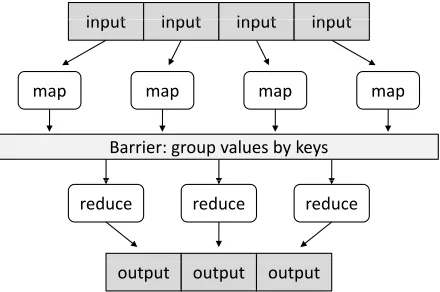
Figure 2: Illustration of the MapReduce framework: the “mapper” is applied to all input records, which generates results that are aggregated by the “reducer”.
Key/value pairs form the basic data structure in MapReduce. The “mapper” is applied to every input key/value pair to generate an arbitrary number of in-termediate key/value pairs. The “reducer” is applied to all values associated with the same intermediate key to generate output key/value pairs. This two-stage processing structure is illustrated in Figure 2.
Under this framework, a programmer need only provide implementations of map and reduce. On top of a distributed file system (Ghemawat et al., 2003), the runtime transparently handles all other aspects of execution, on clusters ranging from a few to a few thousand workers on commodity hardware assumed to be unreliable, and thus is tolerant to various faults through a number of error recovery mechanisms. The runtime also manages data exchange, includ-ing splittinclud-ing the input across multiple map workers and the potentially very large sorting problem be-tween the map and reduce phases whereby interme-diate key/value pairs must be grouped by key.
For the MapReduce experiments reported in this
paper, we used Hadoop version 0.16.0,3 which is
an open-source Java implementation of MapRe-duce, running on a 20-machine cluster (1 master, 19 slaves). Each machine has two processors (run-ning at either 2.4GHz or 2.8GHz), 4GB memory (map and reduce tasks were limited to 768MB), and 100GB disk. All software was implemented in Java.
3http://hadoop.apache.org/
Method 1
Map1 hA, Bi → hhA, Bi,1i
Reduce1 hhA, Bi, c(A, B)i
Map2 hhA, Bi, c(A, B)i → hhA,∗i, c(A, B)i
Reduce2 hhA,∗i, c(A)i
Map3 hhA, Bi, c(A, B)i → hA,hB, c(A, B)ii
Reduce3 hA,hB,
c(A,B)
c(A) ii
Method 2
Map1 hA, Bi → hhA, Bi,1i;hhA,∗i,1i
Reduce1 hhA, Bi,
c(A,B)
c(A) i
Method 3
Map1 hA, Bii → hA,hBi: 1ii Reduce1 hA,hB1:
c(A,B1)
c(A) i,hB2:
c(A,B2)
[image:3.612.77.297.60.206.2]c(A) i · · · i
Table 1: Three methods for computing PM LE(B|A). The first element in each tuple is a key and the second element is the associated value produced by the mappers and reducers.
3 Maximum Likelihood Estimates
The two classes of models under consideration are parameterized with conditional probability distribu-tions over discrete events, generally estimated ac-cording to the maximum likelihood criterion:
PM LE(B|A) =
c(A, B)
c(A) =
c(A, B)
P
B0c(A, B0)
(1)
Since this calculation is fundamental to both ap-proaches (they distinguish themselves only by where the counts of the joint events come from—in the case of the phrase model, they are observed directly, and in the case of the word-alignment models they are the number of expected events in a partially hidden process given an existing model of that process), we begin with an overview of how to compute condi-tional probabilities in MapReduce.
We consider three possible solutions to this prob-lem, shown in Table 1. Method 1 computes the count
for each pairhA, Bi, computes the marginalc(A),
and then groups all the values for a givenAtogether,
such that the marginal is guaranteed to be first and
then the pair counts follow. This enables Reducer3
to only hold the marginal value in memory as it pro-cesses the remaining values. Method 2 works
simi-larly, except that the original mapper emitstwo
will be the marginal and one that contributes to the pair count. The reducer groups all pairs together by
the A value, processes the marginal first, and, like
Method 1, must only keep this value in memory as it processes the remaining pair counts. Method 2 re-quires more data to be processed by the MapReduce framework, but only requires a single sort operation (i.e., fewer MapReduce iterations).
Method 3 works slightly differently: rather than computing the pair counts independently of each
other, the counts ofalltheBevents jointly occurring
with a particularA=aevent are stored in an
asso-ciative data structure in memory in the reducer. The
marginal c(A) can be computed by summing over
all the values in the associative data structure and then a second pass normalizes. This requires that
the conditional distribution P(B|A = a) not have
so many parameters that it cannot be represented in memory. A potential advantage of this approach is that the MapReduce framework can use a
“com-biner” to group manyhA, Bipairs into a single value
before the key/value pair leaves for the reducer.4 If
the underlying distribution from which pairshA, Bi
has certain characteristics, this can result in a signifi-cant reduction in the number of keys that the mapper emits (although the number of statistics will be iden-tical). And since all keys must be sorted prior to the reducer step beginning, reducing the number of keys can have significant performance impact.
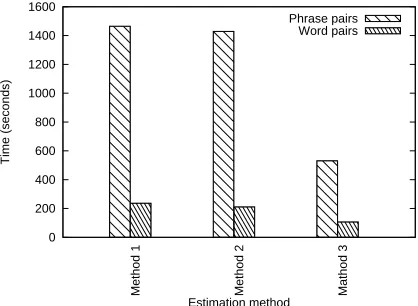
The graph in Figure 3 shows the performance of the three problem decompositions on two model types we are estimating, conditional phrase trans-lation probabilities (1.5M sentences, max phrase length=7), and conditional lexical translation prob-abilities as found in a word alignment model (500k sentences). In both cases, Method 3, which makes
use of more memory to store counts of allB events
associated with eventA=a, completes at least50%
more quickly. This efficiency is due to the Zipfian distribution of both phrases and lexical items in our corpora: a few frequent items account for a large portion of the corpus. The memory requirements were also observed to be quite reasonable for the
4
Combiners operate like reducers, except they run directly on the output of a mapper before the results leave memory. They can be used when the reduction operation is associative and commutative. For more information refer to Dean and Ghe-mawat (2004).
0 200 400 600 800 1000 1200 1400 1600
Method 1 Method 2 Mathod 3
Time (seconds)
Estimation method
[image:4.612.318.527.59.212.2]Phrase pairs Word pairs
Figure 3:PM LEcomputation strategies.
Figure 4: A word-aligned sentence. Examples of consistent phrase pairs include hvi, i sawi,
hla mesa pequena,˜ the small tablei, and
hmesa pequena, small tablei˜ ; but, note that, for example, it is not possible to extract a consistent phrase corresponding to the foreign stringla mesaor the English stringthe small.
models in question: representingP(B|A=a)in the
phrase model required at most 90k parameters, and in the lexical model, 128k parameters (i.e., the size of the vocabulary for language B). For the remainder of the experiments reported, we confine ourselves to the use of Method 3.
4 Phrase-Based Translation
1.5 min 5 min 20 min 60 min 3 hrs 12 hrs 2 days
10000 100000 1e+06 1e+07
Time (seconds)
[image:5.612.75.296.59.213.2]Corpus size (sentences) Moses training time MapReduce training (38 M/R) Optimal (Moses/38)
Figure 5: Phrase model extraction and scoring times at various corpus sizes.
Constructing a model involves extracting all the
phrase pairs he, fi and computing the conditional
phrase translation probabilities in both directions.5
With a minor adjustment to the techniques
intro-duced in Section 3, it is possible to estimateP(B|A)
andP(A|B)concurrently.
Figure 5 shows the time it takes to construct a phrase-based translation model using the Moses tool, running on a single core, as well as the time it takes to build the same model using our MapRe-duce implementation. For reference, on the same graph we plot a hypothetical, optimally-parallelized
version of Moses, which would run in 381 of the time
required for the single-core version on our cluster.6
Although these represent completely different im-plementations, this comparison offers a sense of MapReduce’s benefits. The framework provides a conceptually simple solution to the problem, while providing an implementation that is both scalable and fault tolerant—in fact, transparently so since the runtime hides all these complexities from the re-searcher. From the graph it is clear that the overhead associated with the framework itself is quite low, es-pecially for large quantities of data. We concede that it may be possible for a custom solution (e.g., with MPI) to achieve even faster running times, but we argue that devoting resources to developing such a solution would not be cost-effective.
Next, we explore a class of models where the
stan-5
Following Och and Ney (2002), it is customary to combine both these probabilities as feature values in a log-linear model.
6
In our cluster, only 19 machines actually compute, and each has two single-core processors.
dard tools work primarily in memory, but where the computational complexity of the models is greater.
5 Word Alignment
Although word-based translation models have been largely supplanted by models that make use of larger
translation units, the task of generating aword
align-ment, the mapping between the words in the source
and target sentences that are translationally equiva-lent, remains crucial to nearly all approaches to sta-tistical machine translation.
The IBM models, together with a Hidden Markov Model (HMM), form a class of generative mod-els that are based on a lexical translation model
P(fj|ei)where each wordfjin the foreign sentence
f1mis generated by precisely one wordeiin the
sen-tenceel1, independently of the other translation
de-cisions (Brown et al., 1993; Vogel et al., 1996; Och and Ney, 2000). Given these assumptions, we let the sentence translation probability be mediated by
a latent alignment variable (am1 in the equations
be-low) that specifies the pairwise mapping between words in the source and target languages.
Assum-ing a given sentence lengthmforf1m, the translation
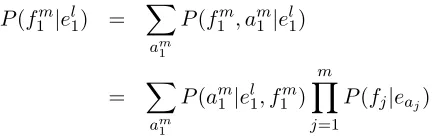
probability is defined as follows:
P(f1m|el1) = X
am 1
P(f1m, am1 |el1)
= X
am 1
P(am1 |el1, f1m)
m
Y
j=1
P(fj|eaj)
Once the model parameters have been estimated, the single-best word alignment is computed according to the following decision rule:
ˆ
am1 = arg max
am 1
P(am1 |el1, f1m)
m
Y
j=1
P(fj|eaj)
In this section, we consider the MapReduce imple-mentation of two specific alignment models:
1. IBM Model 1, whereP(am1 |el1, f1m)is uniform
over all possible alignments.
2. The HMM alignment model where
P(am1 |el1, f1m) =Qm
[image:5.612.319.535.419.489.2]Estimating the parameters for these models is more difficult (and more computationally expensive) than with the models considered in the previous section: rather than simply being able to count the word pairs and alignment relationships and estimate the mod-els directly, we must use an existing model to
com-pute theexpected countsfor all possible alignments,
and then use these counts to update the new model.7
This training strategy is referred to as expectation-maximization (EM) and is guaranteed to always im-prove the quality of the prior model at each iteration (Brown et al., 1993; Dempster et al., 1977).
Although it is necessary to compute a sum over all possible alignments, the independence assumptions made in these models allow the total probability of generating a particular observation to be efficiently
computed using dynamic programming.8 The HMM
alignment model uses the forward-backward algo-rithm (Baum et al., 1970), which is also an in-stance of EM. Even with dynamic programming,
this requires O(Slm) operations for Model 1, and
O(Slm2) for the HMM model, wherem andlare
the average lengths of the foreign and English
sen-tences in the training corpus, andSis the number of
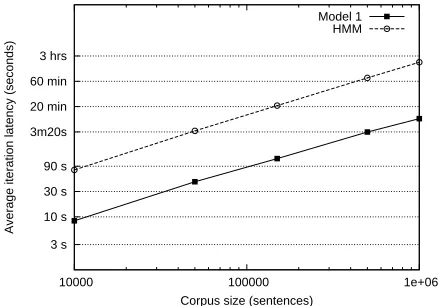
sentences. Figure 6 shows measurements of the av-erage iteration run-time for Model 1 and the HMM alignment model as implemented in Giza++ (Och and Ney, 2003), a state-of-the-art C++ implemen-tation of the IBM and HMM alignment models that is widely used. Five iterations are generally neces-sary to train the models, so the time to carry out full
training of the models is approximatelyfive timesthe
per-iteration run-time.
5.1 EM with MapReduce
Expectation-maximization algorithms can be ex-pressed quite naturally in the MapReduce frame-work (Chu et al., 2006). In general, for discrete gen-erative models, mappers iterate over the training in-stances and compute the partial expected counts for all the unobservable events in the model that should
7For the first iteration, when there is no prior model, a heuristic, random, or uniform distribution may be chosen.
8
For IBM Models 3-5, which are not our primary focus, dy-namic programming is not possible, but the general strategy for computing expected counts from a previous model and updat-ing remains identical and therefore the techniques we suggest in this section are applicable to those models as well.
3 s 10 s 30 s 90 s 3m20s 20 min 60 min 3 hrs
10000 100000 1e+06
Average iteration latency (seconds)
Corpus size (sentences) Model 1
[image:6.612.316.535.60.213.2]HMM
Figure 6: Per-iteration average run-times for Giza++ im-plementations of Model 1 and HMM training on corpora of various sizes.
be associated with the given training instance. Re-ducers aggregate these partial counts to compute the total expected joint counts. The updated model is estimated using the maximum likelihood crite-rion, which just involves computing the appropri-ate marginal and dividing (as with the phrase-based models), and the same techniques suggested in Sec-tion 3 can be used with no modificaSec-tion for this
purpose. For word alignment models, Method 3
is possible since word pairs distribute according to Zipf’s law (meaning there is ample opportunity for the combiners to combine records), and the number
of parameters forP(e|fj = f)is at most the
num-ber of items in the vocabulary ofE, which tends to
be on the order of hundreds of thousands of words, even for large corpora.
Since the alignment models we are considering are fundamentally based on a lexical translation probability model, i.e., the conditional probability
distributionP(e|f), we describe in some detail how
EM updates the parameters for this model.9 Using
the model parameters from the previous iteration (or starting from an arbitrary or heuristic set of param-eters during the first iteration), an expected count is
computed for everyl×mpairhei, fjifor each
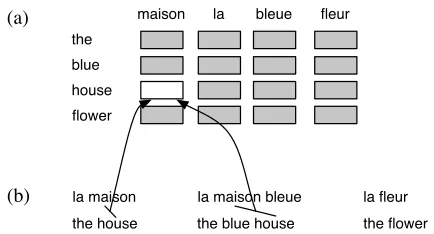
par-allel sentence in the training corpus. Figure 7
the
blue
house
maison la bleue fleur
flower
la maison
the house
la maison bleue la fleur
the blue house the flower
(a)
[image:7.612.75.292.53.170.2](b)
Figure 7: Each cell in (a) contains the expected counts for the word pairhei, fji. In (b) the example training data is marked to show which training instances contribute par-tial counts for the pairhhouse, maisoni.
3 s 10 s 30 s 90 s 3m20s 20 min 60 min 3 hrs
10000 100000 1e+06
Time (seconds)
Corpus size (sentences) Optimal Model 1 (Giza/38)
[image:7.612.75.296.244.400.2]Optimal HMM (Giza/38) MapReduce Model 1 (38 M/R) MapReduce HMM (38 M/R)
Figure 8: Average per-iteration latency to train HMM and Model 1 using the MapReduce EM trainer, compared to an optimal parallelization of Giza++ across the same number of processors.
trates the relationship between the individual train-ing instances and the global expected counts for a particular word pair. After collecting counts, the
conditional probabilityP(f|e)is computed by
sum-ming over all columns for eachfand dividing. Note
that under this training regime, a non-zero
probabil-ity P(fj|ei) will be possible only ifei and fj
co-occur in at least one training instance.
5.2 Experimental Results
Figure 8 shows the timing results of the MapReduce implementation of Model 1 and the HMM alignment model. Similar to the phrase extraction experiments, we show as reference the running time of a hy-pothetical, optimally-parallelized version of Giza++ on our cluster (i.e., values in Figure 6 divided by 38). Whereas in the single-core implementation the
added complexity of the HMM model has a signif-icant impact on the per-iteration running time, the data exchange overhead dominates in the perfor-mance of both models in a MapReduce environment, making running time virtually indistinguishable. For these experiments, after each EM iteration, the up-dated model parameters (which are computed in a distributed fashion) are compiled into a compressed representation which is then distributed to all the processors in the cluster at the beginning of the next iteration. The time taken for this process is included in the iteration latencies shown in the graph. In fu-ture work, we plan to use a distributed model repre-sentation to improve speed and scalability.
6 Related work
Expectation-maximization algorithms have been previously deployed in the MapReduce framework in the context of several different applications (Chu et al., 2006; Das et al., 2007; Wolfe et al., 2007). Wolfe et al. (2007) specifically looked at the perfor-mance of Model 1 on MapReduce and discuss how several different strategies can minimize the amount of communication required but they ultimately ad-vocate abandoning the MapReduce model. While their techniques do lead to modest performance im-provements, we question the cost-effectiveness of the approach in general, since it sacrifices many of the advantages provided by the MapReduce envi-ronment. In our future work, we instead intend to make use of an approach suggested by Das et al. (2007), who show that a distributed database run-ning in tandem with MapReduce can be used to provide the parameters for very large mixture mod-els efficiently. Moreover, since the database is dis-tributed across the same nodes as the MapReduce jobs, many of the same data locality benefits that Wolfe et al. (2007) sought to capitalize on will be available without abandoning the guarantees of the MapReduce paradigm.
There has been a fair amount of work inspired by the problems of long latencies and excessive space requirements in the construction of phrase-based and hierarchical phrase-based translation models. Several authors have advocated indexing the train-ing data with a suffix array and computtrain-ing the nec-essary statistics during or immediately prior to de-coding (Callison-Burch et al., 2005; Lopez, 2007). Although this technique works quite well, the
stan-dard channel probability P(f|e) cannot be
com-puted, which is not a limitation of MapReduce.10
7 Conclusions
We have shown that an important class of model-building algorithms in statistical machine transla-tion can be straightforwardly recast into the MapRe-duce framework, yielding a distributed solution that is cost-effective, scalable, robust, and exact
(i.e., doesn’t resort to approximations).
Alterna-tive strategies for parallelizing these algorithms ei-ther impose significant demands on the developer, the hardware infrastructure, or both; or, they re-quire making unwarranted independence assump-tions, such as dividing the training data into chunks
and building separate models. We have further
shown that on a 20-machine cluster of commodity hardware, the MapReduce implementations have ex-cellent performance and scaling characteristics.
Why does this matter? Given the difficulty of im-plementing model training algorithms (phrase-based model estimation is difficult because of the size of data involved, and word-based alignment models are a challenge because of the computational complex-ity associated with computing expected counts), a handful of single-core tools have come to be widely used. Unfortunately, they have failed to scale with the amount of training data available. The long la-tencies associated with these tools on large datasets imply that any kind of experimentation that relies on making changes to variables upstream of the word alignment process (such as, for example, altering the
training dataf →f0, building a new modelP(f0|e),
and reevaluating) is severely limited by this state of affairs. It is our hope that by reducing the cost of this
10
It is an open question whether the channel probability and inverse channel probabilities are both necessary. Lopez (2008) presents results suggesting thatP(f|e)is not necessary, whereas Subotin (2008) finds the opposite.
these pieces of the translation pipeline, we will see a greater diversity of experimental manipulations. To-wards that end, we intend to release this code under an open source license.
For our part, we plan to continue pushing the lim-its of current word alignment models by moving to-wards a distributed representation of the model pa-rameters used in the expectation step of EM and abandoning the compiled model representation. Fur-thermore, initial experiments indicate that reorder-ing the trainreorder-ing data can lead to better data local-ity which can further improve performance. This will enable us to scale to larger corpora as well as to explore different uses of translation models, such as techniques for processing comparable corpora, where a strict sentence alignment is not possible un-der the limitations of current tools.
Finally, we note that the algorithms and tech-niques we have described here can be readily ex-tended to problems in other areas of NLP and
be-yond. HMMs, for example, are widely used in
ASR, named entity detection, and biological se-quence analysis. In these areas, model estimation can be a costly process, and therefore we believe this work will be of interest for these applications as well. It is our expectation that MapReduce will also provide solutions that are fast, easy, and cheap.
Acknowledgments
This work was supported by the GALE program of the Defense Advanced Research Projects Agency, Contract No. HR0011-06-2-0001. We would also like to thank the generous hardware support of IBM and Google via the Academic Cloud Computing Ini-tiative. Specifically, thanks go out to Dennis Quan and Eugene Hung from IBM for their tireless sup-port of our efforts. Philip Resnik and Miles Osborne provided helpful comments on an early draft. The last author would like to thank Esther and Kiri for their kind support.
References
Luiz Andr´e Barroso, Jeffrey Dean, and Urs H¨olzle. 2003. Web search for a planet: The Google cluster architec-ture. IEEE Micro, 23(2):22–28.
occur-ring in the statistical analysis of probabilistic functions of Markov chains. Annals of Mathematical Statistics, 41(1):164–171.
Thorsten Brants, Ashok C. Popat, Peng Xu, Franz J. Och, and Jeffrey Dean. 2007. Large language models in machine translation. InProceedings of the 2007 Joint Conference on Empirical Methods in Natural guage Processing and Computational Natural
Lan-guage Learning, pages 858–867, Prague, Czech
Re-public.
Peter F. Brown, Vincent J. Della Pietra, Stephen A. Della Pietra, and Robert L. Mercer. 1993. The mathe-matics of statistical machine translation: parameter es-timation.Computational Linguistics, 19(2):263–311. Chris Callison-Burch, Colin Bannard, and Josh
Schroeder. 2005. Scaling phrase-based statisti-cal machine translation to larger corpora and longer phrases. In Proceedings of the 43rd Annual Meeting of the Association for Computational Linguistics (ACL
2005), pages 255–262, Ann Arbor, Michigan.
Cheng T. Chu, Sang K. Kim, Yi A. Lin, Yuanyuan Yu, Gary R. Bradski, Andrew Y. Ng, and Kunle Oluko-tun. 2006. Map-Reduce for machine learning on mul-ticore. InAdvances in Neural Information Processing
Systems 19 (NIPS 2006), pages 281–288, Vancouver,
British Columbia, Canada.
Abhinandan S. Das, Mayur Datar, Ashutosh Garg, and Shyam Rajaram. 2007. Google news personalization: scalable online collaborative filtering. InProceedings of the 16th International Conference on World Wide
Web (WWW 2007), pages 271–280, Banff, Alberta,
Canada.
Jeffrey Dean and Sanjay Ghemawat. 2004. MapReduce: Simplified data processing on large clusters. In Pro-ceedings of the 6th Symposium on Operating System
Design and Implementation (OSDI 2004), pages 137–
150, San Francisco, California.
Arthur Dempster, Nan Laird, and Donald Rubin. 1977. Maximum likelihood from incomplete data via the EM algorithm. Journal of the Royal Statistics Society, 39(1):1–38.
Yonggang Deng and William J. Byrne. 2006. MTTK: An alignment toolkit for statistical machine transla-tion. In Proceedings of the 2006 Human Language Technology Conference of the North American Chap-ter of the Association for Computational Linguistics
(HLT/NAACL 2006), Companion Volume, pages 265–
268, New York, New York.
Sanjay Ghemawat, Howard Gobioff, and Shun-Tak Le-ung. 2003. The Google File System. InProceedings of the 19th ACM Symposium on Operating Systems
Principles (SOSP-03), pages 29–43, Bolton Landing,
New York.
Philipp Koehn, Franz Josef Och, and Daniel Marcu. 2003. Statistical phrase-based translation. In Pro-ceedings of the 2003 Human Language Technology Conference of the North American Chapter of the As-sociation for Computational Linguistics (HLT/NAACL
2003), pages 48–54, Edmonton, Alberta, Canada.
Jimmy Lin. 2008. Exploring large-data issues in the cur-riculum: A case study with MapReduce. In Proceed-ings of the Third Workshop on Issues in Teaching
Com-putational Linguistics at ACL 2008, Columbus, Ohio.
Adam Lopez. 2007. Hierarchical phrase-based trans-lation with suffix arrays. In Proceedings of the 2007 Joint Conference on Empirical Methods in Natu-ral Language Processing and Computational NatuNatu-ral
Language Learning, pages 976–985, Prague, Czech
Republic.
Adam Lopez. 2008. Machine Translation by Pattern
Matching. Ph.D. dissertation, University of Maryland,
College Park, MD.
Franz Josef Och and Hermann Ney. 2000. A comparison of alignment models for statistical machine translation.
In Proceedings of the 18th International Conference
on Computational Linguistics (COLING 2000), pages
1086–1090, Saarbrucken, Germany.
Franz Josef Och and Hermann Ney. 2002. Discrimini-tive training and maximum entropy models for statis-tical machine translation. InProceedings of the 40th Annual Meeting of the Association for Computational
Linguistics (ACL 2002), pages 295–302, Philadelphia,
Pennsylvania.
Franz Josef Och and Hermann Ney. 2003. A system-atic comparison of various statistical alignment
mod-els. Computational Linguistics, 29(1):19–51.
Franz Josef Och, Christoph Tillmann, and Hermann Ney. 1999. Improved alignment models for statistical ma-chine translation. In Proceedings of the 1999 Joint SIGDAT Conference on Empirical Methods in Natural
Language Processing and Very Large Corpora, pages
20–28, College Park, Maryland.
Michael Subotin. 2008. Exponential models for machine translation. Master’s thesis, University of Maryland, College Park, MD.
Stephan Vogel, Hermann Ney, and Christoph Tillmann. 1996. HMM-based word alignment in statistical trans-lation. InProceedings of the 16th conference on
Com-putational linguistics (COLING 1996), pages 836–
841, Copenhagen, Denmark.