SEISMIC RESPONSE OF VERTICALLY IRREGULAR
RC FRAME WITH STIFFNESS IRREGULARITY AT
GROUND FLOOR
Shaikh Sameer J.
1, S.B. Shinde
21(Student, Civil Engineering, MGM Jawaharlal Nehru Engineering College, Aurangabad, India)
2(Associate Professor, Civil Engineering, MGM Jawaharlal Nehru Engineering College,
Aurangabad, India)
ABSTRACT
In past, several major earthquakes have exposed the shortcomings in buildings, which had caused them to
damage or collapse. It has been found that regular shaped buildings perform better during earthquake. The
presence of vertical irregular frame subject to devastating earthquake is matter of concern. The present paper
attempts to investigate the proportional distribution of lateral forces evolved through seismic action in each
storey level due to changes in stiffness of frame on vertically irregular frame. As per the Bureau of Indian
Standard (BIS) 1893:2002 (part1) provisions, a G+10 vertically irregular building is modelled as a simplified
lump mass model for the analysis with stiffness irregularity at ground floor. To response parameters like story
drift, story deflection and story shear of structure under seismic force under the linear static & dynamic analysis
is studied. This analysis shows focuses on the base shear carrying capacity of a structure and performance level
of structure under sever zone of India. The result remarks the conclusion that, a building structure with stiffness
irregularity provides instability and attracts huge storey shear. A proportionate amount of stiffness is
advantageous to control over the storey and base shear. The soft computing tool and commercial software
CSI-ETABS is used for analysis.
Keywords:- Base Shear, I.S 1893:2002(Part1) Provisions, Storey Drift, Structural irregularities,
Vertical irregularities.
I. INTRODUCTION
Recently and in past, several major earthquakes have exposed the shortcomings in buildings, which lead to
damage or collapse. It has been found that regular shaped buildings perform better during earthquakes. The
structural irregularities cause non-uniform load distribution in various members of a building. There must be a
this transmission path results in failure of the structure at that location. There have been several studies on the
irregularities, viz., (Jack P. Moehle, A. M. ASCE 1984) [1], Seismic Response of Vertically Irregular Structures,
evaluation of mass, strength and stiffness limits for regular buildings specified by UBC (Valmundsson and Nau,
1997)[3], Seismic Response of RC Frame Buildings with Soft First Storeys (ArlekarJaswant N, Jain Sudhir K.
and Murty C.V.R, 1997) [4] etc. In the present paper, response of a G+10-storeyed vertically irregular frame to
lateral loads has studied for stiffness irregularity at ground floor in the elevation. These irregularities are
introduced by changing the properties of the members of the storey under consideration maintaining aspect ratio
for vertically irregular frame specified in I.S 1893:2002(part1) [9] guidelines. Stiffness irregularities include the
height of the column increased on the ground floor which is applied on vertically irregular frame. Effects on
storey-shear forces, storey drifts and deflection of beams is studied.
1.1 Structural Irregularities
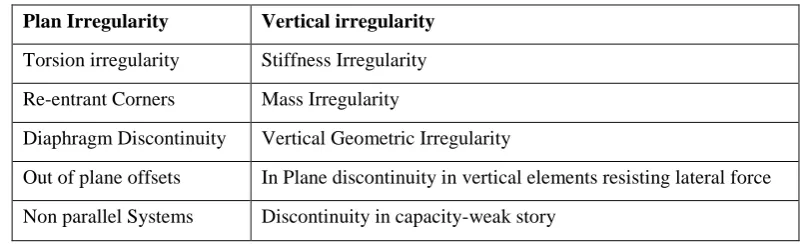
There are various types of irregularities in the buildings depending upon their location and scope, but mainly,
they are divided into two groups plan irregularities and vertical irregularities. In the Study, the vertical
irregularities are considered which are described as follows.
Table 1: Types of Irregularity
Plan Irregularity Vertical irregularity
Torsion irregularity Stiffness Irregularity
Re-entrant Corners Mass Irregularity
Diaphragm Discontinuity Vertical Geometric Irregularity
Out of plane offsets In Plane discontinuity in vertical elements resisting lateral force
Non parallel Systems Discontinuity in capacity-weak story
II. PROBLEM FORMULATION
With reference to IS 1893:2002 part-1[9] the vertical geometric irregular building model is considered for
modelling purpose and on this irregular frame stiffness irregularity has been applied. This building model is
G+10 storey building (35.5M) high is made of reinforced concrete (RC) Special moment resisting frame
(SMRF). These two frames have been analysed using equivalent static method of IS 1893: 2002 (Part-1).
Analysis has been carried out using commercial software ETABS program with following preliminary data.
Location of structure in seismic zone V, with soil type is medium, zone factor is 0.36, effective damping 5%
and importance factor is 1.
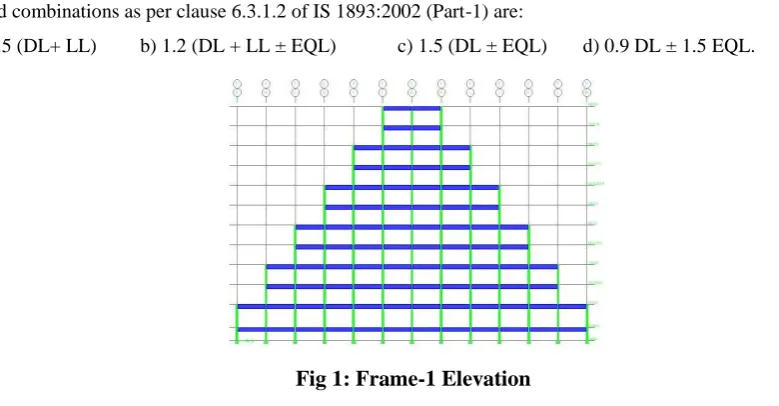
2.1 Frame-1
Frame-1 structure with geometrically vertical irregularities and having ten bays and G+10 storeys with 60m x
basic specifications of the building are: Dimensions of the beam = 0.3 m × 0.6 m; Column size = 0.70 m × 0.30
m; Beam length = 5 m; M30, Fe415 materials are used. Depth of slab 150 mm; Imposed load 5 kN/m2; specific
weight of infill is 20 kN/m3, lateral stiffness of infill is not taken in the study and specific weight of concrete is
25 kN/m3. The Frame-1 is as shown in Fig. 1.
Load combinations as per clause 6.3.1.2 of IS 1893:2002 (Part-1) are:
a) 1.5 (DL+ LL) b) 1.2 (DL + LL ± EQL) c) 1.5 (DL ± EQL) d) 0.9 DL ± 1.5 EQL.
Fig 1: Frame-1 Elevation
2.2 Frame-2
Model-2 consists of increase in height of the column on ground floor which is introduced in Frame-1, the
Frame-1 itself is a vertically irregular structure. It has 10 bays and ten storeys, with a ground storey height of 5
m and typical floor height 3.0 m the bay width is 5 m. The frame-1 having the shape irregular to know the effect
of stiffness irregularity on the shape (vertical geometric) irregular building the excess height of column at
ground floor as per the IS 1893:2002 (part-1). The structural and seismic forces are same with respect to the
frame-1.
1. Floor height at GF : 5 m
The respective change is incorporated on the ground floor and as shown in Fig. 2.
III. ANALYSIS RESULTS
Two frames have been analysed and responses like lateral storey-displacements, storey drifts and base shears
have been computed to study the effects of stiffness irregularity on the vertically irregular frame. The results
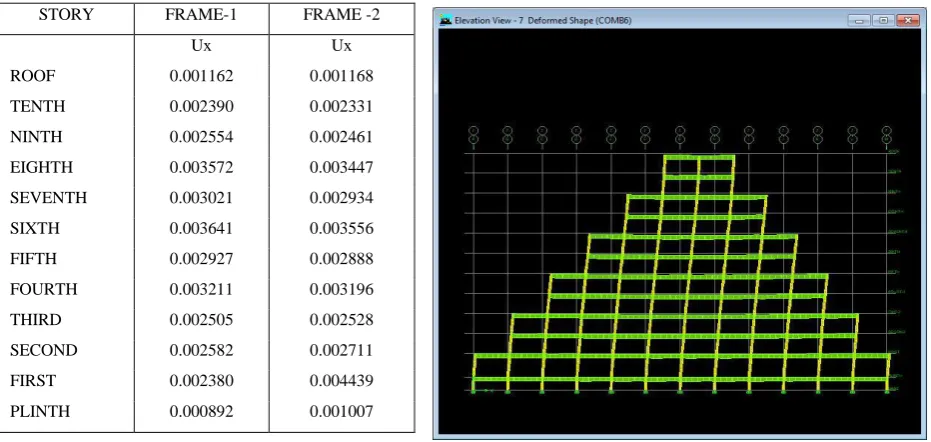
are presented and discussed hereafter. Table-2 shows displacement of storeys of various frames in X-direction
(horizontal) graphically presented in figure. It can be seen that from table-2, the frame-2 gets slightly displaced
the more since the lateral stiffness with reference to frame-1 and the bottom two storeys is quite less than other
storeys. Whereas its being minimum being in the base frame. Typical deflected shapes of two various frames in
combinations is represented in Fig. 3.
Table 2: Story Disp. (Ux) In X-direction (M)
Fig. 3: Deflected shape of frame-1 in their combination
Table 3 shows the analysis result for Storey-drifts for two frames and graphically presented in Fig. 4. Frame-1
and frame-2 are seen to exhibit abrupt change in storey drifts at ground storey, which is slightly changed in
respective storey.
The storey shears as given by ETABS using IS 1893: 2002 (part-1), are tabulated in table-4 and represented in
fig. 5. Frame-2, being the slightly heaviest one, develops considerable amount of shear force in its storey’s
compare to frames-1.
STORY FRAME-1 FRAME -2
Ux Ux
ROOF 0.001162 0.001168
TENTH 0.002390 0.002331
NINTH 0.002554 0.002461
EIGHTH 0.003572 0.003447
SEVENTH 0.003021 0.002934
SIXTH 0.003641 0.003556
FIFTH 0.002927 0.002888
FOURTH 0.003211 0.003196
THIRD 0.002505 0.002528
SECOND 0.002582 0.002711
FIRST 0.002380 0.004439
Table 3: Story Drift In X-direction (M)
Fig. 4: Deflected shape of frame-2 in their combination
Table 4: Story Shear in X-direction (kN)
STORY FRAME-1 FRAME-2
Vx Vx
ROOF -279.809 -284.262
TENTH -766.984 -746.045
NINTH -2121.59 -2041.60
EIGHTH -3283.75 -3165.30
SEVENTH -5146.13 -4990.77
SIXTH -6625.35 -6466.24
FIFTH -8427.29 -8305.89
FOURTH -9705.73 -9654.06
THIRD -10908.0 -10984.7
SECOND -11582.6 -11793.4
FIRST -11981.0 -12374.2
PLINTH -12016.6 -12417.7
STORY FRAME-1 FRAME- 2
Ux Ux
ROOF 0.092815 0.105871
TENTH 0.089327 0.102367
NINTH 0.082156 0.095375
EIGHTH 0.074495 0.087991
SEVENTH 0.063778 0.077649
SIXTH 0.054715 0.068848
FIFTH 0.043792 0.058179
FOURTH 0.035010 0.049515
THIRD 0.025377 0.039927
SECOND 0.017860 0.032342
FIRST 0.010113 0.024209
PLINTH 0.001783 0.002014
IV. CONCLUSION
Considering the storey displacement, the frame with excess height of ground floor (frame-2) is the weakest than
the (frame-1), as it suffers the considerable change in displacement in all the floors. As far as storey drift is
concerned, frame-2 is weak than the frame-1, as the frame -2 having the suddenly extreme change at ground
floor in story drift. Story shear is slightly more in frame-2. From this it is clear that the frame having stiffness
irregularity on vertically irregular frame is susceptible to damage in earthquake prone zone.
In this paper, two frames having different irregularities but with same dimensions have been analysed to study
their behaviour when subjected to lateral loads. All the frames were analysed with the same method as stated in
IS 1893: 2002 (part-1). The frame-1 (vertically irregular) develops least storey drifts while the building with
stiffness irregularity on vertically irregular building (frame-1) shows maximum storey drift on the respective
storey levels. Hence, this is the most vulnerable to damages under this kind of loading and the same frame with
excess height of story develops slightly more storey shears, which should be accounted for in design of columns
suitably.
The analysis proves that vertically irregular structures are harmful and the effect of stiffness irregularity on the
vertically irregular structure is also dangerous in seismic zone. Therefore, as far as possible irregularities in a
building must be avoided. But, if irregularities have to be introduced for any reason, they must be designed
properly following the conditions of IS 1893: 2002 (part-1) and IS- 456: 2000 [8], and joints should be made
ductile as per IS 13920:1993. Now a days, complex shaped buildings are getting popular, but they carry a risk of
sustaining damages during earthquakes. Therefore, such buildings should be designed properly taking care of
IV. ACKNOWLEDGEMENTS
The authors wish to thank the management, principal, head of civil department and staff of Jawaharlal Nehru
Engineering College and authorities of Dr. Babasaheb Ambedkar Marathwada University and Mr. Shaikh Aijaj
for their support
REFERENCES
[1]. Jack P. Moehle, A. M. ASCE, Seismic Response of Vertically Irregular Structures, ASCE Journal of
Structural Engineering, Vol. 110, No. 9. September, 1984. ISSN 0733- 9445/84/0009-2002.
[2]. Bhattacharya S.P, Chakraborty S.K, Estimation of storey shear of a building with Mass and Stiffness
variation due to Seismic excitation, International Journal Of Civil And Structural Engineering Volume 1,
No 3, 2010, ISSN 0976 – 4399.
[3]. Valmundsson and Nau, Seismic response of buildings frames with vertical structural Irregularities, ASCE
Journal of Structural Engineering, 1997, Vol. 123, No. 1, 30-41.
[4]. ArlekarJaswant N, Jain Sudhir K. and Murty C.V.R, , Seismic Response of RC frame buildings with soft
first storeys, Proceedings of the CBRI Golden Jubilee Conference on Natural Hazards in Urban Habitat,
New Delhi. 1997.
[5]. Chintanapakdee and Chopra, Seismic response of vertically irregular frames response history and modal
pushover analyses, ASCE Journal of Structural Engineering, 2004, Vol. 130, No. 8, 1177-1185.
[6]. Vinod K. Sadashiva, Gregory A. MacRae& Bruce L. Deam, Determination Of Structural Irregularity
Limits – Mass Irregularity Example, Bulletin Of The New Zealand Society For Earthquake Engineering,
2009, Vol. 42, No. 4.
[7]. Ravikumar C M, Babu Narayan K S, Sujith B V, Venkat Reddy D. , Effect of Irregular Configurations on
Seismic Vulnerability of RC Buildings, Architecture Research 2012, 2(3): 20-26, Surathkal, India.
[8]. IS: 456-2000 (Fourth Revision), Indian standard code for practice for plain reinforced concrete for
general building construction, Bureau of Indian Standards, New Delhi.
[9]. IS 1893:2002 (Part-I), Criteria for earthquake design structures, General provisions on buildings, Bureau
of Indian Standards, New Delhi.
[10]. C.V.R. Murty, Earth quake tips, Indian Institute of Technology Kanpur, India.
[11]. Arun Solomon A, Hemalatha G, Limitation of irregular structure for seismic response, International