Abstract
FLOYD, JEANNE-MARIE NICOLE MORLIER. Common Irregularity: Comparative Analysis of the Use of Irregular Verb Forms Across Vernacular Dialects. (Under the direction of Walt Wolfram, William C. Friday Distinguished Professor.)
While a speech community can draw the attention of linguistic scholars because of a single or small amount of unique dialect features, the occurrence of shared features across many dialects is equally noteworthy. Shared features can generally be tied back to two scenarios: (1) traceable, historical connections that exist between the dialects, or, where no direct connection can be found, (2) a universal process within the language that creates parallel structures.
The primary focus of this study is the second of these two scenarios as no direct connection can be made between the dialects examined; knowing the historical development of the parent language is crucial to understanding how dialects that are isolated from each other have come to evolve parallel patterns of behavior.
This study examines the behavior of three highly irregular, strong verbs (come, be, and do) across five English dialects (Beech Bottom, NC; Princeville, NC; Robeson County, NC; Abaco, Bahamas; and Tristan da Cunha). Of particular interest is the fact that these three verbs all exhibit the use of the past participle in place of the simple past tense, in the absence of an auxiliary. The dialects examined in this study were chosen for their particularly
vernacular qualities, which result in great part from the extreme social, historical, and geographical isolation that has shaped these speech communities.
The shared behavior of come, be, and do (the past participles for each and the
inflectional markers within the verbs themselves. Tracking how these three verbs have behaved in Old, Middle, and Modern English (Standard and the five vernacular varieties) reveals not only the historic movement away from an inflected past tense formation with the addition of an auxiliary, but continuing that movement to eliminate even the inflected auxiliary (either completely or reducing it to a cliticized form). The result is a completely weakened past tense form that consists of an orphaned past participle functioning solely as the simple past tense verb form.
Auxiliary use as it changed historically is also examined to show how the role of auxiliaries in conjunction with verbs moving toward weak formations has shifted over time to place the burden of inflection almost entirely on the auxiliary rather than the main verb itself. In particular auxiliary do is given as an example as several studies have looked at how usage of this verb has increased over time, both in response to the strong-to-weak movement and as a product of the influence of non-native (L2) English speakers. Have is also given as an example to show how it was historically the auxiliary of choice, especially with be, in support of the current study’s data, which shows evidence of deleted have/had.
Finally, the example of deletion of the auxiliary within negative sentence
constructions, following historical insertion of the negative marker, is provided to show a parallel development in auxiliary insertion followed by deletion. In both the negative
Common Irregularity: Comparative Analysis of the Use of Irregular Verb Forms Across Vernacular Dialects
by
Jeanne-Marie Floyd
A thesis submitted to the Graduate Faculty of North Carolina State University
in partial fulfillment of the requirements for the Degree of
Master of Arts
English
Raleigh 2006
Approved by:
_____________________________ _____________________________ Erik R. Thomas Charlotte Gross
_____________________________ Walt Wolfram
Biography
Jeanne-Marie Floyd was born Jeanne-Marie Morlier in Houston, Texas on Groundhog’s Day in 1978. An unusual name, a notable birthday (and subsequent nickname), and non-standard, curly hair has made for an interesting life of coming to realize that uniqueness is one of God’s greatest blessings. Living in North Carolina with parents who retained strong dialect ties to their native New Orleans, Louisiana, Jeanne-Marie grew up fascinated (and at times embarrassed) by her parents’ “Nawlins-isms”. However, it was not until much later that she would be introduced to the field entirely devoted to dialect studies, Linguistics. Jeanne-Marie graduated NC State University in 2001 with a BA in English, minor in Zoology. She
Acknowledgements
Table of Contents
List of Tables ... vi
List of Figures ... vii
1 Introduction... 1
2 Sociohistorical Context... 3
2.1 Study Sites ... 3
2.1.1 North Carolina Speech Communities ... 3
2.1.1.1 Beech Bottom, NC... 4
2.1.1.2 Princeville, NC... 4
2.1.1.3 Robeson County, NC ... 5
2.1.2 Non-American Speech Communities ... 5
2.1.2.1 Abaco, Bahamas ... 6
2.1.2.2 Tristan da Cunha... 7
3 Methodology... 9
3.1 Sampling ... 9
3.2 Data... 11
4 Data Analysis: Historical Comparison... 16
4.1 Defining Strong and Weak Verbs ... 17
4.2 Shifting Role of Auxiliaries and the Past Participle ... 19
4.3 Variables in Context ... 28
4.3.1 Development of Been... 30
4.3.2 Development of Done... 33
4.3.3 Development of Come... 35
4.4 Parallel Analogical Constructions... 38
4.4.1 Negation and the Auxiliary... 38
5 Conclusions... 41
5.1 Summary of Findings and Analysis... 41
5.2 Further Study ... 44
6 References... 46
List of Tables
Table 3.1: Age Distribution for American Speech Communities... 10
Table 3.2: Age Distribution for Non-American Speech Communities... 10
Table 3.3: Example of Been for Each Sample Community... 11
Table 3.4: Example of Done for Each Sample Community ... 12
Table 3.5: Example of Come for Each Sample Community... 12
Table 3.6: Percent of Been Token Exhibited by Environment ... 14
Table 3.7: Percent of Done Token Exhibited by Environment... 14
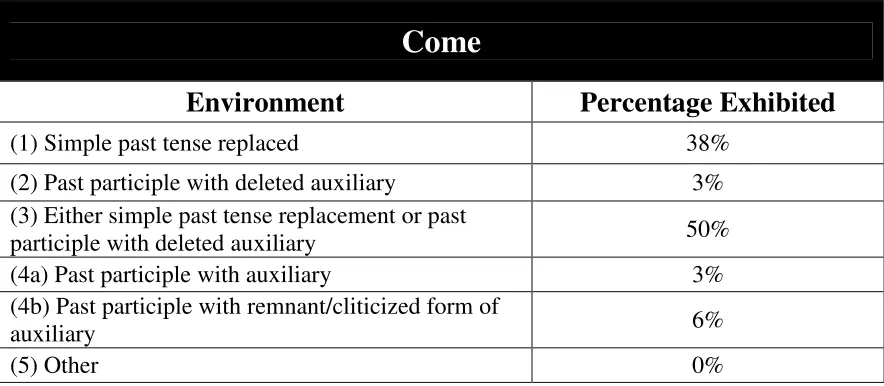
Table 3.8: Percent of Come Token Exhibited by Environment ... 15
Table 4.1: Infinitive/Past Tense Pairing Comparison... 16
Table 4.2: Conjugation of Glide in Old English ... 18
Table 4.3: Conjugation of Glide in Modern English ... 18
Table 4.4: Strong Verb Formation Examples ... 19
Table 4.5: Denison’s Dates of Grammaticalization... 27
Table 4.6: Old English Conjugation of Beon, Is, and Wesan... 31
Table 4.7: Old English Conjugation of Don... 34
Table 4.8: Old English Conjugation of Cuman... 36
Table 7.1: Recorded Environments for the Been Token... 50
Table 7.2: Recorded Environments for the Done Token ... 51
Table 7.3: Recorded Environments for the Come Token ... 52
Table 7.3 (continued)... 53
List of Figures
Figure 2.1: Speech Communities Used in North Carolina ... 3
Figure 2.2: Cherokee Sound, Abaco, Bahamas ... 6
Figure 2.3 Tristan da Cunha... 7
1 Introduction
The focus of many linguistic studies is to isolate and analyze a single feature or small set of features that help to characterize a dialect as unique. A dialect’s unique features set it apart in much the same way its community of speakers is set apart from other communities. Both have a cultural origin and historical background that shapes them and yet is also shaped by them. Understanding the features that help to make a dialect and the people who speak it unique strengthens a community’s sense of identity and legitimizes its existence and need for preservation.
For all the noteworthy differences that set one dialect uniquely apart from another, however, it is also possible to observe some features that are shared across dialects. Causes for shared features can be summed up in two possible scenarios:
(1) Traceable, historical connections exist between the dialects (e.g., contact between members of the dialect communities took place).
Or, where no direct connection can be found:
(2) A universal process is taking place within the language that creates parallel structures.
Scenario (2) is the primary focus of this study as no direct connection can be made between the dialects examined. The historical development of the parent language is crucial to
understanding the common denominator that allows dialects that are isolated from each other to evolve parallel patterns of behavior.
participle. For example, rather than saying, “I have been here for thirty years,” a speaker in one of the speech communities studied might say, “I been here for thirty years.” Likewise, instead of saying, “the water came up to here” a speaker from one of these communities might say, “the water come up to here.” In addition, as strong verbs, come, be, and do are subject to the trend of growing pressure for English strong verbs to become more like weak verbs. In general, this trend “encourages” verbs with a fluctuating core vowel (e.g.,
plead/pled) to take on fewer inflectional forms to indicate changes in tense (e.g.,
plead/pleaded).
Because the dialects being examined stem from such diverse historical backgrounds, this analysis seeks to determine how and why these three verbs came to behave the same way. What factors and trends were already in place in the English language historically that allowed these verbs to develop identical behaviors in very different, and often very isolated, dialect environments? Why did the environmental and historical factors that shaped these dialects not also cause these verbs to develop differently? Is there evidence of other, similar developments in the English language that also span multiple dialects?
To answer these questions, it is necessary to examine the behavior of come, be, and
2 Sociohistorical Context
2.1 Study Sites
This study utilizes samples from five language communities: Beech Bottom, NC; Princeville, NC; Robeson County, NC; Abaco, Bahamas; and Tristan da Cunha. These five language communities were selected for their particularly vernacular English qualities. The three dialects from North Carolina represent three major ethnic groups: Caucasian, African American, and Lumbee (Native American). The Abaco, Bahamas and the Tristan da Cunha dialects represent non-American varieties of English. This section will provide a brief overview of the sociohistorical backgrounds for these five speech communities.
2.1.1 North Carolina Speech Communities
Figure 2.1 shows the three North Carolina study sites chosen for this study: Beech Bottom, Robeson County, and Princeville.
2.1.1.1 Beech Bottom, NC
Beech Bottom is a community in northwestern North Carolina, about 35 miles southwest of Boone. Beech Bottom was settled in the 1870s and from 1900 to 1940, had a population ranging from 80 to 110 people, including African American, Anglo American, and Native American residents. The current population, however, is only about ten residents due to the closing of feldspar mines and the impact of World War II in the early 1940s.1
Beech Bottom is notable linguistically because all of its residents (Anglo American, Native American, and African American alike) have adapted their linguistic features to match those of the localized Appalachian English dialect. It was these Appalachian English features that were of greatest interest for the purposes of this study.
2.1.1.2 Princeville, NC
Princeville is located in the Coastal Plain region of eastern North Carolina, just south of the Tar River in Edgecombe County. It is the oldest incorporated Black town in the United States and was settled just after the Civil War in 1865. Originally called “Freedom Hill,” this community was renamed Princeville when it became officially incorporated in 1885, in honor of Turner Prince, a former slave who used his skills as a carpenter to help build the free community.2
Princeville continues to exist as a symbol of self-sufficiency, survival, solidarity, and pride. The town has endured racial, social, economic, and environmental challenges
throughout its existence. The African American residents of Princeville hold an
overwhelming majority (98 percent of its approximately 2,100 residents), and are singularly aware and proud of their important place in African American history in the United States.
Princeville was chosen for this study as an ideal representative of an African American speech community within North Carolina.
2.1.1.3 Robeson County, NC
Robeson County is a tri-ethnic community consisting of Native Americans, African Americans, and Anglo Americans. Historical accounts record that early Anglo settlers from the Scottish Highlands found the Native-American group, the Lumbee, speaking English when they arrived in Robeson County in the 1730s. Robeson County was also home to a group of African Americans, including both runaway and free slaves.
Historically a farming community that produced tobacco, cotton, and corn, Robeson County is moving away from agriculture into other businesses and is also home to the
University of North Carolina at Pembroke, originally an Indian normal school in the late 19th century.3
This study focuses on the Lumbee speech community of Robeson County.
2.1.2 Non-American Speech Communities
The following two non-American speech communities of Abaco, Bahamas and Tristan da Cunha were chosen as a basis for comparison with the American speech
communities in this study. Since this study proposes parallel structures among the variables being examined created by a universal feature of the language as a whole (that is, that the
variables appear across the English language as a whole), it is important to demonstrate that these variables appear in both American and non-American based dialects of English.
2.1.2.1 Abaco, Bahamas
Figure 2.2: Cherokee Sound, Abaco, Bahamas
The history of Abaco really begins with the end of the American Revolutionary War. At that time 2,500 British Loyalists and 4,000 slaves fled to the islands. Among these were a group from the Carolinas, who went first to Florida, then continued to Abaco where they settled the Cherokee Sound peninsula.
Parliament asking for financial assistance. The names on the petition included Albury, Bethel, Johnson, Pinder, Roberts, Russell, Sands, Sawyer and Sweeting. All but two of these families still reside in Cherokee today.
This study focused on the Cherokee Sound speech community because of its isolated nature among majority Black communities of the Bahamas, and because of its ties to the Carolinas.
2.1.2.2 Tristan da Cunha
Figure 2.3 Tristan da Cunha
1942, Britain established a naval station on the island, which brought significant modernization, including radio, electricity, running water, and a stable currency-based economy. The eruption of the volcano on Tristan da Cunha in 1961 caused an evacuation of the island’s inhabitants to England for two years. They returned beginning in 1963 to rebuild their community and way of life almost completely from the ground up.
3 Methodology
3.1 Sampling
The speech samples analyzed in this study come from tape-recorded sociolinguistic interviews that are part of the larger collection of recorded interviews in the North Carolina Language and Life Project (NCLLP) as well as collected recordings from Dr. Daniel Schreier from his study of Tristan da Cunha. The recordings represent speech collected primarily by allowing the speakers to comment on subjects of their choice, but also focused on creating an oral history with older interviewees.
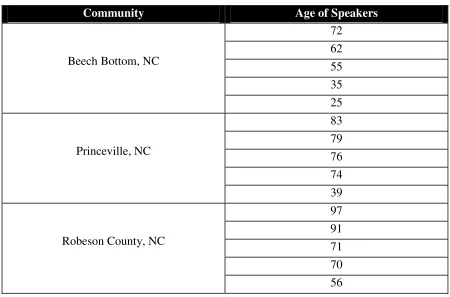
Table 3.1: Age Distribution for American Speech Communities
Community Age of Speakers
72 62 55 35 Beech Bottom, NC
25 83 79 76 74 Princeville, NC 39 97 91 71 70 Robeson County, NC
56
Table 3.2: Age Distribution for Non-American Speech Communities
Community Age of Speakers
85 80 79 57 Cherokee Sound, Abaco, Bahamas 27 77 65 59 32 Tristan da Cunha
While a few younger generation speakers were sampled in most of the communities, the majority of speakers selected were over the age of 60. This was done to maximize the amount of tokens observed, which can decrease with younger generations due to the effects of micro-variables, such as economic pressure to work outside the community and increasing access to and influence of technology, especially telecommunications technology (Wolfram 2004).
3.2 Data
Each speech sample was analyzed for occurrences of three tokens: come, been, and
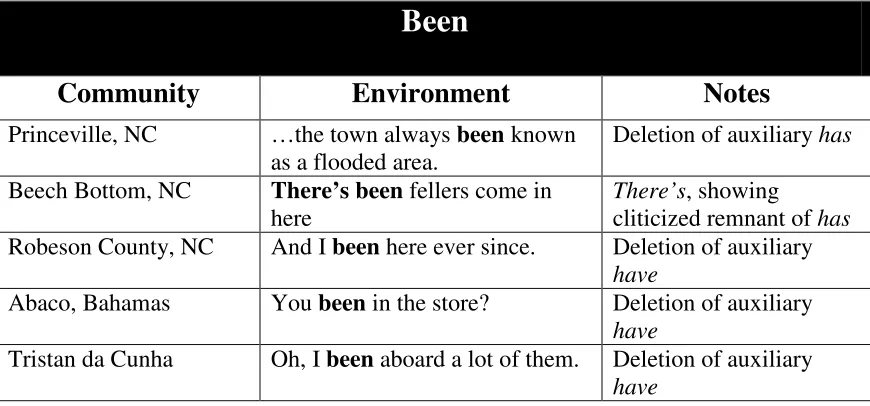
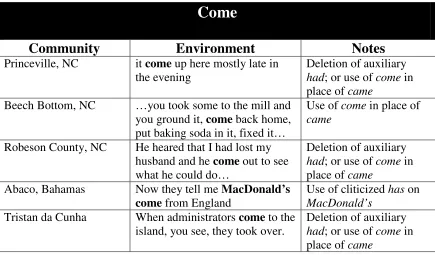
done. The environments for the occurrences of these verbs were also recorded and analyzed for comparison across the five speech communities. Tables 3.3 through 3.5 show examples for each token, from each community, along with brief comments on the behavior of the token in the example environment. (Note: tables showing all tokens collected are provided in the Appendix.)
Table 3.3: Example of Been for Each Sample Community
Been
Community
Environment
Notes
Princeville, NC …the town always been known
as a flooded area. Deletion of auxiliary has Beech Bottom, NC There’s been fellers come in
here There’scliticized remnant of , showing has Robeson County, NC And I been here ever since. Deletion of auxiliary
have
Abaco, Bahamas You been in the store? Deletion of auxiliary
have
Tristan da Cunha Oh, I been aboard a lot of them. Deletion of auxiliary
Table 3.4: Example of Done for Each Sample Community
Table 3.5: Example of Come for Each Sample Community
Done
Community
Environment
Notes
Princeville, NC And that’s exactly what I done Use of done in place of
did
Beech Bottom, NC I done it for thirty years Deletion of auxiliary
had; or use of done in place of did
Robeson County, NC And, uh, I done very good up
until uh this past August. Deletion of auxiliary had; or use of done in place of did
Abaco, Bahamas I done some farming, wedone
farming Deletion of auxiliary have; or use of done in place of did
Tristan da Cunha the people done away with theys
dogs before they left Deletion of auxiliary had; or use of done in place of did
Come
Community
Environment
Notes
Princeville, NC it come up here mostly late in
the evening Deletion of auxiliary had; or use of come in place of came
Beech Bottom, NC …you took some to the mill and you ground it, come back home, put baking soda in it, fixed it…
Use of come in place of
came
Robeson County, NC He heared that I had lost my husband and he come out to see what he could do…
Deletion of auxiliary
had; or use of come in place of came
Abaco, Bahamas Now they tell me MacDonald’s
come from England Use of cliticized MacDonald’s has on
Tristan da Cunha When administrators come to the
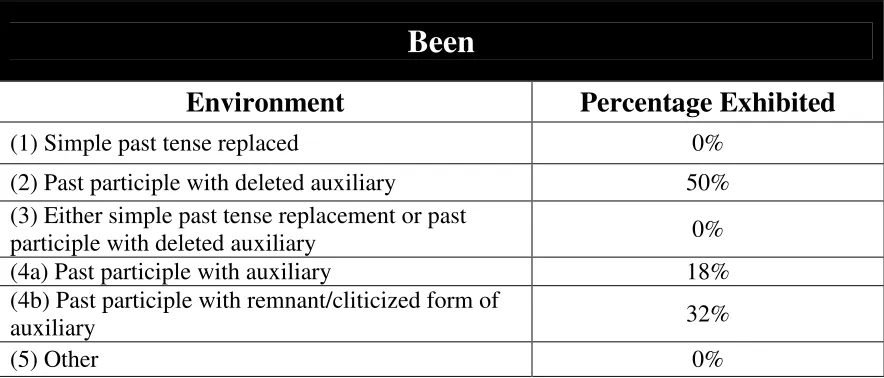
Once all tokens were noted, several common environments for occurrence were observed:
(1) Token replaced simple past tense form; past perfect was not possible in this environment.
(2) Token functioning as the past participle, with clear deletion of auxiliary; past perfect was possible and appropriate in this environment.
(3) Deletion of auxiliary was not clearly evident; token could be exhibiting 1 or 2.
(4a) Token was present with auxiliary.
(4b) Token was present with remnant/cliticized form of auxiliary.
(5) Token exhibited other use (e.g. completive done, in subjunctive construction with modals, etc.).
The distinction between 1 and 2 is particularly crucial. If a token was observed in
environment (1), it was functioning as the simple past tense marker solely. If a token was observed in environment (2), however, it was functioning as a past participle, in the past perfect, but the auxiliary was not present. In (1) the past participle is fulfilling a role it was not meant to, while in (2) it is functioning correctly in the absence of its auxiliary.
Table 3.6: Percent of Been Token Exhibited by Environment
Been
Environment
Percentage Exhibited
(1) Simple past tense replaced 0%
(2) Past participle with deleted auxiliary 50% (3) Either simple past tense replacement or past
participle with deleted auxiliary 0%
(4a) Past participle with auxiliary 18%
(4b) Past participle with remnant/cliticized form of
auxiliary 32%
(5) Other 0%
Table 3.7: Percent of Done Token Exhibited by Environment
Done
Environment
Percentage Exhibited
(1) Simple past tense replaced 20%
(2) Past participle with deleted auxiliary 0% (3) Either simple past tense replacement or past
participle with deleted auxiliary 67%
(4a) Past participle with auxiliary 0%
(4b) Past participle with remnant/cliticized form of
auxiliary 0%
Table 3.8: Percent of Come Token Exhibited by Environment
Come
Environment
Percentage Exhibited
(1) Simple past tense replaced 38%
(2) Past participle with deleted auxiliary 3% (3) Either simple past tense replacement or past
participle with deleted auxiliary 50%
(4a) Past participle with auxiliary 3%
(4b) Past participle with remnant/cliticized form of
auxiliary 6%
(5) Other 0%
Evidence of the past participle used with a deleted auxiliary is strongest for been.
4 Data Analysis: Historical Comparison
The behavior of come, been, and done documented in this study illustrates a form of analogical change, which “involves the influence of one form or group of forms on another, causing one group of forms to become more like the other” (Tserdanelis 2004). More
specifically, conforming irregular (strong) verbs to more regular (weak) verb behaviors could be described as a four-part (or proportional) analogy: x is to x’ as y is to y’. This type of analogy is responsible for “the regularization of irregular past and participle verb forms [often found] in vernacular dialects” (Wolfram & Schilling-Estes 1998). So, for example, the past tense of know has been regularized to knowed in some vernacular dialects by analogy with look/looked.
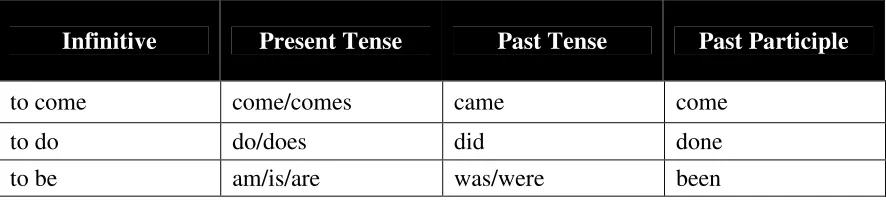
In the case of come, been, and done, this type of regularization by analogy occurs at a much broader level, conforming the entire past tense structure (not only the designated past tense marker, but also the past participle) of strong (but particularly irregular) verbs to act like their more systematic, regular weak counterparts. The result is the use of the past participle, which much more closely resembles the infinitive (and usually the present tense) than the varied past tense of these verbs in standard form. Table 4.1 illustrates this point. Table 4.1: Infinitive/Past Tense Pairing Comparison
Infinitive Present Tense Past Tense Past Participle
to come come/comes came come
to do do/does did done
To understand the cause of this cross-dialectal, analogical change impacting the past tense functionality of come, been, and done, it is first necessary to understand the nature of the root verbs themselves (come, be, and do). This section addresses the following questions in an attempt to analyze the observed data in Section 3:
• What shared characteristics have shaped the functionality of these verbs over
time?
• How do these verbs form the past tense?
• How has past tense functionality changed historically?
4.1 Defining Strong and Weak Verbs
The first important characteristic shared by come, been, and done is that they stem from irregular, strong verbs. Most irregular verbs are a type of strong verb, though some are so irregular, they can be classified into categories of their own (most notable of these are be
and go).
represents the maintenance of the suffix used for these tenses on verbs in Old English” (Christian, et al 1988).
In Standard English, the historical trend has been a regularization of strong verb forms to weak verb forms. For example, the verb glide in Old English used to be conjugated as shown in Table 4.2:
Table 4.2: Conjugation of Glide in Old English
Infinitive Preterit 3rd Singular Preterit Plural Past Participle
gl dan gl d glidon gliden
In Modern English the same verb would be conjugated as shown in Table 4.3: Table 4.3: Conjugation of Glide in Modern English
Infinitive Preterit 3rd Singular Preterit Plural Past Participle
glide glided glided glided
Table 4.4: Strong Verb Formation Examples
Infinitive
(translation)
Preterit
Sing.
Preterit Pl.
Past Part.
Modern English
Past/Past Part.
b dan (bide) b d bidon biden bided/bided
b tan (bite) b t biton biten bit/bitten
r san (rise) r s rison risen rose/risen
wr tan (write) wr t writon writen wrote/written
When one considers the mechanisms involved in learning language and how strong and weak verbs fit into that process, the tendency to want to weaken strong verbs makes sense. As Pinker and Prince (1988) note, “the past tense forms of strong verbs must be memorized; the past tense forms of regular verbs can be generated by rule.” This makes strong verbs much more susceptible to change, that is, it seems to be easier to learn regular morphological rules than lexical-specific forms. Because of this, strong verbs are more easily deleted in usage depending on the reliability of a speaker’s memory.
4.2 Shifting Role of Auxiliaries and the Past Participle
auxiliary. The significance of the observed verb forms from this study occurring as past participles can be better understood with an explanation of past participle function in Standard English.
In addition to forming passive voice and functioning as an adjective, the past
participle in Standard English functions to show an action that has been completed in the past either prior to the present (present perfect) or prior to another past action (past perfect).4 An example of present perfect construction would be I have finished my exam. In this example, the auxiliary + past participle construction is represented by have finished. An example of past perfect would be, I had gone to the store, then I realized I forgot my shopping list. In this example, the auxiliary + past participle construction is represented by had gone. In either perfect construction, the accompanying auxiliary provides the inflection for the past participle.
Using the auxiliary + past participle construction for past tense marking continues the pattern of movement from strong to weak formation. A verb that formerly showed tense via a change in core vowel (or other prominent part of the word) now shows little change within the verb itself, relying instead on the auxiliary to show tense. The verb itself is able to remain more static (weak) in nature with a reduced number of inflectional changes, while the
auxiliary takes on the burden of changing for inflection. In a language system undergoing reduction of inflectional usage, a smaller number of auxiliaries changing for tense marking would be much more acceptable than a large number of main verbs changing.
A number of studies have examined the shifting role of auxiliaries and their
importance in tense marking in light of declining inflectional usage (Pollock 1989; Ellegård
1953; Chomsky 1957, 1989; Kroch 1989). These studies support the idea of a hierarchy of verb application in which three processes are observed, listed here in the order of universally preferred occurrence (Battistella 1991):
(1) Verb fronting: Proximity of the verb to its subject/object is used for indicating tense and agreement.
(2) Inflectional movement: Tense and agreement rely more on changes in inflectional endings.
(3) Auxiliary support: An inflected auxiliary is inserted to indicate tense and agreement.
Any given language may exhibit one or more than one of these processes of inflection; however, as this hierarchy applies to English, use of auxiliaries to indicate tense and agreement falls into a “last resort” category.
Between Old English and Modern English, a restructuring of the verb application hierarchy5 took place, shifting the importance of tense marking away from inflection and toward syntax. “[T]he loss of the verbal inflectional system as a whole…led to a parametric change in the grammar whereby morphological agreement was replaced by syntactic
agreement” (Nagle 1989). The emphasis on inflection of the main verb as the key indicator of tense and number became overshadowed by the indicators found in a phrase as a whole. To facilitate this change, the focus on tense marking needed to shift from the verb itself (both by its location and its inflectional markers) to an auxiliary (the last available choice in the hierarchy in the absence of verb fronting and inflectional movement).
Auxiliary do in particular has been the subject of several auxiliary studies as an example of how auxiliary function has changed over time.6 It is one example of how auxiliaries in general increased in usage, taking on almost every functional role of inflected main verbs between Old and Middle English, before their usage was finally reduced to their present day functionality between Late Middle English and Early Modern English. Kroch (1989) examined the use of auxiliary do historically and found that “the increase in do use proceeded at the same rate in different syntactic contexts (questions, negatives, etc.) and that
do use is quantitatively connected to the loss of VF [verb fronting]” (Battistella 1991). In short, a restructuring took place in which auxiliaries filled a functional role to fulfill the need to weaken verbs. Examples (a) through (d) illustrate this restructuring:
(a) Have you the book? (b) Do you have the book? (c) He went not to the village. (d) He did not go to the village.
In both (a) and (c), the main verb is well to the front of the sentence and in (c) the verb has also been conjugated to its strong past tense, which of course is morphologically very different from the root verb go. In (b) and (d), however, by using auxiliary do/did the main verb remains unchanged, uninflected, and weak.
Dekeyser (1992) proposed a theory for the origin of periphrastic (auxiliary) do, again as a model for the origin of other auxiliaries exhibiting more prominent usage. While
Dekeyser affirms the origins of periphrastic do in written accounts from Late Middle English, he proposes that these written accounts may reflect a trickle down effect from much earlier,
during the years following the Norman Conquest. In Dekeyser’s model, “upper and upper-middle class prestigious L2 [English as a second language] speakers…had adopted a periphrastic do rule, and…following their increasing integration into the English-speaking population…this rule percolated into the spoken and written language of the educated native speaker.” He points to modern studies of L2 adults and children to support this possible theory as a form of hypercorrection (see examples (e) and (f) below). In essence, using do as an auxiliary allows the speaker to postpone or completely avoid having to select the
appropriate conjugation of the verb. The L2 speaker needs to remember only the conjugation of the auxiliary do,for example:
(e) [Where did you buy it?] L2 speaker: I did buy it in…
(f) [How much does it cost?] L2 speaker: It do cost seventeen marks.
Dekeyser describes the development of periphrastic do as an “exaptation”: a structure that arose for one function and adapted for use in another function. In essence, do and other auxiliaries potentially arose as a functional element for L2 speakers of English. Speakers used auxiliary do to weaken verbs requiring inflected endings, and make the transition from their native language (in this case French) to English easier. As the French speaking
Normans integrated more into English speaking society, however, do began to lose its L2 functionality. It became the object of only marginal use, but eventually was reintegrated, first in interrogative (e.g., Do you know him?) and negative (e.g., I do not know him.) sentences, and finally in affirmative sentences (e.g., I do know him.). Dekeyser links this progression of
to place the subject after the main verb and to separate an object from its main verb. Auxiliaries (such as do) allowed these word-order constraints to be maintained.7
A study conducted by Hawkins and Liszka (2003) illustrates a slightly different approach to the concept of L2 speakers weakening verbs. Though not focused on auxiliary use, their study maintains the overall premise that L2 speakers will sometimes adapt the rules of the second language, whether it is to simplify learning or to mold the second language into the rules of their primary language.
Hawkins and Liszka observed Chinese, Japanese, and German advanced L2 speakers of English to study how each group applied past tense marking on verbs (regular and
irregular) in both written tests and oral recordings. They discovered that “Chinese informants do mark simple past tense optionally in oral production…but the Japanese and German speakers are significantly less likely to do so.” The authors tested each group for proficiency and determined that the optional past tense marking was not a reflection of a lack of
understanding. Chinese speakers were as proficient as Japanese or German participants at past tense marking for regular and irregular verbs in written tests. What the authors suggest is that for the Chinese language, there is no syntactic past tense marking feature, but rather a context-based tense marker. So for Chinese, marking a verb to indicate tense is not necessary because meaning can be derived based on context. The observed result was that Chinese speakers often used the bare root (infinitive) form for a verb rather than the inflected past tense form (e.g., The police caught the man and take him away.). On the other hand,
Japanese and German, like English, do utilize a past tense marking feature on the verb. So for these languages, as with English, past tense marking is not optional for meaning.
The authors were able to rule out what they referred to as “performance pressures” as a cause for optional past tense marking in oral production tests. They observed that while past tense marking was made optional, Chinese speakers were accurate where they did use past tense marking, and successfully used more complex constructions (such as past participles) correctly. The explanation that the authors offer is that “where parametrised syntactic features are not present in the speaker’s L1, they will not be accessible in later L2 acquisition.” Since Chinese allows the option of not marking for tense and rather, relying on context for specific verb meaning, L2 Chinese speakers of English tend to apply this
optionality to English verbs. Along these lines, where Chinese speakers did use past tense marking in oral production, the authors attribute this to the speakers “monitoring” verbs in context and assigning past tense marking based on the “pastness” of the overall discourse context.
but rather—since very late Old English—always with have.” In short, in cases where a cliticized auxiliary form is present for the past perfect, it is almost certainly a cliticized form of have.
Another important point that Denison makes is that there is a certain order in which auxiliaries are added to a phrase, beginning with the addition of one auxiliary, up through three or more. He notes that “auxiliaries are added on at the left, at the tensed end of the verbal group” so that in a construction such as is/was being sung, the addition of an auxiliary would result in has been being sung. An alternative production might be has been sung
Table 4.5: Denison’s Dates of Grammaticalization
Auxiliary
Grammaticalization
Modals and onginnan Already in Old English
Perfect have Already in Old English
Periphrastic do Fourteenth-fifteenth centuries Passive be Fourteenth-eighteenth centuries (?) Progressive be Late eighteenth century (?)
Passive get Twentieth century and continuing
In general, the earlier a development has taken place, the more likely it is to be used first to accomplish a particular functional goal. In this case, perfect have developed as an auxiliary prior to progressive be; therefore, it is more likely that the verbs were exchanged than that an additional participle was added.
In summary, the major points to remember regarding the focus verbs for this study are as follows:
• Verb application hierarchy was restructured to place emphasis on auxiliary support instead of verb fronting and inflectional movement.
• Auxiliary usage may have developed as a function of L2 users and in response to word-order constraints that arose requiring the subject to come before the main verb and an object to not be separated from its corresponding main verb.
• Perfect (present and past) almost exclusively uses have/has as its auxiliary, to the
• Auxiliaries were added historically from the left within a phrase and developed in
a particular order, some of the oldest of which were perfect have, periphrastic do, and passive be.
All of these developments in auxiliary usage set the stage for weakening the simple past tense by using the auxiliary + past participle construction. The remaining aspect of the occurrences of come, been, and done observed in the five study dialects is the deletion of this established auxiliary. Clues to the mechanism of this deletion can be found by examining how come, be, and do have changed between Old, Middle, and Modern English.
4.3 Variables in Context
Modern scholars of Old English (dated roughly from AD 449-1100) categorized the strong verbs into seven major classes. These classes are mostly separated based on the present tense stem vowel. For all seven classes, there are four principle parts: the infinitive, the preterit singular, the preterit plural, and the past participle (Cassidy and Ringler 1971).
The Middle English period (dated roughly from AD 1100 to 1500) saw a reduction of these four principle parts to three, in which the preterit singular and preterit plural adopted the same vowel gradation. There was also a dramatic reduction in the number of strong verbs, many becoming weak, but a large number of them disappeared from use completely.
The fourteenth century marked the peak for the strong to weak shift. Following this period, the shift continued at a much slower pace. Smith (2000) summarizes the significance of this shift when she observes, “Of approximately 360 strong verbs that existed in Old English…80 are retained in present day Standard English.”
principle dialects were spoken in Anglo-Saxon England: Kentish, West Saxon, Mercian, and Northumbrian. During the ninth century, the Norse (who included Danes, Norwegians, and Swedes) began invading and occupying the four kingdoms of Northumbria, Mercia, Wessex, and East Anglia. While the initial goal of these invasions was largely to pillage and loot, a good deal of integration and settlement resulted. By the tenth and eleventh centuries, Norse invaders seemed much more interested in colonization, eventually settling down peaceably with the English. This integration occurred somewhat seamlessly (aside from the inherent bloodshed brought by the invasions), assisted by the similarities between Old English and Old Norse. But Old Norse did impact Old English verbs. While both Old Norse and Anglo-Saxon were Germanic in origin, Old Norse differed in its inflectional endings: namely it had fewer.
The Norman Conquest brought another significant impact to the English language. In 1066, at the Battle of Hastings, the English king, Harold, was defeated by the Normans, under the leadership of William the Conqueror. The Normans were descended from
Scandinavian settlers to France (their name stemming from the Old French form of the word “Northmen”). In only five generations between the first duke of Normandy (William’s great-great-great grandfather, Rollo) and William himself, the Normans had culturally and
English word order to subject-verb-object and additional loss of inflectional endings. Both of these changes were gradual and varied from region to region, but they helped to push forward the movement from a more inflected case system to a simpler case system seen in Modern English (Mitchell and Robinson 2001).
As strong verbs, come, be, and do were at the heart of these drastic changes in verb function. The following sections will examine each of these verbs in more detail as they developed historically.
4.3.1 Development of Been
Table 4.6: Old English Conjugation of Beon, Is, and Wesan8
Case Number Present Preterit
ic:I eom b o wæs
þ :you, thou
eart bist w re
Sing.
h , hit, h o: he, it, she
is bið wæs
Indicative
Plur. we, ge, hie: we, you, they
sind, sint,
sindon b oð w ron
Sing. s e, s , s o b o w re Subjunctive
Plur. s en, s n b on w ren Sing. b o, wes
Imperative
Plur. b oð, wesað
Participle b onde, wesende
While there was a past tense in Old English (formed by w s, w re, and w ron), there
was no past participle. It wasn’t until about the twelfth century that the first documented occurrences of the be past participle (which notably took the beon form rather than either the
is or wesan forms) appear in literary sources, as shown in Figure 4.1:
Figure 4.1: Timetable for Appearance of the past participle of Be in Literary Sources9
In Old English, beon (as its own distinct verb) had all the present tenses, but no past tenses. Its meaning was slightly different than the Modern English “to be,” meaning instead “become” or “come to be.” As such, beon often served as the future tense for is/wesan. An important transition took place, however, such that by the beginning of the thirteenth century, parts of be took the place of the infinitive, participle, imperative, and subjunctive forms of
is/wesan. This effectively merged the three Old English stems into one Middle English verb. Wherever been occurs in literature historically, functioning as a past participle, it is always accompanied by an auxiliary (usually has/have/had), as shown in the following examples (which demonstrate past perfect):
(1) Vche mon þat he mette, he made hem a þonke/ For his seruyse and his solace and his sere pyne,/ Þat þay wyth busynes had ben aboute hym to serue;
[Each man that he met, he gave them his thanks/ For his service and his kindness and his individual trouble,/ Those whom with solicitude had been about to serve him (Sir Gawain and the Green Knight, lines 1984-1986)]
(2) At mortal batailles hadde he been fiftene,/ And foughten for oure feith at Tramyssene/ In lystes thries, and ay slayn his foo.
[At mortal battles had he been fifteen/ and fought for our faith at Tramyssene (Tlemcen)/ in formal duels three times, and always slain his foe. (Canterbury Tales, General Prologue, lines 61-63)]
As a past participle, been required an auxiliary and did not function as a simple past tense replacement (which would not be necessary since be had a viable past tense marker in wesan, and later, was). This pattern has continued into Modern English in that been as the past participle requires an auxiliary.
The data presented in section 3.2 likewise supports this pattern in the vernacular environments observed for this study. The majority of tokens for been were categorized as exhibiting the past participle with a deleted auxiliary, with the second largest number of tokens showing either a remnant/cliticized form of the auxiliary or the whole auxiliary. This indicates that while the auxiliary requirement for been has survived to Modern English, vernacular usage is less reliant on the presence of the auxiliary for the past participle to function. Less reliance on the inflected auxiliary could indicate leveling (and thereby
weakening) of been to more closely mimic the infinitive and other forms of the original beon, which remained in circulation along with am/is/are until as late as the seventeenth century.
4.3.2 Development of Done
Table 4.7: Old English Conjugation of Don10
Case Number Present Preterit
ic:I d dyde
þ :you, thou
d st dydest
Sing.
h , hit, h o: he, it, she
d ð dyde
Indicative
Plur. we, ge, hie: we, you, they
d ð dydon
Sing. d dyde
Subjunctive
Plur. d n dyden
Sing. d
Imperative
Plur. d ð
Participle d nde d n
As with been, the literary record for done shows it being used with an auxiliary when used as a past participle:
(1) Bi þat þe diner watz done and þe dere vp/ Hit watz ne3 at þe niy3t ne3ed þe tyme. [By the time dinner was done and the noble [Sir Gawain] was up from the table/ nighttime had drawn near. (Sir Gawain and the Green Knight, lines 928-929)]
The majority of tokens for done in section 3.2 are categorized as exhibiting simple past tense replacement or past participle with a deleted auxiliary, with no definite indication in most cases that the token is solely exhibiting one of these behaviors over the other.
The requirement for an auxiliary accompanying the past participle has survived in Modern English for done as it has for been. The results of this study, however, suggest that done is
more acceptable in vernacular usage without the auxiliary (either whole or as a remnant/cliticized form) than been.
Once again, the explanation can be found in leveling done with the infinitive do and the present tense (neither of which require an auxiliary to function). Replacing a viable past tense form (did) with the past participle, with or without its auxiliary, further reduces what inflection remains in the endings for do, and further drives this verb toward a weaker format.
4.3.3 Development of Come
Table 4.8: Old English Conjugation of Cuman11
Case Number Present Preterit
ic:I cyme c m
þ :you, thou
cymest c mest
Sing.
h , hit, h o: he, it, she
cymeð c m
Indicative
Plur. we, ge, hie: we, you, they
cumað c mon
Sing. Cume c me
Subjunctive
Plur. Cumen c men
Sing. Cum
Imperative
Plur. Cumað
Participle Cumande cumen, cymen
The paradigm shown in Table 4.7 does not represent the sole, definitive forms of
cuman. There was a great deal of variation in spelling depending on dialect/regional
differences, especially during the Middle English period. For example, before AD 1100, the infinitive form was cuman; however, between AD 1200 and AD 1400, the infinitive form
was cumen. Another major variation was in the core vowel, which was spelled as y, u, o, or .
For example, the present indicative, third person singular form appeared in literature as cym ,
cymme , cume , and cometh between AD 1100 and AD 1300. The preterit indicative, third
person singular appeared in literature as cw m, cu m, c m, and coom between AD 1100 and
AD 1500. Aside from regional differences, one of the main reasons for this level of variation
in the written record was the tendency of Middle English scribes to use short o for u before
m, n, and u (or v). Scribes also tended to use short o in place of the long in the past tense.
These written variations are not indicative of a change in pronunciation, but they should be noted when considering conjugations of cuman in Old and Middle English literary sources.12
Of particular interest for the purposes of this study are the transitions that took place in the past participle and past tense of cuman between AD 1100 and AD 1500. Taking into consideration the variations in the core vowel, as mentioned above, the past participle existed in three major forms between the twelfth and nineteenth centuries: cumen (forms ending in
n); cum, ycome, come (forms without the n ending); and cummed, com’d (forms exhibiting the weakened past participle, ending in ed/d). Beginning in the thirteenth century, the past participle cumen showed a loss of word-final n. This loss was especially prevalent in forms of the word appearing with the y prefix, so that ycomen became ycome. The form that
resulted was eventually leveled with the infinitive and would go on to be standardized as the Modern English form come. Before this standardization, however, there was a period during the sixteenth and seventeenth centuries in which the tendency was to conform the past participle to the weakened conjugation, comed, which became established dialectally, for example south of Scotland. While full weakening to an -ed ending did not survive to Modern English, leveling the past participle to match the infinitive still shows considerable
weakening of the verb over time.
Coinciding with the changes in the past participle, the past tense also existed in three major forms, but had all but completed its final transition by the early sixteenth century. The
three past tense forms were cuom/cuomon, c m/c mon, and cam/camen. The final of these
three forms represents a change in the core vowel that originated in northern dialects of English and made its way gradually into the other dialects until it had all but replaced the
previous c m/c mon form. Smith (2000) notes “The form came entered the language in the
thirteenth or fourteenth century in more northern varieties of Middle English, and in southern varieties, even later, around the fifteenth century.” The earlier form remained prevalent in Midland and Southern dialects, but appeared very little in literary contexts beyond AD 1500.
Though came eventually replaced come for the simple past tense marker, it is possible
that dialectal retention of the earlier c m form would have persisted to Modern English.
Given the transitions in both the past participle and the past tense, and the leveling of the past participle to a form that closely resembles the former past tense form (though it arrived at this form by different means), it is not difficult to understand why Modern English dialects might use come as the past tense marker. As with done, this is in fact what is reflected in the data for come in section 3.2, as the majority of tokens were categorized as exhibiting either simple past tense replacement or past participle with deleted auxiliary.
4.4 Parallel Analogical Constructions
4.4.1 Negation and the Auxiliary
While it is helpful to understand the causes of auxiliary deletion within the
parameters of the tokens observed in this study, it is equally helpful to see similar processes at work in other environments to support the notion that such processes can and do occur. As part of her overall study of Scottish English, Jennifer Smith (2000) examines negation historically and in Scottish English, particularly the dialect of the small fishing town of Buckie. Smith notes four points of development in English negation:
(2) Appearance of noht post-verbally (coexisting with ne) (3) Use of post-verbal noht only
(4) Insertion of auxiliary do and re-introduction of a pre-verbal negative particle, not. She also observes, however, that there was a brief period in which the negative particle noht
was used in the preverbal position without auxiliary do.
As Smith’s study reveals, Scottish English shows interesting developments with negation in which the do that developed in English as a whole also developed in their negation; however, in Scottish English, this inserted auxiliary disappears. The result is negation marked in some (but not all) instances with only a pre-verbal na without the auxiliary do. In essence, Scottish English underwent the developments outlined in (1) through (4), then reverted to the final “intermediate” stage, in which do was deleted.
Smith attributes this deletion to syntactic influence in which the presence or deletion of do depends entirely on the syntactic environment: at times dependent on the type of subject and at times dependent on the person and number of the subject. For example, Smith observes that do absence is particularly high for the first person singular of the verbs she studied, while third person singular tends to include do.
While the cause and environment for Smith’s data is different from those of this study, the overall phenomenon is the same:
(1) A structure was created for a particular function. (2) An auxiliary was inserted to support that function. (3) The auxiliary was deleted as an optional support.
5 Conclusions
5.1 Summary of Findings and Analysis
This study has observed, and set out to explain, the apparent use of past participle verb forms with deleted auxiliary to mark the simple past tense. The tokens come, been, and
done were recorded by occurrence and environment across five dialects of English, three American (Beech Bottom, NC; Princeville, NC; Robeson County, NC) and two non-American (Abaco, Bahamas; and Tristan da Cunha). Five common environments were observed as a result:
(1) Token replaced simple past tense form; past perfect was not possible in this environment.
(2) Token functioning as the past participle, with clear deletion of auxiliary; past perfect was possible and appropriate in this environment.
(3) Deletion of auxiliary was not clearly evident; token could be exhibiting 1 or 2.
(4a) Token was present with auxiliary.
(4b) Token was present with remnant/cliticized form of auxiliary.
(5) Token exhibited other use (e.g. completive done, in subjunctive construction with modals, etc.).
represented by a past participle where it normally, grammatically would not appear. For
been, there was a strong occurrence of deleted auxiliary, followed closely by evidence of a remnant form of the auxiliary: either the auxiliary was still completely present or a remnant, cliticized form was present. For done, there was a strong occurrence of replacement of the simple past tense, with ambiguous evidence of auxiliary deletion (environment (3)). For
come, there was some evidence of the cliticized form of the auxiliary, as well as some evidence that the auxiliary was still present, but overall, there was a strong occurrence of replacement of the simple past tense, with ambiguous evidence of auxiliary deletion (again, environment (3)).
The results of this study are in line with the historical development of these tokens. The auxiliary should be more evident for been since be required (and continues to require in Modern English) the presence of an auxiliary wherever the past participle was used. As this study demonstrated, vernacular usage is less reliant on the presence of the auxiliary for the past participle to function. Less reliance on the inflected auxiliary could indicate leveling (and thereby weakening) of been to more closely mimic the infinitive and other forms of the original beon.
Likewise for do an auxiliary was required historically whenever done was used to form the past participle; however the results of this study suggest that done is more acceptable in Modern English vernacular usage without the auxiliary than been. Again, leveling with the infinitive and present tense can be used to explain these results as neither infinitive nor present tense require an auxiliary to function. The end result, replacing a viable past tense form (did) with the past participle, with or without its auxiliary, is reduced
The history of come, while not as straightforward as that of been and done, also shows this pattern of weakening via leveling of the past participle to resemble the infinitive and present tense. The simple past tense and past participle for come both underwent significant structural changes between Old and Modern English to the extent that the past participle developed into a form that closely resembled a past tense form for come that no longer exists today. Dialectal retention of come as a simple past tense marker (which would not require an auxiliary to function) makes sense in light of the historical development of these two parts of the verb come. The data generated from this study, showing a majority of tokens exhibiting either simple past tense replacement or past participle with deleted
auxiliary, also supports the explanation that come has been leveled historically to a weakened format.
The overall pattern of development for auxiliaries helps to solidify the mechanism for their deletion in modern vernacular environments. Recall that Smith (2000) observes the following progression:
(1) A structure was created to fulfill the past tense function. (2) The auxiliary was inserted to support that function. (3) The auxiliary was deleted as it became optional support.
Movement overall among these and all English verbs has been from strong to weak, and the deletion of the auxiliary reflects this. The auxiliary was inserted to make strong verbs weaker, but the momentum for change to weaken strong verb forms carried the process further until the historically optional auxiliary (the only remaining inflected part of the verb phrase for these strong verb, past tense constructions) was itself deleted in favor of the uninflected, past participle functioning as simple past tense marker. In the case of the Smith (2000) study, the mechanism for deletion of the auxiliary was syntactic pressure making the auxiliary optional. For this study, the mechanism is the pressure to move toward increasingly weak constructions. The net result, however, is identical: the auxiliary is at first optional, but ultimately becomes obsolete, subdued by the greater force of strong-to-weak movement.
5.2 Further Study
In order to keep the scope of this study within reason, three tokens that appeared commonly across all five dialect communities examined were chosen and analyzed for shared characteristics and patterns of development historically. Outside of been, done, and
come, however, there were several other verbs, strong and weak, that exhibited shared characteristics and behaviors across all of the dialects. Given a greater amount of time and resources, continuation of this study to encompass a broader look at cross-dialectal behaviors among verbs would be worthwhile.
6 References
Battistella, Edwin. "On Verb Fronting, Inflection Movement, and Aux Support." Canadian Journal of Linguistics 36, no. 3 (1991): 255-67.
Benson, Larry D. and Edward E. Foster, ed. King Arthur's Death: The Middle English
Stanzaic Morte Arthur and Alliterative Morte Arthure. Kalamazoo: Medieval Institute Publications, 1994.
Cassidy, Frederic G. and Richard N. Ringler, ed. Bright's Old English Grammar and Reader. 3 ed. New York: Holt, Rinehart and Winston, Inc., 1971.
Chomsky, Noam. "Some Notes on the Economy of Derivation and Representation." MIT Working Papers in Linguistics 10 (1989): 43-74.
———. Syntactic Structures. The Hague: Mouton, 1957.
Crampton, Georgia Ronan, ed. The Shewings of Julian of Norwich. Kalamazoo: Medieval Institute Publications, 1994.
Dekeyser, Xavier. "Periphrastic Do in Late Middle English and Modern English Revisited."
Leuvensche bijdragen 81, no. 1-3 (1992): 101-11.
Denison, David. "Combining English Auxiliaries." In Pathways of Change:
Grammaticalization in English, edited by Olga Fischer, Anette Rosenbach, and Dieter Stein, 111-47. Amsterdam: John Benjamins, 2000.
Donaldson, E. Talbot, et al. The Norton Anthology: English Literature, the Major Authors. 6th Ed. New York: W. W. Norton and Company, 1996.
Hawkins, Roger and Sarah Liszka. “Locating the Source of Defective Past Tense Marking in Advanced L2 English Speakers.” In The Lexicon-Syntax Interface in Second
Language Acquisition, edited by Roeland van Hout. Amsterdam: John Benjamins, 2003.
Joseph, Brian D. and Richard D. Janda, ed. The Handbook of Historical Linguistics. Malden: Blackwell Publishing, 2003.
Kroch, Anthony. "Function and Grammar in the History of English: Periphrastic Do." In
Language Change and Variation, edited by Ralph Fasold. Amsterdam: John Benjamins, 1989.
Merriam-Webster Online Dictionary.2004. http://www.merriam-webster.com (accessed 2006).
Mitchell, Bruce and Fred C. Robinson. A Guide to Old English. 6 ed. Malden: Blackwell Publishing, 2001.
Nagle, Stephen. "Quasi-Modals, Marginal Modals, and the Diachrony of the English Modal Auxiliaries." Folia Linguistica Historica 9, no. 2 (1989): 93-104.
Oxford English Dictionary. 2nd Ed. 1989. In OED Online,ed. J. A. and E. S. C. Weiner Simpson. Oxford University Press, http://dictionary.oed.com. (accessed 2006). Pinker, S. and A. Prince. "On Language and Connectionism: Analysis of a Parallel
Distributed Processing Model of Language Acquistition." Cognition 28 (1988): 73-193.
Pyles, Thomas and John Algeo. The Origins and Development of the English Language. 4 ed. Orlando: Harcourt College Publishers, 1993.
Schreier, Daniel. Isolation and Language Change: Contemporary and Sociohistorical Evidence from Tristan Da Cunha English. Houndmills: Palgrave Macmillan, 2003. Smith, Jennifer. "Synchrony and Diachrony in the Evolution of English: Evidence from
Scotland." Dissertation, University of York, 2000.
Tserdanelis, Georgios and Wai Yi Peggy Wong, ed. Language Files. 9 ed. Columbus: The Ohio State University Press, 2004.
Wolfram, Walt "Language Death and Dying." In The Handbook of Language Variation and Change, edited by J.K. Chambers, Peter Trudgill, and Natalie Schilling-Estes, 764-87. Malden: Blackwell Publishing, 2004.
7 Appendices
The following tables list the recorded environments for the been, done, and come
Table 7.1: Recorded Environments for the Been Token
Been
Environment
Notes
…the town always been known as a
flooded area. Deletion of auxiliary has I always been a community person
with the organization that I work for… Deletion of auxiliary have I been here since ‘60… Deletion of auxiliary have
I been around Princeville… Deletion of auxiliary have
and I been in this area… Deletion of auxiliary have
I been sick over it… Deletion of auxiliary have
I’m been here 85 years I’m in place of I’ve [I have]
cause I’m been here the longest I’m in place of I’ve [I have]
You been in the store? Deletion of auxiliary have
but I am been to the colored woman am in place of have
There’s been fellers come in here There’s, showing cliticized remnant of
has
And I been here ever since. Deletion of auxiliary have
I asked ‘em had they been up there… Presence of auxiliary had
She says, “Yes, ma’am, we been up
there and we can’t find it.” Deletion of auxiliary have ‘Cause my children’s always been my
heart, and my grandchildren. They’re just as close to me as my heart.
Children’s, showing cliticized remnant of has
So one day I gone by there; I forgot
where I had been. Use of auxiliary had I’ve been to school, and it’d be so cold
when you’d get there, you couldn’t even unbutton your coat hardly.
Use of cliticized auxiliary have
I been talking to some people in the
last couple months. Deletion of auxiliary have But it would have been a bit
expensive. Use of auxiliary have
But there just encyclopedia’s there that’s been there since we’ve been there.
Use of cliticized has on that’s; use of cliticized auxiliary have
And nothing’s been done about it. Use of cliticized l has on nothing’s
Table 7.2: Recorded Environments for the Done Token
Done
Environment
Notes
You done lost everything Done used emphatically (e.g., you did lose everything)
And that’s exactly what I done Use of done in place of did
I done some farming, wedone farming Deletion of auxiliary have; or use of
done in place of did
That’s all he ever done Use of done in place of did
I done it for thirty years Deletion of auxiliary had; or use of done
in place of did
All you done was rode it a couple
times… Use of have donedone in place of would do/would
He done all right in it. Use of done in place of did
…but when you done the wrong thing,
the teacher’d eat you up. Deletion of auxiliary in place of did had; or use of done
Done a lot of hard work and I done a
lot of easy work. Deletion of auxiliary I have; deletion of auxiliary have in understood have; or use of done in place of did
That’s the way my daddy done. Deletion of auxiliary had; or use of done
in place of did
And I got up when it done that and I said, “Well stay right there if you want to and I’m going to shoot right out the window.”
Deletion of auxiliary had; or use of done
in place of did
First year I was there, I done pretty good and was awarded the president’s ring of honor.
Deletion of auxiliary had; or use of done
in place of did
And then I had another song that done
very well. Deletion of auxiliary in place of did had; or use of done
And, uh, I done very good up until uh
this past August. Deletion of auxiliary in place of did had; or use of done
At that time, they, you know, they done