PROJECT-BASED LEARNING FRAMEWORK FOR NON-TECHNICAL SKILLS
MUHAMMAD KHAIR BIN NOORDIN
A thesis submitted in fulfilment of the requirements for the award of the degree of
Doctor of Philosophy (Technical and Vocational Education)
Faculty of Education Universiti Teknologi Malaysia
Special dedication to my beloved parents,Noordin bin Atan and Kamsiah binti
Sumiran, my sweety wife, Nur Asilah Abd Ghafar, my cuppy cake son, Mukhlis ‘Afy
Muhammad Khair, my dearly parents-in-law, Abd Ghafar bin Tahir and Latifah binti
Ahmad, my brothers and sisters who have encouraged, guide and inspired me
ACKNOWLEDGEMENT
All praise to the Almighty Allah, the Most Gracious, Most Merciful and Most Benevolent for giving me an opportunity to pursue my higher education and giving me strength and patience in completing my doctorate research.
I would like to express my deepest gratitude towards my doctorate supervisor, Dr. Mohd Safarin bin Nordin who has persistently and determinedly assisted me during the research. It would be very arduous to complete this project without his passionate support, guidance and encouragement.
My utmost thanks also goes to my family who has given me their support and care throughout my academic years. Without them, I might not be able to become who I am today. My fellow friends should also be recognized for their continuous support and acknowledgement. My sincere appreciation also extends to my entire colleagues and my friends who have provided assistance at various occasions. Their views and tips are definitely useful.
ABSTRACT
ABSTRAK
TABLE OF CONTENTS
CHAPTER TITLE PAGE
DECLARATION ii
DEDICATION iii
ACKNOWLEDGEMENT iv
ABSTRACT v
ABSTRAK vi
TABLE OF CONTENTS vii
LIST OF TABLES xiii
LIST OF FIGURES xix
LIST OF ABBREVIATIONS xxi
LIST OF APPENDICES xxii
1 INTRODUCTION
1.1 Introduction 1
1.2 Background of Problem
1.2.1 The needs for non-technical skills among engineers 3 1.2.2 Non-technical skills development for
engineering students 7
1.2.3 Changes needed in engineering education 9 1.2.4 Project-Based Learning for Engineering
Education 12
1.2.5 Preliminary Study
Analysis 19 1.2.5.3 Preliminary Study Discussions 24
1.3 Statement of the Problem 26
1.4 Objectives of the Research 28
1.5 Research Questions 28
1.6 Significance of the research 30
1.7 Scope of the problem 31
1.8 Operational definitions 33
1.9 Conclusion 37
2 LITERATURE REVIEW
2.1 Introduction 39
2.2 Theoretical Framework 39
2.3 Non-Technical Skills Improvement from
Constructivist Viewpoint 46
2.4The need for non-technical skills for
engineering graduates in the workforce 48
2.4.1 Communication Skills 49
2.4.2 Problem Solving Skills 52
2.2.3 Teamwork skills 55
2.2.4 Lifelong learning skills 57
2.2.5 Ethics 59
2.5 Need of changes in engineering education 61 2.6 Definition of non-technical skills 63 2.7 Past related study on non-technical skills
development 66
2.8 Definition of Project-Based Learning (PjBL) 72 2.8.1 Learning process of Project-Based
Learning 77
2.9 Effectiveness of PjBL 79
in UTM 81 2.11 Ministry of Education (MOE) non-technical
skills development model 84
2.12 Conclusion 92
3 METHODOLOGY
3.1 Introduction 93
3.2 Research design 93
3.3 Population and Sample 97
3.4 Research Instruments 102
3.4.1 Quantitative research instrument 103 3.4.1.1 Non-technical Skills Self-
assessment Questionnaire 103 3.4.2 Qualitative research instrument 106
3.4.2.1 Interview 106
3.4.2.2 Observations 107
3.5 Validity and Reliability Test 108
3.5.1 Quantitative instrument validity and
reliability test 109
3.5.2 Qualitative instrument validity and
trustworthiness test 110
3.6 Research operational Framework 109
3.7 Data collection 111
3.7.1 Quantitative data collection 113 3.7.2 Qualitative data collection 114
3.8 Data Analysis 114
3.8.1 Quantitative data analysis 114 3.8.2 Qualitative data analysis 115
4 RESULTS AND FINDINGS
4.1 Introduction 120
4.2 Data Analysis 120
4.2.1 Respondents Demographic 121
4.2.2 The Findings of Research Question
(1) and (2) 122
4.2.3 The Findings of Research Question
(3) 165
4.2.4 The Findings of Research Questions
(4) 207
4.3 Conclusion 217
5 SUMMARY, DISCUSSIONS AND RECOMMENDATIONS
5.1 Introduction 218
5.2 Summary of the study 219
5.2.1 Demographic background of the
Respondents 219
5.2.2 Summary of discussion 220
5.3 Discussion 225
5.3.1 The satisfaction and development of non-technical skills among electrical
engineering students 225 5.3.2 The environment of PjBL in reflecting
the practice of engineers in the real world 251 5.3.3 The levels of non-technical skills among
electrical engineering students before being exposed to the PjBL, semi-PjBL
and non-PjBL 257
and non-PjBL 261 5.3.5 The differences of non-technical
skills among electrical engineering students before being exposed to the
PjBL, semi-PjBL and non-PjBL 264 5.3.6 The differences of non-technical
skills among electrical engineering students before after exposed to the
PjBL, semi-PjBL and non-PjBL 266 5.3.7 The differences in the level of non-
technical skills among electrical engineering students before and after
been exposed to the PjBL 270
5.3.8 The differences in the level of non- technical skills among electrical engineering students before and after
been exposed to the semi- PjBL 276 5.3.9 The differences in the level of non-
technical skills among electrical engineering students before and after
been exposed to the non-PjBL 279 5.3.10 Development of a new framework for
PjBL in order to develop non-technical skills among electrical engineering
students 281
5.4 Recommendations 286
5.4.1 Ministry of Education (MOE) 286
5.4.2 Implementers 293
5.4.2.1 Engineering faculties 294
5.4.2.2 Lecturers 305
5.4.3 Engineering Students 309
5.4.4 Recommendations for future
research for other researchers 311
REFERENCES 313
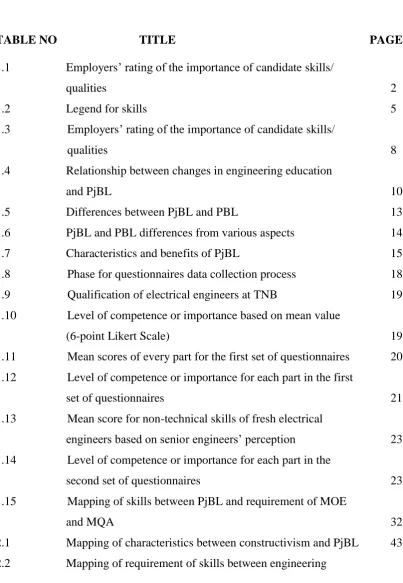
LIST OF TABLES
TABLE NO TITLE PAGE
1.1 Employers’ rating of the importance of candidate skills/
qualities 2
1.2 Legend for skills 5
1.3 Employers’ rating of the importance of candidate skills/
qualities 8
1.4 Relationship between changes in engineering education
and PjBL 10
1.5 Differences between PjBL and PBL 13
1.6 PjBL and PBL differences from various aspects 14
1.7 Characteristics and benefits of PjBL 15
1.8 Phase for questionnaires data collection process 18 1.9 Qualification of electrical engineers at TNB 19 1.10 Level of competence or importance based on mean value
(6-point Likert Scale) 19
1.11 Mean scores of every part for the first set of questionnaires 20 1.12 Level of competence or importance for each part in the first
set of questionnaires 21
1.13 Mean score for non-technical skills of fresh electrical
engineers based on senior engineers’ perception 23 1.14 Level of competence or importance for each part in the
second set of questionnaires 23
1.15 Mapping of skills between PjBL and requirement of MOE
and MQA 32
professional bodies in the world from Washington Accord 49
2.3 The differences between problem solving and exercise solving 54 2.4 Various name for generic skills according to country 64 2.5 Various learning strategy implemented by universities and the characteristics 67 2.6 Relationships between educational objectives and strategies 74 2.7 Comparison between Maastricht and Aalborg model 79 2.8 Levels of communication skills 87 2.9 Levels of critical thinking and problem-solving skills 88 2.10 Levels of critical teamwork skills 88 2.11 Levels of information management and lifelong learning 88 2.12 Levels of entrepreneurial skills 89 2.13 Levels of values, ethics and professionalism 89 2.14 Levels of leadership skills 89 2.15 Mapping non-technical skills development with delivery methods 91 3.1 Independent variables and dependent variable for causal comparative 97
3.2 Population and sample of respondents for quantitative method 98
3.3 Population and sample of respondents for qualitative method (Interview) 98 3.4 Population and sample of respondents for qualitative method (Observation) 99
3.5 Comparison of teaching methods in every university with PjBL characteristics 100
3.6 Population and sample for each research question 101
3.7 Instrument used to answer each research question 102
3.8 Distribution of items for the questionnaire 104
3.9 Likert Scale of Item Scoring 105
3.10 Reliability according to category of non-technical skills 110
3.11 Date of data collection for qualitative data 113
3.12 Date of data collection for qualitative data 114
3.13 Analysis method and statistic for each research questions 115
4.2 Students respondents distribution based on teaching method 121 4.3 Gender distribution for every teaching method 122 4.4 Students respondents distribution based on nationality 122 4.5 Lecturers respondents distribution based on teaching method 122 4.6 Level of competence based on mean value 165
4.7 Means score of pre-test 166
4.8 Engineering students’ non-technical skills competency
before exposed to PjBL 166
4.9 Mean scores of communication skills before students underwent PjBL based on category 166 4.10 Mean scores of problem solving skills before students
underwent PjBL based on category 167 4.11 Mean scores of teamwork skills before students underwent
PjBL based on category 167
4.12 Mean scores of lifelong learning skills before students underwent PjBL based on category 167 4.13 Mean scores of ethics before students underwent PjBL
based on category 167
4.14 Engineering students’ non-technical skills competency before exposed to semi-PjBL 169 4.15 Mean scores of communication skills before students
underwent semi-PjBL based on category 169 4.16 Mean scores of problem solving skills before students
underwent semi-PjBL based on category 170 4.17 Mean scores of teamwork skills before students underwent
semi-PjBL based on category 170 4.18 Mean scores of problem solving skills before students
underwent semi-PjBL based on category 170 4.19 Mean scores of ethics before students underwent
semi-PjBL based on category 170 4.20 Engineering students’ non-technical skills competency
before exposed to non-PjBL 172 4.21 Mean scores of communication skills before students
4.22 Mean scores of problem solving skills before students underwent non-PjBL based on category 172 4.23 Mean scores of teamwork skills before students underwent
non-PjBL based on category 173 4.24 Mean scores of lifelong learning skills before students
underwent non-PjBL based on category 173 4.25 Mean scores of ethics before students underwent non-PjBL
based on category 173
4.26 Means score of post-test 175
4.27 Engineering students’ non-technical skills competency
after exposed to PjBL 175
4.28 Mean scores of communication skills after students underwent PjBL based on category 175 4.29 Mean scores of problem solving skills after students
underwent PjBL based on category 176 4.30 Mean scores of teamwork skills after students underwent
PjBL based on category 176
4.31 Mean scores of lifelong learning skills after students underwent PjBL based on category 176 4.32 Mean scores of ethics after students underwent PjBL
based on category 176
4.33 Engineering students’ non-technical skills competency after exposed to semi-PjBL 178 4.34 Mean scores of communication skills after students
underwent semi-PjBL based on category 179 4.35 Mean scores of problem solving skills after students’
underwent semi-PjBL based on category 179 4.36 Mean scores of teamwork skills after students underwent
semi-PjBL based on category 179 4.37 Mean scores of lifelong learning skills after students
underwent semi-PjBL based on category 179 4.38 Mean scores of ethics after students underwent semi-PjBL
based on category 180
exposed to non-PjBL 181
4.40 Mean scores of communication skills after students underwent non-PjBL based on category 182
4.41 Mean scores of problem-solving skills after students underwent non-PjBL based on category 182
4.42 Mean scores of teamwork skills after students underwent non-PjBL based on category 182
4.43 Mean scores of lifelong learning skills after students underwent non-PjBL based on category 182
4.44 Mean scores of ethics after students underwent non-PjBL based on category 182
4.45 Descriptives statictics for pre-test 185
4.46 ANOVA for pre-test 186
4.47 Descriptive statistics for post-test 188
4.48 ANOVA for post-test 188
4.49 Post-hoc test (Bonferroni) 189
4.50 The differences in mean scores of pre-test/ post-test for the PjBL 191
4.51 Paired Samples Test 191
4.52 Differences in mean scores for every category in PjBL (Post – Pre) 192
4.53 Phase distribution for observations 193
4.54 Development of non-technical skills based on phases for students in University A 193
4.55 The differences in mean scores of pre-test/ post-test for the semi-PjBL 199
4.56 Paired Samples Test for semi-PjBL 200
4.57 Differences in mean scores for every category in semi-PjBL (Post – Pre) 201
4.58 Development of non-technical skills based on phases for students in University B 201
4.59 The differences in mean scores of pre-test/ post-test for the non-PjBL 204
4.67 Differences in mean scores for every category in non-PjBL (Post – Pre) 205 4.62 Development of non-technical skills based on phases for
students in University C 206 5.1 Level of competence based on mean value 258 5.2 Non-technical skills infusion based on teaching method (adapted
and modified from soft-skills model of MOE) 287 5.3 Ranking of importance of non-technical skills that should
be possessed engineers and the ranking of non-technical skills
LIST OF FIGURES
FIGURE NO TITLE PAGE
1.1 Mean gap between expectation and perception of industries 5 1.2 Interview coding theme for engineers at TNB 22
2.1 Theoretical Framework 40
2.2 The process how people create their understanding based on
constructivism 43
2.3 Model of lifelong learner 58
2.4 List of non-technical skills from Lange 65
2.5 List of non-technical skills from Kruger 65
2.6 PjBL and PBL learning principles 76
2.7 Learning process of PjBL 78
2.8 Typical PBL cycle 82
2.9 CPBL model 83
2.10 Non-technical skills development model by MOE 86 2.11 Non-technical skills development based on formal
teaching and learning framework 90
2.12 Type of delivery methods 91
3.1 Research Procedure for causal-comparative methodology 95
3.2 Operational Framework 112
4.1 Themes of interview for PjBL students in University A
for first research question 147
4.2 Themes of interview for semi-PjBL students in University
B for first research question 148 4.3 Themes of interview for non-PjBL students in University
University A for second research question 162 4.5 Themes of interview for semi-PjBL students and lecturers
in University B for second research question 163 4.6 Themes of interview for non-PjBL students and lecturers
in University C for second research question 164 5.1 Tuckman’s stages of group development model 271 5.2 PjBL framework to develop non-technical skills among
engineering students 285
5.3 Framework of non-technical skills development for
engineering courses in university (Embedded) 290 5.4 Teaching method that can be used to infuse non-technical
development (adapted and modified from soft-skills model
LIST OF ABBREVIATIONS
PjBL - Project-Based Learning PBL - Problem-Based Learning
UA - University A
UB - University B
UC - University C
NACE - National Association of Colleges and Employers ASEE - American Society of Engineering Education BEM - Board of Engineers Malaysia
IEM - Institution of Engineers Malaysia
MCED - Malaysian Council of Engineering Deans TNB - Tenaga Nasional Berhad
SPSS - Statistical Package for the Social Science MQA - Malaysia and Qualification Agency MOE - Ministry of Education
IEA - International Engineering Alliance
JABEE - Japan Accreditation Board for Engineering Education ABET - Accreditation Board for Engineering and Technology EAC - Engineering Accreditation Council
HKIE - The Hong Kong Institution of Engineers
ABEEK - Accreditation Board for Engineering Education of Korea IES - Institute of Engineers Singapore
FKE - Faculty of Electrical Engineering
LIST OF APPENDICES
APPENDIX TITLE PAGE
A Interview protocol for engineering students 344 B Interview protocol for engineering lecturers 345
CHAPTER 1
INTRODUCTION
1.1 Introduction
patient safety over time”. Traditional engineering education has put a lot of emphasize on technical problem solving skills by developing specialized and theoretical knowledge. As a result, engineers are well trained, yet lack some of the skills that make other professionals successful which are known as non-technical skills (Meadows and Samantha, 2006).
Table 1.1: Employers‟ rating of the importance of candidate skills/qualities
No Skill/Quality Mean Score*
1 Ability to verbally communicate with persons inside and outside
the organization
4.63
2 Ability to work in a team structure 4.60
3 Ability to make decisions and solve problems 4.51
4 Ability to plan, organize and prioritize work 4.46
5 Ability to obtain and process information 4.43
6 Ability to analyze quantitative data 4.30
7 Technical knowledge related to the job 3.99
8 Proficiency with computer software programs 3.95
9 Ability to create and/or edit written reports 3.56
10 Ability to sell or influence others 3.55
*5-point scale, where 1=Not at all important; 2=Not very important; 3= Somewhat important; 4=very important; and 5= Extremely important
Adapted from NACE Job Outlook 2013
engineering graduates with the skills demanded by industries. Strong pressures from industries, community and undergraduates have been put on top of universities to carry such responsibilities (Huet et al., 2009). Preparing well equipped graduates is never an easy job. Therefore, engineering education needs to evolve along with the ceaseless globalization process. Technical skills are the foundation of knowledge for engineering graduates where they learn those skills by listening to lectures and doing laboratory work. According to Martin et al. (2005), technical skills can be divided into two categories which are: i) engineering science, which is also known as theoretical knowledge of mathematics and science to resolve engineering issues, ii) engineering practice, the process of identification of problem and its resolution. These skills and knowledge are the distinct line that separates the engineering profession from others and it is what makes engineers an engineer. Nevertheless, according to Tang, Luan and Tho (2005), success cannot be guaranteed by solely depending on technical skills since an engineer needs to possess a good set of non-technical skills as well. Thus, it is important for engineering graduates to equip themselves with sufficient non-technical skills to complement their technical skills.
1.2 Background of the research
This part explains on fews topics that related to the importance of development of non-technical skills for engineering students. Furthermore, this part also provides more details on how the problem for this research is arises.
1.2.1 The need for non-technical skills among engineers
the industry‟s rapid development. Engineers must know how to adapt themselves so that they always become productive in any kind of situation. According to ASEE (2003), an engineer is defined as “problem solvers, people, who search for quicker, better, less expensive ways to use the forces and materials of nature to meet tough challenges”. In today‟s world, society has put a lot of burden on engineers where people are expecting the engineering world to provide creative and innovative solutions in order to make their life easier and comfortable (Clark and Andrews, 2010). As engineers, they need to fulfil the humans‟ needs, but at the same time they must put environment and nature into consideration. They cannot sacrifice the nature and environment in order to satisfy human desire. Thus, code of conduct or engineering ethics is established in order to provide guidelines to engineers. In other words, engineers must have good problem solving skills and ethics, which are part of non-technical skills.
and Malaysian Council of Engineering Deans (MCED) (MegatJohari et al., 2002; Khairiyah et al., 2004).
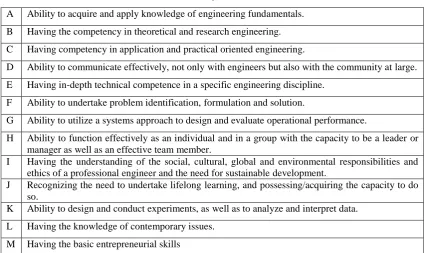
Table 1.2: Legend for skills A Ability to acquire and apply knowledge of engineering fundamentals.
B Having the competency in theoretical and research engineering.
C Having competency in application and practical oriented engineering.
D Ability to communicate effectively, not only with engineers but also with the community at large.
E Having in-depth technical competence in a specific engineering discipline.
F Ability to undertake problem identification, formulation and solution.
G Ability to utilize a systems approach to design and evaluate operational performance.
H Ability to function effectively as an individual and in a group with the capacity to be a leader or manager as well as an effective team member.
I Having the understanding of the social, cultural, global and environmental responsibilities and ethics of a professional engineer and the need for sustainable development.
J Recognizing the need to undertake lifelong learning, and possessing/acquiring the capacity to do so.
K Ability to design and conduct experiments, as well as to analyze and interpret data.
L Having the knowledge of contemporary issues.
M Having the basic entrepreneurial skills
As for graduates, they need to learn and grasp all these skills mentioned by BEM when they are studying in universities. The big question now is, are Malaysian engineering graduates well prepared and equipped with all these attributes? To answer that, perceptions and expectations of industries and employers towards engineering graduates in the workforce can be considered as the best answer because they know what the graduates are lacking. Azami (2008) had conducted a gap analysis to identify employers‟ perception and expectation towards engineering graduates in Malaysia, which is shown in Table 1.2 and Figure 1.1. From Figure 1.1, attribute F (problem solving) has the highest gap, whereas attribute D (communication skills) and attribute H (team management) have the second and third highest gaps respectively. As the gap widens, the perceptions of industries towards graduates becomes worse since the industries put high level of expectations towards these skills.
1.2.2 Non-technical skills development for engineering students
Alas, rapid changes on the requirement of the industries towards graduates‟ skills rendered higher education institutions, especially universities, unable to keep up with the evolution. In a worst case scenario, universities fail to provide engineering undergraduate students with appropriate education, knowledge and skills which are sought by current industries and unable to prepare them adequately for professional practice (Jorgensen and Howard, 2000; Nair and Patil, 2008). Therefore, discrepancies emerge between what educations provided and industry needed (Arnold, 2010; Brent, 2009; Domal, Stappenbelt &Trevelyan, 2008; Walsh, Crockett and Zahed, 2008; Nair, and Patil, 2008; Mustafa et al., 2008, Azami, 2008). Walther and Radcliffe (2007) further added that universities and industries have different views and perspectives of skills needed by graduates. Such disconnectedness must be solved to make sure universities and industries are on the same page in terms of development of graduates‟ skills. In order for engineering graduates to be an engineer, a balance between technical and non-technical skills must be provided in their education. According to Nilsson (2010), universities put a lot of focus on substantive content of engineering with only a little focus on non-technical skills. Engineering education cannot put sole emphasis on in-depth technical knowledge because it will create a skills gap when students join the workforce since most of their work requires the practice of non-technical skills as well.
and Özdemir, 2007). But, this is not enough because not all skills can be developed through final year projects. Case in point, students work alone on their projects, thus there is no room for teamwork skills to be put into practice.
Table 1.3: Employer‟s rating of the importance of candidate skills/qualities
No Skills Mean Score
1 Communication Skills 4.7
2 Honesty/integrity 4.7
3 Interpersonal skills (relates well to others) 4.5
4 Motivation/initiative 4.5
5 Strong work ethic 4.5
6 Teamwork skills (works well with others) 4.5
7 Computer skills 4.4
8 Analytical skills 4.3
9 Flexibility/adaptability 4.3
10 Detail-oriented 4.2
11 Organizational skills 4.0
12 Leadership skills 4.0
13 Self-confidence 4.0
14 Friendly/outgoing personality 3.9
15 Tactfulness 3.9
16 Well-mannered/polite 3.8
17 Creativity 3.7
18 GPA (3.0 or better) 3.6
19 Entrepreneurial skills/risk-taker 3.3
20 Sense of humor 3.2
21 Bilingual skills 2.3
(5-point scale, where 1=not important, 2=not very important; 3=somewhat important; 4=very important, and 5=extremely important)
Traditional lectures and traditional laboratories seem obsolete since these methods are unable to develop these skills. In lectures, lecturers deliver the information and the students just need to absorb it, and eventually their level of theoretical and technical knowledge will be evaluated through paper-based examination, thus, leaving the development of non-technical skills behind (Berhannudin et al., 2007; Khairiyah et al., 2004). Engineering education in Malaysia needs to be reviewed and reassessed in order to find an effective way to improve the teaching and learning system. Accordingly, the development of non-technical skills can be integrated in technical subjects (Shahrin et al., 2004). Such method can be seen as killing two birds with one stone where students not only improve on their technical skills, but indirectly, on their non-technical skills as well. Regardless, adding extra subjects into the curriculum to teach students about non-technical skills seems less effective because these courses often lack the direct application to the students' engineering experiences and the ability to track and improve over time (Kedrowicz et al., 2006).
1.2.3 Changes needed in engineering education
Table 1.4: Relationship between changes in engineering education and PjBL CHANGES IN ENGINEERING EDUCATION Project
related
work
Emphasize on
non-technical skills besides
technical skills
Non-technical
context must be
learned along with
technical context
Theory and
application must
be closely related
Multidisciplinary
– integration of
knowledge Student centered approach Focus on active learning Responsive
to demand of
industries P RO J E CT -B A SE D L E ARN ING Integration and application of knowledge –
learning by doing
√ √ √ √ √ Active and collaborative learning √ √ √ Real world experience- facing real problems √ √ √ √ √ √
Work in a group √ √
Student centered –
students develop
and formulate their
own design and
experiment
√ √ √ √ √ √ √
1999), where active learning should and must take place in the teaching and learning process (Domínguez & Magdaleno, 2008). Active learning can be promoted by changing teacher-centered to student-centered approach for a more student-driven learning process.
According to Tu (2006), engineering education nowadays need to emphasize on project related work in order to provide early exposure on the real practice in the industry to engineering students. They can neither be taught using traditional method nor solely doing laboratory work that require them to follow instruction as their cognitive and practical skills cannot be improved since these methods close the opportunity for them to apply knowledge and skills. Project work is able to motivate them (Yam, 2010) and enhance their interest in engineering education. On the other hand, non-technical skills development should be considered in educating engineering students besides technical skills (Mardam-Bey, Sanjay & Saran, 2008). Non-technical skills are very important nowadays since these are the skills that are sought by the industries among engineering graduates. Without these skills, it will be difficult for engineering students to get employed. Alternately, even if they are successfully employed, surviving in the industry may not be as easy. Also, their career advancement opportunities may be slim and they may lose out on any chance to get promoted in their job position. Engineering students must be taught non-technical skills within non-technical context (Shahrin, 2004). This is a great way to instill and improve their non-technical skills, but at the same time, testing their technical skills.
subject without knowing how to apply it. In order to improve laboratory work, multidisciplinary task must be emphasized on engineering students (Ashford, 2004). This aspect is important to ensure that students understand the relevance of each subject that they have learned so that they will be able to integrate and apply their knowledge into practice. By looking into the characteristics of PjBL, the implementation of PjBL may be able to fulfill all the changes needed in engineering education. Several characteristics have been chosen in order to match and meet the changes, which can be seen from table 1.4.
1.2.4 Project-Based Learning for Engineering Education
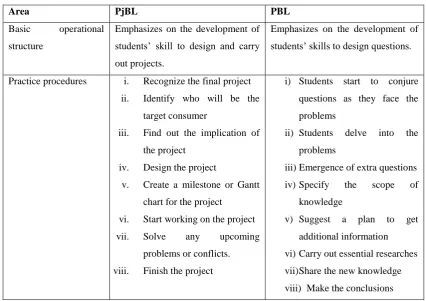
According to Kolmos, (2009), the solution for the new requirement of skills of undergraduates in engineering education is by implementing problem-based learning (PBL) or project-based learning (PjBL). Both methods emphasize on student-centered learning and negate traditional teacher-driven approach. As seen in the table above, PjBL and PBL show the best characteristics compared to others methods. These characteristics provide motivation and are suitable for the development of non-technical skills. Nevertheless, these two approaches of learning were deemed confusing and people misjudge both methods as the same thing. The fact is, as the names differ, so are the methods although they have a lot of similarities which was stated previously. Jon-Chao (2007) has listed the differences between PBL and PjBL as summarized in table 1.5.
It therefore seems that project-based learning is likely to be more readily
adopted and adapted by university engineering programs than problem-based
learning.
Lowenthal (2006: 1) in his research stated that:
Project-Based Learning incorporates methods from problem-based learning,
cooperative learning, active learning and project management theory.
Table 1.5: Differences between PjBL and PBL
Area PjBL PBL
Basic operational
structure
Emphasizes on the development of
students‟ skill to design and carry
out projects.
Emphasizes on the development of
students‟ skills to design questions.
Practice procedures i. Recognize the final project
ii. Identify who will be the
target consumer
iii. Find out the implication of
the project
iv. Design the project
v. Create a milestone or Gantt
chart for the project
vi. Start working on the project
vii. Solve any upcoming
problems or conflicts.
viii. Finish the project
i) Students start to conjure
questions as they face the
problems
ii) Students delve into the
problems
iii)Emergence of extra questions
iv)Specify the scope of
knowledge
v) Suggest a plan to get
additional information
vi)Carry out essential researches
vii)Share the new knowledge
viii) Make the conclusions
for engineering undergraduates. PjBL more often correlates to the field of engineering and science. While PBL is also implemented in those fields, it originated from the medical field and other professional preparatory training (Chakravarthi and Haleagrahara, 2010). This statement is supported by Perez et al. (2010), which stated that PjBL was established in the engineering field to provide experience for engineering students, which is able to promote life-long learning and cognitive abilities.
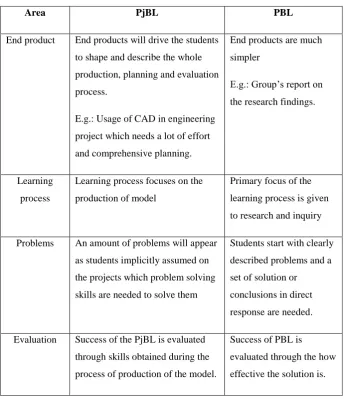
Table 1.6: PjBL and PBL differences from various aspects
Area PjBL PBL
End product End products will drive the students
to shape and describe the whole
production, planning and evaluation
process.
E.g.: Usage of CAD in engineering
project which needs a lot of effort
and comprehensive planning.
End products are much
simpler
E.g.: Group‟s report on
the research findings.
Learning
process
Learning process focuses on the
production of model
Primary focus of the
learning process is given
to research and inquiry
Problems An amount of problems will appear
as students implicitly assumed on
the projects which problem solving
skills are needed to solve them
Students start with clearly
described problems and a
set of solution or
conclusions in direct
response are needed.
Evaluation Success of the PjBL is evaluated
through skills obtained during the
process of production of the model.
Success of PBL is
evaluated through the how
effective the solution is.
students to come out with an end product in which something can be seen, as compared to PBL that expects abstract outcomes. Donnelly and Fitzmaurice (2005) in their research stated that the continuous differences between both methods can be seen from two aspects. Clearer distinction between these two can be further made as stated in table 1.6. Notwithstanding, they share a lot of characteristics other than student centered. Purpose of both methods is to connect the students in the real world tasks to improve learning by working on open ended problems or projects. The role of lecturer will be never the same since they act as tutor, coach or facilitator (Jon-Chao, 2007). Moreover, lecturer just provides them with guidance in order to make sure they are working in right path instead of spoon-feeding them with direct answer. Both methods imparting the students an in-depth understanding of a topic (Bell, 2010), connect the students to higher level of thinking (Savery, 2006), providing students with auxiliary, flexible and stimulating environment (Maier, 2008) and based on constructivist learning theory (Donnelly and Fitzmaurice, 2005). PjBL already proved that it is able to provide a lot of of benefits, especially to the students during the teaching and learning process. Those benefits were able to be obtained due the good characteristics of PjBL itself as shown in Table 1.7.
Table 1.7: Characteristics and benefits of PjBL
Characteristics: Benefits:
1. PjBL is the process of application of
knowledge – students apply what they have
learned (theory) into practice – hands-on
approach.
2. Integration of knowledge – interdisciplinary
learning
3. Problems are based on real world problems -
problems are relevant and contextual. It is in
the process of struggling with actual
problems that students learn content and
critical thinking skills
4. End products will drive the students to shape
and describe the whole production, planning
and evaluation process.
5. Emphasizes on the development of students‟
1. Learn how to solve problems using relevant
knowledge independently of the discipline
source
2. Students retain the knowledge that they have
learned for a longer period
3. Activities are focused on exploring and
working practical problems with an
unknown solution
4. Involve several contents of the same
discipline or the interaction of different
disciplines
5. Application of knowledge or theory of
different interdisciplinary knowledge into
practice – appreciate the relationship
Characteristics: Benefits: skill to design and carry out project
6. PjBL is learner-centered - learners are
progressively given more responsibility for
their education and become increasingly
independent of the teacher for their
education
7. Learning process focuses on the production
of model
8. Success of the PjBL is evaluated through
skills obtained during the process of
production of the model.
9. Provides real world experience to students
10. Teachers or lecturers act as facilitator who
give them guidance and help.
11. Emphasizes on higher level thinking skills
12. Students develop and formulate their own
designs and experiments
13. Students work on the project as a group
14. Consumes a lot of time to finish the product
15. It is carried out in risk-free environment
where it provides positive feedback and
allows students to make their choice
development of a particular subject
6. Allowing the search of open solution so
students are free to create new knowledge
7. Allows for more other conventional teaching
and learning to occur in parallel
8. Can create situations that can be authentic or
real life scenario.
9. Motivates students to study and to develop a
product while providing them with an
experience regarding engineering practice.
10. Creates closer ties or bonds between
students, technical supervisors and industrial
partner.
11. Improves students‟ non-technical skills such
as communication, project management,
leadership, problem solving, teamwork and
critical thinking skills.
12. Provides contextual knowledge to help
students learn concepts in relation to one
another.
13. Helps motivate students to learn the building
blocks because they know the end goal and
why it will be useful.
14. Allowing students to move beyond mere
knowledge and comprehension skills into
application, analysis, synthesis and
evaluation
15. Allowing students to be in charge of their
own learning and thinking
16. Increases students‟ attendance and
motivation to learn
17. PjBL produces independent, life-long
learners - students continue to learn on their
1.2.5 Preliminary Study
In order to provide better insight on the background of the problems on electrical engineering field, the researcher has conducted a preliminary study on senior electrical engineers and electrical engineers who work at Tenaga Nasional Berhad (TNB).
1.2.5.1 Preliminary Study Methodology
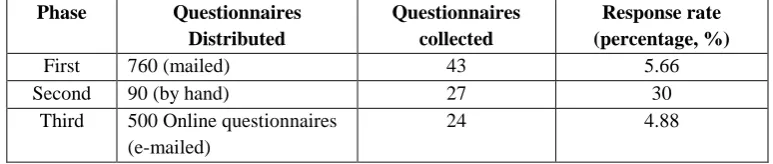
which are through questionnaires, because the response rate for each set of questionnaires was very low. The phases for the questionnaires distribution are shown in table 1.8. For the first phase, the researcher mailed 760 questionnaires to every TNB General Manager offices in the peninsular Malaysia, but the response rate is very low, which is 5.66%.
Thus, the researcher conducted the second phase for this process, in which the researchers sent 90 questionnaires to three randomly selected TNB General Manager‟s offices in Peninsular Malaysia by hand. Unfortunately, the researchers only obtained 30% of response rate through the second phase. As the researchers tried to collect more data, the researcher conducted the third and last phase of data collection. In the third phase, the researchers used online questionnaire and links for the online questionnaires were emailed to every TNB electrical engineers‟ email, which were sent through TNB Human Resource officer. The online questionnaires were opened for two months, but only collected 24 questionnaires. Overall, the researchers were able to obtain 62 questionnaires from the electrical engineers and 32 questionnaires from the senior electrical engineers in TNB.
Table 1.8: Phase for questionnaires data collection process
As for the data for the interviews, five electrical engineers were interviewed. The sampling method that was used for the questionnaires was non-probability sampling, which is snowball sampling. The data from the interviews were used as supportive data for the questionnaires and to gather the electrical engineers‟ opinions in order to improve and enhance engineering education in Malaysia.
Phase Questionnaires Distributed
Questionnaires collected
Response rate (percentage, %)
First 760 (mailed) 43 5.66
Second 90 (by hand) 27 30
Third 500 Online questionnaires (e-mailed)
1.2.5.2 Preliminary Study Data Analysis
The collected questionnaires were analyzed using IBM SPSS Statistics version 20 software. All data was analyzed by using descriptive statistics, in which the researchers obtained frequencies and mean scores for the questionnaires. From the first set of the questionnaires, it is identified that most TNB‟s electrical engineers (82.3 %) participated in this study have obtained their Bachelor‟s degree in their qualification, whereas the number of engineers who hold diploma and Master‟s degree are very low, which are 8.1% and 9.7% respectively as shown as in table 1.9.
Table 1.9: Qualification of electrical engineers at TNB
Qualification Frequency Percent Valid Percent Cumulative Percent
Diploma 5 8.1 8.1 8.1
Degree 51 82.3 82.3 90.3
Master 6 9.7 9.7 100.0
TOTAL 62 100.0 100.0
In order to analyze the result from the questionnaires, the level of competence or importance will be discussed according to the level of competence or importance based on the descriptors in Table 1.10.
Table 1.10: Level of competence or importance based on mean value (6-point Likert Scale)
Competent/Important Less
competent/ Less important
Not competent/ Not important
Extremely competent/ Extremely important Very competent/ Very important Competent/ Important Not competent/ Not important Not competent at all/ Not important at all
*≥5.2 4.4-5.1 3.5-4.3 2.8-3.4 2.1-2.7 ≤2.0
*Mean value
Table 1.11 shows the descriptive statistics for the questions in the first set. The descriptions of each part on the first set are as below:
i. meanSOFT - how the electrical engineers perceived themselves to be equipped with enough non-technical skills after they graduated from university.
ii. meanDEVELOP - how the electrical engineers agreed they were able to develop their non-technical skills while in university.
iii. meanAWARE – how the electrical engineers are aware of the importance of non-technical skills for engineers before they graduated.
iv. meanREAL – how the electrical engineers perceived the importance of non-technical skills after they work as engineers.
Table 1.11: Mean scores for every part of the first set of questionnaires.
Part Mean
meanSOFT 3.2688
meanDEVELOP 3.1263
meanAWARE 3.4597
meanREAL 4.4086
Valid N (list wise)
Table 1.12: Level of competence or importance for each part in the first set of questionnaires
Part Level
meanSOFT Less competent meanDEVELOP Less competent meanAWARE Important meanREAL Very Important
As for the findings that the researchers obtained from the interviews, which are shown in figure 1.2, it was found that the engineers were aware of the importance of non-technical skills for them to work in the industry. However, some of them claimed that they did not have sufficient non-technical skills after they graduated. This situation was caused by the lecturers who put a lot of emphasis on the technical aspect without giving much weight on the development of students‟ non-technical skills. Moreover, the engineers also claimed that they were only able to develop their non-technical skills after they began working in the industry, which provides a better platform for them to practice their non-technical skills. Even though some of the engineers stated that they were able to develop non-technical skills sufficiently; it was mainly on account of their participation on extracurricular programs during their study in university. Nevertheless, all of them agreed that formal teaching and learning in the university was unable to provide them with significant effect on their non-technical skills development.
Table 1.13 shows the mean score for questions in the second set. The descriptions of each part on the first set are as below:
i. meanCOM – how the senior engineers perceived the level of communication skills among fresh electrical engineers.
ii. meanPROB– how the senior engineers perceived the level of problem solving skills among fresh electrical engineers.
iii. meanTEAM – how the senior engineers perceived the level of teamwork skills among fresh electrical engineers.
iv. meanLIFe – how the senior engineers perceived the level of lifelong learning skills among fresh electrical engineers.
TNB electrical engineers
Emphasis on technical aspect
Enough non-technical skills after graduated Engineer 1:
..my university is too technical, so it‟s less success in producing well rounded engineer.. But when it comes to the exposure to develop non-technical skills, it is maybe less or not at all. Engineer 2:
... during my study, there‟s no emphasis on non-technical skills. I learned a lot of theories all the time. Engineer 3:
If just teaching and learning during my study in university, it didn‟t able to develop my non-technical skills. Because mostly of the subjects just emphasize on theories only.
My non-technical skills are not enough after I finished my study
Engineer 2:
Emm, I think my non-technical skills are not enough even though sometimes I felt okay with mine.
Engineer 3:
If I want to say enough, I can‟t, because my non-technical skills are not enough
Not enough non-technical skills after graduated
Develop non-technical skills through extracurricular
program Aware on the importance of
non-technical skills in industry
Engineer 2:
I knew about the importance of non-technical skills since I studying in university.
Engineer 3:
I already knew about the importance of non-technical skills because I read about the articles and heard from the news.. Engineer 4:
I already knew about that since I was in university Engineer 5:
Yes, I already knew during my study.
Develop non-technical skills when working in
industry
Engineer 1:
After I worked in the industry, I am able to develop my non-technical skills. But it‟s quite late. But, it‟s okay because it‟s better late than never.
Engineer 3:
But, if I want to say when I developed my non-technical skills, I developed them fully when in the industry. Since I work, my non-technical skills are highly developed.
Inability of teaching and learning to develop
non-technical skills
Engineer 2:
I learned about the non-technical skills in university, but there‟s no actual practice. So, it is wasted.
Engineer 4:
Frankly, the teaching and learning method is don‟t provide enough help (to develop my non-technical skills)
Engineer 5:
So, teaching and learning is not helping much in developing my non-technical skills during my study in university.
Engineer 4:
But overall, my non-technical skills can be claimed as enough. And my skills are enough because I joined outside programs.
Engineer 5:
If about non-technical skills, I think I obtained a lot through extracurricular activities. I joined a lot of outside activities, such as community service, education service, convocation fair
vi. meanSOFT – how the senior engineers perceived the overall level of non-technical skills among fresh electrical engineers.
vii. meanIMP – how the senior engineers perceived the importance of non-technical skills for engineers.
Table 1.13: Mean score for non-technical skills of fresh electrical engineers based on senior engineers‟ perception
No Non-technical skills Mean score
1 Communication 3.23
2 Problem Solving 3.42
3 Teamwork 3.37
4 Lifelong learning 3.64
5 Ethics 3.73
6 Overall 3.20
7 Importance of non-technical skills 3.94
Table 1.14: Level of competence or importance of each part in the second set of questionnaires
Part Level
meanCOM Less competent
meanPROB Less competent meanTEAM Less competent
meanLIFE Competent
meanETH Competent
meanSOFT Less competent
meanIMP Important
were less competent in their non-technical skills. The senior engineers also viewed the non-technical skills as a crucial skill engineers must be equipped with.
1.2.5.3 Preliminary Study Discussions
From the findings, the senior engineers from TNB deemed non-technical skills as important skills that electrical engineers need, as an additional quality and to complement their technical skills. These skills are important for them to survive in the industry because engineers nowadays do not work with machines only. Their scopes of work are changing as they need to deal with people from a variety of backgrounds, which requires a set of non-technical skills.
As perceived by their superiors, the electrical engineers from TNB also rated themselves as less competent in their non-technical skills when they started working there. They also claimed that the teaching and learning method in universities are less competent or less effective in developing their non-technical skills, since the teaching and learning in universities put too much focus on theoretical aspects and only assesses their theoretical knowledge by giving so many assignments, tests, quizzes and examinations. They further added that the teaching and learning in universities do not put any or enough emphasis on the development of non-technical skills. This situation is similar to what was claimed by Nilsson (2010), which stated that universities put a lot of focus on substantive content of engineering with only a little focus on non-technical skills Thus, it puts a lot of burden on the engineering students as they struggle to get better results, which is mostly evaluated through paper-based evaluations.
When they enter the workforce as an engineer, they belatedly realized that non-technical skills are very important for them as they claimed that they need to work and communicate with their subordinates and their higher-ups. In addition, they mostly work in a team when they work on projects. So, as an engineer, the non-technical skills are a set of skills that they must equip themselves with in order to keep surviving and being relevant to today‟s industry requirements. Without these non-technical skills, one can be considered as unnecessary and irrelevant with regards today‟s requirements (Azami, 2008). And of course, one is unlikely to get promoted and instead, will have to stay on the same position as they do not have the proficiency essential in interacting and dealing with people. As for the experiments students did in the laboratory, the experiments are not fully applicable in the industry as they only learn the basics and fundamentals of electrical system. Despite that, these experiments, though not comprehensive, still provides the students with a picture of how real systems that are used in the real world. But, it is important for today‟s engineering education to provide better experimental and laboratory experiences that remains relevant with today‟s technology with the purpose of exposing the students to real world problems, since there are a lot of universities that still provide both out-dated experiments and technology. Without real world experience, the students are unable to develop their non-technical skills within the engineering context. Moreover, this situation can lead to bad consequences for the students as they are not able to keep pace with current technology, as well as not knowing how to operate technological features when they start working in the industry.
1.3 Statement of the Problem
broaden if universities keep using the same approach of teaching. Such a problem can be viewed from the perspective of engineers in the industries towards engineering education which asserted that engineering education should put more emphasis on communication skill, leadership and management skill and must put in tremendous effort in order to nurture interest towards engineering profession among undergraduates (Mustafa et al., 2008). Kamsah (2004) in his research stated that current engineering graduates are not deficient in technical capability or their knowledge but they are deficient in their soft skills which are important for them to work collaboratively and use their technical abilities. Based on the findings from the preliminary result, the electrical engineers in TNB also confessed that they were not equipped with sufficient non-technical skills when they graduated. Moreover, they claimed that the teaching and learning in universities did not put sufficient emphasis on the development of non-technical skills.
1.4 Objectives of the Research
The main objective of this study is to investigate the effectiveness of PjBL to develop electrical engineering students‟ non- technical skills by comparing the performance of engineering students in three categorical groups, which are PjBL, semi-PjBL and non-PjBL. At the end of this study, the researcher intends to develop a new framework of PjBL that is effective in developing the non-technical skills for engineering students. Specifically, the objectives of this study are to:
1. Investigate the opinions of electrical engineering students after they underwent PjBL teaching method on their satisfaction on the development of non-technical skills
2. Investigate the effect of PjBL in providing an environment that mirrors the practice of engineers in the real world for the engineering students
3. Investigate the effect of PjBL, semi-PjBL and non-PjBL towards the level of non-technical skills among electrical engineering students.
4. Develop a new framework for PjBL in order to develop non-technical skills among electrical engineering students
1.5 Research Questions
The research question is based on the statement of problem and the objectives of the study. These questions include:
2. Is PjBL providing an environment that mirrors the practice of engineers in the real world for the engineering students from the perspective of engineering lecturers and students?
3. What is the effect of PjBL, semi-PjBL and non-PjBL towards the levels of non-technical skills among electrical engineering students?
i. What are the levels of non-technical skills among electrical engineering students before they are exposed to PjBL, semi-PjBL and non-PjBL?
ii. What are the levels of non-technical skills among electrical engineering students after they are exposed to PjBL, semi-PjBL and non-PjBL?
iii. What are the differences of level of non-technical skills among electrical engineering students before they are exposed to PjBL, semi-PjBL and non-semi-PjBL?
iv. What are the differences of level of non-technical skills among electrical engineering students after they are exposed to the PjBL, semi-PjBL and non-PjBL?
v. What is the difference in terms of non-technical skills level among electrical engineering students before and after they are exposed to the PjBL?
vi. What is the difference in terms of non-technical skills level among electrical engineering students before and after they are exposed to semi-PjBL?
vii. What is the difference in terms of non-technical skills level among electrical engineering students before and after they are exposed to non-PjBL?
1.6 Significance of the research
The researcher hopes that this study can give a new vision and perspective to the PjBL approach, which is widely implemented in engineering education nowadays. Nevertheless, PjBL is a new approach in Malaysia and it is hardly known by educators and researchers. This study is important in helping responsible parties in order to provide and equip engineering undergraduates in Malaysia with critical skills that is required by employers in recent days. Furthermore, this research can bridge or close the gap between the perception and expectation of industries towards the level of fresh graduates‟ skills. There are four (4) target groups that will reap the benefits from this research, which are the policy maker, the implementers, the engineering students and the scholars.
The first target group, the policy maker in this study is the Ministry of Higher Education. They are the highest level of authority that can change the education system in Malaysia and strive to make Malaysia a world-class Centre of excellence in parallel with their mission, which is „to develop and put in place a higher education environment that encourages the growth of premier knowledge centers and individuals who are competent, innovative with high moral values to meet national and international needs.‟ This research will help them to make better policy that will benefit the educators and other stakeholders in order to make Malaysia a better place for Centre of knowledge dissemination.
collaborate in projects with universities. Besides, universities will be able to produce local graduates that are comparable or even better with overseas graduates.
The third target group is the engineering students. As students, they are required to accept every change in the PjBL learning process since PjBL is based on student-centered approach. Thus, the students play significant roles in order to make sure PjBL implementation is successful in developing both engineering students‟ technical and non-technical skills. The fourth target group is the scholars or the researchers. other researchers in any field of education can conduct further study regarding PjBL. PjBL is not limited to engineering education, but it is flexible and can be widely used in any fields or courses. PjBL still needs a lot of studies in order to reveal its real potency and effectiveness by taking different perspectives and opinions from different sides and parties.
1.7 Scope of the problem
Based on the literature review, there are a lot of similarities of the engineering graduates‟ attributes between countries although Japan only shares two attributes with the others. By excluding Japan in the context of similarities, there are five (5) non-technical attributes that are in common, which are:
1. Lifelong learning
2. Effective communication
3. Engineering problem solving and decision making skills 4. Interpersonal or team working skills
5. Understand professional and ethical responsibilities
sought by industries and should be possessed by engineering graduates in order to get employed. Furthermore, the skills mentioned above are also in line with the Ministry of Education (MOE) of Malaysia and Qualification Agency (MQA) requirements as shown in table 1.15.
Table 1.15: Mapping of skills between PjBL and requirement of MOE and MQA
Skills MOE MQA
Lifelong learning √ √
Communicate effectively √ √
Engineering problem solving and decision making skills √ √
Interpersonal or team working skills √ √
Understand professional and ethical responsibilities √ √
1.8 Operational definitions
Non-technical skills - Non-technical skills have been referred to by different names, for example, „soft skills‟ (Ahmad Nabil et al., 2011), „professional skills‟ (Colwell, 2010), „key competencies‟ (McLeish, 2002), „generic skills‟ and „employability skills‟ (Shahrin, 2004). Zubaidah et al. (2006: 30) defined non-technical skills in her research as “skills that refer to general skills such as communication, negotiation, teamwork, problem solving, positive work attitudes and cooperation, which are not specific to any particular job position or workplace environment”. According to Noor Azizi et al. (2001), non-technical skills comprise the ability to carry out specific tasks. They include initiative, group work, reading and writing abilities, computerization, problem solving, personal attitudes, ethical and professional skills, communication skills, accounting and financial skills, leadership, decision-making skill, general knowledge to execute tasks, analytical, mathematical, statistical, interpretation, project management, knowledge from other relevant disciplines, self-projection, and awareness on global issues. Non-technical skills consist of many skills were stated in conceptual definitions. Nonetheless, this research will adapt non-technical skills from the students‟ attributes as stated in the engineering accreditation of a few countries from Washington Accord. There are five non-technical skills, which are identified by looking at the similarities of respective accreditation. The non-technical skills are communication skills, problem solving skills, teamwork skills, lifelong learning skills and engineering ethics.
research, communication skills consist of listening, speaking, reading and writing. Listening is the ability to accept people‟s idea and giving response accordingly. Speaking consists of the ability to present, deliver the idea and information, convince people, negotiate and ask. While writing is the ability to write a report, graphs, tables, charts, figures, problem statements, summary. Reading is defined as the ability to understand problem, data and information. Communication skills in this context also emphasizes on the ability to communicate in the English language.