Copyright © 2006 Inderscience Enterprises Ltd.
A high accuracy variant of the iterative alternating
decomposition explicit method for solving the heat
equation
M.S. Sahimi*, N.A. Mansor, N.M. Nor and N.M. Nusi
Department of Engineering Sciences and Mathematics,
Universiti Tenaga Nasional, 43009 Kajang, Selangor, Malaysia
E-mail: [email protected]
*
Corresponding author
N. Alias
Department of Mathematics,
Universiti Teknologi Malaysia,
81310 UTM Skudai, Johor, Malaysia
E-mail: [email protected]
Abstract:
We consider three level difference replacements of parabolic equations focusing on the
heat equation in two space dimensions. Through a judicious splitting of the approximation,
the scheme qualifies as an alternating direction implicit (ADI) method. Using the well known fact
of the parabolic-elliptic correspondence, we shall derive a two stage iterative procedure
employing a fractional splitting strategy applied alternately at each intermediate time step to the
one dimensional heat equation. As the basis of derivation is the unconditionally stable (4,2)
accurate ADI scheme, this method is convergent, computationally stable and highly accurate.
Keywords:
alternating direction implicit (ADI) method; iterative alternating decomposition
explicit (IADE) method; fractional splitting.
Reference
to this paper should be made as follows: Sahimi, M.S., Mansor, N.A., Nor, N.M.,
Nusi, N.M. and Alias, N. (2006) ‘A high accuracy variant of the iterative alternating
decomposition explicit method for solving the heat equation’, Int. J. Simulation and Process
Modelling, Vol. 2, Nos. 1/2, pp.45–49.
Biographical notes:
Mohd Salleh Sahimi obtained his BS from the Bandung Institute of
Technology, Indonesia (1975), MA from the University of Lancaster, UK (1976) and PhD from
the Loughborough University of Technology, UK (1986). He served in various academic
executive capacities in the Universiti Kebangsaan Malaysia including as Deputy Dean of the
Faculty of Mathematical and Computer Sciences (1994) and Deputy Dean of the Faculty of
Information Science and Technology (1997). He was awarded a Commonwealth Fellowship to
conduct research in the UK (1993). Presently, he is a Professor in Numerical and Scientific
Computing at the Department of Engineering Sciences and Mathematics, Universiti Tenaga
Nasional.
Noreliza Abu Mansor obtained her BSc in Physics (1982) and MSc in Mathematics (1985), both
from Ohio University, USA. She received her Diploma in Education (1988) from Universiti
Kebangsaan Malaysia. She started her career as a Teacher (1988) before joining as a Lecturer at
Kolej Yayasan Pelajaran Mara (1994). She is currently a Mathematics Lecturer in the Department
of Engineering Sciences and Mathematics, Universiti Tenaga Nasional.
Norhalena Mohd Nor obtained her BSc with honours in 1985 from the University of Tasmania,
Australia and MSc in Pure Mathematics from the University of Leeds in 1987. She started her
career as an Assistant Lecturer at the Universiti Teknologi Malaysia, Kuala Lumpur. Currently
she is a Senior Lecturer in the Department of Engineering Sciences and Mathematics at
Universiti Tenaga Nasional.
Noraini Md. Nusi obtained her B.App.Sc Degree from Universiti Sains Malaysia in 1997 and
MSc from Universiti Kebangsaan Malaysia in 2002. She is currently a Mathematics Lecturer in
the Department of Engineering Sciences and Mathematics, Universiti Tenaga Nasional.
computing in numerical methods for application in the manufacturing industry. She has also
published and presented about 50 papers related to variants of the iterative alternating
decomposition explicit and alternating group explicit class of methods. She has received various
awards including medals for invention and innovation in national and international expositions.
1 Introduction
Consider the heat equation,
2 2
U
U
t
x
∂
=
∂
∂
∂
(1)
subject to given initial and Dirichlet boundary conditions
over a rectangular domain with a uniformly spaced network
whose mesh points are xi = i
∆
x,
tj = j
∆
t. Its corresponding
equation in two space is given by,
2 2
2 2
.
U
U
U
t
x
y
∂
=
∂
+
∂
∂
∂
∂
(2)
Following (Mitchell and Griffiths, 1980), a stable and (4,2)
accurate three level difference replacement of equation (2)
is given by,
2 2
. . 1
2 2 2 2
, ,
2 2
, , 1
2
2 2
, , , , 1
1
2
1
2
1
1
12 3
12 3
2
1
3
2
1
2
1
(
)
12 3
1
2
(2
)
12 3
x y i j k
x y x y i j k
x y i j k
x y i j k i j k
u
u
u
u
u
λ δ
λ δ
λ δ
δ
δ δ
λ δ
δ
λ δ δ
+ − −
+
−
+
−
=
+
+
+ +
+
+
+
−
−
(3)
where
δ
is the usual central difference operator and
λ
=
∆
t/(
∆
x)
2=
∆
t/(
∆
y)
2, the mesh ratio for equidistance
spacing. The difference scheme equation (3) can be split as
follows, to qualify as an alternating direction implicit (ADI)
scheme,
2
, , 1/ 2
2
, , . . 1
2 2 2 2
, ,
2 2
, , 1
1
2
1
12 3
1
2
(2
)
12 3
2
1
3
2
1
2
1
(
)
12 3
x i j k
y i j k i j k
x y x y i j k
x y i j k
u
u
u
u
u
λ δ
λ δ
λ δ
δ
δ δ
λ δ
δ
+ − −
+
−
= −
−
−
+
+
+
+ +
+
+
(4)
and
2
, , 1 , , 1/ 2
2
, , , , 1
1
2
1
12 3
1
2
(2
).
12 3
y i j k i j k
y i j k i j k
u
u
u
u
λ δ
λ δ
+ + −
+
−
=
+
−
−
(5)
As the temperature reaches steady state over time,
U
→
constant and (
∂
U/
∂
t)
→
0 and the parabolic equation
(5) reduces to the elliptic equation (Laplace’s equation),
2 2
2 2
0
U
U
x
y
∂
+
∂
=
∂
∂
(6)
whose numerical solution can be solved iteratively using the
same ADI technique,
(
)
2 ,
2 2 2 2 2
2 2 ( )
,
1
2
*
1
12 3
1
2
2
1
12 3
3
2
1
2
1
12 3
x i j
y x y x y
p x y i j
r
u
r
r
r
u
δ
δ
δ
δ
δ δ
δ
δ
+
−
= −
−
+
+
+
+ +
+
+
(7)
and
2 ( 1) 2 ( )
, , ,
1
2
*
1
2
1
12 3
12 3
p p
y
u
i ju
i jr
y i ju
δ
+δ
+
−
=
+
−
(8)
where r is the acceleration parameter.
2 The iterative alternating decomposition explicit
(IADE) method
Note from the composite formula equation (3) that the
iterative procedure converges if
ui
,j,k–1= ui
,j,k = ui,j,k+1= ui
,jfor k sufficiently large, leading to
2 2 2 2
,
1
0
6
x y x y
u
i jδ
δ
δ δ
+
+
=
which represents a nine point difference replacement of the
Laplace’s equation (6). Hence we are motivated by this well
known fact of the parabolic-elliptic correspondence (Varga,
1962; Wachspress, 1966; Yanenko, 1971) to develop a new
iterative scheme for the solution of equation (1) by
considering the following two step iterates corresponding to
equations (7) and (8),
( +1/2)
1 2 1 2 1 2
( )
1 2
ˆ
( +
)
(
(
(1 2
)
(
))
2
p
p
r
I
G u
G
G + G
)G G
I
G + G
u
f
α
α
ω
ω
= −
+
+
+ +
−
(9)
and
(
I
+
α
G
2)
u
(p+1)=
u
(p+1/2)+
α
G
2u
(p)(10)
1
2
1
2
ˆ
2
,
,
12 3
r
12 3
r
3
r
α
=
−
ω
=
+
ω
=
with
r > 0 being the acceleration parameter of the iterative
process.
Noting that
u
(p+1)=
u
(p)as p
→
∞
, we have,
at the (p + 1/2) iterate,
(
I
+
α
G
2)
u
(p+1/2)= (
I
+ (
α
+ 2r)
G
1)(
I
+ (2r
G
2)
+
β
G
1G
2)
u
(p)– 2r
f
(11)
and at the (p + 1) iterate,
(
I
+
α
G
2)
u
(p+1)=
u
(p+1/2)+
α
G
2u
(p)(12)
where
β
= 2r(3
α
– 2r)/3, and
G
1and
G
2are lower and upper
bidiagonal matrices given by,
1 2
1
2
1 ( )
1
1
1
.
.
,
.
.
.
.
1
1
m m mxmk
k
k
k
− −
=
G
(13)
1 2 3 2 1 ( )
.
.
.
.
.
.
.
m m mxme
h
e
h
e
h
e
h
e
−
=
G
(14)
Elimination of
u
(p+1/2)from equations (11) and (12) leads to
the single composite formula,
(
I
+
α
G
1)(
I
+
α
G
2)
u
(p+1)= ((
I
+ (
α
+ 2r)
G
1)(
I
+ 2r
G
2) +
β
G
1G
2)
u
(p)– 2r
f
+
α
(
I
+
α
G
1) +
G
2u
)
(p).
As p
→
∞
,
u
(p),
u
(p+1)→
u
resulting in
1 2 1 2
1
6
=
+
+
A G
G
G G
(15)
and
Au
=
f
(16)
A
is a tridiagonal matrix which arises from the difference
method used to approximate the parabolic equation (1). For
example, if the familiar weighted approximation,
1, 1 , 1 1, 1
1, 1,
(1 2
)
(1
)
(1 2 (1
))
(1
)
i j i j i j
i j ij i j
u
u
u
u
u
u
λθ
λθ
λθ
λ
θ
λ
θ
λ
θ
− + + + + − +−
+ +
−
=
−
+ −
−
+
−
is used with order of accuracy of (1,2), (2,2), (2,4) and (1,2)
when
θ
= 1, 1/2, (1/2 – 1/12
λ
) and 0 respectively, then its
totality can be displayed in matrix form equation (16) as,
1 1
2 2
3 3
1 1
( ) 1
.
.
.
.
.
.
.
.
.
.
.
.
.
.
.
.
m m m m mxm ju
f
a b
u
f
c a b
u
f
c a b
u
f
c a b
u
f
c a
− − +
=
(17)
Using equations (11) and (12), we have,
u
(p+1/2)= (
I
+
α
G
1
)
–1((
I
+ (
α
+ 2r)
G
1)(
I
+ (2r
G
2)
+
β
G
1G
2)
u
(p)– 2r
f)
(18)
and
u
(p+1)= (
I
+
α
G
2
)
–1(
u
(p+1/2)+
α
+
G
2u
(p))
(19)
giving us the following computational formulae at each of
the half-iterates,
at the (p + 1/2) iterate,
( 1/ 2) ( ) ( ) ( ) ( 1/ 2)
1 1
ˆ
1 1 1(
* ) / ,
1, 2, ,
p p p p p
i i i i i i i i i
u
s u
v u
su
w u
r f
A
i
m
+ +
− − + − −
=
+
+
−
−
=
…
(20)
with
s
0=v
0= w
0= 0 and
1
(1 8 )
0
12
r
A
= +
+
≠
at the (p + 1) iterate,
( 1) ( 1/ 2) ( ) ( )
1 1 1 1 2
( 1)
2 1
(
) /(1
)
p p p p
m i m i m i m i m i p
m i m i
u
u
d
u
du
du
d
+ + + − + − + − + − + − + + − + −=
+
+
−
+
(21)
with di
≠
0 for i = 1, 2 ,
…
, m and
1
1
1 1 1 1
1
1 1
6
1 8
*
2 ,
,
,
7
12
*(3
*)
,
2 ,
ˆ
* ,
3
ˆ
,
ˆ
( *
),
,
6(
1)
6
ˆ 1
,
,
,
7
6
6
1 ,
2,3, ,
7
6
,
1, 2, ,
1
*
(
),
,
i i
i i
i i i i
i i i i
i i i
r
r
r
h
b
r
r
q
P
r
f
r P
g
f
q
s h r
f
q
d
h
a
c
A
e
k
e
k h
e
a
i
m
s
Pk
gk e
i
m
v
r e
P g hk
e
w
k
d
…
…
α
α
α
α
α
α
+ − − − − − − =+
= −
=
=
−
=
= −
=
= +
=
+ +
=
−
= +
=
=
+
=
−
−
=
=
+
=
= +
+ +
+
=
=
α
e
i,
i
=
1, 2, , .
…
m
each iterate, the solution of an explicit equation. This is
continued until convergence is reached, that is, when the
convergence requirement ||
u
(p+1)–
u
(p)||
∞
≤
ε
is met where
ε
is the convergence criterion.
3 Numerical
results
In this experiment we attempted to solve the following heat
conduction problem (Saulev, 1964),
2
2
0
1
U
U
x
t
x
∂
=
∂
≤ ≤
∂
∂
(22)
subject to the initial condition
U
(
x
, 0) = 4
x
(1 –
x
) 0
≤
x
≤
1
and the boundary conditions
U
(0,
t
) =
U
(1,
t
) = 0
t
≥
0.
The exact solution is given by
2 2
3 3
1,(2)
32
1
( , )
k tsin(
).
kU x t
e
k x
k
π
π
π
∞−
=
=
∑
(23)
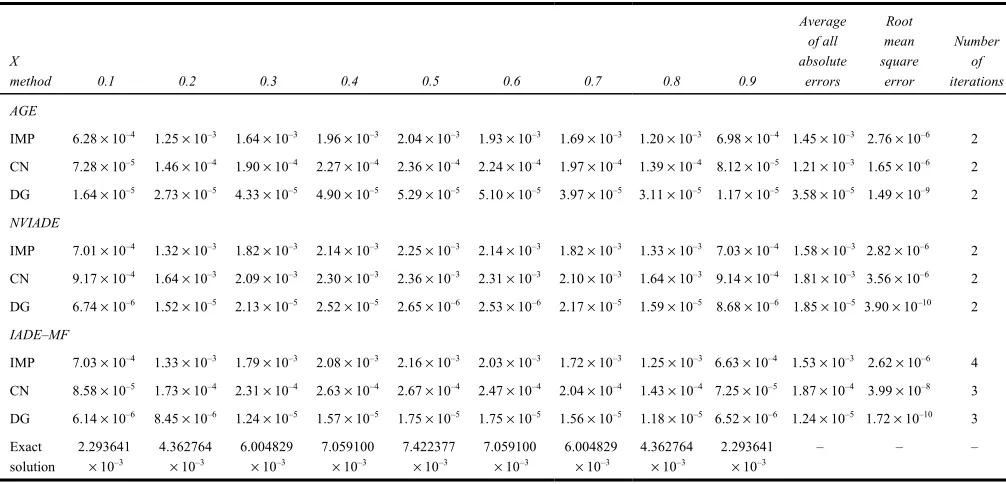
Tables 1–3 provide a comparison of the accuracy of the
methods under consideration in terms of the absolute errors
as well as the root mean square error at the appropriate grid
points for mesh ratios
λ
= 0.1,
λ
= 0.5 and
λ
= 1.0 at time
levels of
t
= 0.05,
t
= 0.25 and
t
= 0.5. The results in these
tables amply demonstrate that this new variant of the IADE
(NVIADE) method has comparable accuracy with the
highly accurate AGE method of the Peaceman-Rachford
(Tien and Chawla, 1989) variant as well as the IADE
scheme using the Mitchell-Fairweather variant (Sahimi
et al., 1993). This is even more apparent when the (2,4)
accurate Douglas finite difference approximation is used to
approximate the parabolic equation (1). As the basis of
derivation is the unconditionally stable (4,2) accurate ADI
scheme, the NVIADE method is convergent and
computationally stable and its accuracy compares well with
the (4,2) accurate IADE-MF and (2,2) accurate AGE.
Table 1
Absolute errors of numerical solutions
λ
= 0.1,
t
= 0.05,
∆
t
= 0.001,
∆
x
= 0.1,
eps
= 10
–4X
method 0.1 0.2 0.3 0.4 0.5 0.6 0.7 0.8 0.9
Average of all absolute
errors
Root mean square
error
Number of iterations Age
IMP 1.47 × 10⁻³ 2.63 × 10⁻³ 3.34 × 10⁻³ 3.67 × 10⁻³ 3.76 × 10⁻³ 3.67 × 10⁻³ 3.35 × 10⁻³ 2.63 × 10⁻³ 1.47 × 10⁻³ 2.89 × 10⁻³ 9.07 × 10⁻⁶ 2
CN 9.15 × 10⁻⁴ 1.64 × 10⁻³ 2.09 × 10⁻³ 2.30 × 10⁻³ 2.36 × 10⁻³ 2.30 × 10⁻³ 2.09 × 10⁻³ 1.64 × 10⁻³ 9.15 × 10⁻⁴ 1.81 × 10⁻³ 3.56 × 10⁻⁶ 2
DG 1.67 × 10⁻⁶
5.49 × 10⁻⁶
1.15 × 10⁻⁵
1.72 × 10⁻⁵
1.97 × 10⁻⁵
1.73 × 10⁻⁵
1.15 × 10⁻⁵
5.52 × 10⁻⁶
1.60 × 10⁻⁶
1.01 × 10⁻⁵
1.46 × 10⁻¹⁰
2
NVIADE
IMP 1.49 × 10⁻³ 2.64 × 10⁻³ 3.35 × 10⁻³ 3.67 × 10⁻³ 3.75 × 10⁻³ 3.67 × 10⁻³ 3.35 × 10⁻³ 2.64 × 10⁻³ 1.47 × 10⁻³ 2.89 × 10⁻³ 9.08 × 10⁻⁶ 2
CN 9.17 × 10⁻⁴ 1.64 × 10⁻³ 2.10 × 10⁻³ 2.31 × 10⁻³ 2.36 × 10⁻³ 2.31 × 10⁻³ 2.10 × 10⁻³ 1.64 × 10⁻³ 9.14 × 10⁻⁴ 1.81 × 10⁻³ 3.57 × 10⁻⁶ 2
DG 2.47 × 10⁻⁶ 1.50 × 10⁻⁷ 1.33 × 10⁻⁶ 4.09 × 10⁻⁶ 4.32 × 10⁻⁷ 1.23 × 10⁻⁷ 3.30 × 10⁻⁷ 5.89 × 10⁻⁷ 4.12 × 10⁻⁶ 4.13 × 10⁻⁶ 1.22 × 10⁻¹¹ 2
IADE-MF
IMP 1.07 × 10⁻³ 1.88 × 10⁻³ 2.74 × 10⁻³ 3.19 × 10⁻³ 3.36 × 10⁻³ 3.34 × 10⁻³ 3.11 × 10⁻³ 2.59 × 10⁻³ 1.65 × 10⁻³ 2.55 × 10⁻³ 9.07 × 10⁻⁶ 4
CN 7.94 × 10⁻⁴ 1.43 × 10⁻³ 1.86 × 10⁻³ 2.07 × 10⁻³ 2.14 × 10⁻³ 2.11 × 10⁻³ 1.95 × 10⁻³ 1.55 × 10⁻⁴ 8.71 × 10⁻⁴ 1.64 × 10⁻³ 3.53 × 10⁻⁷ 3
DG 5.84 × 10⁻⁶ 8.46 × 10⁻⁶ 3.74 × 10⁻⁷ 8.94 × 10⁻⁶ 1.38 × 10⁻⁵ 1.35 × 10⁻⁵ 9.28 × 10⁻⁶ 4.48 × 10⁻⁶ 1.39 × 10⁻⁶ 7.34 × 10⁻⁶ 1.35 × 10⁻¹⁰ 3
Exact solution
0.1950648 0.3707705 0.5098716 0.5989617 0.6296137 0.5989617 0.5098716 0.3707705 0.1950648 – – –
Table 2
Absolute errors of numerical solutions
λ
= 0.5,
t
= 0.25,
∆
t
= 0.005,
∆
x
= 0.1,
eps
= 10
–4X
method 0.1 0.2 0.3 0.4 0.5 0.6 0.7 0.8 0.9
Average of all absolute
errors
Root mean square
error
Number of iterations Age
IMP 2.18 × 10⁻³ 4.15 × 10⁻³ 5.69 × 10⁻³ 6.70 × 10⁻³ 7.04 × 10⁻³ 6.69 × 10⁻³ 5.71 × 10⁻³ 4.14 × 10⁻³ 2.19 × 10⁻³ 4.94 × 10⁻³ 2.76 × 10⁻⁵ 2
CN 5.32 × 10⁻⁴ 1.02 × 10⁻³ 1.39 × 10⁻³ 1.64 × 10⁻³ 1.72 × 10⁻³ 1.64 × 10⁻³ 1.40 × 10⁻³ 1.01 × 10⁻³ 5.43 × 10⁻⁴ 1.21 × 10⁻³ 1.65 × 10⁻⁶ 2
DG 7.38 × 10⁻⁶ 2.05 × 10⁻⁵ 3.06 × 10⁻⁵ 3.77 × 10⁻⁵ 4.11 × 10⁻⁵ 4.53 × 10⁻⁵ 3.62 × 10⁻⁵ 2.76 × 10⁻⁵ 1.17 × 10⁻⁵ 3.23 × 10⁻⁵ 1.20 × 10⁻⁹ 2
NVIADE
IMP 2.23 × 10⁻³ 4.19 × 10⁻³ 5.76 × 10⁻³ 6.77 × 10⁻³ 7.11 × 10⁻³ 6.77 × 10⁻³ 5.75 × 10⁻³ 4.18 × 10⁻³ 2.19 × 10⁻³ 5.00 × 10⁻³ 2.82 × 10⁻⁵ 2
CN 5.47 × 10⁻⁴
1.03 × 10⁻³
1.41 × 10⁻³
1.65 × 10⁻³
1.74 × 10⁻³
1.65 × 10⁻³
1.40 × 10⁻³
1.02 × 10⁻³
5.32 × 10⁻⁴
1.22 × 10⁻³
1.68 × 10⁻⁶
2 DG 7.38 × 10⁻⁶ 2.05 × 10⁻⁶ 3.06 × 10⁻⁵ 3.77 × 10⁻⁵ 4.11 × 10⁻⁶ 4.04 × 10⁻⁵ 3.57 × 10⁻⁵ 2.74 × 10⁻⁵ 1.63 × 10⁻⁵ 2.85 × 10⁻⁵ 9.37 × 10⁻¹⁰ 2
IADE-MF
IMP 2.20 × 10⁻³ 4.19 × 10⁻³ 5.76 × 10⁻³ 6.76 × 10⁻³ 7.10 × 10⁻³ 6.75 × 10⁻³ 5.74 × 10⁻³ 4.17 × 10⁻³ 2.19 × 10⁻³ 4.98 × 10⁻³ 2.81 ×10⁻⁵ 3
CN 5.37 × 10⁻⁴ 1.02 × 10⁻³ 1.41 × 10⁻³ 1.65 × 10⁻³ 1.74 × 10⁻³ 1.65 × 10⁻³ 1.41 × 10⁻³ 1.02 × 10⁻⁴ 5.38 × 10⁻⁴ 1.22 × 10⁻³ 1.68 × 10⁻⁶ 3
DG 8.14 × 10⁻⁶
2.53 × 10⁻⁵
3.40 × 10⁻⁵
3.97 × 10⁻⁵
4.15 × 10⁻⁵
3.92 × 10⁻⁵
3.29 × 10⁻⁵
2.31 × 10⁻⁵
1.03 × 10⁻⁵
2.82 × 10⁻⁵
9.35 × 10⁻¹⁰
2 Exact
solution
2.704606
× 10–2
5.144467
× 10–2
7.080751
× 10–2
8.323922
× 10–2
8.7522990
× 10–2
8.323922
× 10–2
7.080751
× 10–2
5.144467
× 10–2
2.704606
× 10–2
Table 3
Absolute errors of numerical solutions
λ
= 1.5,
t
= 0.5,
∆
t
= 0.01,
∆
x
= 0.1,
eps
= 10
–4X
method 0.1 0.2 0.3 0.4 0.5 0.6 0.7 0.8 0.9
Average of all absolute
errors
Root mean square
error
Number of iterations AGE
IMP 6.28 × 10⁻⁴ 1.25 × 10⁻³ 1.64 × 10⁻³ 1.96 × 10⁻³ 2.04 × 10⁻³ 1.93 × 10⁻³ 1.69 × 10⁻³ 1.20 × 10⁻³ 6.98 × 10⁻⁴ 1.45 × 10⁻³ 2.76 × 10⁻⁶ 2
CN 7.28 × 10⁻⁵ 1.46 × 10⁻⁴ 1.90 × 10⁻⁴ 2.27 × 10⁻⁴ 2.36 × 10⁻⁴ 2.24 × 10⁻⁴ 1.97 × 10⁻⁴ 1.39 × 10⁻⁴ 8.12 × 10⁻⁵ 1.21 × 10⁻³ 1.65 × 10⁻⁶ 2
DG 1.64 × 10⁻⁵ 2.73 × 10⁻⁵ 4.33 × 10⁻⁵ 4.90 × 10⁻⁵ 5.29 × 10⁻⁵ 5.10 × 10⁻⁵ 3.97 × 10⁻⁵ 3.11 × 10⁻⁵ 1.17 × 10⁻⁵ 3.58 × 10⁻⁵ 1.49 × 10⁻⁹ 2
NVIADE
IMP 7.01 × 10⁻⁴ 1.32 × 10⁻³ 1.82 × 10⁻³ 2.14 × 10⁻³ 2.25 × 10⁻³ 2.14 × 10⁻³ 1.82 × 10⁻³ 1.33 × 10⁻³ 7.03 × 10⁻⁴ 1.58 × 10⁻³ 2.82 × 10⁻⁶ 2
CN 9.17 × 10⁻⁴ 1.64 × 10⁻³ 2.09 × 10⁻³ 2.30 × 10⁻³ 2.36 × 10⁻³ 2.31 × 10⁻³ 2.10 × 10⁻³ 1.64 × 10⁻³ 9.14 × 10⁻⁴ 1.81 × 10⁻³ 3.56 × 10⁻⁶ 2
DG 6.74 × 10⁻⁶ 1.52 × 10⁻⁵ 2.13 × 10⁻⁵ 2.52 × 10⁻⁵ 2.65 × 10⁻⁶ 2.53 × 10⁻⁶ 2.17 × 10⁻⁵ 1.59 × 10⁻⁵ 8.68 × 10⁻⁶ 1.85 × 10⁻⁵ 3.90 × 10⁻¹⁰ 2
IADE–MF
IMP 7.03 × 10⁻⁴ 1.33 × 10⁻³ 1.79 × 10⁻³ 2.08 × 10⁻³ 2.16 × 10⁻³ 2.03 × 10⁻³ 1.72 × 10⁻³ 1.25 × 10⁻³ 6.63 × 10⁻⁴ 1.53 × 10⁻³ 2.62 × 10⁻⁶ 4
CN 8.58 × 10⁻⁵ 1.73 × 10⁻⁴ 2.31 × 10⁻⁴ 2.63 × 10⁻⁴ 2.67 × 10⁻⁴ 2.47 × 10⁻⁴ 2.04 × 10⁻⁴ 1.43 × 10⁻⁴ 7.25 × 10⁻⁵ 1.87 × 10⁻⁴ 3.99 × 10⁻⁸ 3
DG 6.14 × 10⁻⁶ 8.45 × 10⁻⁶ 1.24 × 10⁻⁵ 1.57 × 10⁻⁵ 1.75 × 10⁻⁵ 1.75 × 10⁻⁵ 1.56 × 10⁻⁵ 1.18 × 10⁻⁵ 6.52 × 10⁻⁶ 1.24 × 10⁻⁵ 1.72 × 10⁻¹⁰ 3
Exact solution
2.293641
× 10–3
4.362764
× 10–3
6.004829
× 10–3
7.059100
× 10–3
7.422377
× 10–3
7.059100
× 10–3
6.004829
× 10–3
4.362764
× 10–3
2.293641
× 10–3
– – –