University of Windsor University of Windsor
Scholarship at UWindsor
Scholarship at UWindsor
Electronic Theses and Dissertations Theses, Dissertations, and Major Papers
2009
Mining very long sequences with PLWAPLong algorithms
Mining very long sequences with PLWAPLong algorithms
Kashif Saeed University of Windsor
Follow this and additional works at: https://scholar.uwindsor.ca/etd
Recommended Citation Recommended Citation
Saeed, Kashif, "Mining very long sequences with PLWAPLong algorithms" (2009). Electronic Theses and Dissertations. 7868.
https://scholar.uwindsor.ca/etd/7868
This online database contains the full-text of PhD dissertations and Masters’ theses of University of Windsor students from 1954 forward. These documents are made available for personal study and research purposes only, in accordance with the Canadian Copyright Act and the Creative Commons license—CC BY-NC-ND (Attribution, Non-Commercial, No Derivative Works). Under this license, works must always be attributed to the copyright holder (original author), cannot be used for any commercial purposes, and may not be altered. Any other use would require the permission of the copyright holder. Students may inquire about withdrawing their dissertation and/or thesis from this database. For additional inquiries, please contact the repository administrator via email
NOTE TO USERS
This reproduction is the best copy available.
Mining Very Long Sequences with PLWAPLong
Algorithms
By
Kashif Saeed
A Thesis
Submitted to the Faculty of Graduate Studies
through the School of Computer Science
in Partial Fulfillment of the Requirements
for the Degree of Master of Science
at the
University of Windsor
Windsor, Ontario, Canada
2009
1*1
Library and Archives CanadaPublished Heritage Branch
395 Wellington Street Ottawa ON K1A 0N4 Canada
Bibliotheque et Archives Canada
Direction du
Patrimoine de ('edition
395, rue Wellington OttawaONK1A0N4 Canada
Your file Votre reference ISBN: 978-0-494-57610-6 Our file Notre reference ISBN: 978-0-494-57610-6
NOTICE: AVIS:
The author has granted a
non-exclusive license allowing Library and Archives Canada to reproduce, publish, archive, preserve, conserve, communicate to the public by
telecommunication or on the Internet, loan, distribute and sell theses
worldwide, for commercial or non-commercial purposes, in microform, paper, electronic and/or any other formats.
L'auteur a accorde une licence non exclusive permettant a la Bibliotheque et Archives Canada de reproduire, publier, archiver, sauvegarder, conserver, transmettre au public par telecommunication ou par I'lntemet, preter, distribuer et vendre des theses partout dans le monde, a des fins commerciales ou autres, sur support microforme, papier, electronique et/ou autres formats.
The author retains copyright ownership and moral rights in this thesis. Neither the thesis nor substantial extracts from it may be printed or otherwise reproduced without the author's permission.
L'auteur conserve la propriete du droit d'auteur et des droits moraux qui protege cette these. Ni la these ni des extraits substantiels de celle-ci ne doivent etre imprimes ou autrement
reproduits sans son autorisation.
In compliance with the Canadian Privacy Act some supporting forms may have been removed from this thesis.
Conformement a la loi canadienne sur la protection de la vie privee, quelques
formulaires secondaires ont ete enleves de cette these.
While these forms may be included in the document page count, their removal does not represent any loss of content from the thesis.
Bien que ces formulaires aient inclus dans la pagination, il n'y aura aucun contenu manquant.
Mining Very Long Sequences with PLWAPLong
Algorithms
By
Kashif Saeed
APPROVED BY:
Dr. Severien Nkurunziza, External Reader
Dept. of Mathematics & Statistics
Dr. Luis Rueda, Internal Reader
School of Computer Science
Dr. Christie I. Ezeife, Advisor
School of Computer Science
Dr. Robert Kent, Chair
Author's Declaration of Originality
I hereby certify that I am the sole author of this thesis and that no part of this
thesis has been published or submitted for publication.
I certify that, to the best of my knowledge, my thesis does not infringe upon
anyone's copyright nor violate any proprietary rights and that any ideas, techniques,
quotations, or any other material from the work of other people included in my thesis,
published or otherwise, are fully acknowledged in accordance with the standard
referencing practices. Furthermore, to the extent that I have included copyrighted
material that surpasses the bounds of fair dealing within the meaning of the Canada
Copyright Act, I certify that I have obtained a written permission from the copyright
owner(s) to include such material(s) in my thesis and have included copies of such
copyright clearances to my appendix.
Abstract
Sequential pattern mining is the process of finding inter-transaction frequent sequential patterns from a sequential database, where records consist of ordered sets of events (or items), by applying data mining techniques on such sequential databases. Discovering sequential patterns in web server logs is an example application of sequential mining, which is useful for predicting visiting patterns of web users for such purposes as targeted advertisements. Position Coded Pre-order Linked Web Access Pattern (PLWAP) mining algorithm is one of the existing efficient web sequential pattern mining algorithms, which stores the frequently stored sequences of the entire sequential database in a compressed tree form with position coded nodes.
However, for very long sequences exceeding thirty two nodes, the number of bits an integer position code can hold, the PLWAP algorithm's performance begins to degrade because it employs linked lists to store conjunctions of long position codes and the linked list traversals slow down the algorithm both during tree construction and mining. PLWAP algorithm also uses each and every node in the frequent 1-item event queue to test for that event inclusion in the suffix tree root set during mining. This is a very expensive operation since except for one node all other nodes that are its ancestors and descendents are not included in the root set.
This thesis proposes two new algorithms, i.e. PLWAPLongl and PLWAPLong2. Both of these new algorithms use a new position code numbering scheme where each node is assigned two numeric variables (startPosition, endPosition) instead of one. Using this scheme we can determine the ancestor node in O (1) operation by comparing the startPosition and endPosition of two nodes. PLWAPLongl algorithm also proposes transforming the linked list based tree to an equivalent array representation and using binary search to find the immediate descendant in a suffix tree. PLWAPLong2 uses existing linked list based tree. Both PLWAPLongl and PLWAPLong2 algorithms introduce a new technique called "Last Descendant" to eliminate the unwanted nodes from ancestor/descendent test when creating the suffix tree root set.
Keywords: Data mining, Web Mining, Association Rule Mining, Long Sequences,
Dedication
Acknowledgement
I would like to give my sincere appreciation to all of the people who have helped me
throughout my education. I express my heartfelt gratitude to my Mother, Father, Wife,
Daughter and Sisters for their prayers, moral and financial support throughout my
graduate studies.
I am very grateful to my supervisor, Dr. Christie Ezeife for her continuous support
throughout my graduate study. She always guided me and encouraged me throughout the
process of this research work, taking time to read all my thesis updates.
I would also like to thank my external reader, Dr. Severien Nkurunziza, my internal
reader, Dr. Luis Rueda, and my thesis committee chair, Dr. Robert Kent for making time
to be in my thesis committee, reading the thesis and providing valuable input. I appreciate
all your valuable suggestions and the time, which have helped improve the quality of this
thesis.
At last, I would express my appreciations to all my friends and colleagues, for their help
Table of Contents
Author's Declaration of Originality iii
Abstract iv Dedication v Acknowledgement vi
Table of Figures ix Table of Tables xi 1. Introduction 1
1.1. Web Mining 7
1.1.1. Web Content Mining 2 1.1.2. Web Structure Mining 2 1.1.3. Web Usage Mining 2 1.2. Phases of web usage mining 4
1.2.1. Preprocessing 4 1.2.1.1. Data Cleaning 4 1.2.1.2. User Identification 5 1.2.1.3. Formatting 5 1.2.2. Pattern Discovery 5 1.2.3. Pattern Analysis 6
1.3. Sequential Pattern mining 6
1.4. Thesis Contribution 7 1.5. Outline of the Thesis Proposal 8
2. Previous/Related Work 9
2.1. Association Rules 9
2.2. Apriori 9 2.3. FP-Tree 14 2.4. Sequential Pattern Mining Algorithms. 17
2.5. AprioriALL 17 2.6. AprioriSome 20 2.7. WAP Tree 21 2.8. SPADE 27 2.9. PrefixSpan 27 2.10. PLWAPTree.... 28 2.11. PLWAP1 & PLWAP2 33
3. Position Coded Pre-Ordered linked WAP-Tree Long (PLWAPLongl & PLWAPLong2) 34
3.1. Problem addressed 34 3.2. Proposed solution 35
3.2.1. PLWAPLongl 36 3.2.1.1. Array Representation 37
3.2.2. PLWAPLong2 42 3.2.3. Maintaining Last Descendant 45
3.2.4. Mining Process - PLWAPLongl 49 3.2.5. Mining Process-PLWAPLong2 53
3.3 Formal Definitions of PLWAPLong 1 and PLWAPLong2 Algorithms 54
4. Performance Analysis 62
4. / Experimental Evaluation 63
4.1.1 PLWAPLongl vs PLWAP 64
4.1.2 Short Sequence Experiments 64
4.1.2.2 Experiment 2 65 4.1.2.3 Experiments 65 4.1.2.4 Experiment 4 66 4.1.3 Long Sequence Experiments 66
4.1.3.1 Experiment 1 66 4.1.3.2 Experiment 2 67 4.1.3.3 Experiment 3 67
4.2 PLWAPLong2 vs PLWAP 70
4.2.1 Long Sequences 70 4.2.1.1 Experiment 1 70 4.2.1.2 Experiment 2 71 4.2.1.3 Experiment 3 72 4.2.1.4 Experiment 4 73 4.2.1.5 Experiments 73 4.2.1.6 Experiment 6 74 4.2.1.7 Experiment 7 75 4.2.2 Short Sequences 76
4.2.2.1 Experiment 1 76 4.2.2.2 Experiment 2. 77 4.2.2.3 Experiments 78 4.2.2.4 Experiment 4 79
5. Conclusions & Future Work 80
5.1 Future Work 80
Table of Figures
Figure 1 Web Usage Mining Phases 4 Figure 2 Tree branch for T100 15 Figure 3 Tree branch for T200 15 Figure 4 Complete FP tree 16 Figure 5 I3 conditional FP Tree 16 Figure 6 Web log sequence 21 Figure 7 Tree branch for TID 100 23 Figure 8 Tree branch for TID 200 24
Figure 9 WAP Tree 24 Figure 10 Conditional WAP-tree|c 25
Figure 11 Conditional WAP-tree|ac 26 Figure 12 Complete frequent pattern set 26
Figure 13 PLWAP Tree 31 Figure 14 Transformed PLWAPLong-Tree with node a:3:l 38
Figure 15 Transformed PLWAPLong-Tree with node b:3:11 39 Figure 16 Transformed PLWAPLong-Tree with node c: 1:11111 39 Figure 17 Transformed PLWAPLong Tree with c:l:1110 40
Figure 18 Transformed PLWAPLong Tree 41 Figure 19 Complete Transformed PLWAPLong tree 42
Figure 20 Example PLWAP Tree 45 Figure 21 PLWAPLong Mine with root set a:3 and a:l 52
Figure 22 PLWAPLong Mine with root set a:2, a:l and a:l 52
Figure 23 Algorithm PLWAPLongl() 56 Figure 24 Algorithm PLWAPLong2() 56 Figure 25 Algorithm transformTree() 57 Figure 26 Complete new numeric position code tree 58
Figure 27 Algorithm buildDesc()... 59 Figure 27-1 Complete PLWAPLong tree with Last Descendant references...70
Figure 28 Algorithm PLWAPLong 1-Mine 60 Figure 29 Algorithm PLWAPLong2-Mine 61 Figure 30 Short Sequence- Experiment 1 (PLWAPLongl) 64
Figure 31 Short Sequence- Experiment 2 (PLWAPLongl) 65 Figure 32 Short Sequence- Experiment 3 (PLWAPLongl) 65 Figure 33 Short Sequence- Experiment 4 (PLWAPLongl) 66 Figure 34 Long Sequence- Experiment 1 (PLWAPLongl)... 67
Figure 35 Long Sequence- Experiment 2 (PLWAPLongl) 67 Figure 36 Long Sequence- Experiment 3 (PLWAPLongl) 68
Table of Tables
Table 1 Sample Web Log 3 Table 2 Transaction DB 10 Table 3 Candidate 1-itemset 11 Table 4 Frequent 1-itemsets 11 Table 5 Candidate 2-itemsets 12 Table 6 Support Count of C2 12 Table 7 Frequent 2-itemsets 12 Table 8 Candidate 3-itemsets 12 Table 9 Support Count of C3 13 Table 10 Frequent 3-itemsets 13 Table 11 Frequent Patterns 17 Table 12 Customer-sequence database 18
Table 13 Large Itemset mapping 18 Table 14 Mapped sequences 18 Table 15 Transformed Database 18
Table 16 CI 19 Table 17 LI 19 Table 18 L2 19 Table 19 C2 19 Table 20 C4 20 Table 21 L4 20 Table 22 L3 20 Table 23 C3 20 Table 24 Maximal Large Sequences 20
1. Introduction
Organizations that have large amount of data need to make decisions that impact
their future activities. Data mining is a process of extracting relevant and important
knowledge from that large data to facilitate decision making. Automatic discovery of
user access patters from web usage log is known as web usage mining. Analysis of such
pattern can help improve server performance, restructuring of a web site and better
marketing strategies in e-commerce web sites. It can also be used to find significant user
actions like sending an email or searching [SM+99]. In this thesis, we study efficient
mining of sequential patterns from web usage log. This chapter is organized as follows:
section 1.1 introduces web mining and its categories; section 1.2 introduces phases of
web usage mining.
1.1. Web Mining
The growth of World Wide Web (WWW) has amazing impact on our everyday life.
Online shopping, following news feeds, keeping track of stock market, weather update,
banking or simply conducting online business, World Wide Web has grown in both
volume and traffic. This growth has brought new challenges to web site design, web
server design and also the web site navigation. When data mining techniques are applied
on web data it becomes web mining. Web mining finds interesting patterns from the web
by applying automatic mining techniques. Interesting patterns are discovered from web
contents or web pages, web links in the web pages or web logs. This web data can be
collected at the server-side, client-side, proxy-servers or organizations' database.
According to [BL99], [MBN+99] and [SCD+00] web mining can be categorized into web
1.1.1. Web Content Mining
Web sites are built up with text, hyperlinks, images, scripts and multimedia. Web content
mining discovers useful information from these data items that make up the website.
1.1.2. Web Structure Mining
A website usually consists of more than one web page. These web pages are connected
to each other using hyperlinks. Web structure mining discovers the patterns from such
hyperlinks. These patterns represent the underlying model of the website and such a
model then can be used to categorize the web pages. Using such patterns, similarity and
relationship with different websites can be discovered.
1.1.3. Web Usage Mining
Although sequential pattern mining technique can be used with applications other than
the web-based, focus of this thesis will only be on the web usage. Web usage mining
finds relationships between and patterns in access log files generated by the user's visit to
the website. It provides straightforward statistics, such as page access frequency along
with finding common traversal paths with the website [CMS99]. According to [BM98],
log files can be of three kinds: server log, error log and cookie log. A typical web log at
least consists of entries shown in Table -1. An Example of a line of data in a web log is
137.207.76.120-[30/Aug/2001:12:03:24-0500] ',GET/jdkl.3/docs/relnotes/deprecatedlist.html
HTTP/1.0" 200 2781"
Where 137.207.76.120 is the host/ip, '-'represents annonymus user,
"request url", '200' is the status of the URL request and 2781 is the number of bytes
requested.
Field
Host/ip User Date
Request URL
Status
Bytes
Description
Remote client IP address Remote log user name Date, time and time zone of request
User request identifier (URI) with the uniform resource locator(URL) string Status code returned to the client
Bytes transferred (sent and received)
Example
111.125.12.112
Xyz or ' - ' for anonymous user. 14/Jan/2008:10:01:01-0400
URI: http, ftp, mailto etc URL:
http://cricket.resultsvault.com/cricket/reports/matchmenu.asp
200 [series of success], 300 [series of redirect], 400 [series of failure] and 500 [series of server error]
1024 bytes
Table 1 Sample Web Log
With the help of web usage mining, organizations can monitor the browsing behavior of
users on the web-based applications. For example, if users access page with URL
/products/games/hardware.html, 95% of times they also access page
/products/games/accessories.html. Such information can be useful in laying out the links
closer to each other hence providing easier browsing routes. Such patters can also help in
doing better marketing of products to targeted users. Web usage data can be obtained
from TCP-IP packets using sniffing software [SCD+0O], cookie log data, query data and
1.2. Phases of web usage mining
Web usage mining can be categorized into three phases: preprocessing,
Knowledge/pattern discovery and pattern analysis.
Log file
r
1=2.1= Preprocessing
Preprocessing constitutes about 80% of the work of data mining tasks [AKM+01].
According to [CMS99] following tasks may be included in the preprocessing phase: Data
cleaning, User-Identification, session-identification, path-completion,
transaction-identification, formatting.
1.2.1.1. Data Cleaning
Web pages these days are rich with images, multimedia, scripts and hyperlinks. When
user visits the web site and requests for a web page, all the data ingredients of that page Preprocessing
Pattern Discovery
Pattern Analysis
get recorded in the server log file. For web log analysis, only the html page should be
listed in the navigational path of the log file. Multimedia embedded files, images, scripts
and hyperlinks all become noise data and should be cleaned.
1.2.1.2. User Identification
Web logs contain IP addresses to identify the users. Sometimes, IP address can not
uniquely identify every user because users share their computers or are connected
through proxy servers. According to [CMS99], log/site method can be employed to
identify unique users. Users and user sessions also become difficult to identify from the
web logs because of the stateless nature of HTTP [CMS99, CP95, P97, SP+98]
1.2.1.3. Formatting
Formatting is the final step in preprocessing. A predefined module is used to format the
cleaned log that could then be used for data mining.
1.2.2. Pattern Discovery
Once the usage log is cleaned and formatted, it is ready to be operated by various
algorithms and methods. Let's see some of the methods applicable to web usage mining.
Association Rule Mining:
According to [AIS93], association rule is an implication of the form X => Y;,
where X is a set of some items in Y, and Y; is a single item in Y that is not present in X
capturing relationships among page views based on user navigational patterns
[MDKN01].
Clustering:
Clustering allows grouping of users or data items on the basis of similar characteristics
[CMS99]. Web server logs generated by user's visits to a website can be used to cluster
user information to learn and develop future marketing plans.
Sequential Pattern Mining:
While association rule mining discovers intra-transaction patterns (patterns within
same transaction), sequential pattern mining finds inter-transactions (patterns in more
than one transaction) from a set of time-ordered items.
1.2.3. Pattern Analysis
Pattern analysis comes at the end of the web usage mining process. After applying
mining techniques and algorithms patterns are analyzed and uninterested patterns are
discarded. OLAP operations can also be performed on the load usage data once it is
loaded into a data cube [SCD+00].
1.3. Sequential Pattern mining
Sequential pattern discovery is to find inter-transaction patterns such that presence of one
set of items is followed by another set, where items are ordered by their respective
transaction time. Sequential mining is a process of applying data mining techniques on
such sequential databases. Discovering sequential patterns in web server logs is helpful
in predicting visiting patterns of web users in turn helping targeted advertisement or
1.4. Thesis Contribution
This thesis proposes two new algorithms, PLWAPLongl and PLWAPLong2, to
efficiently find sequential patterns from long sequences.
Both PLWAPLongl and PLWAPLong2 are based on PLWAP algorithm [LE03] [LE05].
PLWAP algorithm stores the entire sequential database in a compressed tree form with
position coded nodes. However, for very long sequences exceeding thirty two nodes, the
PLWAP algorithm's performance begins to degrade because it employs linked lists to
store conjunctions of long position codes and the linked list traversals slow down the
algorithm both during tree construction and mining [ELL05]. PLWAP algorithm also
uses each and every node in the frequent 1-item event queue to test for that event
inclusion in the suffix tree root set during mining. This is a very expensive operation
since except for one node all other nodes that are its ancestors and descendants are not
included in the root set.
The new proposed algorithms, i.e. PLWAPLongl and PLWAPLong2, use a new position
code numbering scheme where each node is assigned two numeric variables
(startPosition, endPosition) instead of one. Using this scheme we can determine the
ancestor node in 0(1) operation by comparing the startPosition and endPosition of two
nodes. The PLWAPLongl algorithm also proposes transforming the linked list based
tree to an equivalent array representation and using binary search to find the immediate
descendant in a suffix tree. The PLWAPLong2 algorithm uses same linked list based tree
structure as that used by PLWAP algorithm. Both PLWAPLongl and PLWAPLong2
algorithms introduce a new technique called "Last Descendant" to eliminate the
1.5. Outline of the Thesis Proposal
The remaining of the thesis proposal is organized as follows: Chapter 2 reviews related
work to this thesis. Chapter 3 details discussion of the problem addressed along with the
new algorithms proposed. Chapter 4 gives performance analysis and experimental
2. Previous/Related Work
2.1. Association Rules
According to [AIS93], association rule is an implication of the form X => Yj,
where X is a set of some items in Y, and Yj is a single item in Y that is not present in X
and Y being the set of all the items. Association rule mining on web usage data helps
capturing relationships among page views based on user navigational patterns.
[AIS93] introduced many algorithms to apply association rule mining on market
basket data. Market basket data contains list of items bough by customers in each
transaction. With the advancements in bar-code scanning, task of recording such
information has also become easy and fast. Mining such basket-data helps management
of supermarkets in making decision like what two items to be put together, what items to
be put on sale or what coupons should be designed and etc. Association rule provides
information in the form of "if-then" statement. The " i f or the first part is the antecedent
and the "then" part is the consequence. Association rules make use of two numbers i.e.
support and confidence, to measure the degree of uncertainty in the rule. Support is the
number of transactions that include all items in the antecedent and consequence parts of
the rule. Confidence on the other hand is ratio of the number of the transactions that
include all the items in consequence as well as the antecedent.
2.2. Apriori
[AIS93] introduced an algorithm to apply association rule mining over the
market-basket data. Their algorithm, also know as AIS algorithm, answered the key
1. Generation of large itemsets. Large itemsets are those that have fractional
transaction support greater than a certain threshold called minsupport. This
step is also called join step.
2. Generating all rules from the large itemset. This step is also called prune step.
AIS algorithm's main drawback is that it makes multiple passes over the database to find
all association rules [AS94]. It turns out to be exponentially large. [AS94] has presented
three algorithms that outperform AIS algorithm. They all use the common function
called apriori-gen that reduces the candidate itemsets.
Transaction ID (TID)
1
2
3
4
5
6
7
8
9
Items purchased
I l , I2, l 5
h,U
I
2,I
3Ii, h, I4
I,,I
3I2, Is
Ii, I3
Ii, I2, I3, I5
I l , I2, l 3
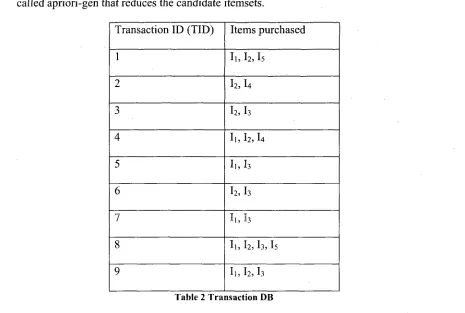
Table 2 Transaction DB
The essence of apriori algorithm is that it employs iterative approach know as level-wise
search. With such a technique, the algorithm uses prior knowledge of frequent itemset
found at previous level to find the frequent itemset at present level. Algorithm starts with
itemset is used to find L3, and so on, until no more frequent k-itemsets can be found. Let
us run through the transaction database shown in Table-2 to see how apriori algorithm
works. Let us assume that the minsupport is 2 transactions. In our example it would be
2/9 = 22%.
1. In first iteration, each item belongs to the candidate 1 -itemsets, CI. A database scan
is performed to get the occurrence count of each item.
C, Itemset I, I2 I3 I4 Is Support count 6 7 6 2 2
Table 3 Candidate 1-itemset
2. Now the algorithm will generate the Li, set of frequent 1-itemsets, by satisfying the
minsupport of candidate 1-itemsets.
L,
Itemset Ii I2 Is I4 Is Support count 6 7 6 2 2Table 4 Frequent 1-itemsets
3. With the L\ itemset in hand, algorithm will now perform a self join of Lj i.e. L] x L]
to generate a candidate 2-itemsets satisfying minsupport.
C
2 Itemset {Ii {Ii {Ii {Ii {I2 {I2,I2}
,I3}
,M
{12 {13 {13 {14
I5}
14} 15}
Is)
Table 5 Candidate 2-itemsets
4. Algorithm will now use the C2 to find the minsupport of each 2-itemset by scanning
the database once more. Support count of each candidate itemset in C2 is
accumulated as shown below.
C
2Itemset {Ii,I2}
{Il,I3>
{ i i , M
{Ii.Is} {I2.I3} {12,14}
{I2,I5}
{I3.M
{I3,I5}
H4.I5} Support Count 4 4 1 2 4 2 2 0 1 0
Table 6 Support Count of C2
5. Using the last step data set, L
2will be generated. By joining L
2x L
2we will get the
C3 candidate itemset.
L
2Itemset {Ii,I2}
{I],l3>
{IlJs}
{ 12, I3}
{ h, 14}
{ 12, I5)
Support Count 4 4 2 4 2 2
Table 7 Frequent 2-itemsets
C3
Itemset
{ I , , 12,13}
{I1.I2.I5}
Table 8 Candidate 3-itemsets
C3
Itemset
{I1.I2.I3}
{ I 1 I 2 I 5 }
Support Count
2
2
Table 9 Support Count of C3
7. Algorithm will now produce the L3 by comparing the candidate support count with
minsupport.
L3
Itemset
{I1.I2.I3} {I1.I2.I5>
Support Count
2
2
Table 10 Frequent 3-itemsets
8. A self join on L3 is performed to produce candidate set of 4-itemsets, C4. As a result,
we will get {{Ii; I2,13,15}}. Since the subset {I2, 13,15} is not frequent, the 4-itemsets
{{Ii, I2, I3, Is}} will be pruned resulting in empty C4, causing the algorithm to
terminate.
With the termination of the algorithm, the final large itemset obtained is the union of LI,
L2 and L3 i.e.
L = {I], I2,13,14, Is, {h, I2}, {Ii, I3}, {Ii, Is}, {I2,13}, {I2,14}, {I2, Is}, {Ii, I2,13}, {Ii, h,
Is}}-[AS94] introduced two more algorithms based on apriori i.e. AprioriTid and
AprioriHybrid. In AprioriTid, the database is not scanned again for count support after
the first scan for candidate 1-itemsets. This algorithm uses special encoding scheme to
find the support count, hence reducing the database scans. AprioriHybrid on the other
hand is a combination of Apriori and AprioriTid. AprioriHybrid addresses the memory
memory. AprioriHybird switches between Apriori and AprioriTid depending on memory
availability. We will not be addressing these algorithms here.
2.3. FP-Tree
Apriori-like algorithms [AIS [AIS93], AprioriTid [AS94], AprioriHybrid [AS94]] use
candidate set generation and test approach. These Apriori like algorithms are costly,
especially when large number of patterns exist [HPYOO]. [HPYOO] proposed a
frequent-pattern tree (FP-tree) structure that compresses the database representing the frequent
items and stores it in a prefix tree in descending order of their support. The FP-tree is
then mined using the FP-growth mining method. Let us mine the database from Table 2
using the FP-growth method.
9. In the first scan'frequent 1-itemsets are obtained with their support count. Keeping
the same minsupport count of 2 as we used in previous section. The set obtained in
first scan is stored in descending order of the support count denoted by L.
L = [I2:7, Ii:6,13:6,14:2,15:2].
10. After the first scan, the FP-tree construction process begins with the creation of the
root node labeled 'null'.
(^ Null J
• After this the database is scanned for the second time. All of the items in each
transaction are processed in descending support count order and branch is created for
• Transaction T100 has three items "I], I2, I5". Its L order would be "12, Ii, Is"- The
tree branch created for this transaction is shown in Figure 2.
Item ID Support Node-Link ^ n u l 1 »
Count , ^ M
\ 1 / ^
I2 II I3 I4 Is 7 6 6 2 2 — -*,- - - - - K l ^
Figure 2 Tree branch for T100
This completes the transformation of first transaction from the database to one of the
branches of the FP-tree. Now let us work on the second transaction.
Second transaction T200 consists of two items "I2, V - Its L order would be "I2,14".
I2 will be connected to the root and I4 will be connected to the node I2. The support
count for I2 will be incremented by 1 since this new branch shares the common
prefix (I2). Hence a new node I4 will be created as a child note of I2, as shown in
Figure 3.
Item ID Support N o d e.L i n k null {}
, Count , ^ M
\
1 /
s*
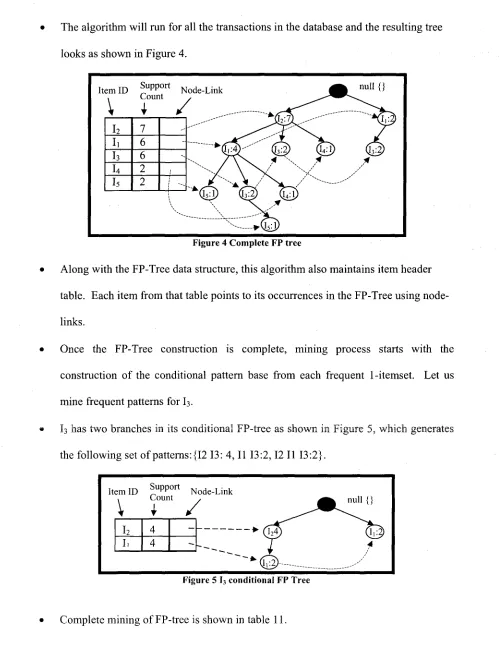
The algorithm will run for all the transactions in the database and the resulting tree
looks as shown in Figure 4.
Figure 4 Complete FP tree
Along with the FP-Tree data structure, this algorithm also maintains item header
table. Each item from that table points to its occurrences in the FP-Tree using
node-links.
Once the FP-Tree construction is complete, mining process starts with the
construction of the conditional pattern base from each frequent 1-itemset. Let us
mine frequent patterns for I3.
I3 has two branches in its conditional FP-tree as shown in Figure 5, which generates
the following set of patterns: {12 13: 4, II 13:2,12 II 13:2}.
Item ID ^U p p o r t Node-Link
. Count . ^ ^ n uu {}
I
2L
4
4
----- 1 ^
Figure 5 13 conditional FP Tree
Item
Is
I4
I3
Ii
Conditional pattern base
[(l2li:l),(I2IiI3:l)]
[(I2Ii :l),(l2:l)]
[(I2Ii:2),(I2:2),(Ii:2)]
[(I2:4)]
Conditional FP-tree
(I2:2,1,:2)
(I2:2)
(l2:4,I,:2),(Ii:2)
(I2:4)
Frequent patterns generated
h I5:2,1,15:2,12 I, I5:2
I2 I4:2
I2 I3:4,1,13:2,121,13:2
I2I,:4
Table 11 Frequent Patterns
2.4. Sequential Pattern Mining Algorithms
Sequential pattern mining algorithms were first presented by [AS95]. These algorithms
were based on the apriori algorithms presented by [AS94].
2.5. Apriori ALL
AprioriAll is the first of two algorithms presented by [AS95] to mine sequential patterns.
The essence of this algorithm is to find the maximal sequences. Each such maximal
sequence represents a sequential pattern. A sequence is maximal if it is not contained in
any other longer frequent sequence. This algorithm is based on the Apriori algorithm
presented in [AS94] with the addition of maximal phase that prunes out all non-maximal
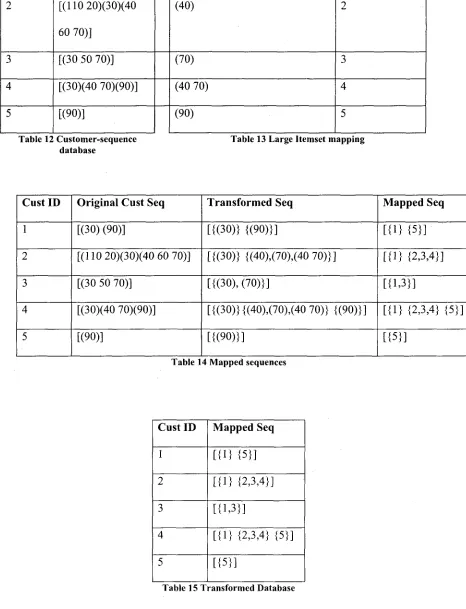
sequences. AprioriAll algorithm works on a transformed database, shown in Table 15.
Original customer-sequence database (Table 12) is transformed to a table where
transactions are large itemset (Table 13) which is further replaced by litemset mapping,
as shown in Table 14.
Cust ID
1
Original Cust Seq
[(30) (90)]
Large Itemsets
(30)
Mapped To
2 3 4 5 [(110 20)(30)(40 60 70)]
[(30 .50 70)]
[(30)(40 70)(90)] [(90)] (40) (70) (40 70) (90) 2 3 4 5
Table 12 Customer-sequence Table 13 Large Itemset mapping database Cust ID 1 2 3 4 5
Original Cust Seq
[(30) (90)]
[(110 20)(30)(40 60 70)]
[(30 50 70)]
[(30)(40 70)(90)] [(90)] Transformed Seq [{(30)} {(90)}] [{(30)}{(40),(70),(40 70)}] [{(30), (70)}] [{(30)}{(40),(70),(40 70)}{(90)}] [{(90)}] Mapped Seq [{1}{5}] [{1} {2,3,4}] [{1,3}]
[{1} {2,3,4} {5}]
[{5}]
Table 14 Mapped sequences
Cust ID 1 2 3 4 5 Mapped Seq [{1} {5}] [{1} {2,3,4}] [{1,3}]
[{1} {2,3,4} {5}]
[{5}]
The algorithm finds all the frequent patterns the same way as apriori algorithm does. It
starts by scanning the database to get the support count of each frequent 1-itemset, Table
16. Assuming the user specified support to be 40% or 2 customer sequences, we will get
the L] from Ci, shown in Table 17. We get the C
2by doing a self join of Li using
apriori-gen function as described in [AS94]. The algorithm will keep on generating the
candidate itemsets and their corresponding large itemsets unless our candidate itemset
becomes empty and we can not produce anymore large itemsets. Table 18 to Table 23
shows all of the candidate itemsets and large itemsets generated in sequence phase of
AprioriAll algorithm. The maximal phase prunes out all of the non-maximal sequences
from the large sequence sets to give the sequential patterns. Maximal phase uses the
following algorithm to do this task [AS95]
F o r ( k = n ; k > l ; k - ) d o
For each k-sequence Sk do
Delete from S all subsequences of Sk
S is the set of all large sequences generated in sequence phase. The maximal large
sequences (sequential patterns) generated are shown in Table 24.
Seq
(1)
(2)
(3)
(4)
(5)
Supp4
2
4
4
4
Seq
(1)
(2)
(3)
(4)
(5)
Supp4
2
4
4
4
Table 16 CI Table 17 LISeq (12 3) (12 4) (13 4) (13 5) (14 5)
(2 3 4)
(3 4 5)
Supp
2
2
3
2
1
2
1
Table 23 C3Seq
(12 3 4) (13 5) (4 5) Supp
2
2
2
Seq(123)
(12 4) (13 4) (13 5)(2 3 4)
Supp
2
2
3
2
2
Table 22 L3Table 24 Maximal Large Sequences
2.6. AprioriSome
Seq (12 3 4)
Supp
2
Seq (12 3 4)
Supp
2
Table 20 C4 Table 21 L4AprioriSome is also presented in [AS95] along with AS. The main difference between
AprioriAll and AprioriSome is that AprioriAll generates all large sequences, including
non-maximal sequences. Whereas AprioriSome generates large sequences for some and
avoids generating unnecessary non-maximal sequences for the others. AprioriSome has
two phases: forward phase and a backward phase. In the forward phase, it generates all
the large itemsets for certain length sequences. It uses a function next that gives the
length of next sequence to be processed. In backward phase, algorithm counts the
sequences for the lengths that it skipped in the forward phase along with deleting
non-maximal sequences that were found in the forward phase. Taking the same database
sample we used in Table 15 the AprioriSome forward phase will generate the Q , Li, C2,
L2 and C3. It will skip generating the L3 and using the apriori-generate function will
generate the C4 from C3. From C4 it will get the L4. Forward phase will halt here since
sequences from L4. Since the only sequence in L4 is (1 2 3 4), from Table 23, which is
maximal, hence nothing will be deleted from L4. Since we skipped the L3 in forward
phase, in backward we will delete all the subsequences of (1 2 3 4) that are in C3. As a
result, we are left with (1 3 5) and (3 4 5). Since (3 4 5) support count is only 1, it is also
dropped. Going one step back, all sequences from L2 are also deleted except (4 5). At
the end, all of the sequences form the L] will be deleted since all of them are subsets of
the thus far found maximal sequences. Final maximal large sequences are (1 2 3 4) (1 3
5) and (4 5).
2.7. WAP Tree
In the last section we saw apriori like algorithms for mining sequential patterns.
WAP-tree or Web Access Pattern Tree was developed by [PHM+00] for mining the sequential
patterns from web logs in non-apriori like fashion. WAP tree resembles more the FP-tree
algorithm in the sense that WAP Tree also transforms the database into a compact tree
like structure and then employees a mining algorithm on it. WAP-tree uses a WASD,
Web Access Sequence database. WASD is obtained after the first scan of the database is
done and the non-frequent parts of every sequence are discarded. Let us work on an
example of web log sequence shown in Figure 6 as <User ID, Access content>
< 100,a><l 00,b><200,e><200,a><300,b><200,e>< 100,d><200,b><400,a><400,f> <100,a><400,b><300,a><100,c><200,c><400,a><200,a><300,b><200,c><300,f> <400,c><400,f><400,c><300,a><300,e><300,c>
These events are pre-processed in such a way that all access sequences for each user are
grouped together to form a transaction database as shown in Table 25
TID
100 200 300 400
WASD
abdac eaebcac babfaec afbacfc
Table 25 Web Access Sequence Database
After the transformation, dataset is scanned to get the frequency of each event. Assuming
the minimum support of 75%, each sequence in WASD database is transformed into
frequent subsequence as shown in Table 26. The support count for the events is a=4,
b=4, c=4, d=l, e=2 and f=2. Since the support count for d, e and f is less that 75%, they
are dropped from the web access sequences.
TID
100 200 300 400
WASD
abdac eaebcac babfaec afbacfc
Frequent Subsequence
abac abcac babac abacc
Table 26 WASD Frequent Subsequences
Construction of WAP tree starts the same way as of FP-tree. A header node table is
created with frequent events from the frequent subsequences to facilitate the tree
traversal. Lets us now look at the complete construction of the three in following steps.
o A virtual root is created.
(^ Null J
o Each event from the sequence is inserted into the tree as a node with count 1 from
Root if that node type does not exist in that path, but the count is incremented by
o Taking first sequence 'abac' from the Table 26, node with label 'a' will be
inserted as a left child of the Root. Header node table is also updated and event
'a' in the header table is linked to this node. Since there is no immediate child of
the root labeled 'a', we will assign 1 to this node 'a', ' b ' follows 'a' in this
sequence and it will be made the let child of node labeled 'a'. After that we will
insert 'a' as the right child of the node ' b ' . At the end we will insert ' c ' as the
right child of the just created node 'a'. Counter for all these nodes will be set to 1.
Final branch for sequence 'abac' is shown in Figure 7
Item ID Node-Link
/ ^ ^ null {}
a b c
-\ \
\
_ . / V y
U5
( a:l J
•A J
Figure 7 Tree branch for TID 100
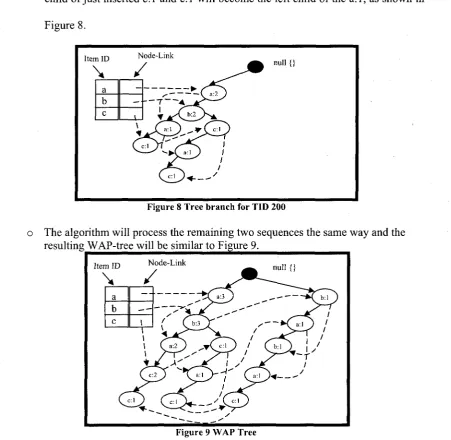
o The second sequence 'abcac' is then processed. Since there is an immediate child
of root with label 'a' exists, algorithm does not insert a new node with label 'a' as
child instead it will increment the count of 'a' to 2. Counter for node with label
'b' will also be incremented by 1 since it also already exists. Since the next node
in the existing path is 'a' which does not match the event ' c ' in this sequence,
child of just inserted c:l and c:l will become the left child of the a:l, as shown in
Figure 8.
Item ID
\ a b c
Node-Link
—
\ \
— T — + - 4 T —
-— ^•C
aO '
r CM ^-^ y
A null {}
Figure 8 Tree branch for TID 200
o The algorithm will process the remaining two sequences the same way and the
resulting WAP-tree will be similar to Figure 9.
Item ID Node-Link
\ /
null {}
a
Figure 9 WAP Tree
Completion of the WAP-tree is followed by the WAP-mine algorithm that mines all
frequent sequential patterns from the tree. Following steps are taken to complete the
WAP-mine.
o Mining starts with the lowest entry in the header table which in our example is 'c'
and all the conditional sequence base of c are discovered, i.e. aba:2, ab:l, abca:l,
from the list of conditional sequence base of 'c' because such sequences are
prefix sequences of other sequences. For example, aba and ab have count -1 and
you may notice that aba and ab are prefix sequences of conditional sequence aba.
This deduction is done to avoid these sequences from contributing twice. Now
for these events to qualify as a frequent conditional event, one event must have a
count of at least 3. Getting the counts from the sequences above, we get a:4, b:4
and c:2. Since c:2 is less than the min support of 3, it will be discarded. After
this elimination of 'c', the resulting conditional sequences based on c are aba:2,
ab:l, aba:l, ab:-l,baba:l, aba:l.
o Using the above sequence, algorithm will now generate a conditional WAP tree,
WAP-tree|c as shown in Figure 10.
Item ID \
a b
Node-Link
- -
—/^—4_>^-\ S v
* * / \ b:3 f ^" A a:l ) i
Figure 10 Conditional WAP-tree|c
o New conditional WAP tree is now ready to be mined, as shown in Figure 10.
o Next suffix subsequence be is found as a:3, ba:l and NULL. Since a is the only
frequent event with count 3, 'b' will be discarded and a:4 becomes the frequent
sequence base of 'be'. The recursive re-construction of WAP tree based on be
ends here with c, be and abc as the frequent sequences found so far. The
suffix 'ac' computed from figure 10 is NULL, ab:3, b:l, bab:l, and b:-l. Using
the just mentioned list, algorithm will build the conditional WAP-tree for base
'ac', as shown in Figure 11.
Item ID \
a b
Node-Link /
-C b:3
a:3 \ s ' V b : 1 )
* — '
Figure 11 Conditional WAP-tree|ac
o The algorithm next finds the conditional sequence bases of bac as a:3 and ba:l.
The only frequent sequence from here is a:4. Next the conditional WAP-treejbac
is built with a:4. From here, the algorithm will go back to complete the mining of
suffix ac and starts mining for suffix aac. The only sequence we get from
conditional sequence base aac is b: 1 which is not frequent hence the conditional
search for 'c' ends. The conditional search for events 'a' and ' b ' is also done the
same way as the mining for patterns with suffix 'c' is done.
o The complete frequent pattern set obtained at the end of WAP-mine algorithm is
shown in figure 11.
{c, aac, bac, abac, ac, abc, be, ,b, ab, a, aa, ba, aba}
Figure 12 Complete frequent pattern set
Unlike Apriori-like algorithms that make multiple scans of the databases to mine
generation of candidate sets. But, at the same time, it introduces the construction of large
recursive intermediate WAP-trees during mining process, hence introducing the problem
of efficiently storing and managing the main memory for such intermediate WAP trees.
In the next section we will see how PLWAP algorithm presented by [LE03], [LE05] and
[ELL05] eliminates the construction of such intermediate WAP-trees and improves the
performance of mining sequential patterns.
2.8. SPADE
In [ZOO], the author proposed the SPADE (Sequential PAttern Discovery using
Equivalent Class) algorithm. SPADE uses vertical format sequential pattern mining
technique. In this technique an object is associated with each sequence in which it
occurred along with the time stamp. Sequential pattern mining is implemented by
growing the subsequences using apriori candidate generation. Bottleneck of SPADE is
the generation of huge set of candidate sequences and the multiple scans of database in
mining.
2.9. PrefixSpan
PrefixSpan was introduced by [PJ+01] and it is based on freeSpan. FreeSpan uses
frequent items to recursively project sequences databases into a set of smaller projected
databases and grow subsequence fragments in each projected database. The drawback of
freeSpan is that the algorithm needs to keep the projected sequence in its original
database without length reduction. PrefixSpan on the other hand is a prefix-based
projection algorithm. It examines the prefix subsequence and projects their
candidate sequences and projected databases keeps on shrinking. Major cost of
PrefixSpan is the construction of the project database and storing it in the memory.
PrefixSpan also proposed two projection techniques 1) bi-level projection for reducing
the number and sizes of projected database 2) Pseudo-projection that avoids physical
copying of postfixes by using pointers to form projections.
2.10. PLWAPTree
PLWAP or the Pre-order Linked Web Access Pattern Tree was introduced by [LE03],
[LE05] and [ELL05]. It eliminates the need for recursively re-constructing the
intermediate WAP-trees during mining. It employs binary position code assignment to
the nodes that helps determine the suffix tree for any frequent pattern prefix and
eliminates the need of constructing the intermediate trees. Rule 2.1 from [LE03] defines
the assignment of binary code as
"Given a WAP-tree with some nodes, the position code of each node can simply
be assigned following the rule that the root has null position code, and the
leftmost child of the root has a code of 1, but the code of any other node is derived
by appending 1 to the position code of its parent, if this node is the leftmost child,
or appending 10 to the position code of the parent if this node is the second
leftmost child, the third leftmost child has 100 appended, etc. In general, for the
nth leftmost child, the position code is obtained by appending the binary number
PLWAP or the Pre-order Linked Web Access Pattern Tree was introduced by [LE03],
[LE05] and [ELL05]. It eliminates the need for recursively re-constructing the
intermediate WAP-trees during mining. It employs binary position code assignment to
the nodes that helps determine the suffix tree for any frequent pattern prefix and
eliminates the need of constructing the intermediate trees. Rule 2.1 from [LE03] defines
the assignment of binary code as
"Given a WAP-tree with some nodes, the position code of each node can simply
be assigned following the rule that the root has null position code, and the
leftmost child of the root has a code of 1, but the code of any other node is derived
by appending 1 to the position code of its parent, if this node is the leftmost child,
or appending 10 to the position code of the parent if this node is the second
leftmost child, the third leftmost child has 100 appended, etc. In general, for the
nth leftmost child, the position code is obtained by appending the binary number
of "' to the parent's code ".
There are three main steps of PLWAP algorithm implementation, which are given below.
• Step 1: Frequent-1 events are obtained by scanning the access sequence database.
All events that have support equal or greater than the minimum support are frequent. In
the PLWAP-tree, each node stores node label, node count and node position code. The
root of the tree is a special virtual node with an empty label and count 0.
• Step 2: Database is scanned for the second time to obtain the frequent sequences
from each transaction. The non-frequent events in each sequence are deleted from the
prefix tree data structure, called PLWAP tree, by inserting the frequent sequence of each
transaction in the tree the same way the WAP-tree algorithm would insert them. The
insertion of frequent subsequence is started from the root of the PLWAP-tree. Taking
first sequence 'abac' from Table 26, node with label 'a' will be inserted as a left child of
the Root. Since there is no immediate child of the root labeled 'a', we will assign count 1
to this node 'a' and set its position code by applying Rule 2.1 above. Event ' b ' follows
'a' in this sequence and it will be made the let child of node labeled 'a' with count set to
' 1' and position code set by again using rule 2.1. After that we will insert 'a' as the right
child of the node ' b ' . At the end we will insert ' c ' as the right child of the just created
node 'a'.
Once all of the sequences are inserted in the PLWAP-tree from table 26, the tree is
traversed in pre-order fashion (by visiting the root first, the left subtree next and the right
subtree finally), to create the frequent header node linkage. To assist node traversal
during mining process, auxiliary node linkage structure is constructed. All the nodes in
the tree with the same label are linked by shared-label linkages into a queue, called
event-node queue. The event-event-node queue with label e; is also called ej -queue. There is one
header table for a PLWAP-tree, and the head of each event-node queue is registered.
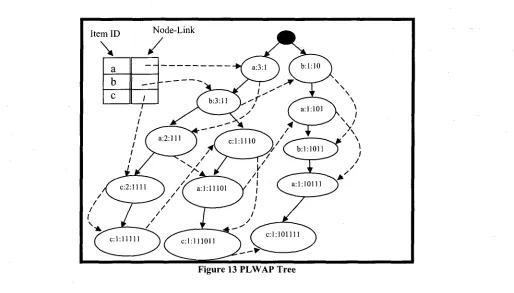
Figure 13 PLWAP Tree
Step 3: mine algorithm uses suffix subsequences to construct intermediate
WAP-trees to find the frequent sequence. PLWAP on the other hand finds the prefix event first
and then uses the suffix tree. Since PLWAP does not create intermediate WAP-trees, it
uses property 2.1 [LE03] to determine quickly if the given node is an ancestor or
descendant of the other node hence finding the suffix tree of a particular event without
reconstructing the intermediate trees. The property 2.1 from [LE03] states
"A node a is an ancestor of another node f3 if and only if the position code of a with "1"
appended to its end, equals the first x number of bits in the position code of p, where x is
the ((number of bits in the position code of a) + I). "
Taking Figure 13 as an example with minimum support of 75%, let us find frequent
• PL WAP Algorithm starts mining with the first element from the header linkage table.
In our example it is 'a'. Following the 'a' link, the first occurrence of 'a' node in the
two suffix trees of the root at a:3:l and b:l :10 is mined. The first occurrence in both
suffix trees is found at node a:3:1 and a: 1:101. Since the sum of counts of both these
nodes is greater than the minimum support, hence 'a' is considered as frequent
1-sequence.
• Next the algorithm will look at 2-sequence that starts with 'a'. The suffix trees of
1:3:1 and a:l:101 rooted at b:3;ll and b:l: 1011 are mined. The first occurrences of
'a' in these suffix trees are found at nodes a : 2 : l l l , a:l: 11101 and a:l: 10111. Since
the frequency count of these node is more than 3 hence 'a' is added to the last list of
frequent sequence 'a' forming 'aa' frequent sequence.
• The algorithm will next mine the suffix trees of nodes mentioned in last step. The
roots of these suffix trees c:2:l 111, c:l:l 11011 and c:l:101 111 will give ' c ' frequent
event to make 'aac' frequent sequence. The last suffix tree is c: 1:11111 which is not
frequent hence terminating the recursive search for 'a' and starts with the next event
'b' from the header linkage table. The algorithm backtracks and finds b:3:ll and
b: 1:1011 and generates ' b ' frequent event giving 'ab' frequent sequence. The
algorithm progresses and finds other frequent sequences with 'ab' as their prefix
sequence i.e 'aba', 'abac' and 'abc'. The algorithm terminates here as no more
frequent sequences are found and backtracks to find frequent sequences that have ' c '
as prefix event. Algorithm finds frequent event ' c ' from c:2;l 111, c: 1:111011 and
c: 1:101111 to give 'ac' as the frequent sequence. This completes finding all the
• The PLWAP algorithm then finds the frequent sequences starting with 'b' and 'c'.
The complete set of frequent sequences found by PLWAP are
{a,aa,aac,ab,aba„abac,abc,ac,b,ba,bac,bc,c}.
2.11. PLWAP1 & PLWAP2
[WP08] introduced PLWAP 1 and PLWAP2 algorithms that are based on WAP and
PLWAP algorithms. In PLWAP1 algorithm implementation, a new header table is
created in every recursive call during mining that links only those nodes that are under
the new root set. With this approach they are avoiding redundant node checking. In
PLWAP2 algorithm, no new header table is created but the algorithm filters out events
that are not under the new roots. This filtering is achieved by traversing from the new
3. Position Coded Pre-Ordered linked WAP-Tree Long
(PLWAPLongl & PLWAPLong2)
3.1. Problem addressed
We have identified two problems that degrade the PLWAP algorithm performance.
Problem #1: In previous chapter we saw that PLWAP eliminates the need to generate
intermediate conditional WAP trees by first assigning the position codes to each node and
then identifying quickly if a node on a current suffix tree set belongs to a different subtree
so that its count can contribute to the total support count of root set. PLWAP algorithm
implementation represents binary position code of each node by storing its binary code in
a linked list data structure. However, for very long sequences exceeding thirty two
nodes, the number of bits an integer position code can hold, the PLWAP algorithm's
performance begins to degrade because the linked list traversals slow down the algorithm
both during tree construction and mining [ELL05]. This is because when the algorithm
starts the mining process and needs to test the ancestor-descendant relationship of two
nodes, it will first retrieve the complete position code of these nodes by following the
linked lists associated with each one of them. If these nodes happen to be part of the tail
of a very long (more than 32 items) sequence, the retrieval of position codes becomes
slow because the linked list will need to make too many memory reads to traverse
completely through the linked list.
Problem #2: Second problem seen in the PLWAP algorithm implementation is that
during construction of the suffix trees the ancestor-descendant relationship check
unnecessary checks. This is because all events, with the same label, that are ancestor of
event for which suffix tree is being explored, should not be tested for this relationship as
they will never be counted in the suffix tree support. Similarly, those events, with the
same labels, that are descendants of event for which suffix tree is being explored, should
not be included in the support count of the suffix tree as well [LE03]. When dealing with
long sequences where branches have hundreds of event nodes having repeated events, the
algorithm will do many relationship checks just to ignore their support count. This
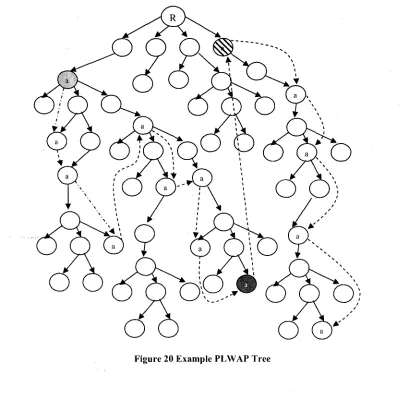
support check affects the performance when we have very long sequences. From
Figure-12 we can see that when algorithm starts the mining process with "root" node in the root
set and event queue 'a', node "a:3:l" is the first node from the event queue 'a' found to
be the first descendant of root and added to the new root set. Although all the
descendants of this node "a:3:l" will be checked for ancestor-descendant relationship but
their counts will not be added, hence taking up time and costing the performance
especially when we have large sequences.
3.2. Proposed solution
To address the problems identified in previous section, we are proposition two new
algorithms, i.e. PLWAPLongl and PLWAPLong2. Both of these algorithms share same
solution for problem #1. To address problem #2, PLWAPLongl algorithm proposes the
transformation of linked list based PLWAP tree into its equivalent array based
representation and employing binary search to find the descendents during root set
creation. On the other hand, PLWAPLong2 algorithm uses the same linked list base tree
technique called 'Last Descendant' to eliminate unwanted node comparisons during root
set creation.
Solution for problem #1: To overcome the first problem, we are proposing a new
position code numbering scheme. Our approach uses two new labels instead of one for
each node i.e. 'startPosition' and 'endPosition' and assigns the numeric values to these
labels during transformation of linked list tree into array based tree with pre-order
traversal of the PLWAP-tree. Along with the assignment of new position code, we are
also proposing the following rule that will be used during the mining process to
determine the ancestor-descendant relationship of any two nodes.
Rule 1.0
"Given two nodes, n\ and n2, nj is ancestor of n2 (or n2 is descended of nj) if
nj.startPosition < n2.startPosition & if'«;.endPosition > n2.endPosition".
In subsequent section we will discuss both new algorithms in detail and discuss how to
address problem #2.
3.2.1. PLWAPLongl
Solution of problem #2: To address the second problem identified in section 3.1, we are
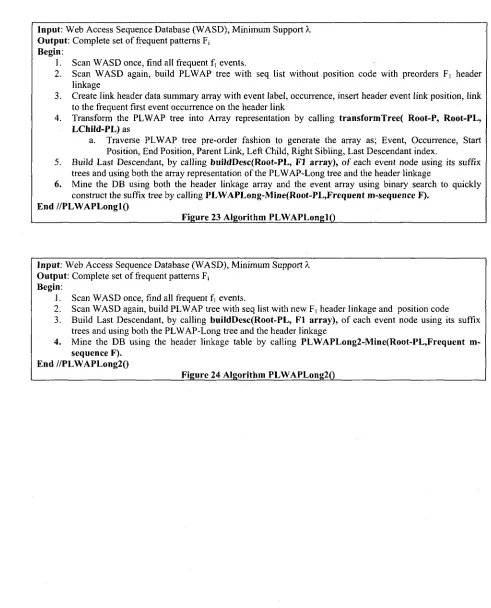
proposing the following new processing:
1. Transform the PL WAP tree to its equal Array representation.
2. Maintain the position of the last descendant of each event.
3. Employ binary search to find the immediate descendant during root set creation.
Here is how rest of this chapter is organized. Section 3.2.1 details the new approach of
transforming the linked list based PLWAP tree to its equivalent array based
3.2.3 details the importance of using binary search to find immediate descendant. Section
3.2.4 presents the mining algorithm for PLWAP-Long with example. Section 3.2.5
outlines PLWAPLongl, transformTree and buildDesc algorithms.
3.2.1.1. Array Representation
The reason for transforming the linked list tree to its equivalent array representation is
that with arrays we can jump from one node to the other known node in a 0(1) time. In
case of linked list based PLWAP-tree, memory references of parent, child and sibling are
stored in nodes and memory seek is required in order to obtain the actual address.
Another advantage of array representation is that we do not need to chain the same label
events as we did in the linked list tree because during transformation event arrays are
constructed using the pre-order traversal of the linked list tree and hence all events with
same label are inserted in their respective event arrays in ascending startPosition. Once
all of the events with same label are inserted in their respective event arrays, starting from
index 0 and incrementing the index by 1 will explicitly chain these same label events.
The header table is also represented using array of linkheader structure.
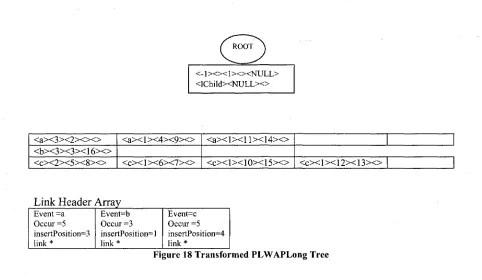
Note: To keep the transformed array based PLWAP-Long tree figures simple, all of the
values a node holds are shown within <>. The order of these values is
<event><occur><startPosition><endPosition><lastDesc>.
Taking the Figure-13 as example, let us transform the tree to its array representation
using pseudo code of transformTree algorithm shown in Figure 21. A new method
transformTree() is called that takes in root node of the linked list tree, NULL parent node
and NULL leftChild node. transformTree method traverses through the linked list tree in
the startPosition and the endPosition. It starts with the event of the root node and looks
up the header table array and finds the event.
Since it is the start of the transformation and the fact that root event has label - 1 , we
won't find this event in the header table and hence create a new root node. startPosition
' 1 ' is assigned to the root node. This root node will point the transformed array
represented tree. Following the algorithm from Figure-21, we will call the transform tree
method with left child of the root (i.e. a:3:l), the newly created root and the NULL (since
the newly created root has not yet assigned the left child). Note: The link header array
is populated when the original linked list PL WAP tree is constructed. The event arrays
are also dynamically created at this very moment and start of each array is linked to the
event entry in the link header array. In this example from Figure-13, three event arrays
will be created for event 'a' size 5, event 'b' size 2 and event 'c' with size 5. Algorithm
will find the array index of this event from the link header array, i.e. 0, and also retrieve
the insertPosition. InsertPosition gives the location where new node should be inserted
within that event array. Since this is the first time event 'a' is seen, this node will be
inserted at position 0, as shown in Figure 14.
( ROOT )
<-1 > o < 1 ><><NULL> <lChild><NULL><>
Link Header Array
Event =a Occur =5 insertPosition=l link *
Event=b Occur =3 insertPosition=0 link*
Event=c Occur =5 insertPosition=0 link *
Next we get the left child of this event which is b:3:ll and insert it into the event array
'b' pointed by the link header array index 1. Since this is the first time event b is
recorded, the inserfPosition is set to 0 and hence b:3:ll will be inserted at position 0 in
the event array 'b' as seen in Figure 15. We will keep on traversing in the pre-order
fashion until we get to the last event in leftmost branch of the original tree. The array
values at that point will be as shown in Figure 16.
ROOT
<-1 > o < l > < > < N U L L > <lChild><NULL>o
<a><3><2><><> <b><3><3><><>
Link Header Array
Event =a Occur =5 insertPosition=l link* Event=b Occur =3 insertPosition=l link * Event=c Occur =5 insertPosition=0 link *
Figure 15 Transformed PLWAPLong-Tree with node b:3:ll
f ROOT A
<-1 > o < 1 ><><NULL> <lChild><NULL>o <a><3><2><><> <b><3><3><><> <c><2><5><><> <a><]><4><><> <c><1><6><7><>
Link Header Array
Event =a Occur =5 insertPosition=2 link * Event=b Occur =3 insertPosition=l link * Event=c Occur =5 insertPosition= link * =2