ISSN(Online): 2320-9801
ISSN (Print): 2320-9798
International Journal of Innovative Research in Computer
and Communication Engineering
(An ISO 3297: 2007 Certified Organization)
Vol. 3, Issue 8, August 2015
Single-Carrier Frequency-Domain Equalizer
Sunil Shankar Mane
1, Dr. S. L. Lahudkar
2Student, Dept. of E&TC Engineering, JSPM’s ICOER, Pune, India1
Assistant Professor, Dept. of E&TC Engineering, JSPM’s ICOER, Pune, India 2
ABSTRACT: Single-carrier (SC) block transmission with cyclic prefix (CP) is a method with several advantages that has been incorporated into standards. This paper has analyzed the performance of multi-antenna SC-FDE under Alamouti signaling and cyclic-delay diversity (CDD). Our analysis shows that the characteristic of diversity it is depends on data block length and data transmission rate as well as on the channel memory and antenna configuration. At higher rates their diversity diminishes and full diversity is available to both CDD and Alamouti signalling below a certain rate threshold. From our investigation we say that at high rates Alamouti signalling provides twice the diversity of SISO SC-FDE, while the diversity of the SISO SC-FDE under the CDD diversity degenerates.
KEYWORDS: Alamouti Signalling, CyclicPrefixes, Cyclic Delay Diversity, Single-Carrier.
I. INTRODUCTION
Orthogonal frequency division multiplexing (OFDM) is an effective technique that combats this effect by converting a frequency selective fading channel into a set of nearly flat narrowband orthogonal fading channels, thereby solving equalization at the receiver side. SINGLE-CARRIER Frequency Domain Equalization (SCFDE) is an alternative to OFDM that avoids several OFDM drawbacks, including the high sensitivity to carrier frequency offset and peak-to-average power ratio.
This article discusses an alternative approach based on more traditional single-carrier (SC) modulation methods. We had shown that when it combined with FDE, this SC modulation approach delivers performance with essentially the same overall complexity similar to OFDM. In addition, SC modulation uses a single carrier so the peak-to-average transmitted power ratio for SC-modulated signals is smaller. This in turn means that the power amplifier of an SC transmitter requires a smaller linear range to support a given average power. So we can use the use of a cheaper power amplifier than a comparable OFDM system; and this is a benefit of some importance, since the power amplifier can be one of the more costly components in a consumer broadband wireless transceiver.
II. RELATED WORK
This paper[4] analyzes the diversity gain achieved by single-carrier frequency-domain equalizers (SC-FDE) in
frequency selective channels, and uncovers the interplay between diversity gain 𝑑, channel memory length 𝜈,
transmission block length 𝐿, and the spectral efficiency 𝑅. We specifically show that for the class of minimum
mean-square error (MMSE) SCFDE receivers, for rates 𝑅 ≤ log 𝐿𝜈full diversity of 𝑑= 𝜈+ 1 is achievable, while for higher
rates the diversity is given by 𝑑= 2−𝑅𝐿+ 1.
In most multiple-input multiple-output (MIMO) systems, the family of waterfall error curves, calculated at different spectral efficiencies, is asymptotically parallel at high signal-to noise ratio. In other words, most MIMO systems exhibit a single diversity value for all fixed rates. The MIMO minimum mean square error (MMSE) receiver does not follow this pattern and exhibits a varying diversity in its family of error curves.
III.SCOPE
ISSN(Online): 2320-9801
ISSN (Print): 2320-9798
International Journal of Innovative Research in Computer
and Communication Engineering
(An ISO 3297: 2007 Certified Organization)
Vol. 3, Issue 8, August 2015
memory, and number of antennas) below which the full spatial-temporal diversity is achieved, while at higher rates the diversity of both schemes diminishes. Our analysis shows that at high rates Alamouti signaling provides twice the
diversity of SISO SCFDE, while the CDD diversity degenerates to the diversity of the SISO SC-FDE.
IV.CYCLIC PREFIX TRANSMISSION
We consider a frequency selective quasi-static wireless fading channel. For this intersymbol interference (ISI) channel the equivalent baseband model is given by a multipath model with ν + 1 paths. The channel coefficients and
the channel vector is denoted by h = [h0...hν]are assumed independent and identically distributed ∼ CN(0, 1). We
assume a block-fading model where the channel is fixed over the transmission block. A cyclic-prefix (CP) with length at least ν is inserted at the beginning of each data-block of length L to remove the inter-block interference at the receiver. The CP also transforms linear convolution into circular convolution and thus permits channel diagonalization. The I/O system model for a block transmission scheme with length-ν CP is
In single-carrier frequency domain equalizer (SC-FDE), the DFT/IDFT operation is performed at the receiver. This operation in the SC-FDE diagonalizes the channel thus a single-tap equalizer can be used to reduce the complexity of equalization. The DFT of Equation (2) is
Where N, S and Y are the DFT of the noise, transmitted and received vectors respectively.
In [3] the linear MMSE receiver is analyzed for SC-FDE, as we are studying later in this paper and therefore we review it here briefly. In [3] the received signal after equalization is given by
Wn
s
WH
Wy
Y
e
~
and subject to this model it was shown that MMSE SC-FDE can achieve full diversity for certain values of block length and operating rate R b/s/Hz. The process of developing this result was as follows.
The analysis performed in [3] consists of two main steps. We first characterize the outage probability. Then
the lower and upper bounds on the error probability via outage are provided. It is shown that these two bounds are tight and thus the diversity is fully characterized. This type of approach was first proposed in [12] due to the intractability of the direct pair wise error probability (PEP) analysis for many MIMO architectures.
The diversity of the MMSE SC-FDE is [3]
v
L
R
L
v
L
R
v
d
R out
log
2
ISSN(Online): 2320-9801
ISSN (Print): 2320-9798
International Journal of Innovative Research in Computer
and Communication Engineering
(An ISO 3297: 2007 Certified Organization)
Vol. 3, Issue 8, August 2015
Fig.1. Single- carrier and multicarrier MISO system with transmitter sided CDD scheme and the proposed MMSE receiver.
V. CYCLIC DELAY DIVERSITY
One common transmit diversity technique used for single carrier and multicarrier systems is antenna delay diversity, which can take the form of time delay, cyclic delay and phase delay [13], [14]. Among them, cyclic delay diversity (CDD) is more widely adopted for single carrier and multicarrier applications as CDD can be applied to any number of transmit antennas without any rate loss or change in the receiver structure [14]–[16]. In this section we show that linear MMSE receivers can achieve the maximal spatio-temporal diversity provided that the equalizer and the cyclic delay taps are properly designed.
System Model: Consider a MISO system with M transmit antennas and a block fading channel model where the channel remains unchanged during the block transmission. The channel impulse response from the transmit antenna I to the received antenna is given by hi = [hi,0, . . . , hi,νi ] with channel memory length denoted by νi. We also define ν = maxi νi. We adopt the system model of [14]. The model is shown in Figure 1 which displays the front end of a single carrier and multicarrier MISO system with CDD. In vector form, the received signal can be written as
n
S
H
Y
i iM
i
^ 1
0
Where Hi is an L×L circulant channel matrix whose first row is [hi,0, . . . , hi,νi , 0, . . . , 0], is the L × 1 transmitted datablock (without the CP) from transmit antenna i. CDD converts the MISO channel into a SISO channel with increased channel selectivity. The model can be written as [15]
n
Qs
Q
n
S
H
Y
cir
H
where Hcir is L×L circulant matrix, s is the L×1 modulated symbols (cf. Figure 1), Q is the L × L normalized DFT matrix, and Λ is a diagonal matrix whose diagonal entries are the DFT point of the first row of Hcir.
The selection of the delay samples {δi} and its impact on the data rate, the signal-to-interference-and-noise ratio (SINR) and maximum achievable diversity is studied in [15], [17]. While the CP length is independent of δi, it must be no less than the maximum channel delay spread ν [17]. Also for the receiver to exploit the full diversity the delays can be chosen as δi > δi−1 + ν [15] or simply δi = iδ with δ > ν
2) Diversity Analysis of MMSE Receiver: We first consider the case where νi = ν = 0∀i (i.e. flat MISO channel) and
ISSN(Online): 2320-9801
ISSN (Print): 2320-9798
International Journal of Innovative Research in Computer
and Communication Engineering
(An ISO 3297: 2007 Certified Organization)
Vol. 3, Issue 8, August 2015
the equalizer is designed according to Hcir, it is known that in the SISO ISI CP transmission a rate-dependent diversity is observed [3], and due to equivalence of channel models this result can be directly lifted to the flat MISO CDD system. This result will be extended to the general case of the multipath MISO channel under CDD.
Lemma 1: Consider the M × 1 MISO flat-fading channel. The diversity of the MMSE receiver under uncoded CDD transmission and L data-blocks is given by
)
1
(
log
1
2
)
1
(
log
M
L
R
L
M
L
R
M
d
R out
VI.ALAMOUTI SIGNALLING
The Alamouti method of space-time signaling can also be characterized as a transmit diversity scheme. Unlike the CDD system, our analysis shows that Alamouti signaling preserves the transmit diversity and thus provides a larger diversity gain compared with the CDD scheme above a rate threshold Rth. We consider SC block transmission over an additive-noise frequency-selective channel with memory ν, similar to [5]. The model supports a 2 × 1 system and can be extended to 2 × N system.
VII. SIMULATION RESULTS
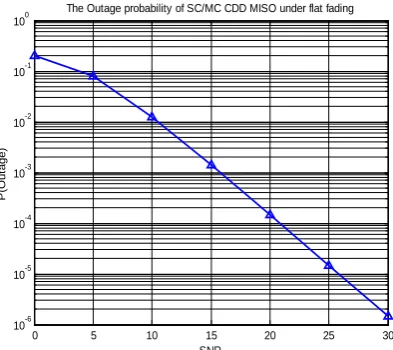
Figure 2 shows under various choices of the cyclic delay taps, the outage probability Pout for the equivalent model of the MMSE receiver in the CDD CP MISO flat fading channel with 3 transmit antennas. In this case, the MMSE
diversity is two since this rate is greater than Rth. The rate is R = 2 b/s/Hz and L = 5.
Fig. 2. The Outage probability of SC/MC CDD MISO under flat fading with three transmit antennas and R = 2 b/s/Hz.
VIII. CONCLUSION AND FUTURE WORK
This paper analyzes the single-carrier frequency domain equalizer (SC-FDE) for two common transmit diversity schemes: cyclic delay diversity (CDD) and Alamouti signalling. We characterize the diversity for both schemes at all spectral efficiencies. In the process, we obtain a threshold rate (as a function of data-block length, channel memory, and number of antennas) below which the full spatial-temporal diversity is achieved. Our investigation shows that at high rates the CDD diversity degenerates to the diversity of the SISO SCFDE, while
0 5 10 15 20 25 30
10-6 10-5 10-4 10-3 10-2 10-1 100
The Outage probability of SC/MC CDD MISO under flat fading
SNR
P
(O
u
ta
g
e
ISSN(Online): 2320-9801
ISSN (Print): 2320-9798
International Journal of Innovative Research in Computer
and Communication Engineering
(An ISO 3297: 2007 Certified Organization)
Vol. 3, Issue 8, August 2015
REFERENCES
1. F. Pancaldi, G. Vitetta, R. Kalbasi, N. Al-Dhahir, M. Uysal, and H. Mheidat, “Single-carrier frequency domain equalization,” IEEE Signal Process. Mag., vol. 25, no. 5, pp. 37–56, Sept. 2008.
2. D. Falconer, S. Ariyavisitakul, A. Benyamin-Seeyar, and B. Eidson, “Frequency domain equalization for single-carrier broadband wireless systems,” IEEE Commun. Mag., vol. 40, no. 4, pp. 58–66, Apr. 2002.
3. A. Tajer and A. Nosratinia, “Diversity order in ISI channels with single carrier frequency-domain equalizer,” IEEE Trans. Wireless Commun., vol. 9, no. 3, pp. 1022–1032, Mar. 2010.
4. A. Hesham Mehana and A. Nosratinia, “The diversity of MMSE receiver over frequency-selective MIMO channel,” in Proc. 2011 IEEE ISIT.
5. N. Al-Dhahir, “Single-carrier frequency-domain equalization for spacetime block-coded transmissions over frequency-selective fading channels,” IEEE Commun. Lett., vol. 5, no. 7, pp. 304–306, July 2001
6. Z. Wang and G. Giannakis, “Linearly precoded or coded OFDM against wireless channel fades?” in Proc. 2001 IEEE Signal Process. Advances Wireless Commun., pp. 267–270.
7. C. Tepedelenlioglu, “Maximum multipath diversity with linear equalization in precoded OFDM systems,” IEEE Trans. Inf. Theory, vol. 50, pp. 232–235, Jan. 2004.
BIOGRAPHY