R E S E A R C H
Open Access
Error concealment algorithm using inter-view
correlation for multi-view video
Yuan-Kai Kuan
1, Gwo-Long Li
2, Mei-Juan Chen
1*, Kuang-Han Tai
1and Pin-Cheng Huang
1Abstract
This paper proposes an error concealment algorithm for whole frame loss for multi-view video decoding. In our proposal, the relationship between motion vectors and disparity vectors is exploited first. Based on the parallelogram-like motion relationship, the motion vectors of error frames can be indirectly derived by projecting the disparity vectors from the counterpart view. In addition, to further improve the concealing results, a joint sum of the absolute difference (SAD) minimization approach is also proposed to find the block for the purpose of concealing the current error block by jointly considering motion vectors and disparity vectors. Experimental results show that our proposed algorithm provides better video quality than previous work and reduces error propagation.
Keywords:Error concealment; Multi-view; MVC; Motion vector; Disparity vector
1. Introduction
As multimedia technology has advanced in recent years, the applications of three-dimensional (3D) television and free viewpoint video (FVV) have become more at-tractive. To support view video coding, the multi-view video coding standard has been proposed [1,2] based on the motion-compensated prediction (MCP) technology adopted in H.264/AVC [3,4] by incorporat-ing the disparity-compensated prediction (DCP) tech-nology as shown in Figure 1, to eliminate inter-view redundancy.
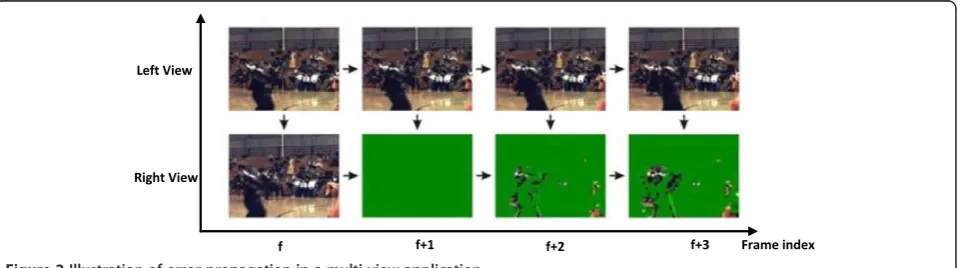
In the error-prone network environment, packet er-rors or packet loss may occur very frequently due to the unpredictable interruption of noise sources, which leads to the decline of the received video quality as shown in Figure 2. Therefore, error recovering mecha-nisms have become an important research issue. To deal with the problem in multi-view applications, many studies have been proposed. In general, error recovery can be undertaken by two approaches called error resili-ence [5-9] and error concealment [10-18]. For multi-view error concealment, study [17] uses the intra-view differ-ence, view correlation, and difference of the inter-view disparity vector projections on the neighboring inter-views
to conceal the error frames. However, this requires com-plex computations in terms of the temporal change detec-tion, disparity estimadetec-tion, and frame difference projection which results in difficulties for real-time applications. Study [18] compares the sum of the absolute difference (SAD) between the previous two frames and the SAD be-tween adjacent views of the previous frame to achieve error concealment. However, useful information regarding disparity vectors has not been considered to help with the error concealment process. In [17], the authors prove that the disparity vectors could significantly improve the error concealment results.
To deal with error problem for multi-view video cod-ing, we propose a whole frame error concealment algo-rithm which applies a predictive compensation approach as well as considering the inter-view correlation to con-ceal the error frame of the right view. By using the dis-parity vectors (DVs) in the previous frame as the reference prediction DVs, the motion vectors (MVs) in-side the block, referred by the reference DVs, are col-lected to be the candidates for our error concealment process. Finally, the candidate MV with the smallest joint SAD is chosen as the best MV to conceal the error block, once the candidate MVs have been successfully collected.
The rest of this paper is organized as follows. In Section 2, the proposed algorithm is described in detail. Section 3 shows some simulation results to demonstrate * Correspondence:[email protected]
1
Department of Electrical Engineering, National Dong Hwa University, 97401 Hualien, Taiwan
Full list of author information is available at the end of the article
the efficiency of our proposed error concealment algo-rithm. The conclusion is provided in Section 4.
2. Proposed algorithm
For the single-view error concealment approach, the error concealment algorithms are only considered using the in-formation from the spatial and temporal domains. How-ever, since we can have the information between coding views in the multi-view video coding, we can consider that the relationship between views achieves better error cealment results compared to the single-view error con-cealment. Therefore, we will first observe the relationship between views and propose our error concealment algo-rithm based on the observation.
2.1 Observation of multi-view characteristics
To create multi-view video sources, the cameras are usually placed along a horizontal line to capture the scene at the same time. In this case, the motion vectors between different views are very similar to each other due to the identical capturing target from the perspec-tive of the time axis. However, when observing the target from the perspective of the view axis, we can observe that the distance between the placement of the cameras will cause the appearance of objects in the scene. There-fore, the inter-view disparity vectors are usually used to
describe the object relationship between views. Figure 3 gives an example to illustrate the movement between frames and views.
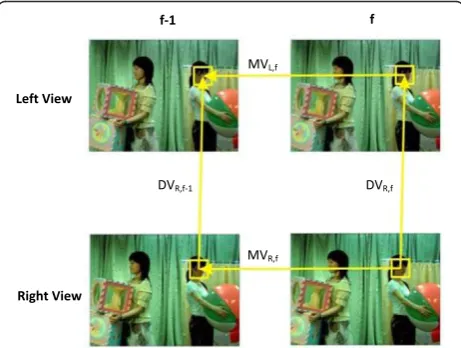
If we discover the multi-view sequences, we can inves-tigate the following properties. First, for the quiescent regions which have almost zero motion behavior, the re-lationship between frames in single view is higher than that between views. Second, for the high-motion regions, the relationship between views is much higher than that between frames. Based on the above observation, study [17] proposes a parallelogram-like motion relationship to describe the correlation between motion vectors and disparity vectors as shown in Figure 4. From this figure, we can find that if an object has been moved from frame (f-1) to frame (f ) in one view, we can also observe the same movement in another view. Similarly, if we obtain certain disparity vectors from frame (f-1), we can obtain the similar disparity vectors from frame (f ) as well.
2.2 Proposed error concealment algorithm
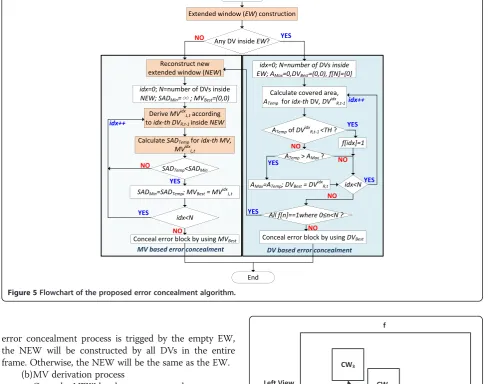
From the above sub-section, we observe that the motion vectors between views and disparity vectors between frames have a high degree of similarity and a close rela-tionship. The proposed error concealment algorithm is based on this observation. Figure 5 shows the flowchart of the proposed algorithm. First, a DV set is reconstructed Figure 1The prediction structure of two views.
according to the extended window (EW). Once the EW has been decided, we check if there is any dispar-ity vector within EW. If there is, the proposed DV-based error concealment algorithm will be applied for dealing with the error recover problem. Otherwise, the proposed MV-based error concealment algorithm will be used. The details of the proposed algorithm are de-scribed as follows:
1. EW construction
In the proposed algorithm, the block size ofBis adopted to conceal the erroneous frames. However, using 16 or 8 forBwill obtain better concealment results since selecting 4 forBwould result in a broken frame. After deciding on the block size, we extendBpixels all around the corresponding block in the previous frame to form a 3B× 3B-size EW as
shown in Figure6. The derivation process of EW can be expressed as follows:
EW¼ DViR;f‐10≤i<N;DViR;f‐1covered by 3B3Bg n
ð1Þ
2. DV-based error concealment
If the EW contains any DV, we will calculate the area covered by each disparity vector in the EW and check whether any covered area has exceeded a predefined threshold. In our proposed algorithm, the default of the threshold is set to half of the EW area. If all of the covered areas pointed to by DVs in the EW are less than a predefined threshold TH, the error concealment algorithm will switch to the MV-based error concealment. Otherwise, the covered area of each DV inside the EW will be calculated and the DV with the biggest area size in the EW will be selected to conceal the error block.
3. MV-based error concealment
(a) Reconstruction of new extended window The proposed MV-based error concealment algorithm will be executed by two conditions. The first condition is the switching from DV-based error concealment while the second condition is the empty EW. Therefore, based on the condition, a new extended window (NEW) will be reconstructed as follows:
NEW¼
fDViR;f‐10≤i<N; DViR;f‐1covered byWHg;
if EW is empty
EW; if switched from DV‐based EC
ð2Þ 8
> > < > > :
whereWandHmean the width and height, respectively, of the entire frame. In other words, if the MV-based Figure 3Illustration of real sequence with multi-views.
error concealment process is trigged by the empty EW, the NEW will be constructed by all DVs in the entire frame. Otherwise, the NEW will be the same as the EW.
(b)MV derivation process
Once the NEW has been constructed successfully, the DVs inside NEW will be considered to select the motion vectors from the left view. To derive the motion vectors
corresponding to all DVs in NEW, the DVs inside NEW will be used to be projected onto the left view with aB×Bwindow called a covered Figure 5Flowchart of the proposed error concealment algorithm.
window (CW) as shown in Figure7. After the DV projection, we will face the problem that the CW would cover more than one motion vector as shown in Figure8. Therefore, a simple mechanism that the motion vector with the largest covered area by CW will be selected as the final motion vector in the motion vector derivation process. The motion vectors can be selected as follows:
MViL;f¼argmax0≤k<NfArea MVð kÞg; ð3Þ
where Area(.) is the function of the area calculation ac-cording to the specific target.
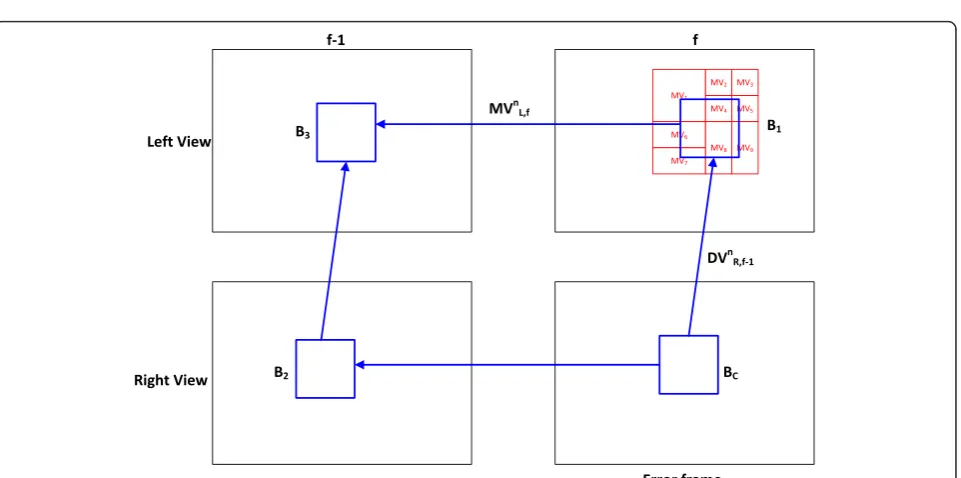
(c) SAD calculation according to selected MV Based on the parallelogram-like motion relationship between inter-frame and inter-view correlation as shown in Figure4, we can observe that the DVnR;f‐1 will be very similar to the DVnR;f and the MVnL;f will be very similar to the MVnR;f also. Therefore, when thefth frame of the right view has an error occurring, the MV obtained from the corresponding block in the left view shifted by the DV will be very similar to the original MV of the error frame if the corresponding DV in the previous frame is correct. Therefore, the SADs betweenB1andB2as shown in Figure9
are calculated for all MVs covered by CW to determine the block for concealing the current erroneous block. However, the situation might be faced when the block has been shifted from the wrong DV and the luminance component difference between blocks pointed to by the wrong MVs is unnoticeable. To solve this problem, we further consider SADs between the left and right views in the previous frame (FL,f-1). The
step-by-step block selecting procedure for computing SADs is described below.
Step 1: The disparity vector DVnR;f‐1of erroneous blockBchas been selected and projected onto the left view to obtain the blockB1pointed to by
DVnR;f‐1. Figure 8Illustration of motion vectors covered by CW.
Step 2: The motion vector MVnL;f with the largest area coverage byB1will be selected and
projected onto the previous frame of the right view to obtainB2.
Step 3: The corresponding blockB3pointed by
DVnR;f‐1fromB2will be used to calculate the SAD
betweenB2andB3.
Step 4: Finally, the motion vector with minimum joint SADs will be derived by the following equations to conceal the error blockBc:
MVL;fð Þ ¼i;j arg minMVnL;f∈MVL;f
XB−1
a¼0
XB−1
b¼0
FR;f‐1
BiþMVnL;f;xþa;BjþMVnLf;yþb
−FL;f BiþDVnR;f‐1;xþa;BjþDVRn;f‐1;yþb
j
þFR;f‐1 BiþMVnL;f;xþa;BjþMVnL;f;yþb
−FL;f‐1 BiþMVnL;f;xþDVnR;f‐1;xþa;Bj
þMVnL;f;yþDVnR;f‐1;yþbÞj
ð4Þ
The notations of Equation4are listed as follows:
iandj, the horizontal and vertical indexes of theB×Bblock in a frame
aandb, the horizontal and vertical indexes of the pixel inside the block
FR,f, the lost frame of the right view
FR,f-1, the previous frame of the lost frame in
the right view
FL,f, the current frame of the left view
Table 1 Simulation parameters
Parameter Value
View 2
Reference software JMVC8.5
Processor Intel Core i7 870 2.93 GHz
GOP structure IPPP…
Intra-refresh Only the first frame
Frame rate 25
Frame number 100
Reference frame number 2
Coding order 0→1
QP 32
PLR 5%, 10%, 15%, 20%
Table 2 PSNR comparison of our proposed algorithm with other methods for entire frames (B= 8) Sequences
Ballroom Vassar Race1 Exit AkkoKayo Flamenco Average
Error free 35.499 34.957 35.820 37.214 36.930 38.448 36.478
5% FC 29.077 34.396 22.635 33.617 28.069 29.673 29.578
MC 29.323 34.494 23.885 33.721 29.610 29.818 30.142
[18] 29.292 34.388 22.780 33.614 28.184 29.743 29.667
Proposed 30.241 34.541 26.926 33.608 31.232 30.239 31.131
ΔPSNR 0.949 0.153 4.146 −0.006 3.048 0.496 1.464
10% FC 25.463 33.525 19.551 30.748 23.431 26.445 26.527
MC 25.445 33.579 21.189 31.083 26.098 26.325 27.287
[18] 25.470 33.583 20.040 30.970 23.688 26.524 26.713
Proposed 26.063 33.721 23.877 30.972 26.293 26.608 27.922
ΔPSNR 0.593 0.138 3.837 0.002 2.6050 0.084 1.210
15% FC 23.466 32.394 17.479 29.056 20.595 24.308 24.550
MC 23.481 32.634 19.937 29.506 22.249 24.447 25.376
[18] 23.666 32.480 18.336 29.114 20.762 24.557 24.819
Proposed 24.399 33.114 21.557 28.902 23.547 24.917 26.073
ΔPSNR 0.733 0.634 3.221 −0.212 2.785 0.360 1.254
20% FC 22.117 31.900 16.568 27.301 19.939 22.948 23.462
MC 22.220 31.747 19.048 28.247 22.089 23.095 24.408
[18] 22.334 31.964 17.693 27.213 20.726 22.858 23.798
Proposed 23.439 32.726 20.698 27.811 22.921 23.446 25.174
Table 3 PSNR comparison of our proposed algorithm with [18] for error frames only (B= 8)
Sequences
Ballroom Vassar Race1 Exit AkkoKayo Flamenco Average
5% Error free 35.520 34.991 35.792 37.275 36.906 38.505 36.498
[18] 22.114 33.049 16.732 30.809 21.823 25.485 25.002
Proposed 22.659 33.325 21.309 30.585 25.286 26.378 26.590
ΔPSNR 0.545 0.276 4.577 −0.224 3.463 0.893 1.588
10% Error free 35.519 34.970 35.772 37.225 36.953 38.480 36.487
[18] 21.479 32.296 16.590 29.216 20.429 24.088 24.016
Proposed 22.185 32.582 20.847 29.131 23.299 24.456 25.417
ΔPSNR 0.706 0.286 4.257 −0.085 2.870 0.368 1.400
15% Error free 35.513 34.973 35.762 37.224 36.972 38.439 36.481
[18] 20.854 31.360 16.261 27.885 18.848 22.928 23.023
Proposed 21.593 32.327 19.747 27.674 21.785 23.449 24.429
ΔPSNR 0.739 0.967 3.486 −0.211 2.937 0.521 1.407
20% Error free 35.513 34.965 35.790 37.219 36.950 38.462 36.483
[18] 20.134 32.120 15.894 26.341 19.026 21.567 22.514
Proposed 21.143 31.973 19.151 26.897 21.427 22.235 23.804
ΔPSNR 1.009 −0.147 3.257 0.556 2.401 0.668 1.291
Table 4 PSNR comparison of our proposed algorithm with other methods for entire frames (B= 16) Sequences
Ballroom Vassar Race1 Exit AkkoKayo Flamenco Average
Error free 35.499 34.957 35.820 37.214 36.930 38.448 36.478
5% FC 29.077 34.396 22.635 33.617 28.069 29.673 29.578
MC 29.323 34.494 23.885 33.721 29.610 29.818 30.142
[18] 29.604 34.382 22.765 33.686 28.022 29.705 29.694
Proposed 30.441 34.460 26.631 33.558 31.159 30.607 31.143
ΔPSNR 0.837 0.078 3.866 −0.128 3.137 0.902 1.449
10% FC 25.463 33.525 19.551 30.748 23.431 26.445 26.527
MC 25.445 33.579 21.189 31.083 26.098 26.325 27.287
[18] 25.782 33.509 20.141 30.769 23.870 26.468 26.757
Proposed 26.668 33.831 23.684 31.445 25.872 26.509 28.002
ΔPSNR 0.886 0.323 3.543 0.676 2.002 0.041 1.245
15% FC 23.466 32.394 17.479 29.056 20.595 24.308 24.550
MC 23.481 32.634 19.937 29.506 22.249 24.447 25.376
[18] 23.933 32.458 18.515 28.960 20.719 24.541 24.854
Proposed 25.131 33.075 21.264 29.478 22.781 25.209 26.156
ΔPSNR 1.198 0.617 2.749 0.518 2.062 0.668 1.302
20% FC 22.117 31.900 16.568 27.301 19.939 22.948 23.462
MC 22.220 31.747 19.048 28.247 22.089 23.095 24.408
[18] 22.506 31.942 17.867 27.220 20.881 23.016 23.905
Proposed 24.040 32.996 20.741 28.031 22.787 23.167 25.294
FL,f-1, the previous frame of the lost frame in
the left view
DVnR;f‐1;x, the horizontal component of thenth DV in the block of the previous frame of the right view
DVnR;f‐1;y, the vertical component of thenth DV in the block of the previous frame of the right view
MVnL;f;x, the horizontal component of thenth MV in the block of the current frame of the left view
MVnL;f;y, the vertical component of thenth MV in the block of the current frame of the left view
By jointly considering the SADs between views and frames, the concealing results can be further improved.
3. Simulation results
In this section, several simulation results are given to demonstrate the efficiency of our proposed MVC error concealment algorithm. The test sequences we used for simulation are Ballroom (640 × 480), Exit (640 × 480), Fla-menco (640 × 480), Race1 (640 × 480), AkkoKayo (640 × 480), and Vassar (640 × 480). In our simulation, we as-sume that only the right view has the whole frame error while the left view has not. Study [18] is adopted for com-parison in this paper, but we have made some modifica-tions for [18] in order to allow the algorithm of [18] to be able to support whole frame loss error concealment. The simulation settings are summarized in Table 1, in which
the packet loss rate (PLR) is simulated by randomly drop-ping a certain number of frames. For example, the 5% PLR is simulated by randomly dropping 5 frames out of 100 frames.
Tables 2 and 3 tabulate the peak signal-to-noise ratio (PSNR) comparison for our proposed algorithm with other methods under different packet error rate condi-tions for entire frame and error frame only cases, re-spectively. Frame Copy (FC), Motion Copy (MC), and the algorithm of [18] are compared. In these tables, the
ΔPSNR is calculated by the PSNR values of our proposal minus the PSNR values of [18] whileBis set to 8, which means that the basic error concealing block size is 8. From these tables, we can observe that our proposed al-gorithm outperforms other methods. Quantitatively, our proposed algorithm can achieve about 4-dB PSNR im-provement compared to [18] for the high-motion se-quence Race1 under the 5% packet error rate condition. However, for other sequences such as Exit and Vassar, the PSNR improvement is less significant. This situation can be explained as follows. From [18], it can be found that the MB pixels at the same spatial position from the Table 5 PSNR comparison of our proposed algorithm with [18] for error frames only (B= 16)
Sequences
Ballroom Vassar Race1 Exit AkkoKayo Flamenco Average
5% Error free 35.520 34.991 35.792 37.275 36.906 38.505 36.498
[18] 22.229 33.039 16.674 31.007 21.862 25.495 25.051
Proposed 23.965 33.759 21.246 31.382 26.274 26.474 27.183
ΔPSNR 1.736 0.720 4.572 0.375 4.412 0.979 2.132
10% Error free 35.519 34.970 35.772 37.225 36.953 38.480 36.487
[18] 21.701 32.113 16.656 29.200 20.596 24.054 24.053
Proposed 23.291 32.948 20.843 30.043 23.349 24.305 25.797
ΔPSNR 1.590 0.835 4.187 0.843 2.753 0.251 1.743
15% Error free 35.513 34.973 35.762 37.224 36.972 38.439 36.481
[18] 20.993 31.330 16.401 27.757 18.831 22.916 23.038
Proposed 22.603 32.306 19.633 28.399 21.351 23.715 24.668
ΔPSNR 1.610 0.976 3.232 0.642 2.520 0.799 1.630
20% Error free 35.513 34.965 35.790 37.219 36.950 38.462 36.483
[18] 20.295 31.080 16.020 26.373 19.191 21.705 22.444
Proposed 22.105 32.398 19.234 27.279 21.488 21.946 24.075
ΔPSNR 1.810 1.318 3.214 0.906 2.297 0.241 1.631
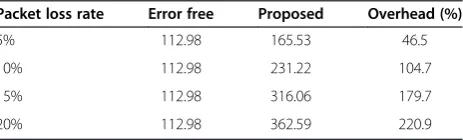
Table 6 Average decoding time comparison of our proposed algorithm (Ballroom sequence) (ms/frame)
Packet loss rate Error free Proposed Overhead (%)
5% 112.98 165.53 46.5
10% 112.98 231.22 104.7
15% 112.98 316.06 179.7
temporal and inter-view directions are evaluated. In other words, [18] does not take the motion of the frame into account. This mechanism could be able to obtain good concealment results for low-motion sequences.
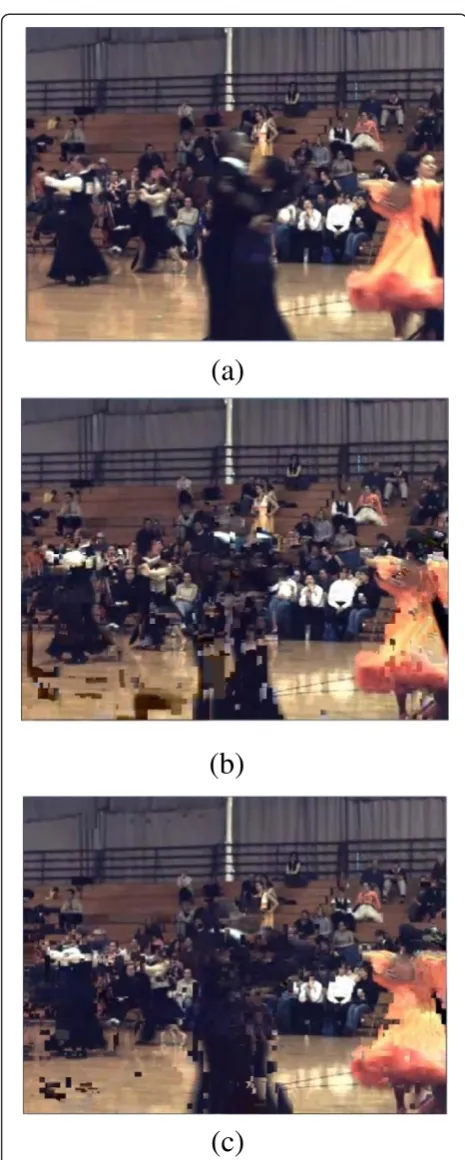
(a)
(b)
(c)
Figure 10Subjective comparison of Ballroom sequence at the 30th frame (B= 8). (a)Error free (35.444 dB).(b)Concealed frame by [18] (19.093 dB).(c)Concealed frame by the proposed algorithm (20.134 dB).
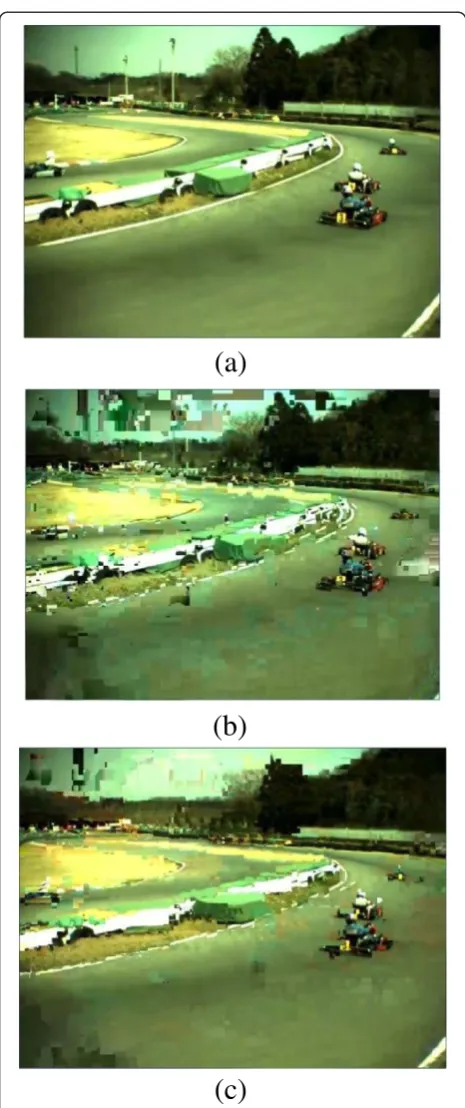
(a)
(b)
(c)
However, since our proposal takes both motion vector and disparity motion into account, the proposal can obtain better concealment results for high-motion sequences. On
average, our proposed algorithm can receive 1.326- and 1.421-dB PSNR improvement compared to [18] for entire frame and error frame only cases, respectively.
Tables 4 and 5 list the PSNR comparison for the case thatBis 16. From these tables, we can observe that even though the basic error concealing block size has been extended to 16, our proposed algorithm can still achieve PSNR improvement when compared to [18]. On average, our proposed algorithm can receive 1.346- and 1.784-dB PSNR improvement compared to [18] for entire frame and error frame only cases, respectively. From Tables 2, 3, 4, and 5, we can observe that the PSNR improvement of smallerBis better than that of largerB. This situation can be explained as follows. In general, the largerBwill contain more objects within a single block. Intuitively, it will not be easy to find a matching block from the tem-poral or inter-view directions which contains multiple objects. For smaller B, multiple objects can be possibly divided into multiple blocks and thus leads to the ease of finding matching blocks. Table 6 tabulates the decod-ing time of our proposed algorithm when compared to the error frame decoding.
Figures 10, 11, and 12 exhibit the subjective quality comparisons for our proposed algorithm with [18]. From these figures, it is very obvious that our proposed algo-rithm can significantly improve the subjective quality re-sults. In general, our proposed algorithm can efficiently reduce the broken image effects.
4. Conclusions
To deal with entire frame loss problem in multi-view video decoding, this paper proposes an error concealment algorithm by considering the relationship between motion vectors and disparity vectors. Based on the parallelogram-like motion relationship, a joint SAD minimization ap-proach is proposed to find the best block for concealing the current error block. Through the help of the proposal, the error propagation problem can thus be reduced. Simu-lation results demonstrate that our proposed algorithm out-performs previous work in terms of subject and objective quality measurements.
Competing interests
The authors declare that they have no competing interests.
Author details
1Department of Electrical Engineering, National Dong Hwa University, 97401
Hualien, Taiwan.2Department of Video Coding Core Technology, Industrial Technology Research Institute, 31040 Hsinchu, Taiwan.
Received: 11 March 2014 Accepted: 13 June 2014 Published: 2 August 2014
References
1. YS Ho, KJ Oh, Overview of multi-view video coding, inProceedings of International Workshop on Systems, Signals and Image Processing, 2007 and 6th EURASIP Conference focused on Speech and Image Processing, Multimedia Communications and Services(Maribor, 2007), pp. 5–12
(a)
(b)
(c)
2. A Vetro, T Wiegand, GJ Sullivan, Overview of the stereo and multi-view video coding extensions of the H.264/MPEG-4 AVC standard. IEEE Proc. 99(4), 626–642 (2011)
3. T Wiegand, GJ Sullivan, G Bjontegaard, A Luthra, Overview of the H.264/AVC video coding standard. IEEE Trans. Circ. Syst. Vid. Technol.13(7), 560–576 (2003) 4. T Wiegand, G Sullivan, Draft ITU-T recommendation and final draft international standard of joint video specification (ITU-T Rec. H.264/ISO/IEC 14496-10 AVC), inJoint Video Team of ISO/IEC MPEG and ITU-T VCEG, JVT-G050(Pattaya, 2003) 5. Y Wang, JY Tham, WS Lee, KH Goh, Pattern selection for error-resilient slice
interleaving based on receiver error concealment technique, inProceedings of IEEE International Conference on Multimedia and Expo(Barcelona, 2011) 6. BW Micallef, CJ Debono, An analysis on the effect of transmission errors in
real-time H.264-MVC bit-streams, inProceedings of IEEE Mediterranean Electrotechnical Conference MELECON(Valletta, 2010), pp. 1215–1220 7. MB Dissanayake, DVSX De Silva, ST Worrall, WAC Fernando, Error resilience
technique for multi-view coding using redundant disparity vectors, inProceedings of IEEE International Conference on Multimedia and Expo(Suntec, 2010), pp. 1712–1717
8. J Xiao, T Tillo, C Lin, Y Zhao, Joint redundant motion vector and intra macroblock refreshment for video transmission. EURASIP J. Image Vid. Process.2011(12), (2011). doi:10.1186/1687-5281-2011-12
9. S Ye, M Ouaret, F Dufaux, T Ebrahimi, Improved side information generation for distributed video coding by exploiting spatial and temporal correlations. EURASIP J. Image Vid. Process.2009, 683510 (2009). doi:10.1155/2009/683510 10. X Xiang, D Zhao, S Ma, W Gao, Auto-regressive model based error
concealment scheme for stereoscopic video coding, inProceedings of IEEE International Conference on Acoustics, Speech and Signal Processing (Prague, 2011), pp. 849–852
11. PJ Lee, KT Kuo, An adaptive error concealment method selection algorithm for multi-view video coding, inProceedings of IEEE International Conference on Consumer Electronics(Las Vegas, 2013), pp. 474–475
12. O Stankiewicz, K Wegner, M Domanski, Error concealment for MVC and 3D video coding, inProceedings of Picture Coding Symposium(Nagoya, 2010), pp. 498–501
13. SH Lee, SH Lee, NI Cho, JH Yang, A motion vector prediction method for multi-view video coding, inProceedings of International Conference on Intelligent Information Hiding and Multimedia Signal Processing(Harbin, 2008), pp. 1247–1250
14. S Liu, Y Chen, YK Wang, M Gabbouj, MM Hannuksela, H Li, Frame loss error concealment for multi-view video coding, inProceedings of IEEE International Symposium on Circuits and Systems(Seattle, 2008), pp. 3470–3473 15. L Liang, R Ma, P An, C Liu, An effective error concealment method used in
multi-view video coding, inProceedings of International Congress on Image and Signal Processing(Shanghai, 2011), pp. 76–79
16. TY Chung, S Sull, CS Kim, Frame loss concealment for stereoscopic video plus depth sequences. IEEE Trans. Consum. Electron.57(3), 1336–1344 (2011) 17. Y Chen, C Cai, KK Ma, Stereoscopic video error concealment for missing
frame recovery using disparity-based frame difference projection, in Proceedings of IEEE International Conference on Image Processing(Cairo, 2009), pp. 4289–4292
18. Y Zhou, C Hou, R Pan, Z Yuan, L Yang, Distortion analysis and error concealment for multi-view video transmission, inProceedings of IEEE International Symposium on Broadband Multimedia Systems and Broadcasting (Shanghai, 2010), pp. 1–5
doi:10.1186/1687-5281-2014-38
Cite this article as:Kuanet al.:Error concealment algorithm using inter-view correlation for multi-view video.EURASIP Journal on Image and Video Processing20142014:38.
Submit your manuscript to a
journal and benefi t from:
7 Convenient online submission 7 Rigorous peer review
7 Immediate publication on acceptance 7 Open access: articles freely available online 7 High visibility within the fi eld
7 Retaining the copyright to your article

![Table 3 PSNR comparison of our proposed algorithm with [18] for error frames only (B = 8)](https://thumb-us.123doks.com/thumbv2/123dok_us/912594.1589067/7.595.55.541.415.733/table-psnr-comparison-proposed-algorithm-error-frames-b.webp)